Wrongful Dismissal
Presented on June 13, 2013 for Community Legal Education Ontario
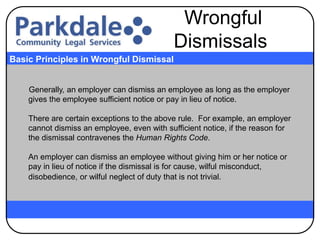
Generally, an employer can dismiss an employee as long as the employer
gives the employee sufficient notice or pay in lieu of notice.
There are certain exceptions to the above rule. For example, an employer
cannot dismiss an employee, even with sufficient notice, if the reason for
the dismissal contravenes the Human Rights Code.
An employer can dismiss an employee without giving him or her notice or
pay in lieu of notice if the dismissal is for cause, wilful misconduct,
disobedience, or wilful neglect of duty that is not trivial.
Basic Principles in Wrongful Dismissal
Wrongful
Dismissals
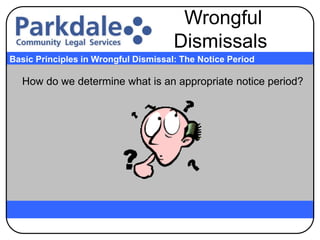
How do we determine what is an appropriate notice period?
Basic Principles in Wrongful Dismissal: The Notice Period
Wrongful
Dismissals
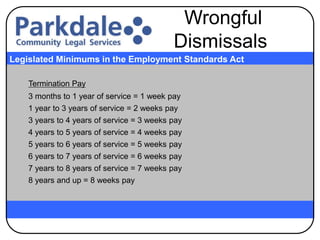
Termination Pay
3 months to 1 year of service = 1 week pay
1 year to 3 years of service = 2 weeks pay
3 years to 4 years of service = 3 weeks pay
4 years to 5 years of service = 4 weeks pay
5 years to 6 years of service = 5 weeks pay
6 years to 7 years of service = 6 weeks pay
7 years to 8 years of service = 7 weeks pay
8 years and up = 8 weeks pay
Legislated Minimums in the Employment Standards Act
Wrongful
Dismissals
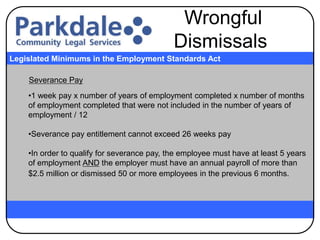
Severance Pay
•1 week pay x number of years of employment completed x number of months
of employment completed that were not included in the number of years of
employment / 12
•Severance pay entitlement cannot exceed 26 weeks pay
•In order to qualify for severance pay, the employee must have at least 5 years
of employment AND the employer must have an annual payroll of more than
$2.5 million or dismissed 50 or more employees in the previous 6 months.
Legislated Minimums in the Employment Standards Act
Wrongful
Dismissals
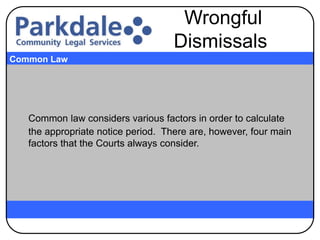
Common law considers various factors in order to calculate
the appropriate notice period. There are, however, four main
factors that the Courts always consider.
Common Law
Wrongful
Dismissals
(1) Length of Service
Four Main Factors Considered in Common Law
Wrongful
Dismissals
(2) Age of Employee
Four Main Factors Considered in Common Law
Wrongful
Dismissals
(3) Availability of Similar Employment
Four Main Factors Considered in Common Law
Wrongful
Dismissals
(4) Character of Employment
Four Main Factors Considered in Common Law
Wrongful
Dismissals
Hi, I am
Employment. And I
am one bad #*@!
character.
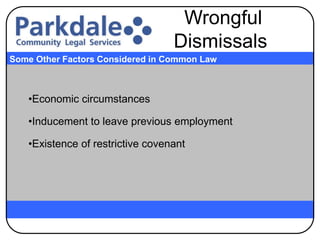
•Economic circumstances
•Inducement to leave previous employment
•Existence of restrictive covenant
Some Other Factors Considered in Common Law
Wrongful
Dismissals
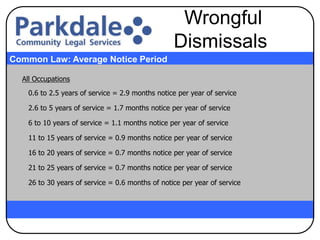
All Occupations
0.6 to 2.5 years of service = 2.9 months notice per year of service
2.6 to 5 years of service = 1.7 months notice per year of service
6 to 10 years of service = 1.1 months notice per year of service
11 to 15 years of service = 0.9 months notice per year of service
16 to 20 years of service = 0.7 months notice per year of service
21 to 25 years of service = 0.7 months notice per year of service
26 to 30 years of service = 0.6 months of notice per year of service
Common Law: Average Notice Period
Wrongful
Dismissals
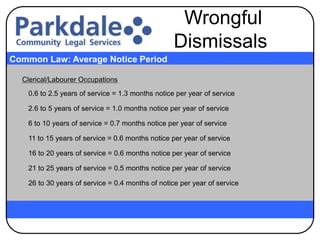
Clerical/Labourer Occupations
0.6 to 2.5 years of service = 1.3 months notice per year of service
2.6 to 5 years of service = 1.0 months notice per year of service
6 to 10 years of service = 0.7 months notice per year of service
11 to 15 years of service = 0.6 months notice per year of service
16 to 20 years of service = 0.6 months notice per year of service
21 to 25 years of service = 0.5 months notice per year of service
26 to 30 years of service = 0.4 months of notice per year of service
Common Law: Average Notice Period
Wrongful
Dismissals
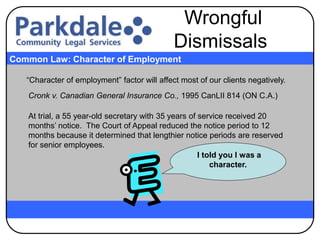
“Character of employment” factor will affect most of our clients negatively.
Cronk v. Canadian General Insurance Co., 1995 CanLII 814 (ON C.A.)
At trial, a 55 year-old secretary with 35 years of service received 20
months’ notice. The Court of Appeal reduced the notice period to 12
months because it determined that lengthier notice periods are reserved
for senior employees.
Common Law: Character of Employment
Wrongful
Dismissals
I told you I was a
character.
Bramble v. Medis Health and Pharmaceutical Services Inc., [1999] N. B. J. No. 207
“Should Canadian Courts continue to award less adequate compensation
in dismissal situations by virtue of the fact that the employee in question
is less educated than other employees?... Simply put, is the decision of the
Court of Appeal [in Cronk] elitist?... If justice is blind, why does it see rich
businessmen as more needy than clerks?”
Di Tomaso v. Crown Metal Packaging Canada LP, 2011 ONCA 469
“Recent jurisprudence suggests that, if anything, [character of employment] is
today a factor of declining relative importance.”
Common Law: Character of Employment
Wrongful
Dismissals
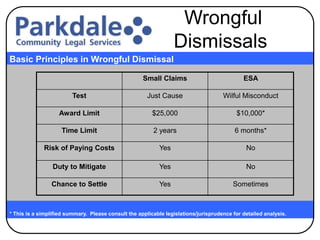
* This is a simplified summary. Please consult the applicable legislations/jurisprudence for detailed analysis.
Basic Principles in Wrongful Dismissal
Wrongful
Dismissals
Small Claims ESA
Test Just Cause Wilful Misconduct
Award Limit $25,000 $10,000*
Time Limit 2 years 6 months*
Risk of Paying Costs Yes No
Duty to Mitigate Yes No
Chance to Settle Yes Sometimes
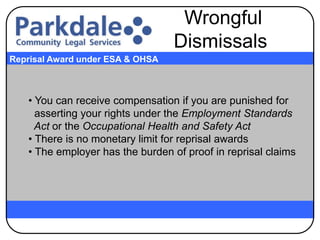
• You can receive compensation if you are punished for
asserting your rights under the Employment Standards
Act or the Occupational Health and Safety Act
• There is no monetary limit for reprisal awards
• The employer has the burden of proof in reprisal claims
Reprisal Award under ESA & OHSA
Wrongful
Dismissals
•In addition to pay in lieu of notice, ask for the value of lost employment benefits
(e.g. dental and medical), compensation for lost employer contribution to the
Canada Pension Plan, reasonable expenses incurred for employment
searches, etc.
•Remember to keep track of your mitigation attempts in order to ensure that the
Court does not reduce your pay in lieu of notice.
Further Methods of Increasing Awards at Court
Wrongful
Dismissals
What? You
couldn’t find a
nice clip art for
this slide?
Remember too that you need to assess your case
for any human rights violations. If there are any human
rights violations, then you will need to consider the option
of a Human Rights Tribunal application.
Human Rights Complaints
Wrongful
Dismissals
Thank You
Wrongful
Dismissals
How about
you and I go
for drinks?
No, I didn’t
mean U.

Wrongful Dismissal

  • 1.
    Wrongful Dismissal Presented onJune 13, 2013 for Community Legal Education Ontario
  • 2.
    Generally, an employercan dismiss an employee as long as the employer gives the employee sufficient notice or pay in lieu of notice. There are certain exceptions to the above rule. For example, an employer cannot dismiss an employee, even with sufficient notice, if the reason for the dismissal contravenes the Human Rights Code. An employer can dismiss an employee without giving him or her notice or pay in lieu of notice if the dismissal is for cause, wilful misconduct, disobedience, or wilful neglect of duty that is not trivial. Basic Principles in Wrongful Dismissal Wrongful Dismissals
  • 3.
    How do wedetermine what is an appropriate notice period? Basic Principles in Wrongful Dismissal: The Notice Period Wrongful Dismissals
  • 4.
    Termination Pay 3 monthsto 1 year of service = 1 week pay 1 year to 3 years of service = 2 weeks pay 3 years to 4 years of service = 3 weeks pay 4 years to 5 years of service = 4 weeks pay 5 years to 6 years of service = 5 weeks pay 6 years to 7 years of service = 6 weeks pay 7 years to 8 years of service = 7 weeks pay 8 years and up = 8 weeks pay Legislated Minimums in the Employment Standards Act Wrongful Dismissals
  • 5.
    Severance Pay •1 weekpay x number of years of employment completed x number of months of employment completed that were not included in the number of years of employment / 12 •Severance pay entitlement cannot exceed 26 weeks pay •In order to qualify for severance pay, the employee must have at least 5 years of employment AND the employer must have an annual payroll of more than $2.5 million or dismissed 50 or more employees in the previous 6 months. Legislated Minimums in the Employment Standards Act Wrongful Dismissals
  • 6.
    Common law considersvarious factors in order to calculate the appropriate notice period. There are, however, four main factors that the Courts always consider. Common Law Wrongful Dismissals
  • 7.
    (1) Length ofService Four Main Factors Considered in Common Law Wrongful Dismissals
  • 8.
    (2) Age ofEmployee Four Main Factors Considered in Common Law Wrongful Dismissals
  • 9.
    (3) Availability ofSimilar Employment Four Main Factors Considered in Common Law Wrongful Dismissals
  • 10.
    (4) Character ofEmployment Four Main Factors Considered in Common Law Wrongful Dismissals Hi, I am Employment. And I am one bad #*@! character.
  • 11.
    •Economic circumstances •Inducement toleave previous employment •Existence of restrictive covenant Some Other Factors Considered in Common Law Wrongful Dismissals
  • 12.
    All Occupations 0.6 to2.5 years of service = 2.9 months notice per year of service 2.6 to 5 years of service = 1.7 months notice per year of service 6 to 10 years of service = 1.1 months notice per year of service 11 to 15 years of service = 0.9 months notice per year of service 16 to 20 years of service = 0.7 months notice per year of service 21 to 25 years of service = 0.7 months notice per year of service 26 to 30 years of service = 0.6 months of notice per year of service Common Law: Average Notice Period Wrongful Dismissals
  • 13.
    Clerical/Labourer Occupations 0.6 to2.5 years of service = 1.3 months notice per year of service 2.6 to 5 years of service = 1.0 months notice per year of service 6 to 10 years of service = 0.7 months notice per year of service 11 to 15 years of service = 0.6 months notice per year of service 16 to 20 years of service = 0.6 months notice per year of service 21 to 25 years of service = 0.5 months notice per year of service 26 to 30 years of service = 0.4 months of notice per year of service Common Law: Average Notice Period Wrongful Dismissals
  • 14.
    “Character of employment”factor will affect most of our clients negatively. Cronk v. Canadian General Insurance Co., 1995 CanLII 814 (ON C.A.) At trial, a 55 year-old secretary with 35 years of service received 20 months’ notice. The Court of Appeal reduced the notice period to 12 months because it determined that lengthier notice periods are reserved for senior employees. Common Law: Character of Employment Wrongful Dismissals I told you I was a character.
  • 15.
    Bramble v. MedisHealth and Pharmaceutical Services Inc., [1999] N. B. J. No. 207 “Should Canadian Courts continue to award less adequate compensation in dismissal situations by virtue of the fact that the employee in question is less educated than other employees?... Simply put, is the decision of the Court of Appeal [in Cronk] elitist?... If justice is blind, why does it see rich businessmen as more needy than clerks?” Di Tomaso v. Crown Metal Packaging Canada LP, 2011 ONCA 469 “Recent jurisprudence suggests that, if anything, [character of employment] is today a factor of declining relative importance.” Common Law: Character of Employment Wrongful Dismissals
  • 16.
    * This isa simplified summary. Please consult the applicable legislations/jurisprudence for detailed analysis. Basic Principles in Wrongful Dismissal Wrongful Dismissals Small Claims ESA Test Just Cause Wilful Misconduct Award Limit $25,000 $10,000* Time Limit 2 years 6 months* Risk of Paying Costs Yes No Duty to Mitigate Yes No Chance to Settle Yes Sometimes
  • 17.
    • You canreceive compensation if you are punished for asserting your rights under the Employment Standards Act or the Occupational Health and Safety Act • There is no monetary limit for reprisal awards • The employer has the burden of proof in reprisal claims Reprisal Award under ESA & OHSA Wrongful Dismissals
  • 18.
    •In addition topay in lieu of notice, ask for the value of lost employment benefits (e.g. dental and medical), compensation for lost employer contribution to the Canada Pension Plan, reasonable expenses incurred for employment searches, etc. •Remember to keep track of your mitigation attempts in order to ensure that the Court does not reduce your pay in lieu of notice. Further Methods of Increasing Awards at Court Wrongful Dismissals What? You couldn’t find a nice clip art for this slide?
  • 19.
    Remember too thatyou need to assess your case for any human rights violations. If there are any human rights violations, then you will need to consider the option of a Human Rights Tribunal application. Human Rights Complaints Wrongful Dismissals
  • 20.
    Thank You Wrongful Dismissals How about youand I go for drinks? No, I didn’t mean U.