Why weren’t Ants the first Astronauts?  Dieter Fensel University of Innsbruck
The Theory of the Branching Universes
The theory of the branching Universes
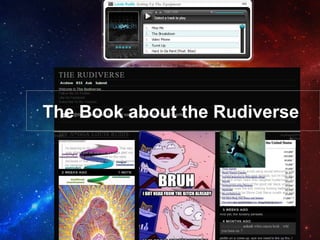
The theory of the branching Universes The Book about the Rudiverse
The theory of the branching Universes
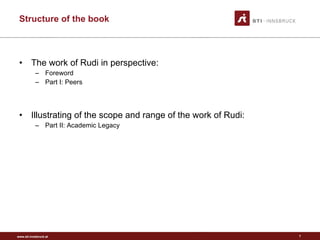
Structure of the book The work of Rudi in perspective:  Foreword Part I: Peers Illustrating of the scope and range of the work of Rudi: Part II: Academic Legacy
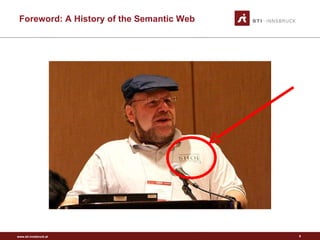
Foreword: A History of the Semantic Web
A History of the Semantic Web 1996:  Simple HTML Ontology Extensions ( SHOE) 1997: Ontobroker Dagstuhl seminar in 2000 DAML RDF DAML+OIL OWL OIL First International Semantic Web Conference in 2002 First European Semantic Web Conference in 2004
Part I Colleagues and Historical Roots A Retrospective on Semantics and Interoperability Research  Bernhard Haslhofer and Erich Neuhold Interoperability  problems arise when  distinct applications communicate and  exchange information objects with  each other.  Often the structure and semantics of  these objects is defined by autonomous  designers, each having an individual  interpretation of the real world in mind.
Part I Colleagues and Historical Roots Semantic Web and Applied Informatics: Selected Research Activities in the Institute AIFB Andreas Oberweis, Hartmut Schmeck, Detlef Seese, Wolffried Stucky, and Stefan Tai Effectiveness and Efficiency of Semantics Peter C. Lockemann Knowledge Engineering Rediscovered: Towards Reasoning Patterns for the SemanticWeb Frank van Harmelen, Annette ten Teije, and Holger Wache Semantic Technology and Knowledge Management John Davies, Paul Warren, and York Sure Tool Support for Ontology Engineering Ian Horrocks
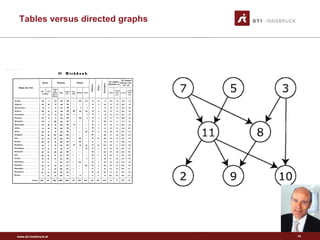
Effectiveness and Efficiency of Semantics Provides an excellent analysis of the communalities and differences of database and Ontology technology in terms of efficiency and effectiveness. Even after more than 30 years of existence, relational databases remain the mainstay of data archiving because they are the most efficient way to store, select and access data, particularly if the data are to be interrelated. However they make strong assumptions on how data should be structured …  Which makes reuse and interoperability more difficult.
Effectiveness and Efficiency of Semantics Semantics can add effectiveness to information retrieval without loss of efficiency.  Databases implement the aspect of handling data efficiently with a computer Ontologies/semantics implement the aspect of handling data effectively in order to achieve a certain goal within a certain domain and resource boundaries. Semantic solutions are always put “on top of” database  solutions!
Tables versus directed graphs
Part II Academic Legacy Combining Data-Driven and Semantic Approaches for Text Mining From SemanticWeb Mining to Social and Ubiquitous Mining Towards Networked Knowledge Reflecting Knowledge Diversity on theWeb Software Modeling Using Ontology Technologies Intelligent Service Management—Technologies and Perspectives Semantic Technologies and Cloud Computing Semantic Complex Event Reasoning—Beyond Complex Event Processing Semantics in Knowledge Management Semantic MediaWiki  Real World Application of Semantic Technology
The theory of the branching Universes The Population of the Rudiverse
Size matters! Wife Secretaries Rabbits Children PhD students
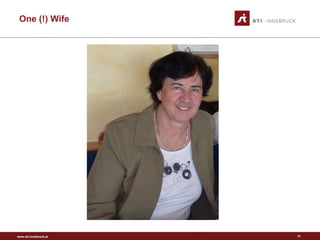
One (!) Wife
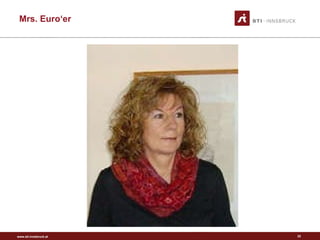
Mrs. Euro‘er
Rabbits – How many?
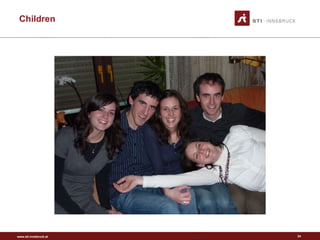
Children
50 PhDs Susanne Becher Dieter Landes Barbara Messing Markus Wiese Robert Engels Thomas Pirlein Jürgen Angele Dieter Fensel
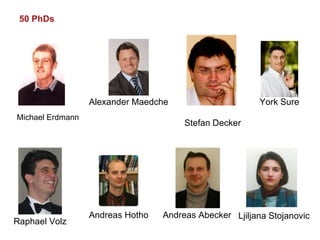
50 PhDs Stefan Decker Ljiljana Stojanovic Michael Erdmann Alexander Maedche York Sure Raphael Volz Andreas Hotho Andreas Abecker
Transformators
50 PhDs Stefan Decker Ljiljana Stojanovic Michael Erdmann Alexander Maedche York Sure Raphael Volz Andreas Hotho Andreas Abecker
50 PhDs Marc Ehrig Philipp Cimiano Christoph Tempich Guido Lindner Siegfried Handschuh Nenad Stojanovic Daniel Oberle Boris Motik
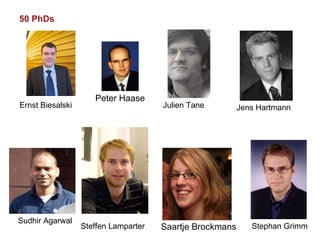
50 PhDs Ernst Biesalski Julien Tane Jens Hartmann Sudhir Agarwal Steffen Lamparter Stephan Grimm Saartje Brockmans Peter Haase
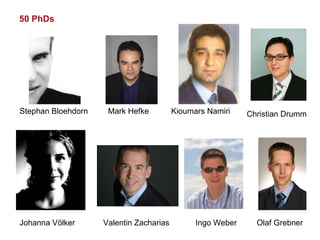
50 PhDs Stephan Bloehdorn Mark Hefke Kioumars Namiri Christian Drumm  Johanna Völker Valentin Zacharias Ingo Weber Olaf Grebner
50 PhDs Denny Vrandecic Jens Lemcke Ivan Markovitch  Sebastian Blohm Tuvshintur Tserendorj Markus Krötzsch Kay-Uwe Schmidt Thanh Duc Tran
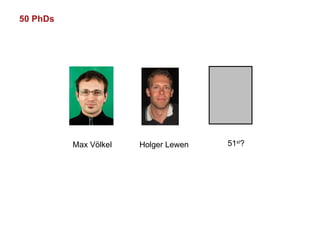
50 PhDs Holger Lewen Max Völkel 51 st ?
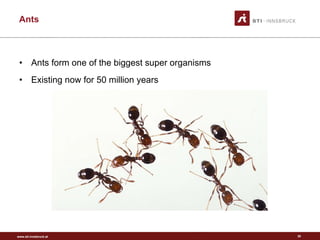
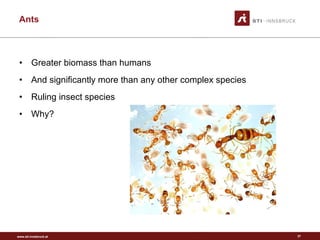
Ants form one of the biggest super organisms Existing now for 50 million years Ants
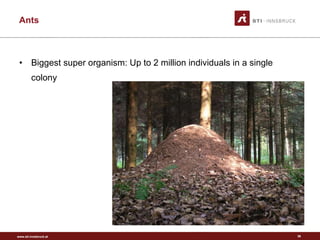
Biggest super organism: Up to 2 million individuals in a single colony Ants
Greater biomass than humans And significantly more than any other complex species Ruling insect species Why? Ants
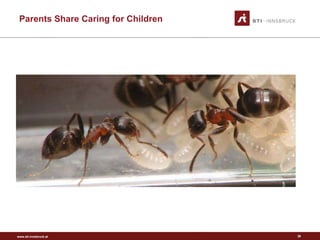
Parents Share Caring for Children
Cooperation
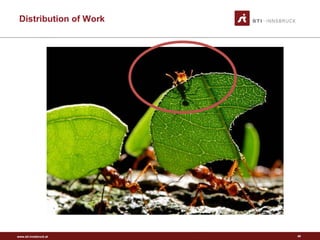
Distribution of Work
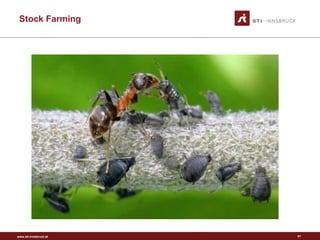
Stock Farming
Agriculture
Why then no Space Travels? Ants have reached these achievements now for more than about 50 million years Humans only for about 10 000 years So why ants were not first on the moon? This question is similar to the following: “Why were humans not on the moon in the 18th century?“ „ It is the information processing, stupid!“.
The theory of the branching Universes Summary
The RudiUniverse In the mid 1990s, Tim Berners-Lee had the idea of developing the World Wide Web into a „Semantic Web“,  a web of information that could be interpreted by machines in order to allow the automatic exploitation of data, which until then had to be done by humans manually.
The RudiUniverse One of the first people to research topics related to the Semantic Web was Professor Rudi Studer.  From the beginning, Rudi drove projects like ONTOBROKER and OIL, which later resulted in W3C standards such as RDF and OWL.  By the late 1990s, Rudi had established a research group at the University of Karlsruhe, which later became the nucleus and breeding ground for Semantic Web research, … …  and many of today’s well-known research groups were either founded by his disciples … or benefited from close cooperation with this think tank.
Lets give Rudi Studer an applause and not the speaker!
Not finished yet! – The epilogue Dwarfs placed on the shoulders of giants see more than  the giants themselves
The power of evolution
The power of evolution - simplified
Watch the fur! Prosimian  Neuholdonis Homo Erectus  Studerus Homo sapiens Fenselus
The theory of the branching Universes Fine
Rudi

  • 1.
    Why weren’t Antsthe first Astronauts? Dieter Fensel University of Innsbruck
  • 3.
    The Theory ofthe Branching Universes
  • 4.
    The theory ofthe branching Universes
  • 5.
    The theory ofthe branching Universes The Book about the Rudiverse
  • 6.
    The theory ofthe branching Universes
  • 7.
    Structure of thebook The work of Rudi in perspective: Foreword Part I: Peers Illustrating of the scope and range of the work of Rudi: Part II: Academic Legacy
  • 8.
    Foreword: A Historyof the Semantic Web
  • 9.
    A History ofthe Semantic Web 1996: Simple HTML Ontology Extensions ( SHOE) 1997: Ontobroker Dagstuhl seminar in 2000 DAML RDF DAML+OIL OWL OIL First International Semantic Web Conference in 2002 First European Semantic Web Conference in 2004
  • 10.
    Part I Colleaguesand Historical Roots A Retrospective on Semantics and Interoperability Research Bernhard Haslhofer and Erich Neuhold Interoperability problems arise when distinct applications communicate and exchange information objects with each other. Often the structure and semantics of these objects is defined by autonomous designers, each having an individual interpretation of the real world in mind.
  • 11.
    Part I Colleaguesand Historical Roots Semantic Web and Applied Informatics: Selected Research Activities in the Institute AIFB Andreas Oberweis, Hartmut Schmeck, Detlef Seese, Wolffried Stucky, and Stefan Tai Effectiveness and Efficiency of Semantics Peter C. Lockemann Knowledge Engineering Rediscovered: Towards Reasoning Patterns for the SemanticWeb Frank van Harmelen, Annette ten Teije, and Holger Wache Semantic Technology and Knowledge Management John Davies, Paul Warren, and York Sure Tool Support for Ontology Engineering Ian Horrocks
  • 12.
    Effectiveness and Efficiencyof Semantics Provides an excellent analysis of the communalities and differences of database and Ontology technology in terms of efficiency and effectiveness. Even after more than 30 years of existence, relational databases remain the mainstay of data archiving because they are the most efficient way to store, select and access data, particularly if the data are to be interrelated. However they make strong assumptions on how data should be structured … Which makes reuse and interoperability more difficult.
  • 13.
    Effectiveness and Efficiencyof Semantics Semantics can add effectiveness to information retrieval without loss of efficiency. Databases implement the aspect of handling data efficiently with a computer Ontologies/semantics implement the aspect of handling data effectively in order to achieve a certain goal within a certain domain and resource boundaries. Semantic solutions are always put “on top of” database solutions!
  • 14.
  • 15.
  • 16.
  • 17.
  • 18.
    Part II AcademicLegacy Combining Data-Driven and Semantic Approaches for Text Mining From SemanticWeb Mining to Social and Ubiquitous Mining Towards Networked Knowledge Reflecting Knowledge Diversity on theWeb Software Modeling Using Ontology Technologies Intelligent Service Management—Technologies and Perspectives Semantic Technologies and Cloud Computing Semantic Complex Event Reasoning—Beyond Complex Event Processing Semantics in Knowledge Management Semantic MediaWiki Real World Application of Semantic Technology
  • 19.
    The theory ofthe branching Universes The Population of the Rudiverse
  • 20.
    Size matters! WifeSecretaries Rabbits Children PhD students
  • 21.
  • 22.
  • 23.
  • 24.
  • 25.
    50 PhDs SusanneBecher Dieter Landes Barbara Messing Markus Wiese Robert Engels Thomas Pirlein Jürgen Angele Dieter Fensel
  • 26.
    50 PhDs StefanDecker Ljiljana Stojanovic Michael Erdmann Alexander Maedche York Sure Raphael Volz Andreas Hotho Andreas Abecker
  • 27.
  • 28.
    50 PhDs StefanDecker Ljiljana Stojanovic Michael Erdmann Alexander Maedche York Sure Raphael Volz Andreas Hotho Andreas Abecker
  • 29.
    50 PhDs MarcEhrig Philipp Cimiano Christoph Tempich Guido Lindner Siegfried Handschuh Nenad Stojanovic Daniel Oberle Boris Motik
  • 30.
    50 PhDs ErnstBiesalski Julien Tane Jens Hartmann Sudhir Agarwal Steffen Lamparter Stephan Grimm Saartje Brockmans Peter Haase
  • 31.
    50 PhDs StephanBloehdorn Mark Hefke Kioumars Namiri Christian Drumm Johanna Völker Valentin Zacharias Ingo Weber Olaf Grebner
  • 32.
    50 PhDs DennyVrandecic Jens Lemcke Ivan Markovitch Sebastian Blohm Tuvshintur Tserendorj Markus Krötzsch Kay-Uwe Schmidt Thanh Duc Tran
  • 33.
    50 PhDs HolgerLewen Max Völkel 51 st ?
  • 35.
    Ants form oneof the biggest super organisms Existing now for 50 million years Ants
  • 36.
    Biggest super organism:Up to 2 million individuals in a single colony Ants
  • 37.
    Greater biomass thanhumans And significantly more than any other complex species Ruling insect species Why? Ants
  • 38.
  • 39.
  • 40.
  • 41.
  • 42.
  • 43.
    Why then noSpace Travels? Ants have reached these achievements now for more than about 50 million years Humans only for about 10 000 years So why ants were not first on the moon? This question is similar to the following: “Why were humans not on the moon in the 18th century?“ „ It is the information processing, stupid!“.
  • 44.
    The theory ofthe branching Universes Summary
  • 45.
    The RudiUniverse Inthe mid 1990s, Tim Berners-Lee had the idea of developing the World Wide Web into a „Semantic Web“, a web of information that could be interpreted by machines in order to allow the automatic exploitation of data, which until then had to be done by humans manually.
  • 46.
    The RudiUniverse Oneof the first people to research topics related to the Semantic Web was Professor Rudi Studer. From the beginning, Rudi drove projects like ONTOBROKER and OIL, which later resulted in W3C standards such as RDF and OWL. By the late 1990s, Rudi had established a research group at the University of Karlsruhe, which later became the nucleus and breeding ground for Semantic Web research, … … and many of today’s well-known research groups were either founded by his disciples … or benefited from close cooperation with this think tank.
  • 47.
    Lets give RudiStuder an applause and not the speaker!
  • 48.
    Not finished yet!– The epilogue Dwarfs placed on the shoulders of giants see more than the giants themselves
  • 49.
    The power ofevolution
  • 50.
    The power ofevolution - simplified
  • 51.
    Watch the fur!Prosimian Neuholdonis Homo Erectus Studerus Homo sapiens Fenselus
  • 52.
    The theory ofthe branching Universes Fine