From Publishing to Communication eLanguage, WALS and digital linguistics Cornelius Puschmann University of Düsseldorf [email_address] Max Planck Institute for Evolutionary Anthropology, Leipzig 5 November 2007
Contents of this presentation eLanguage: concept & organization The technology Where we are eLanguage and WALS: a comparison More than “putting things on the Web” Open access, open data – what are the implications?
eLanguage: concept and organization
What is eLanguage? an  aggregator  for peer-reviewed content from open access journals a  platform  for publishing scientific articles on-line a  source of meta-information  on academic linguistics (book reviews, department news etc) an  academic community  on the Web
Project  Partners
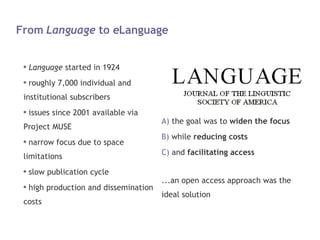
From  Language  to eLanguage Language  started in 1924 roughly 7,000 individual and institutional subscribers issues since 2001 available via Project MUSE narrow focus due to space limitations slow publication cycle high production and dissemination costs the goal was to  widen the focus while  reducing costs and  facilitating access ...an open access approach was the ideal solution
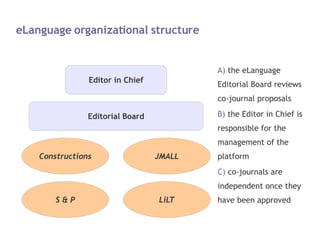
eLanguage organizational structure the eLanguage Editorial Board reviews co-journal proposals the Editor in Chief is responsible for the management of the platform co-journals are independent once they have been approved Editor in Chief Editorial Board
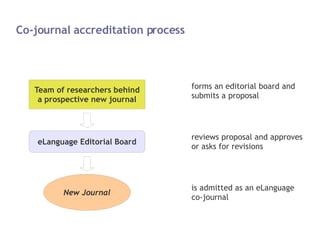
Co-journal accreditation process forms an editorial board and  submits a proposal reviews proposal and approves or asks for revisions is admitted as an eLanguage co-journal eLanguage Editorial Board
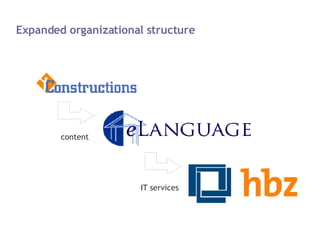
Expanded organizational structure content IT services
The technology
A mashup of tools OJS 2.1.1 + Wordpress 2.2
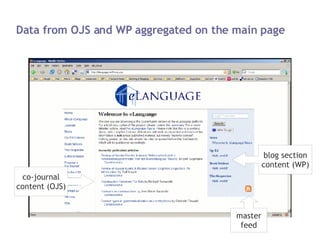
Data from OJS and WP aggregated on the main page blog section content (WP) co-journal content (OJS) master feed
Open Source Reliability all first-level products (OJS, WP) are based on second-level FOSS technologies and protocols such as PHP, MySQL, Apache and RSS/Atom mature, well-supported and well-documented products 90% of software development is outsourced - advantage : we can focus on the content and on making it accessible
Using external tools for added services Google Domain Tools (admin) Google Custom Search (search) Google Mail (email) Google Groups (mailing lists) Google Analytics (web statistics) Technorati (blog management) Feedburner (feed diagnostics)
Three goals for maximum accessibility to make all eLanguage content accessible via search to make everything published in eLanguage accessible both via library catalogs and commercial search engines to make access to our  content  independent from access to our  website  by using feeds (everything but the full text of articles is available via feeds)
Benefits of the platform Benefits for... readers : content is free and easily accessible authors : no costs, greater impact, faster publication, ownership of article, precise metrics editors : full control over their publication, less or no headaches about technical issues, no volumes of specialized knowledge necessary Linguistic Society of America : "what's good for the discipline is good for the association", great visibility HBZ/DIPP : strategic value / experience
Where we are
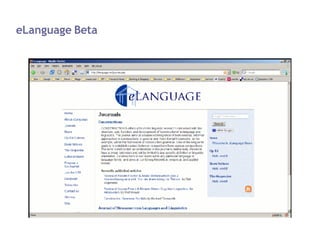
eLanguage Beta
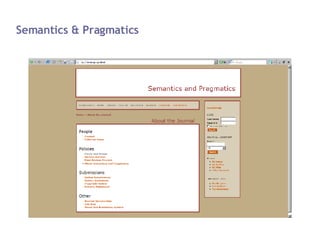
Semantics & Pragmatics
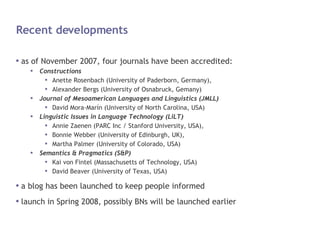
Recent developments as of November 2007, four journals have been accredited: Constructions Anette Rosenbach (University of Paderborn, Germany), Alexander Bergs (University of Osnabruck, Gemany) Journal of Mesoamerican Languages and Linguistics (JMLL) David Mora-Marín (University of North Carolina, USA) Linguistic Issues in Language Technology (LiLT) Annie Zaenen (PARC Inc / Stanford University, USA), Bonnie Webber (University of Edinburgh, UK), Martha Palmer (University of Colorado, USA) Semantics & Pragmatics (S&P) Kai von Fintel (Massachusetts of Technology, USA) David Beaver (University of Texas, USA) a blog has been launched to keep people informed launch in Spring 2008, possibly BNs will be launched earlier
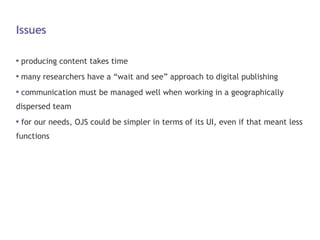
Issues producing content takes time many researchers have a “wait and see” approach to digital publishing communication must be managed well when working in a geographically dispersed team for our needs, OJS could be simpler in terms of its UI, even if that meant less functions
What could we do better? Once the platform has successfully launched we will look into... unified citation database preprint repository more "reader" involvement (blog comments? link external sources?)
eLanguage and WALS: a comparison
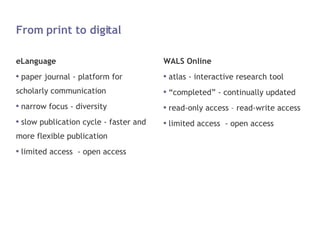
From print to digital eLanguage paper journal - platform for scholarly communication narrow focus - diversity slow publication cycle - faster and more flexible publication limited access  - open access  WALS Online atlas - interactive research tool “completed” - continually updated read-only access – read-write access limited access  - open access
More than “putting things on the Web”
Useful but problematic metaphors an “electronic journal” can be designed to look like a print product but the digital form makes entirely new uses possible storage “just happens” publishing  = conserving knowledge for posterity communication  = exchanging information more rapidly
Practical implications we will increasingly not just publish  “completed”  papers on the Web, but conduct  ongoing  discussions and debates there collaborative research on the Web (with something like WALS Online) is the next logical step tools for data visualization, modeling etc are likely to become ubiquitous Research will increasingly “happen” on the Web
Open access, open data – what are the implications?
Implications natural language data is available on an unprecedented scale tools for processing and analysis of this data are increasingly available a virtual space for discussing and interpreting the results of such analyses is also available (your research blog or wiki, eLanguage, WALS...) Most importantly, all of these levels are open and accessible to everyone!
How we can benefit collaborative language documentation (endangered languages, typology) more salient corpus-based investigations (syntax, semantics, pragmatics, ...) better intradisciplinary connectivity (what are my colleagues doing?) better interdisciplinary communication (too many related fields to name!)
Thanks for listening!

WALS and eLanguage (Leipzig)

  • 1.
    From Publishing toCommunication eLanguage, WALS and digital linguistics Cornelius Puschmann University of Düsseldorf [email_address] Max Planck Institute for Evolutionary Anthropology, Leipzig 5 November 2007
  • 2.
    Contents of thispresentation eLanguage: concept & organization The technology Where we are eLanguage and WALS: a comparison More than “putting things on the Web” Open access, open data – what are the implications?
  • 3.
  • 4.
    What is eLanguage?an aggregator for peer-reviewed content from open access journals a platform for publishing scientific articles on-line a source of meta-information on academic linguistics (book reviews, department news etc) an academic community on the Web
  • 5.
  • 6.
    From Language to eLanguage Language started in 1924 roughly 7,000 individual and institutional subscribers issues since 2001 available via Project MUSE narrow focus due to space limitations slow publication cycle high production and dissemination costs the goal was to widen the focus while reducing costs and facilitating access ...an open access approach was the ideal solution
  • 7.
    eLanguage organizational structurethe eLanguage Editorial Board reviews co-journal proposals the Editor in Chief is responsible for the management of the platform co-journals are independent once they have been approved Editor in Chief Editorial Board
  • 8.
    Co-journal accreditation processforms an editorial board and submits a proposal reviews proposal and approves or asks for revisions is admitted as an eLanguage co-journal eLanguage Editorial Board
  • 9.
  • 10.
  • 11.
    A mashup oftools OJS 2.1.1 + Wordpress 2.2
  • 12.
    Data from OJSand WP aggregated on the main page blog section content (WP) co-journal content (OJS) master feed
  • 13.
    Open Source Reliabilityall first-level products (OJS, WP) are based on second-level FOSS technologies and protocols such as PHP, MySQL, Apache and RSS/Atom mature, well-supported and well-documented products 90% of software development is outsourced - advantage : we can focus on the content and on making it accessible
  • 14.
    Using external toolsfor added services Google Domain Tools (admin) Google Custom Search (search) Google Mail (email) Google Groups (mailing lists) Google Analytics (web statistics) Technorati (blog management) Feedburner (feed diagnostics)
  • 15.
    Three goals formaximum accessibility to make all eLanguage content accessible via search to make everything published in eLanguage accessible both via library catalogs and commercial search engines to make access to our content independent from access to our website by using feeds (everything but the full text of articles is available via feeds)
  • 16.
    Benefits of theplatform Benefits for... readers : content is free and easily accessible authors : no costs, greater impact, faster publication, ownership of article, precise metrics editors : full control over their publication, less or no headaches about technical issues, no volumes of specialized knowledge necessary Linguistic Society of America : "what's good for the discipline is good for the association", great visibility HBZ/DIPP : strategic value / experience
  • 17.
  • 18.
  • 19.
  • 20.
    Recent developments asof November 2007, four journals have been accredited: Constructions Anette Rosenbach (University of Paderborn, Germany), Alexander Bergs (University of Osnabruck, Gemany) Journal of Mesoamerican Languages and Linguistics (JMLL) David Mora-Marín (University of North Carolina, USA) Linguistic Issues in Language Technology (LiLT) Annie Zaenen (PARC Inc / Stanford University, USA), Bonnie Webber (University of Edinburgh, UK), Martha Palmer (University of Colorado, USA) Semantics & Pragmatics (S&P) Kai von Fintel (Massachusetts of Technology, USA) David Beaver (University of Texas, USA) a blog has been launched to keep people informed launch in Spring 2008, possibly BNs will be launched earlier
  • 21.
    Issues producing contenttakes time many researchers have a “wait and see” approach to digital publishing communication must be managed well when working in a geographically dispersed team for our needs, OJS could be simpler in terms of its UI, even if that meant less functions
  • 22.
    What could wedo better? Once the platform has successfully launched we will look into... unified citation database preprint repository more "reader" involvement (blog comments? link external sources?)
  • 23.
    eLanguage and WALS:a comparison
  • 24.
    From print todigital eLanguage paper journal - platform for scholarly communication narrow focus - diversity slow publication cycle - faster and more flexible publication limited access - open access WALS Online atlas - interactive research tool “completed” - continually updated read-only access – read-write access limited access - open access
  • 25.
    More than “puttingthings on the Web”
  • 26.
    Useful but problematicmetaphors an “electronic journal” can be designed to look like a print product but the digital form makes entirely new uses possible storage “just happens” publishing = conserving knowledge for posterity communication = exchanging information more rapidly
  • 27.
    Practical implications wewill increasingly not just publish “completed” papers on the Web, but conduct ongoing discussions and debates there collaborative research on the Web (with something like WALS Online) is the next logical step tools for data visualization, modeling etc are likely to become ubiquitous Research will increasingly “happen” on the Web
  • 28.
    Open access, opendata – what are the implications?
  • 29.
    Implications natural languagedata is available on an unprecedented scale tools for processing and analysis of this data are increasingly available a virtual space for discussing and interpreting the results of such analyses is also available (your research blog or wiki, eLanguage, WALS...) Most importantly, all of these levels are open and accessible to everyone!
  • 30.
    How we canbenefit collaborative language documentation (endangered languages, typology) more salient corpus-based investigations (syntax, semantics, pragmatics, ...) better intradisciplinary connectivity (what are my colleagues doing?) better interdisciplinary communication (too many related fields to name!)
  • 31.