A Brief Introduction to Ruby : P1
(Book Review of “Learn to Program”)
                    Brady Cheng
        http://bradyisstudying.blogspot.tw/
Agenda


Install
Comment
Data Types
Variables, Arrays, and Iterators
Methods
Flow Control
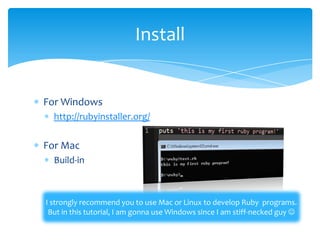
Install


For Windows
  http://rubyinstaller.org/

For Mac
  Build-in


I strongly recommend you to use Mac or Linux to develop Ruby programs.
 But in this tutorial, I am gonna use Windows since I am stiff-necked guy 
Comment


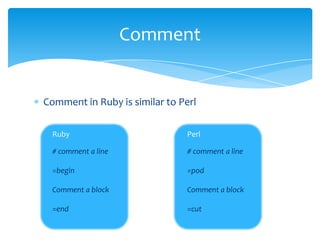
Comment in Ruby is similar to Perl

  Ruby                         Perl

  # comment a line             # comment a line

  =begin                       =pod

  Comment a block              Comment a block

  =end                         =cut
Data Types


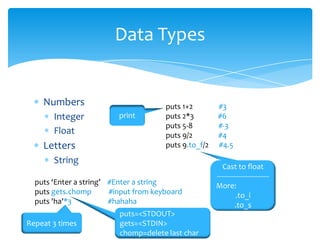
    Numbers                            puts 1+2        #3
       Integer            print        puts 2*3        #6
                                       puts 5-8        #-3
       Float                           puts 9/2        #4
    Letters                            puts 9.to_f/2   #4.5
       String
                                                          Cast to float
                                                       --------------------------
  puts ‘Enter a string’ #Enter a string                More:
  puts gets.chomp       #input from keyboard                    .to_i
  puts 'ha'*3           #hahaha                                 .to_s
                          puts=<STDOUT>
Repeat 3 times            gets=<STDIN>
                          chomp=delete last char
Variables, Arrays, and Iterators


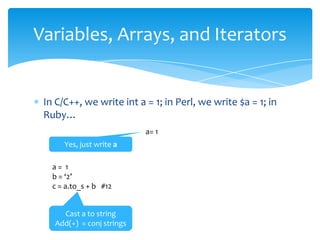
 In C/C++, we write int a = 1; in Perl, we write $a = 1; in
 Ruby…
                           a= 1
      Yes, just write a

   a= 1
   b = ‘2’
   c = a.to_s + b #12


     Cast a to string
   Add(+) = conj strings
Variables, Arrays, and Iterators


 Arrays
   [ele1, ele2, ele3]
 Some array methods
   .pop
    .push
   .join(‘join string’)
   .last
   .length
Variables, Arrays, and Iterators


 There is a special array method : each
   iterator
                                  An array with 3 elements
    color= [‘R', 'G', 'R']
    color.each do | c |             | c | = variable in this
              puts “color=” + c        do…end block
    end
                                  Output=
                                            color=R
                                            color=G
                                            color=B
Methods


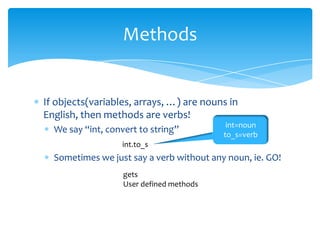
If objects(variables, arrays, …) are nouns in
English, then methods are verbs!
                                           int=noun
  We say “int, convert to string”         to_s=verb
                  int.to_s
  Sometimes we just say a verb without any noun, ie. GO!
                   gets
                   User defined methods
Methods


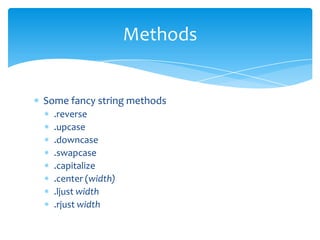
Some fancy string methods
  .reverse
  .upcase
  .downcase
  .swapcase
  .capitalize
  .center (width)
  .ljust width
  .rjust width
Methods


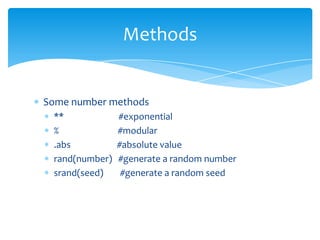
Some number methods
 **             #exponential
 %              #modular
 .abs           #absolute value
 rand(number)   #generate a random number
 srand(seed)     #generate a random seed
Methods


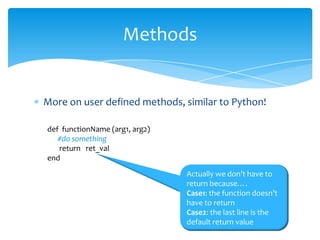
More on user defined methods, similar to Python!

def functionName (arg1, arg2)
   #do something
   return ret_val
end
                                Actually we don’t have to
                                return because….
                                Case1: the function doesn’t
                                have to return
                                Case2: the last line is the
                                default return value
Flow Control


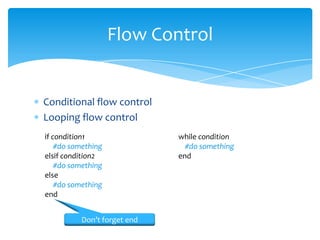
Conditional flow control
Looping flow control
if condition1                while condition
    #do something              #do something
elsif condition2             end
    #do something
else
    #do something
end


          Don’t forget end
The End


The first part is over, please wait for the second part
Any comments would be appreciated
Welcome to my study page
  http://bradyisstudying.blogspot.tw/

Ruby introduction part1

  • 1.
    A Brief Introductionto Ruby : P1 (Book Review of “Learn to Program”) Brady Cheng http://bradyisstudying.blogspot.tw/
  • 2.
    Agenda Install Comment Data Types Variables, Arrays,and Iterators Methods Flow Control
  • 3.
    Install For Windows http://rubyinstaller.org/ For Mac Build-in I strongly recommend you to use Mac or Linux to develop Ruby programs. But in this tutorial, I am gonna use Windows since I am stiff-necked guy 
  • 4.
    Comment Comment in Rubyis similar to Perl Ruby Perl # comment a line # comment a line =begin =pod Comment a block Comment a block =end =cut
  • 5.
    Data Types Numbers puts 1+2 #3 Integer print puts 2*3 #6 puts 5-8 #-3 Float puts 9/2 #4 Letters puts 9.to_f/2 #4.5 String Cast to float -------------------------- puts ‘Enter a string’ #Enter a string More: puts gets.chomp #input from keyboard .to_i puts 'ha'*3 #hahaha .to_s puts=<STDOUT> Repeat 3 times gets=<STDIN> chomp=delete last char
  • 6.
    Variables, Arrays, andIterators In C/C++, we write int a = 1; in Perl, we write $a = 1; in Ruby… a= 1 Yes, just write a a= 1 b = ‘2’ c = a.to_s + b #12 Cast a to string Add(+) = conj strings
  • 7.
    Variables, Arrays, andIterators Arrays [ele1, ele2, ele3] Some array methods .pop .push .join(‘join string’) .last .length
  • 8.
    Variables, Arrays, andIterators There is a special array method : each iterator An array with 3 elements color= [‘R', 'G', 'R'] color.each do | c | | c | = variable in this puts “color=” + c do…end block end Output= color=R color=G color=B
  • 9.
    Methods If objects(variables, arrays,…) are nouns in English, then methods are verbs! int=noun We say “int, convert to string” to_s=verb int.to_s Sometimes we just say a verb without any noun, ie. GO! gets User defined methods
  • 10.
    Methods Some fancy stringmethods .reverse .upcase .downcase .swapcase .capitalize .center (width) .ljust width .rjust width
  • 11.
    Methods Some number methods ** #exponential % #modular .abs #absolute value rand(number) #generate a random number srand(seed) #generate a random seed
  • 12.
    Methods More on userdefined methods, similar to Python! def functionName (arg1, arg2) #do something return ret_val end Actually we don’t have to return because…. Case1: the function doesn’t have to return Case2: the last line is the default return value
  • 13.
    Flow Control Conditional flowcontrol Looping flow control if condition1 while condition #do something #do something elsif condition2 end #do something else #do something end Don’t forget end
  • 14.
    The End The firstpart is over, please wait for the second part Any comments would be appreciated Welcome to my study page http://bradyisstudying.blogspot.tw/