RUBY BLOCKS, LOOPS/ITERATORS
            & FLOW CONTROLS
●   Ruby blocks
●   Ruby yield
●   Block, proc and lambda
●   Iterators: ruby-loops
●   Flow controls
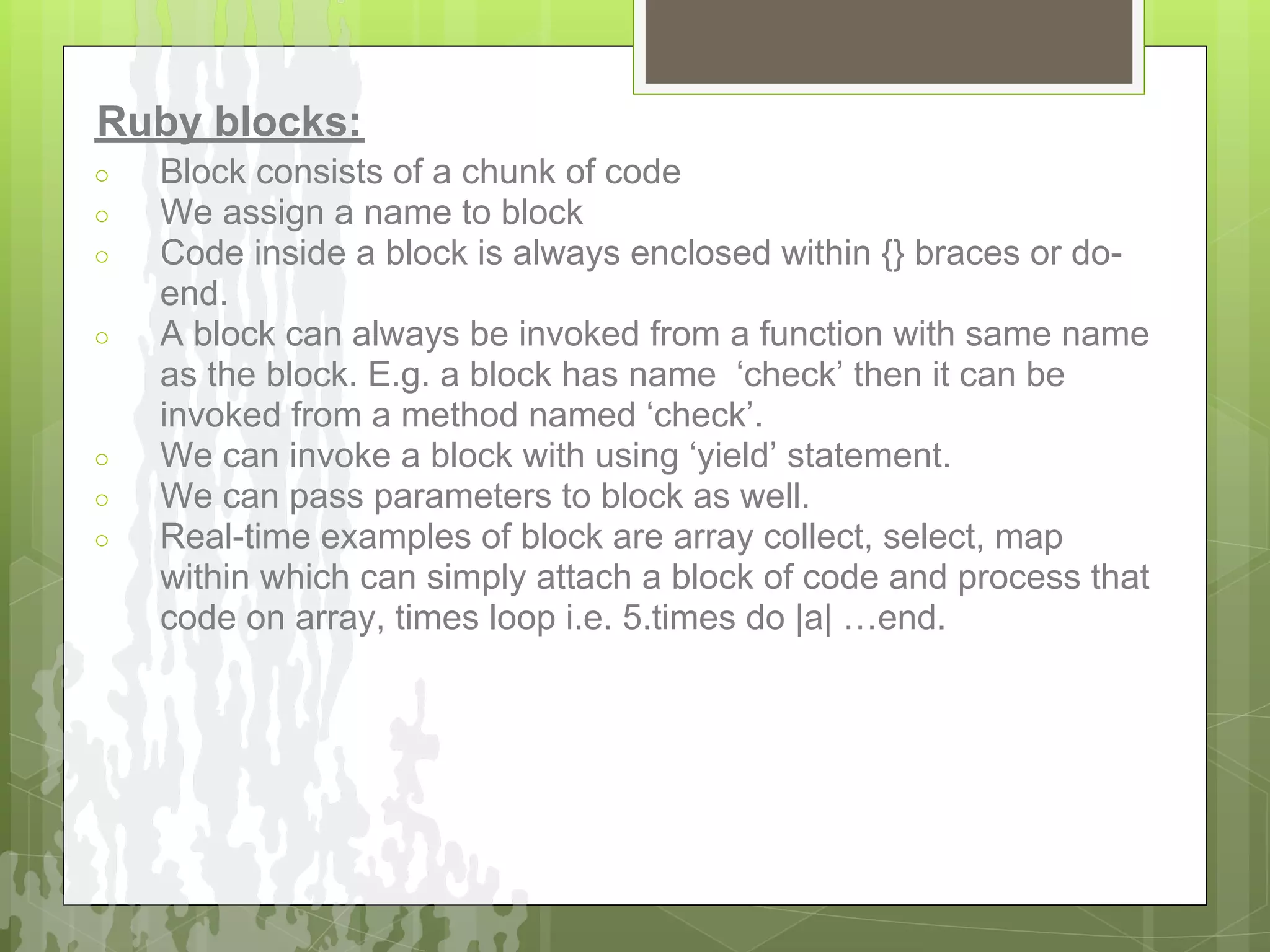
Ruby blocks:
○   Block consists of a chunk of code
○   We assign a name to block
○   Code inside a block is always enclosed within {} braces or do-
    end.
○   A block can always be invoked from a function with same name
    as the block. E.g. a block has name ‘check’ then it can be
    invoked from a method named ‘check’.
○   We can invoke a block with using ‘yield’ statement.
○   We can pass parameters to block as well.
○   Real-time examples of block are array collect, select, map
    within which can simply attach a block of code and process that
    code on array, times loop i.e. 5.times do |a| …end.
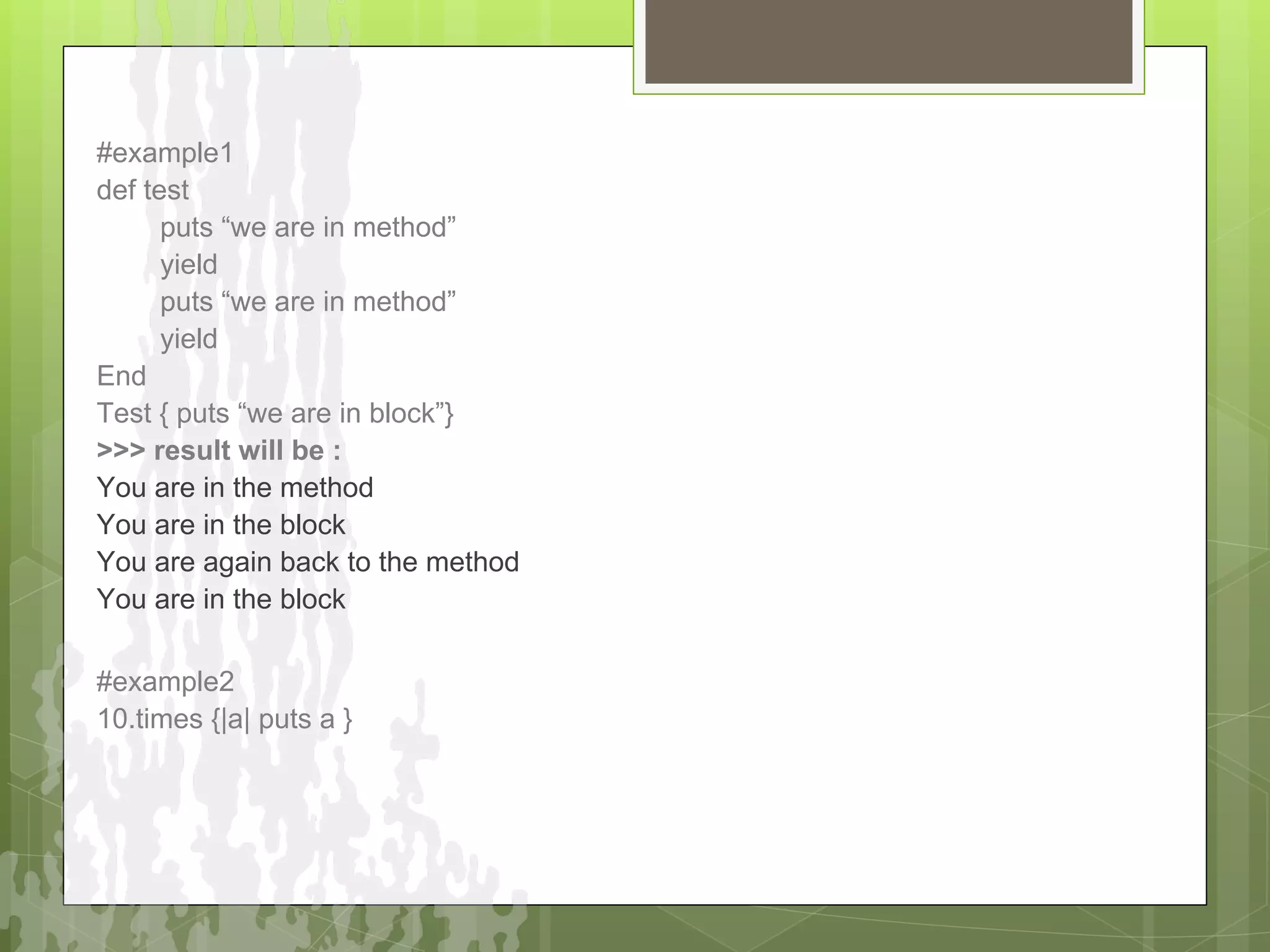
#example1
def test
      puts “we are in method”
      yield
      puts “we are in method”
      yield
End
Test { puts “we are in block”}
>>> result will be :
You are in the method
You are in the block
You are again back to the method
You are in the block

#example2
10.times {|a| puts a }
Block, Proc, Lambda & methods:
○   Blocks, procs and lamdba are one of the most powerful aspects of ruby,
    and also one of the most misunderstood too.
○   This can be because ruby handles CLOSURES in a bit different/unique
    way. To make it more difficult its has four different ways of handling
    closures.
○   Block: most common, easiest and arguably most “ruby like” way to use
    closures in ruby.
○   Procedures AKA Procs: blocks are good, but we cant reuse them,
    whenever we need we have to rewrite them. There comes Procs. Procs
    are nothing more than a block that can be reused.
○   Lambda: lambda is almost similar to Procs except two subtle
    differences,
     ○ unlike Procs, lambdas check the number of arguments passed and returns
       error if not.
     ○ lambdas have diminutive returns.
○   Method: when we already have some method and want to pass it to
    another method as a closure, we use ‘method’ method provided by ruby
    to keep things DRY.
How Proc works?
class Array
 def iterate!(code)
   self.each_with_index do |n, i|
     self[i] = code.call(n)
   end
 end
end
array_1 = [1, 2, 3, 4]
array_2 = [2, 3, 4, 5]              #example2
                                    def callbacks(procs) procs[:
square = Proc.new do |n|
                                    starting].call
     n ** 2                              puts "Still going" procs[:
end                                 finishing].call
array_1.iterate!(square)            end
array_2.iterate!(square)
                                    callbacks(:starting => Proc.new { puts
                                    "Starting" }, :finishing => Proc.new {
                                    puts "Finishing" })
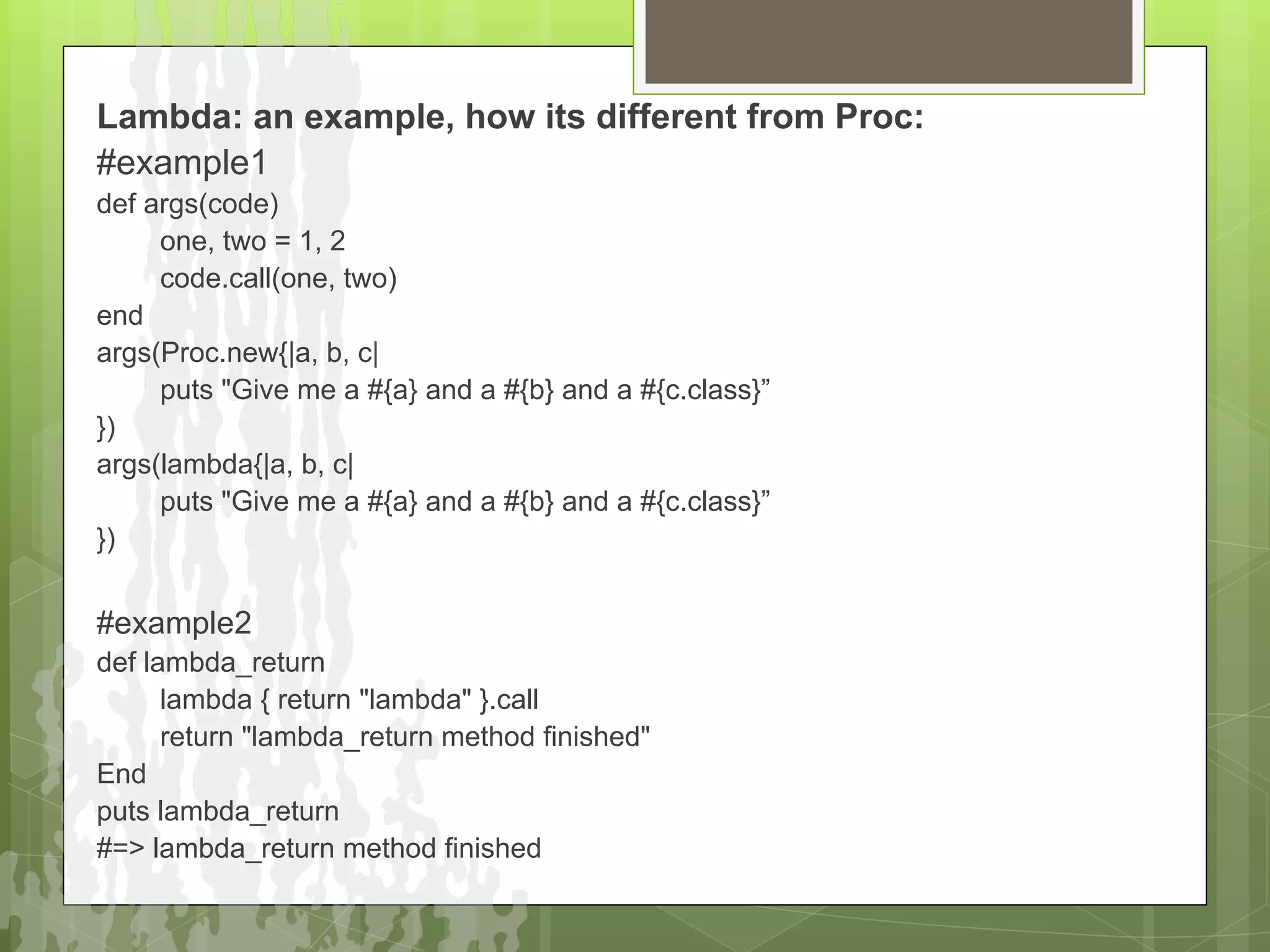
Lambda: an example, how its different from Proc:
#example1
def args(code)
     one, two = 1, 2
     code.call(one, two)
end
args(Proc.new{|a, b, c|
     puts "Give me a #{a} and a #{b} and a #{c.class}”
})
args(lambda{|a, b, c|
     puts "Give me a #{a} and a #{b} and a #{c.class}”
})


#example2
def lambda_return
      lambda { return "lambda" }.call
      return "lambda_return method finished"
End
puts lambda_return
#=> lambda_return method finished
‘method’ ruby method:

class Array
 def iterate!(code)
    self.each_with_index do |n, i|
     self[i] = code.call(n)
    end
  end
end
def square(n)
   n ** 2
end
array = [1, 2, 3, 4]
array.iterate!(method(:square))
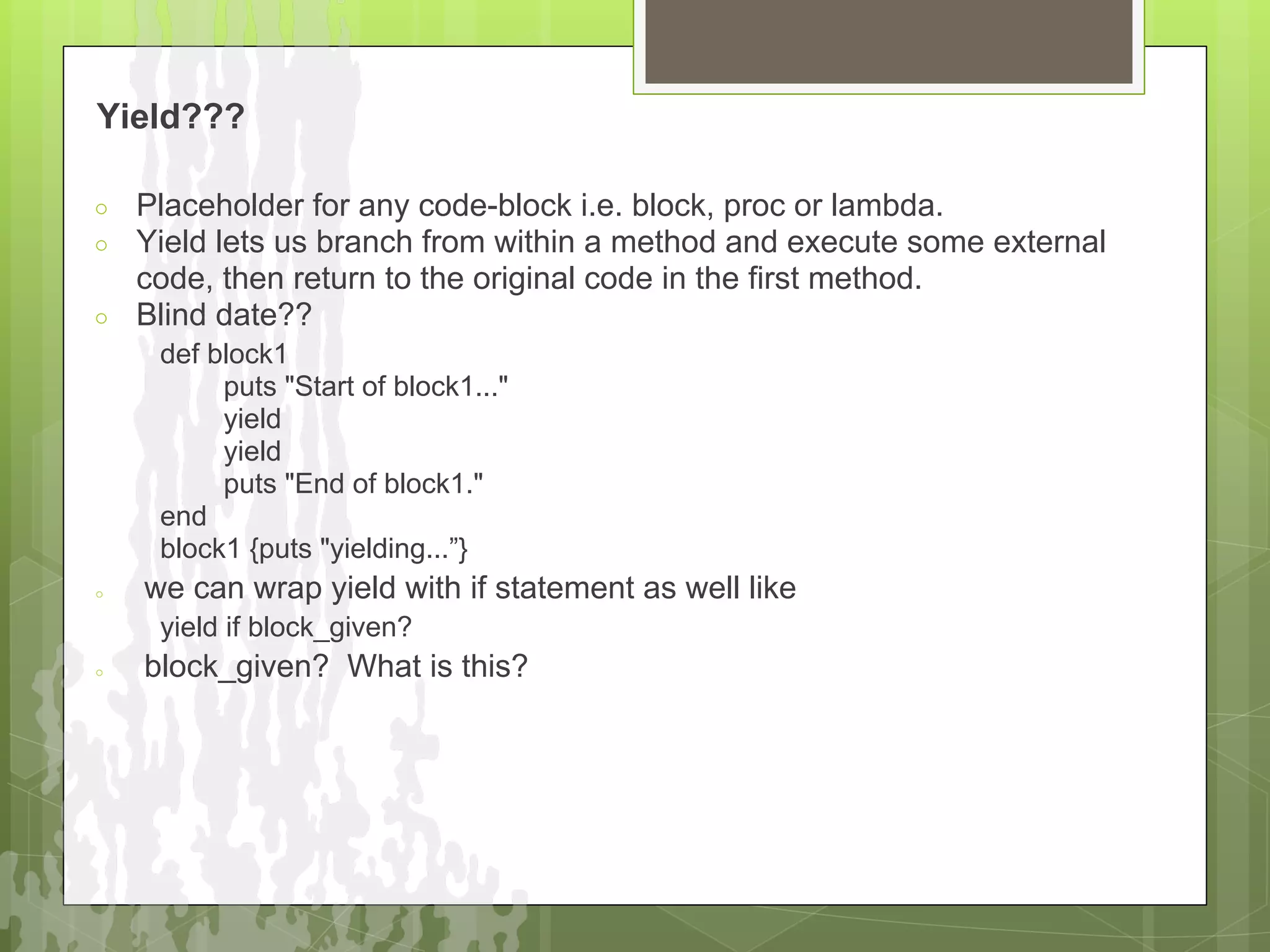
Yield???

○   Placeholder for any code-block i.e. block, proc or lambda.
○   Yield lets us branch from within a method and execute some external
    code, then return to the original code in the first method.
○   Blind date??
     def block1
          puts "Start of block1..."
          yield
          yield
          puts "End of block1."
     end
     block1 {puts "yielding...”}
○   we can wrap yield with if statement as well like
     yield if block_given?
○   block_given? What is this?
Ruby Iterators: looping
Ruby Loops/Iterators:

●   Loops/Iterators in Ruby are used to execute the same block of code a
    specified number of times.
●   In ruby, for better understanding, we can assume to classify
    looping/iterating in 2 buckets:
     ●   Simple way to loop/iterate.
     ●   Complex way to loop/iterate.
●   Common Looping ways we use in ruby are for, while, loop, until,
    while/until modifiers etc.
●   Common iterating ways we use in ruby are each iterators, time iterators,
    upto & step iterators, each_index iterators.
Ruby Looping Constructs:

○   Loop: The simplest looping constructs in ruby is ‘loop’ method.
    Technically it’s an iterating block as it takes a block as input.
○   While: The while loop in Ruby is just like the standard while loop in any
    other language nothing too fancy.
○   Until: The until loop is similar to the while loop but the logic is reversed.
○   While/until modifiers: Ruby also allows you to use the while and until
    keywords as modifiers, which means you can put them at the end of an
    expression just like you can do with the if statement.
○   For: If we discount the loop method then the for loop acts as a kind of
    bridge between looping constructs and iterators in Ruby. The for loop is
    still a looping construct but it acts almost like an iterator without actually
    taking a block.
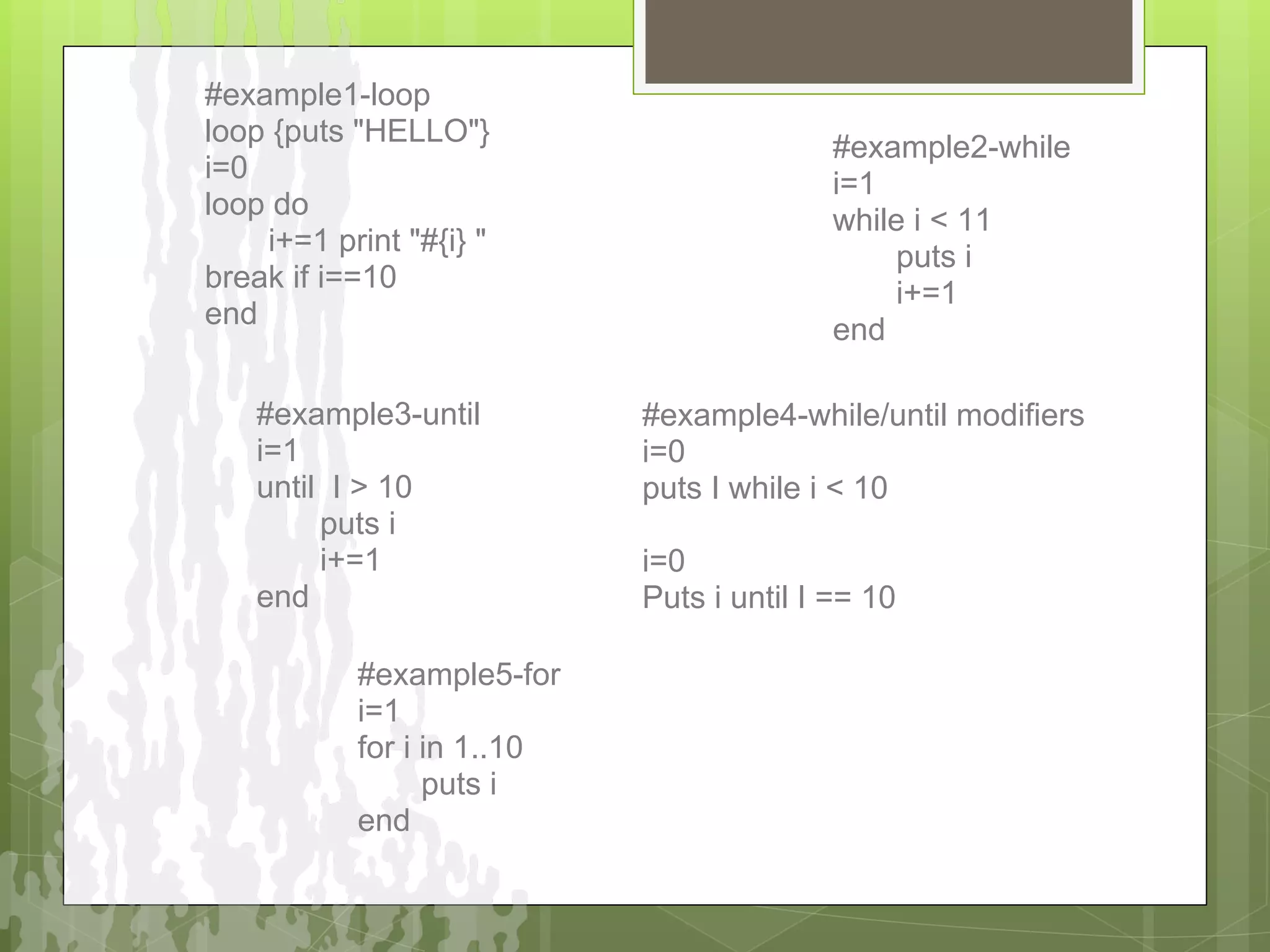
#example1-loop
loop {puts "HELLO"}
                                           #example2-while
i=0
                                           i=1
loop do
                                           while i < 11
    i+=1 print "#{i} "
                                               puts i
break if i==10
                                               i+=1
end
                                           end

   #example3-until          #example4-while/until modifiers
   i=1                      i=0
   until I > 10             puts I while i < 10
        puts i
        i+=1                i=0
   end                      Puts i until I == 10

           #example5-for
           i=1
           for i in 1..10
                 puts i
           end
Ruby Iterators:

○   Iterators are methods that take blocks and execute that block as many
    times as there are iterations.
○   Each iterators(something.each do ... end)
    ○   Iterates through each elements.
○   Times iterators(x.times do … end)
    ○   The times iterator is similar to you classic for loop in other languages and
        will allow you to execute a loop and perform an action (according to the
        block you write) x number of time
○   Upto and step iterators
    ○   This is also similar to for loop too, that we execute from number x up to
        number y.
    ○   Step iterators helps to skip few steps between.
‘Each’ Iterators:

array = [1,2,3,4,5,6,7,8,9,10]
array.each {|value| print "#{value} "}

(1..5).each { puts ‘We are here!’ }

(1…5).each { puts ‘we are here’}


****
Also, for does not exactly qualify as a syntax sugar for each, because they
handle the scoping of new variables differently: each makes them
disappear outside the block, whereas for makes them persist. With
experience you’re likely to find you want new variables to be confined to
the block, making each the better choice.
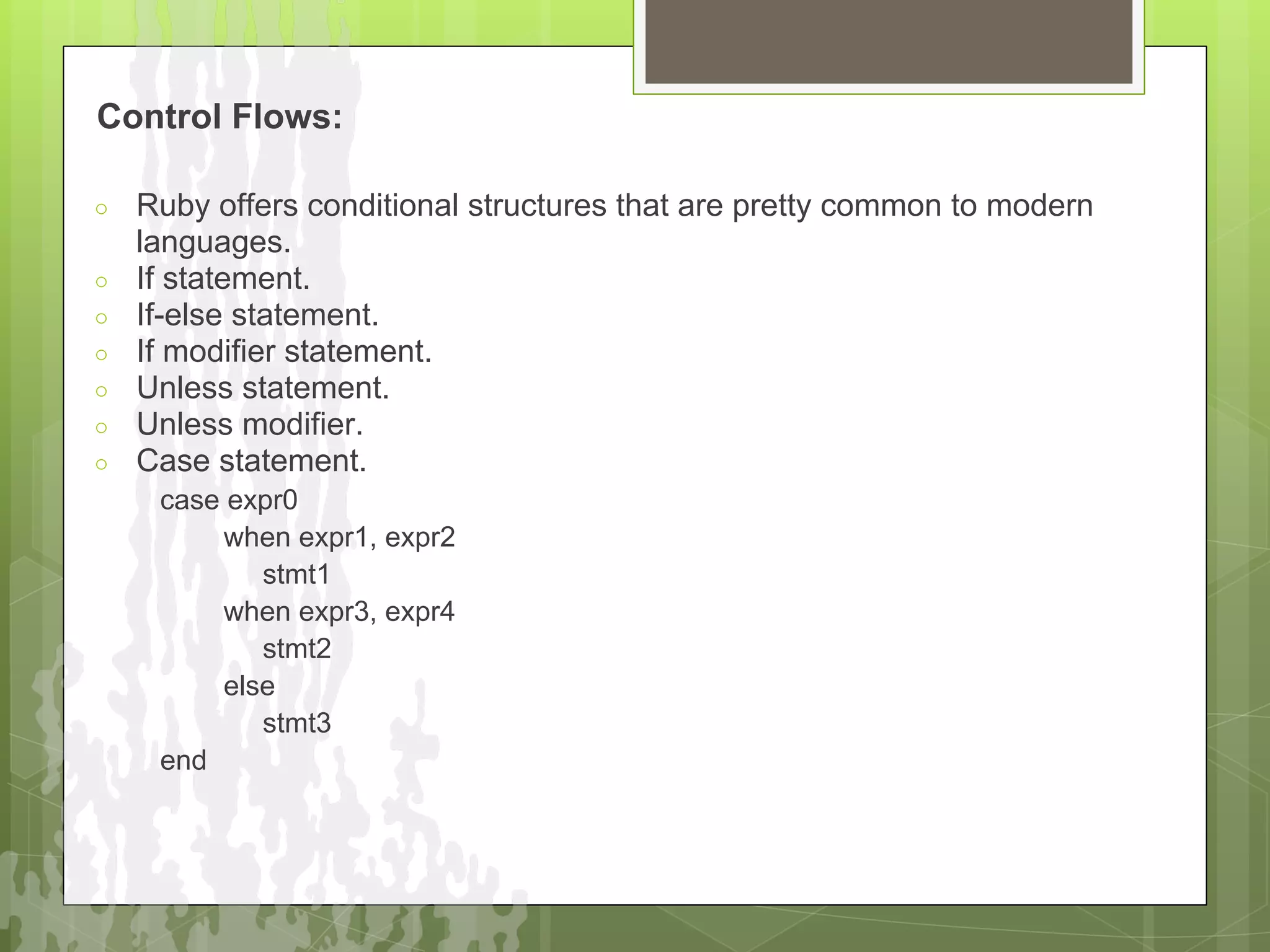
Control Flows:

○   Ruby offers conditional structures that are pretty common to modern
    languages.
○   If statement.
○   If-else statement.
○   If modifier statement.
○   Unless statement.
○   Unless modifier.
○   Case statement.
     case expr0
         when expr1, expr2
            stmt1
         when expr3, expr4
            stmt2
         else
            stmt3
     end
QUESTIONS???

Blocks and loops.pptx

  • 1.
  • 2.
    Ruby blocks ● Ruby yield ● Block, proc and lambda ● Iterators: ruby-loops ● Flow controls
  • 3.
    Ruby blocks: ○ Block consists of a chunk of code ○ We assign a name to block ○ Code inside a block is always enclosed within {} braces or do- end. ○ A block can always be invoked from a function with same name as the block. E.g. a block has name ‘check’ then it can be invoked from a method named ‘check’. ○ We can invoke a block with using ‘yield’ statement. ○ We can pass parameters to block as well. ○ Real-time examples of block are array collect, select, map within which can simply attach a block of code and process that code on array, times loop i.e. 5.times do |a| …end.
  • 4.
    #example1 def test puts “we are in method” yield puts “we are in method” yield End Test { puts “we are in block”} >>> result will be : You are in the method You are in the block You are again back to the method You are in the block #example2 10.times {|a| puts a }
  • 5.
    Block, Proc, Lambda& methods: ○ Blocks, procs and lamdba are one of the most powerful aspects of ruby, and also one of the most misunderstood too. ○ This can be because ruby handles CLOSURES in a bit different/unique way. To make it more difficult its has four different ways of handling closures. ○ Block: most common, easiest and arguably most “ruby like” way to use closures in ruby. ○ Procedures AKA Procs: blocks are good, but we cant reuse them, whenever we need we have to rewrite them. There comes Procs. Procs are nothing more than a block that can be reused. ○ Lambda: lambda is almost similar to Procs except two subtle differences, ○ unlike Procs, lambdas check the number of arguments passed and returns error if not. ○ lambdas have diminutive returns. ○ Method: when we already have some method and want to pass it to another method as a closure, we use ‘method’ method provided by ruby to keep things DRY.
  • 6.
    How Proc works? classArray def iterate!(code) self.each_with_index do |n, i| self[i] = code.call(n) end end end array_1 = [1, 2, 3, 4] array_2 = [2, 3, 4, 5] #example2 def callbacks(procs) procs[: square = Proc.new do |n| starting].call n ** 2 puts "Still going" procs[: end finishing].call array_1.iterate!(square) end array_2.iterate!(square) callbacks(:starting => Proc.new { puts "Starting" }, :finishing => Proc.new { puts "Finishing" })
  • 7.
    Lambda: an example,how its different from Proc: #example1 def args(code) one, two = 1, 2 code.call(one, two) end args(Proc.new{|a, b, c| puts "Give me a #{a} and a #{b} and a #{c.class}” }) args(lambda{|a, b, c| puts "Give me a #{a} and a #{b} and a #{c.class}” }) #example2 def lambda_return lambda { return "lambda" }.call return "lambda_return method finished" End puts lambda_return #=> lambda_return method finished
  • 8.
    ‘method’ ruby method: classArray def iterate!(code) self.each_with_index do |n, i| self[i] = code.call(n) end end end def square(n) n ** 2 end array = [1, 2, 3, 4] array.iterate!(method(:square))
  • 9.
    Yield??? ○ Placeholder for any code-block i.e. block, proc or lambda. ○ Yield lets us branch from within a method and execute some external code, then return to the original code in the first method. ○ Blind date?? def block1 puts "Start of block1..." yield yield puts "End of block1." end block1 {puts "yielding...”} ○ we can wrap yield with if statement as well like yield if block_given? ○ block_given? What is this?
  • 10.
  • 11.
    Ruby Loops/Iterators: ● Loops/Iterators in Ruby are used to execute the same block of code a specified number of times. ● In ruby, for better understanding, we can assume to classify looping/iterating in 2 buckets: ● Simple way to loop/iterate. ● Complex way to loop/iterate. ● Common Looping ways we use in ruby are for, while, loop, until, while/until modifiers etc. ● Common iterating ways we use in ruby are each iterators, time iterators, upto & step iterators, each_index iterators.
  • 12.
    Ruby Looping Constructs: ○ Loop: The simplest looping constructs in ruby is ‘loop’ method. Technically it’s an iterating block as it takes a block as input. ○ While: The while loop in Ruby is just like the standard while loop in any other language nothing too fancy. ○ Until: The until loop is similar to the while loop but the logic is reversed. ○ While/until modifiers: Ruby also allows you to use the while and until keywords as modifiers, which means you can put them at the end of an expression just like you can do with the if statement. ○ For: If we discount the loop method then the for loop acts as a kind of bridge between looping constructs and iterators in Ruby. The for loop is still a looping construct but it acts almost like an iterator without actually taking a block.
  • 13.
    #example1-loop loop {puts "HELLO"} #example2-while i=0 i=1 loop do while i < 11 i+=1 print "#{i} " puts i break if i==10 i+=1 end end #example3-until #example4-while/until modifiers i=1 i=0 until I > 10 puts I while i < 10 puts i i+=1 i=0 end Puts i until I == 10 #example5-for i=1 for i in 1..10 puts i end
  • 14.
    Ruby Iterators: ○ Iterators are methods that take blocks and execute that block as many times as there are iterations. ○ Each iterators(something.each do ... end) ○ Iterates through each elements. ○ Times iterators(x.times do … end) ○ The times iterator is similar to you classic for loop in other languages and will allow you to execute a loop and perform an action (according to the block you write) x number of time ○ Upto and step iterators ○ This is also similar to for loop too, that we execute from number x up to number y. ○ Step iterators helps to skip few steps between.
  • 15.
    ‘Each’ Iterators: array =[1,2,3,4,5,6,7,8,9,10] array.each {|value| print "#{value} "} (1..5).each { puts ‘We are here!’ } (1…5).each { puts ‘we are here’} **** Also, for does not exactly qualify as a syntax sugar for each, because they handle the scoping of new variables differently: each makes them disappear outside the block, whereas for makes them persist. With experience you’re likely to find you want new variables to be confined to the block, making each the better choice.
  • 16.
    Control Flows: ○ Ruby offers conditional structures that are pretty common to modern languages. ○ If statement. ○ If-else statement. ○ If modifier statement. ○ Unless statement. ○ Unless modifier. ○ Case statement. case expr0 when expr1, expr2 stmt1 when expr3, expr4 stmt2 else stmt3 end
  • 17.