




Mobile
         Software
      Engineering
L02 – Java Primer

                  Mohammad Shaker
           FIT of Damascus - AI dept.
      MohammadShakerGtr@gmail.com
             Mobile SE – August 2012
IDE
eclipse, netbeans, etc.
eclipse
eclipse Juno, 2012
btw, why eclipse?!
eclipse Download
  http://www.eclipse.org/
eclipse Download
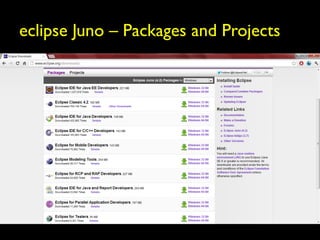
eclipse Juno – Packages and Projects
Java
JVM – Java Virtual Machine
Java
Write once, run anywhere
Java
everything is an object!
        Or is it?
Java
everything is an object!
        Or is it?
API
        http://java.sun.com/javase/6/docs/api/


                    Tutorial
http://java.sun.com/docs/books/tutorial/java/TOC.html
Variables - Naming
•   Subsequent characters also can be numbers
•   Case sensitive
•   No spaces
•   Examples:
    name
    firstName
    phoneNumber
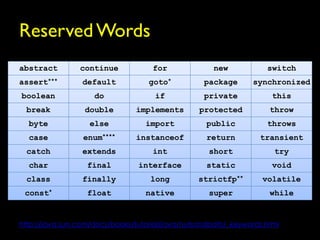
Reserved Words
abstract        continue             for             new            switch
assert***        default           goto*           package      synchronized
boolean             do               if            private            this
  break           double        implements       protected           throw
  byte             else            import          public           throws
  case           enum****       instanceof         return         transient
  catch          extends             int            short             try
  char            final          interface         static             void
  class          finally            long         strictfp**        volatile
 const*           float            native           super            while


http://java.sun.com/docs/books/tutorial/java/nutsandbolts/_keywords.html
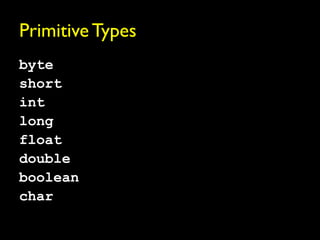
Primitive Types
byte
short
int
long
float
double
boolean
char
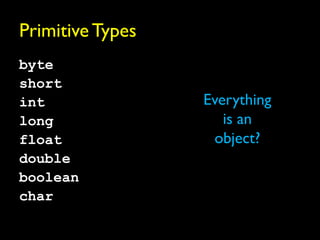
Primitive Types
byte
short
int               Everything
long                 is an
float              object?
double
boolean
char
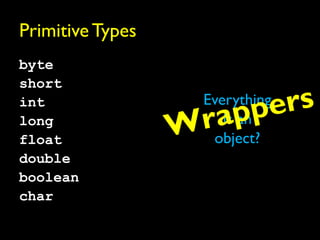
Primitive Types
byte
short
int               Everything
long                 is an
float              object?
double
boolean
char
Objects
String
BigDecimal
Arrays
int[] grades;
grades = new int[15];
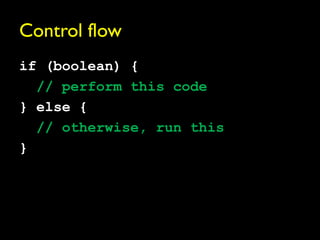
Control flow
if (boolean) {
  // perform this code
} else {
  // otherwise, run this
}
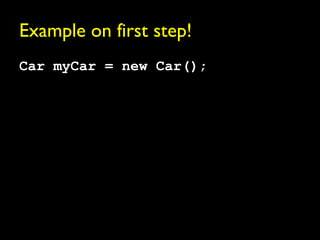
Example on first step!
Car myCar = new Car();
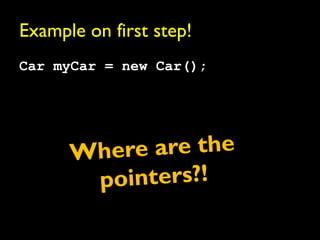
Example on first step!
Car myCar = new Car();
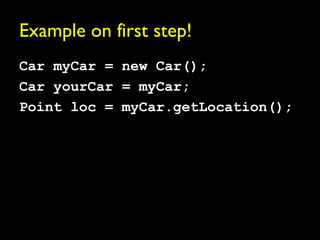
Example on first step!
Car myCar = new Car();
Car yourCar = myCar;
Point loc = myCar.getLocation();
New paradigms
• Stack
• Heap
• Garbage collection
Setters and Getters
Let’s get our hands dirty
         Objects
Packages vs Namespaces
void main(string[] args)
Instance vs Class methods
    void shootBall(Point point)
  static void main(string[] args)
Inheritance and Polymorphism
     extends, super, @Override
Some diff.
protected in a form of package scope not class scope
Some diff.
final vs const vs readonly
interfaces
Interfaces
 extends
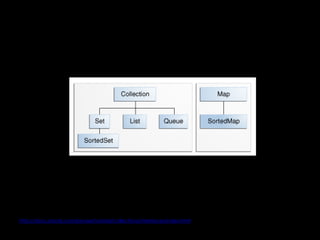
Collections
http://docs.oracle.com/javase/tutorial/collections/interfaces/index.html
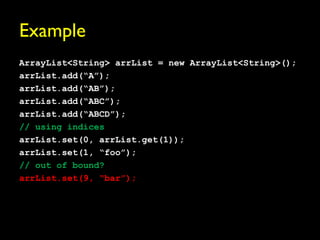
Example
ArrayList<String> arrList = new ArrayList<String>();
arrList.add(“A”);
arrList.add(“AB”);
arrList.add(“ABC”);
arrList.add(“ABCD”);
// using indices
arrList.set(0, arrList.get(1));
arrList.set(1, “foo”);
// out of bound?
arrList.set(9, “bar”);
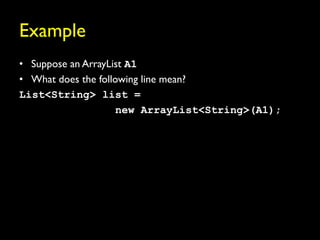
Example
• Suppose an ArrayList A1
• What does the following line mean?
List<String> list =
                     new ArrayList<String>(A1);
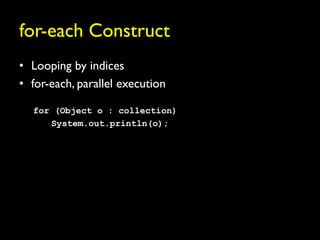
for-each Construct
• Looping by indices
• for-each, parallel execution

  for (Object o : collection)
     System.out.println(o);
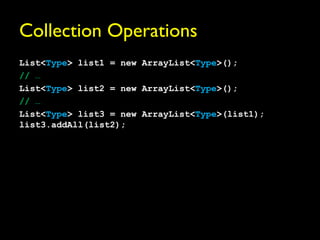
Collection Operations
List<Type> list1 = new ArrayList<Type>();
// …
List<Type> list2 = new ArrayList<Type>();
// …
List<Type> list3 = new ArrayList<Type>(list1);
list3.addAll(list2);
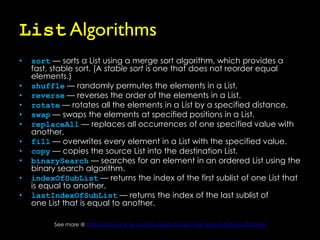
List Algorithms
•   sort — sorts a List using a merge sort algorithm, which provides a
    fast, stable sort. (A stable sort is one that does not reorder equal
    elements.)
•   shuffle — randomly permutes the elements in a List.
•   reverse — reverses the order of the elements in a List.
•   rotate — rotates all the elements in a List by a specified distance.
•   swap — swaps the elements at specified positions in a List.
•   replaceAll — replaces all occurrences of one specified value with
    another.
•   fill — overwrites every element in a List with the specified value.
•   copy — copies the source List into the destination List.
•   binarySearch — searches for an element in an ordered List using the
    binary search algorithm.
•   indexOfSubList — returns the index of the first sublist of one List that
    is equal to another.
•   lastIndexOfSubList — returns the index of the last sublist of
    one List that is equal to another.

          See more @ http://docs.oracle.com/javase/tutorial/collections/interfaces/list.html
Iterators
Multithreading
synchronized, wait,
 notify, notifyall
Exception Handling, IO...
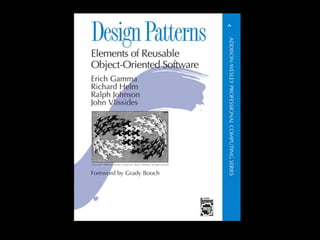
Design Patterns
Singleton, Factory, Proxy, Template.. etc.
Gang of four
Implementing Singleton with Java
            “live”
Thx for listening

Mobile Software Engineering Crash Course - C02 Java Primer