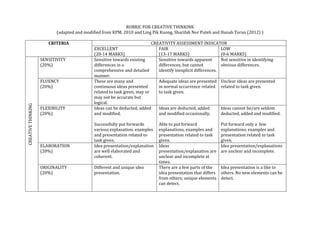
RUBRIC FOR CREATIVE THINKINK
(adapted and modified from KPM, 2010 and Ling Pik Kuong, Sharifah Nor Puteh and Hanah Toran (2012) )
CRITERIA CREATIVITY ASSESSMENT INDICATOR
EXCELLENT
(20-14 MARKS)
FAIR
(13-17 MARKS)
LOW
(0-6 MARKS)
CREATIVETHINKING
SENSITIVITY
(20%)
Sensitive towards existing
differences in a
comprehensive and detailed
manner.
Sensitive towards apparent
differences, but cannot
identify inexplicit differences.
Not sensitive in identifying
obvious differences.
FLUENCY
(20%)
These are many and
continuous ideas presented
related to task given, may or
may not be accurate but
logical.
Adequate ideas are presented
in normal occurrence related
to task given.
Unclear ideas are presented
related to task given.
FLEXIBILITY
(20%)
Ideas can be deducted, added
and modified.
Successfully put forwards
various explanation, examples
and presentation related to
task given.
Ideas are deducted, added
and modified occasionally.
Able to put forward
explanations, examples and
presentation related to task
given.
Ideas cannot be/are seldom
deducted, added and modified.
Put forward only a few
explanations, examples and
presentation related to task
given.
ELABORATION
(20%)
Idea presentation/explanation
are well elaborated and
coherent.
Ideas
presentation/explanation are
unclear and incomplete at
times.
Idea presentation/explanations
are unclear and incomplete.
ORIGINALITY
(20%)
Different and unique idea
presentation.
There are a few parts of the
idea presentation that differs
from others; unique elements
can detect.
Idea presentation is a like to
others. No new elements can be
detect.
Rubric for creative thinkink

Rubric for creative thinkink

  • 1.
    RUBRIC FOR CREATIVETHINKINK (adapted and modified from KPM, 2010 and Ling Pik Kuong, Sharifah Nor Puteh and Hanah Toran (2012) ) CRITERIA CREATIVITY ASSESSMENT INDICATOR EXCELLENT (20-14 MARKS) FAIR (13-17 MARKS) LOW (0-6 MARKS) CREATIVETHINKING SENSITIVITY (20%) Sensitive towards existing differences in a comprehensive and detailed manner. Sensitive towards apparent differences, but cannot identify inexplicit differences. Not sensitive in identifying obvious differences. FLUENCY (20%) These are many and continuous ideas presented related to task given, may or may not be accurate but logical. Adequate ideas are presented in normal occurrence related to task given. Unclear ideas are presented related to task given. FLEXIBILITY (20%) Ideas can be deducted, added and modified. Successfully put forwards various explanation, examples and presentation related to task given. Ideas are deducted, added and modified occasionally. Able to put forward explanations, examples and presentation related to task given. Ideas cannot be/are seldom deducted, added and modified. Put forward only a few explanations, examples and presentation related to task given. ELABORATION (20%) Idea presentation/explanation are well elaborated and coherent. Ideas presentation/explanation are unclear and incomplete at times. Idea presentation/explanations are unclear and incomplete. ORIGINALITY (20%) Different and unique idea presentation. There are a few parts of the idea presentation that differs from others; unique elements can detect. Idea presentation is a like to others. No new elements can be detect.