Rubic_Print_FormatCourse CodeClass CodeHLT-520HLT-520-
O500Ethical Decision
Making75.0CriteriaPercentageUnsatisfactory (0.00%)Less than
Satisfactory (65.00%)Satisfactory (75.00%)Good
(85.00%)Excellent (100.00%)CommentsPoints
EarnedContent70.0%Dimensions of the Ethical Dilemma30.0%A
description of the dimensions of the ethical dilemma is not
included. A description of the dimensions of the ethical
dilemma is incomplete or incorrect. A description of the
dimensions of the ethical dilemma is included but lacks detail.A
description of the dimensions of the ethical dilemma is
complete and includes detail.A description of the dimensions of
the ethical dilemma is extremely thorough with substantial
supporting evidence.Potential Organizational Policies 20.0%A
description of the potential organizational policies is not
included.A description of the potential organizational policies is
incomplete or incorrect.A description of the potential
organizational policies is included but lacks detail.A description
of the potential organizational policies is complete and includes
detail.A description of the potential organizational policies is
extremely thorough with substantial supporting evidence.Four
Core Ethical Principles and Decision Making 20.0%Application
of the four core health care ethical principles and the process of
ethical decision making is not included.Application of the four
core health care ethical principles and the process of ethical
decision making is incomplete or incorrect.Application of the
four core health care ethical principles and the process of
ethical decision making is included but lacks detail.Application
of the four core health care ethical principles and the process of
ethical decision making is complete and includes
detail.Application of the four core health care ethical principles
and the process of ethical decision making is extremely
thorough with substantial supporting evidence.Organization and
Effectiveness20.0%Thesis Development and Purpose7.0%Paper
lacks any discernible overall purpose or organizing claim.Thesis
is insufficiently developed or vague. Purpose is not clear.Thesis
is apparent and appropriate to purpose.Thesis is clear and
forecasts the development of the paper. Thesis is descriptive
and reflective of the arguments and appropriate to the
purpose.Thesis is comprehensive and contains the essence of the
paper. Thesis statement makes the purpose of the paper
clear.Argument Logic and Construction8.0%Statement of
purpose is not justified by the conclusion. The conclusion does
not support the claim made. Argument is incoherent and uses
noncredible sources.Sufficient justification of claims is lacking.
Argument lacks consistent unity. There are obvious flaws in the
logic. Some sources have questionable credibility.Argument is
orderly, but may have a few inconsistencies. The argument
presents minimal justification of claims. Argument logically,
but not thoroughly, supports the purpose. Sources used are
credible. Introduction and conclusion bracket the thesis.
Argument shows logical progressions. Techniques of
argumentation are evident. There is a smooth progression of
claims from introduction to conclusion. Most sources are
authoritative.Clear and convincing argument that presents a
persuasive claim in a distinctive and compelling manner. All
sources are authoritative.Mechanics of Writing (includes
spelling, punctuation, grammar, language use)5.0%Surface
errors are pervasive enough that they impede communication of
meaning. Inappropriate word choice or sentence construction is
used.Frequent and repetitive mechanical errors distract the
reader. Inconsistencies in language choice (register) or word
choice are present. Sentence structure is correct but not
varied.Some mechanical errors or typos are present, but they are
not overly distracting to the reader. Correct and varied sentence
structure and audience-appropriate language are employed.Prose
is largely free of mechanical errors, although a few may be
present. The writer uses a variety of effective sentence
structures and figures of speech.Writer is clearly in command of
standard, written, academic English.Format10.0%Paper Format
(use of appropriate style for the major and
assignment)5.0%Template is not used appropriately or
documentation format is rarely followed correctly.Appropriate
template is used, but some elements are missing or mistaken. A
lack of control with formatting is apparent.Appropriate template
is used. Formatting is correct, although some minor errors may
be present. Appropriate template is fully used. There are
virtually no errors in formatting style.All format elements are
correct. Documentation of Sources (citations, footnotes,
references, bibliography, etc., as appropriate to assignment and
style)5.0%Sources are not documented.Documentation of
sources is inconsistent or incorrect, as appropriate to
assignment and style, with numerous formatting errors.Sources
are documented, as appropriate to assignment and style,
although some formatting errors may be present.Sources are
documented, as appropriate to assignment and style, and format
is mostly correct. Sources are completely and correctly
documented, as appropriate to assignment and style, and format
is free of error.Total Weightage100%
Running head: MANAGING TEAM AND GROUPS
MANAGING TEAM AND GROUPS
Managing team and groups
Francisco Hernandez
Abstract
This paper deals with the analysis of differentiating team with
group. The paper discusses how team thinking and group
thinking differentiates in perspective, efficiency and outcome of
the task. The traits of effective leadership in terms of multi
culturalism and operational leg is also discussed in this report.
Introduction
Team and Group seems to be synonyms but they possess a vast
difference in the operational leg, work efficiency and outcome
of the task. The team work and group work have a vast line
between them in terms of carrying out the task. The main
difference between a group and a team is the unity among them
(Eikenberry, 2015). Group initially is a gathering of people
following a defined set of rules in order to achieve the assigned
task. But on the other hand team is a group of people not only
following the rules but also creating a sense of unity among
each other in order to carry out the highest efficiency for the
task (David W. Parker, 2015).
Difference between Team and Group
In order to understand the difference between a group and a
team we need to discuss the meaning of both the terms. A group
initiates when a group of people try to achieve a single unified
goal by only following a set of rules (Eikenberry, 2015).
However in order to form a team it requires a higher
commitment by the people creating a sense of unity, help and
not only following the rules but also supporting others in order
to not only fulfill the goal but also with the highest efficiency.
· The accountability among team and group is what makes them
different from each other. In a group the accountability lies on
people with individuality but in a team there is a collective
sense of accountability causing a higher efficiency among the
participants (Neck, 1994).
· The team collectively works to achieve the organizational
goals however, the group try to achieve the same goals but on
an individual level decreasing the efficiency overall.
· A group is led by an individual getting all of the decisions on
one shoulder however, a team is led by collective leadership
making everyone an important part.
· In a groups there is an absence of interdependency over each
other causing individuality in the work process however a team
has interdependency causing the achievement of goal with
efficiency and in a timely manner (David W. Parker, 2015).
Difference between Team think and Group think
· The team works in an environment containing more of an
informal nature allowing participants to be more convenient in
expressing their perspectives but in a group there is more of a
formal environment making the participants hesitant of
expressing their views (Neck, 1994).
· Groupthink is something in which the participants tend to
think in the same manner totally ignoring the individual
presence and thoughts but on the other hand team think allows a
collective thinking process and being open to everyone’s views
and thinking.
· Group think contains more of an observation timeline making
the participants to observe and change themselves according to
others but team think provides a sense of presence in the group
and being valued of their effort.
Process of evolving a group into team
The conversion of a group into a team doesn’t have any pre-
defined rules or steps. However, there exists some points that
can be used in implementing the traits of team work in a group
allowing a conversion (Baptist, 2015). The below mentioned
points can be considered:
· If the leader allows the participants of a group to be known of
the values and importance by working with unity can cause a
high efficiency.
· To allow the individuals know of their respective duties and
the importance of their duties for others and vice versa.
· By allowing an increment in the interdependency between the
group can allow a sense of collective and unified working and
realizing the importance of others. (Eikenberry, 2015).
· By demoralizing the formalities among the group can also
allow the participants to be more convenient working together
causing a sense of collectivity.
Effective leadership styles for diverse cultural groups
Due to an increase in Globalization process there exists a high
cultural diversity among the institutions demanding a huge
tolerance of people in working collectively. There exists much
probability that the group would contain persons with different
cultural background and in order to achieve the highest
efficiency the leader should be well equipped with the goal of
creating unity among them (Eikenberry, 2015). However, the
leader should possess the following leadership qualities to
tackle the cultural diversity problem:
· The most important point to be taken care of is participation.
The leader should provide the opportunity to let everyone be
part of the group for completing the task by speaking their
minds and providing a platform allowing everyone to participate
which will create a sense of importance of being in the group in
the individually and collectively.
· Leaders should also be of the view in providing the group with
a supportive culture which will help them in ending the
discrimination and motivating the participants on an individual
level.
· Training should be carried out for the people in order to
acknowledge them of the importance of diverse culture in group
efficiency (Kanki, 2019).
Effective leadership styles
This part deals with the general leadership styles that should be
possessed by the leader in order to execute highest efficiency
from the group or team.
· The leader should not emit any sign favoritism within the
group. This will initiate a sense of isolation among the
participants causing a huge inefficiency in the operations of the
task. Instead the leader should be open to all and be supportive
of each and every person in the group (Baptist, 2015).
· The leader should be passing out feedbacks to the participants
regularly mainly involving his attributes but also discussing
how the things could be done better.
· The leader should have an open door policy as it will create a
sense of equality among the people and it will also be easier in
communication with the leader.
· Being a leader involves creating an example. The leader
should be setting an example of carrying out the tasks at which
the participants can look upon to. This will create an image of
effective leadership among the minds of people (Baptist, 2015).
Conclusion
A team and a group differs a lot in term of efficiency, goal
achieving and outcomes of the tasks. The team is more of a
united platform for the people to work on collectively however
group focuses more on individuality. A team provides more
importance e to the work of a participant than the group.
However, a group can be converted to team if the leader possess
tolerance for culturally diverse group and provide equal
importance to each individual of the group.
Holocaust’s Hannah Senesh
Hannah Senesh originally known as Hannah Szenes was a
Jewish lady born in July 1921 in Budapest by a Hungarian
Jewish family that was well recognized and relatively wealthy.
Her father was a play and newspaper column writer. Hanna
developed interest in writing because of the environment she
grew up in and began writing poems at the age of six. She
actually began recording a diary when she was 13 thirteen years
old. It was in her high school times when Hannah developed
interest in studying more concerning her Jewish culture and
customs. At this time Israel was still under the British
administration as part of Palestine.
While in Palestine, Hanna would write letters to her mother
some of which she wrote in poet form expressing explicitly her
daily life in Palestine. Around this time Hungarian anti-Semitic
attitude began to occur and more strict laws were enacted. Jews
in professions were thrown out of their jobs. Actually, Hanna’s
brother left for France when he failed to join college due to the
prevailing obstructions. Her family demonstrated some form of
rebellion to the laws. Anti-Semitism spread throughout Europe
and to be safe one had to go to the paces that were inhabited by
Jewish only.
As the war continued, Hanna’s family split and could no longer
hear from each other. The security state in Hungary deteriorated
and the Jews in Palestine were obliged to help and mitigate the
horrors and killings that were happening in the Nazi-occupied
Europe locations.
Hanna’s attempt to get her mother out of Hungary but she did
not succeed. When she failed, she decided to go back to
Hungary and arrange a resistance movement in 1942. Hanna
later joined Hagana which was a Jewish military to continue
with the fight. The Brits government in retaliation, searched for
volunteers to join the resistance movement. Hanna together with
thirty other volunteers risked their lives to rescue the Jewish
people. They embarked on parachuting training after which
they would attack the enemies. Hanna was kept in charge of
radio communications.
Hanna’s last picture was taken while she was preparing for her
Yugoslavian mission in March 14 1944. At that time her brother
had arrived in Palestine ad they met after quite a long period of
time. Five days later, the German troops arrived in Hungary and
just before Hanna had managed to organize a resistance
movement. The German troops influenced the Arrow Crossers to
rob and kill Jews. Jews were restricted form working and even
leaving their houses. They were sent to ghettos. There were
over 4,000 Jewish victims.
Hannah decided to cross the border from Palestine to Hungary
which was actually a dangerous but brave act. At that time, she
left behind a poem “Blessed is the Match” to her fellow
parachutists. Hannah was then caught and even after being
tortured and brutally beaten, she refused to disclose the names
of other parachutists.
Hannah and her mother were both taken to jail. Her mother was
released later. Hannah would entertain her inmates, teaching
them Hebrew and telling them about Palestine. At this time, the
arrow crossers took over Hungary but later the soviets came
into the country in October 1944. There seemed to be hope for
Hannah’s release which never happened. Hannah was still
recording her diary. Hannah was accused of treason andin
November 1944, she was executed by a firing squad and she
died an Israel heroine. Her poems and artistic works were
published in Hebrew.
References
Baptist, R. W. (2015). Measuring Predictors of Groupthink:
Instrument developmenta nd validation. Illinois State
University.
David W. Parker. (2015). Exploring communication in project-
based interventions. 146-179.
Eikenberry, K. (2015, December 14). The Difference Between
Groupthink and Teamthink.
Kanki, B. (2019). "Communication and crew resource
management." . In Crew resource management, , 103-137.
Neck, C. P. (1994). From Groupthink to Teamthink: Toward the
Creation of Constructive Thought Patterns in Self-Managing
Work Teams. Arizona State Univerity.
Holocaust. (2018). Hannah Szenes. Retrieved Feb 17, 2019,
from Holocaust:
https://www.holocaust.com.au/resources/supplementary-
material/hannah-szenes/
LLC, S. M. (2018, August 24). A Holocaust Story: Hannah
Szenes. Retrieved Feb 17, 2019, from MissedinHistory:
https://www.missedinhistory.com/podcasts/a-holocaust-story-
hannah-szenes-transcript.htm
Running Head: CONFLICT RESOLUTION PROCESS 1
Conflict Resolution Process
Student’s Name
Institutional Affiliation
Course
Instructor’s Name
Conflict Resolution Process
Diverse views, opinions, as well as ideas among individuals
often result in conflict (Wallensteen, 2015). In order to improve
relations and evade conflicts, an individual is required to put up
with one another to a certain level. As a matter of fact, fights
and conflicts ought to be curbed so as to thwart associated
adverse consequences such as unnecessary tensions, stress and
anxiety (Wallensteen, 2015). The six-step resolution roadmap is
important for formulation of effective conflict resolution
strategies and interventions. The six-step resolution roadmap
presents a set of practices for creating an individual’s conflict
resolution synergies regardless of the prevailing circumstances
(Wallensteen, 2015). These practices equip a person with
essential skills and experiences necessary for resolving disputes
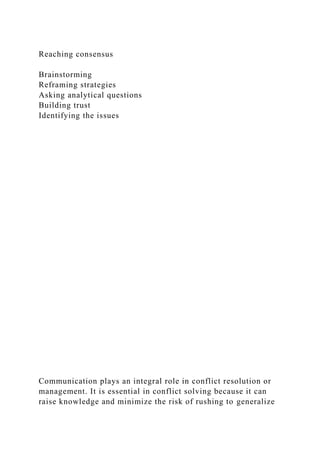
(Wallensteen, 2015). Resolution roadmap can be represented
using the diagram shown below.
Reaching consensus
Brainstorming
Reframing strategies
Asking analytical questions
Building trust
Identifying the issues
Communication plays an integral role in conflict resolution or
management. It is essential in conflict solving because it can
raise knowledge and minimize the risk of rushing to generalize
ideas or make conclusions (Khor, 2015). Several studies have
found that ineffective communication often leads to
misapprehensions and ultimately conflicts (Khor, 2015).
Communication in which probable conflict is completely absent
is regarded as unauthentic (Khor, 2015). As a result, it does not
satisfy the features of efficiency. People should convey their
ideas and opinions in a precise and clear manner to avert
potential conflicts. Indeed, thoughts ought to be cautiously
converted into meaningful and sensible words to ensure others
understand something better. From perspective of conflicts
avoidance, prevention, resolution and management,
interpersonal communication is very crucial. Although
interpersonal communication has potential of generating
conflict within itself, it can perform numerous roles in resolving
conflicts (Khor, 2015).
Communication employs three functions to address conflicts.
First function is helping people understand themselves, as well
as the other people they interact with. This is important because
people are able to understand what to expect from others and
have an idea of how they can influence them (Khor, 2015). In
addition, individuals are able to make their position known to
others so that other individuals can respond to it. Second
function involves establishing unswerving relationship with
others. This makes sure people give significance to their reality.
Last but not least function is about the element of
communication persuasion and influence. This element expands
the idea of collaboration, as well as shared effort (Khor, 2015).
The association between conflict and communication is an
interdependent one (Khor, 2015). Communication can accelerate
conflicts, engender conflicts, prevent conflicts, and assist in
conflict resolving and management actions. Therefore, it
presents a very significant factor when handling any conflict.
Since obstructing and perturbing communication is a paramount
source of conflict, it is important to identify factors that are
thought to hinder the process of communication (Khor, 2015).
Identifying the problem and building trust are very essential
steps of dealing with conflicts. It is a common understanding
that conflict cannot stand on its own (Wallensteen, 2015).
Several background issues or problems may be involved in a
given conflict. Problems are the underlying causes of conflicts
(Wallensteen, 2015) and thus having a clear understanding of
the nature of problems can help resolve conflicts. In fact, the
more information one gathers in regard to the cause of the
conflict, the higher the chances of effectively solving the
conflict. Problem identification helps the person involved in
conflict management to better understand the prevailing
situation and apply his/her impartiality (Wallensteen, 2015). A
problem in conflict may offer a feasible path through which the
conflict may be resolved. When key issues in conflict are
identified, it is possible to develop an intervention that would
solve the conflict once and for all. However, improper problem
analysis may only solve a part of the conflict implying that
there is high potential of the conflict re-emerging in near future.
Trust can be described as a psychological state involving the
willingness to accept liability on grounds of rewarding
expectations of behavior or intentions of another individual
(Dickie, 2015). The interdependence among people creates the
need for trust. Research has identified trust as an important
dimension of effective conflict resolution (Dickie, 2015). Trust
has been closely related to enhanced problem solving,
cooperation, as well as information sharing (Dickie, 2015).
People who trust one another are more open and can give
valuable information regarding the kind of conflict they are
going through. Nonetheless, trust reduces incidents of bias and
disrespect during the process of solving the conflict (Dickie,
2015).
References
Dickie, J. (2015). Trust and Conflict Resolution: Relationship
Building for Learning. Procedia-Social and Behavioral
Sciences, 197, 2066-2073.
Khor, A. C. (2015). Effective and Appropriate Communication
and Conflict Management in Global Organization (Doctoral
dissertation, Monash University).
Wallensteen, P. (2015). Understanding conflict resolution. Sage.

Rubic_Print_FormatCourse CodeClass CodeHLT-520HLT-520-O500Ethical .docx

  • 1.
    Rubic_Print_FormatCourse CodeClass CodeHLT-520HLT-520- O500EthicalDecision Making75.0CriteriaPercentageUnsatisfactory (0.00%)Less than Satisfactory (65.00%)Satisfactory (75.00%)Good (85.00%)Excellent (100.00%)CommentsPoints EarnedContent70.0%Dimensions of the Ethical Dilemma30.0%A description of the dimensions of the ethical dilemma is not included. A description of the dimensions of the ethical dilemma is incomplete or incorrect. A description of the dimensions of the ethical dilemma is included but lacks detail.A description of the dimensions of the ethical dilemma is complete and includes detail.A description of the dimensions of the ethical dilemma is extremely thorough with substantial supporting evidence.Potential Organizational Policies 20.0%A description of the potential organizational policies is not included.A description of the potential organizational policies is incomplete or incorrect.A description of the potential organizational policies is included but lacks detail.A description of the potential organizational policies is complete and includes detail.A description of the potential organizational policies is extremely thorough with substantial supporting evidence.Four Core Ethical Principles and Decision Making 20.0%Application of the four core health care ethical principles and the process of ethical decision making is not included.Application of the four core health care ethical principles and the process of ethical decision making is incomplete or incorrect.Application of the four core health care ethical principles and the process of ethical decision making is included but lacks detail.Application of the four core health care ethical principles and the process of ethical decision making is complete and includes detail.Application of the four core health care ethical principles and the process of ethical decision making is extremely thorough with substantial supporting evidence.Organization and Effectiveness20.0%Thesis Development and Purpose7.0%Paper
  • 2.
    lacks any discernibleoverall purpose or organizing claim.Thesis is insufficiently developed or vague. Purpose is not clear.Thesis is apparent and appropriate to purpose.Thesis is clear and forecasts the development of the paper. Thesis is descriptive and reflective of the arguments and appropriate to the purpose.Thesis is comprehensive and contains the essence of the paper. Thesis statement makes the purpose of the paper clear.Argument Logic and Construction8.0%Statement of purpose is not justified by the conclusion. The conclusion does not support the claim made. Argument is incoherent and uses noncredible sources.Sufficient justification of claims is lacking. Argument lacks consistent unity. There are obvious flaws in the logic. Some sources have questionable credibility.Argument is orderly, but may have a few inconsistencies. The argument presents minimal justification of claims. Argument logically, but not thoroughly, supports the purpose. Sources used are credible. Introduction and conclusion bracket the thesis. Argument shows logical progressions. Techniques of argumentation are evident. There is a smooth progression of claims from introduction to conclusion. Most sources are authoritative.Clear and convincing argument that presents a persuasive claim in a distinctive and compelling manner. All sources are authoritative.Mechanics of Writing (includes spelling, punctuation, grammar, language use)5.0%Surface errors are pervasive enough that they impede communication of meaning. Inappropriate word choice or sentence construction is used.Frequent and repetitive mechanical errors distract the reader. Inconsistencies in language choice (register) or word choice are present. Sentence structure is correct but not varied.Some mechanical errors or typos are present, but they are not overly distracting to the reader. Correct and varied sentence structure and audience-appropriate language are employed.Prose is largely free of mechanical errors, although a few may be present. The writer uses a variety of effective sentence structures and figures of speech.Writer is clearly in command of standard, written, academic English.Format10.0%Paper Format
  • 3.
    (use of appropriatestyle for the major and assignment)5.0%Template is not used appropriately or documentation format is rarely followed correctly.Appropriate template is used, but some elements are missing or mistaken. A lack of control with formatting is apparent.Appropriate template is used. Formatting is correct, although some minor errors may be present. Appropriate template is fully used. There are virtually no errors in formatting style.All format elements are correct. Documentation of Sources (citations, footnotes, references, bibliography, etc., as appropriate to assignment and style)5.0%Sources are not documented.Documentation of sources is inconsistent or incorrect, as appropriate to assignment and style, with numerous formatting errors.Sources are documented, as appropriate to assignment and style, although some formatting errors may be present.Sources are documented, as appropriate to assignment and style, and format is mostly correct. Sources are completely and correctly documented, as appropriate to assignment and style, and format is free of error.Total Weightage100% Running head: MANAGING TEAM AND GROUPS MANAGING TEAM AND GROUPS Managing team and groups Francisco Hernandez
  • 4.
    Abstract This paper dealswith the analysis of differentiating team with group. The paper discusses how team thinking and group thinking differentiates in perspective, efficiency and outcome of the task. The traits of effective leadership in terms of multi culturalism and operational leg is also discussed in this report. Introduction Team and Group seems to be synonyms but they possess a vast difference in the operational leg, work efficiency and outcome of the task. The team work and group work have a vast line between them in terms of carrying out the task. The main difference between a group and a team is the unity among them (Eikenberry, 2015). Group initially is a gathering of people following a defined set of rules in order to achieve the assigned task. But on the other hand team is a group of people not only following the rules but also creating a sense of unity among each other in order to carry out the highest efficiency for the task (David W. Parker, 2015). Difference between Team and Group In order to understand the difference between a group and a team we need to discuss the meaning of both the terms. A group initiates when a group of people try to achieve a single unified goal by only following a set of rules (Eikenberry, 2015). However in order to form a team it requires a higher commitment by the people creating a sense of unity, help and not only following the rules but also supporting others in order to not only fulfill the goal but also with the highest efficiency. · The accountability among team and group is what makes them different from each other. In a group the accountability lies on people with individuality but in a team there is a collective
  • 5.
    sense of accountabilitycausing a higher efficiency among the participants (Neck, 1994). · The team collectively works to achieve the organizational goals however, the group try to achieve the same goals but on an individual level decreasing the efficiency overall. · A group is led by an individual getting all of the decisions on one shoulder however, a team is led by collective leadership making everyone an important part. · In a groups there is an absence of interdependency over each other causing individuality in the work process however a team has interdependency causing the achievement of goal with efficiency and in a timely manner (David W. Parker, 2015). Difference between Team think and Group think · The team works in an environment containing more of an informal nature allowing participants to be more convenient in expressing their perspectives but in a group there is more of a formal environment making the participants hesitant of expressing their views (Neck, 1994). · Groupthink is something in which the participants tend to think in the same manner totally ignoring the individual presence and thoughts but on the other hand team think allows a collective thinking process and being open to everyone’s views and thinking. · Group think contains more of an observation timeline making the participants to observe and change themselves according to others but team think provides a sense of presence in the group and being valued of their effort. Process of evolving a group into team The conversion of a group into a team doesn’t have any pre- defined rules or steps. However, there exists some points that can be used in implementing the traits of team work in a group allowing a conversion (Baptist, 2015). The below mentioned points can be considered: · If the leader allows the participants of a group to be known of the values and importance by working with unity can cause a high efficiency.
  • 6.
    · To allowthe individuals know of their respective duties and the importance of their duties for others and vice versa. · By allowing an increment in the interdependency between the group can allow a sense of collective and unified working and realizing the importance of others. (Eikenberry, 2015). · By demoralizing the formalities among the group can also allow the participants to be more convenient working together causing a sense of collectivity. Effective leadership styles for diverse cultural groups Due to an increase in Globalization process there exists a high cultural diversity among the institutions demanding a huge tolerance of people in working collectively. There exists much probability that the group would contain persons with different cultural background and in order to achieve the highest efficiency the leader should be well equipped with the goal of creating unity among them (Eikenberry, 2015). However, the leader should possess the following leadership qualities to tackle the cultural diversity problem: · The most important point to be taken care of is participation. The leader should provide the opportunity to let everyone be part of the group for completing the task by speaking their minds and providing a platform allowing everyone to participate which will create a sense of importance of being in the group in the individually and collectively. · Leaders should also be of the view in providing the group with a supportive culture which will help them in ending the discrimination and motivating the participants on an individual level. · Training should be carried out for the people in order to acknowledge them of the importance of diverse culture in group efficiency (Kanki, 2019). Effective leadership styles This part deals with the general leadership styles that should be possessed by the leader in order to execute highest efficiency from the group or team. · The leader should not emit any sign favoritism within the
  • 7.
    group. This willinitiate a sense of isolation among the participants causing a huge inefficiency in the operations of the task. Instead the leader should be open to all and be supportive of each and every person in the group (Baptist, 2015). · The leader should be passing out feedbacks to the participants regularly mainly involving his attributes but also discussing how the things could be done better. · The leader should have an open door policy as it will create a sense of equality among the people and it will also be easier in communication with the leader. · Being a leader involves creating an example. The leader should be setting an example of carrying out the tasks at which the participants can look upon to. This will create an image of effective leadership among the minds of people (Baptist, 2015). Conclusion A team and a group differs a lot in term of efficiency, goal achieving and outcomes of the tasks. The team is more of a united platform for the people to work on collectively however group focuses more on individuality. A team provides more importance e to the work of a participant than the group. However, a group can be converted to team if the leader possess tolerance for culturally diverse group and provide equal importance to each individual of the group.
  • 8.
    Holocaust’s Hannah Senesh HannahSenesh originally known as Hannah Szenes was a Jewish lady born in July 1921 in Budapest by a Hungarian Jewish family that was well recognized and relatively wealthy. Her father was a play and newspaper column writer. Hanna developed interest in writing because of the environment she grew up in and began writing poems at the age of six. She actually began recording a diary when she was 13 thirteen years old. It was in her high school times when Hannah developed interest in studying more concerning her Jewish culture and customs. At this time Israel was still under the British administration as part of Palestine. While in Palestine, Hanna would write letters to her mother some of which she wrote in poet form expressing explicitly her daily life in Palestine. Around this time Hungarian anti-Semitic attitude began to occur and more strict laws were enacted. Jews in professions were thrown out of their jobs. Actually, Hanna’s brother left for France when he failed to join college due to the prevailing obstructions. Her family demonstrated some form of rebellion to the laws. Anti-Semitism spread throughout Europe and to be safe one had to go to the paces that were inhabited by Jewish only. As the war continued, Hanna’s family split and could no longer hear from each other. The security state in Hungary deteriorated and the Jews in Palestine were obliged to help and mitigate the horrors and killings that were happening in the Nazi-occupied Europe locations. Hanna’s attempt to get her mother out of Hungary but she did not succeed. When she failed, she decided to go back to Hungary and arrange a resistance movement in 1942. Hanna later joined Hagana which was a Jewish military to continue with the fight. The Brits government in retaliation, searched for volunteers to join the resistance movement. Hanna together with thirty other volunteers risked their lives to rescue the Jewish people. They embarked on parachuting training after which
  • 9.
    they would attackthe enemies. Hanna was kept in charge of radio communications. Hanna’s last picture was taken while she was preparing for her Yugoslavian mission in March 14 1944. At that time her brother had arrived in Palestine ad they met after quite a long period of time. Five days later, the German troops arrived in Hungary and just before Hanna had managed to organize a resistance movement. The German troops influenced the Arrow Crossers to rob and kill Jews. Jews were restricted form working and even leaving their houses. They were sent to ghettos. There were over 4,000 Jewish victims. Hannah decided to cross the border from Palestine to Hungary which was actually a dangerous but brave act. At that time, she left behind a poem “Blessed is the Match” to her fellow parachutists. Hannah was then caught and even after being tortured and brutally beaten, she refused to disclose the names of other parachutists. Hannah and her mother were both taken to jail. Her mother was released later. Hannah would entertain her inmates, teaching them Hebrew and telling them about Palestine. At this time, the arrow crossers took over Hungary but later the soviets came into the country in October 1944. There seemed to be hope for Hannah’s release which never happened. Hannah was still recording her diary. Hannah was accused of treason andin November 1944, she was executed by a firing squad and she died an Israel heroine. Her poems and artistic works were published in Hebrew. References Baptist, R. W. (2015). Measuring Predictors of Groupthink: Instrument developmenta nd validation. Illinois State University. David W. Parker. (2015). Exploring communication in project- based interventions. 146-179.
  • 10.
    Eikenberry, K. (2015,December 14). The Difference Between Groupthink and Teamthink. Kanki, B. (2019). "Communication and crew resource management." . In Crew resource management, , 103-137. Neck, C. P. (1994). From Groupthink to Teamthink: Toward the Creation of Constructive Thought Patterns in Self-Managing Work Teams. Arizona State Univerity. Holocaust. (2018). Hannah Szenes. Retrieved Feb 17, 2019, from Holocaust: https://www.holocaust.com.au/resources/supplementary- material/hannah-szenes/ LLC, S. M. (2018, August 24). A Holocaust Story: Hannah Szenes. Retrieved Feb 17, 2019, from MissedinHistory: https://www.missedinhistory.com/podcasts/a-holocaust-story- hannah-szenes-transcript.htm Running Head: CONFLICT RESOLUTION PROCESS 1
  • 11.
    Conflict Resolution Process Student’sName Institutional Affiliation Course Instructor’s Name Conflict Resolution Process Diverse views, opinions, as well as ideas among individuals often result in conflict (Wallensteen, 2015). In order to improve relations and evade conflicts, an individual is required to put up with one another to a certain level. As a matter of fact, fights and conflicts ought to be curbed so as to thwart associated adverse consequences such as unnecessary tensions, stress and anxiety (Wallensteen, 2015). The six-step resolution roadmap is important for formulation of effective conflict resolution strategies and interventions. The six-step resolution roadmap presents a set of practices for creating an individual’s conflict resolution synergies regardless of the prevailing circumstances (Wallensteen, 2015). These practices equip a person with essential skills and experiences necessary for resolving disputes (Wallensteen, 2015). Resolution roadmap can be represented using the diagram shown below.
  • 12.
    Reaching consensus Brainstorming Reframing strategies Askinganalytical questions Building trust Identifying the issues Communication plays an integral role in conflict resolution or management. It is essential in conflict solving because it can raise knowledge and minimize the risk of rushing to generalize
  • 13.
    ideas or makeconclusions (Khor, 2015). Several studies have found that ineffective communication often leads to misapprehensions and ultimately conflicts (Khor, 2015). Communication in which probable conflict is completely absent is regarded as unauthentic (Khor, 2015). As a result, it does not satisfy the features of efficiency. People should convey their ideas and opinions in a precise and clear manner to avert potential conflicts. Indeed, thoughts ought to be cautiously converted into meaningful and sensible words to ensure others understand something better. From perspective of conflicts avoidance, prevention, resolution and management, interpersonal communication is very crucial. Although interpersonal communication has potential of generating conflict within itself, it can perform numerous roles in resolving conflicts (Khor, 2015). Communication employs three functions to address conflicts. First function is helping people understand themselves, as well as the other people they interact with. This is important because people are able to understand what to expect from others and have an idea of how they can influence them (Khor, 2015). In addition, individuals are able to make their position known to others so that other individuals can respond to it. Second function involves establishing unswerving relationship with others. This makes sure people give significance to their reality. Last but not least function is about the element of communication persuasion and influence. This element expands the idea of collaboration, as well as shared effort (Khor, 2015). The association between conflict and communication is an interdependent one (Khor, 2015). Communication can accelerate conflicts, engender conflicts, prevent conflicts, and assist in conflict resolving and management actions. Therefore, it presents a very significant factor when handling any conflict. Since obstructing and perturbing communication is a paramount source of conflict, it is important to identify factors that are thought to hinder the process of communication (Khor, 2015). Identifying the problem and building trust are very essential
  • 14.
    steps of dealingwith conflicts. It is a common understanding that conflict cannot stand on its own (Wallensteen, 2015). Several background issues or problems may be involved in a given conflict. Problems are the underlying causes of conflicts (Wallensteen, 2015) and thus having a clear understanding of the nature of problems can help resolve conflicts. In fact, the more information one gathers in regard to the cause of the conflict, the higher the chances of effectively solving the conflict. Problem identification helps the person involved in conflict management to better understand the prevailing situation and apply his/her impartiality (Wallensteen, 2015). A problem in conflict may offer a feasible path through which the conflict may be resolved. When key issues in conflict are identified, it is possible to develop an intervention that would solve the conflict once and for all. However, improper problem analysis may only solve a part of the conflict implying that there is high potential of the conflict re-emerging in near future. Trust can be described as a psychological state involving the willingness to accept liability on grounds of rewarding expectations of behavior or intentions of another individual (Dickie, 2015). The interdependence among people creates the need for trust. Research has identified trust as an important dimension of effective conflict resolution (Dickie, 2015). Trust has been closely related to enhanced problem solving, cooperation, as well as information sharing (Dickie, 2015). People who trust one another are more open and can give valuable information regarding the kind of conflict they are going through. Nonetheless, trust reduces incidents of bias and disrespect during the process of solving the conflict (Dickie, 2015). References Dickie, J. (2015). Trust and Conflict Resolution: Relationship Building for Learning. Procedia-Social and Behavioral Sciences, 197, 2066-2073. Khor, A. C. (2015). Effective and Appropriate Communication
  • 15.
    and Conflict Managementin Global Organization (Doctoral dissertation, Monash University). Wallensteen, P. (2015). Understanding conflict resolution. Sage.