Bearing calculation
Extract from the Railway technical handbook,
volume 1, chapter 5, page 106 to 121
Bearing5	
calculation
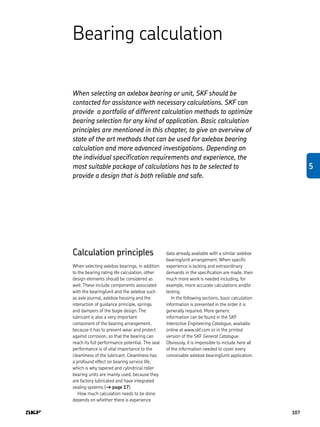
Calculation principles. .  .  .  .  .  .  .  . 	 107
Basic rating life. .  .  .  .  .  .  .  .  .  .  .  .  . 	 108
SKF rating life. .  .  .  .  .  .  .  .  .  .  .  .  .  . 	 112
Advanced calculations . .  .  .  .  .  .  . 	 116
106
Bearing calculation
When selecting an axlebox bearing or unit, SKF should be
contacted for assistance with necessary calculations. SKF can
provide a portfolio of different calculation methods to optimize
bearing selection for any kind of application. Basic calculation
principles are mentioned in this chapter, to give an overview of
state of the art methods that can be used for axlebox bearing
calculation and more advanced investigations. Depending on
the individual specification requirements and experience, the
most suitable package of calculations has to be selected to
provide a design that is both reliable and safe.
Calculation principles
When selecting axlebox bearings, in addition
to the bearing rating life calculation, other
design elements should be considered as
well. These include components associated
with the bearing/unit and the axlebox such
as axle journal, axlebox housing and the
interaction of guidance principle, springs
and dampers of the bogie design. The
lubricant is also a very important
component of the bearing arrangement,
because it has to prevent wear and protect
against corrosion, so that the bearing can
reach its full performance potential. The seal
performance is of vital importance to the
cleanliness of the lubricant. Cleanliness has
a profound effect on bearing service life,
which is why tapered and cylindrical roller
bearing units are mainly used, because they
are factory lubricated and have integrated
sealing systems († page 17).
How much calculation needs to be done
depends on whether there is experience
data already available with a similar axlebox
bearing/unit arrangement. When specific
experience is lacking and extraordinary
demands in the specification are made, then
much more work is needed including, for
example, more accurate calculations and/or
testing.
In the following sections, basic calculation
information is presented in the order it is
generally required. More generic
information can be found in the SKF
Interactive Engineering Catalogue, available
online at www.skf.com or in the printed
version of the SKF General Catalogue.
Obviously, it is impossible to include here all
of the information needed to cover every
conceivable axlebox bearing/unit application.
107
5
Customers are mainly demanding
calculation of the bearing's basic rating life
according to ISO 281. This standard covers
the calculation of the dynamic basic load
rating and basic rating life. The calculation
model for the bearing load conditions is not
covered in this standard.
Specifications
For basic calculations, main input data and
other information, like description of the
operational parameters and drawings, are
needed. Based on this information, it has to
be decided if, in addition to the basic rating
life calculation, further and more advanced
calculations are needed.
Basic rating life
For simplified calculations and to obtain an
approximate value of the bearing life, the
so-called “handbook method” is used to
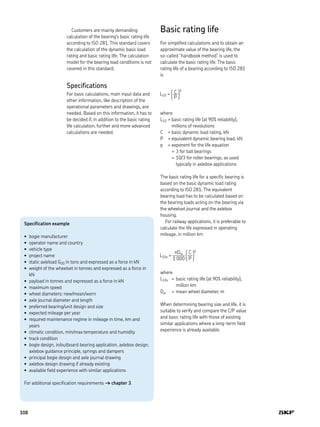
calculate the basic rating life. The basic
rating life of a bearing according to ISO 281
is
where
L10	=	basic rating life (at 90% reliability),
			 millions of revolutions
C	 =	basic dynamic load rating, kN
P	 =	equivalent dynamic bearing load, kN
p	 =	exponent for the life equation
			 =	3 for ball bearings
			 =	10/3 for roller bearings, as used
				 typically in axlebox applications
The basic rating life for a specific bearing is
based on the basic dynamic load rating
according to ISO 281. The equivalent
bearing load has to be calculated based on
the bearing loads acting on the bearing via
the wheelset journal and the axlebox
housing.
For railway applications, it is preferable to
calculate the life expressed in operating
mileage, in million km
where
L10s	 =	basic rating life (at 90% reliability),
				 million km
Dw		 =	mean wheel diameter, m
When determining bearing size and life, it is
suitable to verify and compare the C/P value
and basic rating life with those of existing
similar applications where a long-term field
experience is already available.
Specification example
bogie manufacturer•	
operator name and country•	
vehicle type•	
project name•	
static axleload G•	 00 in tons and expressed as a force in kN
weight of the wheelset in tonnes and expressed as a force in•	
kN
payload in tonnes and expressed as a force in kN•	
maximum speed•	
wheel diameters: new/mean/worn•	
axle journal diameter and length•	
preferred bearing/unit design and size•	
expected mileage per year•	
required maintenance regime in mileage in time, km and•	
years
climatic condition, min/max temperature and humidity•	
track condition•	
bogie design, in/outboard bearing application, axlebox design,•	
axlebox guidance principle, springs and dampers
principal bogie design and axle journal drawing•	
axlebox design drawing if already existing•	
available field experience with similar applications•	
For additional specification requirements † chapter 3.
108
Typical basic life and C/P values and mean wheel diameters
Basic rating life, C/P Mean wheel
Vehicle type million km value diameter DW [m]
Freight cars1) 0,8 6,84) 0,9
Mass transit vehicles
like suburban trains,
underground and
metro vehicles, light rail
and tramway vehicles
1,5 7,1÷7,7 0,7
Passenger coaches2) 33) 7,2÷8,8 0,9
Multiple units 3÷4 7,8÷9,1 1,0
Locomotives 3÷5 6,6÷8,6 1,2
1)	According to UIC International Union of Railways / Union Internationale
des Chemins de fer codex, under continuously acting maximum axleload
2) 	According to UIC codex
3) 	Some operators require up to 5 million km
4) 	Tapered roller bearing units for AAR Association of American Railroads
applications can have, in some specific cases, a lower C/P value down to 5
Dynamic bearing loads
The loads acting on a bearing can be
calculated according to the laws of
mechanics if the external forces, e.g.
axleload, weight of the wheelset and payload
are known or can be calculated. When
calculating the load components for a single
bearing, the axle journal is considered as a
beam resting on rigid, moment–free bearing
supports. Elastic deformation in the bearing,
axlebox housing or bogie frame components
are not considered in the basic rating life
calculation. As well, resulting moments on
the bearing due to elastic deflection of shaft,
axlebox or suspension are not taken into
account. The reason is that it is not only the
shaft that creates moments.
These simplifications help to calculate the
basic rating life, using readily available
means such as a pocket calculator. The
standardized methods for calculating basic
load ratings and equivalent bearing loads
are based on similar assumptions.
G =
G00 – Gr
2
Acting bearing loads principles
Ka = axial load
G00 = static axleload
Gr = wheelset mass
Static bearing load
5
109
Radial bearing load
The maximum static axlebox load per
bearing arrangement/unit is obtained from:
where
G	 = maximum static axlebox load [kN]
G00	= maximum static axleload [kN]
Gr	 = weight of the wheelset [kN]
Based on the static axlebox load, the mean
radial load is calculated by considering any
variations in the payload as well as any
additional dynamic radial forces
Kr = f0 frd ftr G
where
Kr	 = mean radial load [kN]
f0	 = payload factor
frd	 = dynamic radial factor
ftr	 = dynamic traction factor
For standard applications, usually the mean
values are used, e.g. frd = 1,2 for passenger
coaches in standard applications.
For specific applications like high-speed
and very high-speed applications or specific
dynamic effects like irregularities of the rails,
hunting of bogies etc., the dynamic load
factor frd has to be agreed by the customer.
These additional dynamic loads are in many
cases the result of field test recordings and
statistical analysis. In principle, the
dispersion of the dynamic load increases
with the speed.
Payload factor f0 Vehicle type
0,8 to 0,9 Freight cars
0,9 to 1 Multiple units, passenger coaches and
mass transit vehicles
1 Locomotives and other vehicles having a
constant payload
The pay load factor f0 is used for variation in the static loading of the
vehicle, e.g. goods for freight and passengers incl. baggage for coaches.
A locomotive has no significant variation in the static load; that’s why
a full static axlebox load needs to be applied.
Dynamic radial factor frd Vehicle type
1,2 Freight cars, adapter application
1,1 to 1,3 Multiple units, passenger coaches and
mass transit vehicles
1,2 to 1,4 Locomotives and other vehicles having a
constant payload
The dynamic radial factor frd is used to take into account quasi-static
effects like rolling and pitch as well as dynamic effects from the wheel
rail contact.
Dynamic traction factor ftr Vehicle type
1,05 Powered vehicles with an elastic drive
system, e.g. hollow shaft drive with elastic
coupling
1,1 Powered vehicles with a non-elastic drive
system, e.g. axle hung traction motors
1 Non-powered vehicles
The dynamic traction factor is used to take into account additional radial
loads caused by the drive system.
Dynamic axial factor fad Vehicle type
0,1 Freight cars
0,08 Multiple units, passenger coaches and
mass transit vehicles, max speed
160 km/h
0,1 Multiple units, passenger coaches and
mass transit vehicles > 160 km/h
0,12 Locomotives, tilting trains or other
concepts leading to higher lateral
acceleration
110
Symmetrical axleboxes
In most cases, the radial load is acting
symmetrically either on top of the axlebox or
on both sides.
In case of such symmetrical axlebox
designs:
Fr = Kr
where
Fr = radial bearing load [kN]
Non-symmetrical axleboxes
Non-symmetrical axleboxes, like link arm
designs, have to be specially calculated as
mentioned in the calculation example 2
(† page 114).
Axial bearing load
The mean axial load is calculated by
considering the dynamic axial forces on the
axlebox.
Ka = f0 fad G
where
fad	= dynamic axial factor
Fa 	= Ka
Equivalent bearing load P
The equivalent bearing load to be used for
the L10 basic rating life calculation either as
described before or based on specific
customer load configurations is as follows:
P =	Fr + Y Fa for tapered roller bearings
		 and spherical roller bearings
P =	Fr for cylindrical roller bearings
where
P	=	equivalent dynamic bearing load [kN]
Y	=	axial load bearing factor
l
Link arm axlebox calculation model
lh 5
111
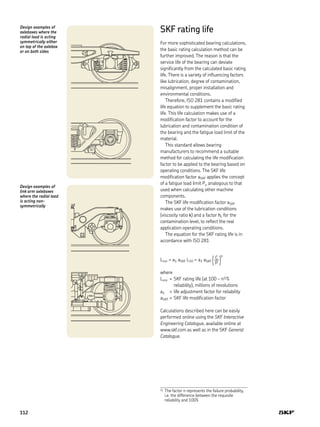
Design examples of
axleboxes where the
radial load is acting
symmetrically either
on top of the axlebox
or on both sides
SKF rating life
For more sophisticated bearing calculations,
the basic rating calculation method can be
further improved. The reason is that the
service life of the bearing can deviate
significantly from the calculated basic rating
life. There is a variety of influencing factors
like lubrication, degree of contamination,
misalignment, proper installation and
environmental conditions.
Therefore, ISO 281 contains a modified
life equation to supplement the basic rating
life. This life calculation makes use of a
modification factor to account for the
lubrication and contamination condition of
the bearing and the fatigue load limit of the
material.
This standard allows bearing
manufacturers to recommend a suitable
method for calculating the life modification
factor to be applied to the bearing based on
operating conditions. The SKF life
modification factor aSKF applies the concept
of a fatigue load limit Pu analogous to that
used when calculating other machine
components.
The SKF life modification factor aSKF
makes use of the lubrication conditions
(viscosity ratio k) and a factor hc for the
contamination level, to reflect the real
application operating conditions.
The equation for the SKF rating life is in
accordance with ISO 281
Lnm = a1 aSKF L10 = a1 aSKF
where
Lnm	=	SKF rating life (at 100 – n1)%
		 reliability), millions of revolutions
a1	 =	life adjustment factor for reliability
aSKF	=	SKF life modification factor
Calculations described here can be easily
performed online using the SKF Interactive
Engineering Catalogue, available online at
www.skf.com as well as in the SKF General
Catalogue.
Design examples of
link arm axleboxes
where the radial load
is acting non-
symmetrically
1)	The factor n represents the failure probability,
i.e. the difference between the requisite
reliability and 100%
112
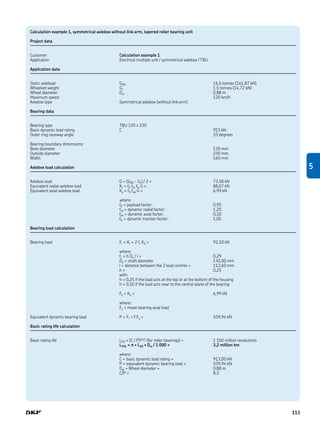
Calculation example 1, symmetrical axlebox without link arm, tapered roller bearing unit
Project data
Customer Calculation example 1
Application Electrical multiple unit / symmetrical axlebox / TBU
Application data
Static axleload G00 16,5 tonnes (161,87 kN)
Wheelset weight Gr 1,5 tonnes (14,72 kN)
Wheel diameter Dw 0,88 m
Maximum speed 120 km/h
Axlebox type Symmetrical axlebox (without link arm)
Bearing data
Bearing type TBU 130 x 230
Basic dynamic load rating C 913 kN
Outer ring raceway angle 10 degrees
Bearing boundary dimensions:
Bore diameter 130 mm
Outside diameter 230 mm
Width 160 mm
Axlebox load calculation
Axlebox load G = (G00 - Gr) / 2 = 73,58 kN
Equivalent radial axlebox load Kr = f0 frd ftr G = 88,07 kN
Equivalent axial axlebox load Ka = f0 fad G = 6,99 kN
where:
f0 = payload factor: 0,95
frd = dynamic radial factor: 1,20
fad = dynamic axial factor: 0,10
ftr = dynamic traction factor: 1,05
Bearing load calculation
Bearing load Fr = Kr + 2 fc Ka = 92,10 kN
where:
fc = h Da / l = 0,29
Da = shaft diameter 130,00 mm
l = distance between the 2 load centres = 112,60 mm
h = 0,25
with:
h = 0,25 if the load acts at the top or at the bottom of the housing
h = 0,10 if the load acts near to the central plane of the bearing
Fa = Ka = 6,99 kN
where:
Fa = mean bearing axial load
Equivalent dynamic bearing load P = Fr + Y Fa = 109,94 kN
Basic rating life calculation
Basic rating life L10 = (C / P)10/3 (for roller bearings) = 1 160 million revolutions
L10s = π × L10 × Dw / 1 000 = 3,2 million km
where:
C = basic dynamic load rating = 913,00 kN
P = equivalent dynamic bearing load = 109,94 kN
Dw = Wheel diameter = 0,88 m
C/P = 8,3
5
113
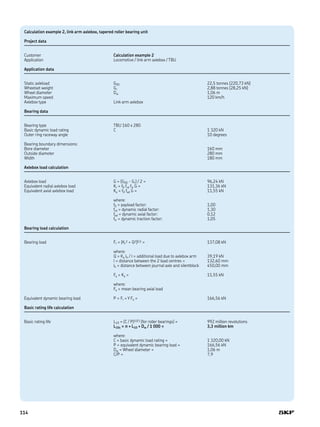
Calculation example 2, link arm axlebox, tapered roller bearing unit
Project data
Customer Calculation example 2
Application Locomotive / link arm axlebox / TBU
Application data
Static axleload G00 22,5 tonnes (220,73 kN)
Wheelset weight Gr 2,88 tonnes (28,25 kN)
Wheel diameter Dw 1,06 m
Maximum speed 120 km/h
Axlebox type Link arm axlebox
Bearing data
Bearing type TBU 160 x 280
Basic dynamic load rating C 1 320 kN
Outer ring raceway angle 10 degrees
Bearing boundary dimensions:
Bore diameter 160 mm
Outside diameter 280 mm
Width 180 mm
Axlebox load calculation
Axlebox load G = (G00 - Gr) / 2 = 96,24 kN
Equivalent radial axlebox load Kr = f0 frd ftr G = 131,36 kN
Equivalent axial axlebox load Ka = f0 fad G = 11,55 kN
where:
f0 = payload factor: 1,00
frd = dynamic radial factor: 1,30
fad = dynamic axial factor: 0,12
ftr = dynamic traction factor: 1,05
Bearing load calculation
Bearing load Fr = (Kr
2 + Q2)0,5 = 137,08 kN
where:
Q = Ka lh / l = additional load due to axlebox arm 39,19 kN
l = distance between the 2 load centres = 132,60 mm
lh = distance between journal axle and silentblock 450,00 mm
Fa = Ka = 11,55 kN
where:
Fa = mean bearing axial load
Equivalent dynamic bearing load P = Fr + Y Fa = 166,56 kN
Basic rating life calculation
Basic rating life L10 = (C / P)10/3 (for roller bearings) = 992 million revolutions
L10s = π × L10 × Dw / 1 000 = 3,3 million km
where:
C = basic dynamic load rating = 1 320,00 kN
P = equivalent dynamic bearing load = 166,56 kN
Dw = Wheel diameter = 1,06 m
C/P = 7,9
114
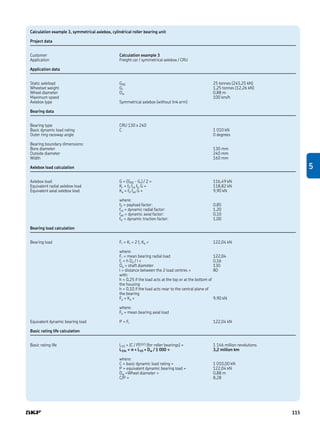
Calculation example 3, symmetrical axlebox, cylindrical roller bearing unit
Project data
Customer Calculation example 3
Application Freight car / symmetrical axlebox / CRU
Application data
Static axleload G00 25 tonnes (245,25 kN)
Wheelset weight Gr 1,25 tonnes (12,26 kN)
Wheel diameter Dw 0,88 m
Maximum speed 100 km/h
Axlebox type Symmetrical axlebox (without link arm)
Bearing data
Bearing type CRU 130 x 240
Basic dynamic load rating C 1 010 kN
Outer ring raceway angle 0 degrees
Bearing boundary dimensions:
Bore diameter 130 mm
Outside diameter 240 mm
Width 160 mm
Axlebox load calculation
Axlebox load G = (G00 - Gr) / 2 = 116,49 kN
Equivalent radial axlebox load Kr = f0 frd ftr G = 118,82 kN
Equivalent axial axlebox load Ka = f0 fad G = 9,90 kN
where:
f0 = payload factor: 0,85
frd = dynamic radial factor: 1,20
fad = dynamic axial factor: 0,10
ftr = dynamic traction factor: 1,00
Bearing load calculation
Bearing load Fr = Kr + 2 fc Ka = 122,04 kN
where:
Fr = mean bearing radial load 122,04
fc = h Da / l = 0,16
Da = shaft diameter 130
l = distance between the 2 load centres = 80
with:
h = 0,25 if the load acts at the top or at the bottom of
the housing
h = 0,10 if the load acts near to the central plane of
the bearing
Fa = Ka = 9,90 kN
where:
Fa = mean bearing axial load
Equivalent dynamic bearing load P = Fr 122,04 kN
Basic rating life calculation
Basic rating life L10 = (C / P)10/3 (for roller bearings) = 1 146 million revolutions
L10s = π × L10 × Dw / 1 000 = 3,2 million km
where:
C = basic dynamic load rating = 1 010,00 kN
P = equivalent dynamic bearing load = 122,04 kN
Dw =Wheel diameter = 0,88 m
C/P = 8,28
5
115
Advanced calculations
SKF has one of the most comprehensive and
powerful sets of modelling and simulation
packages in the bearing industry. They
range from easy-to-use tools, based on SKF
General Catalogue formulae, to the most
sophisticated calculation and simulation
systems running on parallel computers. One
of the most used tools in SKF for advanced
life calculations is the SKF bearing beacon.
SKF bearing beacon
The SKF bearing beacon is the mainstream
bearing application programme used by SKF
engineers to optimize the design of
customers' bearing arrangements. Its
technology enables modelling in a 3D
graphic environment of flexible systems
incorporating customer components. SKF
bearing beacon combines the ability to
model generic mechanical systems (using
also shafts, gears, housings etc.) with a
precise bearing model for an in-depth
analysis of the system behaviour in a virtual
environment. It also performs rolling
bearing raceway fatigue life evaluations
using the SKF rating life in particular. SKF
bearing beacon is the result of several years
of specific research and development within
SKF.
For SKF axlebox bearing/unit calculations,
the SKF bearing beacon is mainly used for
investigating the load distribution on rollers
and inner/outer ring raceways for specific
applications with load offset, axle journal
bending, extreme temperature conditions
etc.
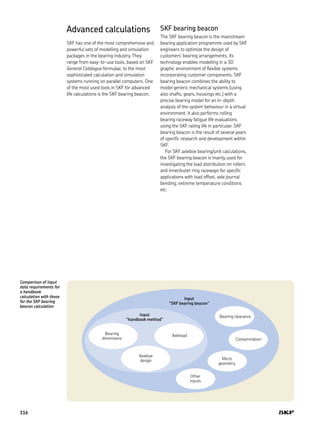
Comparison of input
data requirements for
a handbook
calculation with those
for the SKF bearing
beacon calculation
Input
“SKF bearing beacon”
Input
“handbook method”
Other
inputs
Micro
geometry
Contamination
Bearing clearance
Axleload
Axlebox
design
Bearing
dimensions
116
20 000 [N]
15 000
10 000
5 000
0
90°
270° [deg]
180° 0°
90°
270°
180° 0°
14 000
10 000
6 000
2 000
0
Input data example,
geometry of outer
ring, roller, flange and
raceway
SKF bearing beacon
calculated roller
contact loads
The red and blue
colours relate to the
two different roller
bearing sets. The
calculation is typically
done for various load
conditions. As an
example, two of them
feature here
X
B
A
r2 r4
b
h3e
he
Dik
Dmin
Mw
Pw
R
A
0
5
117
edi
yi
Fr
edi yi
Fr
di
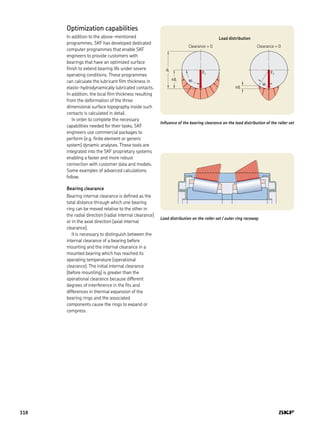
Influence of the bearing clearance on the load distribution of the roller set
Optimization capabilities
In addition to the above-mentioned
programmes, SKF has developed dedicated
computer programmes that enable SKF
engineers to provide customers with
bearings that have an optimized surface
finish to extend bearing life under severe
operating conditions. These programmes
can calculate the lubricant film thickness in
elasto-hydrodynamically lubricated contacts.
In addition, the local film thickness resulting
from the deformation of the three
dimensional surface topography inside such
contacts is calculated in detail.
In order to complete the necessary
capabilities needed for their tasks, SKF
engineers use commercial packages to
perform (e.g. finite element or generic
system) dynamic analyses. These tools are
integrated into the SKF proprietary systems
enabling a faster and more robust
connection with customer data and models.
Some examples of advanced calculations
follow.
Bearing clearance
Bearing internal clearance is defined as the
total distance through which one bearing
ring can be moved relative to the other in
the radial direction (radial internal clearance)
or in the axial direction (axial internal
clearance).
It is necessary to distinguish between the
internal clearance of a bearing before
mounting and the internal clearance in a
mounted bearing which has reached its
operating temperature (operational
clearance). The initial internal clearance
(before mounting) is greater than the
operational clearance because different
degrees of interference in the fits and
differences in thermal expansion of the
bearing rings and the associated
components cause the rings to expand or
compress.
Load distribution on the roller set / outer ring raceway
Clearance > 0Clearance = 0
Load distribution
118
Local stress calculation
Some applications need to operate outside
normal conditions. In these cases, SKF can
offer advanced analysis using commercial
FEM packages and, more importantly,
proprietary software tools developed in-
house. This, in combination with more than
100 years of experience, can provide
valuable knowledge about the expected
performance of an application. One example
is an application of an advanced engineering
calculation to investigate the local stresses
in an inner ring to evaluate the risk of
fatigue.
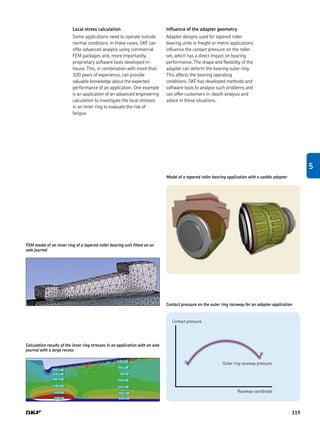
FEM model of an inner ring of a tapered roller bearing unit fitted on an
axle journal
Calculation results of the inner ring stresses in an application with an axle
journal with a large recess
Influence of the adapter geometry
Adapter designs used for tapered roller
bearing units in freight or metro applications
influence the contact pressure on the roller
set, which has a direct impact on bearing
performance. The shape and flexibility of the
adapter can deform the bearing outer ring.
This affects the bearing operating
conditions. SKF has developed methods and
software tools to analyse such problems and
can offer customers in-depth analysis and
advice in these situations.
Model of a tapered roller bearing application with a saddle adapter
Contact pressure on the outer ring raceway for an adapter application
Contact pressure
Raceway coordinate
Outer ring raceway pressure
5
119
Cage modelling and calculation
In operation, the rolling elements pass from
the loaded into the unloaded zone where
the cage has to guide them. SKF developed
this simulation method for bearings in
railway applications to analyse the elastic
behaviour of the cage under all types of
vibrations and shocks, such as the influence
of wheel flats and rail joints. The cage is
modelled as an elastic structure where the
cage mass is uniformly distributed over each
mass centre of the cage bars (prongs) that
are connected by springs with radial,
tangential and bending stiffness. The motion
of each mass of rolling elements is described
by a group of differential equations that are
numerically solved in the simulation
programme. The results of these equations
have been verified experimentally, based on
operating conditions covering most practical
situations.
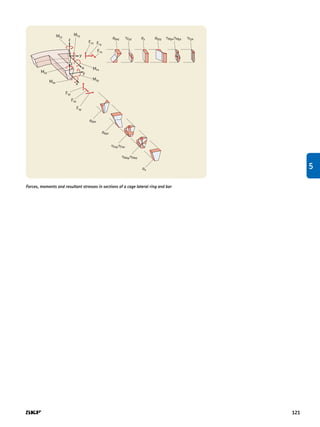
The inertia and support forces acting on
the cage produce internal stresses. In the
model of a cage cross section, the internal
forces, F, and the moments, M, acting on the
cross sections of the bars, s, and the lateral
ring, r, are displayed. The nominal value of
the normal stress is calculated as a function
of the longitudinal forces and bending
moments, while the nominal value of shear
stress is derived from the transverse forces
and the torsional moments. The stress
components can be combined into an
equivalent stress according to the form
change energy hypothesis [25].
0
a
s
as
a
bel
beA
bek
bk
Cr
Ct
Cd
bA
b1
b
e1
0L
Sk
FL
A
Sw
W
k
l
eA
ek rk
r
Dynamic model for simulation of the cage
forces
Calculation results of a FEM design optimization
of a cage lateral ring and bar of a tapered roller
bearing unit polymer cage
120
Mrz
z
z
y
y
x
x
Msz
Msx
Fsz
Fsx
Fsy
Mry
Mrx
Msy
Frz
Frx
Fry
sbxy
sbzx
tFyz sy sbzy tMyx;tMyz
tMxy;tMxz
tFxy;tFxz
tFyx
sbyx
sx
Forces, moments and resultant stresses in sections of a cage lateral ring and bar
5
121
®	SKF, AMPEP, @PTITUDE, AXLETRONIC, EASYRAIL, INSOCOAT, MRC, MULTILOG are registered trademarks of the SKF Group.
All other trademarks are the property of their respective owner.
©	SKF Group 2012
The contents of this publication are the copyright of the publisher and may not be reproduced (even extracts) unless prior written
permission is granted. Every care has been taken to ensure the accuracy of the information contained in this publication but no liability can
be accepted for any loss or damage whether direct, indirect or consequential arising out of the use of the information contained herein.
PUB 42/P2 12789 EN · 2012
Certain image(s) used under license from Shutterstock.com
Bearings
and units
Seals
Lubrication
systems
Mechatronics Services
The Power of Knowledge Engineering
Drawing on five areas of competence and application-specific expertise amassed over more than 100
years, SKF brings innovative solutions to OEMs and production facilities in every major industry world-
wide. These five competence areas include bearings and units, seals, lubrication systems, mechatronics
(combining mechanics and electronics into intelligent systems), and a wide range of services, from 3-D
computer modelling to advanced condition monitoring and reliability and asset management systems.
A global presence provides SKF customers uniform quality standards and worldwide product availability.
References
Liang, B.:[25]	 Berechnungsgleichungen für Reibmomente in Planetenwälzlagern. Ruhr-
Universität Bochum. Fakultät für Maschinenbau, Institut für Konstruktionstechnik.
Schriftenreihe Heft 92.3.
www.railways.skf.com

Rtb 1-05-bearing-calculation

  • 1.
    Bearing calculation Extract fromthe Railway technical handbook, volume 1, chapter 5, page 106 to 121
  • 2.
    Bearing5 calculation Calculation principles. . . . . . . . . 107 Basic rating life. . . . . . . . . . . . . . 108 SKF rating life. . . . . . . . . . . . . . . 112 Advanced calculations . . . . . . . . 116 106
  • 3.
    Bearing calculation When selectingan axlebox bearing or unit, SKF should be contacted for assistance with necessary calculations. SKF can provide a portfolio of different calculation methods to optimize bearing selection for any kind of application. Basic calculation principles are mentioned in this chapter, to give an overview of state of the art methods that can be used for axlebox bearing calculation and more advanced investigations. Depending on the individual specification requirements and experience, the most suitable package of calculations has to be selected to provide a design that is both reliable and safe. Calculation principles When selecting axlebox bearings, in addition to the bearing rating life calculation, other design elements should be considered as well. These include components associated with the bearing/unit and the axlebox such as axle journal, axlebox housing and the interaction of guidance principle, springs and dampers of the bogie design. The lubricant is also a very important component of the bearing arrangement, because it has to prevent wear and protect against corrosion, so that the bearing can reach its full performance potential. The seal performance is of vital importance to the cleanliness of the lubricant. Cleanliness has a profound effect on bearing service life, which is why tapered and cylindrical roller bearing units are mainly used, because they are factory lubricated and have integrated sealing systems († page 17). How much calculation needs to be done depends on whether there is experience data already available with a similar axlebox bearing/unit arrangement. When specific experience is lacking and extraordinary demands in the specification are made, then much more work is needed including, for example, more accurate calculations and/or testing. In the following sections, basic calculation information is presented in the order it is generally required. More generic information can be found in the SKF Interactive Engineering Catalogue, available online at www.skf.com or in the printed version of the SKF General Catalogue. Obviously, it is impossible to include here all of the information needed to cover every conceivable axlebox bearing/unit application. 107 5
  • 4.
    Customers are mainlydemanding calculation of the bearing's basic rating life according to ISO 281. This standard covers the calculation of the dynamic basic load rating and basic rating life. The calculation model for the bearing load conditions is not covered in this standard. Specifications For basic calculations, main input data and other information, like description of the operational parameters and drawings, are needed. Based on this information, it has to be decided if, in addition to the basic rating life calculation, further and more advanced calculations are needed. Basic rating life For simplified calculations and to obtain an approximate value of the bearing life, the so-called “handbook method” is used to calculate the basic rating life. The basic rating life of a bearing according to ISO 281 is where L10 = basic rating life (at 90% reliability), millions of revolutions C = basic dynamic load rating, kN P = equivalent dynamic bearing load, kN p = exponent for the life equation = 3 for ball bearings = 10/3 for roller bearings, as used typically in axlebox applications The basic rating life for a specific bearing is based on the basic dynamic load rating according to ISO 281. The equivalent bearing load has to be calculated based on the bearing loads acting on the bearing via the wheelset journal and the axlebox housing. For railway applications, it is preferable to calculate the life expressed in operating mileage, in million km where L10s = basic rating life (at 90% reliability), million km Dw = mean wheel diameter, m When determining bearing size and life, it is suitable to verify and compare the C/P value and basic rating life with those of existing similar applications where a long-term field experience is already available. Specification example bogie manufacturer• operator name and country• vehicle type• project name• static axleload G• 00 in tons and expressed as a force in kN weight of the wheelset in tonnes and expressed as a force in• kN payload in tonnes and expressed as a force in kN• maximum speed• wheel diameters: new/mean/worn• axle journal diameter and length• preferred bearing/unit design and size• expected mileage per year• required maintenance regime in mileage in time, km and• years climatic condition, min/max temperature and humidity• track condition• bogie design, in/outboard bearing application, axlebox design,• axlebox guidance principle, springs and dampers principal bogie design and axle journal drawing• axlebox design drawing if already existing• available field experience with similar applications• For additional specification requirements † chapter 3. 108
  • 5.
    Typical basic lifeand C/P values and mean wheel diameters Basic rating life, C/P Mean wheel Vehicle type million km value diameter DW [m] Freight cars1) 0,8 6,84) 0,9 Mass transit vehicles like suburban trains, underground and metro vehicles, light rail and tramway vehicles 1,5 7,1÷7,7 0,7 Passenger coaches2) 33) 7,2÷8,8 0,9 Multiple units 3÷4 7,8÷9,1 1,0 Locomotives 3÷5 6,6÷8,6 1,2 1) According to UIC International Union of Railways / Union Internationale des Chemins de fer codex, under continuously acting maximum axleload 2) According to UIC codex 3) Some operators require up to 5 million km 4) Tapered roller bearing units for AAR Association of American Railroads applications can have, in some specific cases, a lower C/P value down to 5 Dynamic bearing loads The loads acting on a bearing can be calculated according to the laws of mechanics if the external forces, e.g. axleload, weight of the wheelset and payload are known or can be calculated. When calculating the load components for a single bearing, the axle journal is considered as a beam resting on rigid, moment–free bearing supports. Elastic deformation in the bearing, axlebox housing or bogie frame components are not considered in the basic rating life calculation. As well, resulting moments on the bearing due to elastic deflection of shaft, axlebox or suspension are not taken into account. The reason is that it is not only the shaft that creates moments. These simplifications help to calculate the basic rating life, using readily available means such as a pocket calculator. The standardized methods for calculating basic load ratings and equivalent bearing loads are based on similar assumptions. G = G00 – Gr 2 Acting bearing loads principles Ka = axial load G00 = static axleload Gr = wheelset mass Static bearing load 5 109
  • 6.
    Radial bearing load Themaximum static axlebox load per bearing arrangement/unit is obtained from: where G = maximum static axlebox load [kN] G00 = maximum static axleload [kN] Gr = weight of the wheelset [kN] Based on the static axlebox load, the mean radial load is calculated by considering any variations in the payload as well as any additional dynamic radial forces Kr = f0 frd ftr G where Kr = mean radial load [kN] f0 = payload factor frd = dynamic radial factor ftr = dynamic traction factor For standard applications, usually the mean values are used, e.g. frd = 1,2 for passenger coaches in standard applications. For specific applications like high-speed and very high-speed applications or specific dynamic effects like irregularities of the rails, hunting of bogies etc., the dynamic load factor frd has to be agreed by the customer. These additional dynamic loads are in many cases the result of field test recordings and statistical analysis. In principle, the dispersion of the dynamic load increases with the speed. Payload factor f0 Vehicle type 0,8 to 0,9 Freight cars 0,9 to 1 Multiple units, passenger coaches and mass transit vehicles 1 Locomotives and other vehicles having a constant payload The pay load factor f0 is used for variation in the static loading of the vehicle, e.g. goods for freight and passengers incl. baggage for coaches. A locomotive has no significant variation in the static load; that’s why a full static axlebox load needs to be applied. Dynamic radial factor frd Vehicle type 1,2 Freight cars, adapter application 1,1 to 1,3 Multiple units, passenger coaches and mass transit vehicles 1,2 to 1,4 Locomotives and other vehicles having a constant payload The dynamic radial factor frd is used to take into account quasi-static effects like rolling and pitch as well as dynamic effects from the wheel rail contact. Dynamic traction factor ftr Vehicle type 1,05 Powered vehicles with an elastic drive system, e.g. hollow shaft drive with elastic coupling 1,1 Powered vehicles with a non-elastic drive system, e.g. axle hung traction motors 1 Non-powered vehicles The dynamic traction factor is used to take into account additional radial loads caused by the drive system. Dynamic axial factor fad Vehicle type 0,1 Freight cars 0,08 Multiple units, passenger coaches and mass transit vehicles, max speed 160 km/h 0,1 Multiple units, passenger coaches and mass transit vehicles > 160 km/h 0,12 Locomotives, tilting trains or other concepts leading to higher lateral acceleration 110
  • 7.
    Symmetrical axleboxes In mostcases, the radial load is acting symmetrically either on top of the axlebox or on both sides. In case of such symmetrical axlebox designs: Fr = Kr where Fr = radial bearing load [kN] Non-symmetrical axleboxes Non-symmetrical axleboxes, like link arm designs, have to be specially calculated as mentioned in the calculation example 2 († page 114). Axial bearing load The mean axial load is calculated by considering the dynamic axial forces on the axlebox. Ka = f0 fad G where fad = dynamic axial factor Fa = Ka Equivalent bearing load P The equivalent bearing load to be used for the L10 basic rating life calculation either as described before or based on specific customer load configurations is as follows: P = Fr + Y Fa for tapered roller bearings and spherical roller bearings P = Fr for cylindrical roller bearings where P = equivalent dynamic bearing load [kN] Y = axial load bearing factor l Link arm axlebox calculation model lh 5 111
  • 8.
    Design examples of axleboxeswhere the radial load is acting symmetrically either on top of the axlebox or on both sides SKF rating life For more sophisticated bearing calculations, the basic rating calculation method can be further improved. The reason is that the service life of the bearing can deviate significantly from the calculated basic rating life. There is a variety of influencing factors like lubrication, degree of contamination, misalignment, proper installation and environmental conditions. Therefore, ISO 281 contains a modified life equation to supplement the basic rating life. This life calculation makes use of a modification factor to account for the lubrication and contamination condition of the bearing and the fatigue load limit of the material. This standard allows bearing manufacturers to recommend a suitable method for calculating the life modification factor to be applied to the bearing based on operating conditions. The SKF life modification factor aSKF applies the concept of a fatigue load limit Pu analogous to that used when calculating other machine components. The SKF life modification factor aSKF makes use of the lubrication conditions (viscosity ratio k) and a factor hc for the contamination level, to reflect the real application operating conditions. The equation for the SKF rating life is in accordance with ISO 281 Lnm = a1 aSKF L10 = a1 aSKF where Lnm = SKF rating life (at 100 – n1)% reliability), millions of revolutions a1 = life adjustment factor for reliability aSKF = SKF life modification factor Calculations described here can be easily performed online using the SKF Interactive Engineering Catalogue, available online at www.skf.com as well as in the SKF General Catalogue. Design examples of link arm axleboxes where the radial load is acting non- symmetrically 1) The factor n represents the failure probability, i.e. the difference between the requisite reliability and 100% 112
  • 9.
    Calculation example 1,symmetrical axlebox without link arm, tapered roller bearing unit Project data Customer Calculation example 1 Application Electrical multiple unit / symmetrical axlebox / TBU Application data Static axleload G00 16,5 tonnes (161,87 kN) Wheelset weight Gr 1,5 tonnes (14,72 kN) Wheel diameter Dw 0,88 m Maximum speed 120 km/h Axlebox type Symmetrical axlebox (without link arm) Bearing data Bearing type TBU 130 x 230 Basic dynamic load rating C 913 kN Outer ring raceway angle 10 degrees Bearing boundary dimensions: Bore diameter 130 mm Outside diameter 230 mm Width 160 mm Axlebox load calculation Axlebox load G = (G00 - Gr) / 2 = 73,58 kN Equivalent radial axlebox load Kr = f0 frd ftr G = 88,07 kN Equivalent axial axlebox load Ka = f0 fad G = 6,99 kN where: f0 = payload factor: 0,95 frd = dynamic radial factor: 1,20 fad = dynamic axial factor: 0,10 ftr = dynamic traction factor: 1,05 Bearing load calculation Bearing load Fr = Kr + 2 fc Ka = 92,10 kN where: fc = h Da / l = 0,29 Da = shaft diameter 130,00 mm l = distance between the 2 load centres = 112,60 mm h = 0,25 with: h = 0,25 if the load acts at the top or at the bottom of the housing h = 0,10 if the load acts near to the central plane of the bearing Fa = Ka = 6,99 kN where: Fa = mean bearing axial load Equivalent dynamic bearing load P = Fr + Y Fa = 109,94 kN Basic rating life calculation Basic rating life L10 = (C / P)10/3 (for roller bearings) = 1 160 million revolutions L10s = π × L10 × Dw / 1 000 = 3,2 million km where: C = basic dynamic load rating = 913,00 kN P = equivalent dynamic bearing load = 109,94 kN Dw = Wheel diameter = 0,88 m C/P = 8,3 5 113
  • 10.
    Calculation example 2,link arm axlebox, tapered roller bearing unit Project data Customer Calculation example 2 Application Locomotive / link arm axlebox / TBU Application data Static axleload G00 22,5 tonnes (220,73 kN) Wheelset weight Gr 2,88 tonnes (28,25 kN) Wheel diameter Dw 1,06 m Maximum speed 120 km/h Axlebox type Link arm axlebox Bearing data Bearing type TBU 160 x 280 Basic dynamic load rating C 1 320 kN Outer ring raceway angle 10 degrees Bearing boundary dimensions: Bore diameter 160 mm Outside diameter 280 mm Width 180 mm Axlebox load calculation Axlebox load G = (G00 - Gr) / 2 = 96,24 kN Equivalent radial axlebox load Kr = f0 frd ftr G = 131,36 kN Equivalent axial axlebox load Ka = f0 fad G = 11,55 kN where: f0 = payload factor: 1,00 frd = dynamic radial factor: 1,30 fad = dynamic axial factor: 0,12 ftr = dynamic traction factor: 1,05 Bearing load calculation Bearing load Fr = (Kr 2 + Q2)0,5 = 137,08 kN where: Q = Ka lh / l = additional load due to axlebox arm 39,19 kN l = distance between the 2 load centres = 132,60 mm lh = distance between journal axle and silentblock 450,00 mm Fa = Ka = 11,55 kN where: Fa = mean bearing axial load Equivalent dynamic bearing load P = Fr + Y Fa = 166,56 kN Basic rating life calculation Basic rating life L10 = (C / P)10/3 (for roller bearings) = 992 million revolutions L10s = π × L10 × Dw / 1 000 = 3,3 million km where: C = basic dynamic load rating = 1 320,00 kN P = equivalent dynamic bearing load = 166,56 kN Dw = Wheel diameter = 1,06 m C/P = 7,9 114
  • 11.
    Calculation example 3,symmetrical axlebox, cylindrical roller bearing unit Project data Customer Calculation example 3 Application Freight car / symmetrical axlebox / CRU Application data Static axleload G00 25 tonnes (245,25 kN) Wheelset weight Gr 1,25 tonnes (12,26 kN) Wheel diameter Dw 0,88 m Maximum speed 100 km/h Axlebox type Symmetrical axlebox (without link arm) Bearing data Bearing type CRU 130 x 240 Basic dynamic load rating C 1 010 kN Outer ring raceway angle 0 degrees Bearing boundary dimensions: Bore diameter 130 mm Outside diameter 240 mm Width 160 mm Axlebox load calculation Axlebox load G = (G00 - Gr) / 2 = 116,49 kN Equivalent radial axlebox load Kr = f0 frd ftr G = 118,82 kN Equivalent axial axlebox load Ka = f0 fad G = 9,90 kN where: f0 = payload factor: 0,85 frd = dynamic radial factor: 1,20 fad = dynamic axial factor: 0,10 ftr = dynamic traction factor: 1,00 Bearing load calculation Bearing load Fr = Kr + 2 fc Ka = 122,04 kN where: Fr = mean bearing radial load 122,04 fc = h Da / l = 0,16 Da = shaft diameter 130 l = distance between the 2 load centres = 80 with: h = 0,25 if the load acts at the top or at the bottom of the housing h = 0,10 if the load acts near to the central plane of the bearing Fa = Ka = 9,90 kN where: Fa = mean bearing axial load Equivalent dynamic bearing load P = Fr 122,04 kN Basic rating life calculation Basic rating life L10 = (C / P)10/3 (for roller bearings) = 1 146 million revolutions L10s = π × L10 × Dw / 1 000 = 3,2 million km where: C = basic dynamic load rating = 1 010,00 kN P = equivalent dynamic bearing load = 122,04 kN Dw =Wheel diameter = 0,88 m C/P = 8,28 5 115
  • 12.
    Advanced calculations SKF hasone of the most comprehensive and powerful sets of modelling and simulation packages in the bearing industry. They range from easy-to-use tools, based on SKF General Catalogue formulae, to the most sophisticated calculation and simulation systems running on parallel computers. One of the most used tools in SKF for advanced life calculations is the SKF bearing beacon. SKF bearing beacon The SKF bearing beacon is the mainstream bearing application programme used by SKF engineers to optimize the design of customers' bearing arrangements. Its technology enables modelling in a 3D graphic environment of flexible systems incorporating customer components. SKF bearing beacon combines the ability to model generic mechanical systems (using also shafts, gears, housings etc.) with a precise bearing model for an in-depth analysis of the system behaviour in a virtual environment. It also performs rolling bearing raceway fatigue life evaluations using the SKF rating life in particular. SKF bearing beacon is the result of several years of specific research and development within SKF. For SKF axlebox bearing/unit calculations, the SKF bearing beacon is mainly used for investigating the load distribution on rollers and inner/outer ring raceways for specific applications with load offset, axle journal bending, extreme temperature conditions etc. Comparison of input data requirements for a handbook calculation with those for the SKF bearing beacon calculation Input “SKF bearing beacon” Input “handbook method” Other inputs Micro geometry Contamination Bearing clearance Axleload Axlebox design Bearing dimensions 116
  • 13.
    20 000 [N] 15000 10 000 5 000 0 90° 270° [deg] 180° 0° 90° 270° 180° 0° 14 000 10 000 6 000 2 000 0 Input data example, geometry of outer ring, roller, flange and raceway SKF bearing beacon calculated roller contact loads The red and blue colours relate to the two different roller bearing sets. The calculation is typically done for various load conditions. As an example, two of them feature here X B A r2 r4 b h3e he Dik Dmin Mw Pw R A 0 5 117
  • 14.
    edi yi Fr edi yi Fr di Influence ofthe bearing clearance on the load distribution of the roller set Optimization capabilities In addition to the above-mentioned programmes, SKF has developed dedicated computer programmes that enable SKF engineers to provide customers with bearings that have an optimized surface finish to extend bearing life under severe operating conditions. These programmes can calculate the lubricant film thickness in elasto-hydrodynamically lubricated contacts. In addition, the local film thickness resulting from the deformation of the three dimensional surface topography inside such contacts is calculated in detail. In order to complete the necessary capabilities needed for their tasks, SKF engineers use commercial packages to perform (e.g. finite element or generic system) dynamic analyses. These tools are integrated into the SKF proprietary systems enabling a faster and more robust connection with customer data and models. Some examples of advanced calculations follow. Bearing clearance Bearing internal clearance is defined as the total distance through which one bearing ring can be moved relative to the other in the radial direction (radial internal clearance) or in the axial direction (axial internal clearance). It is necessary to distinguish between the internal clearance of a bearing before mounting and the internal clearance in a mounted bearing which has reached its operating temperature (operational clearance). The initial internal clearance (before mounting) is greater than the operational clearance because different degrees of interference in the fits and differences in thermal expansion of the bearing rings and the associated components cause the rings to expand or compress. Load distribution on the roller set / outer ring raceway Clearance > 0Clearance = 0 Load distribution 118
  • 15.
    Local stress calculation Someapplications need to operate outside normal conditions. In these cases, SKF can offer advanced analysis using commercial FEM packages and, more importantly, proprietary software tools developed in- house. This, in combination with more than 100 years of experience, can provide valuable knowledge about the expected performance of an application. One example is an application of an advanced engineering calculation to investigate the local stresses in an inner ring to evaluate the risk of fatigue. FEM model of an inner ring of a tapered roller bearing unit fitted on an axle journal Calculation results of the inner ring stresses in an application with an axle journal with a large recess Influence of the adapter geometry Adapter designs used for tapered roller bearing units in freight or metro applications influence the contact pressure on the roller set, which has a direct impact on bearing performance. The shape and flexibility of the adapter can deform the bearing outer ring. This affects the bearing operating conditions. SKF has developed methods and software tools to analyse such problems and can offer customers in-depth analysis and advice in these situations. Model of a tapered roller bearing application with a saddle adapter Contact pressure on the outer ring raceway for an adapter application Contact pressure Raceway coordinate Outer ring raceway pressure 5 119
  • 16.
    Cage modelling andcalculation In operation, the rolling elements pass from the loaded into the unloaded zone where the cage has to guide them. SKF developed this simulation method for bearings in railway applications to analyse the elastic behaviour of the cage under all types of vibrations and shocks, such as the influence of wheel flats and rail joints. The cage is modelled as an elastic structure where the cage mass is uniformly distributed over each mass centre of the cage bars (prongs) that are connected by springs with radial, tangential and bending stiffness. The motion of each mass of rolling elements is described by a group of differential equations that are numerically solved in the simulation programme. The results of these equations have been verified experimentally, based on operating conditions covering most practical situations. The inertia and support forces acting on the cage produce internal stresses. In the model of a cage cross section, the internal forces, F, and the moments, M, acting on the cross sections of the bars, s, and the lateral ring, r, are displayed. The nominal value of the normal stress is calculated as a function of the longitudinal forces and bending moments, while the nominal value of shear stress is derived from the transverse forces and the torsional moments. The stress components can be combined into an equivalent stress according to the form change energy hypothesis [25]. 0 a s as a bel beA bek bk Cr Ct Cd bA b1 b e1 0L Sk FL A Sw W k l eA ek rk r Dynamic model for simulation of the cage forces Calculation results of a FEM design optimization of a cage lateral ring and bar of a tapered roller bearing unit polymer cage 120
  • 17.
    Mrz z z y y x x Msz Msx Fsz Fsx Fsy Mry Mrx Msy Frz Frx Fry sbxy sbzx tFyz sy sbzytMyx;tMyz tMxy;tMxz tFxy;tFxz tFyx sbyx sx Forces, moments and resultant stresses in sections of a cage lateral ring and bar 5 121
  • 18.
    ® SKF, AMPEP, @PTITUDE,AXLETRONIC, EASYRAIL, INSOCOAT, MRC, MULTILOG are registered trademarks of the SKF Group. All other trademarks are the property of their respective owner. © SKF Group 2012 The contents of this publication are the copyright of the publisher and may not be reproduced (even extracts) unless prior written permission is granted. Every care has been taken to ensure the accuracy of the information contained in this publication but no liability can be accepted for any loss or damage whether direct, indirect or consequential arising out of the use of the information contained herein. PUB 42/P2 12789 EN · 2012 Certain image(s) used under license from Shutterstock.com Bearings and units Seals Lubrication systems Mechatronics Services The Power of Knowledge Engineering Drawing on five areas of competence and application-specific expertise amassed over more than 100 years, SKF brings innovative solutions to OEMs and production facilities in every major industry world- wide. These five competence areas include bearings and units, seals, lubrication systems, mechatronics (combining mechanics and electronics into intelligent systems), and a wide range of services, from 3-D computer modelling to advanced condition monitoring and reliability and asset management systems. A global presence provides SKF customers uniform quality standards and worldwide product availability. References Liang, B.:[25] Berechnungsgleichungen für Reibmomente in Planetenwälzlagern. Ruhr- Universität Bochum. Fakultät für Maschinenbau, Institut für Konstruktionstechnik. Schriftenreihe Heft 92.3. www.railways.skf.com