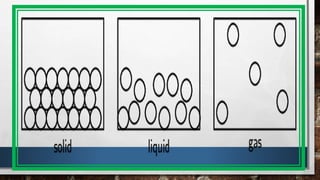
 How does the
arrangement of particles
differ in solids, liquids,
and gases?
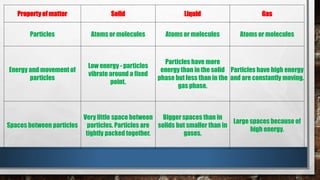
Property of matter Solid Liquid Gas
Particles Atoms or molecules Atoms or molecules Atoms or molecules
Energy and movement of
particles
Low energy - particles
vibrate around a fixed
point.
Particles have more
energy than in the solid
phase but less than in the
gas phase.
Particles have high energy
and are constantly moving.
Spaces between particles
Very little space between
particles. Particles are
tightly packed together.
Bigger spaces than in
solids but smaller than in
gases.
Large spaces because of
high energy.
Property of matter Solid Liquid Gas
Attractive forces between
particles.
Very strong forces. Solids
have a fixed volume.
Weaker forces than in
solids, but stronger forces
than in gases.
Weak forces because of
the large distance
between particles.
Changes in phase.
Solids become liquids or
gases if their temperature
is increased.
A liquid becomes a gas if
its temperature is
increased. A liquid
becomes a solid if its
temperature decreases.
In general a gas becomes
a liquid or solid when it is
cooled. Particles have
less energy and therefore
move closer together so
that the attractive forces
become stronger, and the
gas becomes a liquid or a
solid.
THE KINETIC MOLECULAR THEORY
The kinetic theory of matter helps us to
explain why matter exists in different phases
(i.e. solid, liquid and gas), and how matter can
change from one phase to another.
The kinetic theory of matter also helps us to
understand other properties of matter.
Broadly, the kinetic theory of matter says
that all matter is composed of particles
which have a certain amount of energy
which allows them to move at different
speeds depending on the temperature
(energy).
There are spaces between the
particles and also attractive
forces between particles when
they come close together.
What is the kinetic
theory of gases?
 Kinetic theory explains the behavior of
gases based on the idea that gas
consists of rapidly moving atoms or
molecules.
 This is possible as the interatomic forces
between the molecules are neglected in
gas.
The Kinetic Molecular Theory
(KMT) of gases is a model used
to explain the behavior of
gases at the molecular level.
Who developed the
kinetic theory of gases?
In the 19th century, scientists James
Clark Maxwell and Rudolph Clausius
developed the kinetic theory of
gases in order to explain the
behavior of gases.
What are the
assumptions made in the
Kinetic Molecular Theory
of Gases?
It is based on several
fundamental assumptions
about the nature of gas
particles:
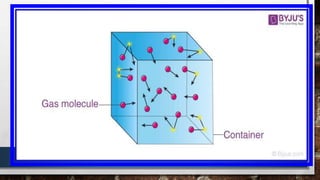
 Gas particles are in constant,
random motion: The particles
within a gas move rapidly and in
straight lines until they collide with
another particle or the walls of the
container.
 Gas particles are negligibly small:
The volume occupied by the gas
particles themselves is considered
to be insignificant compared to the
total volume of the gas.
 Gas particles exhibit no attractive or
repulsive forces: Except during
collisions, gas particles neither attract
nor repel each other. This assumption
simplifies the model and is most
accurate for ideal gases under typical
conditions.
 Collisions between gas particles are
perfectly elastic: When gas particles
collide, there is no net loss or gain of
kinetic energy. The total kinetic
energy of the system remains
constant.
 The average kinetic energy of gas
particles is directly proportional to the
temperature of the gas: This means that
as the temperature of a gas increases, the
average kinetic energy of its particles
also increases.
Why is the kinetic
theory of gases
important?
 The kinetic theory of gases
explains the macroscopic
properties of gases, such as
volume, pressure, and
temperature.
 The assumptions lead to several
key conclusions about the
behavior of gases:
Gas pressure arises from the
collisions of gas particles with the
walls of the container. More
collisions or collisions with greater
force result in higher pressure.
Gas volume is determined by the space
available for the gas particles to move.
Increasing the volume decreases the
frequency of collisions with the
container walls, leading to a decrease
in pressure.
 Gas temperature is a measure of the
average kinetic energy of the gas
particles.
 Increasing the temperature increases
the speed of the gas particles, leading to
more frequent and forceful collisions,
hence increasing the pressure.
While the Kinetic Molecular Theory
provides a useful framework for
understanding the behavior of gases, it is
important to note that it is an idealized
model and may not perfectly describe
real-world gases under all conditions.
An ideal gas is a theoretical gas composed
of many randomly moving particles that are
not subject to interparticle interactions.
A real gas is simply the opposite; it
occupies space and the molecules have
interactions.
 Ideal gas is a hypothetical gas which follows Ideal
Gas Law at all conditions of temperature and
pressure.
 Real gases are those which exist in the
environment.
 They follow Ideal Gas Law only under conditions of
high temperature and low pressure.
However, for many practical
applications, particularly those
involving dilute gases under
ordinary conditions, the KMT
provides accurate predictions of gas
behavior.

BEHAVIOR-OF-GASES-CAMPOS-MAHUSAY-MASIKHAY.pptx

  • 3.
     How doesthe arrangement of particles differ in solids, liquids, and gases?
  • 4.
    Property of matterSolid Liquid Gas Particles Atoms or molecules Atoms or molecules Atoms or molecules Energy and movement of particles Low energy - particles vibrate around a fixed point. Particles have more energy than in the solid phase but less than in the gas phase. Particles have high energy and are constantly moving. Spaces between particles Very little space between particles. Particles are tightly packed together. Bigger spaces than in solids but smaller than in gases. Large spaces because of high energy.
  • 5.
    Property of matterSolid Liquid Gas Attractive forces between particles. Very strong forces. Solids have a fixed volume. Weaker forces than in solids, but stronger forces than in gases. Weak forces because of the large distance between particles. Changes in phase. Solids become liquids or gases if their temperature is increased. A liquid becomes a gas if its temperature is increased. A liquid becomes a solid if its temperature decreases. In general a gas becomes a liquid or solid when it is cooled. Particles have less energy and therefore move closer together so that the attractive forces become stronger, and the gas becomes a liquid or a solid.
  • 7.
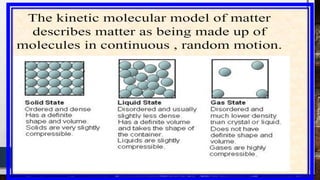
    THE KINETIC MOLECULARTHEORY The kinetic theory of matter helps us to explain why matter exists in different phases (i.e. solid, liquid and gas), and how matter can change from one phase to another. The kinetic theory of matter also helps us to understand other properties of matter.
  • 8.
    Broadly, the kinetictheory of matter says that all matter is composed of particles which have a certain amount of energy which allows them to move at different speeds depending on the temperature (energy).
  • 9.
    There are spacesbetween the particles and also attractive forces between particles when they come close together.
  • 10.
    What is thekinetic theory of gases?
  • 11.
     Kinetic theoryexplains the behavior of gases based on the idea that gas consists of rapidly moving atoms or molecules.  This is possible as the interatomic forces between the molecules are neglected in gas.
  • 12.
    The Kinetic MolecularTheory (KMT) of gases is a model used to explain the behavior of gases at the molecular level.
  • 13.
    Who developed the kinetictheory of gases?
  • 14.
    In the 19thcentury, scientists James Clark Maxwell and Rudolph Clausius developed the kinetic theory of gases in order to explain the behavior of gases.
  • 15.
    What are the assumptionsmade in the Kinetic Molecular Theory of Gases?
  • 16.
    It is basedon several fundamental assumptions about the nature of gas particles:
  • 18.
     Gas particlesare in constant, random motion: The particles within a gas move rapidly and in straight lines until they collide with another particle or the walls of the container.
  • 19.
     Gas particlesare negligibly small: The volume occupied by the gas particles themselves is considered to be insignificant compared to the total volume of the gas.
  • 20.
     Gas particlesexhibit no attractive or repulsive forces: Except during collisions, gas particles neither attract nor repel each other. This assumption simplifies the model and is most accurate for ideal gases under typical conditions.
  • 21.
     Collisions betweengas particles are perfectly elastic: When gas particles collide, there is no net loss or gain of kinetic energy. The total kinetic energy of the system remains constant.
  • 22.
     The averagekinetic energy of gas particles is directly proportional to the temperature of the gas: This means that as the temperature of a gas increases, the average kinetic energy of its particles also increases.
  • 23.
    Why is thekinetic theory of gases important?
  • 24.
     The kinetictheory of gases explains the macroscopic properties of gases, such as volume, pressure, and temperature.
  • 25.
     The assumptionslead to several key conclusions about the behavior of gases:
  • 26.
    Gas pressure arisesfrom the collisions of gas particles with the walls of the container. More collisions or collisions with greater force result in higher pressure.
  • 27.
    Gas volume isdetermined by the space available for the gas particles to move. Increasing the volume decreases the frequency of collisions with the container walls, leading to a decrease in pressure.
  • 28.
     Gas temperatureis a measure of the average kinetic energy of the gas particles.  Increasing the temperature increases the speed of the gas particles, leading to more frequent and forceful collisions, hence increasing the pressure.
  • 29.
    While the KineticMolecular Theory provides a useful framework for understanding the behavior of gases, it is important to note that it is an idealized model and may not perfectly describe real-world gases under all conditions.
  • 30.
    An ideal gasis a theoretical gas composed of many randomly moving particles that are not subject to interparticle interactions. A real gas is simply the opposite; it occupies space and the molecules have interactions.
  • 31.
     Ideal gasis a hypothetical gas which follows Ideal Gas Law at all conditions of temperature and pressure.  Real gases are those which exist in the environment.  They follow Ideal Gas Law only under conditions of high temperature and low pressure.
  • 32.
    However, for manypractical applications, particularly those involving dilute gases under ordinary conditions, the KMT provides accurate predictions of gas behavior.