Key Result Area (KRA 3)
Curriculum and Planning &
Assessment and Reporting
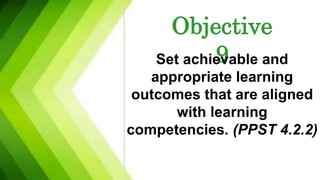
Objective
9
Set achievable and
appropriate learning
outcomes that are aligned
with learning
competencies. (PPST 4.2.2)
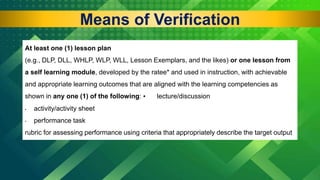
At least one (1) lesson plan
(e.g., DLP, DLL, WHLP, WLP, WLL, Lesson Exemplars, and the likes) or one lesson from
a self learning module, developed by the ratee* and used in instruction, with achievable
and appropriate learning outcomes that are aligned with the learning competencies as
shown in any one (1) of the following: • lecture/discussion
• activity/activity sheet
• performance task
rubric for assessing performance using criteria that appropriately describe the target output
Means of Verification
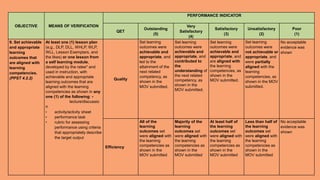
OBJECTIVE MEANS OF VERIFICATION
PERFORMANCE INDICATOR
QET
Outstanding
(5)
Very
Satisfactory
(4)
Satisfactory
(3)
Unsatisfactory
(2)
Poor
(1)
9. Set achievable
and appropriate
learning
outcomes that
are aligned with
learning
competencies.
(PPST 4.2.2)
At least one (1) lesson plan
(e.g., DLP, DLL, WHLP, WLP,
WLL, Lesson Exemplars, and
the likes) or one lesson from
a self learning module,
developed by the ratee* and
used in instruction, with
achievable and appropriate
learning outcomes that are
aligned with the learning
competencies as shown in any
one (1) of the following: •
lecture/discussio
n
• activity/activity sheet
• performance task
• rubric for assessing
performance using criteria
that appropriately describe
the target output
Quality
Set learning
outcomes were
achievable and
appropriate, and
led to the
attainment of the
next related
competency, as
shown in the
MOV submitted.
Set learning
outcomes were
achievable and
appropriate, and
contributed to
the
understanding of
the next related
competency, as
shown in the
MOV submitted.
Set learning
outcomes were
achievable and
appropriate, and
are aligned with
the learning
competencies, as
shown in the
MOV submitted.
Set learning
outcomes were
not achievable or
appropriate, and
were partially
aligned with the
learning
competencies, as
shown in the MOV
submitted.
No acceptable
evidence was
shown
Efficiency
All of the
learning
outcomes set
were aligned with
the learning
competencies as
shown in the
MOV submitted
Majority of the
learning
outcomes set
were aligned with
the learning
competencies as
shown in the
MOV submitted
At least half of
the learning
outcomes set
were aligned with
the learning
competencies as
shown in the
MOV submitted
Less than half of
the learning
outcomes set
were aligned with
the learning
competencies as
shown in the
MOV submitted
No acceptable
evidence was
shown
ACHIEVABLE LEARNING OUTCOME is a set within the range of
abilities of the learners
APPROPRIATE LEARNINGOUTCOME is targetting relevant
skills,
knowledge, and attitudes.
ALIGNMENTWITHTHE COMPETENCY is the congruence of
the
learning outcomes to the level of knowledge, skills, and
attitudes
described in the competency.
LEARNING COMPETENCIES.These refer to the knowledge,
understandings, skills and attitudes the students need to
demonstrate.There are particular learning competencies set
for
every lesson/learning activity. (Department of Education, 2015
In setting learning outcomes, we should think of active verbs
that would demonstrate
our learners’ knowledge and understanding in terms of specific
actions. With this, it is
helpful to review the different cognitive skills as listed in
Bloom’s/Anderson Krathwohl’s
Taxonomy.
Since learning outcomes are built from the content and performance content standards, we have to
observe these principles:
1.They should be achievable.
They should be set within the range of abilities of the learners (Academic Programmes
Quality & Resources Unit, University of Malta, 2009)
2.They should be appropriate.
They should be targeting relevant skills, knowledge, and attitudes.
3.They should be aligned with the learning competencies.
They should be in congruence with the learning competencies set for the learning area and
level.
Objective
10
Used strategies for
providing timely,
accurate and
constructive feedback to
improve learner
performance. (PPST
5.3.2.
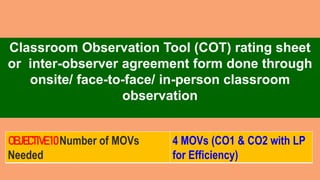
Classroom Observation Tool (COT) rating sheet
or inter-observer agreement form done through
onsite/ face-to-face/ in-person classroom
observation
OBJECTIVE10Number of MOVs
Needed
4 MOVs (CO1 & CO2 with LP
for Efficiency)
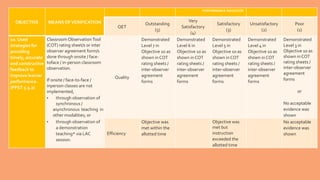
OBJECTIVE MEANS OFVERIFICATION
PERFORMANCE INDICATOR
QET
Outstanding
(5)
Very
Satisfactory
(4)
Satisfactory
(3)
Unsatisfactory
(2)
Poor
(1)
10. Used
strategies for
providing
timely, accurate
and constructive
feedback to
improve learner
performance.
(PPST 5.3.2)
Classroom ObservationTool
(COT) rating sheet/s or inter
observer agreement form/s
done through onsite / face-
toface / in-person classroom
observation.
If onsite / face-to-face /
inperson classes are not
implemented,
• through observation of
synchronous /
asynchronous teaching in
other modalities; or
• through observation of
a demonstration
teaching* via LAC
session.
Quality
Demonstrated
Level 7 in
Objective 10 as
shown inCOT
rating sheets /
inter-observer
agreement
forms
Demonstrated
Level 6 in
Objective 10 as
shown inCOT
rating sheets /
inter-observer
agreement
forms
Demonstrated
Level 5 in
Objective 10 as
shown inCOT
rating sheets /
inter-observer
agreement
forms
Demonstrated
Level 4 in
Objective 10 as
shown inCOT
rating sheets /
inter-observer
agreement
forms
Demonstrated
Level 3 in
Objective 10 as
shown inCOT
rating sheets /
inter-observer
agreement
forms
or
No acceptable
evidence was
shown
Efficiency
Objective was
met within the
allotted time
Objective was
met but
instruction
exceeded the
allotted time
No acceptable
evidence was
shown
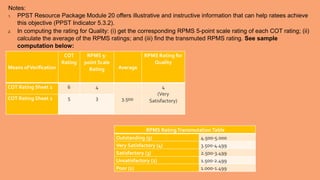
Notes:
1. PPST Resource Package Module 20 offers illustrative and instructive information that can help ratees achieve
this objective (PPST Indicator 5.3.2).
2. In computing the rating for Quality: (i) get the corresponding RPMS 5-point scale rating of each COT rating; (ii)
calculate the average of the RPMS ratings; and (iii) find the transmuted RPMS rating. See sample
computation below:
Means ofVerification
COT
Rating
RPMS 5-
point Scale
Rating Average
RPMS Rating for
Quality
COT Rating Sheet 1 6 4
3.500
4
(Very
Satisfactory)
COT Rating Sheet 2 5 3
RPMS RatingTransmutation Table
Outstanding (5) 4.500-5.000
Very Satisfactory (4) 3.500-4.499
Satisfactory (3) 2.500-3.499
Unsatisfactory (2) 1.500-2.499
Poor (1) 1.000-1.499
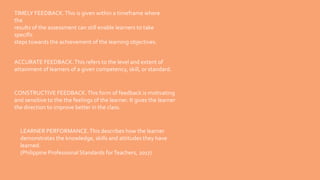
TIMELY FEEDBACK.This is given within a timeframe where
the
results of the assessment can still enable learners to take
specific
steps towards the achievement of the learning objectives.
ACCURATE FEEDBACK.This refers to the level and extent of
attainment of learners of a given competency, skill, or standard.
CONSTRUCTIVE FEEDBACK.This form of feedback is motivating
and sensitive to the the feelings of the learner. It gives the learner
the direction to improve better in the class.
LEARNER PERFORMANCE.This describes how the learner
demonstrates the knowledge, skills and attitudes they have
learned.
(Philippine Professional Standards forTeachers, 2017)
As a facilitator of learning, you need to ensure that your students really
learn. It is not enough that we deliver the lesson, but more importantly we
have to support them along the teaching-learning process.This can be best
achieved if we provide them with feedback during and after instruction so
that they are guided and monitored towards their attainment of the learning
goals.
By collecting information about what goes on in the
classroom, and by analyzing and
evaluating this information, teachers identify and explore their
own practices and
underlying beliefs.This may then lead to changes and
improvements in their teaching.
1 2 3 4 5 6 7
The teacher does not
provide any feedback to
help learners improve
their learning.
The teacher attempts to
provide feedback but does
not result in improving
students’ learning.
The teacher rarely provides
feedback that results in
limited opportunities for
learners to improve their
learning.
The teacher occasionally
provides feedback that
results in opportunities for
majority of the learners to
improve their learning.
The teacher frequently
provides feedback that
results in opportunities for
most of the learners to
improve their learning.
The teacher consistently
provides feedback that
results in opportunities
for all learners to improve
learning and leads to assess
their own progress.
The teacher consistently
provides feedback that
results in opportunities
for all learners to improve
learning and to assess their
own progress and that of
others.
1. Learners receive no
feedback. They have
no idea if they are on
the right track in
achieving the
intended learning
outcomes.
1. Teacher’s
feedback is of
poor quality and
not oriented
toward future
improvement of
learning. It lacks
specificity or is
untimely and
inaccurate.
1. Feedback is
dismissive, does
not explain what
went “wrong,”
and does not
suggest a
specific course of
action for the
learner to follow.
1. Teacher’s
feedback is
superficial, not
informative, and
not constructive.
2. Feedback is
directed to only
some of the
learners.
3. Teacher’s
feedback
partially guides
learners toward
the intended
learning
outcomes and
does not target
students’
strengths and
weaknesses.
1. The teacher
provides accurate
feedback but
sometimes absent
when it is
necessary.
2. Feedback is
selective to some
groups of learners.
3. The teacher falls
short of
addressing the
learners’ common
need/ weakness.
1. The teacher provides
accurate, timely, and
constructive
feedback, i.e.
suggestions/ tasks/
activities/
clarifications, that
fully guides most of
the learners toward
the intended learning
outcomes.
1. The teacher provides
substantive, specific,
and timely feedback,
and shares strategies
to learners to improve
their performance
toward the intended
learning outcomes.
1. The teacher
establishes a
routine for
constructive
feedbacking
where learners
can participate
and respond
productively.
2. The teacher
provides
opportunities
for self and peer
feedbacking
that is specific
and is focused
on advancing
their learning of
the lesson on
hand.
Objective
11
Utilized
assessment data to
inform the modification
of teaching and learning
practices and programs.
(PPST 5.5.2)
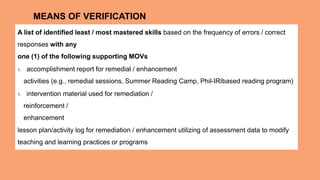
MEANS OF VERIFICATION
A list of identified least / most mastered skills based on the frequency of errors / correct
responses with any
one (1) of the following supporting MOVs
1. accomplishment report for remedial / enhancement
activities (e.g., remedial sessions, Summer Reading Camp, Phil-IRIbased reading program)
1. intervention material used for remediation /
reinforcement /
enhancement
lesson plan/activity log for remediation / enhancement utilizing of assessment data to modify
teaching and learning practices or programs
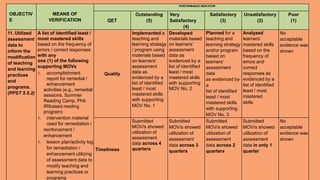
OBJECTIV
E
MEANS OF
VERIFICATION
PERFORMANCE INDICATOR
QET
Outstanding
(5)
Very
Satisfactory
(4)
Satisfactory
(3)
Unsatisfactory
(2)
Poor
(1)
11. Utilized
assessment
data to
inform the
modification
of teaching
and learning
practices
and
programs.
(PPST 5.5.2)
A list of identified least /
most mastered skills
based on the frequency of
errors / correct responses
with any
one (1) of the following
supporting MOVs
1. accomplishment
report for remedial /
enhancement
activities (e.g., remedial
sessions, Summer
Reading Camp, Phil-
IRIbased reading
program)
1. intervention material
used for remediation /
reinforcement /
enhancement
1. lesson plan/activity log
for remediation /
enhancement utilizing
of assessment data to
modify teaching and
learning practices or
programs
Quality
Implemented a
teaching and
learning strategy
/ program using
materials based
on learners’
assessment
data as
evidenced by a
list of identified
least / most
mastered skills
with supporting
MOV No. 1
Developed
materials based
on learners’
assessment
data as
evidenced by a
list of identified
least / most
mastered skills
with supporting
MOV No. 2
Planned for a
teaching and
learning strategy
and/or program
based on
learners’
assessment
data
as evidenced by
a
list of identified
least / most
mastered skills
with supporting
MOV No. 3
Analyzed
learners’
mastered skills
based on the
frequency of
errors and
correct
responses as
evidenced by a
list of identified
least / most
mastered
skills
No
acceptable
evidence was
shown
Timeliness
Submitted
MOV/s showed
utilization of
assessment
data across 4
quarters
Submitted
MOV/s showed
utilization of
assessment
data across 3
quarters
Submitted
MOV/s showed
utilization of
assessment
data across 2
quarters
Submitted
MOV/s showed
utilization of
assessment
data in only 1
quarter
No
acceptable
evidence was
shown
ASSESSMENT DATA.This pertains to the learner data obtained
from diagnostic, formative and/or summative assessment practices
(PPST, 2017).
MODIFICATION.This refers to adjustments implemented by teachers
relative to the teaching-learning process based on the assessment
data to achieve instructional goals.
TEACHING AND LEARNING PRACTICES.These practices are
customary, habitual, or expected procedures or ways that are
involved in the teaching and learning process.
TEACHING AND LEARNING PROGRAMS.This term refers to the
set of related measures or activities with a long-term aim duly
implemented by Department of Education (DepEd) to aid in the
holistic development of Filipino learners.
As ProficientTeachers, learning about learners’ knowledge through assessment is
important in the teaching-learning process. Meanwhile, it is equally significant to
reflect on the effectiveness of one’s own teaching. If teachers begin by planning
a lesson around what he or she wants learners to know and be able to do
through development of student learning outcomes, then by reflecting on the gap
between what he or she wants learners to know and how they do on assessments
teachers can learn more about their teaching.
THANK YOU!

RPMS TOOL -FOR-Proficient TEACHERS-.pptx

  • 1.
    Key Result Area(KRA 3) Curriculum and Planning & Assessment and Reporting
  • 2.
    Objective 9 Set achievable and appropriatelearning outcomes that are aligned with learning competencies. (PPST 4.2.2)
  • 3.
    At least one(1) lesson plan (e.g., DLP, DLL, WHLP, WLP, WLL, Lesson Exemplars, and the likes) or one lesson from a self learning module, developed by the ratee* and used in instruction, with achievable and appropriate learning outcomes that are aligned with the learning competencies as shown in any one (1) of the following: • lecture/discussion • activity/activity sheet • performance task rubric for assessing performance using criteria that appropriately describe the target output Means of Verification
  • 4.
    OBJECTIVE MEANS OFVERIFICATION PERFORMANCE INDICATOR QET Outstanding (5) Very Satisfactory (4) Satisfactory (3) Unsatisfactory (2) Poor (1) 9. Set achievable and appropriate learning outcomes that are aligned with learning competencies. (PPST 4.2.2) At least one (1) lesson plan (e.g., DLP, DLL, WHLP, WLP, WLL, Lesson Exemplars, and the likes) or one lesson from a self learning module, developed by the ratee* and used in instruction, with achievable and appropriate learning outcomes that are aligned with the learning competencies as shown in any one (1) of the following: • lecture/discussio n • activity/activity sheet • performance task • rubric for assessing performance using criteria that appropriately describe the target output Quality Set learning outcomes were achievable and appropriate, and led to the attainment of the next related competency, as shown in the MOV submitted. Set learning outcomes were achievable and appropriate, and contributed to the understanding of the next related competency, as shown in the MOV submitted. Set learning outcomes were achievable and appropriate, and are aligned with the learning competencies, as shown in the MOV submitted. Set learning outcomes were not achievable or appropriate, and were partially aligned with the learning competencies, as shown in the MOV submitted. No acceptable evidence was shown Efficiency All of the learning outcomes set were aligned with the learning competencies as shown in the MOV submitted Majority of the learning outcomes set were aligned with the learning competencies as shown in the MOV submitted At least half of the learning outcomes set were aligned with the learning competencies as shown in the MOV submitted Less than half of the learning outcomes set were aligned with the learning competencies as shown in the MOV submitted No acceptable evidence was shown
  • 5.
    ACHIEVABLE LEARNING OUTCOMEis a set within the range of abilities of the learners APPROPRIATE LEARNINGOUTCOME is targetting relevant skills, knowledge, and attitudes. ALIGNMENTWITHTHE COMPETENCY is the congruence of the learning outcomes to the level of knowledge, skills, and attitudes described in the competency. LEARNING COMPETENCIES.These refer to the knowledge, understandings, skills and attitudes the students need to demonstrate.There are particular learning competencies set for every lesson/learning activity. (Department of Education, 2015
  • 6.
    In setting learningoutcomes, we should think of active verbs that would demonstrate our learners’ knowledge and understanding in terms of specific actions. With this, it is helpful to review the different cognitive skills as listed in Bloom’s/Anderson Krathwohl’s Taxonomy. Since learning outcomes are built from the content and performance content standards, we have to observe these principles: 1.They should be achievable. They should be set within the range of abilities of the learners (Academic Programmes Quality & Resources Unit, University of Malta, 2009) 2.They should be appropriate. They should be targeting relevant skills, knowledge, and attitudes. 3.They should be aligned with the learning competencies. They should be in congruence with the learning competencies set for the learning area and level.
  • 7.
    Objective 10 Used strategies for providingtimely, accurate and constructive feedback to improve learner performance. (PPST 5.3.2.
  • 8.
    Classroom Observation Tool(COT) rating sheet or inter-observer agreement form done through onsite/ face-to-face/ in-person classroom observation OBJECTIVE10Number of MOVs Needed 4 MOVs (CO1 & CO2 with LP for Efficiency)
  • 9.
    OBJECTIVE MEANS OFVERIFICATION PERFORMANCEINDICATOR QET Outstanding (5) Very Satisfactory (4) Satisfactory (3) Unsatisfactory (2) Poor (1) 10. Used strategies for providing timely, accurate and constructive feedback to improve learner performance. (PPST 5.3.2) Classroom ObservationTool (COT) rating sheet/s or inter observer agreement form/s done through onsite / face- toface / in-person classroom observation. If onsite / face-to-face / inperson classes are not implemented, • through observation of synchronous / asynchronous teaching in other modalities; or • through observation of a demonstration teaching* via LAC session. Quality Demonstrated Level 7 in Objective 10 as shown inCOT rating sheets / inter-observer agreement forms Demonstrated Level 6 in Objective 10 as shown inCOT rating sheets / inter-observer agreement forms Demonstrated Level 5 in Objective 10 as shown inCOT rating sheets / inter-observer agreement forms Demonstrated Level 4 in Objective 10 as shown inCOT rating sheets / inter-observer agreement forms Demonstrated Level 3 in Objective 10 as shown inCOT rating sheets / inter-observer agreement forms or No acceptable evidence was shown Efficiency Objective was met within the allotted time Objective was met but instruction exceeded the allotted time No acceptable evidence was shown
  • 10.
    Notes: 1. PPST ResourcePackage Module 20 offers illustrative and instructive information that can help ratees achieve this objective (PPST Indicator 5.3.2). 2. In computing the rating for Quality: (i) get the corresponding RPMS 5-point scale rating of each COT rating; (ii) calculate the average of the RPMS ratings; and (iii) find the transmuted RPMS rating. See sample computation below: Means ofVerification COT Rating RPMS 5- point Scale Rating Average RPMS Rating for Quality COT Rating Sheet 1 6 4 3.500 4 (Very Satisfactory) COT Rating Sheet 2 5 3 RPMS RatingTransmutation Table Outstanding (5) 4.500-5.000 Very Satisfactory (4) 3.500-4.499 Satisfactory (3) 2.500-3.499 Unsatisfactory (2) 1.500-2.499 Poor (1) 1.000-1.499
  • 11.
    TIMELY FEEDBACK.This isgiven within a timeframe where the results of the assessment can still enable learners to take specific steps towards the achievement of the learning objectives. ACCURATE FEEDBACK.This refers to the level and extent of attainment of learners of a given competency, skill, or standard. CONSTRUCTIVE FEEDBACK.This form of feedback is motivating and sensitive to the the feelings of the learner. It gives the learner the direction to improve better in the class. LEARNER PERFORMANCE.This describes how the learner demonstrates the knowledge, skills and attitudes they have learned. (Philippine Professional Standards forTeachers, 2017)
  • 12.
    As a facilitatorof learning, you need to ensure that your students really learn. It is not enough that we deliver the lesson, but more importantly we have to support them along the teaching-learning process.This can be best achieved if we provide them with feedback during and after instruction so that they are guided and monitored towards their attainment of the learning goals. By collecting information about what goes on in the classroom, and by analyzing and evaluating this information, teachers identify and explore their own practices and underlying beliefs.This may then lead to changes and improvements in their teaching.
  • 13.
    1 2 34 5 6 7 The teacher does not provide any feedback to help learners improve their learning. The teacher attempts to provide feedback but does not result in improving students’ learning. The teacher rarely provides feedback that results in limited opportunities for learners to improve their learning. The teacher occasionally provides feedback that results in opportunities for majority of the learners to improve their learning. The teacher frequently provides feedback that results in opportunities for most of the learners to improve their learning. The teacher consistently provides feedback that results in opportunities for all learners to improve learning and leads to assess their own progress. The teacher consistently provides feedback that results in opportunities for all learners to improve learning and to assess their own progress and that of others.
  • 14.
    1. Learners receiveno feedback. They have no idea if they are on the right track in achieving the intended learning outcomes. 1. Teacher’s feedback is of poor quality and not oriented toward future improvement of learning. It lacks specificity or is untimely and inaccurate. 1. Feedback is dismissive, does not explain what went “wrong,” and does not suggest a specific course of action for the learner to follow. 1. Teacher’s feedback is superficial, not informative, and not constructive. 2. Feedback is directed to only some of the learners. 3. Teacher’s feedback partially guides learners toward the intended learning outcomes and does not target students’ strengths and weaknesses. 1. The teacher provides accurate feedback but sometimes absent when it is necessary. 2. Feedback is selective to some groups of learners. 3. The teacher falls short of addressing the learners’ common need/ weakness. 1. The teacher provides accurate, timely, and constructive feedback, i.e. suggestions/ tasks/ activities/ clarifications, that fully guides most of the learners toward the intended learning outcomes. 1. The teacher provides substantive, specific, and timely feedback, and shares strategies to learners to improve their performance toward the intended learning outcomes. 1. The teacher establishes a routine for constructive feedbacking where learners can participate and respond productively. 2. The teacher provides opportunities for self and peer feedbacking that is specific and is focused on advancing their learning of the lesson on hand.
  • 15.
    Objective 11 Utilized assessment data to informthe modification of teaching and learning practices and programs. (PPST 5.5.2)
  • 16.
    MEANS OF VERIFICATION Alist of identified least / most mastered skills based on the frequency of errors / correct responses with any one (1) of the following supporting MOVs 1. accomplishment report for remedial / enhancement activities (e.g., remedial sessions, Summer Reading Camp, Phil-IRIbased reading program) 1. intervention material used for remediation / reinforcement / enhancement lesson plan/activity log for remediation / enhancement utilizing of assessment data to modify teaching and learning practices or programs
  • 17.
    OBJECTIV E MEANS OF VERIFICATION PERFORMANCE INDICATOR QET Outstanding (5) Very Satisfactory (4) Satisfactory (3) Unsatisfactory (2) Poor (1) 11.Utilized assessment data to inform the modification of teaching and learning practices and programs. (PPST 5.5.2) A list of identified least / most mastered skills based on the frequency of errors / correct responses with any one (1) of the following supporting MOVs 1. accomplishment report for remedial / enhancement activities (e.g., remedial sessions, Summer Reading Camp, Phil- IRIbased reading program) 1. intervention material used for remediation / reinforcement / enhancement 1. lesson plan/activity log for remediation / enhancement utilizing of assessment data to modify teaching and learning practices or programs Quality Implemented a teaching and learning strategy / program using materials based on learners’ assessment data as evidenced by a list of identified least / most mastered skills with supporting MOV No. 1 Developed materials based on learners’ assessment data as evidenced by a list of identified least / most mastered skills with supporting MOV No. 2 Planned for a teaching and learning strategy and/or program based on learners’ assessment data as evidenced by a list of identified least / most mastered skills with supporting MOV No. 3 Analyzed learners’ mastered skills based on the frequency of errors and correct responses as evidenced by a list of identified least / most mastered skills No acceptable evidence was shown Timeliness Submitted MOV/s showed utilization of assessment data across 4 quarters Submitted MOV/s showed utilization of assessment data across 3 quarters Submitted MOV/s showed utilization of assessment data across 2 quarters Submitted MOV/s showed utilization of assessment data in only 1 quarter No acceptable evidence was shown
  • 18.
    ASSESSMENT DATA.This pertainsto the learner data obtained from diagnostic, formative and/or summative assessment practices (PPST, 2017). MODIFICATION.This refers to adjustments implemented by teachers relative to the teaching-learning process based on the assessment data to achieve instructional goals. TEACHING AND LEARNING PRACTICES.These practices are customary, habitual, or expected procedures or ways that are involved in the teaching and learning process. TEACHING AND LEARNING PROGRAMS.This term refers to the set of related measures or activities with a long-term aim duly implemented by Department of Education (DepEd) to aid in the holistic development of Filipino learners.
  • 19.
    As ProficientTeachers, learningabout learners’ knowledge through assessment is important in the teaching-learning process. Meanwhile, it is equally significant to reflect on the effectiveness of one’s own teaching. If teachers begin by planning a lesson around what he or she wants learners to know and be able to do through development of student learning outcomes, then by reflecting on the gap between what he or she wants learners to know and how they do on assessments teachers can learn more about their teaching.
  • 20.