MANAGEMENT OF RPL
Dr. Sunita Khedkar
M.B.B.S , DGO (Mumbai )
Consultant , Khedkar
Maternity hospital,
Aurangabad
RECURRENT PREGNANCY LOSS
(RPL)
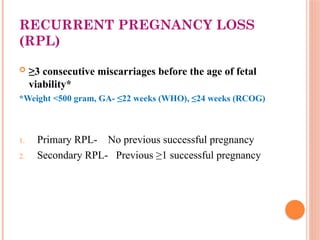
 ≥3 consecutive miscarriages before the age of fetal
viability*
*Weight <500 gram, GA- ≤22 weeks (WHO), ≤24 weeks (RCOG)
1. Primary RPL- No previous successful pregnancy
2. Secondary RPL- Previous ≥1 successful pregnancy
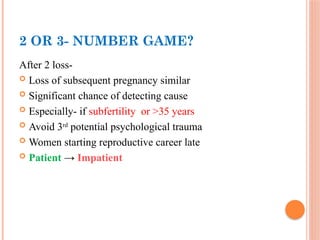
2 OR 3- NUMBER GAME?
After 2 loss-
 Loss of subsequent pregnancy similar
 Significant chance of detecting cause
 Especially- if subfertility or >35 years
 Avoid 3rd
potential psychological trauma
 Women starting reproductive career late
 Patient → Impatient
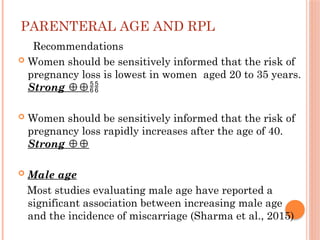
PARENTERAL AGE AND RPL
Recommendations
 Women should be sensitively informed that the risk of
pregnancy loss is lowest in women aged 20 to 35 years.
Strong ⊕⊕
 Women should be sensitively informed that the risk of
pregnancy loss rapidly increases after the age of 40.
Strong ⊕⊕
 Male age
Most studies evaluating male age have reported a
significant association between increasing male age
and the incidence of miscarriage (Sharma et al., 2015)
5
STRESS
 Changes Th2 response in endometrium to Th1 response
 Affects HPO axis
 Adrenaline release reduces placental blood flow
IF DEFINITE CAUSE OF RPL IS
FOUND
 Targeted Therapy
 Explain- the role of chance
factors
CAUSES
fetal
 chromosomal
abrasions-
accounts for 43% of
losses
maternal
 abnormal tropoblast
invasion and development
sec to
1. Endocrine
2.
immunological-local/syste
mic reaction
3. anatomical abrasions
RPL WITH GENETIC BACKGROUND
 Genetic abnormalities of conceptus-
- recognised cause of sporadic , recurrent
pregnancy loss.
 Prevalence of chromosomal abnormality in single
sporadic miscarriage- 45%
 Common abnormalities that occur in early losses
–developmental and genetic
 Most pregnancies – embryo morphologically
abnormal (86-91% where embryo is present)
 Genetically abnormal embryos -Phenotypically
abnormal /normal (some)
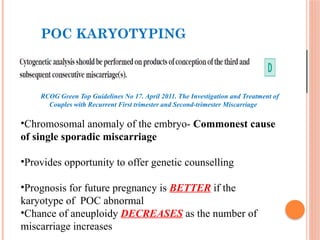
POC KARYOTYPING
RCOG Green Top Guidelines No 17. April 2011. The Investigation and Treatment of
Couples with Recurrent First trimester and Second-trimester Miscarriage
•Chromosomal anomaly of the embryo- Commonest cause
of single sporadic miscarriage
•Provides opportunity to offer genetic counselling
•Prognosis for future pregnancy is BETTER if the
karyotype of POC abnormal
•Chance of aneuploidy DECREASES as the number of
miscarriage increases
CHOROMOSOMAL ANALYSIS-
PARENTS
 Not Routine
 Only if karyotyping of POC - unbalanced structural
abnormalities
 If karyotype of POC not done
.All couples with abnormal foetal /parental karyotype -genetic
councilling , discuss possible Rx options- pros n cons
1.PGT-A( preimplantation genetic testing for aneuploidy)
Embryos in IVF cycle are biopsied and screened for
chromosomal abnormalities prior to implantation.
2.FISH- with embryo biopsy @ D3 ,looks at specific number of
chromosome ,at early stage when mosaicism is higher.
3.Whole genome teqniques-
* Array CGH(Comparative genomic hybridisation )
* NGS( next generation sequencing),
more accurate screening teqniques( biopsy taken at blastocyst
stage, looking at all chromosomes)
 Clinical outcomes are improved in couples with
PGS.
-Costly
 3rd
party reproduction
 adoption
THROMBOPHILIA ( HEREDITORY/ AQUIRED)
Predisposes patient to venous thromboembolism
Hereditory thrombophilia-
 Factor V Leiden mutation
 Prothrombin mutation
 Protein C, Protein S, Antithrombin deficiency
 MTHFR gene mutation
(methylene tetrahydrofolate reductase)
MX
RPL+ Thrombophilia- treatment to prevent thromosis
1. Anthithrombotic agents –aspirin
2. Anticoagulants – heparin(UFH/LMWH)
3. IVIG, Steroids –to suppress immune system, improve
pregnancy outcome
4. FA, vit B6, vit B12- reduce homocystein level
MTHFR mutation +/hyperhomocysteinemia
In women with hereditory thrombophilia + RPL
antithrombotic prophylaxis is NOT recommended
Exept
in context of clinical research /
VTE Prevention .
Screening for hereditory thrombophilia-
not recommened.
APS -ANTIPHOSPHOLIPID
SYNDOME
 Persistent presence of antiphospholipid antibodies +
vascular thrombosis +/ pregnancy complications.
 3/more losses excluding
-Miscarriages before 10 weeks
-Maternal anatomic/hormonal abnormalities
-Maternal and paternal chromosomal causes
Is one of the clinical criteria –diagnosis of APS
3 CLINICALLY RELEVENT ANTIBODIES
( ASSOCIATED WITH THROMBOSIS)-
 Lupus Anticoagulant (LAC)-
Positive
 Anti-Cardiolipin Antibody
(ACL)
IgG/ IgM-
Moderate to High Titre (>40
IU/L)
 Anti- 2-glycoprotein 1
ẞ
IgG/ IgM
Moderate to High Titre
 Considerable laboratory
variations and lack of
standardization
 LAC- dRVVT (with
platelet neutralization)-
better than aPTT
 ACL and 2-
ẞ
glycoprotein- ELISA
 In 2 occasions ≥12
weeks apart
Mx APS-
1.Anticoagulants –
For prevention of thrombosis LMWH is prefered
over UFH-
- less risk of osteoporosis,
heparin induced thrombocytopenia
2.Steroids- prednisolone has been evaluated in Rx
of RPL + APS - no e/o benefit
Adverse effects --eg.risk of GDM,
risk HT, preclampsia,
LBW, NICU admission
3. IVIG-superior to prednisolone
birth wt
number of miscarriages
PTL
4. Hydrxy chloroquine- immunomodulator-
inhibits antigen presentation and B, T cell activation.
Safe ,effectve in preventing obs complications in APS.
Further studies- RPL and APS
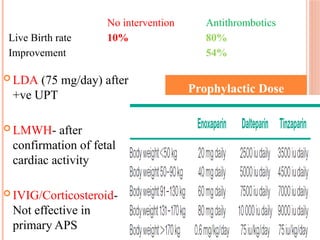
 LDA (75 mg/day) after
+ve UPT
 LMWH- after
confirmation of fetal
cardiac activity
 IVIG/Corticosteroid-
Not effective in
primary APS
Prophylactic Dose
No intervention Antithrombotics
Live Birth rate 10% 80%
Improvement 54%
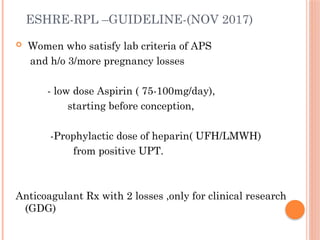
ESHRE-RPL –GUIDELINE-(NOV 2017)
 Women who satisfy lab criteria of APS
and h/o 3/more pregnancy losses
- low dose Aspirin ( 75-100mg/day),
starting before conception,
-Prophylactic dose of heparin( UFH/LMWH)
from positive UPT.
Anticoagulant Rx with 2 losses ,only for clinical research
(GDG)
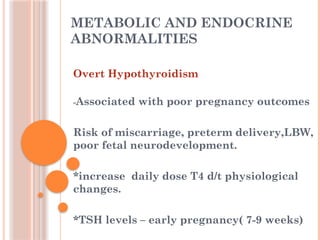
METABOLIC AND ENDOCRINE
ABNORMALITIES
Overt Hypothyroidism
-Associated with poor pregnancy outcomes
Risk of miscarriage, preterm delivery,LBW,
poor fetal neurodevelopment.
*increase daily dose T4 d/t physiological
changes.
*TSH levels – early pregnancy( 7-9 weeks)
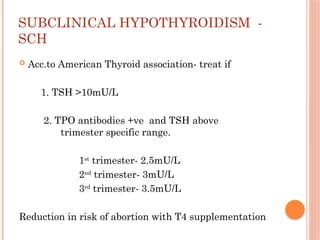
SUBCLINICAL HYPOTHYROIDISM -
SCH
 Acc.to American Thyroid association- treat if
1. TSH >10mU/L
2. TPO antibodies +ve and TSH above
trimester specific range.
1st
trimester- 2.5mU/L
2nd
trimester- 3mU/L
3rd
trimester- 3.5mU/L
Reduction in risk of abortion with T4 supplementation
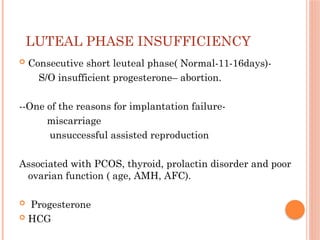
LUTEAL PHASE INSUFFICIENCY
 Consecutive short leuteal phase( Normal-11-16days)-
S/O insufficient progesterone– abortion.
--One of the reasons for implantation failure-
miscarriage
unsuccessful assisted reproduction
Associated with PCOS, thyroid, prolactin disorder and poor
ovarian function ( age, AMH, AFC).
 Progesterone
 HCG
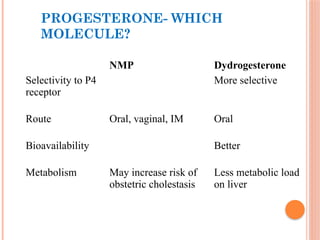
PROGESTERONE- WHICH
MOLECULE?
NMP Dydrogesterone
Selectivity to P4
receptor
More selective
Route Oral, vaginal, IM Oral
Bioavailability Better
Metabolism May increase risk of
obstetric cholestasis
Less metabolic load
on liver
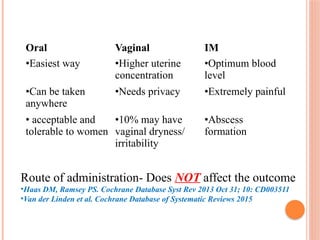
Oral Vaginal IM
•Easiest way •Higher uterine
concentration
•Optimum blood
level
•Can be taken
anywhere
•Needs privacy •Extremely painful
• acceptable and
tolerable to women
•10% may have
vaginal dryness/
irritability
•Abscess
formation
Route of administration- Does NOT affect the outcome
•Haas DM, Ramsey PS. Cochrane Database Syst Rev 2013 Oct 31; 10: CD003511
•Van der Linden et al. Cochrane Database of Systematic Reviews 2015
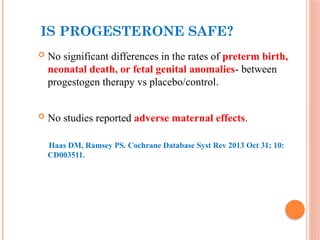
IS PROGESTERONE SAFE?
 No significant differences in the rates of preterm birth,
neonatal death, or fetal genital anomalies- between
progestogen therapy vs placebo/control.
 No studies reported adverse maternal effects.
Haas DM, Ramsey PS. Cochrane Database Syst Rev 2013 Oct 31; 10:
CD003511.
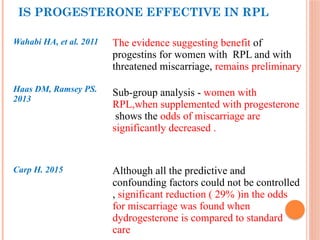
IS PROGESTERONE EFFECTIVE IN RPL
Wahabi HA, et al. 2011 The evidence suggesting benefit of
progestins for women with RPL and with
threatened miscarriage, remains preliminary
Haas DM, Ramsey PS.
2013
Sub-group analysis - women with
RPL,when supplemented with progesterone
shows the odds of miscarriage are
significantly decreased .
Carp H. 2015 Although all the predictive and
confounding factors could not be controlled
, significant reduction ( 29% )in the odds
for miscarriage was found when
dydrogesterone is compared to standard
care
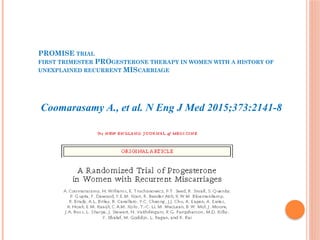
PROMISE TRIAL
FIRST TRIMESTER PROGESTERONE THERAPY IN WOMEN WITH A HISTORY OF
UNEXPLAINED RECURRENT MISCARRIAGE
Coomarasamy A., et al. N Eng J Med 2015;373:2141-8
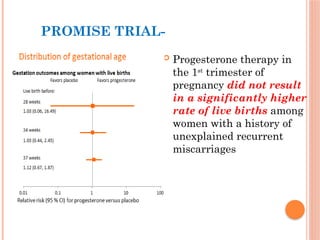
PROMISE TRIAL-
 Progesterone therapy in
the 1st
trimester of
pregnancy did not result
in a significantly higher
rate of live births among
women with a history of
unexplained recurrent
miscarriages
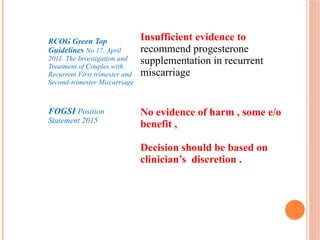
RCOG Green Top
Guidelines No 17. April
2011. The Investigation and
Treatment of Couples with
Recurrent First trimester and
Second-trimester Miscarriage
Insufficient evidence to
recommend progesterone
supplementation in recurrent
miscarriage
FOGSI Position
Statement 2015
No evidence of harm , some e/o
benefit ,
Decision should be based on
clinician’s discretion .
FOGSI POSITION STATEMENT 2015
• No statistically significant difference in congenital
abnormalities seen in clinical studies between
newborns of mothers who received progesterone &
those who did not
• caution in patients with cardiovascular diseases ,
impaired liver function & cholestasis.
HCG AND OESTROGEN
hCG
 Insufficient evidence
 RCOG Green Top Guidelines No 17. April 2011. The
Investigation and Treatment of Couples with Recurrent First
trimester and Second-trimester Miscarriage
 Higher risk of OHSS
 Van der Linden et al. Cochrane Database of
Systematic Reviews 2015
 Smaller placebo controlled study
cited hCG benefit confined to a
small subgroup of patients with
RPL & oligomenorrhoea.
 Quenby S, Farquharson RG. Human chorionic
gonadotropin supplementation in recurring pregnancy
loss: a controlled trial. Fertil Steril 1994;62:708–10.
Oestrogen
 no
improvement
in outcomes
 Van der Linden et al.
Cochrane Database
of Systematic Reviews
2015
PCOS
 Prevalence of PCOS in pts of RPL- 50-60%

Thrombotic association
 high LH , androgen levels
insulin resistance, hyperinsulinemia, glucose intolerence
ovulatory dysfunctions ( endocrino- metabolic)
METFORMIN / INSULIN
 PCOS, Insulin resistance, GDM
 Treatment reduces risk of miscarriage and
improves pregnancy outcomes.
 Metformin- low risk ,effective oral hypoglycemic
agent for type 2DM.
Safe and effective in gestational DM.
corrects glycemic abnormalites.
1. Suppression of high LH- does not improve live
birth- Grade A
2. Metformin- Insufficient evidence- Grade C
3. Laparoscopic Ovarian Drilling- ?
PCOS
 Recommendation
Assessment of PCOS,
fasting insulin and fasting glucose
is not recommended in women with RPL to
improve next pregnancy outcome.
 Strong ⊕⊕
HYPERPROLACTINEMIA
 insufficient folliculogenesis, short luteal phase
 Prolactin disorders are associated with PCOS,
luteal phase deficiency, stress and obesity
 Recommendation
 Prolactin testing is not recommended in
women with RPL in the absence of clinical
symptoms of
hyperprolactinemia(oligo/amenorrhea).
Conditional ⊕
HYPER PROLACTINEIA MX
 Prolactin testing if clinical symptoms of it-
oligo/amenorrhoea.
 Dopamine agonist therapy-bromocriptine
-cabergoline
Bromocriptine- 2.5-5 mg/day (depending upon response)
before conception till 9 weeks- better pregnancy
outcomes.
Bromocriptine can be considered in RPL with
hyperprolactinemia .
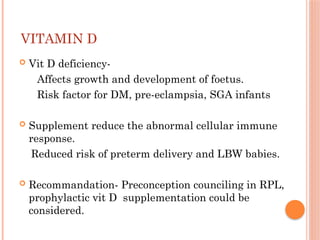
VITAMIN D
 Vit D deficiency-
Affects growth and development of foetus.
Risk factor for DM, pre-eclampsia, SGA infants
 Supplement reduce the abnormal cellular immune
response.
Reduced risk of preterm delivery and LBW babies.
 Recommandation- Preconception counciling in RPL,
prophylactic vit D supplementation could be
considered.
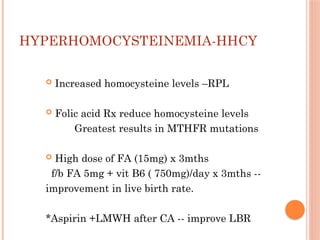
HYPERHOMOCYSTEINEMIA-HHCY
 Increased homocysteine levels –RPL
 Folic acid Rx reduce homocysteine levels
Greatest results in MTHFR mutations
 High dose of FA (15mg) x 3mths
f/b FA 5mg + vit B6 ( 750mg)/day x 3mths --
improvement in live birth rate.
*Aspirin +LMWH after CA -- improve LBR
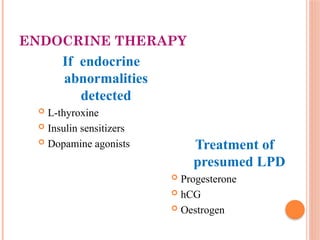
ENDOCRINE THERAPY
If endocrine
abnormalities
detected
 L-thyroxine
 Insulin sensitizers
 Dopamine agonists Treatment of
presumed LPD
 Progesterone
 hCG
 Oestrogen
RPL- IMMUNOLOGICAL
BACKGROUND
 Presence of immune biomarkers in
peripheral blood
/ endometrium / decidua -- RPL
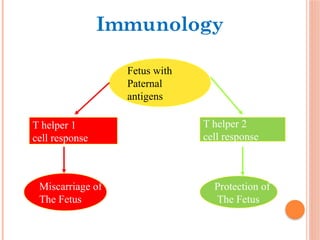
Fetus with
Paternal
antigens
T helper 1
cell response
Miscarriage of
The Fetus
T helper 2
cell response
Protection of
The Fetus
Immunology
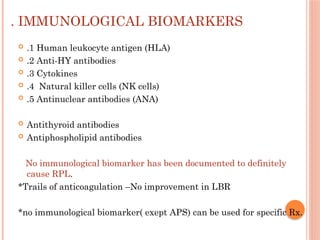
. IMMUNOLOGICAL BIOMARKERS
 .1 Human leukocyte antigen (HLA)
 .2 Anti-HY antibodies
 .3 Cytokines
 .4 Natural killer cells (NK cells)
 .5 Antinuclear antibodies (ANA)
 Antithyroid antibodies
 Antiphospholipid antibodies
No immunological biomarker has been documented to definitely
cause RPL.
*Trails of anticoagulation –No improvement in LBR
*no immunological biomarker( exept APS) can be used for specific Rx.
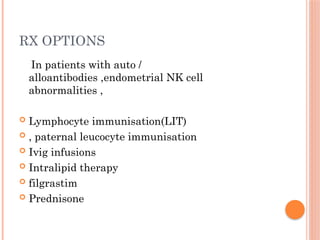
RX OPTIONS
In patients with auto /
alloantibodies ,endometrial NK cell
abnormalities ,
 Lymphocyte immunisation(LIT)
 , paternal leucocyte immunisation
 Ivig infusions
 Intralipid therapy
 filgrastim
 Prednisone
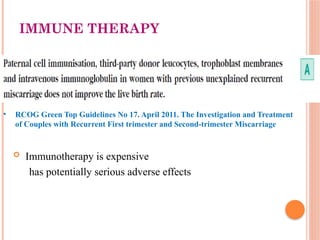
IMMUNE THERAPY
 Immunotherapy is expensive
has potentially serious adverse effects
• RCOG Green Top Guidelines No 17. April 2011. The Investigation and Treatment
of Couples with Recurrent First trimester and Second-trimester Miscarriage
UTERINE ANOMALIES
 Congenital- Mullerian tract malformations
1. Septate utrus
2. Bicorporeal uterus with normal Cx (bicornuate uterus)
3. Bicorporeal uterus with double Cx (Didelphic uterus)
4. Hemiuterus (Unicornuate uterus)
 Well documented association between congenital uterine
malformations and RPL.
 All women with RPL should be assessed for uterine
anomaly (congenital/ acquired)
 Septate Uterus- RPL in 1st
Tm
 Bicornuate/ Arcuate Uterus- RPL in 2nd
Tm
RCOG Green Top Guidelines No 17. April 2011. The Investigation and Treatment of Couples with Recurrent First
trimester and Second-trimester Miscarriage
Initial Screening
• 2D USG
• HSG/ SSG
Further Testing
• 3D USG
• Hystero/Laparoscopy
• MRI
SEPTATE UTERUS-
 Associated with poor pregnancy outcome
 Hysterscopic metroplasty –Rx of choice
easy, less morbidity, less risk of IU adhesions.
After Rx - higher pregnancy rates
reduced miscarriage rates
BICORPOREAL UTERUS , NORMAL CX
Metroplasty (trans abdominal / laproscopic)
Reduce preterm birth ,LBW
But no strong evidence in RPL
–not recommanded for RPL
.
Bicorporeal uterus ,double Cx
Laproscopic unification has been described
Doubtful efficacy in improving LBR
T shaped uterus -No e/o to support Rx
Hemiuterus ( unicornuate uterus)
- Uterine reconstruction –not recommanded
- Irreparable anatomic abnormality + RPL
- IVF and surrogacy can be offered.
ACQUIRED IU MALFORMATIONS
-Not clearly associated RPL
 Endometrial polyps – hysteroscopic removal , if >1cm.
 Fibroids-
1.Submucosal-
myomectomy- reduce miscarriage rates in selected
cases with RPL.
2. Intramural-
fibroids that do not distort uterine cavity- no Sx
needed
3. Subserosal- less likely to cause RPL
HYSTEROSCOPIC MYOMECTOMY-
Post- op complications –may affect future fertility
intra-uterine adhesions
Risk of rupture during future pregnancy
.
INTRA UTERINE ADHESIONS- IUA
RPL- more predisposed to IUA d/t prev D n C
exessive, overzealous curratage.
Rx-Surgical adhesiolysis
care to prevent recurrence of adhesions.
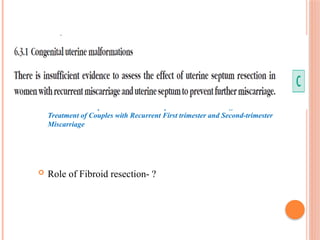
 RCOG Green Top Guidelines No 17. April 2011. The Investigation and
Treatment of Couples with Recurrent First trimester and Second-trimester
Miscarriage
 Role of Fibroid resection- ?
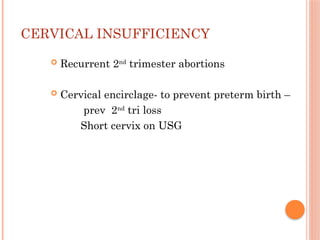
CERVICAL INSUFFICIENCY
 Recurrent 2nd
trimester abortions
 Cervical encirclage- to prevent preterm birth –
prev 2nd
tri loss
Short cervix on USG
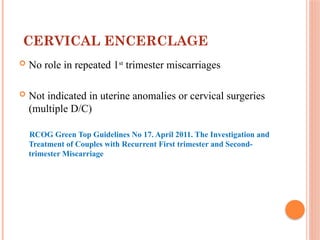
CERVICAL ENCERCLAGE
 No role in repeated 1st
trimester miscarriages
 Not indicated in uterine anomalies or cervical surgeries
(multiple D/C)
RCOG Green Top Guidelines No 17. April 2011. The Investigation and
Treatment of Couples with Recurrent First trimester and Second-
trimester Miscarriage
UNEXPLAINED / IDEOPATHIC RPL
• Counsel them and explain the chances
• Reassure that she is in safe hands
• Give psychological support
• Respect the couple’s concerns and decisions
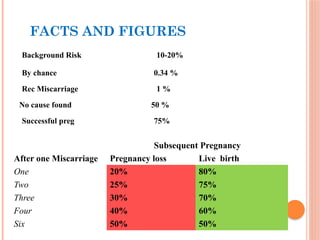
FACTS AND FIGURES
Background Risk 10-20%
By chance 0.34 %
Rec Miscarriage 1 %
No cause found 50 %
Successful preg 75%
Subsequent Pregnancy
After one Miscarriage Pregnancy loss Live birth
One 20% 80%
Two 25% 75%
Three 30% 70%
Four 40% 60%
Six 50% 50%
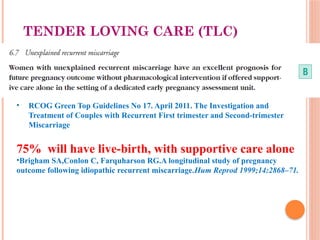
TENDER LOVING CARE (TLC)
• RCOG Green Top Guidelines No 17. April 2011. The Investigation and
Treatment of Couples with Recurrent First trimester and Second-trimester
Miscarriage
75% will have live-birth, with supportive care alone
•Brigham SA,Conlon C, Farquharson RG.A longitudinal study of pregnancy
outcome following idiopathic recurrent miscarriage.Hum Reprod 1999;14:2868–71.
MISCELLANEOUS RX
 Vitamin B12 + Folate + Pyridoxine- to
reduce homocysteine level
 Antioxidants
 Empirical antibiotics
 Probiotics
 Nitric Oxide donors – as vasodilator
Reported in small studies but
no RCT available
Life Style Changes
• Weight Control
• Smoking Cessation
• Reduce alcohol, exessive caffine
. Avoid recreational drugs
Stress reduction
Can be helpful
TAKE HOME MESSAGES
 The pathophysiology of RPL is little understood
 Only tests required- APLA screening, pelvic USG and
selective karyotyping
 Treatment should be offerred for these abnormalities only
 Unexplained RPL is an enigma for gynaecologists
 Gain the confidence of the patients
 Tender Loving Care is all that is needed
 RPL patients carry risk of developing atherosclerotic
disease in later life ( d/t chronic activation of pro-
inflammatory pathways)
Recurrent pregnancy loss and its causes.

Recurrent pregnancy loss and its causes.

  • 1.
    MANAGEMENT OF RPL Dr.Sunita Khedkar M.B.B.S , DGO (Mumbai ) Consultant , Khedkar Maternity hospital, Aurangabad
  • 2.
    RECURRENT PREGNANCY LOSS (RPL) ≥3 consecutive miscarriages before the age of fetal viability* *Weight <500 gram, GA- ≤22 weeks (WHO), ≤24 weeks (RCOG) 1. Primary RPL- No previous successful pregnancy 2. Secondary RPL- Previous ≥1 successful pregnancy
  • 3.
    2 OR 3-NUMBER GAME? After 2 loss-  Loss of subsequent pregnancy similar  Significant chance of detecting cause  Especially- if subfertility or >35 years  Avoid 3rd potential psychological trauma  Women starting reproductive career late  Patient → Impatient
  • 4.
    PARENTERAL AGE ANDRPL Recommendations  Women should be sensitively informed that the risk of pregnancy loss is lowest in women aged 20 to 35 years. Strong ⊕⊕  Women should be sensitively informed that the risk of pregnancy loss rapidly increases after the age of 40. Strong ⊕⊕  Male age Most studies evaluating male age have reported a significant association between increasing male age and the incidence of miscarriage (Sharma et al., 2015)
  • 5.
    5 STRESS  Changes Th2response in endometrium to Th1 response  Affects HPO axis  Adrenaline release reduces placental blood flow
  • 6.
    IF DEFINITE CAUSEOF RPL IS FOUND  Targeted Therapy  Explain- the role of chance factors
  • 7.
    CAUSES fetal  chromosomal abrasions- accounts for43% of losses maternal  abnormal tropoblast invasion and development sec to 1. Endocrine 2. immunological-local/syste mic reaction 3. anatomical abrasions
  • 8.
    RPL WITH GENETICBACKGROUND  Genetic abnormalities of conceptus- - recognised cause of sporadic , recurrent pregnancy loss.  Prevalence of chromosomal abnormality in single sporadic miscarriage- 45%
  • 9.
     Common abnormalitiesthat occur in early losses –developmental and genetic  Most pregnancies – embryo morphologically abnormal (86-91% where embryo is present)  Genetically abnormal embryos -Phenotypically abnormal /normal (some)
  • 10.
    POC KARYOTYPING RCOG GreenTop Guidelines No 17. April 2011. The Investigation and Treatment of Couples with Recurrent First trimester and Second-trimester Miscarriage •Chromosomal anomaly of the embryo- Commonest cause of single sporadic miscarriage •Provides opportunity to offer genetic counselling •Prognosis for future pregnancy is BETTER if the karyotype of POC abnormal •Chance of aneuploidy DECREASES as the number of miscarriage increases
  • 11.
    CHOROMOSOMAL ANALYSIS- PARENTS  NotRoutine  Only if karyotyping of POC - unbalanced structural abnormalities  If karyotype of POC not done
  • 12.
    .All couples withabnormal foetal /parental karyotype -genetic councilling , discuss possible Rx options- pros n cons 1.PGT-A( preimplantation genetic testing for aneuploidy) Embryos in IVF cycle are biopsied and screened for chromosomal abnormalities prior to implantation. 2.FISH- with embryo biopsy @ D3 ,looks at specific number of chromosome ,at early stage when mosaicism is higher. 3.Whole genome teqniques- * Array CGH(Comparative genomic hybridisation ) * NGS( next generation sequencing), more accurate screening teqniques( biopsy taken at blastocyst stage, looking at all chromosomes)
  • 13.
     Clinical outcomesare improved in couples with PGS. -Costly  3rd party reproduction  adoption
  • 14.
    THROMBOPHILIA ( HEREDITORY/AQUIRED) Predisposes patient to venous thromboembolism Hereditory thrombophilia-  Factor V Leiden mutation  Prothrombin mutation  Protein C, Protein S, Antithrombin deficiency  MTHFR gene mutation (methylene tetrahydrofolate reductase)
  • 15.
    MX RPL+ Thrombophilia- treatmentto prevent thromosis 1. Anthithrombotic agents –aspirin 2. Anticoagulants – heparin(UFH/LMWH) 3. IVIG, Steroids –to suppress immune system, improve pregnancy outcome 4. FA, vit B6, vit B12- reduce homocystein level MTHFR mutation +/hyperhomocysteinemia
  • 16.
    In women withhereditory thrombophilia + RPL antithrombotic prophylaxis is NOT recommended Exept in context of clinical research / VTE Prevention . Screening for hereditory thrombophilia- not recommened.
  • 17.
    APS -ANTIPHOSPHOLIPID SYNDOME  Persistentpresence of antiphospholipid antibodies + vascular thrombosis +/ pregnancy complications.  3/more losses excluding -Miscarriages before 10 weeks -Maternal anatomic/hormonal abnormalities -Maternal and paternal chromosomal causes Is one of the clinical criteria –diagnosis of APS
  • 18.
    3 CLINICALLY RELEVENTANTIBODIES ( ASSOCIATED WITH THROMBOSIS)-  Lupus Anticoagulant (LAC)- Positive  Anti-Cardiolipin Antibody (ACL) IgG/ IgM- Moderate to High Titre (>40 IU/L)  Anti- 2-glycoprotein 1 ẞ IgG/ IgM Moderate to High Titre  Considerable laboratory variations and lack of standardization  LAC- dRVVT (with platelet neutralization)- better than aPTT  ACL and 2- ẞ glycoprotein- ELISA  In 2 occasions ≥12 weeks apart
  • 19.
    Mx APS- 1.Anticoagulants – Forprevention of thrombosis LMWH is prefered over UFH- - less risk of osteoporosis, heparin induced thrombocytopenia 2.Steroids- prednisolone has been evaluated in Rx of RPL + APS - no e/o benefit Adverse effects --eg.risk of GDM, risk HT, preclampsia, LBW, NICU admission
  • 20.
    3. IVIG-superior toprednisolone birth wt number of miscarriages PTL 4. Hydrxy chloroquine- immunomodulator- inhibits antigen presentation and B, T cell activation. Safe ,effectve in preventing obs complications in APS. Further studies- RPL and APS
  • 21.
     LDA (75mg/day) after +ve UPT  LMWH- after confirmation of fetal cardiac activity  IVIG/Corticosteroid- Not effective in primary APS Prophylactic Dose No intervention Antithrombotics Live Birth rate 10% 80% Improvement 54%
  • 22.
    ESHRE-RPL –GUIDELINE-(NOV 2017) Women who satisfy lab criteria of APS and h/o 3/more pregnancy losses - low dose Aspirin ( 75-100mg/day), starting before conception, -Prophylactic dose of heparin( UFH/LMWH) from positive UPT. Anticoagulant Rx with 2 losses ,only for clinical research (GDG)
  • 23.
    METABOLIC AND ENDOCRINE ABNORMALITIES OvertHypothyroidism -Associated with poor pregnancy outcomes Risk of miscarriage, preterm delivery,LBW, poor fetal neurodevelopment. *increase daily dose T4 d/t physiological changes. *TSH levels – early pregnancy( 7-9 weeks)
  • 24.
    SUBCLINICAL HYPOTHYROIDISM - SCH Acc.to American Thyroid association- treat if 1. TSH >10mU/L 2. TPO antibodies +ve and TSH above trimester specific range. 1st trimester- 2.5mU/L 2nd trimester- 3mU/L 3rd trimester- 3.5mU/L Reduction in risk of abortion with T4 supplementation
  • 25.
    LUTEAL PHASE INSUFFICIENCY Consecutive short leuteal phase( Normal-11-16days)- S/O insufficient progesterone– abortion. --One of the reasons for implantation failure- miscarriage unsuccessful assisted reproduction Associated with PCOS, thyroid, prolactin disorder and poor ovarian function ( age, AMH, AFC).  Progesterone  HCG
  • 26.
    PROGESTERONE- WHICH MOLECULE? NMP Dydrogesterone Selectivityto P4 receptor More selective Route Oral, vaginal, IM Oral Bioavailability Better Metabolism May increase risk of obstetric cholestasis Less metabolic load on liver
  • 27.
    Oral Vaginal IM •Easiestway •Higher uterine concentration •Optimum blood level •Can be taken anywhere •Needs privacy •Extremely painful • acceptable and tolerable to women •10% may have vaginal dryness/ irritability •Abscess formation Route of administration- Does NOT affect the outcome •Haas DM, Ramsey PS. Cochrane Database Syst Rev 2013 Oct 31; 10: CD003511 •Van der Linden et al. Cochrane Database of Systematic Reviews 2015
  • 28.
    IS PROGESTERONE SAFE? No significant differences in the rates of preterm birth, neonatal death, or fetal genital anomalies- between progestogen therapy vs placebo/control.  No studies reported adverse maternal effects. Haas DM, Ramsey PS. Cochrane Database Syst Rev 2013 Oct 31; 10: CD003511.
  • 29.
    IS PROGESTERONE EFFECTIVEIN RPL Wahabi HA, et al. 2011 The evidence suggesting benefit of progestins for women with RPL and with threatened miscarriage, remains preliminary Haas DM, Ramsey PS. 2013 Sub-group analysis - women with RPL,when supplemented with progesterone shows the odds of miscarriage are significantly decreased . Carp H. 2015 Although all the predictive and confounding factors could not be controlled , significant reduction ( 29% )in the odds for miscarriage was found when dydrogesterone is compared to standard care
  • 30.
    PROMISE TRIAL FIRST TRIMESTERPROGESTERONE THERAPY IN WOMEN WITH A HISTORY OF UNEXPLAINED RECURRENT MISCARRIAGE Coomarasamy A., et al. N Eng J Med 2015;373:2141-8
  • 31.
    PROMISE TRIAL-  Progesteronetherapy in the 1st trimester of pregnancy did not result in a significantly higher rate of live births among women with a history of unexplained recurrent miscarriages
  • 32.
    RCOG Green Top GuidelinesNo 17. April 2011. The Investigation and Treatment of Couples with Recurrent First trimester and Second-trimester Miscarriage Insufficient evidence to recommend progesterone supplementation in recurrent miscarriage FOGSI Position Statement 2015 No evidence of harm , some e/o benefit , Decision should be based on clinician’s discretion .
  • 33.
    FOGSI POSITION STATEMENT2015 • No statistically significant difference in congenital abnormalities seen in clinical studies between newborns of mothers who received progesterone & those who did not • caution in patients with cardiovascular diseases , impaired liver function & cholestasis.
  • 34.
    HCG AND OESTROGEN hCG Insufficient evidence  RCOG Green Top Guidelines No 17. April 2011. The Investigation and Treatment of Couples with Recurrent First trimester and Second-trimester Miscarriage  Higher risk of OHSS  Van der Linden et al. Cochrane Database of Systematic Reviews 2015  Smaller placebo controlled study cited hCG benefit confined to a small subgroup of patients with RPL & oligomenorrhoea.  Quenby S, Farquharson RG. Human chorionic gonadotropin supplementation in recurring pregnancy loss: a controlled trial. Fertil Steril 1994;62:708–10. Oestrogen  no improvement in outcomes  Van der Linden et al. Cochrane Database of Systematic Reviews 2015
  • 35.
    PCOS  Prevalence ofPCOS in pts of RPL- 50-60%  Thrombotic association  high LH , androgen levels insulin resistance, hyperinsulinemia, glucose intolerence ovulatory dysfunctions ( endocrino- metabolic)
  • 36.
    METFORMIN / INSULIN PCOS, Insulin resistance, GDM  Treatment reduces risk of miscarriage and improves pregnancy outcomes.  Metformin- low risk ,effective oral hypoglycemic agent for type 2DM. Safe and effective in gestational DM. corrects glycemic abnormalites.
  • 37.
    1. Suppression ofhigh LH- does not improve live birth- Grade A 2. Metformin- Insufficient evidence- Grade C 3. Laparoscopic Ovarian Drilling- ?
  • 38.
    PCOS  Recommendation Assessment ofPCOS, fasting insulin and fasting glucose is not recommended in women with RPL to improve next pregnancy outcome.  Strong ⊕⊕
  • 39.
    HYPERPROLACTINEMIA  insufficient folliculogenesis,short luteal phase  Prolactin disorders are associated with PCOS, luteal phase deficiency, stress and obesity  Recommendation  Prolactin testing is not recommended in women with RPL in the absence of clinical symptoms of hyperprolactinemia(oligo/amenorrhea). Conditional ⊕
  • 40.
    HYPER PROLACTINEIA MX Prolactin testing if clinical symptoms of it- oligo/amenorrhoea.  Dopamine agonist therapy-bromocriptine -cabergoline Bromocriptine- 2.5-5 mg/day (depending upon response) before conception till 9 weeks- better pregnancy outcomes. Bromocriptine can be considered in RPL with hyperprolactinemia .
  • 41.
    VITAMIN D  VitD deficiency- Affects growth and development of foetus. Risk factor for DM, pre-eclampsia, SGA infants  Supplement reduce the abnormal cellular immune response. Reduced risk of preterm delivery and LBW babies.  Recommandation- Preconception counciling in RPL, prophylactic vit D supplementation could be considered.
  • 42.
    HYPERHOMOCYSTEINEMIA-HHCY  Increased homocysteinelevels –RPL  Folic acid Rx reduce homocysteine levels Greatest results in MTHFR mutations  High dose of FA (15mg) x 3mths f/b FA 5mg + vit B6 ( 750mg)/day x 3mths -- improvement in live birth rate. *Aspirin +LMWH after CA -- improve LBR
  • 43.
    ENDOCRINE THERAPY If endocrine abnormalities detected L-thyroxine  Insulin sensitizers  Dopamine agonists Treatment of presumed LPD  Progesterone  hCG  Oestrogen
  • 44.
    RPL- IMMUNOLOGICAL BACKGROUND  Presenceof immune biomarkers in peripheral blood / endometrium / decidua -- RPL
  • 45.
    Fetus with Paternal antigens T helper1 cell response Miscarriage of The Fetus T helper 2 cell response Protection of The Fetus Immunology
  • 46.
    . IMMUNOLOGICAL BIOMARKERS .1 Human leukocyte antigen (HLA)  .2 Anti-HY antibodies  .3 Cytokines  .4 Natural killer cells (NK cells)  .5 Antinuclear antibodies (ANA)  Antithyroid antibodies  Antiphospholipid antibodies No immunological biomarker has been documented to definitely cause RPL. *Trails of anticoagulation –No improvement in LBR *no immunological biomarker( exept APS) can be used for specific Rx.
  • 47.
    RX OPTIONS In patientswith auto / alloantibodies ,endometrial NK cell abnormalities ,  Lymphocyte immunisation(LIT)  , paternal leucocyte immunisation  Ivig infusions  Intralipid therapy  filgrastim  Prednisone
  • 48.
    IMMUNE THERAPY  Immunotherapyis expensive has potentially serious adverse effects • RCOG Green Top Guidelines No 17. April 2011. The Investigation and Treatment of Couples with Recurrent First trimester and Second-trimester Miscarriage
  • 49.
    UTERINE ANOMALIES  Congenital-Mullerian tract malformations 1. Septate utrus 2. Bicorporeal uterus with normal Cx (bicornuate uterus) 3. Bicorporeal uterus with double Cx (Didelphic uterus) 4. Hemiuterus (Unicornuate uterus)  Well documented association between congenital uterine malformations and RPL.
  • 50.
     All womenwith RPL should be assessed for uterine anomaly (congenital/ acquired)  Septate Uterus- RPL in 1st Tm  Bicornuate/ Arcuate Uterus- RPL in 2nd Tm RCOG Green Top Guidelines No 17. April 2011. The Investigation and Treatment of Couples with Recurrent First trimester and Second-trimester Miscarriage Initial Screening • 2D USG • HSG/ SSG Further Testing • 3D USG • Hystero/Laparoscopy • MRI
  • 51.
    SEPTATE UTERUS-  Associatedwith poor pregnancy outcome  Hysterscopic metroplasty –Rx of choice easy, less morbidity, less risk of IU adhesions. After Rx - higher pregnancy rates reduced miscarriage rates
  • 52.
    BICORPOREAL UTERUS ,NORMAL CX Metroplasty (trans abdominal / laproscopic) Reduce preterm birth ,LBW But no strong evidence in RPL –not recommanded for RPL . Bicorporeal uterus ,double Cx Laproscopic unification has been described Doubtful efficacy in improving LBR
  • 53.
    T shaped uterus-No e/o to support Rx Hemiuterus ( unicornuate uterus) - Uterine reconstruction –not recommanded - Irreparable anatomic abnormality + RPL - IVF and surrogacy can be offered.
  • 54.
    ACQUIRED IU MALFORMATIONS -Notclearly associated RPL  Endometrial polyps – hysteroscopic removal , if >1cm.  Fibroids- 1.Submucosal- myomectomy- reduce miscarriage rates in selected cases with RPL. 2. Intramural- fibroids that do not distort uterine cavity- no Sx needed 3. Subserosal- less likely to cause RPL
  • 55.
    HYSTEROSCOPIC MYOMECTOMY- Post- opcomplications –may affect future fertility intra-uterine adhesions Risk of rupture during future pregnancy . INTRA UTERINE ADHESIONS- IUA RPL- more predisposed to IUA d/t prev D n C exessive, overzealous curratage. Rx-Surgical adhesiolysis care to prevent recurrence of adhesions.
  • 56.
     RCOG GreenTop Guidelines No 17. April 2011. The Investigation and Treatment of Couples with Recurrent First trimester and Second-trimester Miscarriage  Role of Fibroid resection- ?
  • 57.
    CERVICAL INSUFFICIENCY  Recurrent2nd trimester abortions  Cervical encirclage- to prevent preterm birth – prev 2nd tri loss Short cervix on USG
  • 58.
    CERVICAL ENCERCLAGE  Norole in repeated 1st trimester miscarriages  Not indicated in uterine anomalies or cervical surgeries (multiple D/C) RCOG Green Top Guidelines No 17. April 2011. The Investigation and Treatment of Couples with Recurrent First trimester and Second- trimester Miscarriage
  • 59.
    UNEXPLAINED / IDEOPATHICRPL • Counsel them and explain the chances • Reassure that she is in safe hands • Give psychological support • Respect the couple’s concerns and decisions
  • 60.
    FACTS AND FIGURES BackgroundRisk 10-20% By chance 0.34 % Rec Miscarriage 1 % No cause found 50 % Successful preg 75% Subsequent Pregnancy After one Miscarriage Pregnancy loss Live birth One 20% 80% Two 25% 75% Three 30% 70% Four 40% 60% Six 50% 50%
  • 61.
    TENDER LOVING CARE(TLC) • RCOG Green Top Guidelines No 17. April 2011. The Investigation and Treatment of Couples with Recurrent First trimester and Second-trimester Miscarriage 75% will have live-birth, with supportive care alone •Brigham SA,Conlon C, Farquharson RG.A longitudinal study of pregnancy outcome following idiopathic recurrent miscarriage.Hum Reprod 1999;14:2868–71.
  • 62.
    MISCELLANEOUS RX  VitaminB12 + Folate + Pyridoxine- to reduce homocysteine level  Antioxidants  Empirical antibiotics  Probiotics  Nitric Oxide donors – as vasodilator Reported in small studies but no RCT available Life Style Changes • Weight Control • Smoking Cessation • Reduce alcohol, exessive caffine . Avoid recreational drugs Stress reduction Can be helpful
  • 63.
    TAKE HOME MESSAGES The pathophysiology of RPL is little understood  Only tests required- APLA screening, pelvic USG and selective karyotyping  Treatment should be offerred for these abnormalities only  Unexplained RPL is an enigma for gynaecologists  Gain the confidence of the patients  Tender Loving Care is all that is needed  RPL patients carry risk of developing atherosclerotic disease in later life ( d/t chronic activation of pro- inflammatory pathways)