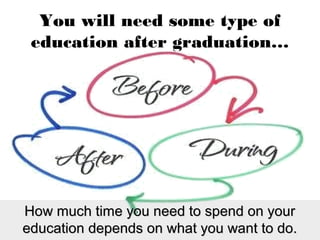
You will need some type of
education after graduation…
How much time you need to spend on yourHow much time you need to spend on your
education depends on what you want to do.education depends on what you want to do.
So, what
do you
want to
do?
There are 5 ways to get to
where you want to be.
(Including Internships,
Apprenticeships,
and Self-Employment)
MilitaryMilitary
VocationalVocational
Formal
Educationa
l
Experience
s
The completion of high school or the equivalent
resulting in the award of a high school diploma
or the equivalent, such as the General Education
Development (GED) credential.
What if I want to beWhat if I want to be
a couch potato???a couch potato???
Sections
• Language Arts, Reading
• Language Arts, Writing
• Mathematics
• Science
• Social Studies
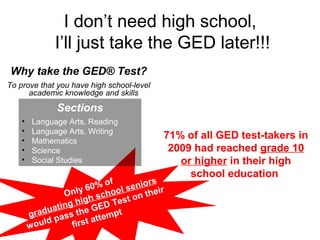
I don’t need high school,
I’ll just take the GED later!!!
Why take the GED® Test?
To prove that you have high school-level
academic knowledge and skills
Only 60% of
graduating high school seniors
would pass the GED Test on their
first attempt
2009 Test-taker Statistics
788,314 candidates (started test)
683,519 completers (completed test)
472,913 passers (passed test)
(69% of all completers passed the GED Test battery
and only 60% of those who tried, passed)
71% of all GED test-takers in
2009 had reached grade 10
or higher in their high
school education
Not all Colleges and
Companies accept
a GED in place of a
diploma.
Moral of the Story…
AND
GRADUATE!!!
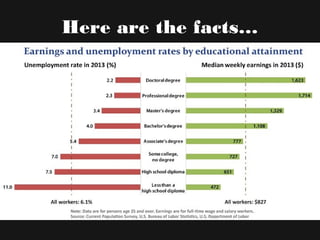
Here are the facts…
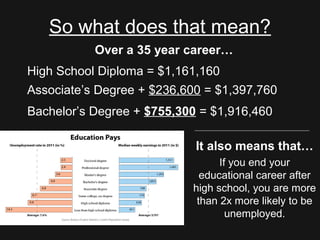
So what does that mean?
Over a 35 year career…
High School Diploma = $1,161,160
It also means that…
If you end your
educational career after
high school, you are more
than 2x more likely to be
unemployed.
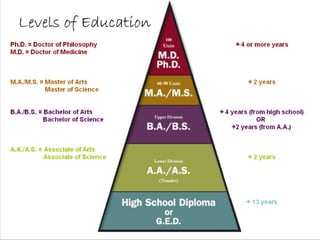
Associate’s Degree + $236,600 = $1,397,760
Bachelor’s Degree + $755,300 = $1,916,460
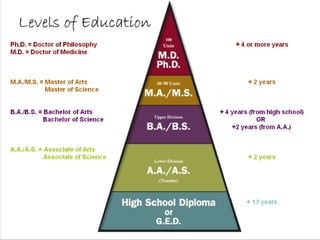
Associate’s Degree
Degree awarded usually
for at least 2 years of
full-time academic work
WHY???
•Prove that you are
ready.
•Save money first!
•You will need to take
some classes outside of
your major.
Undergraduate /
Bachelor’s Degree
Degree awarded for at least 4
years of full-time academic
study beyond high school
•Offer a variety of majors.
•Does not always result in a
specific job/career
•Leave with a broad range of
skills and aptitudes that will
benefit in many career paths.
Master’s / Graduate /
Post-Baccalaureate
Degree
Degree awarded for 1 or 2 years of
full-time academic study beyond a
bachelor’s degree
•It is becoming the new standard in
many professional careers.
•Master of Arts or Science
•Increase your potential earnings.
•Some people work and their
employer will pay for graduate
degree (flexible class schedules)
Doctoral or Professional
Degree
Degree awarded for at
least 3 years of full-time
academic work beyond a
bachelor’s degree
•Law
•Medical
•Veterinary
•Dentistry
…specific skills in an
area to earn credentials
But what if that’s just not for
College College
CoCollegeCollegeCollegeCollege
Aren’t
there any
other
options??
There are 5 ways to get to
where you want to be.
(Including Internships,
Apprenticeships,
and Self-Employment)
MilitaryMilitary
VocationalVocational
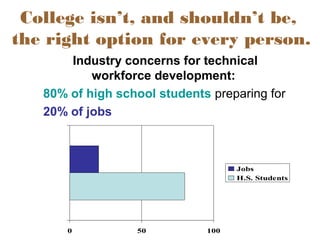
College isn’t, and shouldn’t be,
the right option for every person.
Industry concerns for technical
workforce development:
80% of high school students preparing for
20% of jobs
0 50 100
Jobs
H.S. Students
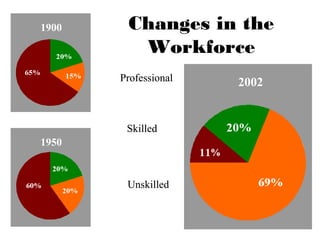
Changes in the
Workforce
1900
1950
2002Professional Skilled UnskilleProfessional Skilled Unskille
onal Skilled Unskilledonal Skilled Unskilled
Professional Skilled UnskilledProfessional Skilled Unskilled
Minimal physical labor.
Usually requires a
specialized degree.
Physical labor usually required.
Individual trained to perform a
specific task or set of tasks.
Physical labor generally
required.
No training.
Easiest to replace.
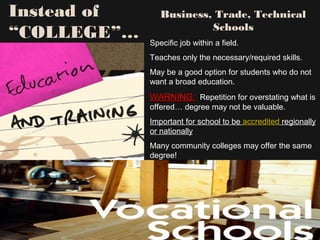
Instead of
“COLLEGE”…
Business, Trade, Technical
Schools
Specific job within a field.
Teaches only the necessary/required skills.
May be a good option for students who do not
want a broad education.
WARNING:WARNING: Repetition for overstating what is
offered… degree may not be valuable.
Important for school to be accredited regionally
or nationally
Many community colleges may offer the same
degree!
Post-Secondary
Non-degree Award
Usually a certificate or other award that is not
a degree. Certifications issued by professional
organizations or certifying bodies are not
included in this category. Programs may last
only a few weeks to 2 years.
– Nursing Assistant
– Emergency Medical Technician (EMT)
– Paramedic
– Hairstylist
Non-Degree Awards
Licenses
Permission granted by
government agencies or
other accrediting bodies that
allows someone to work in a
particular occupation or
perform certain duties.
Certifications
Award for demonstrating
competency in a skill or set
of skills, typically through
the passage of an
examination, work
experience, training, or
some combination thereof.
Certifcation is always
voluntary; some certification
programs may require a
certain level of educational
achievement for eligibility.
On-the-Job
Training
Experience
s
Short Term On-the-Job
Training
1 month or less of combined on-the-job
experience and informal training is needed
for the worker to develop the skills to attain
competency; this on-the-job training
category also includes employer-sponsored
training programs
Moderate On-the-Job
Training
More than 1 month up to 12 months of
combined on-the-job experience and
informal training is needed for the worker to
develop the skills to attain competency; this
on-the-job training category also includes
employer-sponsored training programs.
Long-term On-the-Job
Training
More than 12 months of on-the-job training or alternatively,
combined work experience and formal classroom instruction,
are needed for workers to develop the skills to attain
competency. This on-the-job training category also includes
employer-sponsored training programs. Such programs
include those offered by fire academies and schools for air
traffic controllers. In other occupations in which workers
typically need to possess a natural ability or talent –
including musicians and singers, athletes, dancers,
photographers, and actors – and that ability or talent must
be cultivated over several years, sometimes in a non-work
setting. Excludes apprenticeships
A formal relationship between a worker
and a sponsor that consists of a
combination of on-the-job training and
related occupation-specific instruction in
which the worker learns the practical
and theoretical aspects of an
occupation. Apprenticeship programs
are sponsored by individual employers,
joint employer-and-labor groups, and
employee associations. Apprenticeship
programs usually provide at least 144
hours of occupation-specific technical
instruction and 2,000 hours of on-the-
job training per year over a 3 to 5 year
period.
Want a successful career? Want to further
your education without racking up debt?
Get started on your path to a successful
career and enroll in a Registered
Apprenticeship program.
The Registered
Apprenticeship program
offers access to 1,000
career areas, including the
following top occupations:
– Able seaman
– Carpenter
– Chef
– Child care development
specialist
– Construction craft laborer
– Dental assistant
– Electrician
– Elevator constructor
– Fire medic
– Law enforcement agent
– Over-the-road truck driver
– Pipefitter
Apprenticeships
Internship / Residency
Training that involves preparation in a field
such as medicine or teaching, generally
under supervision in a professional setting,
such as a hospital or classroom. This type of
training may occur before one is employed.
Completion of an internship or residency
program is commonly required for state
licensure or certification in fields including
medicine, counseling, architecture, and
teaching.
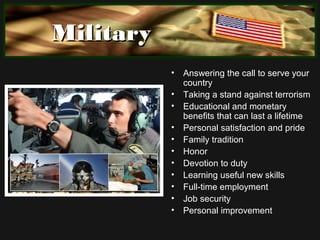
MilitaryMilitary
• Answering the call to serve your
country
• Taking a stand against terrorism
• Educational and monetary
benefits that can last a lifetime
• Personal satisfaction and pride
• Family tradition
• Honor
• Devotion to duty
• Learning useful new skills
• Full-time employment
• Job security
• Personal improvement
Ok, so if I do all
of that, I’m
done right?
NOPE!
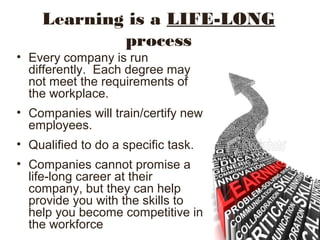
Learning is a LIFE-LONG
process
• Every company is run
differently. Each degree may
not meet the requirements of
the workplace.
• Companies will train/certify new
employees.
• Qualified to do a specific task.
• Companies cannot promise a
life-long career at their
company, but they can help
provide you with the skills to
help you become competitive in
the workforce

Post Secondary

  • 2.
    You will needsome type of education after graduation… How much time you need to spend on yourHow much time you need to spend on your education depends on what you want to do.education depends on what you want to do.
  • 3.
  • 4.
    There are 5ways to get to where you want to be. (Including Internships, Apprenticeships, and Self-Employment) MilitaryMilitary VocationalVocational
  • 5.
  • 7.
    The completion ofhigh school or the equivalent resulting in the award of a high school diploma or the equivalent, such as the General Education Development (GED) credential.
  • 8.
    What if Iwant to beWhat if I want to be a couch potato???a couch potato???
  • 9.
    Sections • Language Arts,Reading • Language Arts, Writing • Mathematics • Science • Social Studies I don’t need high school, I’ll just take the GED later!!! Why take the GED® Test? To prove that you have high school-level academic knowledge and skills Only 60% of graduating high school seniors would pass the GED Test on their first attempt 2009 Test-taker Statistics 788,314 candidates (started test) 683,519 completers (completed test) 472,913 passers (passed test) (69% of all completers passed the GED Test battery and only 60% of those who tried, passed) 71% of all GED test-takers in 2009 had reached grade 10 or higher in their high school education Not all Colleges and Companies accept a GED in place of a diploma.
  • 10.
    Moral of theStory… AND GRADUATE!!!
  • 11.
    Here are thefacts…
  • 12.
    So what doesthat mean? Over a 35 year career… High School Diploma = $1,161,160 It also means that… If you end your educational career after high school, you are more than 2x more likely to be unemployed. Associate’s Degree + $236,600 = $1,397,760 Bachelor’s Degree + $755,300 = $1,916,460
  • 13.
    Associate’s Degree Degree awardedusually for at least 2 years of full-time academic work WHY??? •Prove that you are ready. •Save money first! •You will need to take some classes outside of your major.
  • 14.
    Undergraduate / Bachelor’s Degree Degreeawarded for at least 4 years of full-time academic study beyond high school •Offer a variety of majors. •Does not always result in a specific job/career •Leave with a broad range of skills and aptitudes that will benefit in many career paths.
  • 15.
    Master’s / Graduate/ Post-Baccalaureate Degree Degree awarded for 1 or 2 years of full-time academic study beyond a bachelor’s degree •It is becoming the new standard in many professional careers. •Master of Arts or Science •Increase your potential earnings. •Some people work and their employer will pay for graduate degree (flexible class schedules)
  • 16.
    Doctoral or Professional Degree Degreeawarded for at least 3 years of full-time academic work beyond a bachelor’s degree •Law •Medical •Veterinary •Dentistry …specific skills in an area to earn credentials
  • 18.
    But what ifthat’s just not for College College CoCollegeCollegeCollegeCollege Aren’t there any other options??
  • 19.
    There are 5ways to get to where you want to be. (Including Internships, Apprenticeships, and Self-Employment) MilitaryMilitary VocationalVocational
  • 20.
    College isn’t, andshouldn’t be, the right option for every person. Industry concerns for technical workforce development: 80% of high school students preparing for 20% of jobs 0 50 100 Jobs H.S. Students
  • 21.
    Changes in the Workforce 1900 1950 2002ProfessionalSkilled UnskilleProfessional Skilled Unskille onal Skilled Unskilledonal Skilled Unskilled Professional Skilled UnskilledProfessional Skilled Unskilled Minimal physical labor. Usually requires a specialized degree. Physical labor usually required. Individual trained to perform a specific task or set of tasks. Physical labor generally required. No training. Easiest to replace.
  • 22.
    Instead of “COLLEGE”… Business, Trade,Technical Schools Specific job within a field. Teaches only the necessary/required skills. May be a good option for students who do not want a broad education. WARNING:WARNING: Repetition for overstating what is offered… degree may not be valuable. Important for school to be accredited regionally or nationally Many community colleges may offer the same degree!
  • 23.
    Post-Secondary Non-degree Award Usually acertificate or other award that is not a degree. Certifications issued by professional organizations or certifying bodies are not included in this category. Programs may last only a few weeks to 2 years. – Nursing Assistant – Emergency Medical Technician (EMT) – Paramedic – Hairstylist
  • 24.
    Non-Degree Awards Licenses Permission grantedby government agencies or other accrediting bodies that allows someone to work in a particular occupation or perform certain duties. Certifications Award for demonstrating competency in a skill or set of skills, typically through the passage of an examination, work experience, training, or some combination thereof. Certifcation is always voluntary; some certification programs may require a certain level of educational achievement for eligibility.
  • 25.
  • 26.
    Short Term On-the-Job Training 1month or less of combined on-the-job experience and informal training is needed for the worker to develop the skills to attain competency; this on-the-job training category also includes employer-sponsored training programs
  • 27.
    Moderate On-the-Job Training More than1 month up to 12 months of combined on-the-job experience and informal training is needed for the worker to develop the skills to attain competency; this on-the-job training category also includes employer-sponsored training programs.
  • 28.
    Long-term On-the-Job Training More than12 months of on-the-job training or alternatively, combined work experience and formal classroom instruction, are needed for workers to develop the skills to attain competency. This on-the-job training category also includes employer-sponsored training programs. Such programs include those offered by fire academies and schools for air traffic controllers. In other occupations in which workers typically need to possess a natural ability or talent – including musicians and singers, athletes, dancers, photographers, and actors – and that ability or talent must be cultivated over several years, sometimes in a non-work setting. Excludes apprenticeships
  • 29.
    A formal relationshipbetween a worker and a sponsor that consists of a combination of on-the-job training and related occupation-specific instruction in which the worker learns the practical and theoretical aspects of an occupation. Apprenticeship programs are sponsored by individual employers, joint employer-and-labor groups, and employee associations. Apprenticeship programs usually provide at least 144 hours of occupation-specific technical instruction and 2,000 hours of on-the- job training per year over a 3 to 5 year period. Want a successful career? Want to further your education without racking up debt? Get started on your path to a successful career and enroll in a Registered Apprenticeship program. The Registered Apprenticeship program offers access to 1,000 career areas, including the following top occupations: – Able seaman – Carpenter – Chef – Child care development specialist – Construction craft laborer – Dental assistant – Electrician – Elevator constructor – Fire medic – Law enforcement agent – Over-the-road truck driver – Pipefitter Apprenticeships
  • 30.
    Internship / Residency Trainingthat involves preparation in a field such as medicine or teaching, generally under supervision in a professional setting, such as a hospital or classroom. This type of training may occur before one is employed. Completion of an internship or residency program is commonly required for state licensure or certification in fields including medicine, counseling, architecture, and teaching.
  • 31.
    MilitaryMilitary • Answering thecall to serve your country • Taking a stand against terrorism • Educational and monetary benefits that can last a lifetime • Personal satisfaction and pride • Family tradition • Honor • Devotion to duty • Learning useful new skills • Full-time employment • Job security • Personal improvement
  • 32.
    Ok, so ifI do all of that, I’m done right?
  • 33.
  • 34.
    Learning is aLIFE-LONG process • Every company is run differently. Each degree may not meet the requirements of the workplace. • Companies will train/certify new employees. • Qualified to do a specific task. • Companies cannot promise a life-long career at their company, but they can help provide you with the skills to help you become competitive in the workforce