Router vs Switch layer3
Khan Mohammad Habibi
Nov 20 , 2016
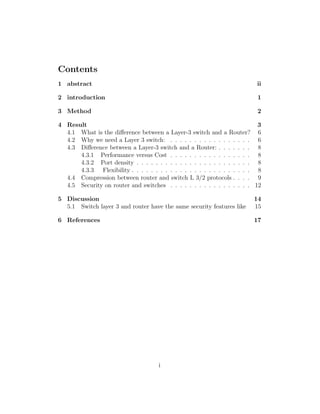
Contents
1 abstract ii
2 introduction 1
3 Method 2
4 Result 3
4.1 What is the difference between a Layer-3 switch and a Router? 6
4.2 Why we need a Layer 3 switch: . . . . . . . . . . . . . . . . . 6
4.3 Difference between a Layer-3 switch and a Router: . . . . . . . 8
4.3.1 Performance versus Cost . . . . . . . . . . . . . . . . . 8
4.3.2 Port density . . . . . . . . . . . . . . . . . . . . . . . . 8
4.3.3 Flexibility . . . . . . . . . . . . . . . . . . . . . . . . . 8
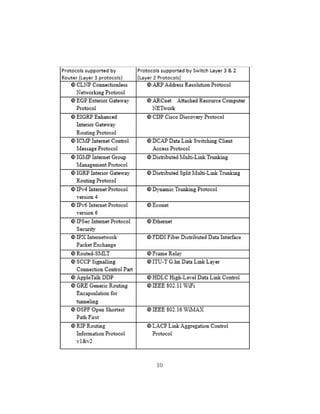
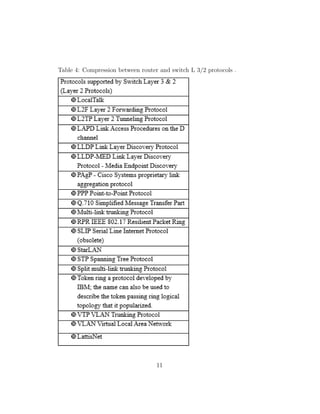
4.4 Compression between router and switch L 3/2 protocols . . . . 9
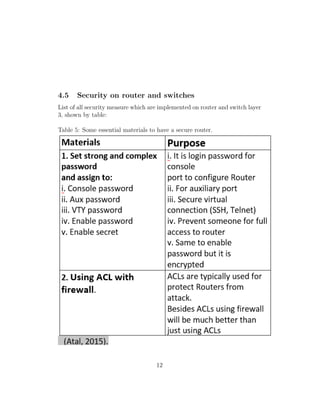
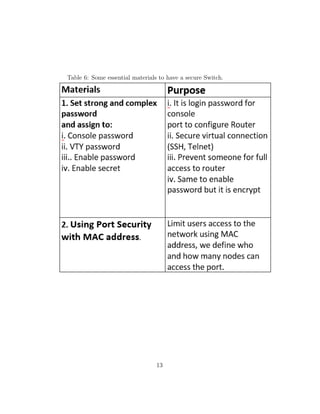
4.5 Security on router and switches . . . . . . . . . . . . . . . . . 12
5 Discussion 14
5.1 Switch layer 3 and router have the same security features like 15
6 References 17
i
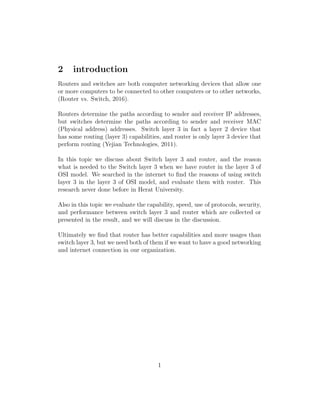
1 abstract
In this paper we introduce some important issues about the usages of switch
layer 3 and router and their capabilities. We discus on differences between
these two layer 3 devices, and what caused to use switch in layer 3. We
searched in internet about my topic and thesis statement to find a good so-
lution. And we found my response.
Ultimately we find that router has better capabilities and more usages than
switch layer 3, but we need both of them if we want to have a good networking
and internet connection in our organization.
ii
2 introduction
Routers and switches are both computer networking devices that allow one
or more computers to be connected to other computers or to other networks,
(Router vs. Switch, 2016).
Routers determine the paths according to sender and receiver IP addresses,
but switches determine the paths according to sender and receiver MAC
(Physical address) addresses. Switch layer 3 in fact a layer 2 device that
has some routing (layer 3) capabilities, and router is only layer 3 device that
perform routing (Yejian Technologies, 2011).
In this topic we discuss about Switch layer 3 and router, and the reason
what is needed to the Switch layer 3 when we have router in the layer 3 of
OSI model. We searched in the internet to find the reasons of using switch
layer 3 in the layer 3 of OSI model, and evaluate them with router. This
research never done before in Herat University.
Also in this topic we evaluate the capability, speed, use of protocols, security,
and performance between switch layer 3 and router which are collected or
presented in the result, and we will discuss in the discussion.
Ultimately we find that router has better capabilities and more usages than
switch layer 3, but we need both of them if we want to have a good networking
and internet connection in our organization.
1
3 Method
We search and collect information about my research in the internet to eval-
uate between router and switch layer 3 and we ask some questions from my
teacher ”Vakili”, about my research, and also we search about my thesis
statement in the internet for more information and better help.
2
4 Result
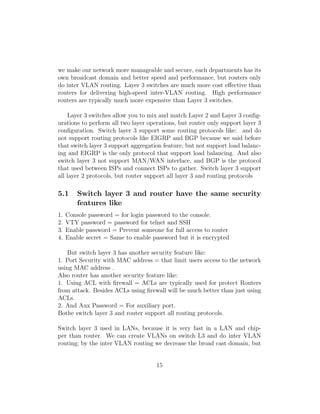
The general differ between Switch layer 3 and Router is that the Switch
layer 3 works very fast like switch layer 2 because they have ” optimized
hardware”, to transfer data as soon as they receive, and Switch layer 3 know
how to forward traffic at layer3 like a Router. ” In fact, many of Ciscos
Layer 3 switches are actually routers that operate faster [In a LAN] because
they are built on switching hardware with customized chips inside the box”,
(Yejian Technologies, 2011).
In switches we have Link Aggregation, we can aggregate multiple physical
links into one logical link, in switches only links which are same in speed,
duplex, access, trunk, VLAN Number, Native VLAN can aggregate white
each other. Aggregations increase the bandwidth. In routers we have load
balancing in which we can aggregate the links that are not same by EIGRP
protocol.
3
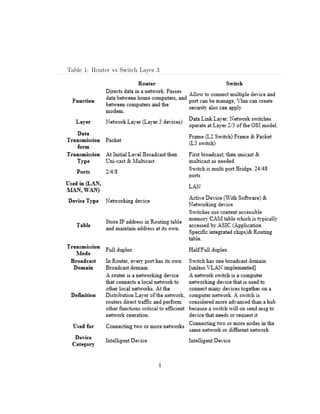
Table 1: Router vs Switch Layer 3
4
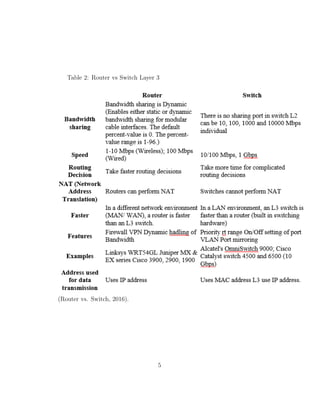
Table 2: Router vs Switch Layer 3
(Router vs. Switch, 2016).
5
4.1 What is the difference between a Layer-3 switch
and a Router?
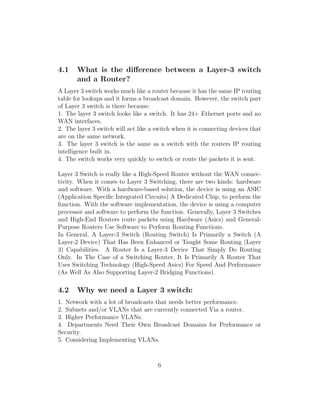
A Layer 3 switch works much like a router because it has the same IP routing
table for lookups and it forms a broadcast domain. However, the switch part
of Layer 3 switch is there because:
1. The layer 3 switch looks like a switch. It has 24+ Ethernet ports and no
WAN interfaces.
2. The layer 3 switch will act like a switch when it is connecting devices that
are on the same network.
3. The layer 3 switch is the same as a switch with the routers IP routing
intelligence built in.
4. The switch works very quickly to switch or route the packets it is sent.
Layer 3 Switch is really like a High-Speed Router without the WAN connec-
tivity. When it comes to Layer 3 Switching, there are two kinds: hardware
and software. With a hardware-based solution, the device is using an ASIC
(Application Specific Integrated Circuits) A Dedicated Chip, to perform the
function. With the software implementation, the device is using a computer
processor and software to perform the function. Generally, Layer 3 Switches
and High-End Routers route packets using Hardware (Asics) and General-
Purpose Routers Use Software to Perform Routing Functions.
In General, A Layer-3 Switch (Routing Switch) Is Primarily a Switch (A
Layer-2 Device) That Has Been Enhanced or Taught Some Routing (Layer
3) Capabilities. A Router Is a Layer-3 Device That Simply Do Routing
Only. In The Case of a Switching Router, It Is Primarily A Router That
Uses Switching Technology (High-Speed Asics) For Speed And Performance
(As Well As Also Supporting Layer-2 Bridging Functions).
4.2 Why we need a Layer 3 switch:
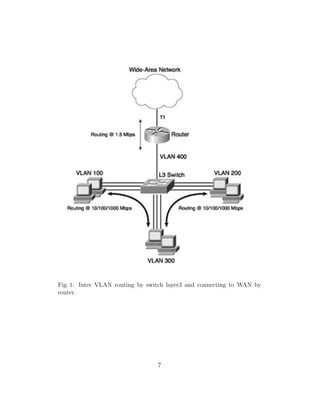
1. Network with a lot of broadcasts that needs better performance.
2. Subnets and/or VLANs that are currently connected Via a router.
3. Higher Performance VLANs.
4. Departments Need Their Own Broadcast Domains for Performance or
Security.
5. Considering Implementing VLANs.
6
Fig 1: Inter VLAN routing by switch layer3 and connecting to WAN by
router.
7
4.3 Difference between a Layer-3 switch and a Router:
4.3.1 Performance versus Cost
Layer 3 switches are much more cost effective than routers for delivering high-
speed inter-VLAN routing. High performance routers are typically much
more expensive than Layer 3 switches.
4.3.2 Port density
Layer 3 switches are enhanced Layer 2 switches and, hence, have the same
high port densities that Layer 2 switches have. Routers on the other hand
typically have a much lower port density.
4.3.3 Flexibility
Layer 3 switches allow you to mix and match Layer 2 and Layer 3 switching,
meaning you can configure a Layer 3 switch to operate as a normal Layer 2
switch, or enable Layer 3 switching as required.
Layer 3 Switch is used to route traffic between Ethernet networks, without
having to worry about the complexities of supporting WAN technologies such
as Frame Relay or ATM. Routing over WAN networks, simply by plugging a
traditional router that connects to the WAN networks into the LAN network
(What is the difference between a Layer-3 switch and a Router, 2016).
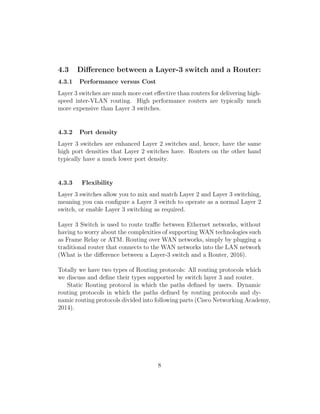
Totally we have two types of Routing protocols: All routing protocols which
we discuss and define their types supported by switch layer 3 and router.
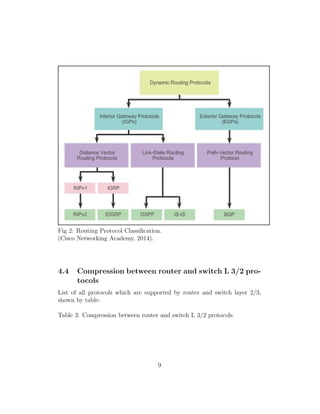
Static Routing protocol in which the paths defined by users. Dynamic
routing protocols in which the paths defined by routing protocols and dy-
namic routing protocols divided into following parts (Cisco Networking Academy,
2014).
8
Fig 2: Routing Protocol Classification.
(Cisco Networking Academy, 2014).
4.4 Compression between router and switch L 3/2 pro-
tocols
List of all protocols which are supported by router and switch layer 2/3,
shown by table:
Table 3: Compression between router and switch L 3/2 protocols.
9
10
Table 4: Compression between router and switch L 3/2 protocols .
11
4.5 Security on router and switches
List of all security measure which are implemented on router and switch layer
3, shown by table:
Table 5: Some essential materials to have a secure router.
12
Table 6: Some essential materials to have a secure Switch.
13
5 Discussion
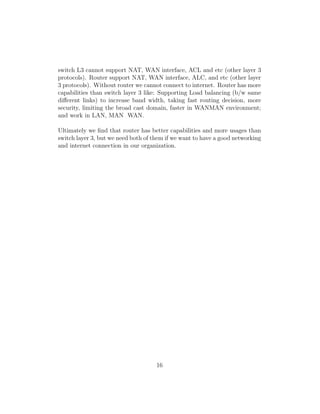
Switches layer 3 is faster than a router in a LAN environment because they
use hardware and software for forwarding data, first time they use software
to forward the first packet which receive after that all packets are switched
as soon as they received, but routers always do forwarding with software,
and routers are faster than switch layer 3 in MAN WAN environment.
In switches we have aggregation, we aggregate multiple physical links into
one logical link which same to increase the bandwidth, but in routers we have
load balancing, we can aggregate the links which are not same. Switches layer
3 can connect more computers to gather and also can pass data between net-
works, but routers can pass data between networks and modems.
Switch layer 3 can operate in layer 2/3 of OSI model and router only can
operate in layer 3 of OSI model. Switch layer 3 transmit the data in the
form of packet (switch layer 3) frame (switch layer 2), but router transmit
only in the form of packet. Switch first broad cast; then unicast multicast
as needed the data, but router initial broad cast; then unicast multicast.
Switch layer 3 has multiple ports 24/48/64, but router has 2/4/8 ports.
Switch layer 3 is active device and networking device, it works only in LAN,
but router is networking device, it works in LAN, MAN, WAN and it connect
LAN with WAN. Switch layer 3 transmission mode is half/full duplex and
it has one broadcast domain (unless VLAN implementation), but router use
always full duplex and every ports has its own broadcast domain.
Both of them intelligent devices. Switch layer 3/2 do not share the band
width, but router can share bind width (dynamic or static) between inter-
faces. The speed of switch layer 3 is 10/100 Mbps 1Gbps, but the speed of
routers 1-10 Mbps (wireless) 100 Mbps (wired).
Switch layer 3 take more time for complicated routing decisions, and
switches cannot perform NAT, but router take faster routing decisions, and
perform NAT. Switch layer 3 use MAC address in L2 and IP address in l3, but
router use IP address. Switch layer 3 act like a switch layer 2 when connect
the devices which are in the same network and it support layer 2 functions
also it has same routing capabilities and a routing table like a router. Switch
layer 3 support VLANs and inter VLAN routings, when we create VLANs
14
we make our network more manageable and secure, each departments has its
own broadcast domain and better speed and performance, but routers only
do inter VLAN routing. Layer 3 switches are much more cost effective than
routers for delivering high-speed inter-VLAN routing. High performance
routers are typically much more expensive than Layer 3 switches.
Layer 3 switches allow you to mix and match Layer 2 and Layer 3 config-
urations to perform all two layer operations, but router only support layer 3
configuration. Switch layer 3 support some routing protocols like: and do
not support routing protocols like EIGRP and BGP because we said before
that switch layer 3 support aggregation feature, but not support load balanc-
ing and EIGRP is the only protocol that support load balancing. And also
switch layer 3 not support MAN/WAN interface, and BGP is the protocol
that used between ISPs and connect ISPs to gather. Switch layer 3 support
all layer 2 protocols, but router support all layer 3 and routing protocols
5.1 Switch layer 3 and router have the same security
features like
1. Console password = for login password to the console.
2. VTY password = password for telnet and SSH
3. Enable password = Prevent someone for full access to router
4. Enable secret = Same to enable password but it is encrypted
But switch layer 3 has another security feature like:
1. Port Security with MAC address = that limit users access to the network
using MAC address .
Also router has another security feature like:
1. Using ACL with firewall = ACLs are typically used for protect Routers
from attack. Besides ACLs using firewall will be much better than just using
ACLs.
2. And Aux Password = For auxiliary port.
Bothe switch layer 3 and router support all routing protocols.
Switch layer 3 used in LANs, because it is very fast in a LAN and chip-
per than router. We can create VLANs on switch L3 and do inter VLAN
routing; by the inter VLAN routing we decrease the broad cast domain, but
15
switch L3 cannot support NAT, WAN interface, ACL and etc (other layer 3
protocols). Router support NAT, WAN interface, ALC, and etc (other layer
3 protocols). Without router we cannot connect to internet. Router has more
capabilities than switch layer 3 like: Supporting Load balancing (b/w same
different links) to increase band width, taking fast routing decision, more
security, limiting the broad cast domain, faster in WANMAN environment;
and work in LAN, MAN WAN.
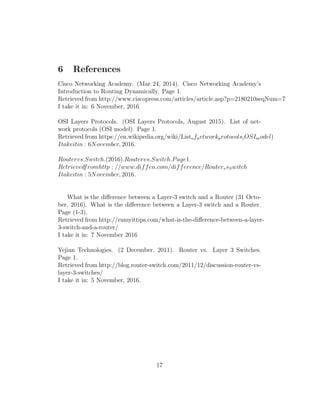
Ultimately we find that router has better capabilities and more usages than
switch layer 3, but we need both of them if we want to have a good networking
and internet connection in our organization.
16
6 References
Cisco Networking Academy. (Mar 24, 2014). Cisco Networking Academy’s
Introduction to Routing Dynamically. Page 1.
Retrieved from http://www.ciscopress.com/articles/article.asp?p=2180210seqNum=7
I take it in: 6 November, 2016
OSI Layers Protocols. (OSI Layers Protocols, August 2015). List of net-
work protocols (OSI model). Page 1.
Retrieved from https://en.wikipedia.org/wiki/Listofnetworkprotocols(OSImodel)
Itakeitin : 6November, 2016.
Routervs.Switch.(2016).Routervs.Switch.Page1.
Retrievedfromhttp : //www.diffen.com/difference/RoutervsSwitch
Itakeitin : 5November, 2016.
What is the difference between a Layer-3 switch and a Router (31 Octo-
ber, 2016). What is the difference between a Layer-3 switch and a Router.
Page (1-3).
Retrieved from http://rumyittips.com/what-is-the-difference-between-a-layer-
3-switch-and-a-router/
I take it in: 7 November 2016
Yejian Technologies. (2 December, 2011). Router vs. Layer 3 Switches.
Page 1.
Retrieved from http://blog.router-switch.com/2011/12/discussion-router-vs-
layer-3-switches/
I take it in: 5 November, 2016.
17

Router vs Switch layer3

  • 1.
    Router vs Switchlayer3 Khan Mohammad Habibi Nov 20 , 2016
  • 2.
    Contents 1 abstract ii 2introduction 1 3 Method 2 4 Result 3 4.1 What is the difference between a Layer-3 switch and a Router? 6 4.2 Why we need a Layer 3 switch: . . . . . . . . . . . . . . . . . 6 4.3 Difference between a Layer-3 switch and a Router: . . . . . . . 8 4.3.1 Performance versus Cost . . . . . . . . . . . . . . . . . 8 4.3.2 Port density . . . . . . . . . . . . . . . . . . . . . . . . 8 4.3.3 Flexibility . . . . . . . . . . . . . . . . . . . . . . . . . 8 4.4 Compression between router and switch L 3/2 protocols . . . . 9 4.5 Security on router and switches . . . . . . . . . . . . . . . . . 12 5 Discussion 14 5.1 Switch layer 3 and router have the same security features like 15 6 References 17 i
  • 3.
    1 abstract In thispaper we introduce some important issues about the usages of switch layer 3 and router and their capabilities. We discus on differences between these two layer 3 devices, and what caused to use switch in layer 3. We searched in internet about my topic and thesis statement to find a good so- lution. And we found my response. Ultimately we find that router has better capabilities and more usages than switch layer 3, but we need both of them if we want to have a good networking and internet connection in our organization. ii
  • 4.
    2 introduction Routers andswitches are both computer networking devices that allow one or more computers to be connected to other computers or to other networks, (Router vs. Switch, 2016). Routers determine the paths according to sender and receiver IP addresses, but switches determine the paths according to sender and receiver MAC (Physical address) addresses. Switch layer 3 in fact a layer 2 device that has some routing (layer 3) capabilities, and router is only layer 3 device that perform routing (Yejian Technologies, 2011). In this topic we discuss about Switch layer 3 and router, and the reason what is needed to the Switch layer 3 when we have router in the layer 3 of OSI model. We searched in the internet to find the reasons of using switch layer 3 in the layer 3 of OSI model, and evaluate them with router. This research never done before in Herat University. Also in this topic we evaluate the capability, speed, use of protocols, security, and performance between switch layer 3 and router which are collected or presented in the result, and we will discuss in the discussion. Ultimately we find that router has better capabilities and more usages than switch layer 3, but we need both of them if we want to have a good networking and internet connection in our organization. 1
  • 5.
    3 Method We searchand collect information about my research in the internet to eval- uate between router and switch layer 3 and we ask some questions from my teacher ”Vakili”, about my research, and also we search about my thesis statement in the internet for more information and better help. 2
  • 6.
    4 Result The generaldiffer between Switch layer 3 and Router is that the Switch layer 3 works very fast like switch layer 2 because they have ” optimized hardware”, to transfer data as soon as they receive, and Switch layer 3 know how to forward traffic at layer3 like a Router. ” In fact, many of Ciscos Layer 3 switches are actually routers that operate faster [In a LAN] because they are built on switching hardware with customized chips inside the box”, (Yejian Technologies, 2011). In switches we have Link Aggregation, we can aggregate multiple physical links into one logical link, in switches only links which are same in speed, duplex, access, trunk, VLAN Number, Native VLAN can aggregate white each other. Aggregations increase the bandwidth. In routers we have load balancing in which we can aggregate the links that are not same by EIGRP protocol. 3
  • 7.
    Table 1: Routervs Switch Layer 3 4
  • 8.
    Table 2: Routervs Switch Layer 3 (Router vs. Switch, 2016). 5
  • 9.
    4.1 What isthe difference between a Layer-3 switch and a Router? A Layer 3 switch works much like a router because it has the same IP routing table for lookups and it forms a broadcast domain. However, the switch part of Layer 3 switch is there because: 1. The layer 3 switch looks like a switch. It has 24+ Ethernet ports and no WAN interfaces. 2. The layer 3 switch will act like a switch when it is connecting devices that are on the same network. 3. The layer 3 switch is the same as a switch with the routers IP routing intelligence built in. 4. The switch works very quickly to switch or route the packets it is sent. Layer 3 Switch is really like a High-Speed Router without the WAN connec- tivity. When it comes to Layer 3 Switching, there are two kinds: hardware and software. With a hardware-based solution, the device is using an ASIC (Application Specific Integrated Circuits) A Dedicated Chip, to perform the function. With the software implementation, the device is using a computer processor and software to perform the function. Generally, Layer 3 Switches and High-End Routers route packets using Hardware (Asics) and General- Purpose Routers Use Software to Perform Routing Functions. In General, A Layer-3 Switch (Routing Switch) Is Primarily a Switch (A Layer-2 Device) That Has Been Enhanced or Taught Some Routing (Layer 3) Capabilities. A Router Is a Layer-3 Device That Simply Do Routing Only. In The Case of a Switching Router, It Is Primarily A Router That Uses Switching Technology (High-Speed Asics) For Speed And Performance (As Well As Also Supporting Layer-2 Bridging Functions). 4.2 Why we need a Layer 3 switch: 1. Network with a lot of broadcasts that needs better performance. 2. Subnets and/or VLANs that are currently connected Via a router. 3. Higher Performance VLANs. 4. Departments Need Their Own Broadcast Domains for Performance or Security. 5. Considering Implementing VLANs. 6
  • 10.
    Fig 1: InterVLAN routing by switch layer3 and connecting to WAN by router. 7
  • 11.
    4.3 Difference betweena Layer-3 switch and a Router: 4.3.1 Performance versus Cost Layer 3 switches are much more cost effective than routers for delivering high- speed inter-VLAN routing. High performance routers are typically much more expensive than Layer 3 switches. 4.3.2 Port density Layer 3 switches are enhanced Layer 2 switches and, hence, have the same high port densities that Layer 2 switches have. Routers on the other hand typically have a much lower port density. 4.3.3 Flexibility Layer 3 switches allow you to mix and match Layer 2 and Layer 3 switching, meaning you can configure a Layer 3 switch to operate as a normal Layer 2 switch, or enable Layer 3 switching as required. Layer 3 Switch is used to route traffic between Ethernet networks, without having to worry about the complexities of supporting WAN technologies such as Frame Relay or ATM. Routing over WAN networks, simply by plugging a traditional router that connects to the WAN networks into the LAN network (What is the difference between a Layer-3 switch and a Router, 2016). Totally we have two types of Routing protocols: All routing protocols which we discuss and define their types supported by switch layer 3 and router. Static Routing protocol in which the paths defined by users. Dynamic routing protocols in which the paths defined by routing protocols and dy- namic routing protocols divided into following parts (Cisco Networking Academy, 2014). 8
  • 12.
    Fig 2: RoutingProtocol Classification. (Cisco Networking Academy, 2014). 4.4 Compression between router and switch L 3/2 pro- tocols List of all protocols which are supported by router and switch layer 2/3, shown by table: Table 3: Compression between router and switch L 3/2 protocols. 9
  • 13.
  • 14.
    Table 4: Compressionbetween router and switch L 3/2 protocols . 11
  • 15.
    4.5 Security onrouter and switches List of all security measure which are implemented on router and switch layer 3, shown by table: Table 5: Some essential materials to have a secure router. 12
  • 16.
    Table 6: Someessential materials to have a secure Switch. 13
  • 17.
    5 Discussion Switches layer3 is faster than a router in a LAN environment because they use hardware and software for forwarding data, first time they use software to forward the first packet which receive after that all packets are switched as soon as they received, but routers always do forwarding with software, and routers are faster than switch layer 3 in MAN WAN environment. In switches we have aggregation, we aggregate multiple physical links into one logical link which same to increase the bandwidth, but in routers we have load balancing, we can aggregate the links which are not same. Switches layer 3 can connect more computers to gather and also can pass data between net- works, but routers can pass data between networks and modems. Switch layer 3 can operate in layer 2/3 of OSI model and router only can operate in layer 3 of OSI model. Switch layer 3 transmit the data in the form of packet (switch layer 3) frame (switch layer 2), but router transmit only in the form of packet. Switch first broad cast; then unicast multicast as needed the data, but router initial broad cast; then unicast multicast. Switch layer 3 has multiple ports 24/48/64, but router has 2/4/8 ports. Switch layer 3 is active device and networking device, it works only in LAN, but router is networking device, it works in LAN, MAN, WAN and it connect LAN with WAN. Switch layer 3 transmission mode is half/full duplex and it has one broadcast domain (unless VLAN implementation), but router use always full duplex and every ports has its own broadcast domain. Both of them intelligent devices. Switch layer 3/2 do not share the band width, but router can share bind width (dynamic or static) between inter- faces. The speed of switch layer 3 is 10/100 Mbps 1Gbps, but the speed of routers 1-10 Mbps (wireless) 100 Mbps (wired). Switch layer 3 take more time for complicated routing decisions, and switches cannot perform NAT, but router take faster routing decisions, and perform NAT. Switch layer 3 use MAC address in L2 and IP address in l3, but router use IP address. Switch layer 3 act like a switch layer 2 when connect the devices which are in the same network and it support layer 2 functions also it has same routing capabilities and a routing table like a router. Switch layer 3 support VLANs and inter VLAN routings, when we create VLANs 14
  • 18.
    we make ournetwork more manageable and secure, each departments has its own broadcast domain and better speed and performance, but routers only do inter VLAN routing. Layer 3 switches are much more cost effective than routers for delivering high-speed inter-VLAN routing. High performance routers are typically much more expensive than Layer 3 switches. Layer 3 switches allow you to mix and match Layer 2 and Layer 3 config- urations to perform all two layer operations, but router only support layer 3 configuration. Switch layer 3 support some routing protocols like: and do not support routing protocols like EIGRP and BGP because we said before that switch layer 3 support aggregation feature, but not support load balanc- ing and EIGRP is the only protocol that support load balancing. And also switch layer 3 not support MAN/WAN interface, and BGP is the protocol that used between ISPs and connect ISPs to gather. Switch layer 3 support all layer 2 protocols, but router support all layer 3 and routing protocols 5.1 Switch layer 3 and router have the same security features like 1. Console password = for login password to the console. 2. VTY password = password for telnet and SSH 3. Enable password = Prevent someone for full access to router 4. Enable secret = Same to enable password but it is encrypted But switch layer 3 has another security feature like: 1. Port Security with MAC address = that limit users access to the network using MAC address . Also router has another security feature like: 1. Using ACL with firewall = ACLs are typically used for protect Routers from attack. Besides ACLs using firewall will be much better than just using ACLs. 2. And Aux Password = For auxiliary port. Bothe switch layer 3 and router support all routing protocols. Switch layer 3 used in LANs, because it is very fast in a LAN and chip- per than router. We can create VLANs on switch L3 and do inter VLAN routing; by the inter VLAN routing we decrease the broad cast domain, but 15
  • 19.
    switch L3 cannotsupport NAT, WAN interface, ACL and etc (other layer 3 protocols). Router support NAT, WAN interface, ALC, and etc (other layer 3 protocols). Without router we cannot connect to internet. Router has more capabilities than switch layer 3 like: Supporting Load balancing (b/w same different links) to increase band width, taking fast routing decision, more security, limiting the broad cast domain, faster in WANMAN environment; and work in LAN, MAN WAN. Ultimately we find that router has better capabilities and more usages than switch layer 3, but we need both of them if we want to have a good networking and internet connection in our organization. 16
  • 20.
    6 References Cisco NetworkingAcademy. (Mar 24, 2014). Cisco Networking Academy’s Introduction to Routing Dynamically. Page 1. Retrieved from http://www.ciscopress.com/articles/article.asp?p=2180210seqNum=7 I take it in: 6 November, 2016 OSI Layers Protocols. (OSI Layers Protocols, August 2015). List of net- work protocols (OSI model). Page 1. Retrieved from https://en.wikipedia.org/wiki/Listofnetworkprotocols(OSImodel) Itakeitin : 6November, 2016. Routervs.Switch.(2016).Routervs.Switch.Page1. Retrievedfromhttp : //www.diffen.com/difference/RoutervsSwitch Itakeitin : 5November, 2016. What is the difference between a Layer-3 switch and a Router (31 Octo- ber, 2016). What is the difference between a Layer-3 switch and a Router. Page (1-3). Retrieved from http://rumyittips.com/what-is-the-difference-between-a-layer- 3-switch-and-a-router/ I take it in: 7 November 2016 Yejian Technologies. (2 December, 2011). Router vs. Layer 3 Switches. Page 1. Retrieved from http://blog.router-switch.com/2011/12/discussion-router-vs- layer-3-switches/ I take it in: 5 November, 2016. 17