JEAN-JACQUES ROUSSEAU
(1712-1778)
Asma
Ph D Scholar
Objectives of the Assignment
Following are the objectives of the assignment
 To describe about the Greek philosopher Rousseau
 His early life
 His conceptions about education
 Aims of Educations, Curriculum, principles of teaching,
teaching methods,
 Discipline, education of woman
 conclusion
11/21/2020
2
ROUSSEAU (1712-1778)
 Jean Jacques Rousseau was born in Geneva,
Switzerland.
 His father was a watch maker.
 His mother died when he was nine days only.
 He started reading novels at the age of three
 He was a Swiss-born philosopher, writer and a political
thinker (Hussain, 1990).
11/21/2020
3
His Life and Work
 Rousseau’s father brought him up after his mother’s death.
 At the age of twelve, Rousseau stops traditional schooling.
 He studied the books of Hobbes and Locke
 From age of 12 to 29, he went from place to place.. He was
sympathetic to poor.
 He remained in contact with the nature (Douglas, 2017).
11/21/2020
4
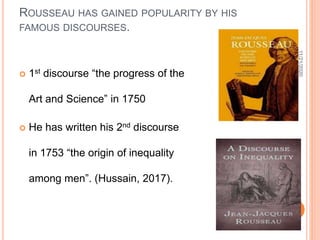
ROUSSEAU HAS GAINED POPULARITY BY HIS
FAMOUS DISCOURSES.
 1st discourse “the progress of the
Art and Science” in 1750
 He has written his 2nd discourse
in 1753 “the origin of inequality
among men”. (Hussain, 2017).
11/21/2020
5
WORKS OF ROUSSEAU
 Social Contract
 Emile or Concerning Education
 Pedagogic Romance
 Confessions
 Basic political writings
 Discourse on inequality
11/21/2020
6
EMILE
 His work of Emile was very unique at that
time
 Emile basically consisted of the education
system of a male boy.
 That is an imaginary. Rousseau has
explained the education of Emile.
 His education is divided into five parts.
 He has described how Emile should be
taught and treated in that way.
11/21/2020
7
Rousseau’s Conception of Education
Sajid (1990) described that Rousseau was basically a
naturalistic. He was against formal education
Rousseau says that there are three sources of education
 Nature
 Men
 things
11/21/2020
8
Rousseau and Educational Aims
 Development of the innate powers of the child.
 Rousseau says that purpose of the education is to enable Emile
so that he could live his life. His organs should be developed.
 To give the child the education of humanity.
 To prepare child in such a way that he can live his life by using
his own abilities.
 Mental, physical, social, moral and emotional development of the
child.
11/21/2020
9
Rousseau views on Curriculum
 As such Rousseau has not described any rules for
different subjects, yet when he describes the different
subjects in Emile’s education that are very useful.
 In the first stage like usual subjects should not be
taught. So in the beginning the training of the senses is
very important for the children.
11/21/2020
10
 in the second stage, Rousseau said that child should get
education in mother languages. But he is not in favor of
many languages and subjects (Peter & Johan, 2019).
 Rousseau gives the concept of negative education. He
emphasis on senses training.
11/21/2020
11
 Rousseau said that there will be no education from the
books. Emile will learn from his experiences. No bookish
knowledge is required in the beginning (Shahid, 2012).
 He said there is no place of moral education in Emile
 In the third stage, Rousseau has recommended one
book which is Robinson Crusoe from five to twelve
years.
11/21/2020
12
RELIGIOUS EDUCATION
Religious education should also be given to child. In
religious education these four concepts should be given
to child (Shahid, 2012).
 God existence, and existence of oneself
 Will of God
 Man’s freedom
 Soul is immortal
11/21/2020
13
Rousseau’s Views on the Principles of Teaching
Douglas and Yacek (2013) stated that Rousseau was a
naturalistic. So the principles of teaching suggested by
Rousseau
 He emphasis learning by doing principle
 He wants that Emile should learn by experience rather than
books
 He laid stress on heuristic attitude which is necessary for
discovery of things
11/21/2020
14
 Wanted to learn subjects by practical experiences
like science, mathematics, history and Geography.
 He said that moral education is necessary in the
adolescence period.
 Like modern educator, Rousseau is in not in favor
of telling method.
11/21/2020
15
Rousseau and Teaching methods
 discovery method,
 laboratory method,
 learning by doing method
 Heuristic method
 Learning through senses experiences
11/21/2020
16
ROUSSEAU’S VIEWS ON DISCIPLINE
 Rousseau believes on freedom. So, he also described
that the ability of the freedom of the child should be
developed continuously
 . He was against punishment because for him child did
not know right and wrong so in that case no use of
punishment. He believed that the nature of the child is
internally good. (Douglas, 2013).
11/21/2020
17
Rousseau’s Views on the Education of Woman
 In the fifth part of the book Emile, Rousseau gives the
imaginary concept of Sophie.
 From here the woman education concept can be
concluded.
 As compare to Emile education that was not
conventional, Sophie education should be conventional
and orthodox.
11/21/2020
18
Sophy has not need to know the literary knowledge
but have to learn
 sewing,
 cutting,
 embroidery,
 lace making
 the art of house decorating and housekeeping
11/21/2020
19
Critical Account of Rousseau’s Theory of Education
 When we look critically at the educational theory and
thoughts of Rousseau, It is very clear that the
educational thoughts of Rousseau was as a result of the
societal conditions of that time.
 There was emphasis on root memorization. Rousseau
raised his voice against traditional system of eduation. In
which there was no importance of child.
11/21/2020
20
 William Boyd stated that child should be given
education according to his age. He also favored the
educational thoughts of Rousseau
11/21/2020
21
 Curtis (1963) stated that the thoughts of the initial
thinkers said to be good for the educational point of
view. But those thoughts are not helpful in the
training of the child.
11/21/2020
22
CRITICAL ACCOUNT OF ROUSSEAU’S THEORY
 When we look critically at the educational theory
and thoughts of Rousseau, It is very clear that the
educational thoughts of Rousseau were as a result
of the societal conditions of that time.
 There was authoritarian type of government of that
time. Schools were equal to jails for the students.
11/21/2020
23
 William Boyd stated that child should be given
education according to his age. He also favored the
educational thoughts of Rousseau.
 Curtis (1963) stated that the thoughts of the initial
thinkers said to be good for the educational point of
view. But those thoughts are not helpful in the
training of the child.
 According to him, Rousseau has given the child
importance and considered him the prime factor in
educational process.
11/21/2020
24
Conclusion
 Rousseau has a special name in history.
 He was a naturalistic.
 Rousseau has laid emphasis on all modern time
principles at that time.
 He asserted on child centered education.
 He at the same time wants education by learning
by doing.
 He was against formal education.
 He wants that child education should be based on
the needs and interest of the child.
11/21/2020
25
REFERENCES
 Annick, M., (1999). Coursework booklet: Philosophy of
Education. Northern Caribbean University: Cordasco,
Francesco.
 Brubacher., & John, S. (1962). Modern Philosophies of
Education. New York : McGraw Hill Book Company Inc.
 Curtis, S. J. (1963). A short history of educational ideas.
Retrieved from https://www.amazon.com/short-history-
educational-ideas/dp/B0007K56N4
 Douglas. W., & Yacek. (2013). Going to School with Friedrich
Nietzsche: The Self in Service of Noble Culture. Studies in
Philosophy and Education. 33( 4). 391-411
 Hussain, M. A., Bhatti, R., & Tufail, M. (2017). Philosophy of
Education. Islamabad: Allama Iqbal open University.
 Hussain, S. S. (1990). Education and its development.
Lahore: Rahber Publishers.
 Kearney., & Hugh. (1972). Locke and the Politics of
Education. History of Education Quarterly 12(1). 107-115.
11/21/2020
26
 Kilpatrick, W. H. (1934). Source Book in the
Philosophy of Education. New York: McMillan and
Company.
 PETER, L., & JOHAN, D. (2019). In the Absence of
Adults: Generations and Formation in Hunt for the
Wilder people, Journal of Philosophy of
Education, 53 (2), 407-424.
 Wokler, R. (2012). Rousseau, the Age of
Enlightenment, and Their Legacies. Retrieved from
https://press.princeton.edu/books/ebook/97814008
42407
 Shahid, S. M. (2012). History and philosophy of
education. Lahore: Majeed Book Depot
11/21/2020
27

Rousseau

  • 1.
  • 2.
    Objectives of theAssignment Following are the objectives of the assignment  To describe about the Greek philosopher Rousseau  His early life  His conceptions about education  Aims of Educations, Curriculum, principles of teaching, teaching methods,  Discipline, education of woman  conclusion 11/21/2020 2
  • 3.
    ROUSSEAU (1712-1778)  JeanJacques Rousseau was born in Geneva, Switzerland.  His father was a watch maker.  His mother died when he was nine days only.  He started reading novels at the age of three  He was a Swiss-born philosopher, writer and a political thinker (Hussain, 1990). 11/21/2020 3
  • 4.
    His Life andWork  Rousseau’s father brought him up after his mother’s death.  At the age of twelve, Rousseau stops traditional schooling.  He studied the books of Hobbes and Locke  From age of 12 to 29, he went from place to place.. He was sympathetic to poor.  He remained in contact with the nature (Douglas, 2017). 11/21/2020 4
  • 5.
    ROUSSEAU HAS GAINEDPOPULARITY BY HIS FAMOUS DISCOURSES.  1st discourse “the progress of the Art and Science” in 1750  He has written his 2nd discourse in 1753 “the origin of inequality among men”. (Hussain, 2017). 11/21/2020 5
  • 6.
    WORKS OF ROUSSEAU Social Contract  Emile or Concerning Education  Pedagogic Romance  Confessions  Basic political writings  Discourse on inequality 11/21/2020 6
  • 7.
    EMILE  His workof Emile was very unique at that time  Emile basically consisted of the education system of a male boy.  That is an imaginary. Rousseau has explained the education of Emile.  His education is divided into five parts.  He has described how Emile should be taught and treated in that way. 11/21/2020 7
  • 8.
    Rousseau’s Conception ofEducation Sajid (1990) described that Rousseau was basically a naturalistic. He was against formal education Rousseau says that there are three sources of education  Nature  Men  things 11/21/2020 8
  • 9.
    Rousseau and EducationalAims  Development of the innate powers of the child.  Rousseau says that purpose of the education is to enable Emile so that he could live his life. His organs should be developed.  To give the child the education of humanity.  To prepare child in such a way that he can live his life by using his own abilities.  Mental, physical, social, moral and emotional development of the child. 11/21/2020 9
  • 10.
    Rousseau views onCurriculum  As such Rousseau has not described any rules for different subjects, yet when he describes the different subjects in Emile’s education that are very useful.  In the first stage like usual subjects should not be taught. So in the beginning the training of the senses is very important for the children. 11/21/2020 10
  • 11.
     in thesecond stage, Rousseau said that child should get education in mother languages. But he is not in favor of many languages and subjects (Peter & Johan, 2019).  Rousseau gives the concept of negative education. He emphasis on senses training. 11/21/2020 11
  • 12.
     Rousseau saidthat there will be no education from the books. Emile will learn from his experiences. No bookish knowledge is required in the beginning (Shahid, 2012).  He said there is no place of moral education in Emile  In the third stage, Rousseau has recommended one book which is Robinson Crusoe from five to twelve years. 11/21/2020 12
  • 13.
    RELIGIOUS EDUCATION Religious educationshould also be given to child. In religious education these four concepts should be given to child (Shahid, 2012).  God existence, and existence of oneself  Will of God  Man’s freedom  Soul is immortal 11/21/2020 13
  • 14.
    Rousseau’s Views onthe Principles of Teaching Douglas and Yacek (2013) stated that Rousseau was a naturalistic. So the principles of teaching suggested by Rousseau  He emphasis learning by doing principle  He wants that Emile should learn by experience rather than books  He laid stress on heuristic attitude which is necessary for discovery of things 11/21/2020 14
  • 15.
     Wanted tolearn subjects by practical experiences like science, mathematics, history and Geography.  He said that moral education is necessary in the adolescence period.  Like modern educator, Rousseau is in not in favor of telling method. 11/21/2020 15
  • 16.
    Rousseau and Teachingmethods  discovery method,  laboratory method,  learning by doing method  Heuristic method  Learning through senses experiences 11/21/2020 16
  • 17.
    ROUSSEAU’S VIEWS ONDISCIPLINE  Rousseau believes on freedom. So, he also described that the ability of the freedom of the child should be developed continuously  . He was against punishment because for him child did not know right and wrong so in that case no use of punishment. He believed that the nature of the child is internally good. (Douglas, 2013). 11/21/2020 17
  • 18.
    Rousseau’s Views onthe Education of Woman  In the fifth part of the book Emile, Rousseau gives the imaginary concept of Sophie.  From here the woman education concept can be concluded.  As compare to Emile education that was not conventional, Sophie education should be conventional and orthodox. 11/21/2020 18
  • 19.
    Sophy has notneed to know the literary knowledge but have to learn  sewing,  cutting,  embroidery,  lace making  the art of house decorating and housekeeping 11/21/2020 19
  • 20.
    Critical Account ofRousseau’s Theory of Education  When we look critically at the educational theory and thoughts of Rousseau, It is very clear that the educational thoughts of Rousseau was as a result of the societal conditions of that time.  There was emphasis on root memorization. Rousseau raised his voice against traditional system of eduation. In which there was no importance of child. 11/21/2020 20
  • 21.
     William Boydstated that child should be given education according to his age. He also favored the educational thoughts of Rousseau 11/21/2020 21
  • 22.
     Curtis (1963)stated that the thoughts of the initial thinkers said to be good for the educational point of view. But those thoughts are not helpful in the training of the child. 11/21/2020 22
  • 23.
    CRITICAL ACCOUNT OFROUSSEAU’S THEORY  When we look critically at the educational theory and thoughts of Rousseau, It is very clear that the educational thoughts of Rousseau were as a result of the societal conditions of that time.  There was authoritarian type of government of that time. Schools were equal to jails for the students. 11/21/2020 23
  • 24.
     William Boydstated that child should be given education according to his age. He also favored the educational thoughts of Rousseau.  Curtis (1963) stated that the thoughts of the initial thinkers said to be good for the educational point of view. But those thoughts are not helpful in the training of the child.  According to him, Rousseau has given the child importance and considered him the prime factor in educational process. 11/21/2020 24
  • 25.
    Conclusion  Rousseau hasa special name in history.  He was a naturalistic.  Rousseau has laid emphasis on all modern time principles at that time.  He asserted on child centered education.  He at the same time wants education by learning by doing.  He was against formal education.  He wants that child education should be based on the needs and interest of the child. 11/21/2020 25
  • 26.
    REFERENCES  Annick, M.,(1999). Coursework booklet: Philosophy of Education. Northern Caribbean University: Cordasco, Francesco.  Brubacher., & John, S. (1962). Modern Philosophies of Education. New York : McGraw Hill Book Company Inc.  Curtis, S. J. (1963). A short history of educational ideas. Retrieved from https://www.amazon.com/short-history- educational-ideas/dp/B0007K56N4  Douglas. W., & Yacek. (2013). Going to School with Friedrich Nietzsche: The Self in Service of Noble Culture. Studies in Philosophy and Education. 33( 4). 391-411  Hussain, M. A., Bhatti, R., & Tufail, M. (2017). Philosophy of Education. Islamabad: Allama Iqbal open University.  Hussain, S. S. (1990). Education and its development. Lahore: Rahber Publishers.  Kearney., & Hugh. (1972). Locke and the Politics of Education. History of Education Quarterly 12(1). 107-115. 11/21/2020 26
  • 27.
     Kilpatrick, W.H. (1934). Source Book in the Philosophy of Education. New York: McMillan and Company.  PETER, L., & JOHAN, D. (2019). In the Absence of Adults: Generations and Formation in Hunt for the Wilder people, Journal of Philosophy of Education, 53 (2), 407-424.  Wokler, R. (2012). Rousseau, the Age of Enlightenment, and Their Legacies. Retrieved from https://press.princeton.edu/books/ebook/97814008 42407  Shahid, S. M. (2012). History and philosophy of education. Lahore: Majeed Book Depot 11/21/2020 27