Shefali Mazumdar
Lecturer ophthalmology
S.N.Medical college
Agra
Introduction
 Multi-factorial retinal disorder
 Primarily of preterm / LBW babies
 Globally 50,000 children become blind/ year
 Incidence of ROP in India ̴ 38 – 51.9 % in LBW
 Annually ̴ 2 million newborns are at risk in India
Normal retinal angiogenesis
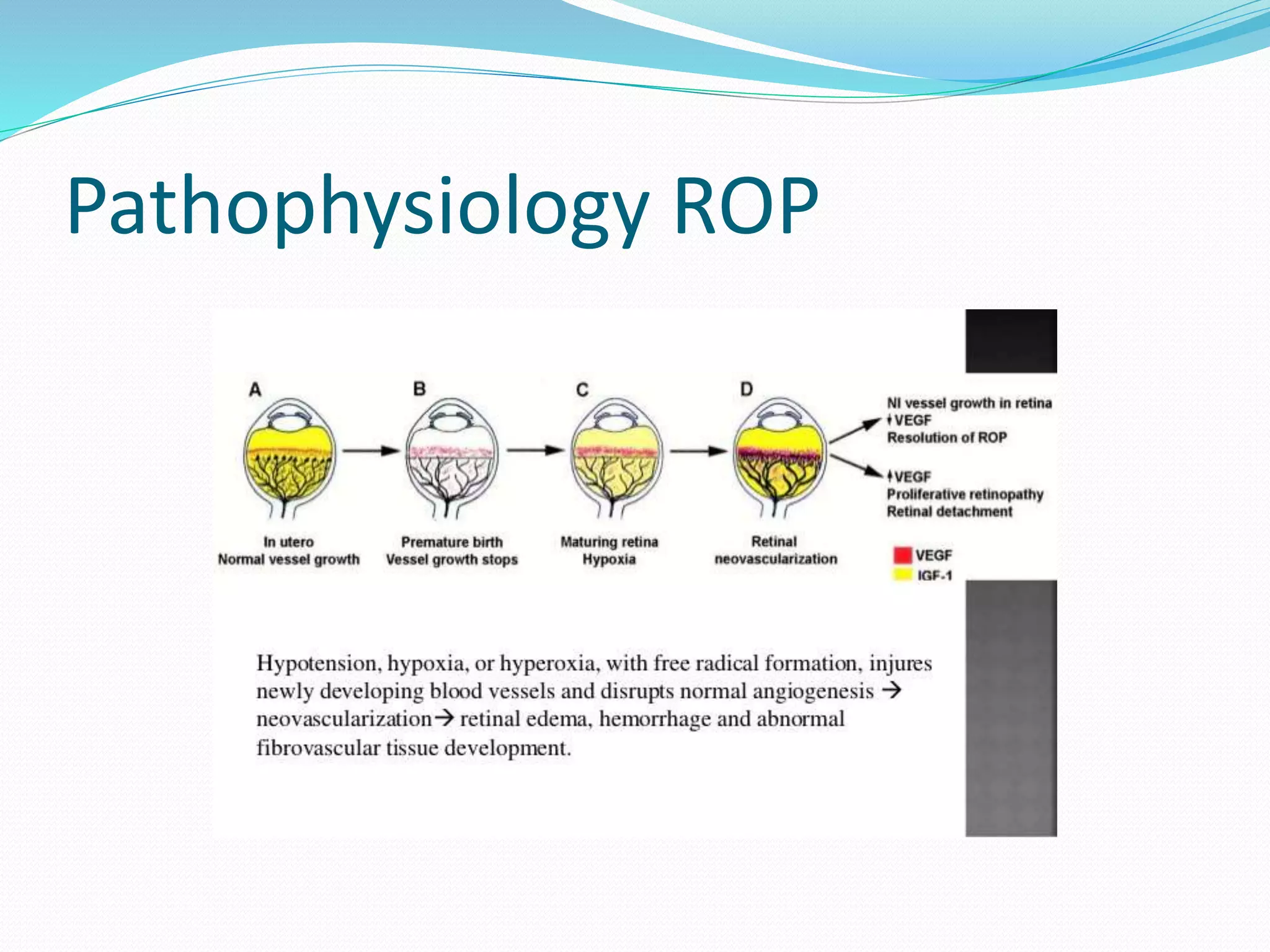
Pathophysiology ROP
Risk Factors
Three crucial risk factors:
• Birth weight
• Gestational age
• Prolonged oxygen therapy
Whom to screen?
 Preterms < 34 wks GA and / or < 1750 gms
 Preterms 34 -366/7 wks or BW 1750 -2000 gms with risk
factors.
Other Risk Factors……
• Mechanical
ventilation
• Hemodynamic
instability
• Multiple births
• Blood transfusions
• Intra Uterine Growth
Retardation (IUGR)
• Respiratory Distress
Syndrome (RDS)
• Multiple apnoeic
episodes
• Hypercarbia, Acidosis
• Sepsis
• Intra Ventricular
Haemorrhage (IVH)
• Vit. E deficiency
• Anaemia
Timing of first screening
31 wks of PMA or after 4 wks of birth
whichever is later
Timing of first screening….
 Studies show that AP-ROP is more common in Indian
babies
 NNF recommends that Infants <28 wks or <1200 gms
should be screened early at 2-3 weeks of age, to enable
early identification of AP-ROP.
How to do
 Ideal setting - under a radiant warmer in the NICU
 Discharged /stable babies may be screened in the
ophthalmologist’s clinic
 Communication with parents with
documentation is highly desirable
 The baby should be swaddled and preferably fed
1hr prior to examination
How to do…
 Pupillary dilatation about 1 hr prior to
screening with tropicamide 0.5-1 % +
phenylephrine (2.5%) drops is used 2-3times
10-15 minutes apart
 Atropine should not be used
 Oral sucrose given to baby for pain relief
 Topical anesthesia without sedation
 wire speculum
 Indirect ophthalmoscopy with 20 D /28 D
How to do….
 First examine anterior segment
 Followed by posterior pole
 Then sequential examination of all clock hours of
peripheral retina
 Scleral depressor
 Recordings of the findings should be done in the
chart or card
 Clearly state date of subsequent followup
Classification of ROP
 Zones
 Extent
 Stages
Zones
Stage 1
Demarcation line
Stage 2
Ridge formation
Stage 3
Extra retinal fibrovascular proliferation
Stage 4 (partial RD)
4A 4B
Stage 5 (total RD)
Classification of ROP cont.
 Plus disease –
signs indicating severity.
Venous dilatation or
arteriolar tortuosity in at
least two quadrants;
vitreous haze; poor pupil
dilatation; vascular
engorgement of the iris.
Terminology
 Threshold disease : Stage 3 in zone 1 or 2 in at least 5
contiguous or 8 non-contiguous clock hours with plus
disease. Point at which infant is treated.
 Pre-threshold disease : ETROP. High and low risk
prethreshold disease.
High risk prethreshold :
Zone1, any stage ROP with plus disease.
Zone 1, stage 3 with or without plus disease.
Zone 2, stage 2/3 with plus disease.
 Rush disease : Rapid progressive severe form of ROP.
Posterior location. Dilated, tortuous vessels with shunt
vessels throughout retina.
Follow up schedule
Zone of retinal findings Stage of retinal
findings
Follow up interval
Zone 1 Immature vascularization 1-2 weeks
Stage 1 or 2 1week or less
Regressing ROP 1-2 weeks
Zone 2 Immature vascularization 2-3 weeks
Stage 1 2 weeks
Stage 2 1-2 weeks
Stage 3 1week or less
Regressing ROP 1-2 weeks
Zone 3 Stage 1or 2 2-3 weeks
Regressing ROP 2-3 weeks
Termination of screening
 Full retinal vascularization;
( usually occurs at about the 40th wk of PMA and
mostly completes by the 45th week)
 Regression of ROP noted
 ROP advances to a stage where treatment is indicated.
Rop screening ppt

Rop screening ppt

  • 1.
  • 2.
    Introduction  Multi-factorial retinaldisorder  Primarily of preterm / LBW babies  Globally 50,000 children become blind/ year  Incidence of ROP in India ̴ 38 – 51.9 % in LBW  Annually ̴ 2 million newborns are at risk in India
  • 3.
  • 4.
  • 5.
    Risk Factors Three crucialrisk factors: • Birth weight • Gestational age • Prolonged oxygen therapy
  • 6.
    Whom to screen? Preterms < 34 wks GA and / or < 1750 gms  Preterms 34 -366/7 wks or BW 1750 -2000 gms with risk factors.
  • 7.
    Other Risk Factors…… •Mechanical ventilation • Hemodynamic instability • Multiple births • Blood transfusions • Intra Uterine Growth Retardation (IUGR) • Respiratory Distress Syndrome (RDS) • Multiple apnoeic episodes • Hypercarbia, Acidosis • Sepsis • Intra Ventricular Haemorrhage (IVH) • Vit. E deficiency • Anaemia
  • 8.
    Timing of firstscreening 31 wks of PMA or after 4 wks of birth whichever is later
  • 10.
    Timing of firstscreening….  Studies show that AP-ROP is more common in Indian babies  NNF recommends that Infants <28 wks or <1200 gms should be screened early at 2-3 weeks of age, to enable early identification of AP-ROP.
  • 11.
    How to do Ideal setting - under a radiant warmer in the NICU  Discharged /stable babies may be screened in the ophthalmologist’s clinic  Communication with parents with documentation is highly desirable  The baby should be swaddled and preferably fed 1hr prior to examination
  • 12.
    How to do… Pupillary dilatation about 1 hr prior to screening with tropicamide 0.5-1 % + phenylephrine (2.5%) drops is used 2-3times 10-15 minutes apart  Atropine should not be used  Oral sucrose given to baby for pain relief  Topical anesthesia without sedation  wire speculum  Indirect ophthalmoscopy with 20 D /28 D
  • 13.
    How to do…. First examine anterior segment  Followed by posterior pole  Then sequential examination of all clock hours of peripheral retina  Scleral depressor  Recordings of the findings should be done in the chart or card  Clearly state date of subsequent followup
  • 14.
    Classification of ROP Zones  Extent  Stages
  • 15.
  • 16.
  • 17.
  • 18.
    Stage 3 Extra retinalfibrovascular proliferation
  • 19.
  • 20.
  • 21.
    Classification of ROPcont.  Plus disease – signs indicating severity. Venous dilatation or arteriolar tortuosity in at least two quadrants; vitreous haze; poor pupil dilatation; vascular engorgement of the iris.
  • 22.
    Terminology  Threshold disease: Stage 3 in zone 1 or 2 in at least 5 contiguous or 8 non-contiguous clock hours with plus disease. Point at which infant is treated.  Pre-threshold disease : ETROP. High and low risk prethreshold disease. High risk prethreshold : Zone1, any stage ROP with plus disease. Zone 1, stage 3 with or without plus disease. Zone 2, stage 2/3 with plus disease.  Rush disease : Rapid progressive severe form of ROP. Posterior location. Dilated, tortuous vessels with shunt vessels throughout retina.
  • 23.
    Follow up schedule Zoneof retinal findings Stage of retinal findings Follow up interval Zone 1 Immature vascularization 1-2 weeks Stage 1 or 2 1week or less Regressing ROP 1-2 weeks Zone 2 Immature vascularization 2-3 weeks Stage 1 2 weeks Stage 2 1-2 weeks Stage 3 1week or less Regressing ROP 1-2 weeks Zone 3 Stage 1or 2 2-3 weeks Regressing ROP 2-3 weeks
  • 24.
    Termination of screening Full retinal vascularization; ( usually occurs at about the 40th wk of PMA and mostly completes by the 45th week)  Regression of ROP noted  ROP advances to a stage where treatment is indicated.

Editor's Notes