Eramus+ ‘Different but together’
2019-1-RO01-KA229-063163_1
‘Gheorghe
Șincai’
Technological
High School
Târgu Mureș,
Romania
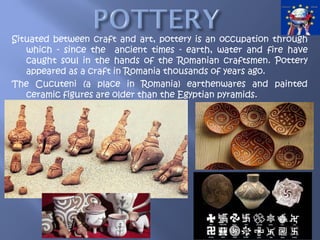
Situated between craft and art, pottery is an occupation through
which - since the ancient times - earth, water and fire have
caught soul in the hands of the Romanian craftsmen. Pottery
appeared as a craft in Romania thousands of years ago.
The Cucuteni (a place in Romania) earthenwares and painted
ceramic figures are older than the Egyptian pyramids.
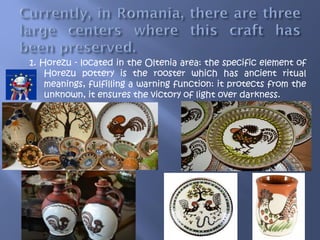
1. Horezu - located in the Oltenia area: the specific element of
Horezu pottery is the rooster which has ancient ritual
meanings, fulfilling a warning function: it protects from the
unknown, it ensures the victory of light over darkness.
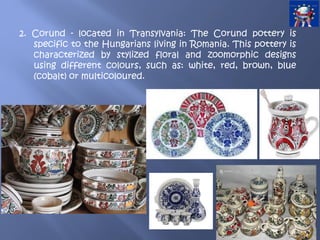
2. Corund - located in Transylvania: The Corund pottery is
specific to the Hungarians living in Romania. This pottery is
characterized by stylized floral and zoomorphic designs
using different colours, such as: white, red, brown, blue
(cobalt) or multicoloured.
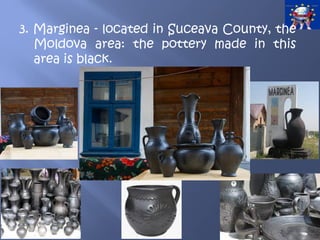
3. Marginea - located in Suceava County, the
Moldova area: the pottery made in this
area is black.
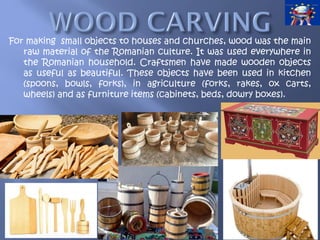
For making small objects to houses and churches, wood was the main
raw material of the Romanian culture. It was used everywhere in
the Romanian household. Craftsmen have made wooden objects
as useful as beautiful. These objects have been used in kitchen
(spoons, bowls, forks), in agriculture (forks, rakes, ox carts,
wheels) and as furniture items (cabinets, beds, dowry boxes).
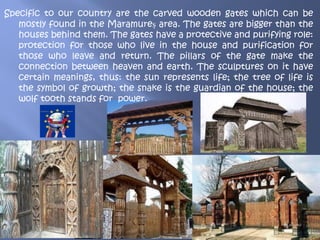
Specific to our country are the carved wooden gates which can be
mostly found in the Maramureș area. The gates are bigger than the
houses behind them. The gates have a protective and purifying role:
protection for those who live in the house and purification for
those who leave and return. The pillars of the gate make the
connection between heaven and earth. The sculptures on it have
certain meanings, thus: the sun represents life; the tree of life is
the symbol of growth; the snake is the guardian of the house; the
wolf tooth stands for power.
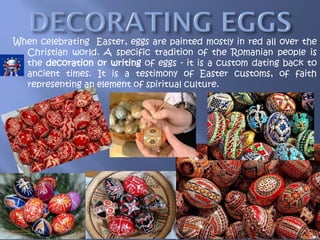
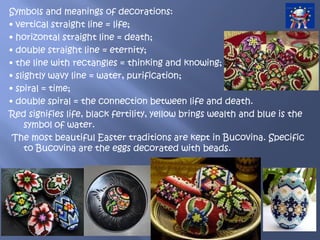
When celebrating Easter, eggs are painted mostly in red all over the
Christian world. A specific tradition of the Romanian people is
the decoration or writing of eggs - it is a custom dating back to
ancient times. It is a testimony of Easter customs, of faith
representing an element of spiritual culture.
Symbols and meanings of decorations:
• vertical straight line = life;
• horizontal straight line = death;
• double straight line = eternity;
• the line with rectangles = thinking and knowing;
• slightly wavy line = water, purification;
• spiral = time;
• double spiral = the connection between life and death.
Red signifies life, black fertility, yellow brings wealth and blue is the
symbol of water.
The most beautiful Easter traditions are kept in Bucovina. Specific
to Bucovina are the eggs decorated with beads.
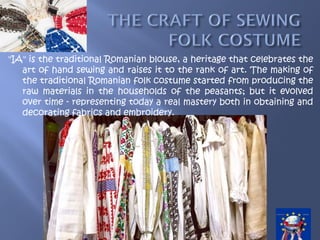
"IA" is the traditional Romanian blouse, a heritage that celebrates the
art of hand sewing and raises it to the rank of art. The making of
the traditional Romanian folk costume started from producing the
raw materials in the households of the peasants; but it evolved
over time - representing today a real mastery both in obtaining and
decorating fabrics and embroidery.
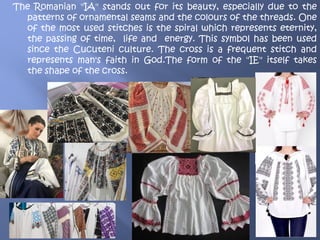
The Romanian "IA" stands out for its beauty, especially due to the
patterns of ornamental seams and the colours of the threads. One
of the most used stitches is the spiral which represents eternity,
the passing of time, life and energy. This symbol has been used
since the Cucuteni culture. The cross is a frequent stitch and
represents man's faith in God.The form of the "IE" itself takes
the shape of the cross.

Romanian crafts

  • 1.
    Eramus+ ‘Different buttogether’ 2019-1-RO01-KA229-063163_1 ‘Gheorghe Șincai’ Technological High School Târgu Mureș, Romania
  • 2.
    Situated between craftand art, pottery is an occupation through which - since the ancient times - earth, water and fire have caught soul in the hands of the Romanian craftsmen. Pottery appeared as a craft in Romania thousands of years ago. The Cucuteni (a place in Romania) earthenwares and painted ceramic figures are older than the Egyptian pyramids.
  • 3.
    1. Horezu -located in the Oltenia area: the specific element of Horezu pottery is the rooster which has ancient ritual meanings, fulfilling a warning function: it protects from the unknown, it ensures the victory of light over darkness.
  • 4.
    2. Corund -located in Transylvania: The Corund pottery is specific to the Hungarians living in Romania. This pottery is characterized by stylized floral and zoomorphic designs using different colours, such as: white, red, brown, blue (cobalt) or multicoloured.
  • 5.
    3. Marginea -located in Suceava County, the Moldova area: the pottery made in this area is black.
  • 6.
    For making smallobjects to houses and churches, wood was the main raw material of the Romanian culture. It was used everywhere in the Romanian household. Craftsmen have made wooden objects as useful as beautiful. These objects have been used in kitchen (spoons, bowls, forks), in agriculture (forks, rakes, ox carts, wheels) and as furniture items (cabinets, beds, dowry boxes).
  • 7.
    Specific to ourcountry are the carved wooden gates which can be mostly found in the Maramureș area. The gates are bigger than the houses behind them. The gates have a protective and purifying role: protection for those who live in the house and purification for those who leave and return. The pillars of the gate make the connection between heaven and earth. The sculptures on it have certain meanings, thus: the sun represents life; the tree of life is the symbol of growth; the snake is the guardian of the house; the wolf tooth stands for power.
  • 8.
    When celebrating Easter,eggs are painted mostly in red all over the Christian world. A specific tradition of the Romanian people is the decoration or writing of eggs - it is a custom dating back to ancient times. It is a testimony of Easter customs, of faith representing an element of spiritual culture.
  • 9.
    Symbols and meaningsof decorations: • vertical straight line = life; • horizontal straight line = death; • double straight line = eternity; • the line with rectangles = thinking and knowing; • slightly wavy line = water, purification; • spiral = time; • double spiral = the connection between life and death. Red signifies life, black fertility, yellow brings wealth and blue is the symbol of water. The most beautiful Easter traditions are kept in Bucovina. Specific to Bucovina are the eggs decorated with beads.
  • 10.
    "IA" is thetraditional Romanian blouse, a heritage that celebrates the art of hand sewing and raises it to the rank of art. The making of the traditional Romanian folk costume started from producing the raw materials in the households of the peasants; but it evolved over time - representing today a real mastery both in obtaining and decorating fabrics and embroidery.
  • 11.
    The Romanian "IA"stands out for its beauty, especially due to the patterns of ornamental seams and the colours of the threads. One of the most used stitches is the spiral which represents eternity, the passing of time, life and energy. This symbol has been used since the Cucuteni culture. The cross is a frequent stitch and represents man's faith in God.The form of the "IE" itself takes the shape of the cross.