Tradiţii şi obiceiuri româneşti
specifice sărbătorilor de iarnă
Romanian traditions and customs
specific to winter holidays
ŞCOALA GIMNAZIALĂ ,,GEORGE VOEVIDCA”
Câmpulung Moldovenesc, România
December 2012 – January 2013
PARTENERIAT ŞCOLAR MULTILATERAL COMENIUS ,,MULTIGHID EUROPEAN”
COMENIUS MULTILATERAL SCHOOL PARTNERSHIP ,,EUROPEAN MULTIGUIDE”
This project has been funded with support from the European Commission. This publication reflects the views only
of the author, and the Commission cannot be held responsible for any use which may be made of the information
contained therein.
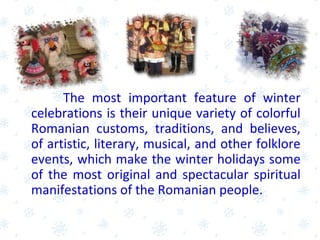
The most important feature of winter
celebrations is their unique variety of colorful
Romanian customs, traditions, and believes,
of artistic, literary, musical, and other folklore
events, which make the winter holidays some
of the most original and spectacular spiritual
manifestations of the Romanian people.
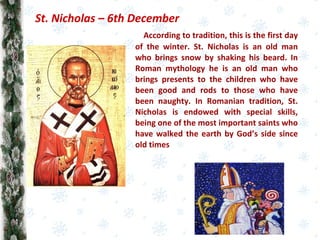
According to tradition, this is the first day
of the winter. St. Nicholas is an old man
who brings snow by shaking his beard. In
Roman mythology he is an old man who
brings presents to the children who have
been good and rods to those who have
been naughty. In Romanian tradition, St.
Nicholas is endowed with special skills,
being one of the most important saints who
have walked the earth by God’s side since
old times
St. Nicholas – 6th December
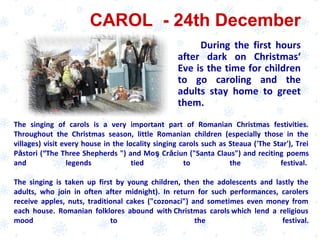
CAROL - 24th December
During the first hours
after dark on Christmas‘
Eve is the time for children
to go caroling and the
adults stay home to greet
them.
The singing of carols is a very important part of Romanian Christmas festivities.
Throughout the Christmas season, little Romanian children (especially those in the
villages) visit every house in the locality singing carols such as Steaua ('The Star'), Trei
Păstori (“The Three Shepherds ") and Moş Crăciun ("Santa Claus") and reciting poems
and legends tied to the festival.
The singing is taken up first by young children, then the adolescents and lastly the
adults, who join in often after midnight). In return for such performances, carolers
receive apples, nuts, traditional cakes ("cozonaci") and sometimes even money from
each house. Romanian folklores abound with Christmas carols which lend a religious
mood to the festival.
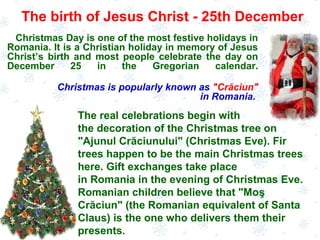
Christmas Day is one of the most festive holidays in
Romania. It is a Christian holiday in memory of Jesus
Christ’s birth and most people celebrate the day on
December 25 in the Gregorian calendar.
Christmas is popularly known as "Crăciun"
in Romania.
The birth of Jesus Christ - 25th December
The real celebrations begin with
the decoration of the Christmas tree on
"Ajunul Crăciunului" (Christmas Eve). Fir
trees happen to be the main Christmas trees
here. Gift exchanges take place
in Romania in the evening of Christmas Eve.
Romanian children believe that "Moş
Crăciun" (the Romanian equivalent of Santa
Claus) is the one who delivers them their
presents.
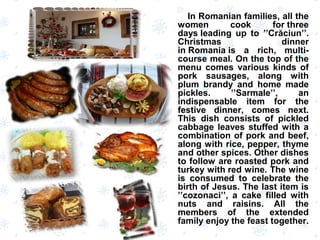
In Romanian families, all the
women cook for three
days leading up to ’’Crăciun’’.
Christmas dinner
in Romania is a rich, multi-
course meal. On the top of the
menu comes various kinds of
pork sausages, along with
plum brandy and home made
pickles. ’’Sarmale’’, an
indispensable item for the
festive dinner, comes next.
This dish consists of pickled
cabbage leaves stuffed with a
combination of pork and beef,
along with rice, pepper, thyme
and other spices. Other dishes
to follow are roasted pork and
turkey with red wine. The wine
is consumed to celebrate the
birth of Jesus. The last item is
’’cozonaci’’, a cake filled with
nuts and raisins. All the
members of the extended
family enjoy the feast together.
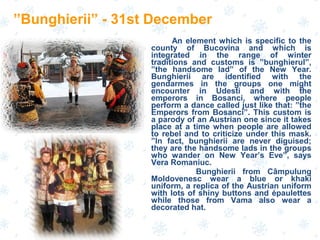
An element which is specific to the
county of Bucovina and which is
integrated in the range of winter
traditions and customs is ”bunghierul”,
”the handsome lad” of the New Year.
Bunghierii are identified with the
gendarmes in the groups one might
encounter in Udesti and with the
emperors in Bosanci, where people
perform a dance called just like that: ”the
Emperors from Bosanci”. This custom is
a parody of an Austrian one since it takes
place at a time when people are allowed
to rebel and to criticize under this mask.
”In fact, bunghierii are never diguised;
they are the handsome lads in the groups
who wander on New Year’s Eve”, says
Vera Romaniuc.
Bunghierii from Câmpulung
Moldovenesc wear a blue or khaki
uniform, a replica of the Austrian uniform
with lots of shiny buttons and épaulettes
while those from Vama also wear a
decorated hat.
”Bunghierii” - 31st December
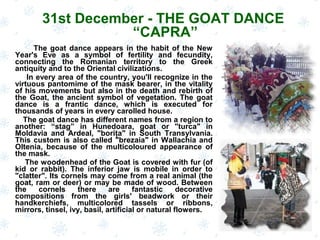
The goat dance appears in the habit of the New
Year's Eve as a symbol of fertility and fecundity,
connecting the Romanian territory to the Greek
antiquity and to the Oriental civilizations.
In every area of the country, you'll recognize in the
virtuous pantomime of the mask bearer, in the vitality
of his movements but also in the death and rebirth of
the Goat, the ancient symbol of vegetation. The goat
dance is a frantic dance, which is executed for
thousands of years in every carolled house.
The goat dance has different names from a region to
another: “stag” in Hunedoara, goat or "turca" in
Moldavia and Ardeal, "boriţa" in South Transylvania.
This custom is also called "brezaia" in Wallachia and
Oltenia, because of the multicoloured appearance of
the mask.
The woodenhead of the Goat is covered with fur (of
kid or rabbit). The inferior jaw is mobile in order to
"clatter". Its cornels may come from a real animal (the
goat, ram or deer) or may be made of wood. Between
the cornels there are fantastic decorative
compositions from the girls' beadwork or their
handkerchiefs, multicolored tassels or ribbons,
mirrors, tinsel, ivy, basil, artificial or natural flowers.
31st December - THE GOAT DANCE
“CAPRA”
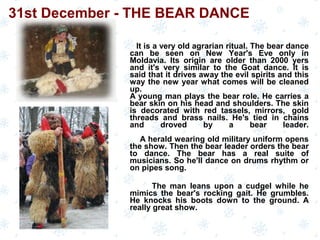
It is a very old agrarian ritual. The bear dance
can be seen on New Year's Eve only in
Moldavia. Its origin are older than 2000 yers
and it's very similar to the Goat dance. It is
said that it drives away the evil spirits and this
way the new year what comes will be cleaned
up.
A young man plays the bear role. He carries a
bear skin on his head and shoulders. The skin
is decorated with red tassels, mirrors, gold
threads and brass nails. He's tied in chains
and droved by a bear leader.
A herald wearing old military uniform opens
the show. Then the bear leader orders the bear
to dance. The bear has a real suite of
musicians. So he'll dance on drums rhythm or
on pipes song.
The man leans upon a cudgel while he
mimics the bear's rocking gait. He grumbles.
He knocks his boots down to the ground. A
really great show.
31st December - THE BEAR DANCE
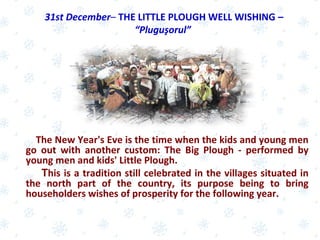
The New Year's Eve is the time when the kids and young men
go out with another custom: The Big Plough - performed by
young men and kids' Little Plough.
This is a tradition still celebrated in the villages situated in
the north part of the country, its purpose being to bring
householders wishes of prosperity for the following year.
31st December– THE LITTLE PLOUGH WELL WISHING –
“Pluguşorul”
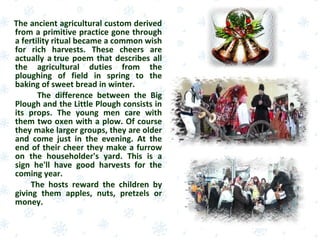
The ancient agricultural custom derived
from a primitive practice gone through
a fertility ritual became a common wish
for rich harvests. These cheers are
actually a true poem that describes all
the agricultural duties from the
ploughing of field in spring to the
baking of sweet bread in winter.
The difference between the Big
Plough and the Little Plough consists in
its props. The young men care with
them two oxen with a plow. Of course
they make larger groups, they are older
and come just in the evening. At the
end of their cheer they make a furrow
on the householder's yard. This is a
sign he'll have good harvests for the
coming year.
The hosts reward the children by
giving them apples, nuts, pretzels or
money.
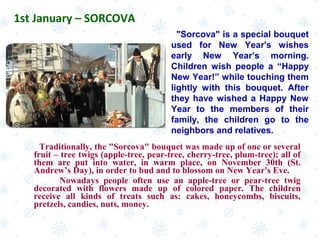
Traditionally, the "Sorcova" bouquet was made up of one or several
fruit – tree twigs (apple-tree, pear-tree, cherry-tree, plum-tree); all of
them are put into water, in warm place, on November 30th (St.
Andrew’s Day), in order to bud and to blossom on New Year's Eve.
Nowadays people often use an apple-tree or pear-tree twig
decorated with flowers made up of colored paper. The children
receive all kinds of treats such as: cakes, honeycombs, biscuits,
pretzels, candies, nuts, money.
1st January – SORCOVA
"Sorcova" is a special bouquet
used for New Year's wishes
early New Year’s morning.
Children wish people a “Happy
New Year!” while touching them
lightly with this bouquet. After
they have wished a Happy New
Year to the members of their
family, the children go to the
neighbors and relatives.
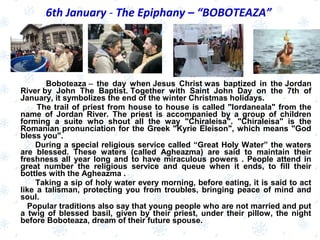
Boboteaza –  the day when Jesus Christ was baptized in the Jordan
River by John The Baptist. Together with Saint John Day on the 7th of
January, it symbolizes the end of the winter Christmas holidays.
The trail of priest from house to house is called "Iordaneala" from the
name of Jordan River. The priest is accompanied by a group of children
forming a suite who shout all the way "Chiraleisa". "Chiraleisa" is the
Romanian pronunciation for the Greek "Kyrie Eleison", which means "God
bless you".
During a special religious service called “Great Holy Water” the waters
are blessed. These waters (called Agheazma) are said to maintain their
freshness all year long and to have miraculous powers . People attend in
great number the religious service and queue when it ends, to fill their
bottles with the Agheazma .
Taking a sip of holy water every morning, before eating, it is said to act
like a talisman, protecting you from troubles, bringing peace of mind and
soul.
Popular traditions also say that young people who are not married and put
a twig of blessed basil, given by their priest, under their pillow, the night
before Boboteaza, dream of their future spouse.
6th January - The Epiphany – “BOBOTEAZA”
Work team:
Documentation team
Teachers:
Lăcrămioara Băcanu
Marcela Norocel
Oltea Nistor
Oltea Hofman
Daniela Stanciu
Students:
The 4th , 5th, 6th, 7th and 8th grade students.
Editing work:
The 7th and 8th grade students guided by Lăcrămioara Băcanu, Marcela
Norocel and Oltea Nistor
Translation:
The 7th and 8th grade students guided by Daniela Stanciu, teacher of
English.
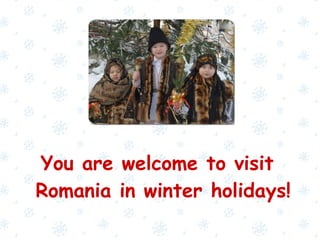
You are welcome to visit
Romania in winter holidays!

Winter holidays in Romania

  • 1.
    Tradiţii şi obiceiuriromâneşti specifice sărbătorilor de iarnă Romanian traditions and customs specific to winter holidays ŞCOALA GIMNAZIALĂ ,,GEORGE VOEVIDCA” Câmpulung Moldovenesc, România December 2012 – January 2013 PARTENERIAT ŞCOLAR MULTILATERAL COMENIUS ,,MULTIGHID EUROPEAN” COMENIUS MULTILATERAL SCHOOL PARTNERSHIP ,,EUROPEAN MULTIGUIDE” This project has been funded with support from the European Commission. This publication reflects the views only of the author, and the Commission cannot be held responsible for any use which may be made of the information contained therein.
  • 2.
    The most importantfeature of winter celebrations is their unique variety of colorful Romanian customs, traditions, and believes, of artistic, literary, musical, and other folklore events, which make the winter holidays some of the most original and spectacular spiritual manifestations of the Romanian people.
  • 3.
    According to tradition,this is the first day of the winter. St. Nicholas is an old man who brings snow by shaking his beard. In Roman mythology he is an old man who brings presents to the children who have been good and rods to those who have been naughty. In Romanian tradition, St. Nicholas is endowed with special skills, being one of the most important saints who have walked the earth by God’s side since old times St. Nicholas – 6th December
  • 4.
    CAROL - 24thDecember During the first hours after dark on Christmas‘ Eve is the time for children to go caroling and the adults stay home to greet them. The singing of carols is a very important part of Romanian Christmas festivities. Throughout the Christmas season, little Romanian children (especially those in the villages) visit every house in the locality singing carols such as Steaua ('The Star'), Trei Păstori (“The Three Shepherds ") and Moş Crăciun ("Santa Claus") and reciting poems and legends tied to the festival. The singing is taken up first by young children, then the adolescents and lastly the adults, who join in often after midnight). In return for such performances, carolers receive apples, nuts, traditional cakes ("cozonaci") and sometimes even money from each house. Romanian folklores abound with Christmas carols which lend a religious mood to the festival.
  • 5.
    Christmas Day isone of the most festive holidays in Romania. It is a Christian holiday in memory of Jesus Christ’s birth and most people celebrate the day on December 25 in the Gregorian calendar. Christmas is popularly known as "Crăciun" in Romania. The birth of Jesus Christ - 25th December The real celebrations begin with the decoration of the Christmas tree on "Ajunul Crăciunului" (Christmas Eve). Fir trees happen to be the main Christmas trees here. Gift exchanges take place in Romania in the evening of Christmas Eve. Romanian children believe that "Moş Crăciun" (the Romanian equivalent of Santa Claus) is the one who delivers them their presents.
  • 6.
    In Romanian families,all the women cook for three days leading up to ’’Crăciun’’. Christmas dinner in Romania is a rich, multi- course meal. On the top of the menu comes various kinds of pork sausages, along with plum brandy and home made pickles. ’’Sarmale’’, an indispensable item for the festive dinner, comes next. This dish consists of pickled cabbage leaves stuffed with a combination of pork and beef, along with rice, pepper, thyme and other spices. Other dishes to follow are roasted pork and turkey with red wine. The wine is consumed to celebrate the birth of Jesus. The last item is ’’cozonaci’’, a cake filled with nuts and raisins. All the members of the extended family enjoy the feast together.
  • 7.
    An element whichis specific to the county of Bucovina and which is integrated in the range of winter traditions and customs is ”bunghierul”, ”the handsome lad” of the New Year. Bunghierii are identified with the gendarmes in the groups one might encounter in Udesti and with the emperors in Bosanci, where people perform a dance called just like that: ”the Emperors from Bosanci”. This custom is a parody of an Austrian one since it takes place at a time when people are allowed to rebel and to criticize under this mask. ”In fact, bunghierii are never diguised; they are the handsome lads in the groups who wander on New Year’s Eve”, says Vera Romaniuc. Bunghierii from Câmpulung Moldovenesc wear a blue or khaki uniform, a replica of the Austrian uniform with lots of shiny buttons and épaulettes while those from Vama also wear a decorated hat. ”Bunghierii” - 31st December
  • 8.
    The goat danceappears in the habit of the New Year's Eve as a symbol of fertility and fecundity, connecting the Romanian territory to the Greek antiquity and to the Oriental civilizations. In every area of the country, you'll recognize in the virtuous pantomime of the mask bearer, in the vitality of his movements but also in the death and rebirth of the Goat, the ancient symbol of vegetation. The goat dance is a frantic dance, which is executed for thousands of years in every carolled house. The goat dance has different names from a region to another: “stag” in Hunedoara, goat or "turca" in Moldavia and Ardeal, "boriţa" in South Transylvania. This custom is also called "brezaia" in Wallachia and Oltenia, because of the multicoloured appearance of the mask. The woodenhead of the Goat is covered with fur (of kid or rabbit). The inferior jaw is mobile in order to "clatter". Its cornels may come from a real animal (the goat, ram or deer) or may be made of wood. Between the cornels there are fantastic decorative compositions from the girls' beadwork or their handkerchiefs, multicolored tassels or ribbons, mirrors, tinsel, ivy, basil, artificial or natural flowers. 31st December - THE GOAT DANCE “CAPRA”
  • 9.
    It is avery old agrarian ritual. The bear dance can be seen on New Year's Eve only in Moldavia. Its origin are older than 2000 yers and it's very similar to the Goat dance. It is said that it drives away the evil spirits and this way the new year what comes will be cleaned up. A young man plays the bear role. He carries a bear skin on his head and shoulders. The skin is decorated with red tassels, mirrors, gold threads and brass nails. He's tied in chains and droved by a bear leader. A herald wearing old military uniform opens the show. Then the bear leader orders the bear to dance. The bear has a real suite of musicians. So he'll dance on drums rhythm or on pipes song. The man leans upon a cudgel while he mimics the bear's rocking gait. He grumbles. He knocks his boots down to the ground. A really great show. 31st December - THE BEAR DANCE
  • 10.
    The New Year'sEve is the time when the kids and young men go out with another custom: The Big Plough - performed by young men and kids' Little Plough. This is a tradition still celebrated in the villages situated in the north part of the country, its purpose being to bring householders wishes of prosperity for the following year. 31st December– THE LITTLE PLOUGH WELL WISHING – “Pluguşorul”
  • 11.
    The ancient agriculturalcustom derived from a primitive practice gone through a fertility ritual became a common wish for rich harvests. These cheers are actually a true poem that describes all the agricultural duties from the ploughing of field in spring to the baking of sweet bread in winter. The difference between the Big Plough and the Little Plough consists in its props. The young men care with them two oxen with a plow. Of course they make larger groups, they are older and come just in the evening. At the end of their cheer they make a furrow on the householder's yard. This is a sign he'll have good harvests for the coming year. The hosts reward the children by giving them apples, nuts, pretzels or money.
  • 12.
    Traditionally, the "Sorcova"bouquet was made up of one or several fruit – tree twigs (apple-tree, pear-tree, cherry-tree, plum-tree); all of them are put into water, in warm place, on November 30th (St. Andrew’s Day), in order to bud and to blossom on New Year's Eve. Nowadays people often use an apple-tree or pear-tree twig decorated with flowers made up of colored paper. The children receive all kinds of treats such as: cakes, honeycombs, biscuits, pretzels, candies, nuts, money. 1st January – SORCOVA "Sorcova" is a special bouquet used for New Year's wishes early New Year’s morning. Children wish people a “Happy New Year!” while touching them lightly with this bouquet. After they have wished a Happy New Year to the members of their family, the children go to the neighbors and relatives.
  • 13.
    Boboteaza –  the daywhen Jesus Christ was baptized in the Jordan River by John The Baptist. Together with Saint John Day on the 7th of January, it symbolizes the end of the winter Christmas holidays. The trail of priest from house to house is called "Iordaneala" from the name of Jordan River. The priest is accompanied by a group of children forming a suite who shout all the way "Chiraleisa". "Chiraleisa" is the Romanian pronunciation for the Greek "Kyrie Eleison", which means "God bless you". During a special religious service called “Great Holy Water” the waters are blessed. These waters (called Agheazma) are said to maintain their freshness all year long and to have miraculous powers . People attend in great number the religious service and queue when it ends, to fill their bottles with the Agheazma . Taking a sip of holy water every morning, before eating, it is said to act like a talisman, protecting you from troubles, bringing peace of mind and soul. Popular traditions also say that young people who are not married and put a twig of blessed basil, given by their priest, under their pillow, the night before Boboteaza, dream of their future spouse. 6th January - The Epiphany – “BOBOTEAZA”
  • 14.
    Work team: Documentation team Teachers: LăcrămioaraBăcanu Marcela Norocel Oltea Nistor Oltea Hofman Daniela Stanciu Students: The 4th , 5th, 6th, 7th and 8th grade students. Editing work: The 7th and 8th grade students guided by Lăcrămioara Băcanu, Marcela Norocel and Oltea Nistor Translation: The 7th and 8th grade students guided by Daniela Stanciu, teacher of English.
  • 15.
    You are welcometo visit Romania in winter holidays!