ROME:
Government and Society
Social Studies for 9th EBG
Teacher: MauricioTorres
Roman Government
▪ With plebeians demanding changes in government, the citiy’s leaders
new that change was urgent.
▪ In order to calm the plebeians, patricians gave way for new offices
that could only be occupied by plebeians.
▪ Gradually, the line that separated both classes began to disappear.
▪ This is how a tripartite government (a government with three parts)
was created.
▪ Each part had its own responsibilities and duties, and their own power, rights
and privileges.
Magistrates
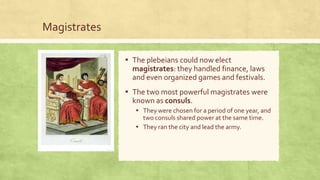
▪ The plebeians could now elect
magistrates: they handled finance, laws
and even organized games and festivals.
▪ The two most powerful magistrates were
known as consuls.
▪ They were chosen for a period of one year, and
two consuls shared power at the same time.
▪ They ran the city and lead the army.
Senate
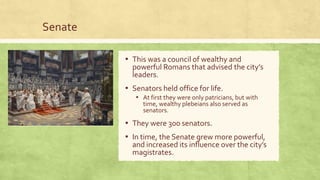
▪ This was a council of wealthy and
powerful Romans that advised the city’s
leaders.
▪ Senators held office for life.
▪ At first they were only patricians, but with
time, wealthy plebeians also served as
senators.
▪ They were 300 senators.
▪ In time, the Senate grew more powerful,
and increased its influence over the city’s
magistrates.
Assemblies &Tribunes
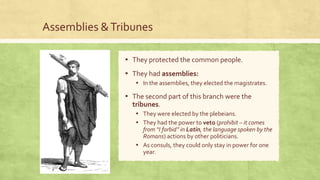
▪ They protected the common people.
▪ They had assemblies:
▪ In the assemblies, they elected the magistrates.
▪ The second part of this branch were the
tribunes.
▪ They were elected by the plebeians.
▪ They had the power to veto (prohibit – it comes
from “I forbid” in Latin, the language spoken by the
Romans) actions by other politicians.
▪ As consuls, they could only stay in power for one
year.
Civic Duties
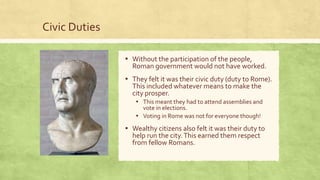
▪ Without the participation of the people,
Roman government would not have worked.
▪ They felt it was their civic duty (duty to Rome).
This included whatever means to make the
city prosper.
▪ This meant they had to attend assemblies and
vote in elections.
▪ Voting in Rome was not for everyone though!
▪ Wealthy citizens also felt it was their duty to
help run the city.This earned them respect
from fellow Romans.
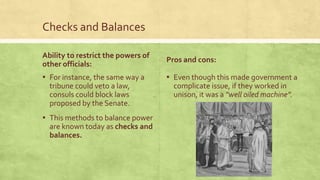
Checks and Balances
Ability to restrict the powers of
other officials:
▪ For instance, the same way a
tribune could veto a law,
consuls could block laws
proposed by the Senate.
▪ This methods to balance power
are known today as checks and
balances.
Pros and cons:
▪ Even though this made government a
complicate issue, if they worked in
unison, it was a “well oiled machine”.
AskYourself
▪ Main ideas:
▪ What were the three parts of the Roman government?
▪ Define:
▪ What was a consul?
▪ Explain:
▪ Why was the senate so powerful?
▪ How did the government keep tribunes from becoming too powerful?
▪ Draw Conclusions:
▪ Why were assemblies and tribunes necessary?
▪ How was civic duty demonstrated in Rome?
▪ Identify:
▪ What was the veto?Who applied it?
Bibliography
▪ Burstein, S. M., & Shek, R. (2012). World History (Teacher´s Edition)
(1st Edition ed.). (H. McDougal, Ed.) Orlando, Florida, US.: Houghton
Mifflin Harcourt Publishing Company.
▪ Images taken from Google.

Roman government

  • 1.
    ROME: Government and Society SocialStudies for 9th EBG Teacher: MauricioTorres
  • 2.
    Roman Government ▪ Withplebeians demanding changes in government, the citiy’s leaders new that change was urgent. ▪ In order to calm the plebeians, patricians gave way for new offices that could only be occupied by plebeians. ▪ Gradually, the line that separated both classes began to disappear. ▪ This is how a tripartite government (a government with three parts) was created. ▪ Each part had its own responsibilities and duties, and their own power, rights and privileges.
  • 3.
    Magistrates ▪ The plebeianscould now elect magistrates: they handled finance, laws and even organized games and festivals. ▪ The two most powerful magistrates were known as consuls. ▪ They were chosen for a period of one year, and two consuls shared power at the same time. ▪ They ran the city and lead the army.
  • 4.
    Senate ▪ This wasa council of wealthy and powerful Romans that advised the city’s leaders. ▪ Senators held office for life. ▪ At first they were only patricians, but with time, wealthy plebeians also served as senators. ▪ They were 300 senators. ▪ In time, the Senate grew more powerful, and increased its influence over the city’s magistrates.
  • 5.
    Assemblies &Tribunes ▪ Theyprotected the common people. ▪ They had assemblies: ▪ In the assemblies, they elected the magistrates. ▪ The second part of this branch were the tribunes. ▪ They were elected by the plebeians. ▪ They had the power to veto (prohibit – it comes from “I forbid” in Latin, the language spoken by the Romans) actions by other politicians. ▪ As consuls, they could only stay in power for one year.
  • 6.
    Civic Duties ▪ Withoutthe participation of the people, Roman government would not have worked. ▪ They felt it was their civic duty (duty to Rome). This included whatever means to make the city prosper. ▪ This meant they had to attend assemblies and vote in elections. ▪ Voting in Rome was not for everyone though! ▪ Wealthy citizens also felt it was their duty to help run the city.This earned them respect from fellow Romans.
  • 7.
    Checks and Balances Abilityto restrict the powers of other officials: ▪ For instance, the same way a tribune could veto a law, consuls could block laws proposed by the Senate. ▪ This methods to balance power are known today as checks and balances. Pros and cons: ▪ Even though this made government a complicate issue, if they worked in unison, it was a “well oiled machine”.
  • 10.
    AskYourself ▪ Main ideas: ▪What were the three parts of the Roman government? ▪ Define: ▪ What was a consul? ▪ Explain: ▪ Why was the senate so powerful? ▪ How did the government keep tribunes from becoming too powerful? ▪ Draw Conclusions: ▪ Why were assemblies and tribunes necessary? ▪ How was civic duty demonstrated in Rome? ▪ Identify: ▪ What was the veto?Who applied it?
  • 11.
    Bibliography ▪ Burstein, S.M., & Shek, R. (2012). World History (Teacher´s Edition) (1st Edition ed.). (H. McDougal, Ed.) Orlando, Florida, US.: Houghton Mifflin Harcourt Publishing Company. ▪ Images taken from Google.