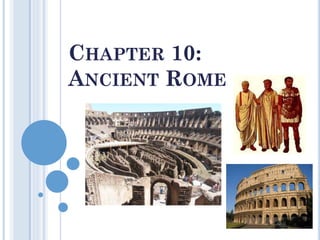
CHAPTER 10:
ANCIENT ROME
LESSON ONE: ROME’S BEGINNINGS
I. Legend
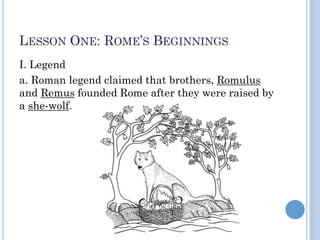
a. Roman legend claimed that brothers, Romulus
and Remus founded Rome after they were raised by
a she-wolf.
II. LANDFORMS AND BODIES OF WATER IN
ROME
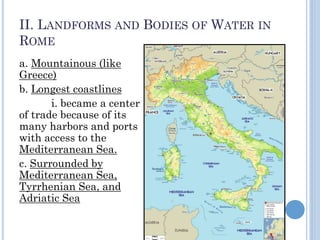
a. Mountainous (like
Greece)
b. Longest coastlines
i. became a center
of trade because of its
many harbors and ports
with access to the
Mediterranean Sea.
c. Surrounded by
Mediterranean Sea,
Tyrrhenian Sea, and
Adriatic Sea
III. CONNECTION
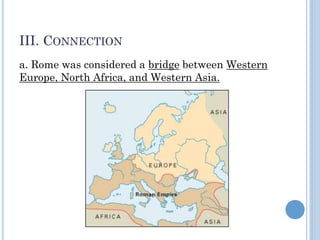
a. Rome was considered a bridge between Western
Europe, North Africa, and Western Asia.
IV. TRADING
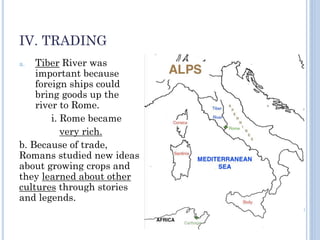
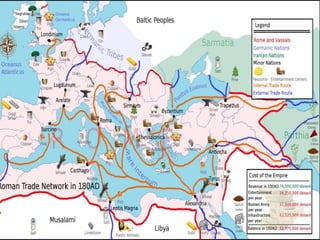
a. Tiber River was
important because
foreign ships could
bring goods up the
river to Rome.
i. Rome became
very rich.
b. Because of trade,
Romans studied new ideas
about growing crops and
they learned about other
cultures through stories
and legends.
V. ETRUSCANS
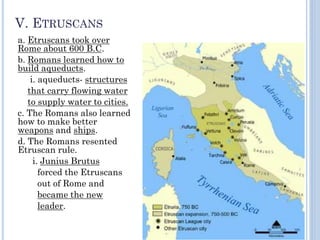
a. Etruscans took over
Rome about 600 B.C.
b. Romans learned how to
build aqueducts.
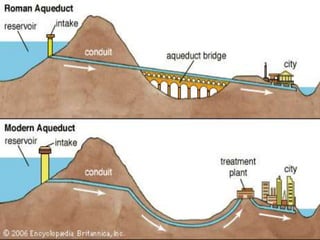
i. aqueducts- structures
that carry flowing water
to supply water to cities.
c. The Romans also learned
how to make better
weapons and ships.
d. The Romans resented
Etruscan rule.
i. Junius Brutus
forced the Etruscans
out of Rome and
became the new
leader.
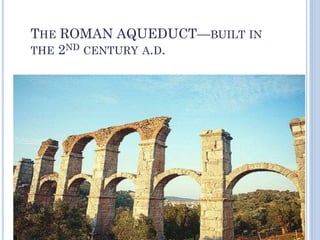
THE ROMAN AQUEDUCT—BUILT IN
THE 2ND CENTURY A.D.
LESSON 2 OUTLINE
LESSON 2-THE ROMAN REPUBLIC
I. Nationalism
a. Romans were proud of their soldiers and loyal to
their homeland. Told many war hero stories to
raise pride and nationalism- a strong devotion to
one’s country.
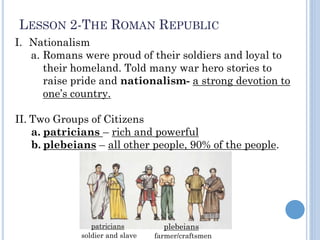
II. Two Groups of Citizens
a. patricians – rich and powerful
b. plebeians – all other people, 90% of the people.
patricians
soldier and slave farmer/craftsmen
plebeians
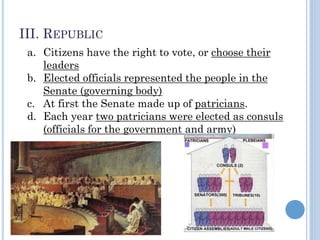
III. REPUBLIC
a. Citizens have the right to vote, or choose their
leaders
b. Elected officials represented the people in the
Senate (governing body)
c. At first the Senate made up of patricians.
d. Each year two patricians were elected as consuls
(officials for the government and army)
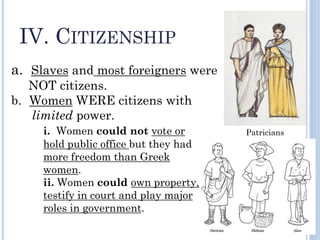
IV. CITIZENSHIP
a. Slaves and most foreigners were
NOT citizens.
b. Women WERE citizens with
limited power.
i. Women could not vote or
hold public office but they had
more freedom than Greek
women.
ii. Women could own property,
testify in court and play major
roles in government.
Patricians
V. TRIBUNES
a. men who were appointed to protect
the rights of the plebeians
b. set up to protect plebeians from the
harsh treatment from patricians
c. Over time plebeians gained in
wealth and power, but the
patricians always had more
power.
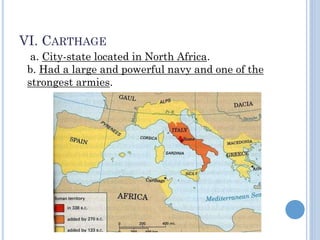
VI. CARTHAGE
a. City-state located in North Africa.
b. Had a large and powerful navy and one of the
strongest armies.
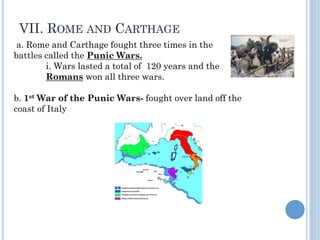
VII. ROME AND CARTHAGE
a. Rome and Carthage fought three times in the
battles called the Punic Wars.
i. Wars lasted a total of 120 years and the
Romans won all three wars.
b. 1st War of the Punic Wars- fought over land off the
coast of Italy
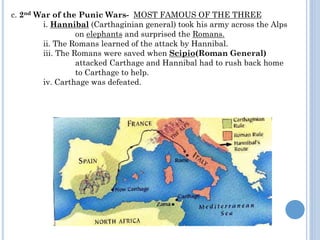
c. 2nd War of the Punic Wars- MOST FAMOUS OF THE THREE
i. Hannibal (Carthaginian general) took his army across the Alps
on elephants and surprised the Romans.
ii. The Romans learned of the attack by Hannibal.
iii. The Romans were saved when Scipio(Roman General)
attacked Carthage and Hannibal had to rush back home
to Carthage to help.
iv. Carthage was defeated.
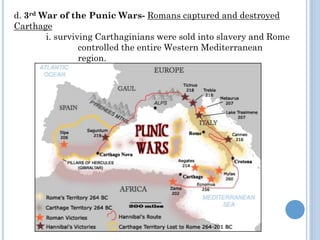
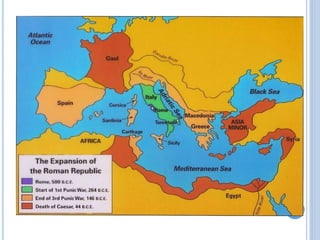
d. 3rd War of the Punic Wars- Romans captured and destroyed
Carthage
i. surviving Carthaginians were sold into slavery and Rome
controlled the entire Western Mediterranean
region.
VIII. CONQUERED PLACES
a.Romans tried to keep people happy
and patriotic (loyal to Rome).
i. They granted Roman
citizenship to people they
conquered
ii. allowed others to keep local
self- government and their
leaders remained in power
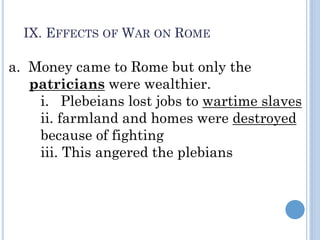
a. Money came to Rome but only the
patricians were wealthier.
i. Plebeians lost jobs to wartime slaves
ii. farmland and homes were destroyed
because of fighting
iii. This angered the plebians
IX. EFFECTS OF WAR ON ROME
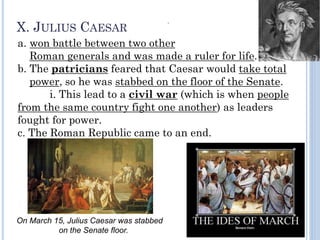
X. JULIUS CAESAR
a. won battle between two other
Roman generals and was made a ruler for life.
b. The patricians feared that Caesar would take total
power, so he was stabbed on the floor of the Senate.
i. This lead to a civil war (which is when people
from the same country fight one another) as leaders
fought for power.
c. The Roman Republic came to an end.
”
On March 15, Julius Caesar was stabbed
on the Senate floor.
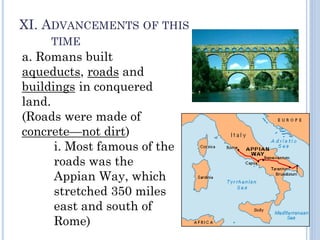
XI. ADVANCEMENTS OF THIS
TIME
a. Romans built
aqueducts, roads and
buildings in conquered
land.
(Roads were made of
concrete—not dirt)
i. Most famous of the
roads was the
Appian Way, which
stretched 350 miles
east and south of
Rome)
LESSON 3
OUTLINE
The Roman Empire
I. AUGUSTUS
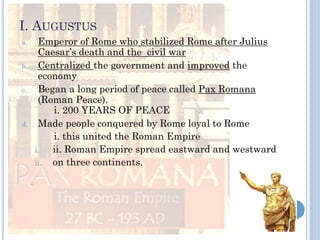
a. Emperor of Rome who stabilized Rome after Julius
Caesar’s death and the civil war
b. Centralized the government and improved the
economy
c. Began a long period of peace called Pax Romana
(Roman Peace).
i. 200 YEARS OF PEACE
d. Made people conquered by Rome loyal to Rome
i. this united the Roman Empire
i. ii. Roman Empire spread eastward and westward
ii. on three continents.
II. GOOD AND BAD EMPERORS
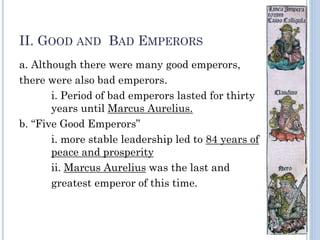
a. Although there were many good emperors,
there were also bad emperors.
i. Period of bad emperors lasted for thirty
years until Marcus Aurelius.
b. “Five Good Emperors”
i. more stable leadership led to 84 years of
peace and prosperity
ii. Marcus Aurelius was the last and
greatest emperor of this time.
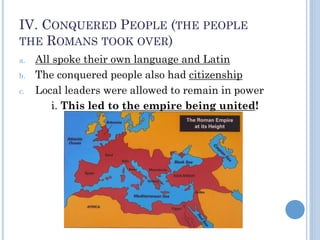
IV. CONQUERED PEOPLE (THE PEOPLE
THE ROMANS TOOK OVER)
a. All spoke their own language and Latin
b. The conquered people also had citizenship
c. Local leaders were allowed to remain in power
i. This led to the empire being united!
V. ROMAN LAW (SIMILAR TO U.S. LAW) THAT ALL
PEOPLE COULD FOLLOW:
a. All free people have equal rights.
b. A person is innocent until he or she is proven
guilty.
c. Accused people should be allowed to face their
accusers and defend themselves.
d. Judges must interpret the law and make
decisions fairly.
e. People have rights that no government can take
away.
The Twelve Tables were laws
engraved on tablets and put on
display in the Forum in Rome for
everyone to see, so they could be
understood by all of the citizens of
Rome.
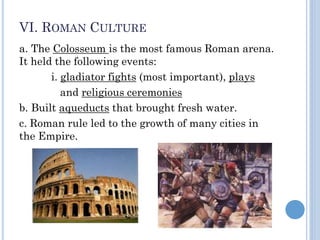
VI. ROMAN CULTURE
a. The Colosseum is the most famous Roman arena.
It held the following events:
i. gladiator fights (most important), plays
and religious ceremonies
b. Built aqueducts that brought fresh water.
c. Roman rule led to the growth of many cities in
the Empire.
LESSON 4 OUTLINE
The Rise of Christianity
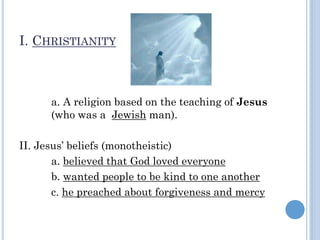
I. CHRISTIANITY
a. A religion based on the teaching of Jesus
(who was a Jewish man).
II. Jesus’ beliefs (monotheistic)
a. believed that God loved everyone
b. wanted people to be kind to one another
c. he preached about forgiveness and mercy
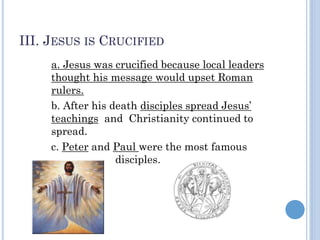
III. JESUS IS CRUCIFIED
a. Jesus was crucified because local leaders
thought his message would upset Roman
rulers.
b. After his death disciples spread Jesus’
teachings and Christianity continued to
spread.
c. Peter and Paul were the most famous
disciples.
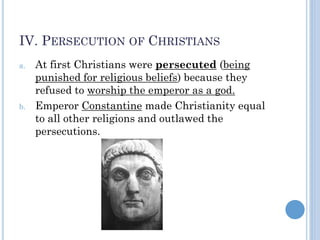
IV. PERSECUTION OF CHRISTIANS
a. At first Christians were persecuted (being
punished for religious beliefs) because they
refused to worship the emperor as a god.
b. Emperor Constantine made Christianity equal
to all other religions and outlawed the
persecutions.
LESSON 5 OUTLINE
Rise and Fall
EMPERORS FOR SALE
I. Emperors
a. Most Emperors after Marcus Aurelius cared about
increasing their wealth and power not the welfare of the
Roman Empire.
II. Choosing a New Ruler
a. Roman Army began to fight each other to get their
favorite person as an Emperor.
b. The Roman Army spent so much time fighting
within Rome (Romans fighting Romans) that they had to
pay mercenaries to fight foreign battles.
i. Mercenaries (hired soldiers) were not loyal to
the Roman Empire.
ii. Mercenaries allowed their own
tribes to attack Rome, especially German
tribes.
c. Roads were unsafe and trade decreased.
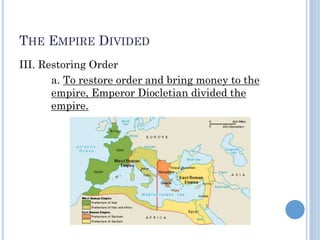
THE EMPIRE DIVIDED
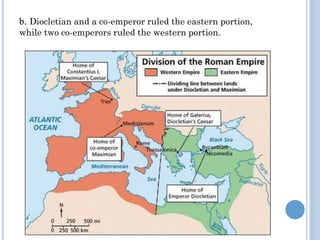
III. Restoring Order
a. To restore order and bring money to the
empire, Emperor Diocletian divided the
empire.
b. Diocletian and a co-emperor ruled the eastern portion,
while two co-emperors ruled the western portion.
THE CITY OF CONSTANTINE/ CHRISTIANITY
DIVIDES
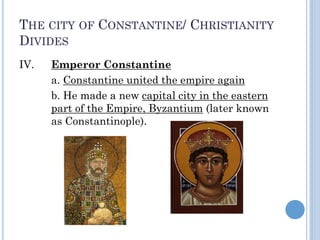
IV. Emperor Constantine
a. Constantine united the empire again
b. He made a new capital city in the eastern
part of the Empire, Byzantium (later known
as Constantinople).
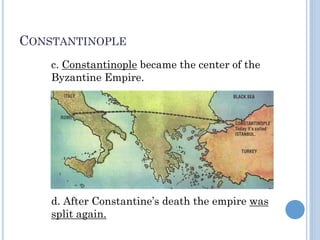
CONSTANTINOPLE
c. Constantinople became the center of the
Byzantine Empire.
d. After Constantine’s death the empire was
split again.
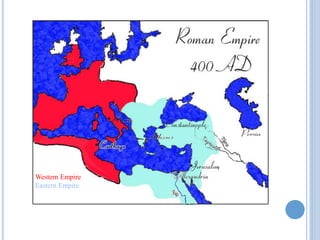
V. DIFFERENCES AMONG THE EMPIRES
a. Eastern part of the empire was strong
and rich; capital city was Constantinople.
i. Emperor was the head of the
church-Byzantine Orthodox Church.
b. Western part of the empire was weak
and poor; capital city was Rome.
i. Pope was the head of the church-the
Roman Catholic Church.
Western Empire
Eastern Empire
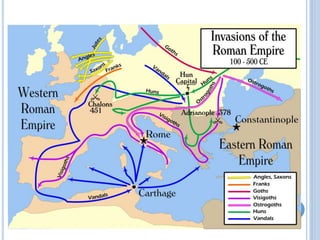
THE FINAL DAYS OF ROME/ THE FALL
VI. Visigoths (German Tribe)
a. Attacked the eastern Empire
b. Alaric, leader, reached the gates of Rome.
c. He surrounded the city, cutting off
its food supply.
i. He pillaged (robbed) the homes of
the wealthy in Rome and burned what
he could not take.
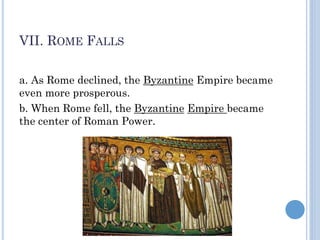
VII. ROME FALLS
a. As Rome declined, the Byzantine Empire became
even more prosperous.
b. When Rome fell, the Byzantine Empire became
the center of Roman Power.

Lesson 1 5 ppt 2013 (2)

  • 1.
  • 2.
    LESSON ONE: ROME’SBEGINNINGS I. Legend a. Roman legend claimed that brothers, Romulus and Remus founded Rome after they were raised by a she-wolf.
  • 3.
    II. LANDFORMS ANDBODIES OF WATER IN ROME a. Mountainous (like Greece) b. Longest coastlines i. became a center of trade because of its many harbors and ports with access to the Mediterranean Sea. c. Surrounded by Mediterranean Sea, Tyrrhenian Sea, and Adriatic Sea
  • 4.
    III. CONNECTION a. Romewas considered a bridge between Western Europe, North Africa, and Western Asia.
  • 5.
    IV. TRADING a. TiberRiver was important because foreign ships could bring goods up the river to Rome. i. Rome became very rich. b. Because of trade, Romans studied new ideas about growing crops and they learned about other cultures through stories and legends.
  • 7.
    V. ETRUSCANS a. Etruscanstook over Rome about 600 B.C. b. Romans learned how to build aqueducts. i. aqueducts- structures that carry flowing water to supply water to cities. c. The Romans also learned how to make better weapons and ships. d. The Romans resented Etruscan rule. i. Junius Brutus forced the Etruscans out of Rome and became the new leader.
  • 9.
    THE ROMAN AQUEDUCT—BUILTIN THE 2ND CENTURY A.D.
  • 10.
  • 11.
    LESSON 2-THE ROMANREPUBLIC I. Nationalism a. Romans were proud of their soldiers and loyal to their homeland. Told many war hero stories to raise pride and nationalism- a strong devotion to one’s country. II. Two Groups of Citizens a. patricians – rich and powerful b. plebeians – all other people, 90% of the people. patricians soldier and slave farmer/craftsmen plebeians
  • 12.
    III. REPUBLIC a. Citizenshave the right to vote, or choose their leaders b. Elected officials represented the people in the Senate (governing body) c. At first the Senate made up of patricians. d. Each year two patricians were elected as consuls (officials for the government and army)
  • 13.
    IV. CITIZENSHIP a. Slavesand most foreigners were NOT citizens. b. Women WERE citizens with limited power. i. Women could not vote or hold public office but they had more freedom than Greek women. ii. Women could own property, testify in court and play major roles in government. Patricians
  • 14.
    V. TRIBUNES a. menwho were appointed to protect the rights of the plebeians b. set up to protect plebeians from the harsh treatment from patricians c. Over time plebeians gained in wealth and power, but the patricians always had more power.
  • 15.
    VI. CARTHAGE a. City-statelocated in North Africa. b. Had a large and powerful navy and one of the strongest armies.
  • 16.
    VII. ROME ANDCARTHAGE a. Rome and Carthage fought three times in the battles called the Punic Wars. i. Wars lasted a total of 120 years and the Romans won all three wars. b. 1st War of the Punic Wars- fought over land off the coast of Italy
  • 17.
    c. 2nd Warof the Punic Wars- MOST FAMOUS OF THE THREE i. Hannibal (Carthaginian general) took his army across the Alps on elephants and surprised the Romans. ii. The Romans learned of the attack by Hannibal. iii. The Romans were saved when Scipio(Roman General) attacked Carthage and Hannibal had to rush back home to Carthage to help. iv. Carthage was defeated.
  • 18.
    d. 3rd Warof the Punic Wars- Romans captured and destroyed Carthage i. surviving Carthaginians were sold into slavery and Rome controlled the entire Western Mediterranean region.
  • 19.
    VIII. CONQUERED PLACES a.Romanstried to keep people happy and patriotic (loyal to Rome). i. They granted Roman citizenship to people they conquered ii. allowed others to keep local self- government and their leaders remained in power
  • 21.
    a. Money cameto Rome but only the patricians were wealthier. i. Plebeians lost jobs to wartime slaves ii. farmland and homes were destroyed because of fighting iii. This angered the plebians IX. EFFECTS OF WAR ON ROME
  • 22.
    X. JULIUS CAESAR a.won battle between two other Roman generals and was made a ruler for life. b. The patricians feared that Caesar would take total power, so he was stabbed on the floor of the Senate. i. This lead to a civil war (which is when people from the same country fight one another) as leaders fought for power. c. The Roman Republic came to an end. ” On March 15, Julius Caesar was stabbed on the Senate floor.
  • 23.
    XI. ADVANCEMENTS OFTHIS TIME a. Romans built aqueducts, roads and buildings in conquered land. (Roads were made of concrete—not dirt) i. Most famous of the roads was the Appian Way, which stretched 350 miles east and south of Rome)
  • 24.
  • 25.
    I. AUGUSTUS a. Emperorof Rome who stabilized Rome after Julius Caesar’s death and the civil war b. Centralized the government and improved the economy c. Began a long period of peace called Pax Romana (Roman Peace). i. 200 YEARS OF PEACE d. Made people conquered by Rome loyal to Rome i. this united the Roman Empire i. ii. Roman Empire spread eastward and westward ii. on three continents.
  • 26.
    II. GOOD ANDBAD EMPERORS a. Although there were many good emperors, there were also bad emperors. i. Period of bad emperors lasted for thirty years until Marcus Aurelius. b. “Five Good Emperors” i. more stable leadership led to 84 years of peace and prosperity ii. Marcus Aurelius was the last and greatest emperor of this time.
  • 27.
    IV. CONQUERED PEOPLE(THE PEOPLE THE ROMANS TOOK OVER) a. All spoke their own language and Latin b. The conquered people also had citizenship c. Local leaders were allowed to remain in power i. This led to the empire being united!
  • 28.
    V. ROMAN LAW(SIMILAR TO U.S. LAW) THAT ALL PEOPLE COULD FOLLOW: a. All free people have equal rights. b. A person is innocent until he or she is proven guilty. c. Accused people should be allowed to face their accusers and defend themselves. d. Judges must interpret the law and make decisions fairly. e. People have rights that no government can take away. The Twelve Tables were laws engraved on tablets and put on display in the Forum in Rome for everyone to see, so they could be understood by all of the citizens of Rome.
  • 29.
    VI. ROMAN CULTURE a.The Colosseum is the most famous Roman arena. It held the following events: i. gladiator fights (most important), plays and religious ceremonies b. Built aqueducts that brought fresh water. c. Roman rule led to the growth of many cities in the Empire.
  • 30.
    LESSON 4 OUTLINE TheRise of Christianity
  • 31.
    I. CHRISTIANITY a. Areligion based on the teaching of Jesus (who was a Jewish man). II. Jesus’ beliefs (monotheistic) a. believed that God loved everyone b. wanted people to be kind to one another c. he preached about forgiveness and mercy
  • 32.
    III. JESUS ISCRUCIFIED a. Jesus was crucified because local leaders thought his message would upset Roman rulers. b. After his death disciples spread Jesus’ teachings and Christianity continued to spread. c. Peter and Paul were the most famous disciples.
  • 33.
    IV. PERSECUTION OFCHRISTIANS a. At first Christians were persecuted (being punished for religious beliefs) because they refused to worship the emperor as a god. b. Emperor Constantine made Christianity equal to all other religions and outlawed the persecutions.
  • 34.
  • 35.
    EMPERORS FOR SALE I.Emperors a. Most Emperors after Marcus Aurelius cared about increasing their wealth and power not the welfare of the Roman Empire. II. Choosing a New Ruler a. Roman Army began to fight each other to get their favorite person as an Emperor. b. The Roman Army spent so much time fighting within Rome (Romans fighting Romans) that they had to pay mercenaries to fight foreign battles. i. Mercenaries (hired soldiers) were not loyal to the Roman Empire. ii. Mercenaries allowed their own tribes to attack Rome, especially German tribes. c. Roads were unsafe and trade decreased.
  • 36.
    THE EMPIRE DIVIDED III.Restoring Order a. To restore order and bring money to the empire, Emperor Diocletian divided the empire.
  • 37.
    b. Diocletian anda co-emperor ruled the eastern portion, while two co-emperors ruled the western portion.
  • 38.
    THE CITY OFCONSTANTINE/ CHRISTIANITY DIVIDES IV. Emperor Constantine a. Constantine united the empire again b. He made a new capital city in the eastern part of the Empire, Byzantium (later known as Constantinople).
  • 39.
    CONSTANTINOPLE c. Constantinople becamethe center of the Byzantine Empire. d. After Constantine’s death the empire was split again.
  • 40.
    V. DIFFERENCES AMONGTHE EMPIRES a. Eastern part of the empire was strong and rich; capital city was Constantinople. i. Emperor was the head of the church-Byzantine Orthodox Church. b. Western part of the empire was weak and poor; capital city was Rome. i. Pope was the head of the church-the Roman Catholic Church.
  • 41.
  • 42.
    THE FINAL DAYSOF ROME/ THE FALL VI. Visigoths (German Tribe) a. Attacked the eastern Empire b. Alaric, leader, reached the gates of Rome. c. He surrounded the city, cutting off its food supply. i. He pillaged (robbed) the homes of the wealthy in Rome and burned what he could not take.
  • 44.
    VII. ROME FALLS a.As Rome declined, the Byzantine Empire became even more prosperous. b. When Rome fell, the Byzantine Empire became the center of Roman Power.