Cooperation in innovation between France & SA
French innovation ecosystem
Romain PETIT : Innovation and Technology Transfer Advisor
Seconded by the French Government
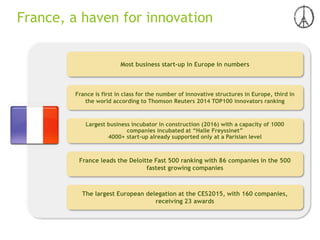
France, a haven for innovation
The largest European delegation at the CES2015, with 160 companies,
receiving 23 awards
France leads the Deloitte Fast 500 ranking with 86 companies in the 500
fastest growing companies
Most business start-up in Europe in numbers
Largest business incubator in construction (2016) with a capacity of 1000
companies incubated at “Halle Freyssinet”
4000+ start-up already supported only at a Parisian level
France is first in class for the number of innovative structures in Europe, third in
the world according to Thomson Reuters 2014 TOP100 innovators ranking
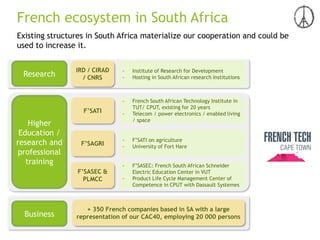
French ecosystem in South Africa
Existing structures in South Africa materialize our cooperation and could be
used to increase it.
F’SAGRI
F’SATI
F’SASEC &
PLMCC
- French South African Technology Institute in
TUT/ CPUT, existing for 20 years
- Telecom / power electronics / enabled living
/ space
- F’SATI on agriculture
- University of Fort Hare
- F’SASEC: French South African Schneider
Electric Education Center in VUT
- Product Life Cycle Management Center of
Competence in CPUT with Dassault Systemes
+ 350 French companies based in SA with a large
representation of our CAC40, employing 20 000 persons
Higher
Education /
research and
professional
training
IRD / CIRAD
/ CNRS
- Institute of Research for Development
- Hosting in South African research InstitutionsResearch
Business
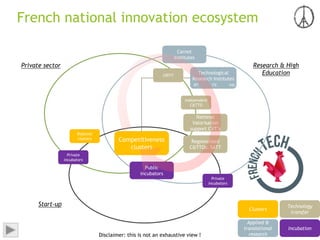
French national innovation ecosystem
Private sector
Start-up
Research & High
Education
Public
incubators
Carnot
Institutes
Regionalized
C&TTOs: SATT
Private
incubators
Applied &
translational
research
Incubation
Clusters
Competitiveness
clusters
Private
incubators
Technological
Research Institutes
IRT ITE IHU
Independent
C&TTO
Technology
transfer
Regional
clusters
National
Valorisation
support CVT’s
Disclaimer: this is not an exhaustive view !
CRITT
Clusters
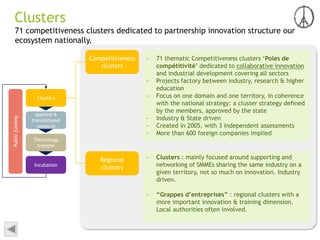
- 71 thematic Competitiveness clusters ‘Poles de
compétitivité’ dedicated to collaborative innovation
and industrial development covering all sectors
- Projects factory between industry, research & higher
education
- Focus on one domain and one territory, in coherence
with the national strategy: a cluster strategy defined
by the members, approved by the state
- Industry & State driven
- Created in 2005, with 3 independent assessments
- More than 600 foreign companies implied
Competitiveness
clusters
Applied &
translational
research
Incubation
Clusters
Technology
transfer
Publicfunding
- Clusters : mainly focused around supporting and
networking of SMMEs sharing the same industry on a
given territory, not so much on innovation. Industry
driven.
- “Grappes d’entreprises” : regional clusters with a
more important innovation & training dimension.
Local authorities often involved.
Regional
clusters
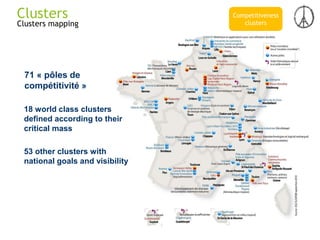
71 competitiveness clusters dedicated to partnership innovation structure our
ecosystem nationally.
71 « pôles de
compétitivité »
18 world class clusters
defined according to their
critical mass
53 other clusters with
national goals and visibility
Clusters mapping
Clusters Competitiveness
clusters
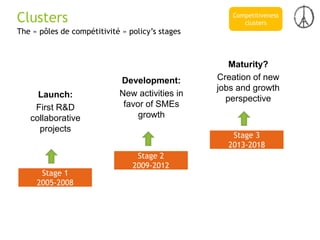
Development:
New activities in
favor of SMEs
growth
Stage 2
2009-2012
Maturity?
Creation of new
jobs and growth
perspectiveLaunch:
First R&D
collaborative
projects
The « pôles de compétitivité » policy’s stages
Stage 3
2013-2018
Stage 1
2005-2008
Clusters Competitiveness
clusters
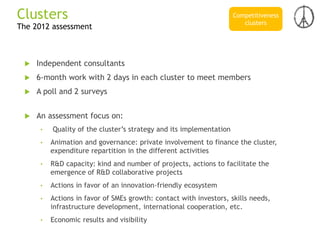
 Independent consultants
 6-month work with 2 days in each cluster to meet members
 A poll and 2 surveys
 An assessment focus on:
• Quality of the cluster’s strategy and its implementation
• Animation and governance: private involvement to finance the cluster,
expenditure repartition in the different activities
• R&D capacity: kind and number of projects, actions to facilitate the
emergence of R&D collaborative projects
• Actions in favor of an innovation-friendly ecosystem
• Actions in favor of SMEs growth: contact with investors, skills needs,
infrastructure development, international cooperation, etc.
• Economic results and visibility
The 2012 assessment
Clusters Competitiveness
clusters
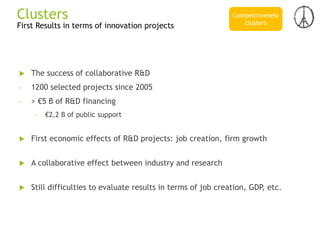
 The success of collaborative R&D
- 1200 selected projects since 2005
- > €5 B of R&D financing
- €2,2 B of public support
 First economic effects of R&D projects: job creation, firm growth
 A collaborative effect between industry and research
 Still difficulties to evaluate results in terms of job creation, GDP, etc.
First Results in terms of innovation projects
Clusters Competitiveness
clusters
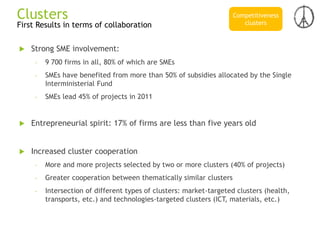
 Strong SME involvement:
- 9 700 firms in all, 80% of which are SMEs
- SMEs have benefited from more than 50% of subsidies allocated by the Single
Interministerial Fund
- SMEs lead 45% of projects in 2011
 Entrepreneurial spirit: 17% of firms are less than five years old
 Increased cluster cooperation
- More and more projects selected by two or more clusters (40% of projects)
- Greater cooperation between thematically similar clusters
- Intersection of different types of clusters: market-targeted clusters (health,
transports, etc.) and technologies-targeted clusters (ICT, materials, etc.)
First Results in terms of collaboration
Clusters Competitiveness
clusters
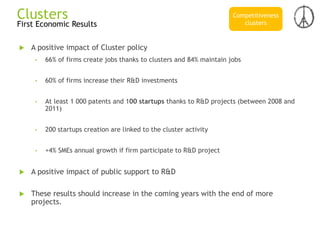
 A positive impact of Cluster policy
• 66% of firms create jobs thanks to clusters and 84% maintain jobs
• 60% of firms increase their R&D investments
• At least 1 000 patents and 100 startups thanks to R&D projects (between 2008 and
2011)
• 200 startups creation are linked to the cluster activity
• +4% SMEs annual growth if firm participate to R&D project
 A positive impact of public support to R&D
 These results should increase in the coming years with the end of more
projects.
First Economic Results
Clusters Competitiveness
clusters
 One goal: to increase economic impacts of the cluster policy
 2 means:
– To define a new role for cluster, further than selecting R&D
projects:
 support to go to the market
– To increase the cluster support to SMEs growth: contacts
with investors, anticipation of skills needs, export capacity,
etc. .
Stage 3 (2013-2018)
Clusters Competitiveness
clusters
Structuring cluster policy : Building the ecosystem
 Creating an environment to nurture cluster growth
– Improving synergies between clusters and the stakeholders on their territory:
creation of infrastructures (innovation platforms), business incubators, etc.
– Integrating more SMEs
– Increasing private financing
– Developing human resources
– Reaffirming IPR framework
– Improving the Cluster International visibility
– Developing durable cluster cooperation
 Boosting private-sector financing: a new label for innovative SMEs
– A concept created by France's world class clusters with Ministry support
– Creation of selection committees to find SMEs with high growth and innovation
potential
– Specialized training
– Possibility to obtain individual appointments with business angels or investors
Competitiveness
clusters
Clusters
Key learnings
 No “one size fits all” approach
 Define precisely the objectives and vision of the clusters: innovation ? Business
? Export oriented ?
 Build on a private and public sector mobilization both nationally and locally
 Aim at building critical masses
 Develop the cooperation at all stages: between companies, higher education,
public authorities
 Create specific incentives for cooperating
 Streamline the innovation process and innovation support and funding entities
 It takes time so give time to the process, but review and adapt it progressively
Competitiveness
clusters
Clusters
Applied and translational research
Applied &
translational
research
Incubation
Clusters
Technology
transfer
Publicfunding
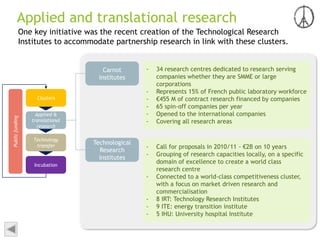
- 34 research centres dedicated to research serving
companies whether they are SMME or large
corporations
- Represents 15% of French public laboratory workforce
- €455 M of contract research financed by companies
- 65 spin-off companies per year
- Opened to the international companies
- Covering all research areas
Carnot
Institutes
- Call for proposals in 2010/11 - €2B on 10 years
- Grouping of research capacities locally, on a specific
domain of excellence to create a world class
research centre
- Connected to a world-class competitiveness cluster,
with a focus on market driven research and
commercialisation
- 8 IRT: Technology Research Institutes
- 9 ITE: energy transition institute
- 5 IHU: University hospital Institute
Technological
Research
Institutes
One key initiative was the recent creation of the Technological Research
Institutes to accommodate partnership research in link with these clusters.
Commercialisation and tech. transfer
Applied &
translational
research
Incubation
Clusters
Technology
transfer
Publicfunding
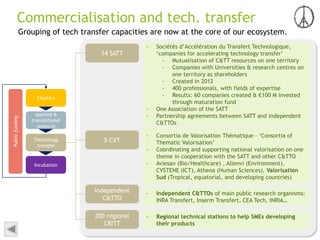
- Consortia de Valorisation Thématique – ‘Consortia of
Thematic Valorisation’
- Coordinating and supporting national valorisation on one
theme in cooperation with the SATT and other C&TTO
- Aviesan (Bio/Healthcare) , Allenvi (Environment),
CVSTENE (ICT), Athena (Human Sciences), Valorisation
Sud (Tropical, equatorial, and developing countries)
5 CVT
14 SATT
- Sociétés d’Accélération du Transfert Technologique,
‘companies for accelerating technology transfer’
- Mutualisation of C&TT resources on one territory
- Companies with Universities & research centres on
one territory as shareholders
- Created in 2012
- 400 professionals, with fields of expertise
- Results: 60 companies created & €100 M invested
through maturation fund
- One Association of the SATT
- Partnership agreements between SATT and independent
C&TTOs
Grouping of tech transfer capacities are now at the core of our ecosystem.
- Independent C&TTOs of main public research organisms:
INRA Transfert, Inserm Transfert, CEA Tech, INRIA…
Independent
C&TTO
200 regional
CRITT
- Regional technical stations to help SMEs developing
their products
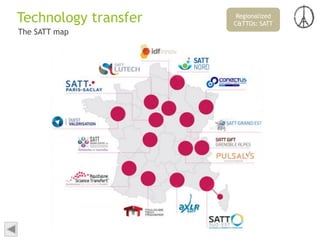
Technology transfer Regionalized
C&TTOs: SATT
The SATT map
Incubation
Applied &
translational
research
Incubation
Clusters
Technology
transfer
Publicfunding
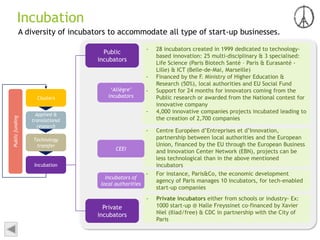
- Private incubators either from schools or industry- Ex:
1000 start-up @ Halle Freyssinet co-financed by Xavier
Niel (Iliad/free) & CDC in partnership with the City of
Paris
Private
incubators
Public
incubators
- 28 incubators created in 1999 dedicated to technology-
based innovation: 25 multi-disciplinary & 3 specialised:
Life Science (Paris Biotech Santé – Paris & Eurasanté -
Lille) & ICT (Belle-de-Mai, Marseille)
- Financed by the F. Ministry of Higher Education &
Research (50%), local authorities and EU Social Fund
- Support for 24 months for innovators coming from the
Public research or awarded from the National contest for
innovative company
- 4,000 innovative companies projects incubated leading to
the creation of 2,700 companies
- Centre Européen d’Entreprises et d’Innovation,
partnership between local authorities and the European
Union, financed by the EU through the European Business
and Innovation Center Network (EBN), projects can be
less technological than in the above mentioned
incubators
- For instance, Paris&Co, the economic development
agency of Paris manages 10 incubators, for tech-enabled
start-up companies
‘Allègre’
incubators
Incubators of
local authorities
CEEI
A diversity of incubators to accommodate all type of start-up businesses.
BPI France
Public funding
Applied &
translational
research
Incubation
Clusters
Technology
transfer
Publicfunding
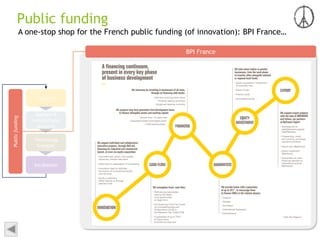
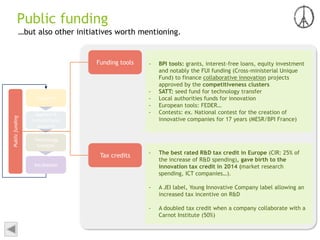
A one-stop shop for the French public funding (of innovation): BPI France…
Tax credits
Public fundingPublicfunding
Funding tools
Applied &
translational
research
Incubation
Clusters
Technology
transfer
- BPI tools: grants, interest-free loans, equity investment
and notably the FUI funding (Cross-ministerial Unique
Fund) to finance collaborative innovation projects
approved by the competitiveness clusters
- SATT: seed fund for technology transfer
- Local authorities funds for innovation
- European tools: FEDER…
- Contests: ex. National contest for the creation of
innovative companies for 17 years (MESR/BPI France)
- The best rated R&D tax credit in Europe (CIR: 25% of
the increase of R&D spending), gave birth to the
innovation tax credit in 2014 (market research
spending, ICT companies…).
- A JEI label, Young Innovative Company label allowing an
increased tax incentive on R&D
- A doubled tax credit when a company collaborate with a
Carnot Institute (50%)
…but also other initiatives worth mentioning.
Thank you !
Romain PETIT
Romain.petit.innovation@gmail.com
079 743 4432

Romain Petit

  • 1.
    Cooperation in innovationbetween France & SA French innovation ecosystem Romain PETIT : Innovation and Technology Transfer Advisor Seconded by the French Government
  • 2.
    France, a havenfor innovation The largest European delegation at the CES2015, with 160 companies, receiving 23 awards France leads the Deloitte Fast 500 ranking with 86 companies in the 500 fastest growing companies Most business start-up in Europe in numbers Largest business incubator in construction (2016) with a capacity of 1000 companies incubated at “Halle Freyssinet” 4000+ start-up already supported only at a Parisian level France is first in class for the number of innovative structures in Europe, third in the world according to Thomson Reuters 2014 TOP100 innovators ranking
  • 3.
    French ecosystem inSouth Africa Existing structures in South Africa materialize our cooperation and could be used to increase it. F’SAGRI F’SATI F’SASEC & PLMCC - French South African Technology Institute in TUT/ CPUT, existing for 20 years - Telecom / power electronics / enabled living / space - F’SATI on agriculture - University of Fort Hare - F’SASEC: French South African Schneider Electric Education Center in VUT - Product Life Cycle Management Center of Competence in CPUT with Dassault Systemes + 350 French companies based in SA with a large representation of our CAC40, employing 20 000 persons Higher Education / research and professional training IRD / CIRAD / CNRS - Institute of Research for Development - Hosting in South African research InstitutionsResearch Business
  • 4.
    French national innovationecosystem Private sector Start-up Research & High Education Public incubators Carnot Institutes Regionalized C&TTOs: SATT Private incubators Applied & translational research Incubation Clusters Competitiveness clusters Private incubators Technological Research Institutes IRT ITE IHU Independent C&TTO Technology transfer Regional clusters National Valorisation support CVT’s Disclaimer: this is not an exhaustive view ! CRITT
  • 5.
    Clusters - 71 thematicCompetitiveness clusters ‘Poles de compétitivité’ dedicated to collaborative innovation and industrial development covering all sectors - Projects factory between industry, research & higher education - Focus on one domain and one territory, in coherence with the national strategy: a cluster strategy defined by the members, approved by the state - Industry & State driven - Created in 2005, with 3 independent assessments - More than 600 foreign companies implied Competitiveness clusters Applied & translational research Incubation Clusters Technology transfer Publicfunding - Clusters : mainly focused around supporting and networking of SMMEs sharing the same industry on a given territory, not so much on innovation. Industry driven. - “Grappes d’entreprises” : regional clusters with a more important innovation & training dimension. Local authorities often involved. Regional clusters 71 competitiveness clusters dedicated to partnership innovation structure our ecosystem nationally.
  • 6.
    71 « pôlesde compétitivité » 18 world class clusters defined according to their critical mass 53 other clusters with national goals and visibility Clusters mapping Clusters Competitiveness clusters
  • 7.
    Development: New activities in favorof SMEs growth Stage 2 2009-2012 Maturity? Creation of new jobs and growth perspectiveLaunch: First R&D collaborative projects The « pôles de compétitivité » policy’s stages Stage 3 2013-2018 Stage 1 2005-2008 Clusters Competitiveness clusters
  • 8.
     Independent consultants 6-month work with 2 days in each cluster to meet members  A poll and 2 surveys  An assessment focus on: • Quality of the cluster’s strategy and its implementation • Animation and governance: private involvement to finance the cluster, expenditure repartition in the different activities • R&D capacity: kind and number of projects, actions to facilitate the emergence of R&D collaborative projects • Actions in favor of an innovation-friendly ecosystem • Actions in favor of SMEs growth: contact with investors, skills needs, infrastructure development, international cooperation, etc. • Economic results and visibility The 2012 assessment Clusters Competitiveness clusters
  • 9.
     The successof collaborative R&D - 1200 selected projects since 2005 - > €5 B of R&D financing - €2,2 B of public support  First economic effects of R&D projects: job creation, firm growth  A collaborative effect between industry and research  Still difficulties to evaluate results in terms of job creation, GDP, etc. First Results in terms of innovation projects Clusters Competitiveness clusters
  • 10.
     Strong SMEinvolvement: - 9 700 firms in all, 80% of which are SMEs - SMEs have benefited from more than 50% of subsidies allocated by the Single Interministerial Fund - SMEs lead 45% of projects in 2011  Entrepreneurial spirit: 17% of firms are less than five years old  Increased cluster cooperation - More and more projects selected by two or more clusters (40% of projects) - Greater cooperation between thematically similar clusters - Intersection of different types of clusters: market-targeted clusters (health, transports, etc.) and technologies-targeted clusters (ICT, materials, etc.) First Results in terms of collaboration Clusters Competitiveness clusters
  • 11.
     A positiveimpact of Cluster policy • 66% of firms create jobs thanks to clusters and 84% maintain jobs • 60% of firms increase their R&D investments • At least 1 000 patents and 100 startups thanks to R&D projects (between 2008 and 2011) • 200 startups creation are linked to the cluster activity • +4% SMEs annual growth if firm participate to R&D project  A positive impact of public support to R&D  These results should increase in the coming years with the end of more projects. First Economic Results Clusters Competitiveness clusters
  • 12.
     One goal:to increase economic impacts of the cluster policy  2 means: – To define a new role for cluster, further than selecting R&D projects:  support to go to the market – To increase the cluster support to SMEs growth: contacts with investors, anticipation of skills needs, export capacity, etc. . Stage 3 (2013-2018) Clusters Competitiveness clusters
  • 13.
    Structuring cluster policy: Building the ecosystem  Creating an environment to nurture cluster growth – Improving synergies between clusters and the stakeholders on their territory: creation of infrastructures (innovation platforms), business incubators, etc. – Integrating more SMEs – Increasing private financing – Developing human resources – Reaffirming IPR framework – Improving the Cluster International visibility – Developing durable cluster cooperation  Boosting private-sector financing: a new label for innovative SMEs – A concept created by France's world class clusters with Ministry support – Creation of selection committees to find SMEs with high growth and innovation potential – Specialized training – Possibility to obtain individual appointments with business angels or investors Competitiveness clusters Clusters
  • 14.
    Key learnings  No“one size fits all” approach  Define precisely the objectives and vision of the clusters: innovation ? Business ? Export oriented ?  Build on a private and public sector mobilization both nationally and locally  Aim at building critical masses  Develop the cooperation at all stages: between companies, higher education, public authorities  Create specific incentives for cooperating  Streamline the innovation process and innovation support and funding entities  It takes time so give time to the process, but review and adapt it progressively Competitiveness clusters Clusters
  • 15.
    Applied and translationalresearch Applied & translational research Incubation Clusters Technology transfer Publicfunding - 34 research centres dedicated to research serving companies whether they are SMME or large corporations - Represents 15% of French public laboratory workforce - €455 M of contract research financed by companies - 65 spin-off companies per year - Opened to the international companies - Covering all research areas Carnot Institutes - Call for proposals in 2010/11 - €2B on 10 years - Grouping of research capacities locally, on a specific domain of excellence to create a world class research centre - Connected to a world-class competitiveness cluster, with a focus on market driven research and commercialisation - 8 IRT: Technology Research Institutes - 9 ITE: energy transition institute - 5 IHU: University hospital Institute Technological Research Institutes One key initiative was the recent creation of the Technological Research Institutes to accommodate partnership research in link with these clusters.
  • 16.
    Commercialisation and tech.transfer Applied & translational research Incubation Clusters Technology transfer Publicfunding - Consortia de Valorisation Thématique – ‘Consortia of Thematic Valorisation’ - Coordinating and supporting national valorisation on one theme in cooperation with the SATT and other C&TTO - Aviesan (Bio/Healthcare) , Allenvi (Environment), CVSTENE (ICT), Athena (Human Sciences), Valorisation Sud (Tropical, equatorial, and developing countries) 5 CVT 14 SATT - Sociétés d’Accélération du Transfert Technologique, ‘companies for accelerating technology transfer’ - Mutualisation of C&TT resources on one territory - Companies with Universities & research centres on one territory as shareholders - Created in 2012 - 400 professionals, with fields of expertise - Results: 60 companies created & €100 M invested through maturation fund - One Association of the SATT - Partnership agreements between SATT and independent C&TTOs Grouping of tech transfer capacities are now at the core of our ecosystem. - Independent C&TTOs of main public research organisms: INRA Transfert, Inserm Transfert, CEA Tech, INRIA… Independent C&TTO 200 regional CRITT - Regional technical stations to help SMEs developing their products
  • 17.
  • 18.
    Incubation Applied & translational research Incubation Clusters Technology transfer Publicfunding - Privateincubators either from schools or industry- Ex: 1000 start-up @ Halle Freyssinet co-financed by Xavier Niel (Iliad/free) & CDC in partnership with the City of Paris Private incubators Public incubators - 28 incubators created in 1999 dedicated to technology- based innovation: 25 multi-disciplinary & 3 specialised: Life Science (Paris Biotech Santé – Paris & Eurasanté - Lille) & ICT (Belle-de-Mai, Marseille) - Financed by the F. Ministry of Higher Education & Research (50%), local authorities and EU Social Fund - Support for 24 months for innovators coming from the Public research or awarded from the National contest for innovative company - 4,000 innovative companies projects incubated leading to the creation of 2,700 companies - Centre Européen d’Entreprises et d’Innovation, partnership between local authorities and the European Union, financed by the EU through the European Business and Innovation Center Network (EBN), projects can be less technological than in the above mentioned incubators - For instance, Paris&Co, the economic development agency of Paris manages 10 incubators, for tech-enabled start-up companies ‘Allègre’ incubators Incubators of local authorities CEEI A diversity of incubators to accommodate all type of start-up businesses.
  • 19.
    BPI France Public funding Applied& translational research Incubation Clusters Technology transfer Publicfunding A one-stop shop for the French public funding (of innovation): BPI France…
  • 20.
    Tax credits Public fundingPublicfunding Fundingtools Applied & translational research Incubation Clusters Technology transfer - BPI tools: grants, interest-free loans, equity investment and notably the FUI funding (Cross-ministerial Unique Fund) to finance collaborative innovation projects approved by the competitiveness clusters - SATT: seed fund for technology transfer - Local authorities funds for innovation - European tools: FEDER… - Contests: ex. National contest for the creation of innovative companies for 17 years (MESR/BPI France) - The best rated R&D tax credit in Europe (CIR: 25% of the increase of R&D spending), gave birth to the innovation tax credit in 2014 (market research spending, ICT companies…). - A JEI label, Young Innovative Company label allowing an increased tax incentive on R&D - A doubled tax credit when a company collaborate with a Carnot Institute (50%) …but also other initiatives worth mentioning.
  • 21.
    Thank you ! RomainPETIT Romain.petit.innovation@gmail.com 079 743 4432