The Use of Role Play Activities in 
the ESL Spanish University 
Classroom 
Lourdes Pomposo
‐ UNED: Universidad Nacional de Educación a 
Distancia. lpomposo@flog.uned.es
‐ UCM: Universidad Complutense
Madrid. Spain.
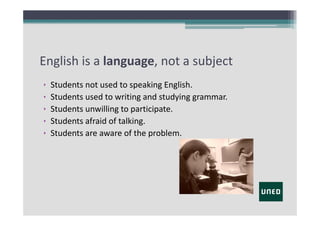
English is a language, not a subject
•
•
•
•
•

Students not used to speaking English.
Students used to writing and studying grammar.
Students unwilling to participate.
Students afraid of talking.
Students are aware of the problem.
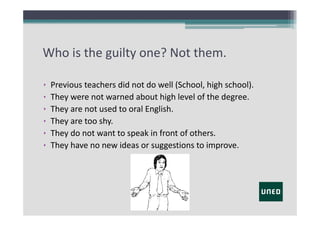
Who is the guilty one? Not them.
•
•
•
•
•
•

Previous teachers did not do well (School, high school).
They were not warned about high level of the degree.
They are not used to oral English.
They are too shy.
They do not want to speak in front of others.
They have no new ideas or suggestions to improve. 
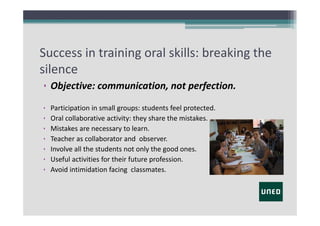
Success in training oral skills: breaking the
silence
• Objective: communication, not perfection.
•
•
•
•
•
•
•

Participation in small groups: students feel protected.
Oral collaborative activity: they share the mistakes.
Mistakes are necessary to learn.
Teacher as collaborator and  observer. 
Involve all the students not only the good ones.
Useful activities for their future profession.
Avoid intimidation facing classmates.
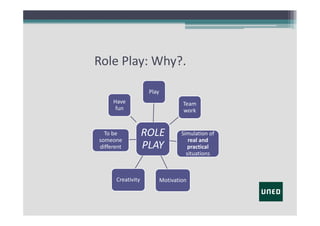
Role Play: Why?.
Play
Have
fun

To be 
someone
different

Creativity

Team
work

ROLE 
PLAY

Simulation of 
real and 
practical
situations

Motivation
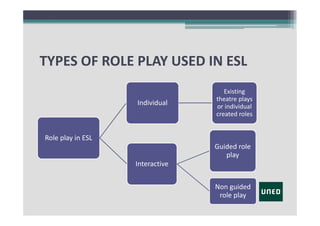
TYPES OF ROLE PLAY USED IN ESL
Individual

Existing
theatre plays
or individual 
created roles

Role play in ESL
Guided role 
play
Interactive
Non guided
role play
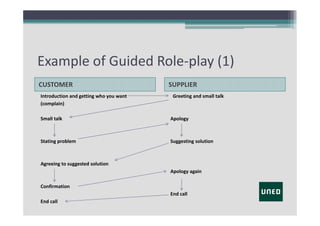
Example of Guided Role‐play (1)
CUSTOMER
Introduction and getting who you want
(complain)

SUPPLIER
Greeting and small talk

Small talk

Apology

Stating problem

Suggesting solution

Agreeing to suggested solution
Apology again
Confirmation
End call
End call
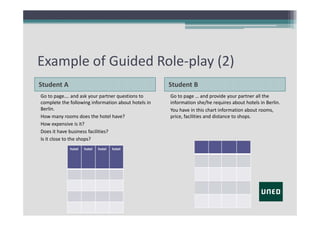
Example of Guided Role‐play (2)
Student A

Student B

Go to page…. and ask your partner questions to
complete the following information about hotels in 
Berlin.
How many rooms does the hotel have?
How expensive is it?
Does it have business facilities?
Is it close to the shops?
hotel

hotel

hotel

hotel

Go to page … and provide your partner all the
information she/he requires about hotels in Berlin.
You have in this chart information about rooms, 
price, facilities and distance to shops.
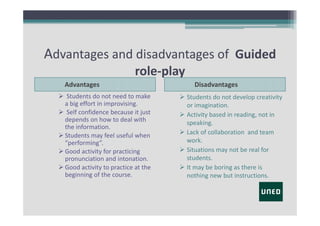
Advantages and disadvantages of  Guided
role‐play
Advantages
 Students do not need to make
a big effort in improvising.
 Self confidence because it just
depends on how to deal with
the information.
 Students may feel useful when
“performing”.     
 Good activity for practicing
pronunciation and intonation.
 Good activity to practice at the
beginning of the course.

Disadvantages
 Students do not develop creativity
or imagination.
 Activity based in reading, not in 
speaking.
 Lack of collaboration and team
work.
 Situations may not be real for
students.
 It may be boring as there is
nothing new but instructions.
Examples of Non‐Guided Role‐play
 Work in groups of three. Choose one of these places to buy food: a 
supermarket, a market or the Internet. Explain the advantages of your
choice and convince the others.
 Work in groups of four/three. You are a group of workmates who have to
organize an event in a hotel. Decide the type of event,  activities, people
attending, needs, food, days, etc. When you finish, meet with a hotel 
director and exchange ideas.
 Work in pairs (or group of three). One of you books a table at a restaurant 
and goes there to have dinner/lunch. Develop the situation as you want
(problem with the food/booking, complain, congratulate, etc)
Advantages and disadvantages of Non‐
Guided role play
Advantages
 Development of  creativity and 
imagination.
 Team work.
 Students feel free to use the
language they know.
 Use of dictionary and willingness
to learn vocabulary or expressions.
 They have fun.      
 They feel more  motivated to
speak.
 Long term learning.     
 Body language: stand up and move.      

Disadvantages

 It requires organization and good
relationship among students.
 They need a minimum level to
express ideas.
 Shy students feel intimidated.
 It requires time to prepare the
activity.
Steps to develop a non‐guided role play
“The instructor persuades the students to alter their mental maps of the
world instead of just filling them”      (Blatner, 2002)
1.
2.
3.
4.
5.
6.
7.

Define objectives (linguistic and communicative ones)
Choose context and roles (related to the learning context and related to
reality)
Students decide about group formation (the teacher does not decide)
Students involve in preparation (in class or outside the classroom)
Performance in class (sitting or standing up but not reading)
Discussion (If the learning context requires it or to keep them listening)
Assessment (at the end of each role‐play)
Case one: Non‐guided role play.
Short dialogue in restaurant
(Tourism students)

• Group profile
 4 hours a week
 18 students. 2nd year of  Tourism Degree.
 19‐21 years old
 Levels: A2, B1.
 Non‐guided role‐play.
 Situation: restaurant booking
 Preparation: in class. 30 minutes.
(VIDEO1)
(VIDEO2)
Results after 3 months (same situation).
•
•
•
•
•
•

More self confidence.
No need of written paper.
More fluency.
No reading.
More  improvising.
More vocabulary.

• More importance to body language.
Case two: Non‐guided role play.
Trade fair (Group work. Business Students)
• Group profile
 3 hours a week
 25 students. 2nd year of  Business studies.
 19‐21 years old
 Levels: A2, B1.
 Non‐guided role‐play.
 Situation: Trade Fair. Each group prepares a stand with products to sell
and visits other stands.
 Preparation:  outside the classroom. 1 week. 
 Performance: at the end of the term. (4months)
(Video)
General results
•
•
•
•

They forgot the teacher was there.
They were completletly involved in the activity. (selling products)
Pronunciation and accuracy was not important. 
Communication was the important aim in order to convince possible clients and 
promote their own products.
• Low level students were communicating: English language and body language.
• There was communication even when the teacher was not listening.
• Disadvantage: individual evaluation.
Assessment and correction of role plays
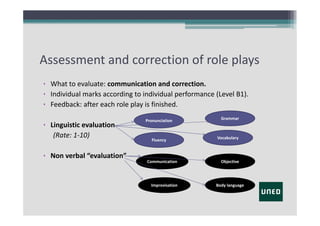
• What to evaluate: communication and correction.
• Individual marks according to individual performance (Level B1).
• Feedback: after each role play is finished.
• Linguistic evaluation
(Rate: 1‐10)
• Non verbal “evaluation” 

Pronunciation

Fluency

Communication

Improvisation

Grammar

Vocabulary

Objective

Body language
Conclusions.
•
•
•
•
•
•
•

Students are willing to participate in communcative activities.
Physical movement in the classroom.
Students explore and teachers watch.
Relaxed and supportive climate in the classroom (Peacock, 1990)
Concentration in the activity while preparing it and while listening to the others.
Development of oral and listening skills.
Student‐centered learning.
References
• Blatner, Adam. (1995). Drama in education as mental hygiene: A child psychiatrist's 
perspective. Youth Theatre Journal, 9, 92‐96.
• Crowther‐Alwyn, J (1997) Business Roles. Cambridge. CUP
• Chesler, M., and Fox, R. (1966). Role‐playing methods in the classroom. Chicago: Science 
Research Associates. 
• Duke, charles. (1974). Creative dramatics and English teaching. Urbana, IL: National Council 
of Teachers of English. 
• Duveen, J & Solomon, J. (1994). The great evolution trial: Use of role‐play in the classroom. 
Journal of research in science teaching, 31(5): 575‐582.  (U Oxford, dept of educational 
studies, England) 
• Dallman‐Jones at al.  (1994) The Expert Educator. Three Blue Herons Publishing. Inc.
• Flinders, S. & Sweeney S. (1996) Business English‐Pair work. Cambridge. Penguin Books.
• Gorea, L. (2009) Speaking English for Success. Bloomington. AuthorHouse. (Photocopiable)
• Porter, L. (2004) Role play. Oxford. OUP.
• Peacock, C. (1990) Classroom Skills in English Teaching. London. Routledge.
• Sheils, J. (1993) Communication in the Modern Languages Classroom. Council of Europe.
Recommended websites
•
•
•
•

http://serc.carleton.edu/introgeo/roleplaying/interact.html
http://serc.carleton.edu/introgeo/roleplaying/refs.html
http://www.angelfire.com/tx/afira/whattypes.html
http://traininganddevelopment.naukrihub.com/methods‐of‐
training/games‐and‐simulations/role‐plays.html
• http://www.blatner.com/adam/pdntbk/rlplayedu.htm  (Interesting
Bibliography)
• http://www.blatner.com/adam/level2/dramaed.htm
THANK YOU!

The Use of Role play in the university classroom

  • 1.
  • 2.
    English is a language, not a subject • • • • • Studentsnot used to speaking English. Students used to writing and studying grammar. Students unwilling to participate. Students afraid of talking. Students are aware of the problem.
  • 3.
    Who is theguilty one? Not them. • • • • • • Previous teachers did not do well (School, high school). They were not warned about high level of the degree. They are not used to oral English. They are too shy. They do not want to speak in front of others. They have no new ideas or suggestions to improve. 
  • 4.
    Success in training oral skills: breaking the silence •Objective: communication, not perfection. • • • • • • • Participation in small groups: students feel protected. Oral collaborative activity: they share the mistakes. Mistakes are necessary to learn. Teacher as collaborator and  observer.  Involve all the students not only the good ones. Useful activities for their future profession. Avoid intimidation facing classmates.
  • 5.
  • 6.
    TYPES OF ROLE PLAY USED IN ESL Individual Existing theatre plays or individual  createdroles Role play in ESL Guided role  play Interactive Non guided role play
  • 7.
    Example of Guided Role‐play(1) CUSTOMER Introduction and getting who you want (complain) SUPPLIER Greeting and small talk Small talk Apology Stating problem Suggesting solution Agreeing to suggested solution Apology again Confirmation End call End call
  • 8.
    Example of Guided Role‐play(2) Student A Student B Go to page…. and ask your partner questions to complete the following information about hotels in  Berlin. How many rooms does the hotel have? How expensive is it? Does it have business facilities? Is it close to the shops? hotel hotel hotel hotel Go to page … and provide your partner all the information she/he requires about hotels in Berlin. You have in this chart information about rooms,  price, facilities and distance to shops.
  • 9.
    Advantages and disadvantages of  Guided role‐play Advantages Students do not need to make a big effort in improvising.  Self confidence because it just depends on how to deal with the information.  Students may feel useful when “performing”.       Good activity for practicing pronunciation and intonation.  Good activity to practice at the beginning of the course. Disadvantages  Students do not develop creativity or imagination.  Activity based in reading, not in  speaking.  Lack of collaboration and team work.  Situations may not be real for students.  It may be boring as there is nothing new but instructions.
  • 10.
    Examples of Non‐Guided Role‐play Work in groups of three. Choose one of these places to buy food: a  supermarket, a market or the Internet. Explain the advantages of your choice and convince the others.  Work in groups of four/three. You are a group of workmates who have to organize an event in a hotel. Decide the type of event,  activities, people attending, needs, food, days, etc. When you finish, meet with a hotel  director and exchange ideas.  Work in pairs (or group of three). One of you books a table at a restaurant  and goes there to have dinner/lunch. Develop the situation as you want (problem with the food/booking, complain, congratulate, etc)
  • 11.
    Advantages and disadvantages of Non‐ Guidedrole play Advantages  Development of  creativity and  imagination.  Team work.  Students feel free to use the language they know.  Use of dictionary and willingness to learn vocabulary or expressions.  They have fun.        They feel more  motivated to speak.  Long term learning.       Body language: stand up and move.       Disadvantages  It requires organization and good relationship among students.  They need a minimum level to express ideas.  Shy students feel intimidated.  It requires time to prepare the activity.
  • 12.
    Steps to developa non‐guided role play “The instructor persuades the students to alter their mental maps of the world instead of just filling them”      (Blatner, 2002) 1. 2. 3. 4. 5. 6. 7. Define objectives (linguistic and communicative ones) Choose context and roles (related to the learning context and related to reality) Students decide about group formation (the teacher does not decide) Students involve in preparation (in class or outside the classroom) Performance in class (sitting or standing up but not reading) Discussion (If the learning context requires it or to keep them listening) Assessment (at the end of each role‐play)
  • 13.
    Case one: Non‐guided role play. Short dialogue in restaurant (Tourism students) •Group profile  4 hours a week  18 students. 2nd year of  Tourism Degree.  19‐21 years old  Levels: A2, B1.  Non‐guided role‐play.  Situation: restaurant booking  Preparation: in class. 30 minutes. (VIDEO1) (VIDEO2)
  • 14.
    Results after 3 months(same situation). • • • • • • More self confidence. No need of written paper. More fluency. No reading. More  improvising. More vocabulary. • More importance to body language.
  • 15.
    Case two: Non‐guided role play. Trade fair(Group work. Business Students) • Group profile  3 hours a week  25 students. 2nd year of  Business studies.  19‐21 years old  Levels: A2, B1.  Non‐guided role‐play.  Situation: Trade Fair. Each group prepares a stand with products to sell and visits other stands.  Preparation:  outside the classroom. 1 week.   Performance: at the end of the term. (4months) (Video)
  • 16.
    General results • • • • They forgot theteacher was there. They were completletly involved in the activity. (selling products) Pronunciation and accuracy was not important.  Communication was the important aim in order to convince possible clients and  promote their own products. • Low level students were communicating: English language and body language. • There was communication even when the teacher was not listening. • Disadvantage: individual evaluation.
  • 17.
    Assessment and correction of role plays •What to evaluate: communication and correction. • Individual marks according to individual performance (Level B1). • Feedback: after each role play is finished. • Linguistic evaluation (Rate: 1‐10) • Non verbal “evaluation”  Pronunciation Fluency Communication Improvisation Grammar Vocabulary Objective Body language
  • 18.
    Conclusions. • • • • • • • Students are willing toparticipate in communcative activities. Physical movement in the classroom. Students explore and teachers watch. Relaxed and supportive climate in the classroom (Peacock, 1990) Concentration in the activity while preparing it and while listening to the others. Development of oral and listening skills. Student‐centered learning.
  • 19.
    References • Blatner, Adam. (1995). Drama in education as mental hygiene: A child psychiatrist's  perspective. Youth Theatre Journal, 9, 92‐96. • Crowther‐Alwyn, J (1997) Business Roles. Cambridge. CUP •Chesler, M., and Fox, R. (1966). Role‐playing methods in the classroom. Chicago: Science  Research Associates.  • Duke, charles. (1974). Creative dramatics and English teaching. Urbana, IL: National Council  of Teachers of English.  • Duveen, J & Solomon, J. (1994). The great evolution trial: Use of role‐play in the classroom.  Journal of research in science teaching, 31(5): 575‐582.  (U Oxford, dept of educational  studies, England)  • Dallman‐Jones at al.  (1994) The Expert Educator. Three Blue Herons Publishing. Inc. • Flinders, S. & Sweeney S. (1996) Business English‐Pair work. Cambridge. Penguin Books. • Gorea, L. (2009) Speaking English for Success. Bloomington. AuthorHouse. (Photocopiable) • Porter, L. (2004) Role play. Oxford. OUP. • Peacock, C. (1990) Classroom Skills in English Teaching. London. Routledge. • Sheils, J. (1993) Communication in the Modern Languages Classroom. Council of Europe.
  • 20.
  • 21.