

FUTUR
E OF
ARTIFICIAL
INTELLIGENCE
TRANSFOrmiNG
INDUSTRIES
WWW.CRUXD
WHAT IS
ARTIFICIAL
INTELLIGENCE?
• Artificial Intelligence (AI) refers to the
simulation of human intelligence in
machines designed to think and learn
like humans.
• AI systems can analyze data, recognize
patterns, make decisions, and improve
their performance over time.
• AI is transforming industries by
automating tasks, enhancing decision-
making, and unlocking new possibilities.
CORE
TECHNOLOGIES
IN AI
01
MACHINE LEARNING
A subset of AI that enables systems to learn from data and improve without being explicitly programmed.
Common applications include recommendation systems and predictive analytics.
02
NATURAL LANGAUGE PROCESSING
Enables machines to understand, interpret, and generate human language. Examples include chatbots
and language translation services.
03
COMPUTER VISION
Allows machines to interpret and make decisions based on visual data. Used in facial recognition,
autonomous vehicles, and medical imaging.
AI APPLICATIONS
ACROSS INDUSTRIES
01
HEALTHCARE
AI assists in diagnosing diseases, personalizing treatment plans, and managing
patient data. Example: AI algorithms analyze medical images to detect
anomalies.
02
FINANCE
AI is used for fraud detection, algorithmic trading, and risk management.
Example: Machine learning models predict market trends and detect unusual
transactions.
03
RETAIL
Enhances customer experience through personalized recommendations,
inventory management, and demand forecasting.
BENEFITS
OF AI
1
Increased Efficiency
Automates routine tasks, reducing time and labor
costs.
2
Cost Reduction
Minimizes human error and operational expenses
through automation.
3
Improved Decision-Making
Provides data-driven insights and predictive analytics
for better strategic planning.
4
Enhanced Customer Experiece
Delivers personalized services and support, improving
customer satisfaction and engagement.
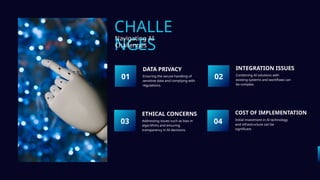
CHALLE
NGES
01 Ensuring the secure handling of
sensitive data and complying with
regulations.
DATA PRIVACY
02 Combining AI solutions with
existing systems and workflows can
be complex.
INTEGRATION ISSUES
03 Addressing issues such as bias in
algorithms and ensuring
transparency in AI decisions.
ETHICAL CONCERNS
04 Initial investment in AI technology
and infrastructure can be
significant.
COST OF IMPLEMENTATION
Navigating AI
Challenges
GETTING STARTED
WITH AI
01
Identify areas where AI can add value to your business or organization.
ASSESS YOUR NEEDS
02
Select AI solutions and platforms that align with your goals and infrastructure.
CHOOSE THE RIGHT TECHNOLOGY
03
Develop a strategy for integrating AI into existing systems and workflows.
PLAN FOR INTEGRATION
04
Continuously evaluate the performance of AI systems and make adjustments as needed to optimize
results.
MONITOR AND ADAPPET
Thank
You