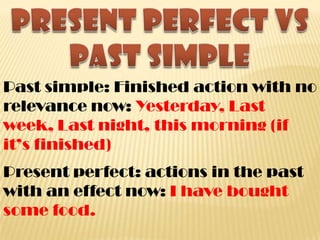
This document discusses the present perfect tense in English and provides examples of its common uses. The present perfect is used to describe an action that began in the past and has relevance in the present. It gives examples of the present perfect used to indicate a result of a past action that is important now, a recently completed action, and a state that began in the past and continues. The document also explains the difference between using "for" with a period of time and "since" with a specific time when an action started.






![[has/have + past participle]
Examples:
You have seen that movie many
times.
Have you seen that movie many
times?
You have not seen that movie many
times.](https://image.slidesharecdn.com/rogerandmarc3rb-120211012140-phpapp02/85/Roger-and-Marc-3r-B-6-320.jpg)


![Culminating%2520 project[1][1]](https://cdn.slidesharecdn.com/ss_thumbnails/culminating2520project11-110503111809-phpapp01-thumbnail.jpg?width=640&height=640&fit=bounds)


