S E S S I O N 23
The Dignity of a Soul
Next week is Holy Week. You still have time for a
Novena!
We have a goal: Transform our hearts into the
fertile soil that God can use to make fruitful.
The Daily Lenten Program
1. Begin the day with a consecration of the
day and ourselves to God.
2. Practice Lectio Divina using the
Scriptural passages and starter
meditations provided.
3. Recitation of the Most Holy Rosary of the
Blessed Virgin Mary.
4. Brief examination of conscience at the
end of the day.
The Weekly Lenten Program
1. Seven Steps:
• Find God in Yourself.
2. Don Bosco:
• Frequent Communion and Confession.
3. Formation:
• Moral Formation
4. Sacrifice:
• Receive the Eucharist EVERY day.
• “Man cannot live without love. He remains a being that
is incomprehensible for himself, his life is senseless, if
love is not revealed to him, if he does not encounter
love, if he does not experience it and make it his own,
if he does not participate intimately in it” (St. John Paul
II, Redemptor Hominis, #10).
• “Self-mastery … is a training in human freedom. The
alternative is clear: either man governs his passions
and finds peace, or he lets himself be dominated by
them and becomes unhappy” (Catechism #2339).
Moral Formation: The Freedom to Love
Beloved we are God’s children now; it does not yet
appear what we shall be, but we know that when he
appears we shall be like him, for we shall see him
as he is. And every one who thus hopes in him
purifies himself as he is pure.
1 John 3:2-3
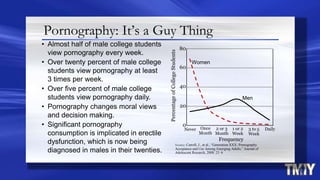
Pornography: It’s a Guy Thing
• Almost half of male college students
view pornography every week.
• Over twenty percent of male college
students view pornography at least
3 times per week.
• Over five percent of male college
students view pornography daily.
• Pornography changes moral views
and decision making.
• Significant pornography
consumption is implicated in erectile
dysfunction, which is now being
diagnosed in males in their twenties.
PercentageofCollegeStudents
Source: Carroll, J., et al., “Generation XXX: Pornography
Acceptance and Use Among Emerging Adults,” Journal of
Adolescent Research, 2008: 23: 6
Never Once
Month
0
20
40
60
80
2 or 3
Month
Daily1 or 2
Week
3 to 5
Week
Frequency
Women
Men
Illegal Drug Use in the Past Year
10
20
30
PercentUsinginPastYear
3515 25 45
0
40
50
55
Source: National Survey on Drug Use and Health: 2011. Detailed Tables, SAMHSA.
20
80
Email
Family
Outings
Email
in Bed
0
CheckingWorkEmailatHome
(Percent)
Email
before
Bed
Email
before
8am
40
60
Source: Survey, Good Technology, July 2, 2012.
Email
Dinner
Table
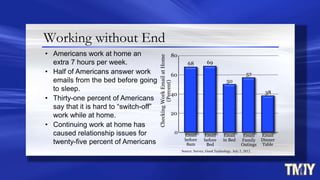
• Americans work at home an
extra 7 hours per week.
• Half of Americans answer work
emails from the bed before going
to sleep.
• Thirty-one percent of Americans
say that it is hard to “switch-off”
work while at home.
• Continuing work at home has
caused relationship issues for
twenty-five percent of Americans
50
68 69
57
Working without End
38
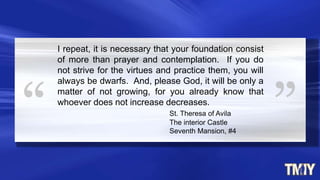
I repeat, it is necessary that your foundation consist
of more than prayer and contemplation. If you do
not strive for the virtues and practice them, you will
always be dwarfs. And, please God, it will be only a
matter of not growing, for you already know that
whoever does not increase decreases.
St. Theresa of Avila
The interior Castle
Seventh Mansion, #4
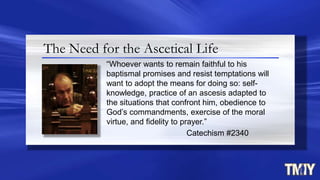
The Need for the Ascetical Life
“Whoever wants to remain faithful to his
baptismal promises and resist temptations will
want to adopt the means for doing so: self-
knowledge, practice of an ascesis adapted to
the situations that confront him, obedience to
God’s commandments, exercise of the moral
virtue, and fidelity to prayer.”
Catechism #2340
Mortification of the Flesh
• “For all that is in the world, the concupiscence of the flesh and the
concupiscence of the eyes and the pride of life is not of the Father but is
of the world” (1 John 2:16).
• In our fallen state, we tend to seek sensual pleasure as its own end,
which is in opposition to the will of God and to right reason.
• Mortification is to “put to death” these tendencies (Cf. Colossians 3:5) by
voluntarily giving up things we desire or doing things we find unpleasant.
• Mortification should involved all five senses, but be adapted to the
individual person and situation.
• Historical practices have included food and drink and those things
causing comfort or discomfort.
• A perfect means, which attacks disordered desires at their root, is to give
your time to God and the family.
Charity and the Spirit of the World
• “For all that is in the world, the concupiscence of the flesh and the
concupiscence of the eyes and the pride of life is not of the Father but is
of the world” (1 John 2:16).
• In our fallen state, we seek worldly success (and the goods it brings) as a
means to build ourselves up in the eyes of others or to make us “popular.”
We seek to constantly compare our success with the success of others.
• Early monks fled from the world to live in caves and monasteries.
• We must flee the “spirit of the world,” which is manifest to us in a very
intense way through the media. We must minimize media consumption.
• We should always seek to live below our means (house, car, clothes,
electronics, vacations, eating out, etc.).
• We should rejoice at our neighbor’s good fortune and publicly praise him
for it.
Prayer and the Pride of Life
• “For all that is in the world, the concupiscence of the flesh and the
concupiscence of the eyes and the pride of life is not of the Father but is
of the world” (1 John 2:16).
• In our fallen state, we tend to insist on our own thoughts and opinions
and believe in our own self-sufficiency.
• These tendencies extend both to other people and to our relationship
with God.
• The first goal is to bring our will into harmony with God’s will, which will
require considerable time in prayer.
• Unless the will of God and/or true good of neighbor is at stake, we
should not insist on our will or way of doing things.
• We should help others cultivate their talents to be put to use for the sake
of souls and the Kingdom of God.
To truly develop virtue, a person needs the grace
of God. Don Bosco made sure that all his boys
had frequent access to the channels of grace.
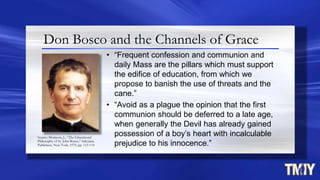
Don Bosco and the Channels of Grace
• “Frequent confession and communion and
daily Mass are the pillars which must support
the edifice of education, from which we
propose to banish the use of threats and the
cane.”
• “Avoid as a plague the opinion that the first
communion should be deferred to a late age,
when generally the Devil has already gained
possession of a boy’s heart with incalculable
prejudice to his innocence.”
Source: Morrison, J., “The Educational
Philosophy of St. John Bosco,” Salesiana
Publishers, New York, 1979, pp. 113-114
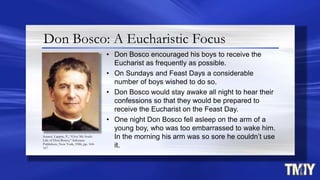
Don Bosco: A Eucharistic Focus
• Don Bosco encouraged his boys to receive the
Eucharist as frequently as possible.
• On Sundays and Feast Days a considerable
number of boys wished to do so.
• Don Bosco would stay awake all night to hear their
confessions so that they would be prepared to
receive the Eucharist on the Feast Day.
• One night Don Bosco fell asleep on the arm of a
young boy, who was too embarrassed to wake him.
In the morning his arm was so sore he couldn’t use
it.
Source: Lappin, P., “Give Me Souls:
Life of Don Bosco,” Salesiana
Publishers, New York, 1986, pp. 164-
167.
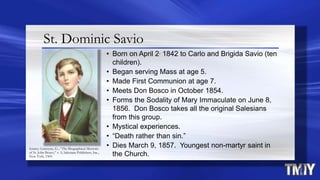
St. Dominic Savio
• Born on April 2, 1842 to Carlo and Brigida Savio (ten
children).
• Began serving Mass at age 5.
• Made First Communion at age 7.
• Meets Don Bosco in October 1854.
• Forms the Sodality of Mary Immaculate on June 8,
1856. Don Bosco takes all the original Salesians
from this group.
• Mystical experiences.
• “Death rather than sin.”
• Dies March 9, 1857. Youngest non-martyr saint in
the Church.
Source: Lemoyne, G., “The Biographical Memoirs
of St. John Bosco,” v. 5, Salesiana Publishers, Inc.,
New York, 1969.
Virtue is not an end in itself. It is simply a means
to prepare our heart to enter into union with God.
This union profoundly occurs through the
Eucharist.
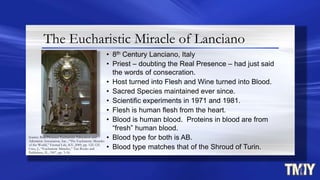
The Eucharistic Miracle of Lanciano
• 8th Century Lanciano, Italy
• Priest – doubting the Real Presence – had just said
the words of consecration.
• Host turned into Flesh and Wine turned into Blood.
• Sacred Species maintained ever since.
• Scientific experiments in 1971 and 1981.
• Flesh is human flesh from the heart.
• Blood is human blood. Proteins in blood are from
“fresh” human blood.
• Blood type for both is AB.
• Blood type matches that of the Shroud of Turin.
Source: Real Presence Eucharistic Education and
Adoration Association, Inc., “The Eucharistic Miracles
of the World,” Eternal Life, KY, 2009, pp. 122-125.
Cruz, J., “Eucharistic Miracles,” Tan Books and
Publishers, IL, 1987, pp. 3-18.
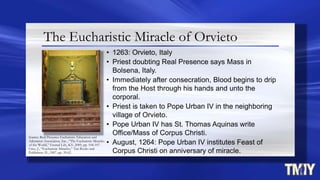
The Eucharistic Miracle of Orvieto
• 1263: Orvieto, Italy
• Priest doubting Real Presence says Mass in
Bolsena, Italy.
• Immediately after consecration, Blood begins to drip
from the Host through his hands and unto the
corporal.
• Priest is taken to Pope Urban IV in the neighboring
village of Orvieto.
• Pope Urban IV has St. Thomas Aquinas write
Office/Mass of Corpus Christi.
• August, 1264: Pope Urban IV institutes Feast of
Corpus Christi on anniversary of miracle.
Source: Real Presence Eucharistic Education and
Adoration Association, Inc., “The Eucharistic Miracles
of the World,” Eternal Life, KY, 2009, pp. 104-107.
Cruz, J., “Eucharistic Miracles,” Tan Books and
Publishers, IL, 1987, pp. 59.62.
Our dignity is to have God dwelling within us. We
are “living tabernacles.” As such, we should keep
ourselves pure as he is pure.
Practical Advice
1. Help your children to truly grasp their dignity as
sons and daughters of God.
2. Develop in them the virtues so that they can
overcome the triple concupiscence and avoid the
temptations that are so prevalent today.
3. Help your children grow closer to Christ in the
Eucharist.

4. Make confession a regular part of your spiritual
life and that of your children.
5. Help your children see the need to balance work
demands with the rest of their life.
Next Week
Finding the Hidden Face of God in
Others
Small Group Discussion
Starter Questions
1. How do you allow the demands of your work
to squeeze out your family time?
2. How can you develop a greater love for Jesus
in the Eucharist?

The Revelation of the Father - Week 23

  • 1.
    S E SS I O N 23 The Dignity of a Soul
  • 2.
    Next week isHoly Week. You still have time for a Novena! We have a goal: Transform our hearts into the fertile soil that God can use to make fruitful.
  • 3.
    The Daily LentenProgram 1. Begin the day with a consecration of the day and ourselves to God. 2. Practice Lectio Divina using the Scriptural passages and starter meditations provided. 3. Recitation of the Most Holy Rosary of the Blessed Virgin Mary. 4. Brief examination of conscience at the end of the day.
  • 4.
    The Weekly LentenProgram 1. Seven Steps: • Find God in Yourself. 2. Don Bosco: • Frequent Communion and Confession. 3. Formation: • Moral Formation 4. Sacrifice: • Receive the Eucharist EVERY day.
  • 5.
    • “Man cannotlive without love. He remains a being that is incomprehensible for himself, his life is senseless, if love is not revealed to him, if he does not encounter love, if he does not experience it and make it his own, if he does not participate intimately in it” (St. John Paul II, Redemptor Hominis, #10). • “Self-mastery … is a training in human freedom. The alternative is clear: either man governs his passions and finds peace, or he lets himself be dominated by them and becomes unhappy” (Catechism #2339). Moral Formation: The Freedom to Love
  • 6.
    Beloved we areGod’s children now; it does not yet appear what we shall be, but we know that when he appears we shall be like him, for we shall see him as he is. And every one who thus hopes in him purifies himself as he is pure. 1 John 3:2-3
  • 7.
    Pornography: It’s aGuy Thing • Almost half of male college students view pornography every week. • Over twenty percent of male college students view pornography at least 3 times per week. • Over five percent of male college students view pornography daily. • Pornography changes moral views and decision making. • Significant pornography consumption is implicated in erectile dysfunction, which is now being diagnosed in males in their twenties. PercentageofCollegeStudents Source: Carroll, J., et al., “Generation XXX: Pornography Acceptance and Use Among Emerging Adults,” Journal of Adolescent Research, 2008: 23: 6 Never Once Month 0 20 40 60 80 2 or 3 Month Daily1 or 2 Week 3 to 5 Week Frequency Women Men
  • 8.
    Illegal Drug Usein the Past Year 10 20 30 PercentUsinginPastYear 3515 25 45 0 40 50 55 Source: National Survey on Drug Use and Health: 2011. Detailed Tables, SAMHSA.
  • 9.
    20 80 Email Family Outings Email in Bed 0 CheckingWorkEmailatHome (Percent) Email before Bed Email before 8am 40 60 Source: Survey,Good Technology, July 2, 2012. Email Dinner Table • Americans work at home an extra 7 hours per week. • Half of Americans answer work emails from the bed before going to sleep. • Thirty-one percent of Americans say that it is hard to “switch-off” work while at home. • Continuing work at home has caused relationship issues for twenty-five percent of Americans 50 68 69 57 Working without End 38
  • 10.
    I repeat, itis necessary that your foundation consist of more than prayer and contemplation. If you do not strive for the virtues and practice them, you will always be dwarfs. And, please God, it will be only a matter of not growing, for you already know that whoever does not increase decreases. St. Theresa of Avila The interior Castle Seventh Mansion, #4
  • 11.
    The Need forthe Ascetical Life “Whoever wants to remain faithful to his baptismal promises and resist temptations will want to adopt the means for doing so: self- knowledge, practice of an ascesis adapted to the situations that confront him, obedience to God’s commandments, exercise of the moral virtue, and fidelity to prayer.” Catechism #2340
  • 12.
    Mortification of theFlesh • “For all that is in the world, the concupiscence of the flesh and the concupiscence of the eyes and the pride of life is not of the Father but is of the world” (1 John 2:16). • In our fallen state, we tend to seek sensual pleasure as its own end, which is in opposition to the will of God and to right reason. • Mortification is to “put to death” these tendencies (Cf. Colossians 3:5) by voluntarily giving up things we desire or doing things we find unpleasant. • Mortification should involved all five senses, but be adapted to the individual person and situation. • Historical practices have included food and drink and those things causing comfort or discomfort. • A perfect means, which attacks disordered desires at their root, is to give your time to God and the family.
  • 13.
    Charity and theSpirit of the World • “For all that is in the world, the concupiscence of the flesh and the concupiscence of the eyes and the pride of life is not of the Father but is of the world” (1 John 2:16). • In our fallen state, we seek worldly success (and the goods it brings) as a means to build ourselves up in the eyes of others or to make us “popular.” We seek to constantly compare our success with the success of others. • Early monks fled from the world to live in caves and monasteries. • We must flee the “spirit of the world,” which is manifest to us in a very intense way through the media. We must minimize media consumption. • We should always seek to live below our means (house, car, clothes, electronics, vacations, eating out, etc.). • We should rejoice at our neighbor’s good fortune and publicly praise him for it.
  • 14.
    Prayer and thePride of Life • “For all that is in the world, the concupiscence of the flesh and the concupiscence of the eyes and the pride of life is not of the Father but is of the world” (1 John 2:16). • In our fallen state, we tend to insist on our own thoughts and opinions and believe in our own self-sufficiency. • These tendencies extend both to other people and to our relationship with God. • The first goal is to bring our will into harmony with God’s will, which will require considerable time in prayer. • Unless the will of God and/or true good of neighbor is at stake, we should not insist on our will or way of doing things. • We should help others cultivate their talents to be put to use for the sake of souls and the Kingdom of God.
  • 15.
    To truly developvirtue, a person needs the grace of God. Don Bosco made sure that all his boys had frequent access to the channels of grace.
  • 16.
    Don Bosco andthe Channels of Grace • “Frequent confession and communion and daily Mass are the pillars which must support the edifice of education, from which we propose to banish the use of threats and the cane.” • “Avoid as a plague the opinion that the first communion should be deferred to a late age, when generally the Devil has already gained possession of a boy’s heart with incalculable prejudice to his innocence.” Source: Morrison, J., “The Educational Philosophy of St. John Bosco,” Salesiana Publishers, New York, 1979, pp. 113-114
  • 17.
    Don Bosco: AEucharistic Focus • Don Bosco encouraged his boys to receive the Eucharist as frequently as possible. • On Sundays and Feast Days a considerable number of boys wished to do so. • Don Bosco would stay awake all night to hear their confessions so that they would be prepared to receive the Eucharist on the Feast Day. • One night Don Bosco fell asleep on the arm of a young boy, who was too embarrassed to wake him. In the morning his arm was so sore he couldn’t use it. Source: Lappin, P., “Give Me Souls: Life of Don Bosco,” Salesiana Publishers, New York, 1986, pp. 164- 167.
  • 18.
    St. Dominic Savio •Born on April 2, 1842 to Carlo and Brigida Savio (ten children). • Began serving Mass at age 5. • Made First Communion at age 7. • Meets Don Bosco in October 1854. • Forms the Sodality of Mary Immaculate on June 8, 1856. Don Bosco takes all the original Salesians from this group. • Mystical experiences. • “Death rather than sin.” • Dies March 9, 1857. Youngest non-martyr saint in the Church. Source: Lemoyne, G., “The Biographical Memoirs of St. John Bosco,” v. 5, Salesiana Publishers, Inc., New York, 1969.
  • 19.
    Virtue is notan end in itself. It is simply a means to prepare our heart to enter into union with God. This union profoundly occurs through the Eucharist.
  • 20.
    The Eucharistic Miracleof Lanciano • 8th Century Lanciano, Italy • Priest – doubting the Real Presence – had just said the words of consecration. • Host turned into Flesh and Wine turned into Blood. • Sacred Species maintained ever since. • Scientific experiments in 1971 and 1981. • Flesh is human flesh from the heart. • Blood is human blood. Proteins in blood are from “fresh” human blood. • Blood type for both is AB. • Blood type matches that of the Shroud of Turin. Source: Real Presence Eucharistic Education and Adoration Association, Inc., “The Eucharistic Miracles of the World,” Eternal Life, KY, 2009, pp. 122-125. Cruz, J., “Eucharistic Miracles,” Tan Books and Publishers, IL, 1987, pp. 3-18.
  • 21.
    The Eucharistic Miracleof Orvieto • 1263: Orvieto, Italy • Priest doubting Real Presence says Mass in Bolsena, Italy. • Immediately after consecration, Blood begins to drip from the Host through his hands and unto the corporal. • Priest is taken to Pope Urban IV in the neighboring village of Orvieto. • Pope Urban IV has St. Thomas Aquinas write Office/Mass of Corpus Christi. • August, 1264: Pope Urban IV institutes Feast of Corpus Christi on anniversary of miracle. Source: Real Presence Eucharistic Education and Adoration Association, Inc., “The Eucharistic Miracles of the World,” Eternal Life, KY, 2009, pp. 104-107. Cruz, J., “Eucharistic Miracles,” Tan Books and Publishers, IL, 1987, pp. 59.62.
  • 22.
    Our dignity isto have God dwelling within us. We are “living tabernacles.” As such, we should keep ourselves pure as he is pure.
  • 23.
    Practical Advice 1. Helpyour children to truly grasp their dignity as sons and daughters of God. 2. Develop in them the virtues so that they can overcome the triple concupiscence and avoid the temptations that are so prevalent today. 3. Help your children grow closer to Christ in the Eucharist. 4. Make confession a regular part of your spiritual life and that of your children. 5. Help your children see the need to balance work demands with the rest of their life.

  • 24.
    Next Week Finding theHidden Face of God in Others Small Group Discussion Starter Questions 1. How do you allow the demands of your work to squeeze out your family time? 2. How can you develop a greater love for Jesus in the Eucharist?