
Presented by:
                               Alexander Braendle
                               Andreas Heil
Robots in Human Environments
                               Date
                               12 Dec 2005
Introduction
"Men Are From Mars, Robots Are From Mitsubishi“
Financial Times (12/09/05) P. 9; Pincock, Stephen
As Carnegie Mellon roboticist Daniel Wilson outlines in his book, "How to Survive a Robot
Uprising," the field of robotics has taken off in recent years, with researchers around the world
developing robotic applications to do everything from vacuuming to exploring space alongside
man. Several Japanese companies are developing robots that can serve as in-home
assistants, link up to the Internet to respond to questions, and serve as a kind of companion.
Toyota recently released its Partner Robot with the ability to play the trumpet through lips
endowed with sensitivity and fingers with human-like dexterity. The convergence of robotics
and artificial intelligence has enabled researchers to develop devices such as Sony's Qrio, a
small robot that knows to hold out its arms if it is falling, and can pick itself up from the
ground. Embodied intelligence seeks to equip robots with such cognitive abilities, though
ingraining many basic components of intelligence still eludes roboticists. Robots still cannot
understand what gives an object its properties, though roboticists are working to give their
creations the ability to learn by experience. The international group of researchers working
together in the RobotCub project is trying to create a child-sized robot that can learn from
interactions with its environment, just as people do. Many researchers feel that people's
perceptions of the role of robots must change if they will ever be accepted as legitimate
companions. Mitsubishi has begun taking orders for its Wakamaru robot, an in-home personal
assistant that wakes you up in the morning, reports the weather and the headlines, and then
greets you in the evening with any telephone messages. "We have tried to create a robot you
can have a relationship with," said Mitsubishi's Ken Onishi.
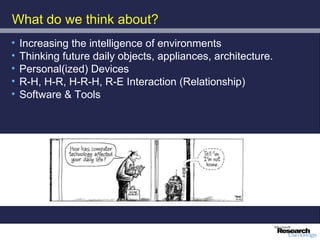
What do we think about?
•   Increasing the intelligence of environments
•   Thinking future daily objects, appliances, architecture.
•   Personal(ized) Devices
•   R-H, H-R, H-R-H, R-E Interaction (Relationship)
•   Software & Tools
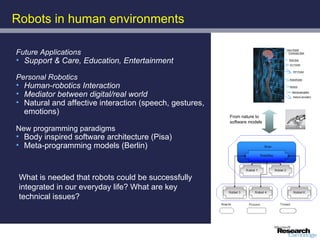
Robots in human environments

Future Applications
• Support & Care, Education, Entertainment

Personal Robotics
• Human-robotics Interaction
• Mediator between digital/real world
• Natural and affective interaction (speech, gestures,
  emotions)
                                                         From nature to
                                                         software models
New programming paradigms
• Body inspired software architecture (Pisa)
• Meta-programming models (Berlin)


 What is needed that robots could be successfully
 integrated in our everyday life? What are key
 technical issues?
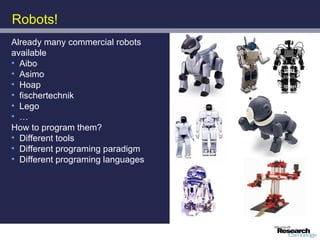
Robots!
Already many commercial robots
available
• Aibo
• Asimo
• Hoap
• fischertechnik
• Lego
• …
How to program them?
• Different tools
• Different programing paradigm
• Different programing languages
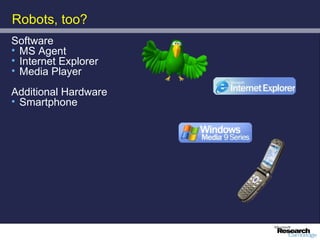
Robots, too?
Software
• MS Agent
• Internet Explorer
• Media Player
Additional Hardware
• Smartphone
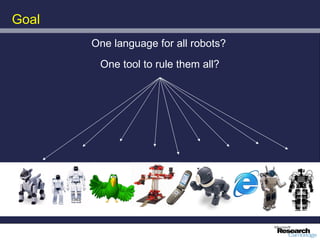
Goal
       One language for all robots?
        One tool to rule them all?
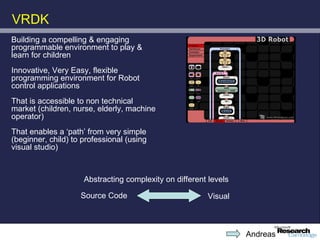
VRDK
Building a compelling & engaging
programmable environment to play &
learn for children
Innovative, Very Easy, flexible
programming environment for Robot
control applications
That is accessible to non technical
market (children, nurse, elderly, machine
operator)
That enables a ‘path’ from very simple
(beginner, child) to professional (using
visual studio)


                     Abstracting complexity on different levels

                    Source Code                         Visual


                                                                  Andreas
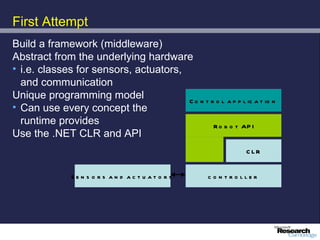
First Attempt
Build a framework (middleware)
Abstract from the underlying hardware
• i.e. classes for sensors, actuators,
  and communication
Unique programming model               C o n t r o l a p p l ic a t io n
• Can use every concept the
  runtime provides                              R o b o t AP I
Use the .NET CLR and API
                                                                C LR


                Sen s o rs an d actuato rs           c o n tro ller
This wont always work!
Things that work fine on a PC don’t scale down
• Thread switches on a smart-phone or PDA are costly
• FischerTechnik controller doesn’t support threads at
  all
Hardware not capable enough for a middleware
• CPU, memory, battery, …
Compact Framework: no serialization, no remoting, …
• Even though PDAs are fairly powerful, CF has some
  severe restrictions
Now think of even smaller devices
• Embedded controllers, wrist-watches, sensor
  networks, …
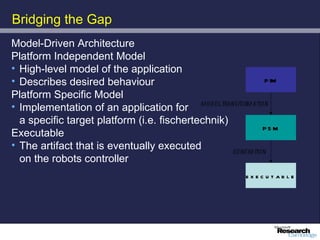
Bridging the Gap
Model-Driven Architecture
Platform Independent Model
• High-level model of the application
• Describes desired behaviour                                P IM

Platform Specific Model
• Implementation of an application for model transformation
  a specific target platform (i.e. fischertechnik)
                                                            PS M
Executable
• The artifact that is eventually executed         generation
  on the robots controller
                                                         exec utable
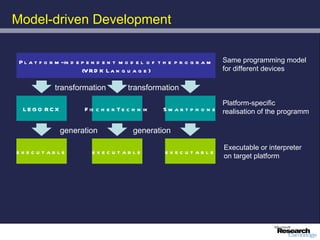
Model-driven Development


 P l a t f o r m -in d e p e n d e n t m o d e l o f t h e p r o g r a m   Same programming model
                         (V R D K L a n g u a g e )                        for different devices

              transformation              transformation
                                                                           Platform-specific
  LEGO RC X              F is c h e r T e c h n ik    Smartph o n e        realisation of the programm

                generation                  generation

                                                                           Executable or interpreter
exec utable                 exec utable                exec utable
                                                                           on target platform
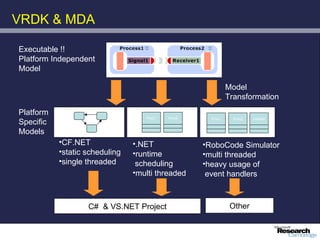
VRDK & MDA

Executable !!
Platform Independent
Model

                                                             Model
                                                             Transformation
Platform
                                   Proc1   Proc2     Proc1     Proc2   Handler
Specific
Models
           •CF.NET              •.NET              •RoboCode Simulator
           •static scheduling   •runtime           •multi threaded
           •single threaded      scheduling        •heavy usage of
                                •multi threaded     event handlers


                   C# & VS.NET Project                        Other
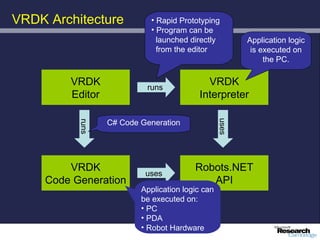
VRDK Architecture           • Rapid Prototyping
                            • Program can be
                              launched directly          Application logic
                              from the editor             is executed on
                                                              the PC.

         VRDK              runs
                                            VRDK
         Editor                           Interpreter

                  C# Code Generation


                                                  uses
           runs


         VRDK                            Robots.NET
                           uses
     Code Generation                        API
                          Application logic can
                          be executed on:
                          • PC
                          • PDA
                          • Robot Hardware
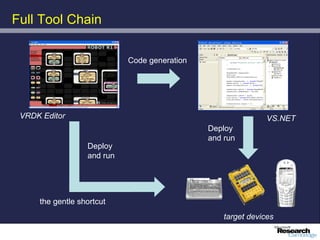
Full Tool Chain

                            Code generation


 VRDK Editor                                                  VS.NET
                                              Deploy
                                              and run
                  Deploy
                  and run


     the gentle shortcut
                                                  target devices
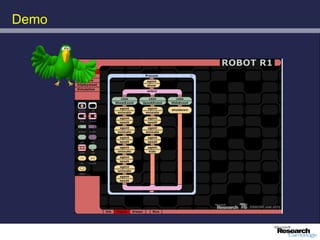
Demo
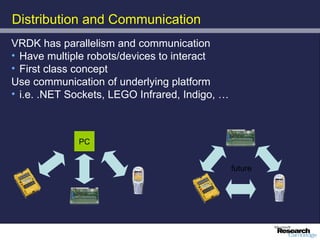
Distribution and Communication
VRDK has parallelism and communication
• Have multiple robots/devices to interact
• First class concept
Use communication of underlying platform
• i.e. .NET Sockets, LEGO Infrared, Indigo, …


             PC


                                                future
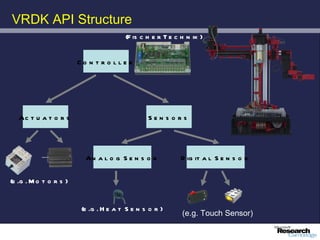
VRDK API Structure
                                        (F is c h e r T e c h n ik )


                        Co n t r o l l e r


   Ac t u a t o r s                             Sen s o rs


                          An a l o g S e n s o r            D ig it a l S e n s o r

(e .g . M o t o r s )


                         (e .g . H e a t S e n s o r )
                                                            (e.g. Touch Sensor)
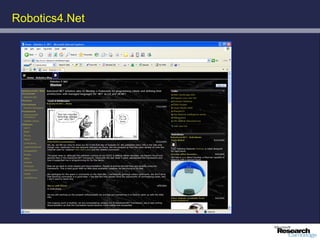
Robotics4.Net
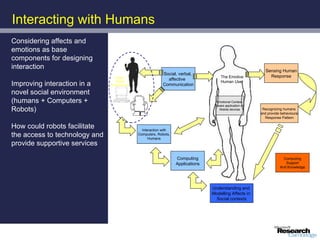
Interacting with Humans
Considering affects and
emotions as base
components for designing
interaction                                                                                                 Sensing Human
                                                           Social, verbal,
                                 Human                                               The Emotive              Response
                                                             affective
                                                                                     Human User
Improving interaction in a        Social
                               Environment                 Communication
novel social environment
(humans + Computers +                                                              Emotional Context-
                                                                                  Aware application on
Robots)                                                                             Mobile devices        Recognizing humans
                                                                                                         and provide behavioural
                                                                                                           Response Pattern

How could robots facilitate                    Interaction with
the access to technology and                 Computers, Robots,
                                                   Humans
provide supportive services

                                                                  Computing                                           Computing
                                                                  Applications                                         Support
                                                                                                                    And Knowledge


                                                                                 Understanding and
                                                                                 Modelling Affects in
                                                                                  Social contexts
Questions

Robots in Human Environments

  • 1.
    Presented by: Alexander Braendle Andreas Heil Robots in Human Environments Date 12 Dec 2005
  • 2.
    Introduction "Men Are FromMars, Robots Are From Mitsubishi“ Financial Times (12/09/05) P. 9; Pincock, Stephen As Carnegie Mellon roboticist Daniel Wilson outlines in his book, "How to Survive a Robot Uprising," the field of robotics has taken off in recent years, with researchers around the world developing robotic applications to do everything from vacuuming to exploring space alongside man. Several Japanese companies are developing robots that can serve as in-home assistants, link up to the Internet to respond to questions, and serve as a kind of companion. Toyota recently released its Partner Robot with the ability to play the trumpet through lips endowed with sensitivity and fingers with human-like dexterity. The convergence of robotics and artificial intelligence has enabled researchers to develop devices such as Sony's Qrio, a small robot that knows to hold out its arms if it is falling, and can pick itself up from the ground. Embodied intelligence seeks to equip robots with such cognitive abilities, though ingraining many basic components of intelligence still eludes roboticists. Robots still cannot understand what gives an object its properties, though roboticists are working to give their creations the ability to learn by experience. The international group of researchers working together in the RobotCub project is trying to create a child-sized robot that can learn from interactions with its environment, just as people do. Many researchers feel that people's perceptions of the role of robots must change if they will ever be accepted as legitimate companions. Mitsubishi has begun taking orders for its Wakamaru robot, an in-home personal assistant that wakes you up in the morning, reports the weather and the headlines, and then greets you in the evening with any telephone messages. "We have tried to create a robot you can have a relationship with," said Mitsubishi's Ken Onishi.
  • 3.
    What do wethink about? • Increasing the intelligence of environments • Thinking future daily objects, appliances, architecture. • Personal(ized) Devices • R-H, H-R, H-R-H, R-E Interaction (Relationship) • Software & Tools
  • 4.
    Robots in humanenvironments Future Applications • Support & Care, Education, Entertainment Personal Robotics • Human-robotics Interaction • Mediator between digital/real world • Natural and affective interaction (speech, gestures, emotions) From nature to software models New programming paradigms • Body inspired software architecture (Pisa) • Meta-programming models (Berlin) What is needed that robots could be successfully integrated in our everyday life? What are key technical issues?
  • 5.
    Robots! Already many commercialrobots available • Aibo • Asimo • Hoap • fischertechnik • Lego • … How to program them? • Different tools • Different programing paradigm • Different programing languages
  • 6.
    Robots, too? Software • MSAgent • Internet Explorer • Media Player Additional Hardware • Smartphone
  • 7.
    Goal One language for all robots? One tool to rule them all?
  • 8.
    VRDK Building a compelling& engaging programmable environment to play & learn for children Innovative, Very Easy, flexible programming environment for Robot control applications That is accessible to non technical market (children, nurse, elderly, machine operator) That enables a ‘path’ from very simple (beginner, child) to professional (using visual studio) Abstracting complexity on different levels Source Code Visual Andreas
  • 9.
    First Attempt Build aframework (middleware) Abstract from the underlying hardware • i.e. classes for sensors, actuators, and communication Unique programming model C o n t r o l a p p l ic a t io n • Can use every concept the runtime provides R o b o t AP I Use the .NET CLR and API C LR Sen s o rs an d actuato rs c o n tro ller
  • 10.
    This wont alwayswork! Things that work fine on a PC don’t scale down • Thread switches on a smart-phone or PDA are costly • FischerTechnik controller doesn’t support threads at all Hardware not capable enough for a middleware • CPU, memory, battery, … Compact Framework: no serialization, no remoting, … • Even though PDAs are fairly powerful, CF has some severe restrictions Now think of even smaller devices • Embedded controllers, wrist-watches, sensor networks, …
  • 11.
    Bridging the Gap Model-DrivenArchitecture Platform Independent Model • High-level model of the application • Describes desired behaviour P IM Platform Specific Model • Implementation of an application for model transformation a specific target platform (i.e. fischertechnik) PS M Executable • The artifact that is eventually executed generation on the robots controller exec utable
  • 12.
    Model-driven Development Pl a t f o r m -in d e p e n d e n t m o d e l o f t h e p r o g r a m Same programming model (V R D K L a n g u a g e ) for different devices transformation transformation Platform-specific LEGO RC X F is c h e r T e c h n ik Smartph o n e realisation of the programm generation generation Executable or interpreter exec utable exec utable exec utable on target platform
  • 13.
    VRDK & MDA Executable!! Platform Independent Model Model Transformation Platform Proc1 Proc2 Proc1 Proc2 Handler Specific Models •CF.NET •.NET •RoboCode Simulator •static scheduling •runtime •multi threaded •single threaded scheduling •heavy usage of •multi threaded event handlers C# & VS.NET Project Other
  • 14.
    VRDK Architecture • Rapid Prototyping • Program can be launched directly Application logic from the editor is executed on the PC. VRDK runs VRDK Editor Interpreter C# Code Generation uses runs VRDK Robots.NET uses Code Generation API Application logic can be executed on: • PC • PDA • Robot Hardware
  • 15.
    Full Tool Chain Code generation VRDK Editor VS.NET Deploy and run Deploy and run the gentle shortcut target devices
  • 16.
  • 17.
    Distribution and Communication VRDKhas parallelism and communication • Have multiple robots/devices to interact • First class concept Use communication of underlying platform • i.e. .NET Sockets, LEGO Infrared, Indigo, … PC future
  • 18.
    VRDK API Structure (F is c h e r T e c h n ik ) Co n t r o l l e r Ac t u a t o r s Sen s o rs An a l o g S e n s o r D ig it a l S e n s o r (e .g . M o t o r s ) (e .g . H e a t S e n s o r ) (e.g. Touch Sensor)
  • 19.
  • 20.
    Interacting with Humans Consideringaffects and emotions as base components for designing interaction Sensing Human Social, verbal, Human The Emotive Response affective Human User Improving interaction in a Social Environment Communication novel social environment (humans + Computers + Emotional Context- Aware application on Robots) Mobile devices Recognizing humans and provide behavioural Response Pattern How could robots facilitate Interaction with the access to technology and Computers, Robots, Humans provide supportive services Computing Computing Applications Support And Knowledge Understanding and Modelling Affects in Social contexts
  • 21.