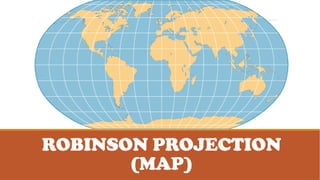
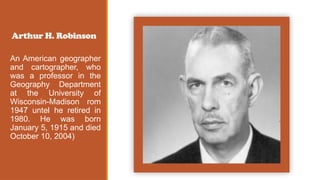
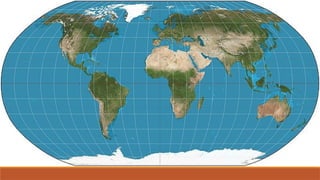
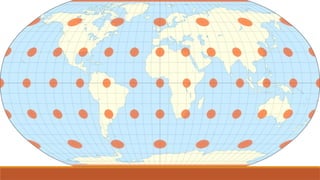
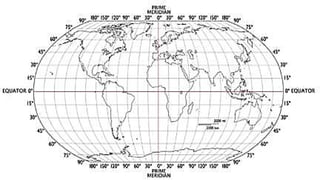
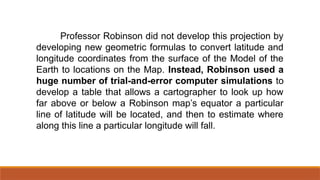
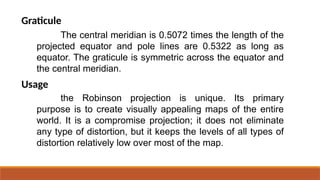
The Robinson projection, developed by American geographer Arthur H. Robinson in 1963, is a visually appealing map that displays the poles as lines rather than points. It is a compromise projection that minimizes distortion of size, shape, and distance across the map. Robinson's approach utilized trial-and-error computer simulations rather than new geometric formulas to create the projection's unique characteristics.


![Introto geography[1]](https://cdn.slidesharecdn.com/ss_thumbnails/introtogeography1-130411124640-phpapp02-thumbnail.jpg?width=640&height=640&fit=bounds)


