Project Based
Learning Project
Community Project - Middle School Students
Robert Nappa M3U4A2
What Can I Do For My
Community?
A sense of community is seriously lacking in my school’s
students. We need to ask ourselves “What can we do for the
community?”
We will work together as a team to tackle the issues that have
been pushed aside for far too long!
Step One: Setting the Stage
Talk about the community, the value of said community,
and what it means to live in a community
“What are our places in the community?”
“What changes would you like to see in the community?”
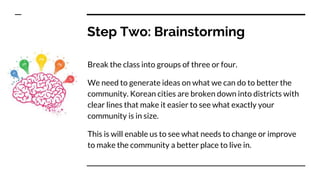
Step Two: Brainstorming
Break the class into groups of three or four.
We need to generate ideas on what we can do to better the
community. Korean cities are broken down into districts with
clear lines that make it easier to see what exactly your
community is in size.
This is will enable us to see what needs to change or improve
to make the community a better place to live in.
Step Three: Gather Data
Groups need to think of their walks and drives to school and
remember how safe the trek was.
Is there cycling infrastructure?
Is it safe?
How much garbage is on the streets?
Step Four: Explain Guidelines for
Project
Individually written paper
Group oral presentation accompanied with 21st century
technology
Letters to the local government
This project should be meaning for the students and they
need to feel passionate for the project
Step Five: Materials and Tools
We will need technology to help us complete this project.
Almost every student has a camera on their smartphones and
we need evidence of what they want to change.
Groups can use afterschool time to take pictures on their way
home of the state of their community and things they want to
change that is congruent to their project.
Step Six: Project Preparation
Groups can share their findings and devise a way to present
the project through a powerpoint, video, or another
presentation tool.
Who can the students contact in the community to help fix
the problems?
Draft letters to the local government asking for assistance or
action that can better the community on a larger scale.
Step Seven: Presentation
Individual papers are handed into the teacher
Groups take turns presenting their findings and actions
that have/can take to better the community
Who they can send letters to, or who to contact in local
government
Peer evaluation sheets are given to the other groups
Step Nine: Reflection and
Evaluation
What did the students like about the project? What did they
find frustrating? What would they change about the project?
Students can share how they found the criteria and how
effectively they followed and executed all guidelines.
How did they like working in groups for the activity? Would
they rather work alone? Bigger groups?
Deeper Learning
When students practice decision making and deductive
reasoning and are exposed to examples from real life, they are
able to expand their skills, evaluate their options, and think
critically. The activities in this section help students visualize
how events actually unfold by having students conduct
research, discuss and write about the material, collect or draw
data, and reflect on their work (Stix, Hrbek 2006).
Deeper Learning con’t
The students are able to learn from each other and work
together to finish a project. They design something from
scratch to present to others and try to make an impact on
something they deal with every day.
The teacher’s role is to set the stage and then let the students
execute. The teacher is there for guidance instead of answers.
Much like a coach in sports, we can motivate the students but
it is the students who make the goals.
References
Stix, Andi; Hrbek, Frank. (2006). Teachers as Classroom
Coaches. Retrieved February 2, 2017 from
http://www.ascd.org/publications/books/106031/chapters/T
he_Nine_Steps_of_Project-Based_Learning.aspx.

Robert Nappa M3U4A2 PBL

  • 1.
    Project Based Learning Project CommunityProject - Middle School Students Robert Nappa M3U4A2
  • 2.
    What Can IDo For My Community? A sense of community is seriously lacking in my school’s students. We need to ask ourselves “What can we do for the community?” We will work together as a team to tackle the issues that have been pushed aside for far too long!
  • 3.
    Step One: Settingthe Stage Talk about the community, the value of said community, and what it means to live in a community “What are our places in the community?” “What changes would you like to see in the community?”
  • 4.
    Step Two: Brainstorming Breakthe class into groups of three or four. We need to generate ideas on what we can do to better the community. Korean cities are broken down into districts with clear lines that make it easier to see what exactly your community is in size. This is will enable us to see what needs to change or improve to make the community a better place to live in.
  • 5.
    Step Three: GatherData Groups need to think of their walks and drives to school and remember how safe the trek was. Is there cycling infrastructure? Is it safe? How much garbage is on the streets?
  • 6.
    Step Four: ExplainGuidelines for Project Individually written paper Group oral presentation accompanied with 21st century technology Letters to the local government This project should be meaning for the students and they need to feel passionate for the project
  • 7.
    Step Five: Materialsand Tools We will need technology to help us complete this project. Almost every student has a camera on their smartphones and we need evidence of what they want to change. Groups can use afterschool time to take pictures on their way home of the state of their community and things they want to change that is congruent to their project.
  • 8.
    Step Six: ProjectPreparation Groups can share their findings and devise a way to present the project through a powerpoint, video, or another presentation tool. Who can the students contact in the community to help fix the problems? Draft letters to the local government asking for assistance or action that can better the community on a larger scale.
  • 9.
    Step Seven: Presentation Individualpapers are handed into the teacher Groups take turns presenting their findings and actions that have/can take to better the community Who they can send letters to, or who to contact in local government Peer evaluation sheets are given to the other groups
  • 10.
    Step Nine: Reflectionand Evaluation What did the students like about the project? What did they find frustrating? What would they change about the project? Students can share how they found the criteria and how effectively they followed and executed all guidelines. How did they like working in groups for the activity? Would they rather work alone? Bigger groups?
  • 11.
    Deeper Learning When studentspractice decision making and deductive reasoning and are exposed to examples from real life, they are able to expand their skills, evaluate their options, and think critically. The activities in this section help students visualize how events actually unfold by having students conduct research, discuss and write about the material, collect or draw data, and reflect on their work (Stix, Hrbek 2006).
  • 12.
    Deeper Learning con’t Thestudents are able to learn from each other and work together to finish a project. They design something from scratch to present to others and try to make an impact on something they deal with every day. The teacher’s role is to set the stage and then let the students execute. The teacher is there for guidance instead of answers. Much like a coach in sports, we can motivate the students but it is the students who make the goals.
  • 13.
    References Stix, Andi; Hrbek,Frank. (2006). Teachers as Classroom Coaches. Retrieved February 2, 2017 from http://www.ascd.org/publications/books/106031/chapters/T he_Nine_Steps_of_Project-Based_Learning.aspx.