REMOTE HEALTHCARE
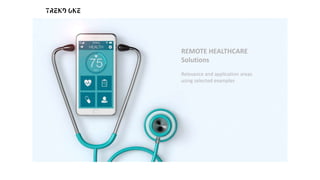
Solutions
Relevance and application areas
using selected examples
• describes the forms of health care that bridge spatial distances.
• innovative diagnostic instruments allow patients to measure their
vital signs independently, which are transmitted in real time to
the family doctor.
• Target group: elderly, non-mobile or rural residents.
• For younger people, health counselling via video chat or
chatbots is of interest, especially for psychotherapeutic
approaches.
REMOTE
HEALTHCARE
• “Health care has become a personal experience for everyone,
based on the meeting principle. We take time off, go to the doctor
and spend at least one or two hours each year talking about our
health. Health care has become a personal, office-based
experience for more or less everyone. We take time off, go to the
doctor's office and spend at least one or two hours talking about
our health."
REMOTE HEALTHCARE
Herausforderung:
REMOTE
HEALTHCARE
• The advantage for patients: better care and better health
outcomes without having to go to the doctor's office or hospital
every day.
REMOTE HEALTHCARE
Ausblick:
• Advantages for doctors: possibility to be
in two places at the same time. Keep an eye
on a patient via video, view his medical
records on his smartphone, study his X-ray
and CT scans from anywhere and do almost
all other tasks that are part of his normal
work.
REMOTE
HEALTHCARE
Challenge:
• Round-the-clock care not feasible for many
relatives.
Solution approaches:
• Support through virtual assistants and
development of technological possibilities for
improved care
Home care for persons in need of care
REMOTE
HEALTHCARE
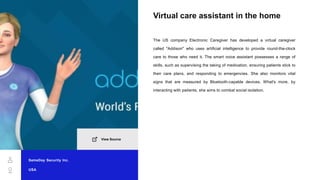
Virtual care assistant in the home
The US company Electronic Caregiver has developed a virtual caregiver
called "Addison" who uses artificial intelligence to provide round-the-clock
care to those who need it. The smart voice assistant possesses a range of
skills, such as supervising the taking of medication, ensuring patients stick to
their care plans, and responding to emergencies. She also monitors vital
signs that are measured by Bluetooth-capable devices. What's more, by
interacting with patients, she aims to combat social isolation.
SameDay Security Inc.
USA
View Source
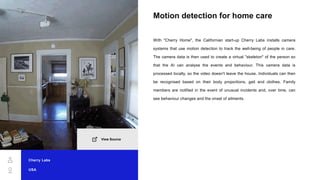
Motion detection for home care
With "Cherry Home", the Californian start-up Cherry Labs installs camera
systems that use motion detection to track the well-being of people in care.
The camera data is then used to create a virtual "skeleton" of the person so
that the AI can analyse the events and behaviour. This camera data is
processed locally, so the video doesn't leave the house. Individuals can then
be recognised based on their body proportions, gait and clothes. Family
members are notified in the event of unusual incidents and, over time, can
see behaviour changes and the onset of ailments.
Cherry Labs
USA
View Source
Robot helps the physically impaired
Researchers from the Georgia Institute of Technology have developed a
mechanism that enables physically disabled people to operate a robot for
their daily care needs. This is achieved via a web browser in which a camera
image is displayed from the perspective of the robot. By using the mouse or
head movements, patients can send the robot in a certain direction and select
certain actions from a menu. These actions include combing their hair,
shaving, applying lotion and picking up a bottle. Over the long term, the hope
is that people with care needs will be able to acquire greater autonomy in
their daily lives.
Georgia Tech Research Institute (GTRI)
USA
View Source
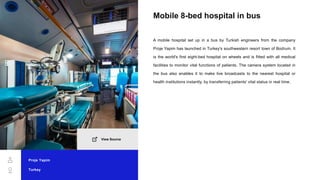
Mobile 8-bed hospital in bus
A mobile hospital set up in a bus by Turkish engineers from the company
Proje Yapim has launched in Turkey's southwestern resort town of Bodrum. It
is the world's first eight-bed hospital on wheels and is fitted with all medical
facilities to monitor vital functions of patients. The camera system located in
the bus also enables it to make live broadcasts to the nearest hospital or
health institutions instantly, by transferring patients' vital status in real time.
Proje Yapim
Turkey
View Source
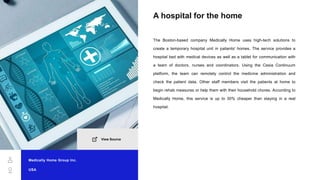
A hospital for the home
The Boston-based company Medically Home uses high-tech solutions to
create a temporary hospital unit in patients' homes. The service provides a
hospital bed with medical devices as well as a tablet for communication with
a team of doctors, nurses and coordinators. Using the Cesia Continuum
platform, the team can remotely control the medicine administration and
check the patient data. Other staff members visit the patients at home to
begin rehab measures or help them with their household chores. According to
Medically Home, this service is up to 30% cheaper than staying in a real
hospital.
Medically Home Group Inc.
USA
View Source
Worldwide access to medical care
Challenge:
• A large part of the world's population has
little or no access to health care
REMOTE
HEALTHCARE
Solution approaches:
• Use of technologies enables patients and
doctors to conduct virtual consultations
and make diagnoses
• Delivery concepts for reliable drug supply
• Use of mobile health apps to reach as many
patients as possible
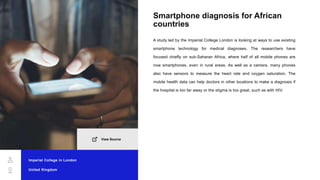
Smartphone diagnosis for African
countries
A study led by the Imperial College London is looking at ways to use existing
smartphone technology for medical diagnoses. The researchers have
focused chiefly on sub-Saharan Africa, where half of all mobile phones are
now smartphones, even in rural areas. As well as a camera, many phones
also have sensors to measure the heart rate and oxygen saturation. The
mobile health data can help doctors in other locations to make a diagnosis if
the hospital is too far away or the stigma is too great, such as with HIV.
Imperial College in London
United Kingdom
View Source
Delivering instant medical care to
islanders
Renmin Hospital in the Chinese city of Zhuhai is one of the first medical
centres to be opened that uses 5G technology. Thanks to faster data transfer
and reduced latency, the hospital has already been able to help a first patient
from the island Guishan Dao. 5G technology from China United and Huawei
enabled ultra-high-definition CT images and an electrocardiograph from
Guishan Dao to be sent for assessment to Renmin Hospital. Shortly
afterwards, face-to-face exchanges were held between the interdisciplinary
team and the patient to produce a preliminary diagnosis.
Huawei Technologies Co. Ltd.
China
View Source
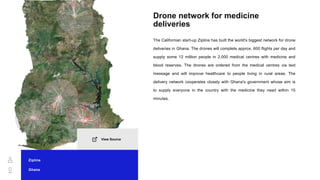
Drone network for medicine
deliveries
The Californian start-up Zipline has built the world's biggest network for drone
deliveries in Ghana. The drones will complete approx. 600 flights per day and
supply some 12 million people in 2,000 medical centres with medicine and
blood reserves. The drones are ordered from the medical centres via text
message and will improve healthcare to people living in rural areas. The
delivery network cooperates closely with Ghana's government whose aim is
to supply everyone in the country with the medicine they need within 15
minutes.
Zipline
Ghana
View Source
Digital Health & Big Data
Challenge:
• To use technical possibilities in such a
way that patients can be optimally
advised throughout
REMOTE
HEALTHCARE
Solution approaches:
• Monitoring of health data
• Use of language assistants to
support patients
• Possibilities of remote diagnosis
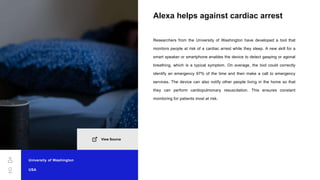
Alexa helps against cardiac arrest
Researchers from the University of Washington have developed a tool that
monitors people at risk of a cardiac arrest while they sleep. A new skill for a
smart speaker or smartphone enables the device to detect gasping or agonal
breathing, which is a typical symptom. On average, the tool could correctly
identify an emergency 97% of the time and then make a call to emergency
services. The device can also notify other people living in the home so that
they can perform cardiopulmonary resuscitation. This ensures constant
monitoring for patients most at risk.
University of Washington
USA
View Source
Smart mirror detects skin cancer
Researchers at Cornell University have developed a smart mirror that can
monitor malignant moles on the skin with the assistance of machine learning
algorithms, and identify early signs of skin cancer. The diagnostic mirror
searches the skin for alterations that could indicate cancer, and provides a
daily portrait of the user's face and upper body. The algorithms record the
profile and reference it through a database in which over 3,000 photographs
of moles are stored. The early diagnosis allows for prompt, effective
treatment to be undertaken.
Cornell University
USA
View Source
Flexible sensor monitors health data
Engineers at Stanford University have developed a flexible sensor that sticks
to the skin. With the "BodyNet" system, sensors made of metallic ink detect
physiological signals emanating from the skin based on electric currents.
They then forward the data wirelessly to a receiver in the clothing. The
researchers stuck the flexible sensors to various parts of the body to
measure things like heartbeat and breath based on skin contraction.
"BodyNet" can also be used to monitor patients with sleep disorders or heart
conditions.
Stanford University
USA
View Source
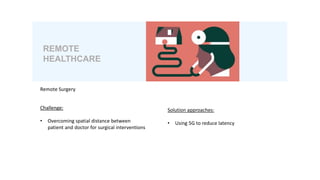
Remote Surgery
Challenge:
• Overcoming spatial distance between
patient and doctor for surgical interventions
REMOTE
HEALTHCARE
Solution approaches:
• Using 5G to reduce latency
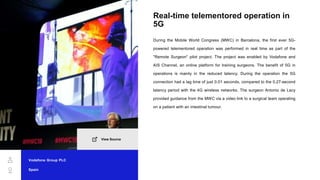
Real-time telementored operation in
5G
During the Mobile World Congress (MWC) in Barcelona, the first ever 5G-
powered telementored operation was performed in real time as part of the
"Remote Surgeon" pilot project. The project was enabled by Vodafone and
AIS Channel, an online platform for training surgeons. The benefit of 5G in
operations is mainly in the reduced latency. During the operation the 5G
connection had a lag time of just 0.01 seconds, compared to the 0.27-second
latency period with the 4G wireless networks. The surgeon Antonio de Lacy
provided guidance from the MWC via a video link to a surgical team operating
on a patient with an intestinal tumour.
Vodafone Group PLC
Spain
View Source
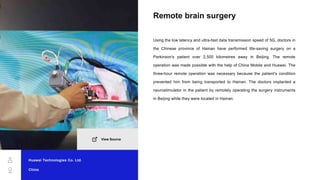
Remote brain surgery
Using the low latency and ultra-fast data transmission speed of 5G, doctors in
the Chinese province of Hainan have performed life-saving surgery on a
Parkinson's patient over 2,500 kilometres away in Beijing. The remote
operation was made possible with the help of China Mobile and Huawei. The
three-hour remote operation was necessary because the patient's condition
prevented him from being transported to Hainan. The doctors implanted a
neurostimulator in the patient by remotely operating the surgery instruments
in Beijing while they were located in Hainan.
Huawei Technologies Co. Ltd.
China
View Source
Mental Health
Challenge:
• Mental illnesses such as depression are on the
rise
• At the same time, long waiting times often
prevent patients from getting help quickly
• In addition, many patients have a high inhibition
threshold to consult doctors because of
psychological stress
REMOTE
HEALTHCARE
Solution approaches:
• Expanding the range of online
consulting services
• Offer online contact points to lower
inhibition thresholds and bridge
waiting times for personal
appointments
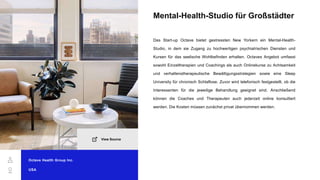
Mental-Health-Studio für Großstädter
Das Start-up Octave bietet gestressten New Yorkern ein Mental-Health-
Studio, in dem sie Zugang zu hochwertigen psychiatrischen Diensten und
Kursen für das seelische Wohlbefinden erhalten. Octaves Angebot umfasst
sowohl Einzeltherapien und Coachings als auch Onlinekurse zu Achtsamkeit
und verhaltenstherapeutische Bewältigungsstrategien sowie eine Sleep
University für chronisch Schlaflose. Zuvor wird telefonisch festgestellt, ob die
Interessenten für die jeweilige Behandlung geeignet sind. Anschließend
können die Coaches und Therapeuten auch jederzeit online konsultiert
werden. Die Kosten müssen zunächst privat übernommen werden.
Octave Health Group Inc.
USA
View Source
Emergency psychological help via
text message
Shout is the British branch of the American Crisis Text Line, a text message-
based counselling service for young people with psychological problems. To
use the service, people in an emergency can text the word SHOUT to a
number. The messages are dealt with by trained volunteers who call back as
quickly as possible. They are trained in talking to people in difficult situations,
and work to calm them down and offer hope. The conversation only ends
when the user is in a calm and safe place. The website also provides
breathing techniques and other useful tips.
Mental Health Innovations
United Kingdom
View Source
Hamburg
TRENDONE GmbH
Gasstrasse 2
22761 Hamburg
Germany
Fon +49 40 52 67 78 0
Fax +49 40 52 67 78 36
info@trendone.com
Berlin
TRENDONE GmbH
Brunnenstrasse 37
10115 Berlin
Germany
Fon +49 30 50 91 48 56
Fax +49 30 50 91 48 60
info@trendone.com
Vienna
TRENDONE GmbH
c/o Kapsch/Evolaris
Lehrbachgasse 11, 1120 Vienna
Austria
Fon +49 40 52 67 78 0
Fax +49 40 52 67 78 36
info@trendone.com
Zurich
TRENDONE GmbH
Kanzleistrasse 53
8004 Zurich
Switzerland
Fon +41 79 607 12 87
info@trendone.com
CONTACT
DISCLAIMER COPYRIGHT 2019 All rights reserved | The documented trends in this presentation and trends theses are intellectual property of TRENDONE GmbH and are subject to th e
applicable copyright laws. | The pictures are used only for research and illustration purposes. They are not free for publication.

Remote Healthcare

  • 1.
    REMOTE HEALTHCARE Solutions Relevance andapplication areas using selected examples
  • 2.
    • describes theforms of health care that bridge spatial distances. • innovative diagnostic instruments allow patients to measure their vital signs independently, which are transmitted in real time to the family doctor. • Target group: elderly, non-mobile or rural residents. • For younger people, health counselling via video chat or chatbots is of interest, especially for psychotherapeutic approaches. REMOTE HEALTHCARE
  • 3.
    • “Health carehas become a personal experience for everyone, based on the meeting principle. We take time off, go to the doctor and spend at least one or two hours each year talking about our health. Health care has become a personal, office-based experience for more or less everyone. We take time off, go to the doctor's office and spend at least one or two hours talking about our health." REMOTE HEALTHCARE Herausforderung: REMOTE HEALTHCARE
  • 4.
    • The advantagefor patients: better care and better health outcomes without having to go to the doctor's office or hospital every day. REMOTE HEALTHCARE Ausblick: • Advantages for doctors: possibility to be in two places at the same time. Keep an eye on a patient via video, view his medical records on his smartphone, study his X-ray and CT scans from anywhere and do almost all other tasks that are part of his normal work. REMOTE HEALTHCARE
  • 5.
    Challenge: • Round-the-clock carenot feasible for many relatives. Solution approaches: • Support through virtual assistants and development of technological possibilities for improved care Home care for persons in need of care REMOTE HEALTHCARE
  • 6.
    Virtual care assistantin the home The US company Electronic Caregiver has developed a virtual caregiver called "Addison" who uses artificial intelligence to provide round-the-clock care to those who need it. The smart voice assistant possesses a range of skills, such as supervising the taking of medication, ensuring patients stick to their care plans, and responding to emergencies. She also monitors vital signs that are measured by Bluetooth-capable devices. What's more, by interacting with patients, she aims to combat social isolation. SameDay Security Inc. USA View Source
  • 7.
    Motion detection forhome care With "Cherry Home", the Californian start-up Cherry Labs installs camera systems that use motion detection to track the well-being of people in care. The camera data is then used to create a virtual "skeleton" of the person so that the AI can analyse the events and behaviour. This camera data is processed locally, so the video doesn't leave the house. Individuals can then be recognised based on their body proportions, gait and clothes. Family members are notified in the event of unusual incidents and, over time, can see behaviour changes and the onset of ailments. Cherry Labs USA View Source
  • 8.
    Robot helps thephysically impaired Researchers from the Georgia Institute of Technology have developed a mechanism that enables physically disabled people to operate a robot for their daily care needs. This is achieved via a web browser in which a camera image is displayed from the perspective of the robot. By using the mouse or head movements, patients can send the robot in a certain direction and select certain actions from a menu. These actions include combing their hair, shaving, applying lotion and picking up a bottle. Over the long term, the hope is that people with care needs will be able to acquire greater autonomy in their daily lives. Georgia Tech Research Institute (GTRI) USA View Source
  • 9.
    Mobile 8-bed hospitalin bus A mobile hospital set up in a bus by Turkish engineers from the company Proje Yapim has launched in Turkey's southwestern resort town of Bodrum. It is the world's first eight-bed hospital on wheels and is fitted with all medical facilities to monitor vital functions of patients. The camera system located in the bus also enables it to make live broadcasts to the nearest hospital or health institutions instantly, by transferring patients' vital status in real time. Proje Yapim Turkey View Source
  • 10.
    A hospital forthe home The Boston-based company Medically Home uses high-tech solutions to create a temporary hospital unit in patients' homes. The service provides a hospital bed with medical devices as well as a tablet for communication with a team of doctors, nurses and coordinators. Using the Cesia Continuum platform, the team can remotely control the medicine administration and check the patient data. Other staff members visit the patients at home to begin rehab measures or help them with their household chores. According to Medically Home, this service is up to 30% cheaper than staying in a real hospital. Medically Home Group Inc. USA View Source
  • 11.
    Worldwide access tomedical care Challenge: • A large part of the world's population has little or no access to health care REMOTE HEALTHCARE Solution approaches: • Use of technologies enables patients and doctors to conduct virtual consultations and make diagnoses • Delivery concepts for reliable drug supply • Use of mobile health apps to reach as many patients as possible
  • 12.
    Smartphone diagnosis forAfrican countries A study led by the Imperial College London is looking at ways to use existing smartphone technology for medical diagnoses. The researchers have focused chiefly on sub-Saharan Africa, where half of all mobile phones are now smartphones, even in rural areas. As well as a camera, many phones also have sensors to measure the heart rate and oxygen saturation. The mobile health data can help doctors in other locations to make a diagnosis if the hospital is too far away or the stigma is too great, such as with HIV. Imperial College in London United Kingdom View Source
  • 13.
    Delivering instant medicalcare to islanders Renmin Hospital in the Chinese city of Zhuhai is one of the first medical centres to be opened that uses 5G technology. Thanks to faster data transfer and reduced latency, the hospital has already been able to help a first patient from the island Guishan Dao. 5G technology from China United and Huawei enabled ultra-high-definition CT images and an electrocardiograph from Guishan Dao to be sent for assessment to Renmin Hospital. Shortly afterwards, face-to-face exchanges were held between the interdisciplinary team and the patient to produce a preliminary diagnosis. Huawei Technologies Co. Ltd. China View Source
  • 14.
    Drone network formedicine deliveries The Californian start-up Zipline has built the world's biggest network for drone deliveries in Ghana. The drones will complete approx. 600 flights per day and supply some 12 million people in 2,000 medical centres with medicine and blood reserves. The drones are ordered from the medical centres via text message and will improve healthcare to people living in rural areas. The delivery network cooperates closely with Ghana's government whose aim is to supply everyone in the country with the medicine they need within 15 minutes. Zipline Ghana View Source
  • 15.
    Digital Health &Big Data Challenge: • To use technical possibilities in such a way that patients can be optimally advised throughout REMOTE HEALTHCARE Solution approaches: • Monitoring of health data • Use of language assistants to support patients • Possibilities of remote diagnosis
  • 16.
    Alexa helps againstcardiac arrest Researchers from the University of Washington have developed a tool that monitors people at risk of a cardiac arrest while they sleep. A new skill for a smart speaker or smartphone enables the device to detect gasping or agonal breathing, which is a typical symptom. On average, the tool could correctly identify an emergency 97% of the time and then make a call to emergency services. The device can also notify other people living in the home so that they can perform cardiopulmonary resuscitation. This ensures constant monitoring for patients most at risk. University of Washington USA View Source
  • 17.
    Smart mirror detectsskin cancer Researchers at Cornell University have developed a smart mirror that can monitor malignant moles on the skin with the assistance of machine learning algorithms, and identify early signs of skin cancer. The diagnostic mirror searches the skin for alterations that could indicate cancer, and provides a daily portrait of the user's face and upper body. The algorithms record the profile and reference it through a database in which over 3,000 photographs of moles are stored. The early diagnosis allows for prompt, effective treatment to be undertaken. Cornell University USA View Source
  • 18.
    Flexible sensor monitorshealth data Engineers at Stanford University have developed a flexible sensor that sticks to the skin. With the "BodyNet" system, sensors made of metallic ink detect physiological signals emanating from the skin based on electric currents. They then forward the data wirelessly to a receiver in the clothing. The researchers stuck the flexible sensors to various parts of the body to measure things like heartbeat and breath based on skin contraction. "BodyNet" can also be used to monitor patients with sleep disorders or heart conditions. Stanford University USA View Source
  • 19.
    Remote Surgery Challenge: • Overcomingspatial distance between patient and doctor for surgical interventions REMOTE HEALTHCARE Solution approaches: • Using 5G to reduce latency
  • 20.
    Real-time telementored operationin 5G During the Mobile World Congress (MWC) in Barcelona, the first ever 5G- powered telementored operation was performed in real time as part of the "Remote Surgeon" pilot project. The project was enabled by Vodafone and AIS Channel, an online platform for training surgeons. The benefit of 5G in operations is mainly in the reduced latency. During the operation the 5G connection had a lag time of just 0.01 seconds, compared to the 0.27-second latency period with the 4G wireless networks. The surgeon Antonio de Lacy provided guidance from the MWC via a video link to a surgical team operating on a patient with an intestinal tumour. Vodafone Group PLC Spain View Source
  • 21.
    Remote brain surgery Usingthe low latency and ultra-fast data transmission speed of 5G, doctors in the Chinese province of Hainan have performed life-saving surgery on a Parkinson's patient over 2,500 kilometres away in Beijing. The remote operation was made possible with the help of China Mobile and Huawei. The three-hour remote operation was necessary because the patient's condition prevented him from being transported to Hainan. The doctors implanted a neurostimulator in the patient by remotely operating the surgery instruments in Beijing while they were located in Hainan. Huawei Technologies Co. Ltd. China View Source
  • 22.
    Mental Health Challenge: • Mentalillnesses such as depression are on the rise • At the same time, long waiting times often prevent patients from getting help quickly • In addition, many patients have a high inhibition threshold to consult doctors because of psychological stress REMOTE HEALTHCARE Solution approaches: • Expanding the range of online consulting services • Offer online contact points to lower inhibition thresholds and bridge waiting times for personal appointments
  • 23.
    Mental-Health-Studio für Großstädter DasStart-up Octave bietet gestressten New Yorkern ein Mental-Health- Studio, in dem sie Zugang zu hochwertigen psychiatrischen Diensten und Kursen für das seelische Wohlbefinden erhalten. Octaves Angebot umfasst sowohl Einzeltherapien und Coachings als auch Onlinekurse zu Achtsamkeit und verhaltenstherapeutische Bewältigungsstrategien sowie eine Sleep University für chronisch Schlaflose. Zuvor wird telefonisch festgestellt, ob die Interessenten für die jeweilige Behandlung geeignet sind. Anschließend können die Coaches und Therapeuten auch jederzeit online konsultiert werden. Die Kosten müssen zunächst privat übernommen werden. Octave Health Group Inc. USA View Source
  • 24.
    Emergency psychological helpvia text message Shout is the British branch of the American Crisis Text Line, a text message- based counselling service for young people with psychological problems. To use the service, people in an emergency can text the word SHOUT to a number. The messages are dealt with by trained volunteers who call back as quickly as possible. They are trained in talking to people in difficult situations, and work to calm them down and offer hope. The conversation only ends when the user is in a calm and safe place. The website also provides breathing techniques and other useful tips. Mental Health Innovations United Kingdom View Source
  • 25.
    Hamburg TRENDONE GmbH Gasstrasse 2 22761Hamburg Germany Fon +49 40 52 67 78 0 Fax +49 40 52 67 78 36 info@trendone.com Berlin TRENDONE GmbH Brunnenstrasse 37 10115 Berlin Germany Fon +49 30 50 91 48 56 Fax +49 30 50 91 48 60 info@trendone.com Vienna TRENDONE GmbH c/o Kapsch/Evolaris Lehrbachgasse 11, 1120 Vienna Austria Fon +49 40 52 67 78 0 Fax +49 40 52 67 78 36 info@trendone.com Zurich TRENDONE GmbH Kanzleistrasse 53 8004 Zurich Switzerland Fon +41 79 607 12 87 info@trendone.com CONTACT DISCLAIMER COPYRIGHT 2019 All rights reserved | The documented trends in this presentation and trends theses are intellectual property of TRENDONE GmbH and are subject to th e applicable copyright laws. | The pictures are used only for research and illustration purposes. They are not free for publication.