International Research Journal of Engineering and Technology (IRJET) e-ISSN: 2395-0056
Volume: 09 Issue: 03 | Mar 2022 www.irjet.net p-ISSN: 2395-0072
© 2022, IRJET | Impact Factor value: 7.529 | ISO 9001:2008 Certified Journal | Page 1114
ROAD SIGN DETECTION USING CONVOLUTIONAL NEURAL NETWORK
(CNN)
Sowmiya1, Suvisesh. R2, Praveen. A3
1
Student ECE Dept. of Dr. Mahalingam College of Engineering and Tech, Tamil Nadu, India
2
Student ECE Dept. of Dr. Mahalingam College of Engineering and Tech, Tamil Nadu, India
----------------------------------------------------------------------***---------------------------------------------------------------------
Abstract - Automated tasks have simplified practically
everything we perform in today's world. Drivers often
miss signage on the side of the road in an effort to focus
on the road, which can be dangerous for them and
others. This issue may be avoided if there was a quick
way to alert the driver without requiring them to divert
their attention. Road sign detection is critical for
autonomous driving, traffic monitoring, and traffic
safety. In this paper, we suggest a method for detecting
and recognising road signs that uses Convolutional
Neural Networks (CNN) for sign recognition. Because
CNNs have a high recognition rate, they are ideal for a
variety of computer vision tasks. For the CNN's
implementation, TensorFlow is employed. In both
training and testing, we achieved greater than 95%
recognition accuracies for signs on the GTSRB data sets.
Key Words: GTSRB, CNN, Tensorflow, Computer vision
1. INTRODUCTION
Expert systems, such as traffic assistance driving
systems and automatic driving systems, rely heavily on
traffic sign detection and recognition.
It rapidly aids drivers or automated driving systems in
detecting and effectively recognising traffic signs.
The two basic categories of road traffic signs are main
signs and auxiliary signs. Warning signs, prohibition
signs, mandatory signs, guiding signs, tourist signs, and
road construction and safety signs are among the most
common types of signage. Prohibition signs were the
most common, and they were used to prohibit 43
different types of activity. Near the intersection,
mandatory signs identify the function of vehicles that
are put in the need to indicate vehicles. The purpose of
a warning is to advise vehicles and pedestrians to be
aware of potentially harmful situations. There are 45
different categories of targets. In traffic signs,they all
play a vital function. The most common speed limit
signs, as well as the restriction of left and right turning
signals, are extremely important for safe driving and
are thus the subject of current traffic sign recognition
study. It is a computer vision technique for locating
and identifying items in an image or video stream.
Despite the fact that the picture of the objects may vary
somewhat in different view-points, in many different
sizes and scales, or even when they are translated or
rotated, humans can recognise a large number of
things in photos with minimal effort. Even when
partially obscured from view, objects can be
recognised. We have presented a more accurate and
robust approach for the automatic detection and
recognition of traffic signs in a variety of challenging
settings and interruptions. The suggested system
employs Convolutional Neural Network (CNN)
architecture to learn features from traffic sign images
automatically. The built system is put to the test with
the German Traffic Sign Recognition Dataset (GTSRB),
which contains a massive collection of traffic sign
images divided into 43 categories.
2. LITERATURE SURVEY
"Evaluation of Robust Spatial Pyramid Pooling Based on
Convolutional Neural Network for Traffic Sign
Recognition System," by Chirstinedewi et al (2020). Due
to the lack of a database or study infrastructure for
Taiwanese traffic sign identification, this work
concentrates on Taiwan's prohibitory sign. The mean
average precision (mAP), workspace size, detection
time, intersection over union (IoU), and the number of
billion floating-point operations are all important
variables to examine while observing and evaluating
particular models (BFLOPS).
Hongwei Dong and colleagues (2019) suggested a
design for "Densely Connected Convolutional Neural
Network Based Polarimetric SAR Image Classification," a
revolutionary classification method for polarimetric
SAR images based on a new deep learning methodology
called Dense Net. To achieve polarimetric SAR image
classification, a 20-layer Dense Net (with 3 dense block
and 2 transition layers) is created. While automatically
extracting high-level features and performing pixel-wise
multi-class classification, the suggested method
effectively prevents gradient disappear and overfitting
by reuse.
International Research Journal of Engineering and Technology (IRJET) e-ISSN: 2395-0056
Volume: 09 Issue: 03 | Mar 2022 www.irjet.net p-ISSN: 2395-0072
© 2022, IRJET | Impact Factor value: 7.529 | ISO 9001:2008 Certified Journal | Page 1115
GulcanYildiz and Bekir Dizdaroglu developed a design for
"Traffic Sign Recognition through Transfer Learning
Using Convolutional Neural Network Models" (2020). The
ImageNet database was used to run the processes on pre-
trained convolutional neural network models. Then, for
10 classes in the GTSRB database, the recognition process
was carried out. VGG19, Res Net, Mobile Net, and
Xception are the models employed in this study. When
the results are compared, it is clear that the Mobile Net
model achieves the highest accuracy value.
Vaibhav Swaminathan and colleagues (2019) suggested
a revolutionary "Autonomous Driving System with Road
Sign Recognition Using Convolutional Neural Networks."
This entails appropriately identifying, classifying, and
responding to traffic signs that an automated vehicle
may encounter. In this study, an attempt is made to
construct such a system by employing image recognition
to record traffic signs, correctly classifying them using a
Convolutional Neural Network, and responding to them
in real-time via an Arduino-controlled autonomous
automobile. Various experiments were conducted using
the Belgium Traffic Signs dataset to examine the
performance of this traffic sign recognition system, and
this approach attained an accuracy of 83.7 percent.
Traffic Sign Detection Using Template Matching
Technique" was given by Pranjali Pandey and Ramesh
Kulkarni (2018).Along the side of the road, there are
traffic signs. The system selects and learns the object of
interest, a traffic sign board, and then detects where the
Region of Interest is in the form of a green-yellow
bounding box. The system gets notified when the item
reappears, that is, after the current frame has passed.
The output is given both in audio as well as in display
message format. This mix of outputs allows the driver to
maintain vigilance.
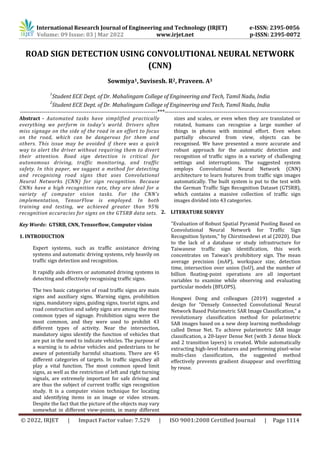
3. BLOCK DIAGRAM
Images from a labelled training dataset are first
subjected to a series of preprocessing procedures,
after which the processed images are sent to a CNN
architecture, which learns the features from the images
automatically. The learnt model is then saved for testing,
during which unlabeled test images are preprocessed
and sent to the model for classification.
4. DATASET IDENTIFICATION
We used the GTSRB dataset from Kaggle for our study.
One directory per class containing one CSV file with
annotations ("GT-ClassID>.csv") and the training images
grouped by tracks containing 30 images of one single
physical traffic sign
The German Traffic Sign Recognition Dataset (GTSRB) is
an image classification dataset with images of traffic
signs containing 43 different traffic sign classes
containing 39,209 labeled imagesand 12,630 unlabeled
images.
5. PREPROCESSING
Image preprocessing refers to a set of procedures for
formatting images in order to turn them into a format
that can be utilized to train the learning model. Both
training and test sets are subjected to these
preprocessing processes. To prepare picture data for
model input, preprocessing is required.
The fully connected layers in a CNN architecture, for
example, demand that all of the images be of the same
size arrays. The preprocessing phases in our suggested
system are as follows:
Splitting the train set for validation and resize the image
Encoding done in single step
6. RESIZING OF IMAGES
Because neural networks receive inputs of the same
size, resizing is necessary. As a result, all images must be
resized to a consistent size. The time it takes for the
learning algorithm to learn can be considerably
International Research Journal of Engineering and Technology (IRJET) e-ISSN: 2395-0056
Volume: 09 Issue: 03 | Mar 2022 www.irjet.net p-ISSN: 2395-0072
© 2022, IRJET | Impact Factor value: 7.529 | ISO 9001:2008 Certified Journal | Page 1116
decreased if the photographs are shrunk to a smaller
size. All of the photographs in our system are reduced to
a resolution of 30 X 30 pixels.
7. TRAIN-TEST SPLIT
The separation of the training data set into train and
validation data sets is the second stage in the
preprocessing. The accuracy of the learning algorithm
can be validated before moving on to the real testing
phase by using a fraction of the training data for
validation. This stage is primarily used to check for data
overfitting. In our approach, we examine 20% of the
training dataset for validation
8. ONE-HOT ENCODING
Categorical data consists of variables with label values
rather than numeric values. Many machine learning
algorithms are unable to operate directly on label data.
They demand that all input and output variables be
numeric. One-hot encoding is a common technique that
works well unless the category values include a
significant number of variables. One hot encoding
generates new binary columns, one for each potential
value from the original data. One-shot encoding in action
Label Encoding
Label Category
Red 1
Blue 2
Green 3
Yellow 4
Yellow 4
.
9. RESULTS AND DISCUSSION
In our project preprocessing is important role in the
dataset. Preprocessing is used to read and resize the
image to improve the quality of the image We have a
GTSRB dataset in this data set we have 39209 images in
these images are in different dimensions. So, we resize
the dataset images dimension of 30x30x3 for our
convenience.
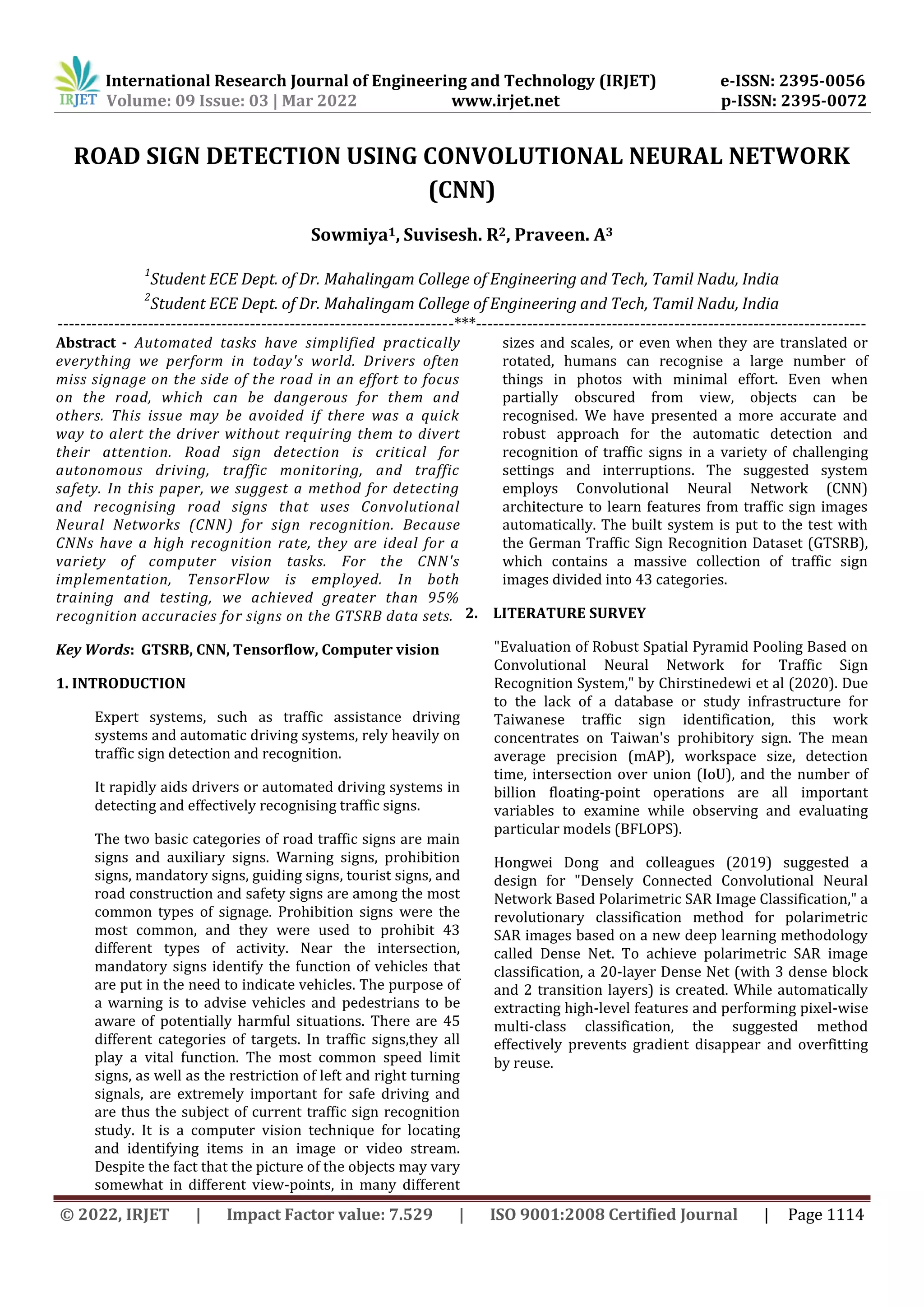
RESIZED IMAGES
One-Hot Encoding
Red Blue Green Yellow
1 0 0 0
0 1 0 0
0 0 1 0
0 0 0 1
Resizing image Dimension 30x30
Total images 39209
Training validation images 80%=26579
Testing validation images 20%=12630
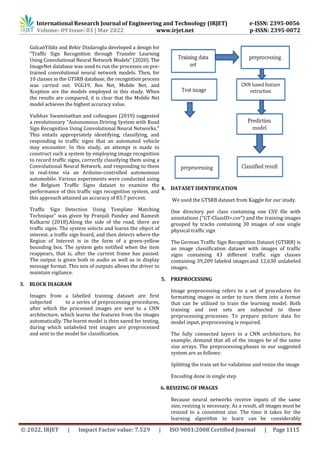
LAYER(TYPE) OUTPUT SHAPE PARAM#
conv2d (Conv2D) (None,26,26,32) 2432
conv2d_1(Conv2D)
(MaxPooling2D)
dropout_1(Dropout)
flatten(Flatten)
dense(Dense)
dropout_2(Dropout)
dense_1(Dense)
None,22,22,32)
(None,11,11,32)
(None,3,3,64)
(None, 576)
(None, 256)
(None, 256)
(None, 43)
25632
0
0
0
147712
0
11051
International Research Journal of Engineering and Technology (IRJET) e-ISSN: 2395-0056
Volume: 09 Issue: 03 | Mar 2022 www.irjet.net p-ISSN: 2395-0072
© 2022, IRJET | Impact Factor value: 7.529 | ISO 9001:2008 Certified Journal | Page 1117
Neural Network Output
Total params: 242,251
Trainable params: 242,251
Non-trainable params: 0
After data preprocessing is to read and resize the
image the second step is to split the training data set
for train and testing data set for test. We have taken
80% for training and 20% for testing in our project
road sign detection and we get accuracy from
training and validation loss.
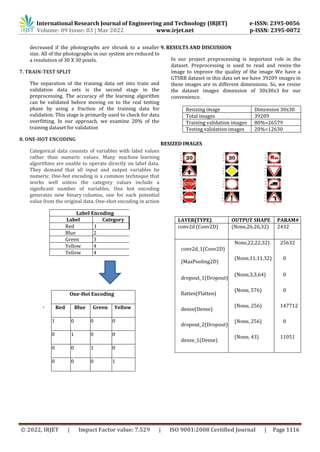
Finally, we get the output of Training accuracy and
Validation accuracy is 98.93% and 94.32% with loss ,
when we increase the training and validation accuracy
and loss will be decreased.
10. CONCLUSION
In the proposed work we use to know about
convolutional neural networks and how they can be
used in neural image recognition. We made a traffic sign
recognizer with the use of convolutional neural
networks by splitting up images into two categories as
testing and training validations. In this implementation,
we fixed 15 epocs for execution and got an accuracy of
94.32% in testing validation (20%) and98.93% in
training validation (80%). This type of road sign
detection is advisable for future use in autonomic self-
driving cars systems.
REFERENCES
[1] H. S. Lee, & K. Kim, “Simultaneous Traffic Sign
Detection and Boundary Estimation Using Convolutional
Neural Network”, vol. 19, no. 5, pp. 1652-1663, 2018
[2] Y. Yang, H. Luo, H. Xu, and F. Wu, “Towards Real-
Time Traffic Sign Detection and Classification”, Vol. 17,
no. 7, pp. 2022-2031, 2016
[3] Yuan Yuan, ZhitongXiong, Qi Wang, "An Incremental
Framework for Video-Based Traffic Sign Detection
Tracking and Recognition", vol. 18, no. 7, pp. 1918-1929,
2017
[4] Dongdong Wang, XinwenHou, JiaweiXu, ShigangYue,
Cheng-Lin Liu, "Traffic Sign Detection Using a Cascade
Method with Fast Feature Extraction and Saliency Test",
vol. 18, no. 12, pp. 3290-3302, 2017
[5] HengliangLuo, Yi Yang, Bei Tong, Fuchao Wu, Bin Fan,
"Traffic Sign Recognition Using a Multi-Task
Convolutional Neural Network", vol. 19, no. 4, pp. 1100-
1111, 2018.
[6] Jia Li, Zengfu Wang, "Real-Time Traffic Sign
Recognition Based on Efficient CNNs in the Wild", vol.20,
no. 3, pp. 975-984, 2019.
[7] CY Wang, "Research and application of traffic sign
detection and recognition based on deep learning",2018.
[8] T Chen and S Lu, "Accurate and Efficient Traffic Sign
Detection Using Discriminative Adaboost and Support
Vector Regression", vol. 65, no. 6, pp. 4006-4015, 2016.
[9] M Xing, M Chunyang, W Yan et al., "Traffic sign
detection and recognition using color standardization
and Zernike moments", 2016.
[10] Y. L. Pierre Sermanet, "Traffic sign recognition
with multiscale convolutional networks",pp. 2809-
2813, 2011.
S.NO TOTAL IMAGES
(39209)
ACCURACY LOSS
1 Training images
(80%=26579)
98.93 0.1776
2 Testing images
(20%=12630)
94.32
0.1296

ROAD SIGN DETECTION USING CONVOLUTIONAL NEURAL NETWORK (CNN)

  • 1.
    International Research Journalof Engineering and Technology (IRJET) e-ISSN: 2395-0056 Volume: 09 Issue: 03 | Mar 2022 www.irjet.net p-ISSN: 2395-0072 © 2022, IRJET | Impact Factor value: 7.529 | ISO 9001:2008 Certified Journal | Page 1114 ROAD SIGN DETECTION USING CONVOLUTIONAL NEURAL NETWORK (CNN) Sowmiya1, Suvisesh. R2, Praveen. A3 1 Student ECE Dept. of Dr. Mahalingam College of Engineering and Tech, Tamil Nadu, India 2 Student ECE Dept. of Dr. Mahalingam College of Engineering and Tech, Tamil Nadu, India ----------------------------------------------------------------------***--------------------------------------------------------------------- Abstract - Automated tasks have simplified practically everything we perform in today's world. Drivers often miss signage on the side of the road in an effort to focus on the road, which can be dangerous for them and others. This issue may be avoided if there was a quick way to alert the driver without requiring them to divert their attention. Road sign detection is critical for autonomous driving, traffic monitoring, and traffic safety. In this paper, we suggest a method for detecting and recognising road signs that uses Convolutional Neural Networks (CNN) for sign recognition. Because CNNs have a high recognition rate, they are ideal for a variety of computer vision tasks. For the CNN's implementation, TensorFlow is employed. In both training and testing, we achieved greater than 95% recognition accuracies for signs on the GTSRB data sets. Key Words: GTSRB, CNN, Tensorflow, Computer vision 1. INTRODUCTION Expert systems, such as traffic assistance driving systems and automatic driving systems, rely heavily on traffic sign detection and recognition. It rapidly aids drivers or automated driving systems in detecting and effectively recognising traffic signs. The two basic categories of road traffic signs are main signs and auxiliary signs. Warning signs, prohibition signs, mandatory signs, guiding signs, tourist signs, and road construction and safety signs are among the most common types of signage. Prohibition signs were the most common, and they were used to prohibit 43 different types of activity. Near the intersection, mandatory signs identify the function of vehicles that are put in the need to indicate vehicles. The purpose of a warning is to advise vehicles and pedestrians to be aware of potentially harmful situations. There are 45 different categories of targets. In traffic signs,they all play a vital function. The most common speed limit signs, as well as the restriction of left and right turning signals, are extremely important for safe driving and are thus the subject of current traffic sign recognition study. It is a computer vision technique for locating and identifying items in an image or video stream. Despite the fact that the picture of the objects may vary somewhat in different view-points, in many different sizes and scales, or even when they are translated or rotated, humans can recognise a large number of things in photos with minimal effort. Even when partially obscured from view, objects can be recognised. We have presented a more accurate and robust approach for the automatic detection and recognition of traffic signs in a variety of challenging settings and interruptions. The suggested system employs Convolutional Neural Network (CNN) architecture to learn features from traffic sign images automatically. The built system is put to the test with the German Traffic Sign Recognition Dataset (GTSRB), which contains a massive collection of traffic sign images divided into 43 categories. 2. LITERATURE SURVEY "Evaluation of Robust Spatial Pyramid Pooling Based on Convolutional Neural Network for Traffic Sign Recognition System," by Chirstinedewi et al (2020). Due to the lack of a database or study infrastructure for Taiwanese traffic sign identification, this work concentrates on Taiwan's prohibitory sign. The mean average precision (mAP), workspace size, detection time, intersection over union (IoU), and the number of billion floating-point operations are all important variables to examine while observing and evaluating particular models (BFLOPS). Hongwei Dong and colleagues (2019) suggested a design for "Densely Connected Convolutional Neural Network Based Polarimetric SAR Image Classification," a revolutionary classification method for polarimetric SAR images based on a new deep learning methodology called Dense Net. To achieve polarimetric SAR image classification, a 20-layer Dense Net (with 3 dense block and 2 transition layers) is created. While automatically extracting high-level features and performing pixel-wise multi-class classification, the suggested method effectively prevents gradient disappear and overfitting by reuse.
  • 2.
    International Research Journalof Engineering and Technology (IRJET) e-ISSN: 2395-0056 Volume: 09 Issue: 03 | Mar 2022 www.irjet.net p-ISSN: 2395-0072 © 2022, IRJET | Impact Factor value: 7.529 | ISO 9001:2008 Certified Journal | Page 1115 GulcanYildiz and Bekir Dizdaroglu developed a design for "Traffic Sign Recognition through Transfer Learning Using Convolutional Neural Network Models" (2020). The ImageNet database was used to run the processes on pre- trained convolutional neural network models. Then, for 10 classes in the GTSRB database, the recognition process was carried out. VGG19, Res Net, Mobile Net, and Xception are the models employed in this study. When the results are compared, it is clear that the Mobile Net model achieves the highest accuracy value. Vaibhav Swaminathan and colleagues (2019) suggested a revolutionary "Autonomous Driving System with Road Sign Recognition Using Convolutional Neural Networks." This entails appropriately identifying, classifying, and responding to traffic signs that an automated vehicle may encounter. In this study, an attempt is made to construct such a system by employing image recognition to record traffic signs, correctly classifying them using a Convolutional Neural Network, and responding to them in real-time via an Arduino-controlled autonomous automobile. Various experiments were conducted using the Belgium Traffic Signs dataset to examine the performance of this traffic sign recognition system, and this approach attained an accuracy of 83.7 percent. Traffic Sign Detection Using Template Matching Technique" was given by Pranjali Pandey and Ramesh Kulkarni (2018).Along the side of the road, there are traffic signs. The system selects and learns the object of interest, a traffic sign board, and then detects where the Region of Interest is in the form of a green-yellow bounding box. The system gets notified when the item reappears, that is, after the current frame has passed. The output is given both in audio as well as in display message format. This mix of outputs allows the driver to maintain vigilance. 3. BLOCK DIAGRAM Images from a labelled training dataset are first subjected to a series of preprocessing procedures, after which the processed images are sent to a CNN architecture, which learns the features from the images automatically. The learnt model is then saved for testing, during which unlabeled test images are preprocessed and sent to the model for classification. 4. DATASET IDENTIFICATION We used the GTSRB dataset from Kaggle for our study. One directory per class containing one CSV file with annotations ("GT-ClassID>.csv") and the training images grouped by tracks containing 30 images of one single physical traffic sign The German Traffic Sign Recognition Dataset (GTSRB) is an image classification dataset with images of traffic signs containing 43 different traffic sign classes containing 39,209 labeled imagesand 12,630 unlabeled images. 5. PREPROCESSING Image preprocessing refers to a set of procedures for formatting images in order to turn them into a format that can be utilized to train the learning model. Both training and test sets are subjected to these preprocessing processes. To prepare picture data for model input, preprocessing is required. The fully connected layers in a CNN architecture, for example, demand that all of the images be of the same size arrays. The preprocessing phases in our suggested system are as follows: Splitting the train set for validation and resize the image Encoding done in single step 6. RESIZING OF IMAGES Because neural networks receive inputs of the same size, resizing is necessary. As a result, all images must be resized to a consistent size. The time it takes for the learning algorithm to learn can be considerably
  • 3.
    International Research Journalof Engineering and Technology (IRJET) e-ISSN: 2395-0056 Volume: 09 Issue: 03 | Mar 2022 www.irjet.net p-ISSN: 2395-0072 © 2022, IRJET | Impact Factor value: 7.529 | ISO 9001:2008 Certified Journal | Page 1116 decreased if the photographs are shrunk to a smaller size. All of the photographs in our system are reduced to a resolution of 30 X 30 pixels. 7. TRAIN-TEST SPLIT The separation of the training data set into train and validation data sets is the second stage in the preprocessing. The accuracy of the learning algorithm can be validated before moving on to the real testing phase by using a fraction of the training data for validation. This stage is primarily used to check for data overfitting. In our approach, we examine 20% of the training dataset for validation 8. ONE-HOT ENCODING Categorical data consists of variables with label values rather than numeric values. Many machine learning algorithms are unable to operate directly on label data. They demand that all input and output variables be numeric. One-hot encoding is a common technique that works well unless the category values include a significant number of variables. One hot encoding generates new binary columns, one for each potential value from the original data. One-shot encoding in action Label Encoding Label Category Red 1 Blue 2 Green 3 Yellow 4 Yellow 4 . 9. RESULTS AND DISCUSSION In our project preprocessing is important role in the dataset. Preprocessing is used to read and resize the image to improve the quality of the image We have a GTSRB dataset in this data set we have 39209 images in these images are in different dimensions. So, we resize the dataset images dimension of 30x30x3 for our convenience. RESIZED IMAGES One-Hot Encoding Red Blue Green Yellow 1 0 0 0 0 1 0 0 0 0 1 0 0 0 0 1 Resizing image Dimension 30x30 Total images 39209 Training validation images 80%=26579 Testing validation images 20%=12630 LAYER(TYPE) OUTPUT SHAPE PARAM# conv2d (Conv2D) (None,26,26,32) 2432 conv2d_1(Conv2D) (MaxPooling2D) dropout_1(Dropout) flatten(Flatten) dense(Dense) dropout_2(Dropout) dense_1(Dense) None,22,22,32) (None,11,11,32) (None,3,3,64) (None, 576) (None, 256) (None, 256) (None, 43) 25632 0 0 0 147712 0 11051
  • 4.
    International Research Journalof Engineering and Technology (IRJET) e-ISSN: 2395-0056 Volume: 09 Issue: 03 | Mar 2022 www.irjet.net p-ISSN: 2395-0072 © 2022, IRJET | Impact Factor value: 7.529 | ISO 9001:2008 Certified Journal | Page 1117 Neural Network Output Total params: 242,251 Trainable params: 242,251 Non-trainable params: 0 After data preprocessing is to read and resize the image the second step is to split the training data set for train and testing data set for test. We have taken 80% for training and 20% for testing in our project road sign detection and we get accuracy from training and validation loss. Finally, we get the output of Training accuracy and Validation accuracy is 98.93% and 94.32% with loss , when we increase the training and validation accuracy and loss will be decreased. 10. CONCLUSION In the proposed work we use to know about convolutional neural networks and how they can be used in neural image recognition. We made a traffic sign recognizer with the use of convolutional neural networks by splitting up images into two categories as testing and training validations. In this implementation, we fixed 15 epocs for execution and got an accuracy of 94.32% in testing validation (20%) and98.93% in training validation (80%). This type of road sign detection is advisable for future use in autonomic self- driving cars systems. REFERENCES [1] H. S. Lee, & K. Kim, “Simultaneous Traffic Sign Detection and Boundary Estimation Using Convolutional Neural Network”, vol. 19, no. 5, pp. 1652-1663, 2018 [2] Y. Yang, H. Luo, H. Xu, and F. Wu, “Towards Real- Time Traffic Sign Detection and Classification”, Vol. 17, no. 7, pp. 2022-2031, 2016 [3] Yuan Yuan, ZhitongXiong, Qi Wang, "An Incremental Framework for Video-Based Traffic Sign Detection Tracking and Recognition", vol. 18, no. 7, pp. 1918-1929, 2017 [4] Dongdong Wang, XinwenHou, JiaweiXu, ShigangYue, Cheng-Lin Liu, "Traffic Sign Detection Using a Cascade Method with Fast Feature Extraction and Saliency Test", vol. 18, no. 12, pp. 3290-3302, 2017 [5] HengliangLuo, Yi Yang, Bei Tong, Fuchao Wu, Bin Fan, "Traffic Sign Recognition Using a Multi-Task Convolutional Neural Network", vol. 19, no. 4, pp. 1100- 1111, 2018. [6] Jia Li, Zengfu Wang, "Real-Time Traffic Sign Recognition Based on Efficient CNNs in the Wild", vol.20, no. 3, pp. 975-984, 2019. [7] CY Wang, "Research and application of traffic sign detection and recognition based on deep learning",2018. [8] T Chen and S Lu, "Accurate and Efficient Traffic Sign Detection Using Discriminative Adaboost and Support Vector Regression", vol. 65, no. 6, pp. 4006-4015, 2016. [9] M Xing, M Chunyang, W Yan et al., "Traffic sign detection and recognition using color standardization and Zernike moments", 2016. [10] Y. L. Pierre Sermanet, "Traffic sign recognition with multiscale convolutional networks",pp. 2809- 2813, 2011. S.NO TOTAL IMAGES (39209) ACCURACY LOSS 1 Training images (80%=26579) 98.93 0.1776 2 Testing images (20%=12630) 94.32 0.1296