Download to read offline
![International Research Journal of Engineering and Technology (IRJET) e-ISSN: 2395-0056
Volume: 09 Issue: 04 | Apr 2022 www.irjet.net p-ISSN: 2395-0072
© 2022, IRJET | Impact Factor value: 7.529 | ISO 9001:2008 Certified Journal | Page 2454
Traffic Sign Recognition Model
Pranay Shetty1, Shrilatha Shripathi1, Prof. Amruta Sankhe2
1Dept. of Information Technology, Atharva College of Engineering, Maharashtra, India
2Assistant Professor, Dept. of Information Technology, Atharva College of Engineering, Maharashtra, India
---------------------------------------------------------------------***---------------------------------------------------------------------
Abstract - Traffic Sign Recognition is very important to
research in this automotive era. The model we build is to
recognize the traffic signs, with an accuracy of 94.98% using
the CNN algorithm. The model consists of the German Traffic
Sign Recognition Benchmark (GTSRB) dataset which consists
of over 43 classes of traffic signs, split into 80% training
images and 20% test images. This model recognizesthetraffic
sign and predict it accordingly. We processed more than 50k
images for the traffic signs. Trained the model through the
CNN algorithm which gave the highest accuracy compared to
other algorithms. This system is portable and can be added in
Advanced driver-assistance systems (ADAS) to add a new
feature to the vehicle. The results of the final experiment
show that the network is valid for the classification of traffic
signs with the accuracy of 94.98%.
Key Words: CNN algorithm, ADAS, GTSRB, Accuracy,
Traffic signs.
1. INTRODUCTION
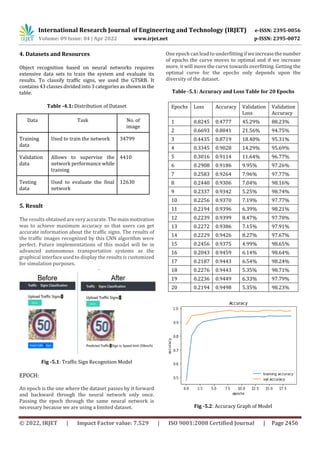
This dataset comprises 43 classes with unbalanced class
frequencies. Before proceedingtowardthe model,thedatais
cleaned which removes redundancy features. These 43
classes are divided into two sets: training sets and testing
sets. 39209 images are in training sets and 12630 images in
testing sets where the model will be trained by the training
sets and the trained model will be tested with thetestset. An
activation function is just a simple function that transforms
its inputs into outputs that have a certain range. Various
types of activation functions perform this task differently.
For example, the sigmoid activation functiontakesinputand
maps the resulting values between 0 to 1. But we have used
the Regression linear activation Unit which is the function
simple and it consists of no heavy computation as thereisno
complicated math. The model can, therefore, take less time
to train or run. One more important property that we
consider the advantage of using theReLUactivationfunction
is sparsity. The model went through 20 epochs and the last
epoch result gave the accuracy as 95%.
2. Literature Review
In [1], Aashrith Vennelakanti, Smriti Shreya, Resmi
Rajendran, Debasis Sarkar, Deepak Muddegowda, and
Phanish Hanagal use Traffic Sign Detection and Recognition
uses image processing for the detection of a sign and an
ensemble of convolutional neural network (CNN) for
recognition of the signs.
In [2], Akshata V. S and Subarna Panda had published a
paper representing the topic of Traffic Sign Recognition and
classification using convolutional neural networks that they
are going through three stages to recognize the traffic sign
which consists of imagesegmentation,detectionofthetraffic
sign, and a classification phase based on the input image.
They will collect the data from the German Traffic Sign
Benchmark and it will explore and summarize each of the
data sets to visualize all the data uniquely.
In [3], Meenakumari V. Umarani and Raghavendra F. Sheddi
used an SVM classifier where theimageisprocessedandLBP
features of the image are extracted and given to PCS for
further reduction. It is recognized that the traffic sign
detection problem using the state-of-the-art multi-object
detection systems such as Faster Recurrent Convolution
Neural Networks(F-RCNN) and Single-shot Multi-Box
Detector (SSD) combined with various feature extractors
such as MobileNet v1 and Inception v2, and also Tiny-
YOLOv2.
In [4], Deeban Chakravarthi S., BalakumarM.,AhithkumarS.,
Karthik, and Mr. A. Vellingiri published a highly efficient
system to process high-definition (1080p) video, which is
captured by a camera to detect the traffic sign using FPGA, it
achieves a throughput of 126 frames per second and an
energy efficiency of 0.041 J/frame
In [5], MD Tarequl Islam had not only taken the dataset of
some particular region but it had considered every data
regarding traffic signs which are used all around the world.
Here, there are two sets one which classifies the signs and
the other the shape. 40000 images have been used to train
the first classifier with 28000 positive images and 12000
negative images were used to train the second classifier.
In [6], Jian-He Shi and Huei-Yung Lin used the Taiwan
dataset as the videos that are recorded using an onboard
dashcam. It is based on image processing, bilateral Chinese
transform, and vertex and bisector techniques. Either the
RGB image input is used directly, or transformed to the HSI
color space and using the hue channel to extract the red
color region
In [7], Djebbara Yasmania, Rebai Karima, and Azouaoui
Ouahiba kept in mind the era of Advanced Driving Systems
(ADAS) and autonomous vehicles used the LeNet-5 network
to extract a deep representation of traffic signs to perform
the recognition. The model is constituted of a Convolution
Neural Network (CNN) Modifies by connecting the output of
all convolutional layers to the Multilayer Perception (MLP).](https://image.slidesharecdn.com/irjet-v9i4275-220927114201-66a7af52/85/Traffic-Sign-Recognition-Model-1-320.jpg)
![International Research Journal of Engineering and Technology (IRJET) e-ISSN: 2395-0056
Volume: 09 Issue: 04 | Apr 2022 www.irjet.net p-ISSN: 2395-0072
© 2022, IRJET | Impact Factor value: 7.529 | ISO 9001:2008 Certified Journal | Page 2454
Traffic Sign Recognition Model
Pranay Shetty1, Shrilatha Shripathi1, Prof. Amruta Sankhe2
1Dept. of Information Technology, Atharva College of Engineering, Maharashtra, India
2Assistant Professor, Dept. of Information Technology, Atharva College of Engineering, Maharashtra, India
---------------------------------------------------------------------***---------------------------------------------------------------------
Abstract - Traffic Sign Recognition is very important to
research in this automotive era. The model we build is to
recognize the traffic signs, with an accuracy of 94.98% using
the CNN algorithm. The model consists of the German Traffic
Sign Recognition Benchmark (GTSRB) dataset which consists
of over 43 classes of traffic signs, split into 80% training
images and 20% test images. This model recognizesthetraffic
sign and predict it accordingly. We processed more than 50k
images for the traffic signs. Trained the model through the
CNN algorithm which gave the highest accuracy compared to
other algorithms. This system is portable and can be added in
Advanced driver-assistance systems (ADAS) to add a new
feature to the vehicle. The results of the final experiment
show that the network is valid for the classification of traffic
signs with the accuracy of 94.98%.
Key Words: CNN algorithm, ADAS, GTSRB, Accuracy,
Traffic signs.
1. INTRODUCTION
This dataset comprises 43 classes with unbalanced class
frequencies. Before proceedingtowardthe model,thedatais
cleaned which removes redundancy features. These 43
classes are divided into two sets: training sets and testing
sets. 39209 images are in training sets and 12630 images in
testing sets where the model will be trained by the training
sets and the trained model will be tested with thetestset. An
activation function is just a simple function that transforms
its inputs into outputs that have a certain range. Various
types of activation functions perform this task differently.
For example, the sigmoid activation functiontakesinputand
maps the resulting values between 0 to 1. But we have used
the Regression linear activation Unit which is the function
simple and it consists of no heavy computation as thereisno
complicated math. The model can, therefore, take less time
to train or run. One more important property that we
consider the advantage of using theReLUactivationfunction
is sparsity. The model went through 20 epochs and the last
epoch result gave the accuracy as 95%.
2. Literature Review
In [1], Aashrith Vennelakanti, Smriti Shreya, Resmi
Rajendran, Debasis Sarkar, Deepak Muddegowda, and
Phanish Hanagal use Traffic Sign Detection and Recognition
uses image processing for the detection of a sign and an
ensemble of convolutional neural network (CNN) for
recognition of the signs.
In [2], Akshata V. S and Subarna Panda had published a
paper representing the topic of Traffic Sign Recognition and
classification using convolutional neural networks that they
are going through three stages to recognize the traffic sign
which consists of imagesegmentation,detectionofthetraffic
sign, and a classification phase based on the input image.
They will collect the data from the German Traffic Sign
Benchmark and it will explore and summarize each of the
data sets to visualize all the data uniquely.
In [3], Meenakumari V. Umarani and Raghavendra F. Sheddi
used an SVM classifier where theimageisprocessedandLBP
features of the image are extracted and given to PCS for
further reduction. It is recognized that the traffic sign
detection problem using the state-of-the-art multi-object
detection systems such as Faster Recurrent Convolution
Neural Networks(F-RCNN) and Single-shot Multi-Box
Detector (SSD) combined with various feature extractors
such as MobileNet v1 and Inception v2, and also Tiny-
YOLOv2.
In [4], Deeban Chakravarthi S., BalakumarM.,AhithkumarS.,
Karthik, and Mr. A. Vellingiri published a highly efficient
system to process high-definition (1080p) video, which is
captured by a camera to detect the traffic sign using FPGA, it
achieves a throughput of 126 frames per second and an
energy efficiency of 0.041 J/frame
In [5], MD Tarequl Islam had not only taken the dataset of
some particular region but it had considered every data
regarding traffic signs which are used all around the world.
Here, there are two sets one which classifies the signs and
the other the shape. 40000 images have been used to train
the first classifier with 28000 positive images and 12000
negative images were used to train the second classifier.
In [6], Jian-He Shi and Huei-Yung Lin used the Taiwan
dataset as the videos that are recorded using an onboard
dashcam. It is based on image processing, bilateral Chinese
transform, and vertex and bisector techniques. Either the
RGB image input is used directly, or transformed to the HSI
color space and using the hue channel to extract the red
color region
In [7], Djebbara Yasmania, Rebai Karima, and Azouaoui
Ouahiba kept in mind the era of Advanced Driving Systems
(ADAS) and autonomous vehicles used the LeNet-5 network
to extract a deep representation of traffic signs to perform
the recognition. The model is constituted of a Convolution
Neural Network (CNN) Modifies by connecting the output of
all convolutional layers to the Multilayer Perception (MLP).](https://image.slidesharecdn.com/irjet-v9i4275-220927114201-66a7af52/75/Traffic-Sign-Recognition-Model-1-2048.jpg)
![International Research Journal of Engineering and Technology (IRJET) e-ISSN: 2395-0056
Volume: 09 Issue: 04 | Apr 2022 www.irjet.net p-ISSN: 2395-0072
© 2022, IRJET | Impact Factor value: 7.529 | ISO 9001:2008 Certified Journal | Page 2455
3. Methodology
3.1. Block diagram
Fig -3.1: Block Diagram
i) Input Image: The dataset of the German Traffic Sign
Recognition Benchmark (GTSRB) contains images of traffic
signs from this set. We take a sample image for testing in the
GUI where the result of the image will be displayed on the
GUI according to the input image given.
ii)ROI Extraction: Region of Interest (ROI) Extraction is the
interest image extractor where the required information is
extracted from the input image and will be processed
towards the next step.
iii)Region Processing: The extractedimagewill beprocessed
and the selected region will be processed in the CNN
algorithm.
iv)CNN-based feature extraction: This algorithmwill extract
the feature present in the images for further classification.
v)Classification: Traffic signs will furtherclassifytheprocess
of automatically recognizing the traffic signs along the road,
including merge signs, stop signs, turn signs, etc
vi)Traffic Sign Labelling: The dataset is split into training,
test, and validation sets.
Storing all this information in the model the GUI gives out
the result of the traffic signs as labelling it.
3.2. Architecture
i) Pre-processing the images:
The dataset we have may have null values and
redundancy values to eliminate that we clean the data,
remove the redundancy features by which we will get the
accurate data to train the model.
ii) Splitting the data:
Pre-processed data should be split into two sets i.e.,
train and test where the train set contains 80% of the data
and test data contains 20% of the data which will test the
model and give the accuracy.
iii) Building the model:
The model is built using CNN Algorithm where
ConV2d is used and ReLU activation is used to get the
accurate results.
iv) Test Data:
Trained model is tested on test data to gettheresult
which showed us an accuracy of 95%.
3.3. Flowchart
Fig -3.3: Flowchart of Model [8]
Here, we start by taking the image as an input where the
image consists of Traffic SignsfromthedatasetoftheGTSRB.
The image taken consists of RGB values, these values are
then divided into 0-70 thresholds each.Thresholdvaluesare
then submerged into a median formula for smoothening.
After filtering and analysing the features of the detected
object, the candidates of the traffic sign are selected. The
flow chart of the system is shown in fig 3.3](https://image.slidesharecdn.com/irjet-v9i4275-220927114201-66a7af52/85/Traffic-Sign-Recognition-Model-2-320.jpg)
![International Research Journal of Engineering and Technology (IRJET) e-ISSN: 2395-0056
Volume: 09 Issue: 04 | Apr 2022 www.irjet.net p-ISSN: 2395-0072
© 2022, IRJET | Impact Factor value: 7.529 | ISO 9001:2008 Certified Journal | Page 2457
Fig -5.3: Data Loss Graph of Model
6. Conclusions
This paper proposes a deep learning-based framework for
fast and efficient traffic sign recognition. To improve the
accuracy speed of the model, a convolutional neural network
(CNN) is used as the base line network. The convolution
module is used to create an enhanced feature map with
greater representation. In the test, a widely used dataset is
adopted to improve the performance of the model and the
entire framework including the German Traffic Sign
Recognition Benchmark (GTSRB) dataset. Test results on
these datasets show that the proposed framework improves
traffic sign detection performance in difficult driving
conditions and meets the real-time requirements of
advanced driver assistance systems. This system can only
recognize forty-three classes of traffic signs, so the traffic
sign recognition range is limited. To increase the range, a
dataset containing different typesoftraffic signscanbeused.
REFERENCES
[1] A. Vennelakanti, S. Shreya, R. Rajendran, D. Sarkar, D.
Muddegowda andP.Hanagal,"Traffic SignDetectionand
Recognition using a CNN Ensemble," 2019 IEEE
International Conference on Consumer Electronics
(ICCE), 2019, pp. 1-4, doi: 10.1109/ICCE.2019.8662019.
[2] Akshata V. and Subarna Panda, "TRAFFIC SIGN
RECOGNITION AND CLASSIFICATION USING
CONVOLUTIONAL NEURAL NETWORKS", International
Journal of Emerging Technologies and Innovative
Research (www.jetir.org | UGC and issn Approved),
ISSN:2349-5162, Vol.6, Issue 2, page no. pp186-204,
February-2019, Available at:
http://www.jetir.org/papers/JETIRAB06034.pdf
[3] Meenakumari.V.Umarani, Raghavendra.F.Sheddi, "Road
Sign Detection and Recognition System Using LBP and
SVM", International Journal ofEngineeringDevelopment
and Research (IJEDR), ISSN:2321-9939,Volume.7,Issue
4, pp.139-144, October 2019, Available at
http://www.ijedr.org/papers/IJEDR1904025.pdf
[4] Deeban Chakravarthi S, Balakumar M, Ajithkumar S,
Karthik V and A. Vellingiri, “FPGA Based Traffic Sign
Detection with High ResolutionCamera,”February2018
| IJIRT | Volume 4 Issue 9 | ISSN: 2349-6002 IJIRT
145372
[5] M. T. Islam, "Traffic signdetectionandrecognitionbased
on convolutional neural networks," 2019 International
Conference on Advances in Computing, Communication
and Control (ICAC3), 2019, pp. 1-6, doi:
10.1109/ICAC347590.2019.9036784.
[6] J. Shi and H. Lin, "A vision system for traffic sign
detection and recognition," 2017 IEEE 26th
International Symposium on Industrial Electronics
(ISIE), 2017, pp. 1596-1601, doi:
10.1109/ISIE.2017.8001485.
[7] D. Yasmina, R. Karima and A. Ouahiba, "Traffic signs
recognition with deep learning," 2018 International
Conference on AppliedSmartSystems(ICASS),2018,pp.
1-5, doi: 10.1109/ICASS.2018.8652024.
[8] Safat B. Wali, Mahammad A. Hannan, Aini Hussain,
Salina A. Samad, "An Automatic Traffic Sign Detection
and Recognition System Based on Colour Segmentation,
Shape Matching, and SVM", Mathematical Problems in
Engineering, vol. 2015, Article ID 250461, 11 pages,
2015.](https://image.slidesharecdn.com/irjet-v9i4275-220927114201-66a7af52/85/Traffic-Sign-Recognition-Model-4-320.jpg)

The document describes a traffic sign recognition model that uses a convolutional neural network (CNN) algorithm to recognize traffic signs from images with 94.98% accuracy. The model was trained on the German Traffic Sign Recognition Benchmark dataset containing over 50,000 images split into 80% for training and 20% for testing. The CNN model extracts features from the images and classifies the traffic signs. The results show the network can accurately classify traffic signs and could be integrated into advanced driver assistance systems to help vehicles recognize road signs.


