Download to read offline



![p 347
mutants.. from copying error.. during cell division..
link between x rays and mutations..radiation causes
cancer.. since x rays also cause mutations.. could
cancer be a disease of mutations..
p 348
what caused mitosis to turn so abruptly from such an
exquisitely regulated process to chaos…. what had
failed was a kind of biological imagination...
p 351
temin imagined creating cancer in a
petri dish… in 1958 .. succeeded…
(previous could only look at rous’s
because only way you could see.. like
looking for keys..lost in house.. under
street corner lampstand..)
temin’s imagination that allowed him to
look… and re imagine
temin believed that the cell and its
interaction with the virus, had all the
biological components necessary to
drive the malignant process. the ghost
was out of the organism.
biological info, the dogma proposed,
only travels down a one way street from
dna to rna to proteins.. how on earth,
temin wondered, could rna turn around
acrobatically and make a dna copy of
itself, driving wrong way
Temin made a leap of faith; if the data
did not fit the dogma, then the dogma—
not the data—needed to be changed.
from documentary – episode 2
52 min – the fact that sarc existed in all –
birds, chickens, emu, people… see through the
darkness a glimpse. of clear theory of cancer.
ie: there are genes in your body that control
normal cellular growth and if you disrupt
these genes.. you essentially begin to
unleash cancer..
important thing.. viral/chemical.. weren’t
wrong. just not sufficient.. like blind men and
elephant… siddhartha –
1:16 – a crisis of faith – siddhartha
when you treat cancer important to know what you can/can’t
be sure of – juliano – uncertainty is part of treating cancer
vepisode 3 -
pointed out genes are much more complex.. –
sidd
abnormalities not oncogenes but tumor
suppressor gene – fail to stop cells from
dividing.. oncogene like an accelerator.. tumor
suppressor like breaks.. all cells have both
defects
dealing w/tip of iceberg.. push cures even
further away.. could see more clearly .. but
chaotic.. like rubix cube.. one side can be fine..
but rest are now toxic – ldk
work for a while.. then stop working… because
of: resistance…. cancer cells are constantly
mutating.. so genetic diversity of cancer
grows… transforms idea of treatment from
static idea to dynamic idea – sidd
may not be the same disease in anyone.. a
moving target.. cancer becomes resistant to
whatever drug we are using
1:11 – immune system:
cancer is literally evolution in a bottle. all
forces.. all history in life.. that plays out at
billion times speed of evolution.
if cancer exploits the power of evolution to
survive.. perhaps only a commensurate
weapon can overcome it.. the human immune
system.. an extraordinary set of defenses…
first explored 19th cent surgeon … william
coley.. tumor seemed to vanish of own accord
after serious infection.. birth of cancer
immunotherapy.. hoping to trigger fever that
would overwhelm the cancer.. steven
rosenberg since 1970s… self-cure.. answer had
to lay in patients own immune system….
sooo..
1:16 try to identify cells that were attacking
the cancer and use them to develop a cancer
treatment..
1:17 – could you educate to attack cancer cell and not
normal cell. sidd
remove tumor.. find t cells fighting tumor… take cells
out.. grow them out.. turn a few cancer fighting sells
into an army.. then put them back in
1:22 – immune system might be holding itself back
from attacking cancer cells – allison – can remove
breaks.. free immune system to attack cancer..
on being attacked for saying such things as.. i think
immune system might solve this..
for many decades we’ve concentrated on the tumor..
rather than the host immune response… ie: patient and
tumor..
1:25 – another novel approach.. immune
system as surveillance… but often blind..
and miss them… so we have to redirect
that t cell.. a new gene forces it to see..
ie: taking off blindfold.. re engineering t
cells..
let the cells do the work they were
designed to do..
on educating immune system to see/kill
cancer
immune system is there for whole trip..
patience that respond to it will respond
for a long time..
intro’d to Jennifer via wef 2016 panel…
staying human
[i was intrigued when she talked of the
ability to zone in on and get rid of
mutations.. thinking.. great.. but won’t
help.. if we don’t also get rid of mutant
living.. that produced them in the first
place. and perhaps in similar
way..thinkings/ponderings from
siddhartha et al.. placebo rna – toward a
nother way to live]
crisper tech
when viruses infect a cell they inject their dna.. in a bacterium..
the crispr system allows that dna to be plucked out of the virus
and inserted in little bits into the chromosome dna of bacterium..
these integrated bits get inserted at a site called crispr…
crispr – a mechanims that allows cells to record over time the
viruses the have been exposed to… those bits of dna are passed on
to the cell’s progeny…
blockchain ness
1:05 – this coordination problem
43 min – turning governance into degovernance systems is kind of
radical.. but over and over again find possible once to loop… so no
need for governance.. policy evaporate..
begs systemic change.. where the b ness becomes irrelevant..
what if the only governance/b we need is getting us out of the
mess/mistrust/mutations.. we’ve accumulated over the years of
ie: manufactured consent et al..
a nother way
this allows cells to keep a record of infection… a
genetic vaccination card…
once bits of dna inserted into dna chromosome..
makes copy … exact replicate.. of viral rna.. a
chemical cousin of dna…
little bits of rna from crispr bind to protein..
called cas9 and form a complex that functions
like a sentinal.. searches to find match… when
sites found… this complex associates and allows
cas9 to cut up the dna..
so like a pair of scissors that can cut dna… and
importantly.. this is programmable… to make
break in dna at that site…
could be harnessed for genome engineering…
analogous to way we use word processing to fix
typing in document
cells have ability to detect broken dna and repair
it… by pasting together or integrating new…
we can trigger cells to repair breaks by disruption
or incorporation of new…
crispr is like software.. can re program
clinical application w/in next 10 yrs
Jennifer Doudna’s crispr](https://image.slidesharecdn.com/rna-160203184130/85/rna-ness-7-320.jpg)






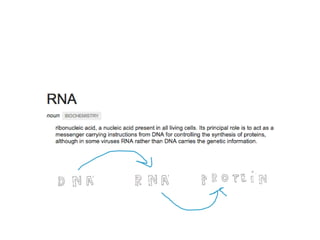
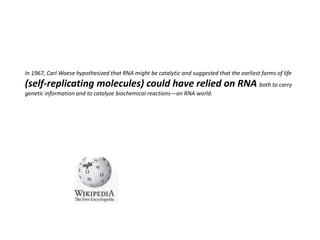
RNA plays an essential role in biology by carrying genetic information from DNA and helping to synthesize proteins. It was discovered in the late 1950s that an intermediary RNA copy of a gene, called messenger RNA (mRNA), is required to translate genetic information stored in DNA into proteins. This established the central dogma of molecular biology whereby genetic information flows from DNA to RNA to protein. Some viruses also use RNA as their genetic material. Carl Woese later hypothesized that an "RNA world" may have existed before DNA and proteins, where RNA served both genetic and catalytic functions essential for life.


