1
What Affects Confidence In
Security Programs?
Rocky Mountain Information Security Conference 2014
Bill Burns | Executive-In-Residence | Scale Venture Partners | Bill@ScaleVP.com | @x509v3
2
My Background
 Production hybrid cloud security at scale
– Deployed distributed, hybrid cloud WAF
– Co-developed CloudHSM for IaaS hardware root of trust
 Corporate IT “all-cloud” security strategy
– Cloud-first, mobile-first infrastructure model
– Mix of public cloud, best-of-breed SaaS
 RSAC Program Committee, Startup Technical Advisory Boards,
ISSA CISO Forum & Career Lifecycle
 Previously:
3
Agenda
 Trends and Forcing Functions on Information Security
 InfoSec’s Role in Managing Business Risk
 Security Innovations, Market Needs
 Early Research Results: Improving Confidence
4
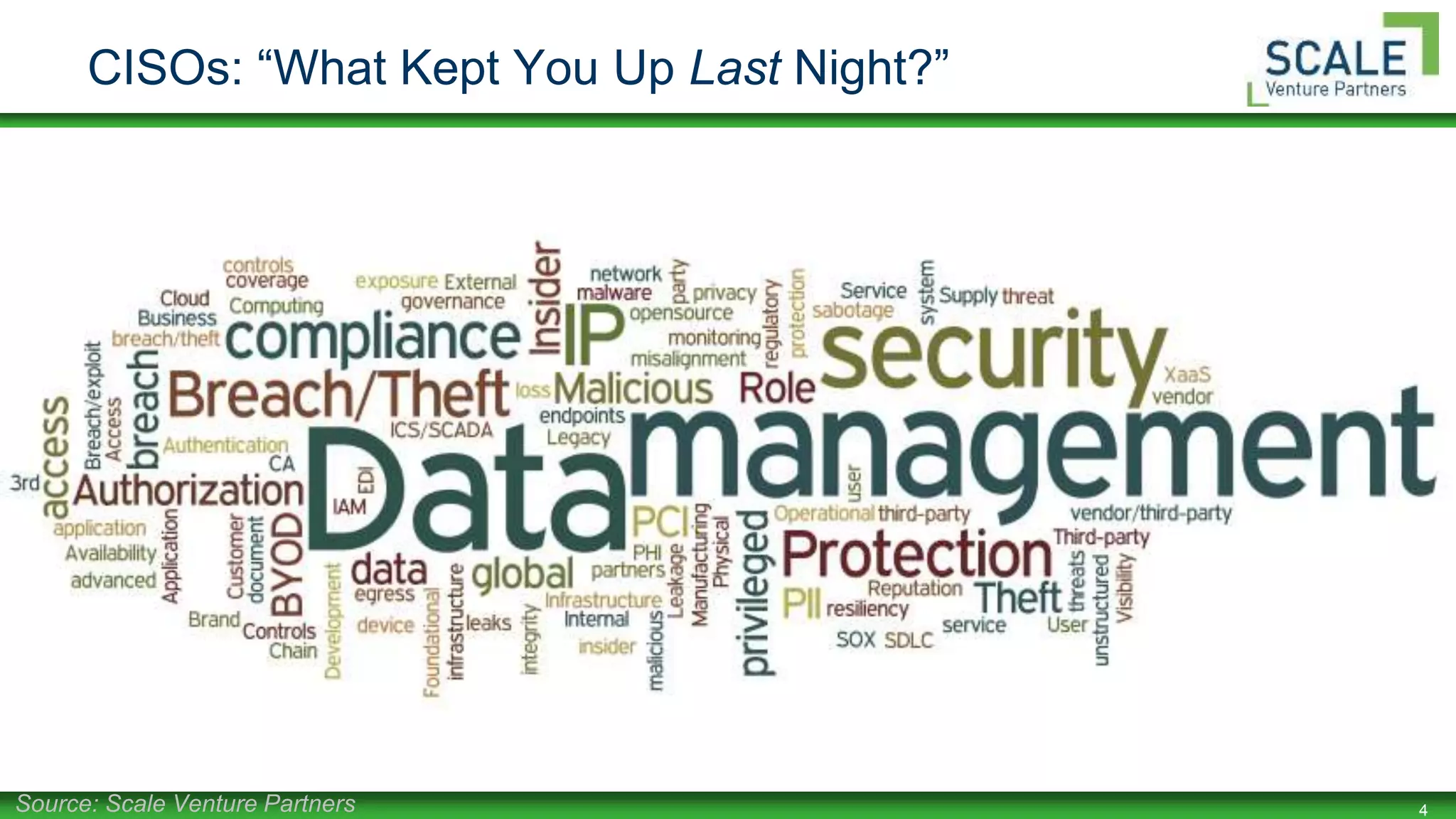
CISOs: “What Kept You Up Last Night?”
Source: Scale Venture Partners
5
Agile/DevOps
BYOD
Shadow IT /
Consumerization
Increased
Regs/Compliance
Internet Of Things
IT Automation
Mobile computing
SaaS
Ubiquitous Internet
Access
Virtualization / IaaS
Weaponization of Internet
/ espionage
Work/Life Integration
Concern
Unconcern
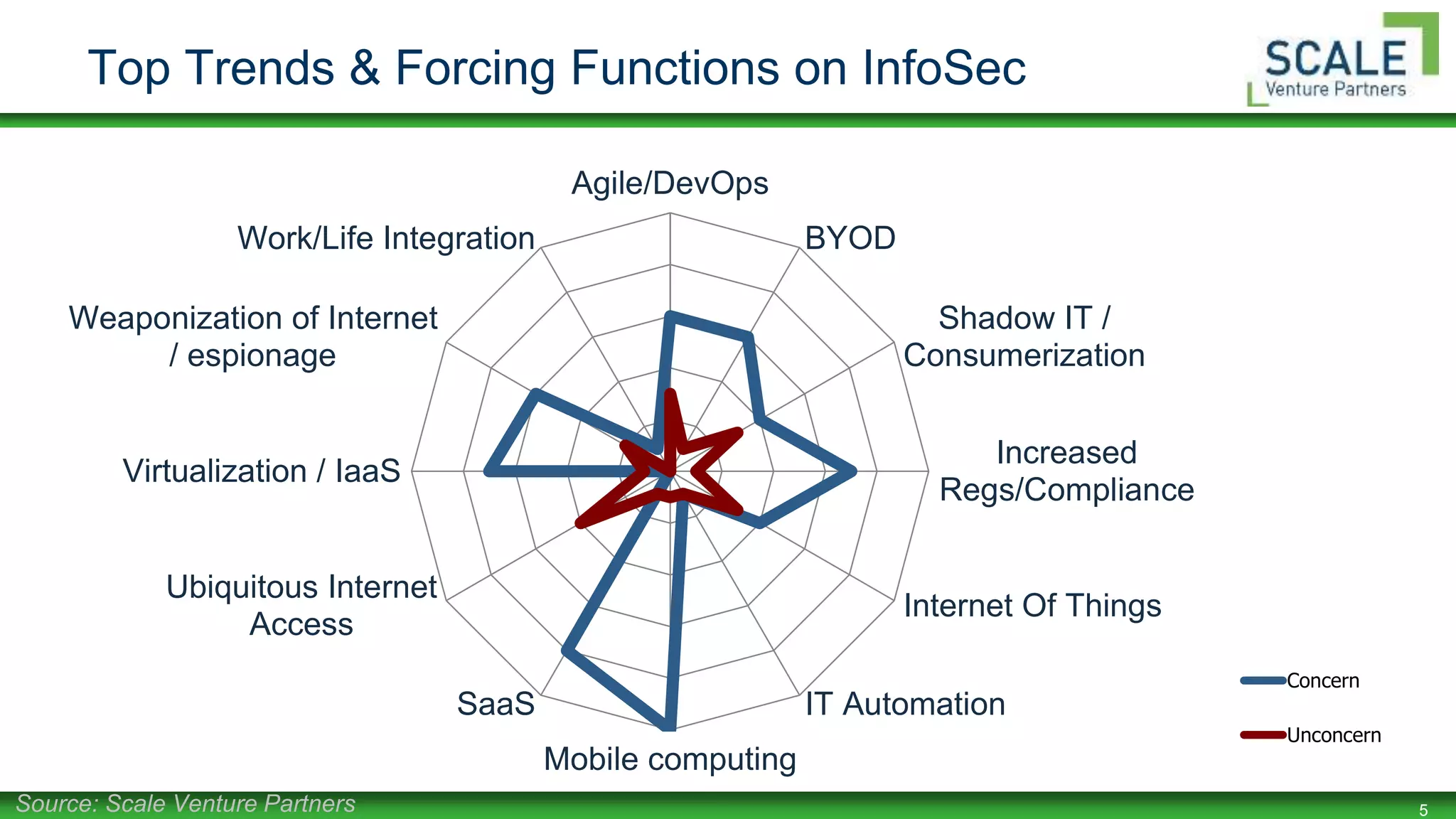
Top Trends & Forcing Functions on InfoSec
Source: Scale Venture Partners
6
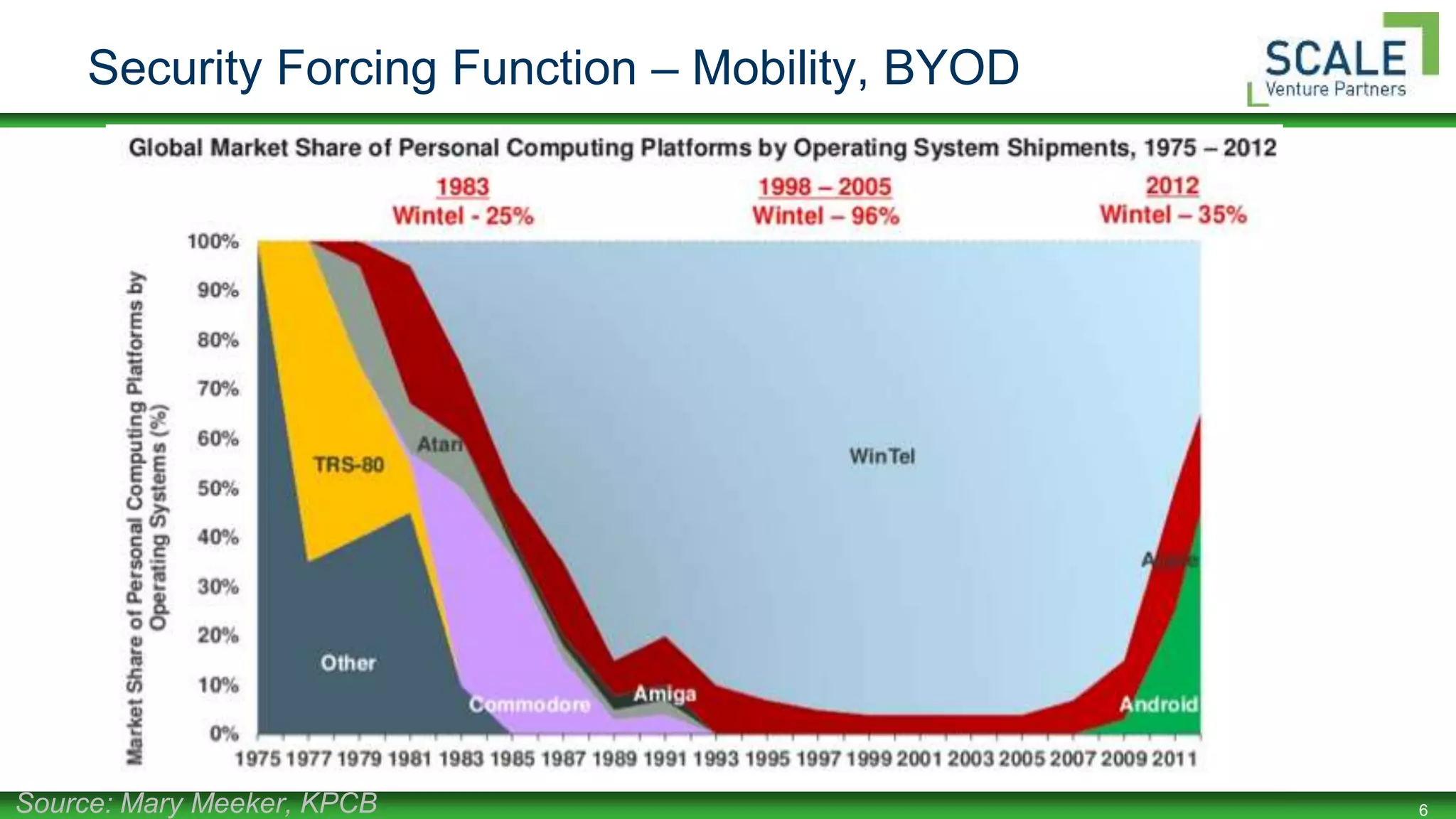
Security Forcing Function – Mobility, BYOD
Source: Mary Meeker, KPCB
7
Security Forcing Function – Mobility, BYOD
(1) Pew Research, Jan 2014 | (2) Gartner, May 2013
Smartphone - 58%
Tablet - 42%
By 2017, 50% of employers will
require you to BYOD[2] for
work.
8
Security Forcing Function – Work Anywhere
 Blurring work/life integration
– Aruba’s “#GenMobile”initiative
– Starbucks wants to be your life’s “3rd Place”
 Ubiquitous network access & seamless roaming
– 802.11ac, n – wireless networking “just works”
• Faster than typical wired ports, easier to provision
– Mobile 4G LTE is also “fast enough”
• Faster than my home’s DSL
– By 2018: 25% of corporate data will flow directly mobile-cloud[3]
(3) Gartner, Nov 2013
9
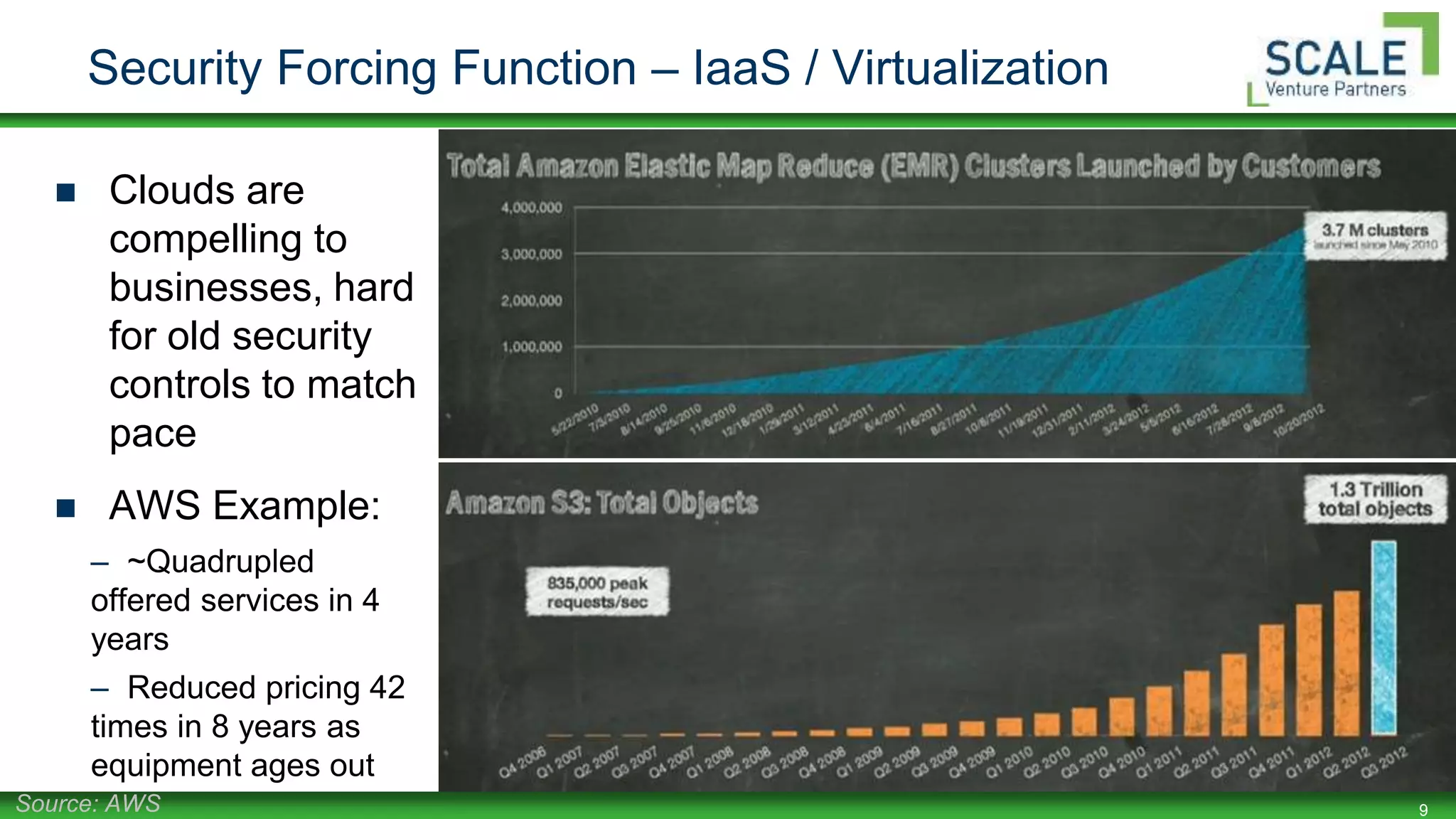
Security Forcing Function – IaaS / Virtualization
 Clouds are
compelling to
businesses, hard
for old security
controls to match
pace
 AWS Example:
– ~Quadrupled
offered services in 4
years
– Reduced pricing 42
times in 8 years as
equipment ages out
Source: AWS
10
Old: Perimeter Firewalls
11
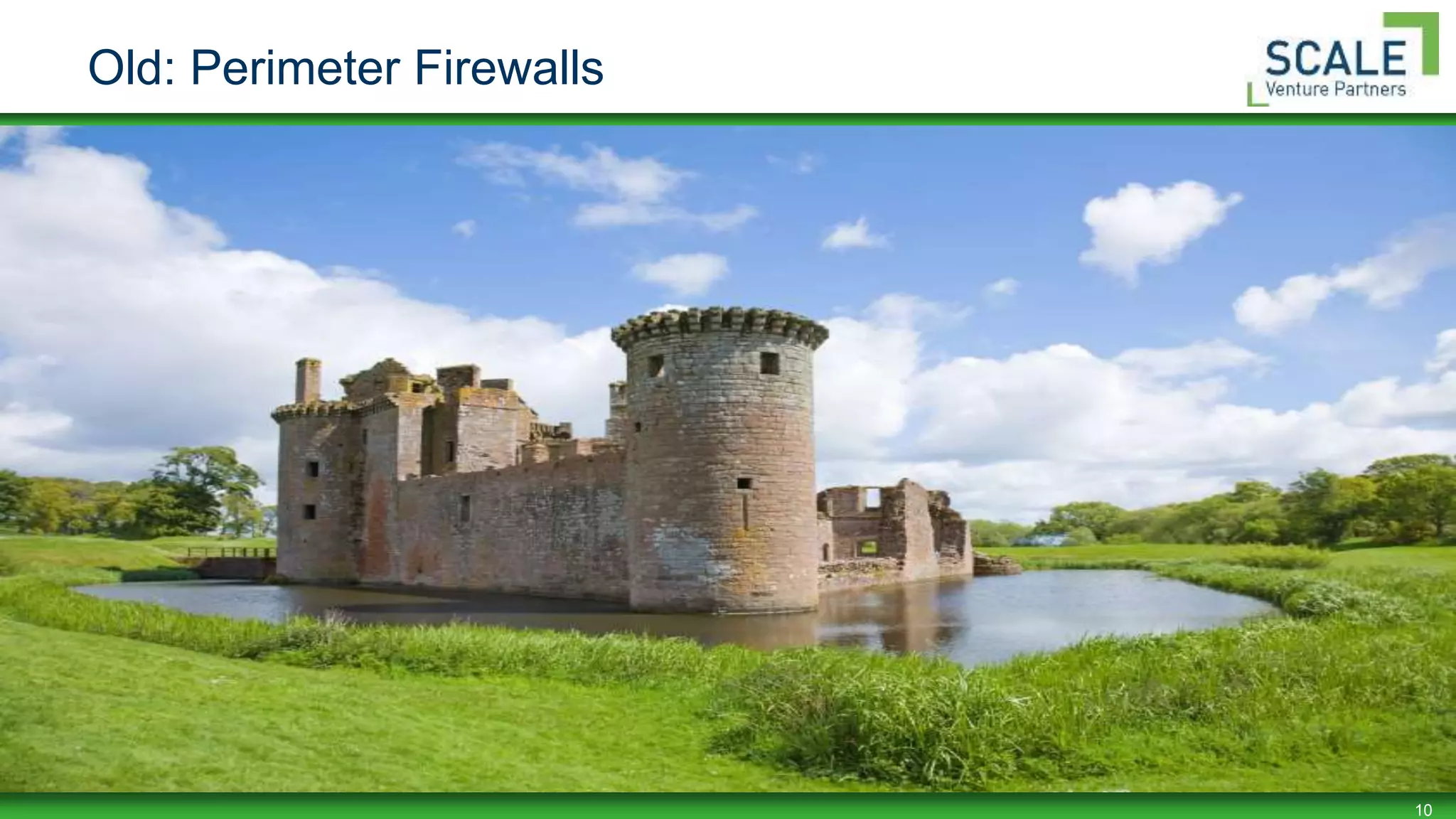
Old: Perimeter Firewalls
 Castle and Moat (layered) defense
 Place people, data behind datacenter firewalls
 Provisioning workflows were serialized, expensive, slow
 “Behind the firewall” = Trusted
12
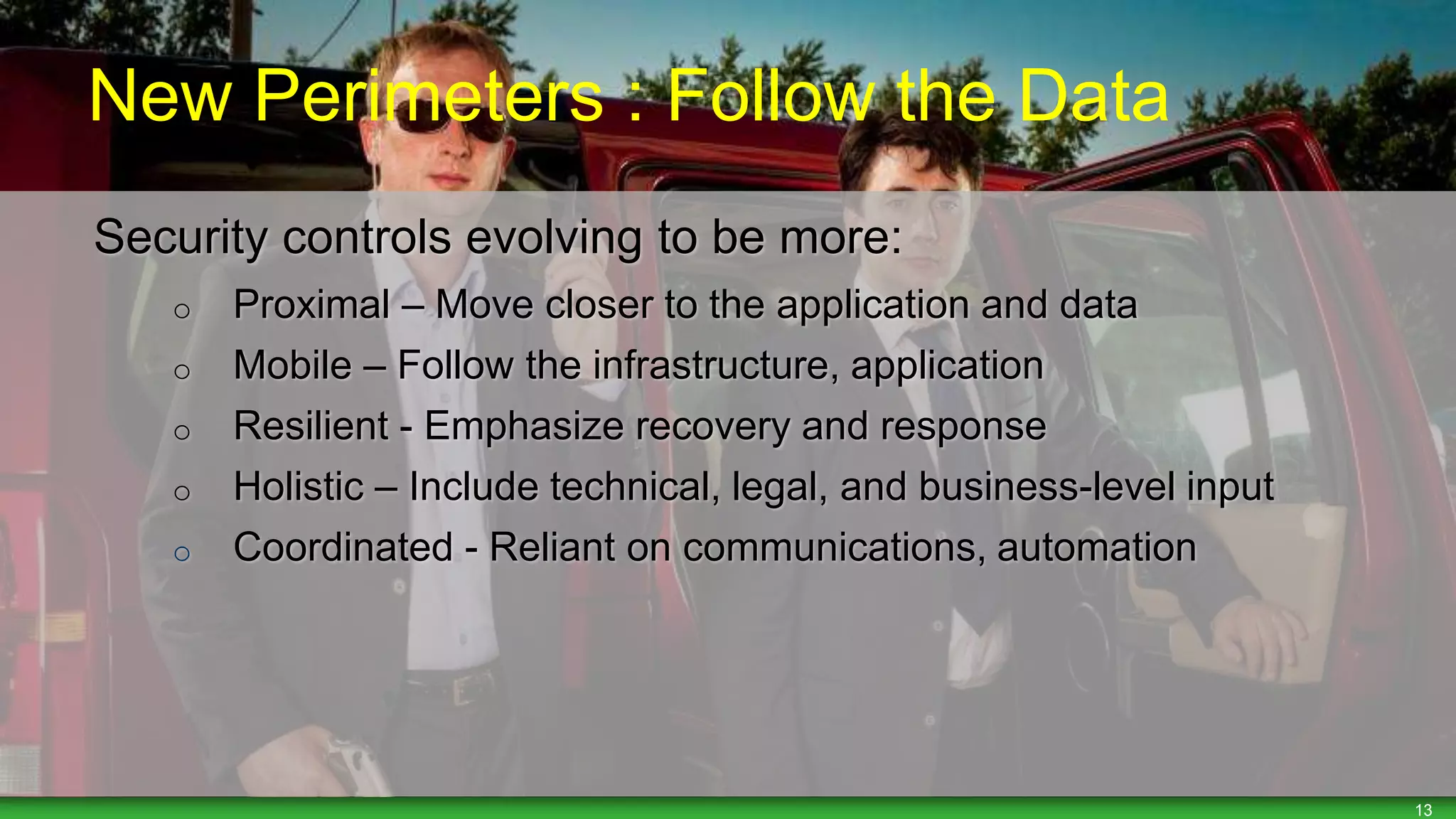
New Perimeters : Follow the Data
13
Security controls evolving to be more:
o Proximal – Move closer to the application and data
o Mobile – Follow the infrastructure, application
o Resilient - Emphasize recovery and response
o Holistic – Include technical, legal, and business-level input
o Coordinated - Reliant on communications, automation
New Perimeters : Follow the Data
14
InfoSec’s Role
 Be a trusted advisor to the business
– InfoSec doesn’t own the risk
– Anticipates security risk/controls changes and needs
– Communicates technical risks in business terms
 Implement guardrails and gates based on risk, sensitivity
– Like breaks on a car: Enables the business to take smart risks
– Architect, design, implement controls
– Measure & report risk with data
– Manage remediation, response
 Success: Customers proactively request your guidance!
15
So…What’s Your Cloud Comfort Level?
 Cloud Adoption / Maturity:
– Naysayers: you can’t do that (but can’t articulate why)
– Pathfinders: here’s how to do it, early lessons learned
– Optimizers: here’s how to do it well, what not to do
16
So…What’s Your Cloud Comfort Level?
 Cloud Adoption/Maturity
– Naysayers
– Pathfinders
– Optimizers
 Cloud is inevitable – Get comfortable managing it
– Example: “We have 10 years of legacy work to deal with, we don’t have
time to look at our cloud usage!”
– Benefits to agility, automation, consistency
 It’s about the business
– Board-level discussion on results, competition, risk
– “Risk is our business” – Philosopher James T. Kirk
17
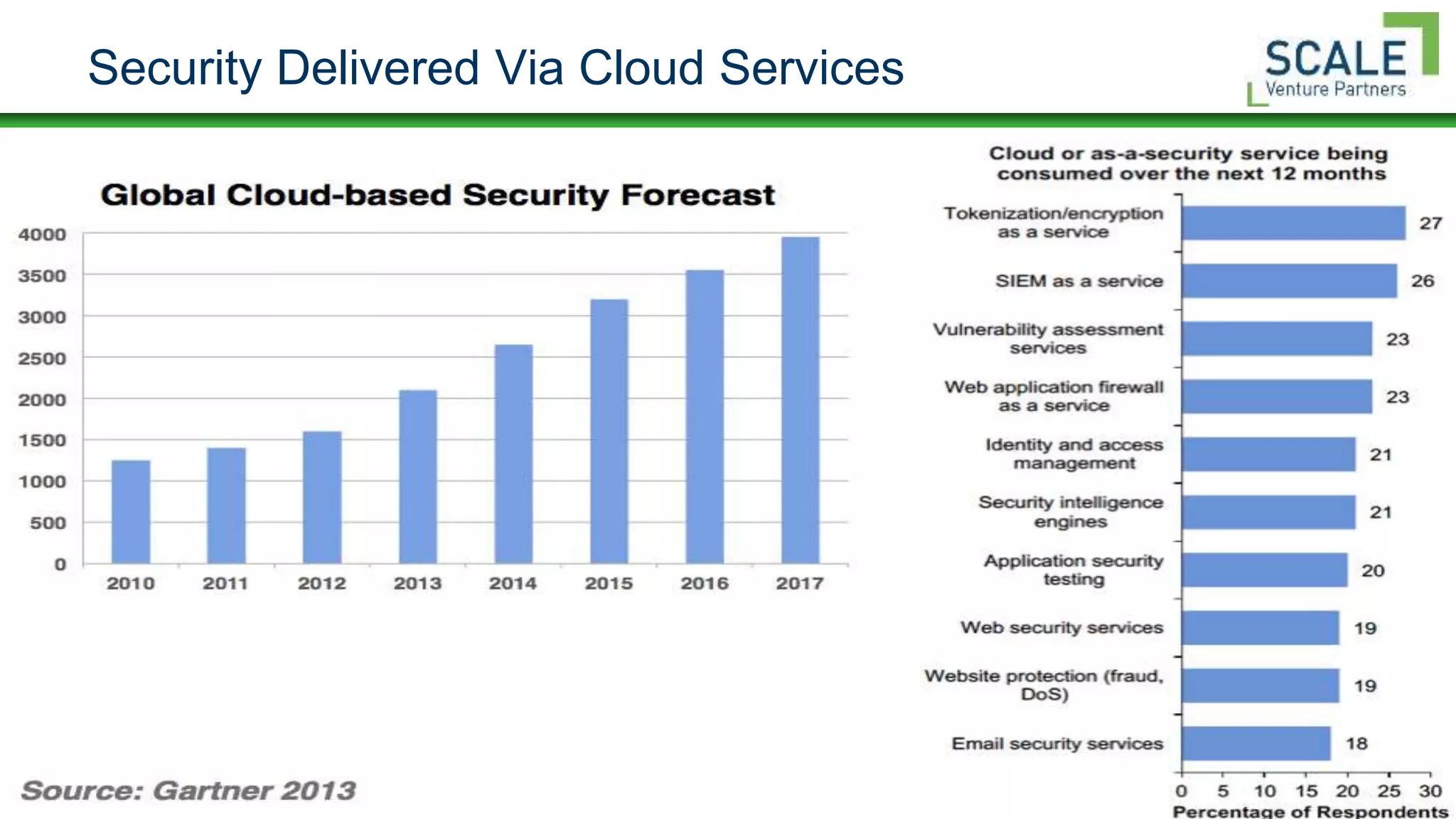
Security Delivered Via Cloud Services
18
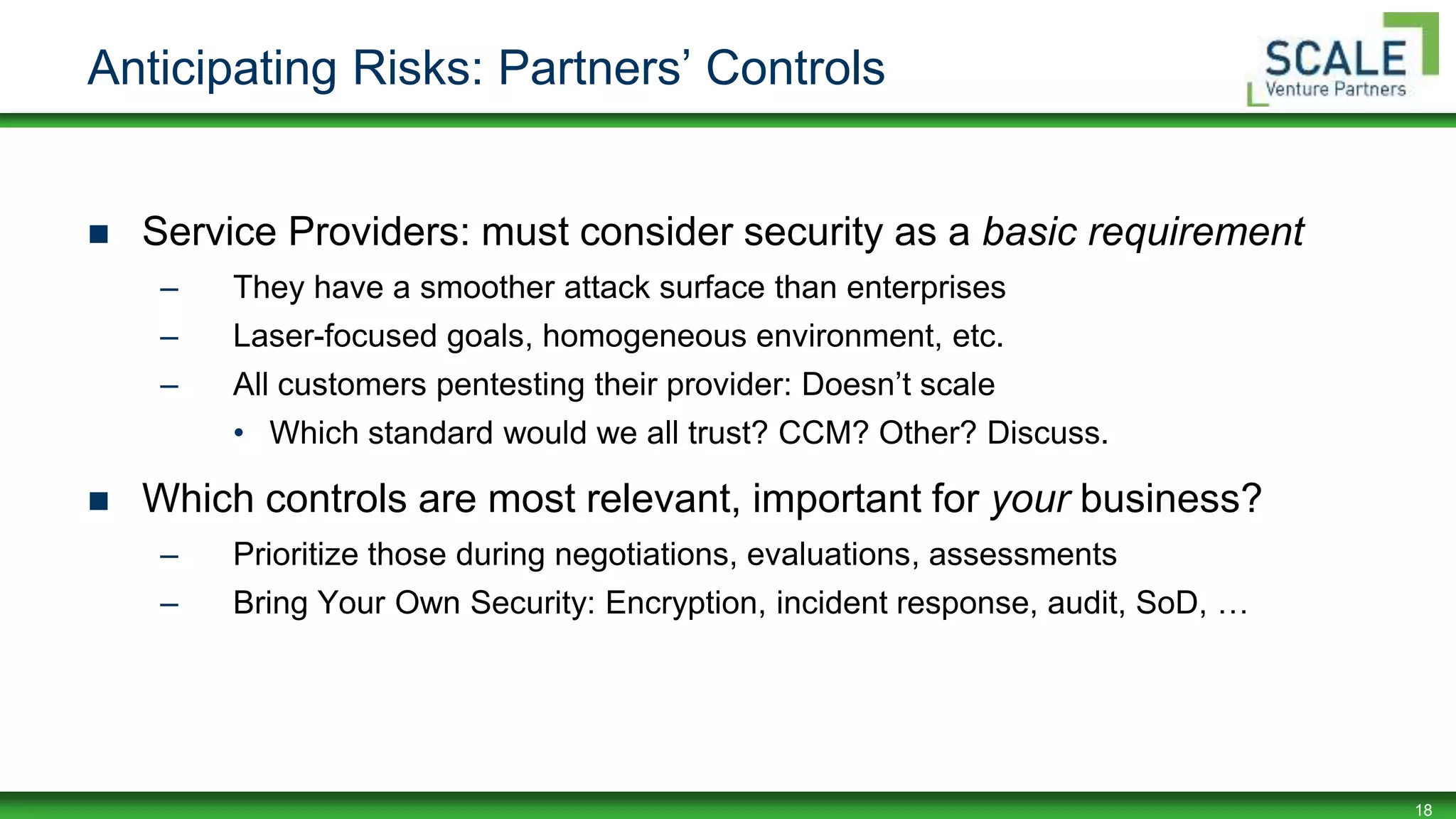
Anticipating Risks: Partners’ Controls
 Service Providers: must consider security as a basic requirement
– They have a smoother attack surface than enterprises
– Laser-focused goals, homogeneous environment, etc.
– All customers pentesting their provider: Doesn’t scale
• Which standard would we all trust? CCM? Other? Discuss.
 Which controls are most relevant, important for your business?
– Prioritize those during negotiations, evaluations, assessments
– Bring Your Own Security: Encryption, incident response, audit, SoD, …
19
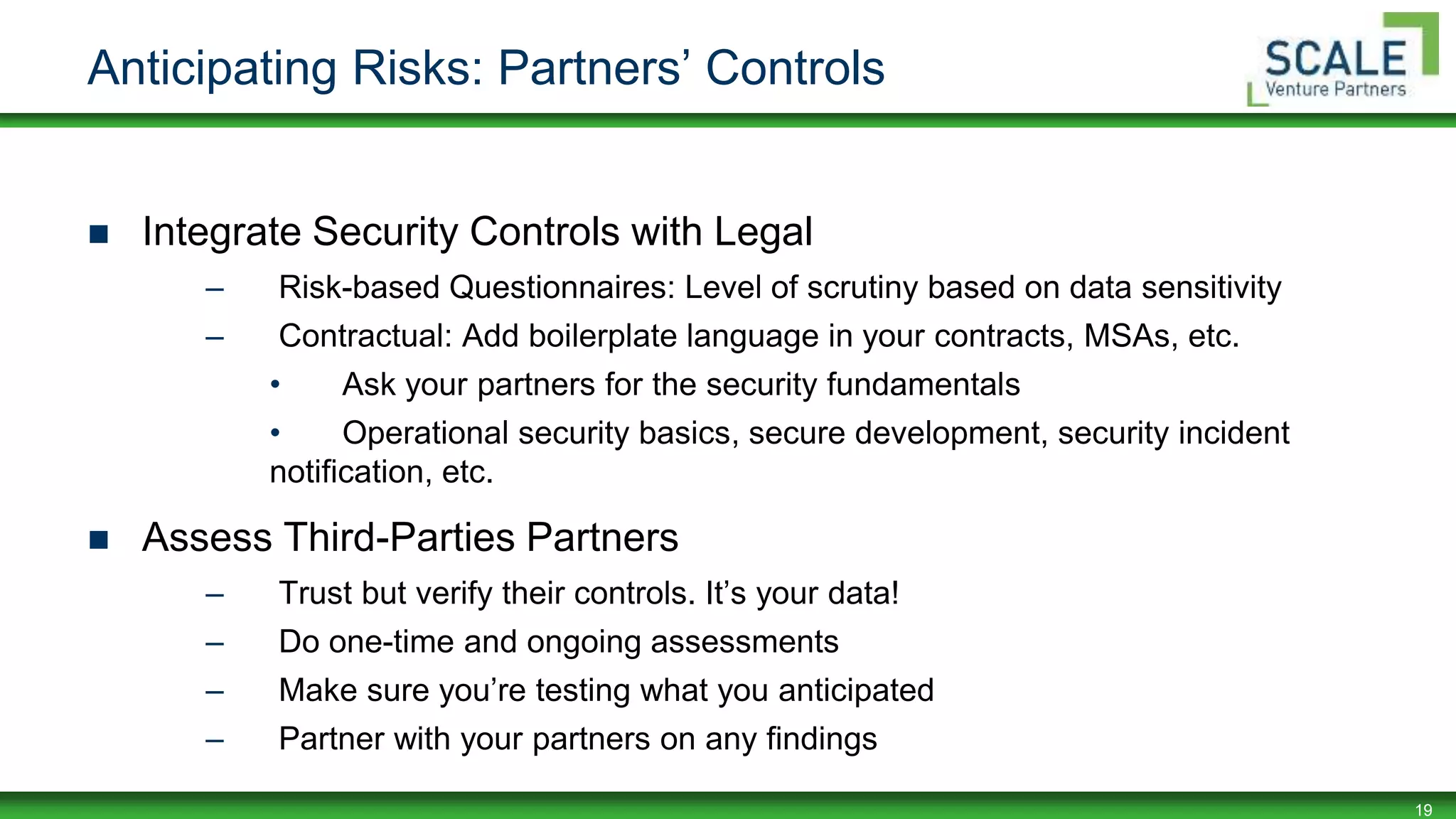
Anticipating Risks: Partners’ Controls
 Integrate Security Controls with Legal
– Risk-based Questionnaires: Level of scrutiny based on data sensitivity
– Contractual: Add boilerplate language in your contracts, MSAs, etc.
• Ask your partners for the security fundamentals
• Operational security basics, secure development, security incident
notification, etc.
 Assess Third-Parties Partners
– Trust but verify their controls. It’s your data!
– Do one-time and ongoing assessments
– Make sure you’re testing what you anticipated
– Partner with your partners on any findings
20
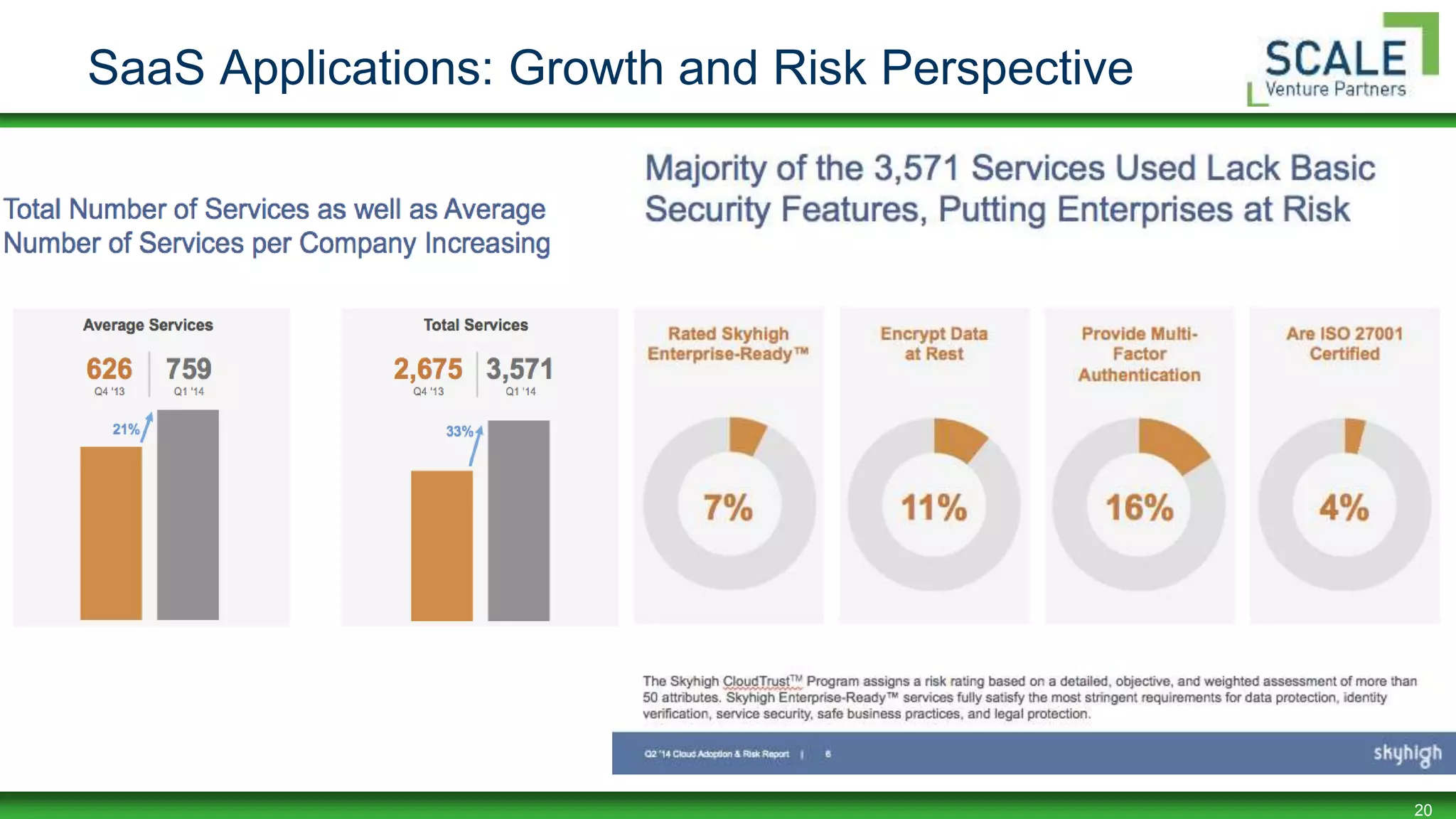
SaaS Applications: Growth and Risk Perspective
21
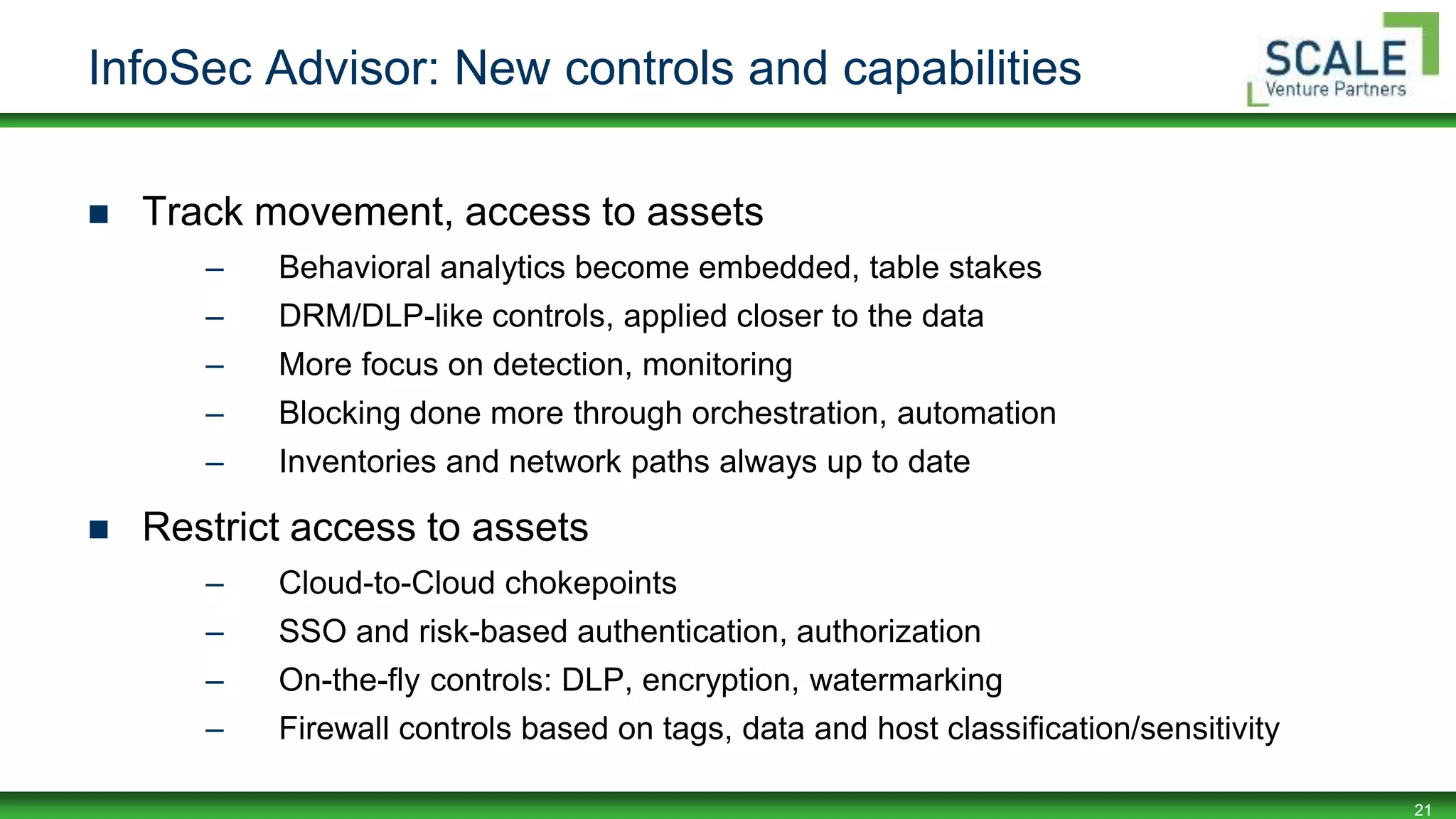
InfoSec Advisor: New controls and capabilities
 Track movement, access to assets
– Behavioral analytics become embedded, table stakes
– DRM/DLP-like controls, applied closer to the data
– More focus on detection, monitoring
– Blocking done more through orchestration, automation
– Inventories and network paths always up to date
 Restrict access to assets
– Cloud-to-Cloud chokepoints
– SSO and risk-based authentication, authorization
– On-the-fly controls: DLP, encryption, watermarking
– Firewall controls based on tags, data and host classification/sensitivity
22
Adopting Cloud: Getting Started in IaaS
 Plan: Pick 1-3 security metrics to improve & compare
– Examples: Days to patch vulns, avg host uptime, fw ACLs used
 Do: Start simple, fail fast on “uninteresting” workflows
 Improve: Codify policies, patches, asset management, provisioning.
 Iterate: Review lessons learned often, make small course
corrections
– Good security starts with solid operational hygiene
23
Summary: Evolving Controls, Maturity
 Get Baseline visibility into your Cloud Services
– Facts critical to business-level conversations
– You’re using more SaaS than you realize
– Share data with IT, legal, other stakeholders
 Monitor and Protect your Data
– Start collecting/mining SaaS access, audit logs
– Integrate with your SIEM, monitoring systems
– Deploy additional controls via chokepoints, automation
 Increase program maturity
– Cloud is an opportunity to codify, automate security
– Operational hygiene is the basis for solid security program
24
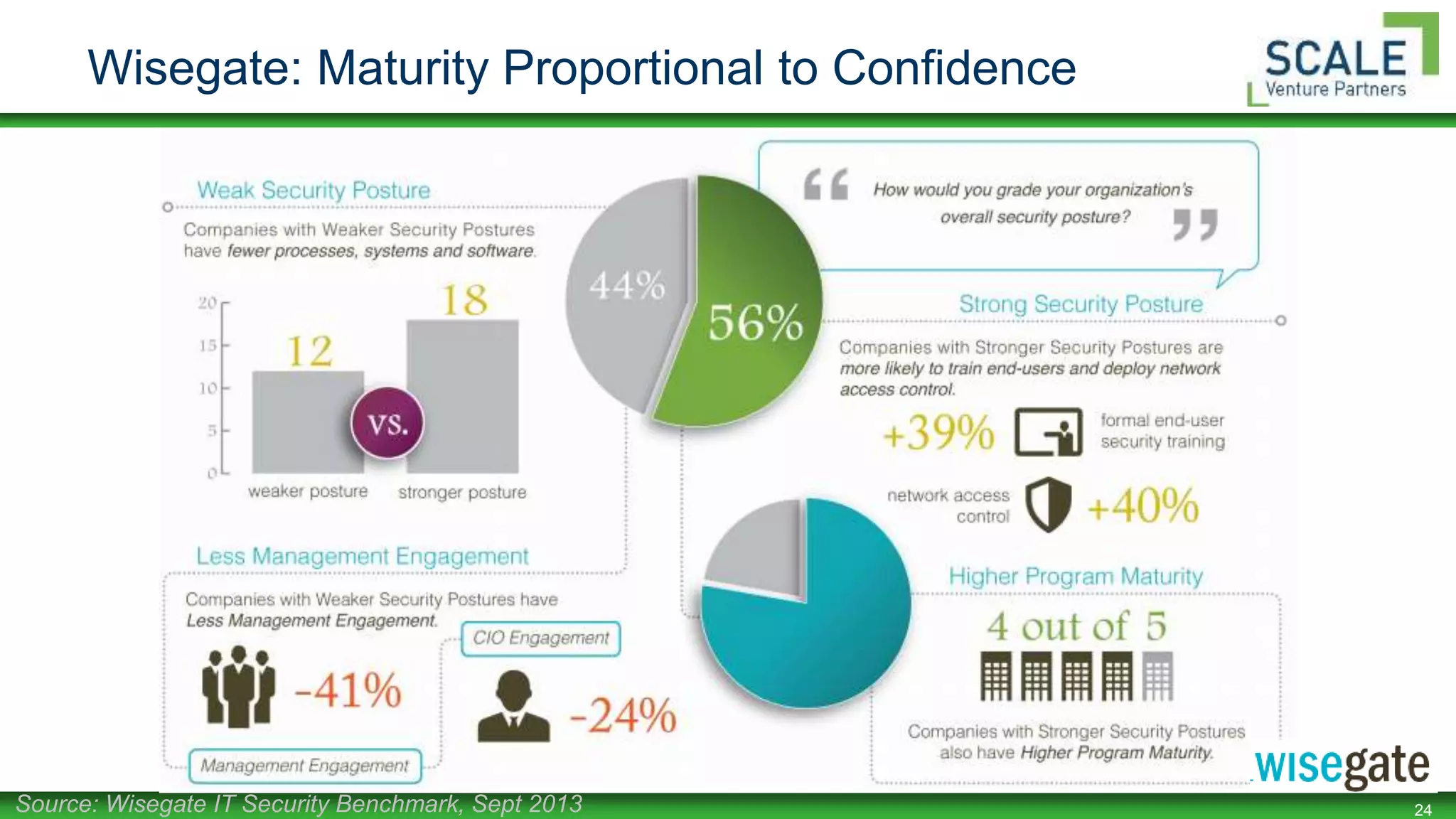
Wisegate: Maturity Proportional to Confidence
Source: Wisegate IT Security Benchmark, Sept 2013
25
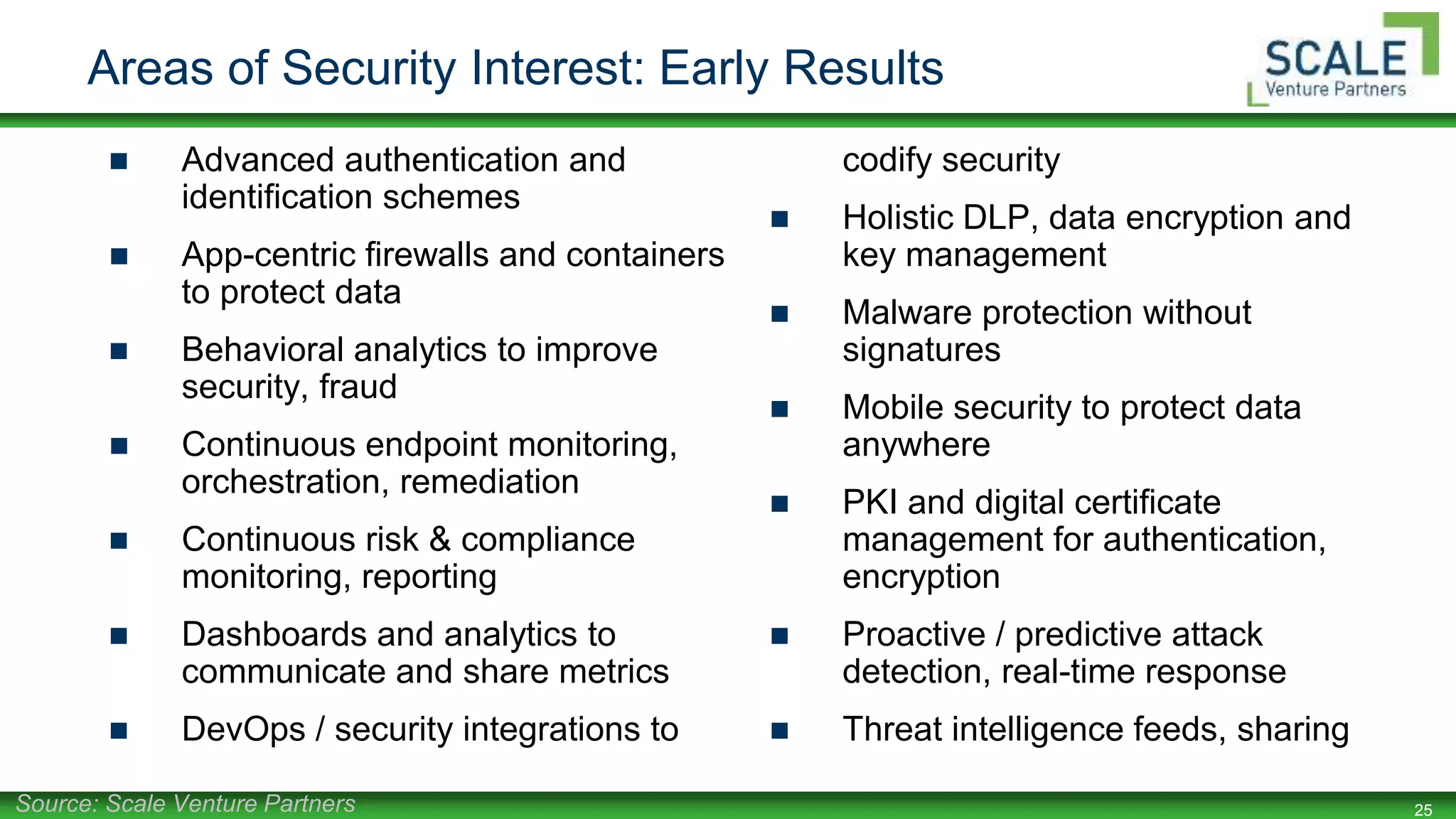
Areas of Security Interest: Early Results
 Advanced authentication and
identification schemes
 App-centric firewalls and containers
to protect data
 Behavioral analytics to improve
security, fraud
 Continuous endpoint monitoring,
orchestration, remediation
 Continuous risk & compliance
monitoring, reporting
 Dashboards and analytics to
communicate and share metrics
 DevOps / security integrations to
codify security
 Holistic DLP, data encryption and
key management
 Malware protection without
signatures
 Mobile security to protect data
anywhere
 PKI and digital certificate
management for authentication,
encryption
 Proactive / predictive attack
detection, real-time response
 Threat intelligence feeds, sharing
Source: Scale Venture Partners
26
Guidance to Security Vendors: Early Feedback
 Be 10x better - provide superior customer value
– Look for disruptive technologies, approaches
– Interoperate with what I already have
– What can I turn off if I buy your thing?
 Think API, integration first
– Defenders & DevOps: The future is automation, interoperability
– InfoSec staffing is hard, automation is a force multiplier
– No cheating: Build your GUI on your API
 Model, measure, provide insights
– Security A/B testing, modeling allows safe experimentation
– Provide insights of current, continuous risk state
– Want to manage cloud risk better than legacy
– Good deployment strategies start with great migration strategies
Source: Scale Venture Partners
27
Increasing Confidence: Early Research Results
 Security programs with higher maturity have more confidence
– Regulations help, but also
– Operational consistency,
– Incorporating standardized frameworks (ISO, NIST)
 Build what works for your company’s culture
– Culture trumps strategy
– There is no one, true “map”: Every program is different
– ? Endpoint-centric vs. network-centric // Block vs. monitor + respond
 Create, market, share metrics with your peers
– Empowers teams that own responsibility for controls
– Encourages fact-based decision-making
– Communicates your program’s Business Impact
Source: Scale Venture Partners
28
Thank you!
Security-Research@ScaleVP.com
Bill Burns | Executive-In-Residence | Scale Venture Partners | Bill@ScaleVP.com | @x509v3

What affects security program confidence? - may2014 - bill burns

  • 1.
    1 What Affects ConfidenceIn Security Programs? Rocky Mountain Information Security Conference 2014 Bill Burns | Executive-In-Residence | Scale Venture Partners | Bill@ScaleVP.com | @x509v3
  • 2.
    2 My Background  Productionhybrid cloud security at scale – Deployed distributed, hybrid cloud WAF – Co-developed CloudHSM for IaaS hardware root of trust  Corporate IT “all-cloud” security strategy – Cloud-first, mobile-first infrastructure model – Mix of public cloud, best-of-breed SaaS  RSAC Program Committee, Startup Technical Advisory Boards, ISSA CISO Forum & Career Lifecycle  Previously:
  • 3.
    3 Agenda  Trends andForcing Functions on Information Security  InfoSec’s Role in Managing Business Risk  Security Innovations, Market Needs  Early Research Results: Improving Confidence
  • 4.
    4 CISOs: “What KeptYou Up Last Night?” Source: Scale Venture Partners
  • 5.
    5 Agile/DevOps BYOD Shadow IT / Consumerization Increased Regs/Compliance InternetOf Things IT Automation Mobile computing SaaS Ubiquitous Internet Access Virtualization / IaaS Weaponization of Internet / espionage Work/Life Integration Concern Unconcern Top Trends & Forcing Functions on InfoSec Source: Scale Venture Partners
  • 6.
    6 Security Forcing Function– Mobility, BYOD Source: Mary Meeker, KPCB
  • 7.
    7 Security Forcing Function– Mobility, BYOD (1) Pew Research, Jan 2014 | (2) Gartner, May 2013 Smartphone - 58% Tablet - 42% By 2017, 50% of employers will require you to BYOD[2] for work.
  • 8.
    8 Security Forcing Function– Work Anywhere  Blurring work/life integration – Aruba’s “#GenMobile”initiative – Starbucks wants to be your life’s “3rd Place”  Ubiquitous network access & seamless roaming – 802.11ac, n – wireless networking “just works” • Faster than typical wired ports, easier to provision – Mobile 4G LTE is also “fast enough” • Faster than my home’s DSL – By 2018: 25% of corporate data will flow directly mobile-cloud[3] (3) Gartner, Nov 2013
  • 9.
    9 Security Forcing Function– IaaS / Virtualization  Clouds are compelling to businesses, hard for old security controls to match pace  AWS Example: – ~Quadrupled offered services in 4 years – Reduced pricing 42 times in 8 years as equipment ages out Source: AWS
  • 10.
  • 11.
    11 Old: Perimeter Firewalls Castle and Moat (layered) defense  Place people, data behind datacenter firewalls  Provisioning workflows were serialized, expensive, slow  “Behind the firewall” = Trusted
  • 12.
    12 New Perimeters :Follow the Data
  • 13.
    13 Security controls evolvingto be more: o Proximal – Move closer to the application and data o Mobile – Follow the infrastructure, application o Resilient - Emphasize recovery and response o Holistic – Include technical, legal, and business-level input o Coordinated - Reliant on communications, automation New Perimeters : Follow the Data
  • 14.
    14 InfoSec’s Role  Bea trusted advisor to the business – InfoSec doesn’t own the risk – Anticipates security risk/controls changes and needs – Communicates technical risks in business terms  Implement guardrails and gates based on risk, sensitivity – Like breaks on a car: Enables the business to take smart risks – Architect, design, implement controls – Measure & report risk with data – Manage remediation, response  Success: Customers proactively request your guidance!
  • 15.
    15 So…What’s Your CloudComfort Level?  Cloud Adoption / Maturity: – Naysayers: you can’t do that (but can’t articulate why) – Pathfinders: here’s how to do it, early lessons learned – Optimizers: here’s how to do it well, what not to do
  • 16.
    16 So…What’s Your CloudComfort Level?  Cloud Adoption/Maturity – Naysayers – Pathfinders – Optimizers  Cloud is inevitable – Get comfortable managing it – Example: “We have 10 years of legacy work to deal with, we don’t have time to look at our cloud usage!” – Benefits to agility, automation, consistency  It’s about the business – Board-level discussion on results, competition, risk – “Risk is our business” – Philosopher James T. Kirk
  • 17.
  • 18.
    18 Anticipating Risks: Partners’Controls  Service Providers: must consider security as a basic requirement – They have a smoother attack surface than enterprises – Laser-focused goals, homogeneous environment, etc. – All customers pentesting their provider: Doesn’t scale • Which standard would we all trust? CCM? Other? Discuss.  Which controls are most relevant, important for your business? – Prioritize those during negotiations, evaluations, assessments – Bring Your Own Security: Encryption, incident response, audit, SoD, …
  • 19.
    19 Anticipating Risks: Partners’Controls  Integrate Security Controls with Legal – Risk-based Questionnaires: Level of scrutiny based on data sensitivity – Contractual: Add boilerplate language in your contracts, MSAs, etc. • Ask your partners for the security fundamentals • Operational security basics, secure development, security incident notification, etc.  Assess Third-Parties Partners – Trust but verify their controls. It’s your data! – Do one-time and ongoing assessments – Make sure you’re testing what you anticipated – Partner with your partners on any findings
  • 20.
    20 SaaS Applications: Growthand Risk Perspective
  • 21.
    21 InfoSec Advisor: Newcontrols and capabilities  Track movement, access to assets – Behavioral analytics become embedded, table stakes – DRM/DLP-like controls, applied closer to the data – More focus on detection, monitoring – Blocking done more through orchestration, automation – Inventories and network paths always up to date  Restrict access to assets – Cloud-to-Cloud chokepoints – SSO and risk-based authentication, authorization – On-the-fly controls: DLP, encryption, watermarking – Firewall controls based on tags, data and host classification/sensitivity
  • 22.
    22 Adopting Cloud: GettingStarted in IaaS  Plan: Pick 1-3 security metrics to improve & compare – Examples: Days to patch vulns, avg host uptime, fw ACLs used  Do: Start simple, fail fast on “uninteresting” workflows  Improve: Codify policies, patches, asset management, provisioning.  Iterate: Review lessons learned often, make small course corrections – Good security starts with solid operational hygiene
  • 23.
    23 Summary: Evolving Controls,Maturity  Get Baseline visibility into your Cloud Services – Facts critical to business-level conversations – You’re using more SaaS than you realize – Share data with IT, legal, other stakeholders  Monitor and Protect your Data – Start collecting/mining SaaS access, audit logs – Integrate with your SIEM, monitoring systems – Deploy additional controls via chokepoints, automation  Increase program maturity – Cloud is an opportunity to codify, automate security – Operational hygiene is the basis for solid security program
  • 24.
    24 Wisegate: Maturity Proportionalto Confidence Source: Wisegate IT Security Benchmark, Sept 2013
  • 25.
    25 Areas of SecurityInterest: Early Results  Advanced authentication and identification schemes  App-centric firewalls and containers to protect data  Behavioral analytics to improve security, fraud  Continuous endpoint monitoring, orchestration, remediation  Continuous risk & compliance monitoring, reporting  Dashboards and analytics to communicate and share metrics  DevOps / security integrations to codify security  Holistic DLP, data encryption and key management  Malware protection without signatures  Mobile security to protect data anywhere  PKI and digital certificate management for authentication, encryption  Proactive / predictive attack detection, real-time response  Threat intelligence feeds, sharing Source: Scale Venture Partners
  • 26.
    26 Guidance to SecurityVendors: Early Feedback  Be 10x better - provide superior customer value – Look for disruptive technologies, approaches – Interoperate with what I already have – What can I turn off if I buy your thing?  Think API, integration first – Defenders & DevOps: The future is automation, interoperability – InfoSec staffing is hard, automation is a force multiplier – No cheating: Build your GUI on your API  Model, measure, provide insights – Security A/B testing, modeling allows safe experimentation – Provide insights of current, continuous risk state – Want to manage cloud risk better than legacy – Good deployment strategies start with great migration strategies Source: Scale Venture Partners
  • 27.
    27 Increasing Confidence: EarlyResearch Results  Security programs with higher maturity have more confidence – Regulations help, but also – Operational consistency, – Incorporating standardized frameworks (ISO, NIST)  Build what works for your company’s culture – Culture trumps strategy – There is no one, true “map”: Every program is different – ? Endpoint-centric vs. network-centric // Block vs. monitor + respond  Create, market, share metrics with your peers – Empowers teams that own responsibility for controls – Encourages fact-based decision-making – Communicates your program’s Business Impact Source: Scale Venture Partners
  • 28.
    28 Thank you! Security-Research@ScaleVP.com Bill Burns| Executive-In-Residence | Scale Venture Partners | Bill@ScaleVP.com | @x509v3

Editor's Notes

  • #6 Internet Access – not a concern, a foregone conclusion IoT – too unclear what it means Agile/DevOps – polarizing Consumerization - polarizing
  • #7 By 2017: 50% of employers will require employees to BYOD for work purposes(2)
  • #8 58% / 42% of Americans now own a smartphone / tablet(1)
  • #13 New: Identity and Authentication Authenticated checkpoints/chokepoints Everything and everyone is “outside the firewall” Controls moving closer to the data, finer-grained Provisioning and security policies are automated Trust no one implicitly; authorize everything
  • #14 New: Identity and Authentication Authenticated checkpoints/chokepoints Everything and everyone is “outside the firewall” Controls moving closer to the data, finer-grained Provisioning and security policies are automated Trust no one implicitly; authorize everything