Chapter 10
Hypothesis Testing
Copyright ©2018 McGraw-Hill Education. All rights reserved.
1
Chapter Outline
10.1 The Null and Alternative Hypotheses and Errors in
Hypothesis Testing
10.2 Tests about a Population Mean: Known
10.3 Tests about a Population Mean: Unknown
10.4 Tests about a Population Proportion
10.5 Type II Error Probabilities and Sample Size Determination
(Optional)
10.6 The Chi-Square Distribution
10.7 Statistical Inference for a Population Variance (Optional)
10-2
2
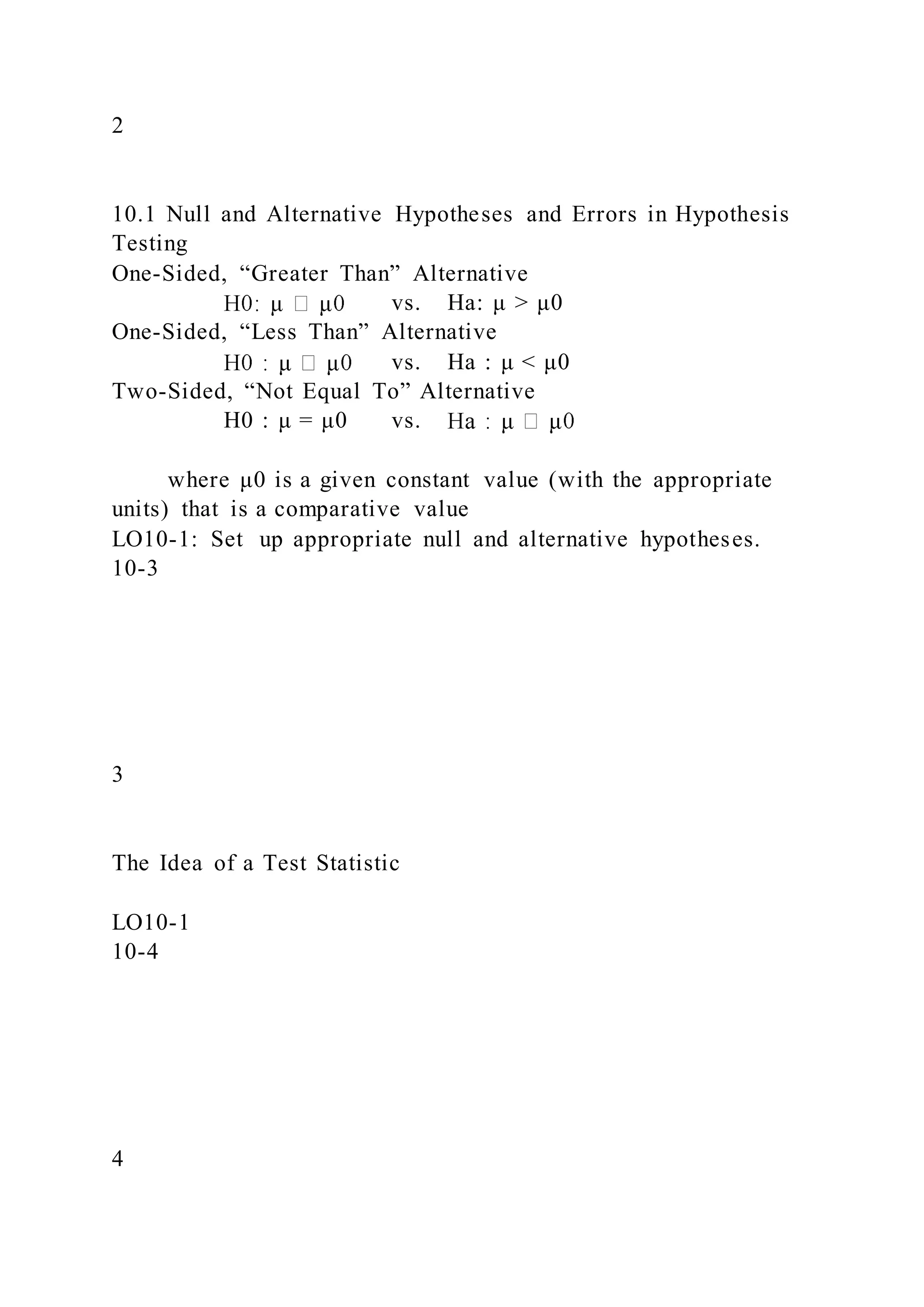
10.1 Null and Alternative Hypotheses and Errors in Hypothesis
Testing
One-Sided, “Greater Than” Alternative
vs. Ha: μ > μ0
One-Sided, “Less Than” Alternative
vs. Ha : μ < μ0
Two-Sided, “Not Equal To” Alternative
H0 : μ = μ0 vs.
where μ0 is a given constant value (with the appropriate
units) that is a comparative value
LO10-1: Set up appropriate null and alternative hypotheses.
10-3
3
The Idea of a Test Statistic
LO10-1
10-4
4
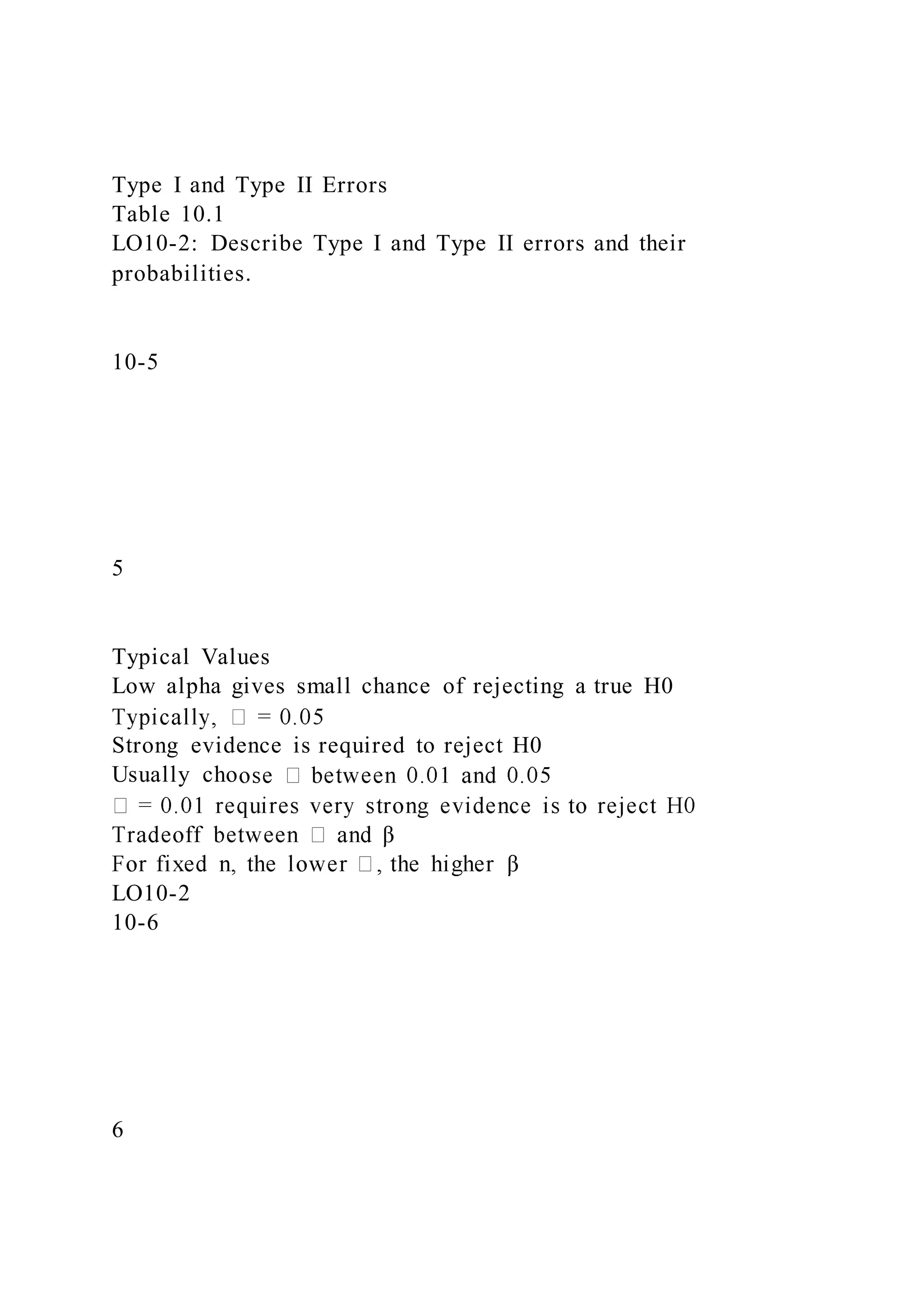
Type I and Type II Errors
Table 10.1
LO10-2: Describe Type I and Type II errors and their
probabilities.
10-5
5
Typical Values
Low alpha gives small chance of rejecting a true H0
Strong evidence is required to reject H0
Usually cho
LO10-2
10-6
6
10.2 Tests about a Population Mean: Known
Test hypotheses about a population mean using the normal
distribution
Called tests
Require that the true value of the population standard deviation
is known
In most real-world situations, is not known
When is unknown, test hypotheses about a population mean
using the distribution
Here, assume that we know
LO10-3: Use critical values and p-values to perform a test
about a population mean when is known.
10-7
7
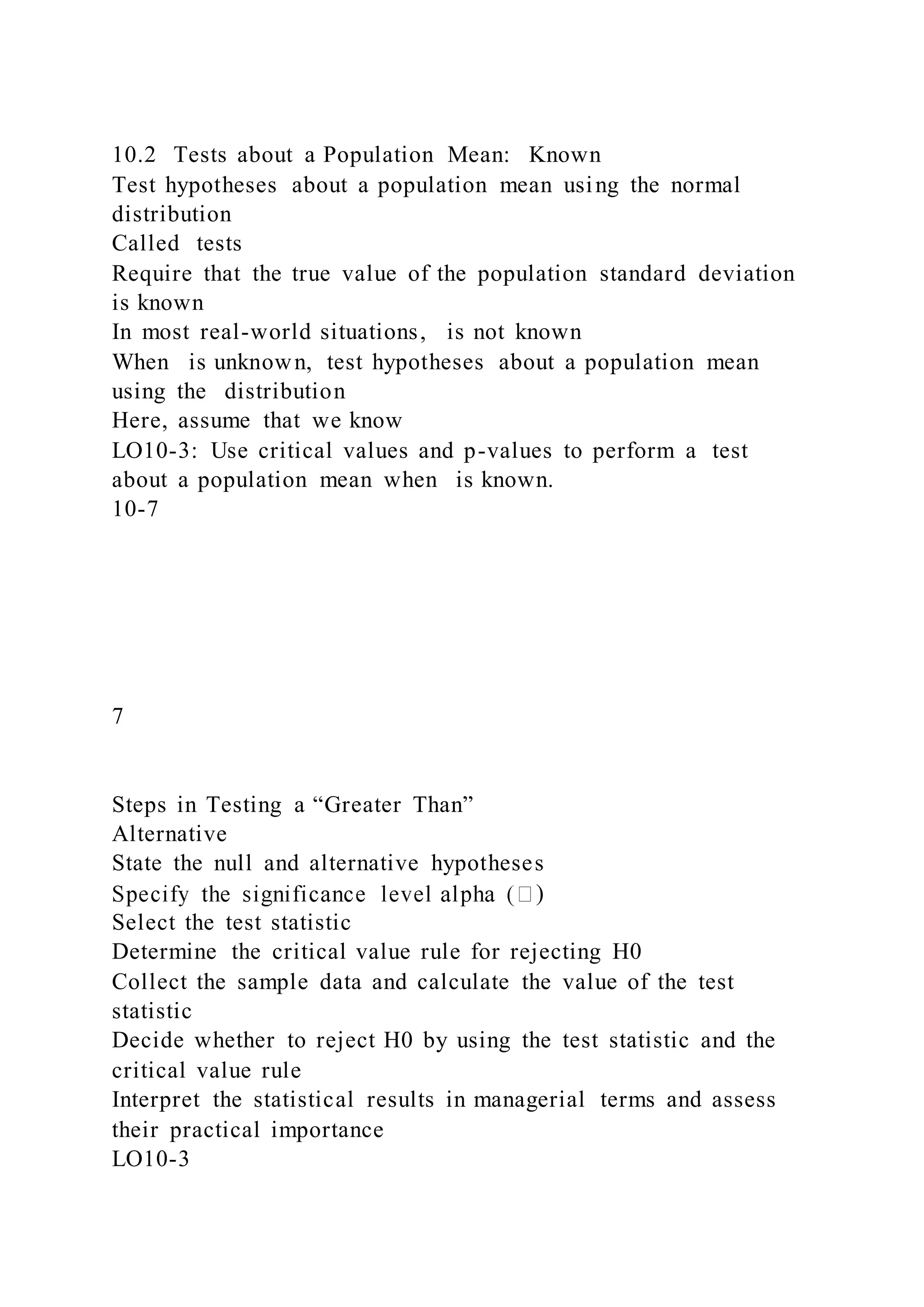
Steps in Testing a “Greater Than”
Alternative
State the null and alternative hypotheses
)
Select the test statistic
Determine the critical value rule for rejecting H0
Collect the sample data and calculate the value of the test
statistic
Decide whether to reject H0 by using the test statistic and the
critical value rule
Interpret the statistical results in managerial terms and assess
their practical importance
LO10-3
10-8
8
Steps in Testing a “Greater Than”
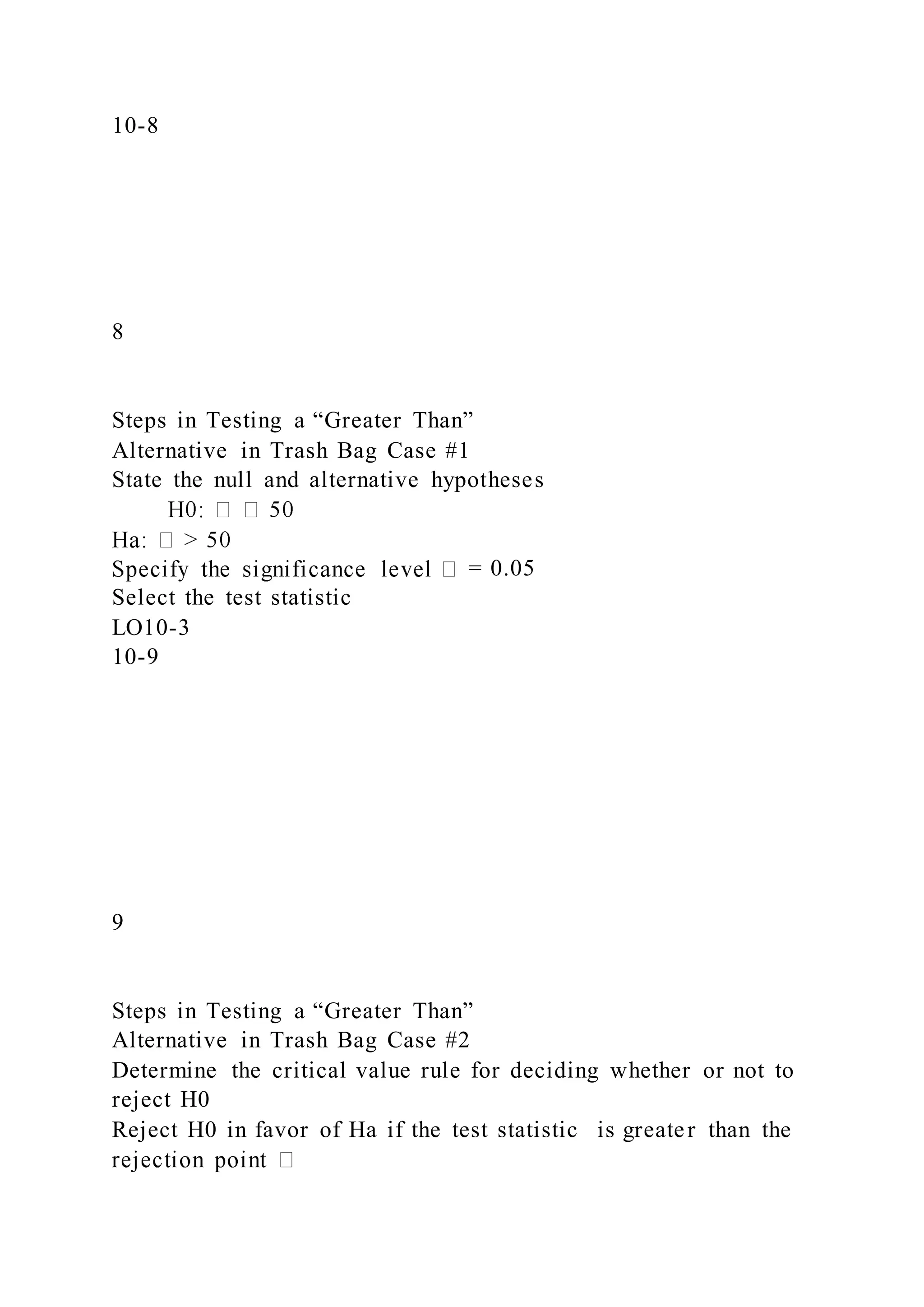
Alternative in Trash Bag Case #1
State the null and alternative hypotheses
= 0.05
Select the test statistic
LO10-3
10-9
9
Steps in Testing a “Greater Than”
Alternative in Trash Bag Case #2
Determine the critical value rule for deciding whether or not to
reject H0
Reject H0 in favor of Ha if the test statistic is greater than the
This is the critical value rule
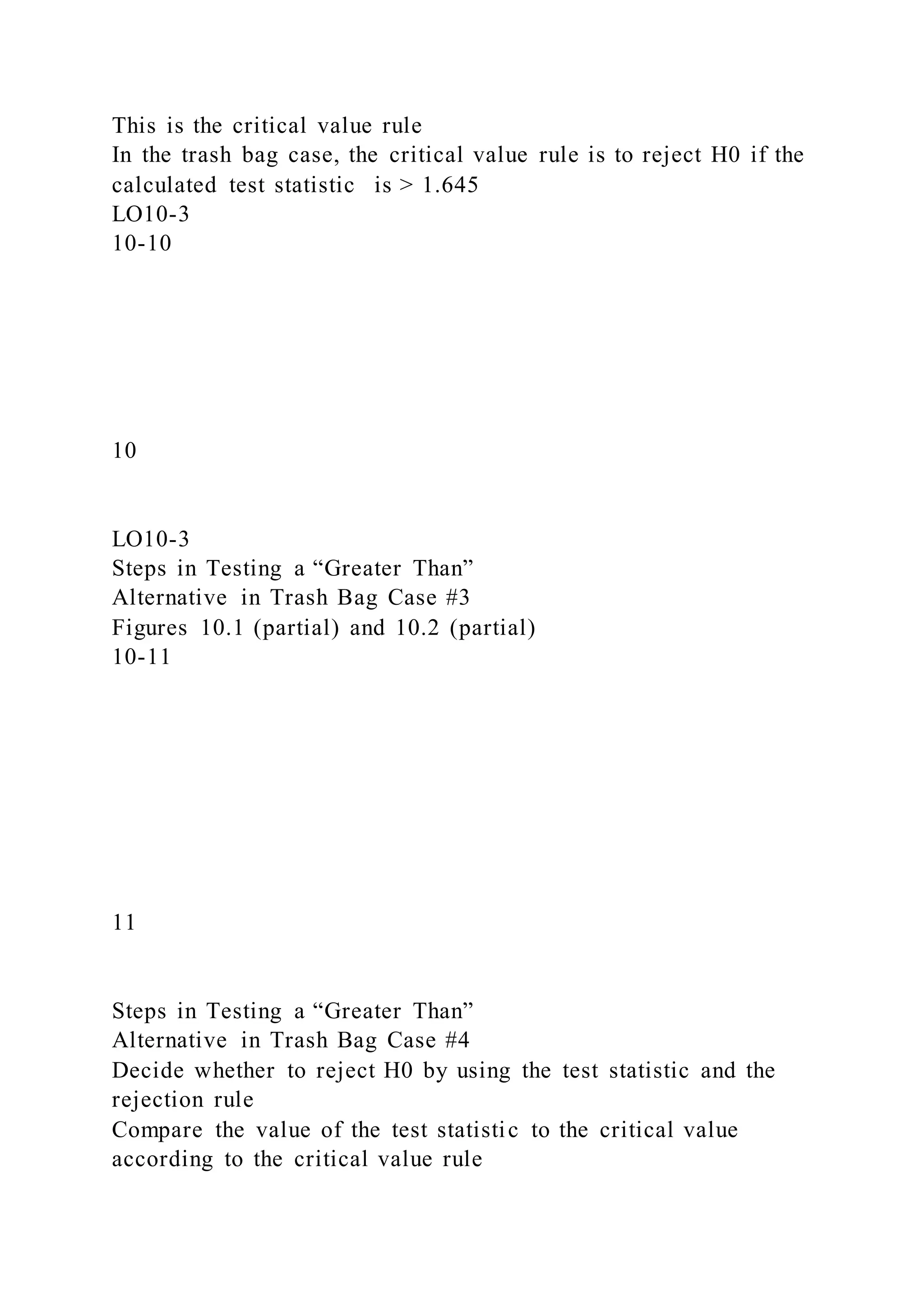
In the trash bag case, the critical value rule is to reject H0 if the
calculated test statistic is > 1.645
LO10-3
10-10
10
LO10-3
Steps in Testing a “Greater Than”
Alternative in Trash Bag Case #3
Figures 10.1 (partial) and 10.2 (partial)
10-11
11
Steps in Testing a “Greater Than”
Alternative in Trash Bag Case #4
Decide whether to reject H0 by using the test statistic and the
rejection rule
Compare the value of the test statistic to the critical value
according to the critical value rule
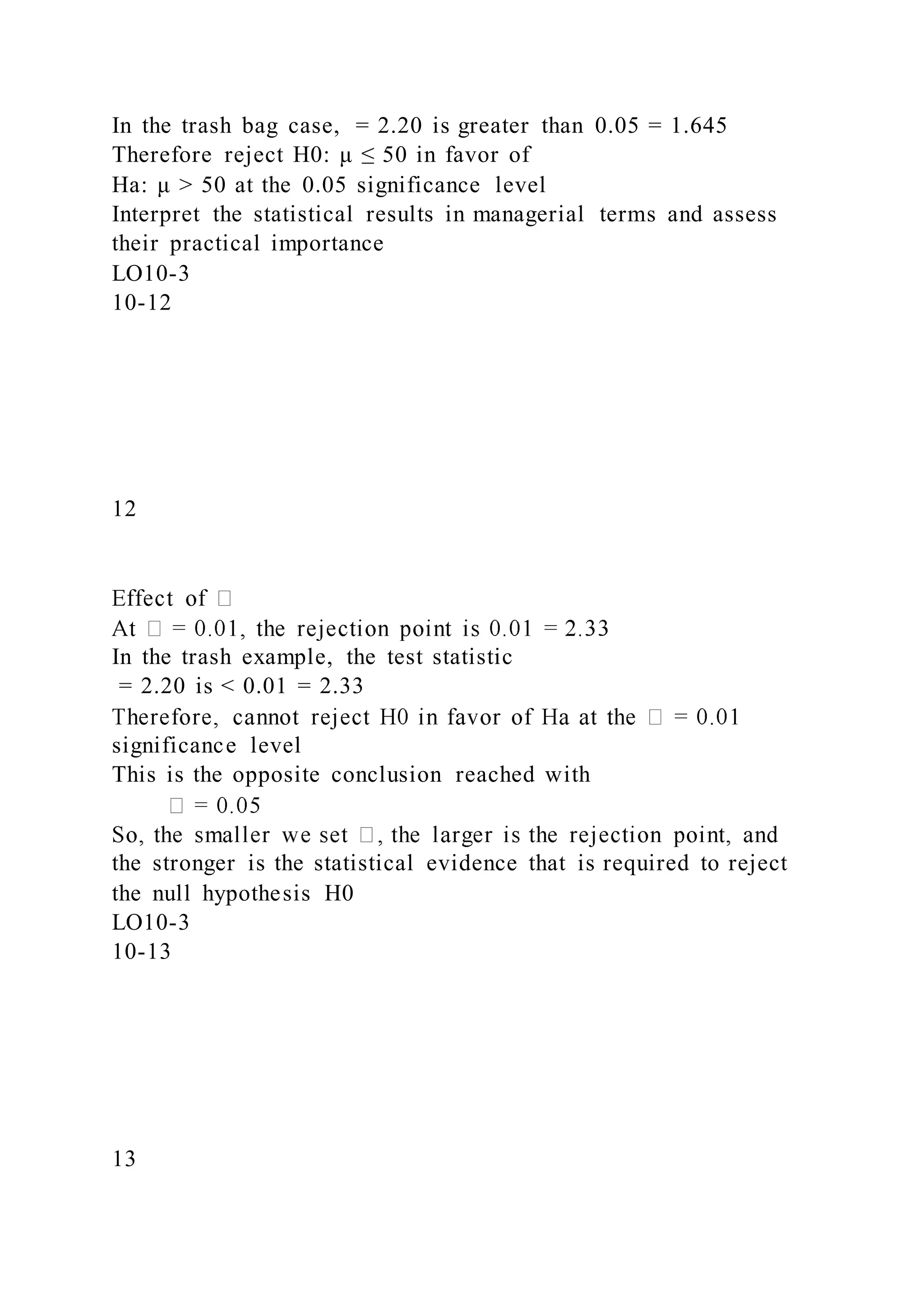
In the trash bag case, = 2.20 is greater than 0.05 = 1.645
Therefore reject H0: μ ≤ 50 in favor of
Ha: μ > 50 at the 0.05 significance level
Interpret the statistical results in managerial terms and assess
their practical importance
LO10-3
10-12
12
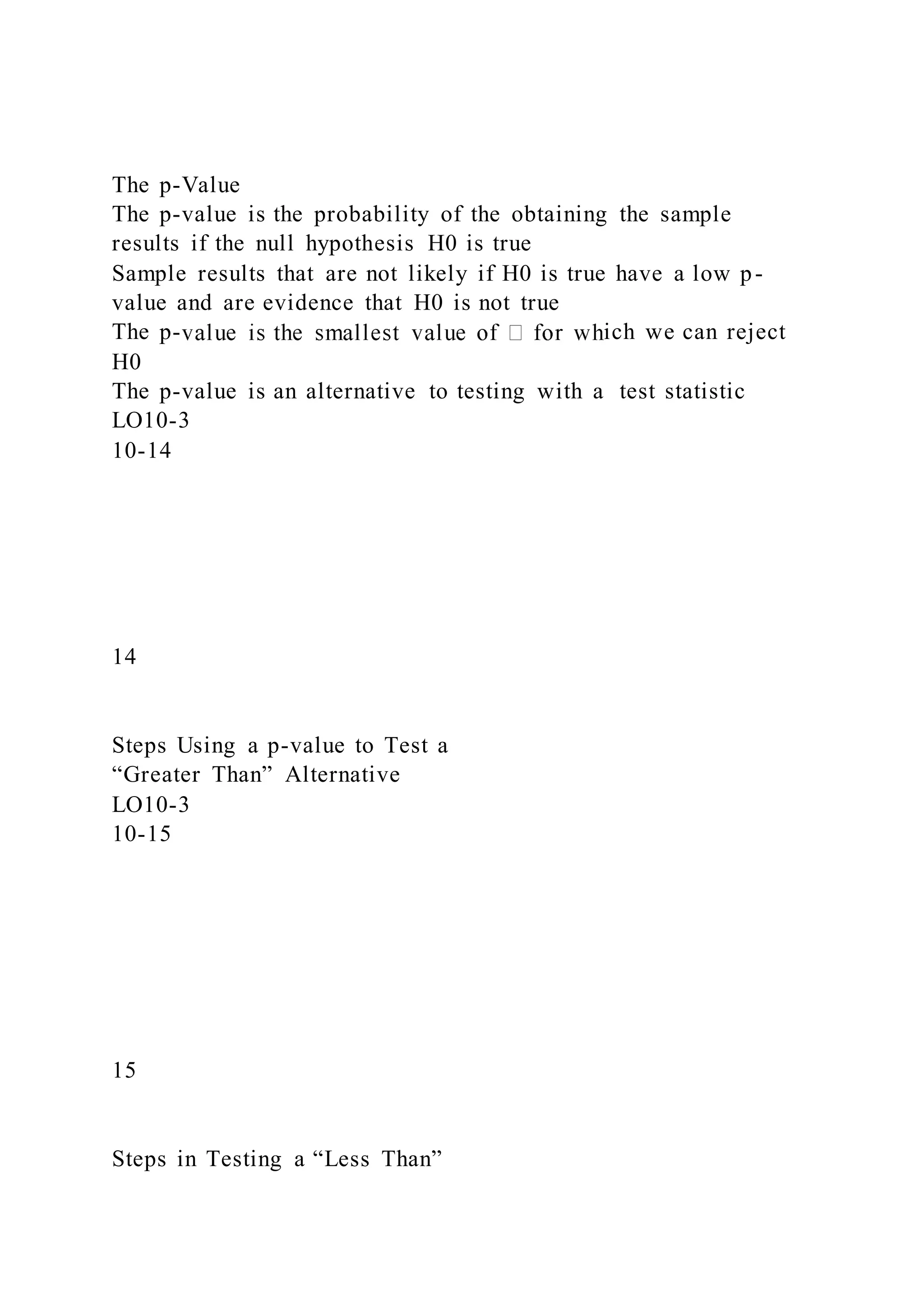
In the trash example, the test statistic
= 2.20 is < 0.01 = 2.33
significance level
This is the opposite conclusion reached with
the stronger is the statistical evidence that is required to reject
the null hypothesis H0
LO10-3
10-13
13
The p-Value
The p-value is the probability of the obtaining the sample
results if the null hypothesis H0 is true
Sample results that are not likely if H0 is true have a low p-
value and are evidence that H0 is not true
The p- ich we can reject
H0
The p-value is an alternative to testing with a test statistic
LO10-3
10-14
14
Steps Using a p-value to Test a
“Greater Than” Alternative
LO10-3
10-15
15
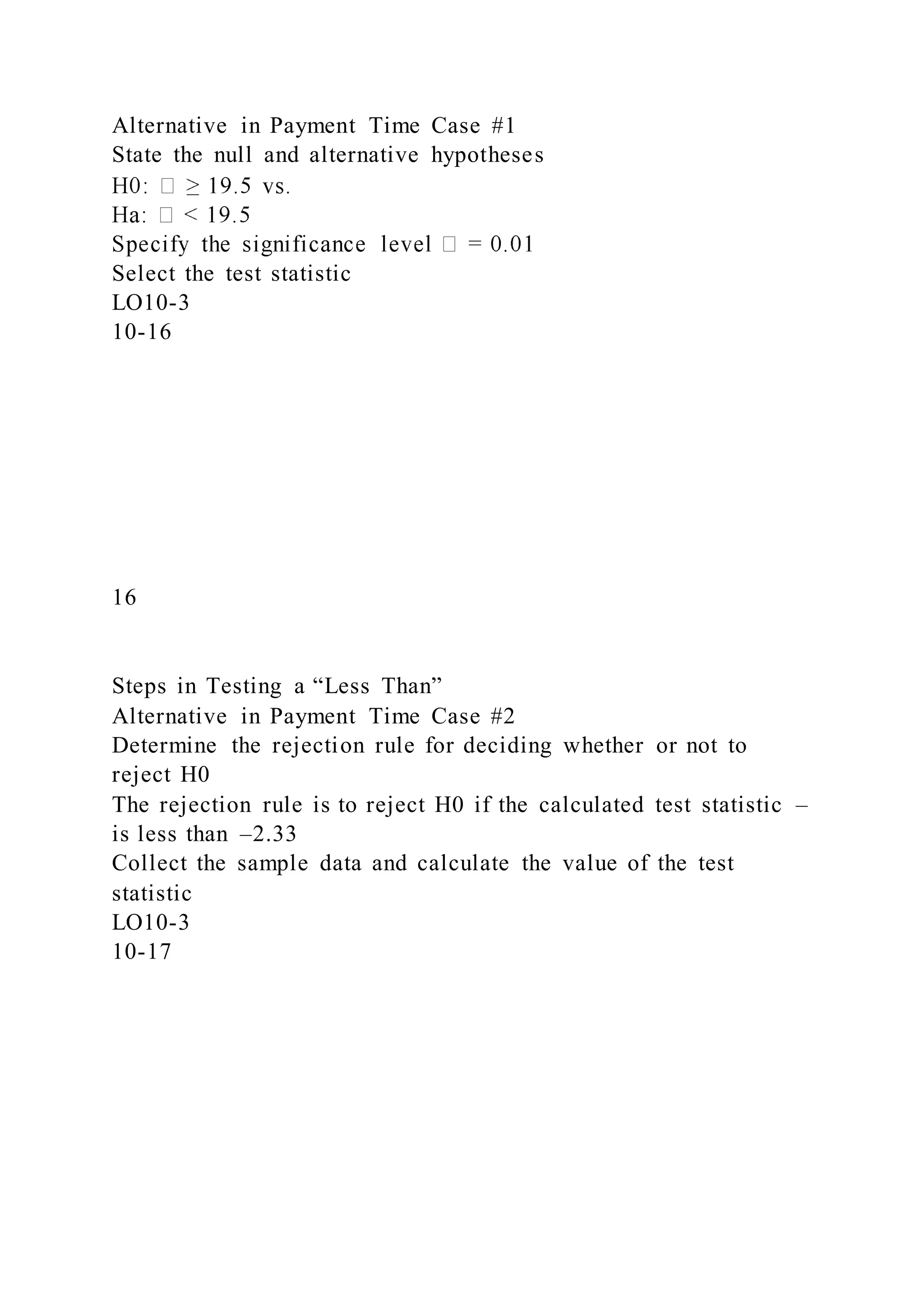
Steps in Testing a “Less Than”
Alternative in Payment Time Case #1
State the null and alternative hypotheses
Select the test statistic
LO10-3
10-16
16
Steps in Testing a “Less Than”
Alternative in Payment Time Case #2
Determine the rejection rule for deciding whether or not to
reject H0
The rejection rule is to reject H0 if the calculated test statistic –
is less than –2.33
Collect the sample data and calculate the value of the test
statistic
LO10-3
10-17
17
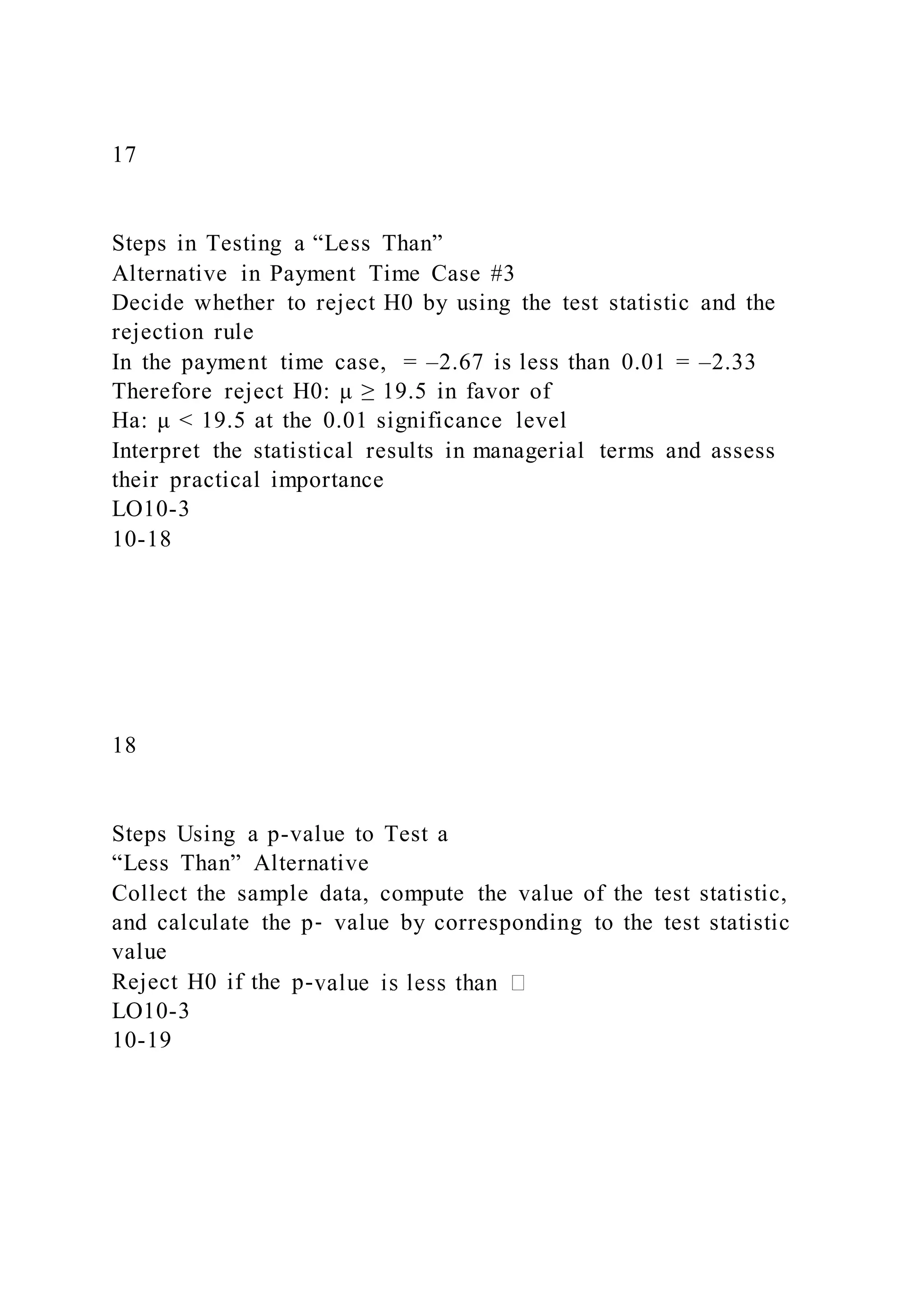
Steps in Testing a “Less Than”
Alternative in Payment Time Case #3
Decide whether to reject H0 by using the test statistic and the
rejection rule
In the payment time case, = –2.67 is less than 0.01 = –2.33
Therefore reject H0: μ ≥ 19.5 in favor of
Ha: μ < 19.5 at the 0.01 significance level
Interpret the statistical results in managerial terms and assess
their practical importance
LO10-3
10-18
18
Steps Using a p-value to Test a
“Less Than” Alternative
Collect the sample data, compute the value of the test statistic,
and calculate the p‑ value by corresponding to the test statistic
value
Reject H0 if the p-
LO10-3
10-19
19
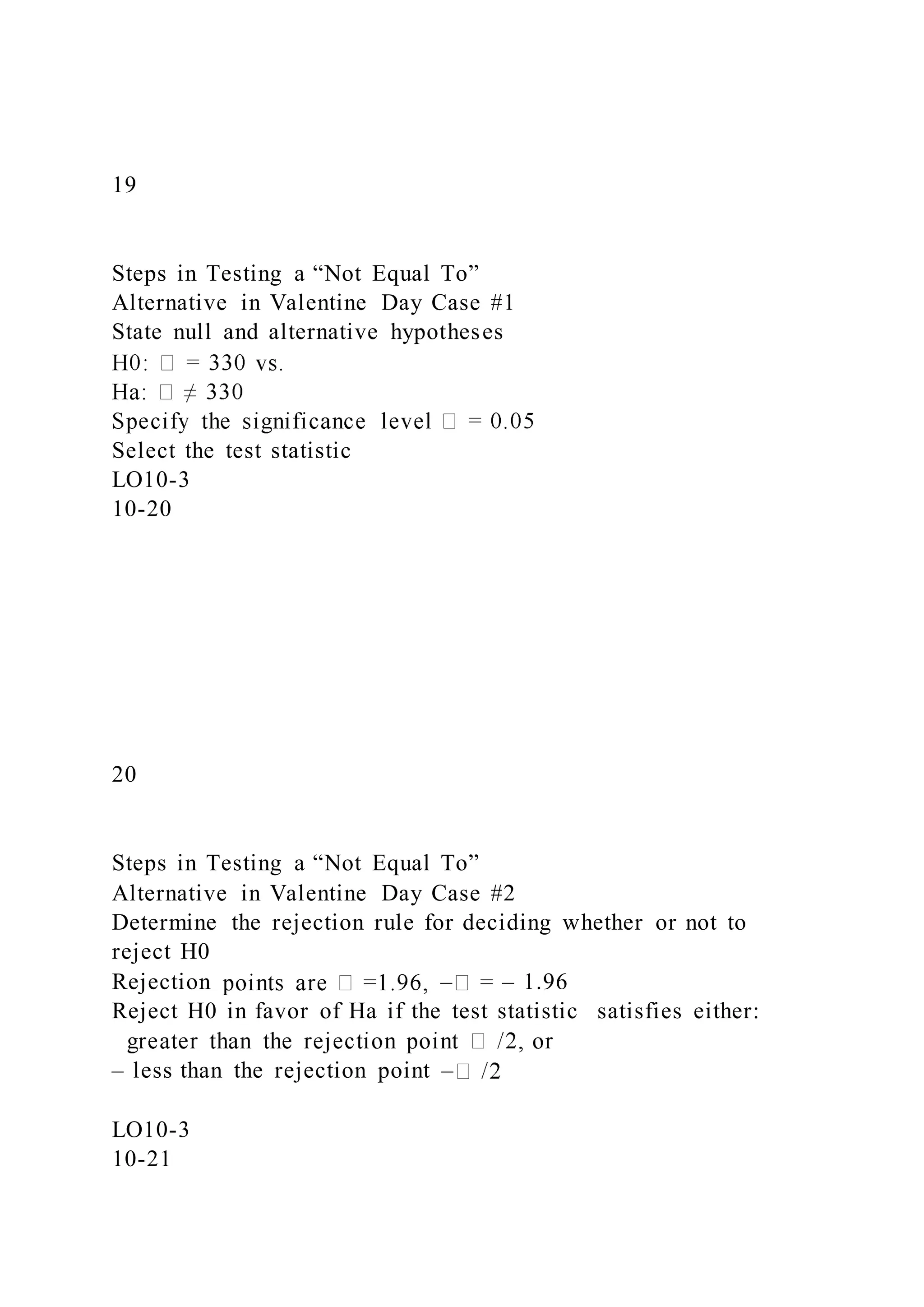
Steps in Testing a “Not Equal To”
Alternative in Valentine Day Case #1
State null and alternative hypotheses
Select the test statistic
LO10-3
10-20
20
Steps in Testing a “Not Equal To”
Alternative in Valentine Day Case #2
Determine the rejection rule for deciding whether or not to
reject H0
Rejection – – 1.96
Reject H0 in favor of Ha if the test statistic satisfies either:
– less than the rejection point –
LO10-3
10-21
21
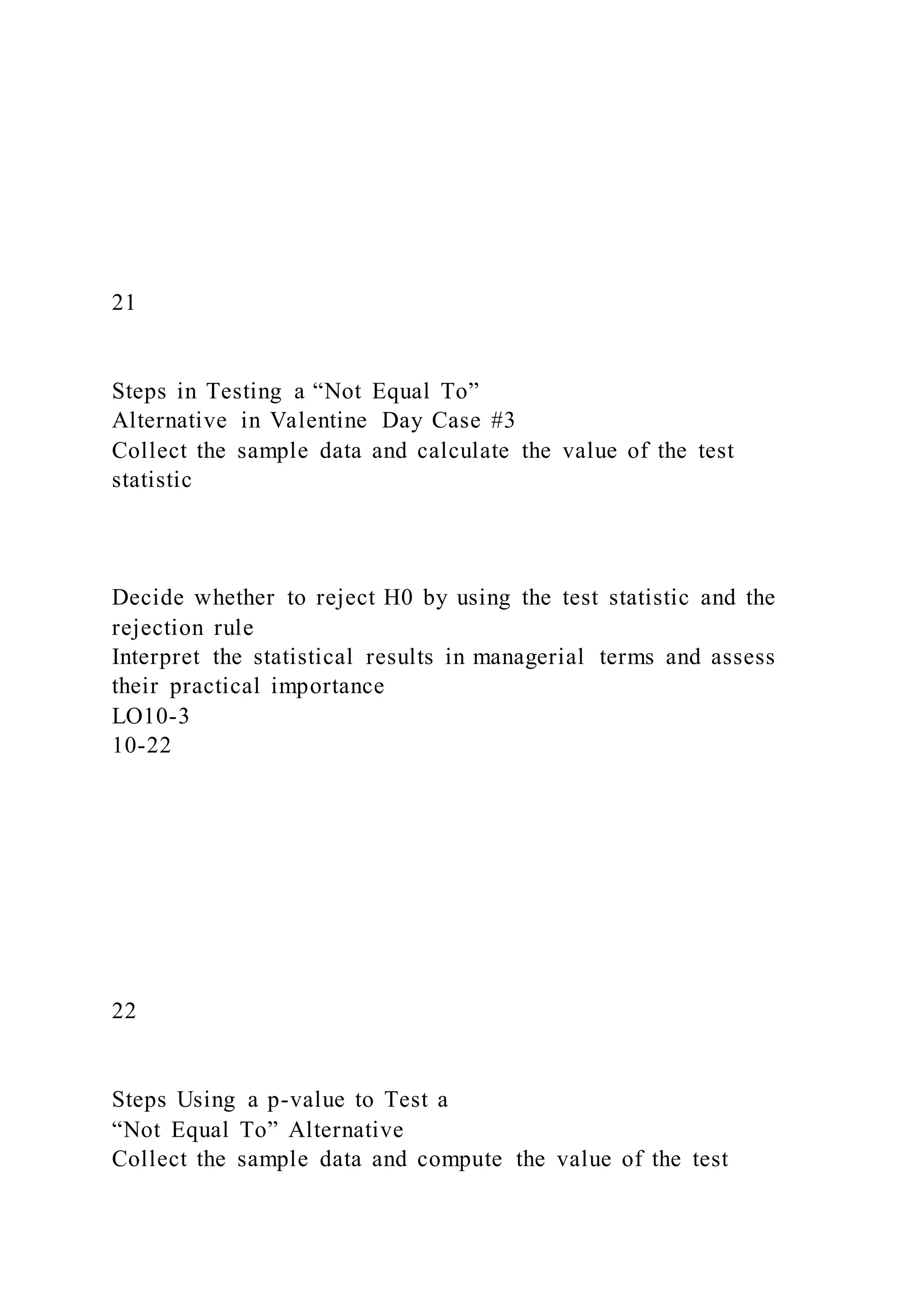
Steps in Testing a “Not Equal To”
Alternative in Valentine Day Case #3
Collect the sample data and calculate the value of the test
statistic
Decide whether to reject H0 by using the test statistic and the
rejection rule
Interpret the statistical results in managerial terms and assess
their practical importance
LO10-3
10-22
22
Steps Using a p-value to Test a
“Not Equal To” Alternative
Collect the sample data and compute the value of the test
statistic
Calculate the p-value by corresponding to the test statistic value
The p-value is 0.1587 · 2 = 0.3174
Reject H0 if the p-
LO10-3
10-23
23
Interpreting the Weight of Evidence Against the Null
Hypothesis
If p < 0.10, there is some evidence to reject H0
If p < 0.05, there is strong evidence to reject H0
If p < 0.01, there is very strong evidence to reject H0
If p < 0.001, there is extremely strong evidence to reject H0
LO10-3
10-24
24
10.3 Tests about a Population Mean: Unknown
Suppose the population being sampled is normally distributed
The population standard deviation is unknown, as is the usual
situation
If the population standard deviation is unknown, then it will
have to estimated from a sample standard deviation
Under these two conditions, the distribution must be used to
test hypotheses
LO10-4: Use critical values and p-values to perform a test
about a population mean when is unknown.
10-25
25
Defining the Random Variable:
Unknown
Define a new random variable
The sampling distribution of this random variable is a
distribution with n – 1 degrees of freedom
LO10-4
10-26
26
Defining the Statistic: Unknown
Let be the mean of a sample of size n with standard deviation s
Also, µ0 is the claimed value of the population mean
Define a new test statistic
If the population being sampled is normal, and is used to
estimate , then …
The sampling distribution of the statistic is a distribution with
n – 1 degrees of freedom
LO10-4
10-27
27
Tests about a Population Mean:
Unknown
LO10-4
10-28
28
10.4 Tests about a Population Proportion
LO 5: Use critical values and p-values to perform a large
sample test about a population proportion.
10-29
29
Example 10.6 The Cheese Spread Case: Improving Profitability
LO10-5
10-30
30
10.5 Type II Error Probabilities and Sample Size Determination
(Optional)
Compute the probability β of not rejecting a false null
hypothesis
That is, compute the probability β of committing a Type II error
1 - β is called the power of the test
LO10-6: Calculate Type II error probabilities and the power of
a test, and determine sample size (Optional).
10-31
31
Calculating β
Assume that the sampled population is normally distributed, or
that a large sample is taken
Test…
H0: µ = µ0 vs
Ha: µ < µ0 or Ha: µ > µ0 or Ha: µ ≠ µ0
Set the probab
select a sample of size n
LO10-6
10-32
32
Calculating β Continued
Probability β of a Type II error corresponding to the alternative
value µa for µ is the area under the standard normal curve to the
left of
-sided (µ <
µ0 or µ > µ0)
-sided (µ ≠ µ0)
LO10-6
10-33
33
Sample Size
Assume the sampled population is normally distributed, or that
a large sample is taken
Test H0: μ = μ0 vs.
Ha: μ < μ0 or Ha: μ > μ0 or Ha: μ ≠ μ0
the probability of a Type II error corresponding to the
Sample size is
LO10-6
10-34
34
10.6 The Chi-Square Distribution (Optional)
Figures 10.9 and 10.10
LO10-7: Describe the properties of the chi-square distribution
and use a chi-square table (Optional).
The chi-
degrees of freedom
A chi- -square
distribution that gives right-
10-35
35
10.7 Statistical Inference for a Population Variance (Optional)
If 2 is the variance of a random sample of n measurements from
a normal population with variance 2
The sampling distribution of the statistic
is a chi-square distribution with (n – 1) degrees of freedom
Can calculate confidence interval and perform hypothesis
testing
LO10-8: Use the chi-square distribution to make statistical
inferences about a population variance (Optional).
10-36
36
Confidence Interval for Population Variance
LO10-8
10-37
37
Statistical Inference for a Population Variance
LO10-8
10-38
38
Selecting an Appropriate Test Statistic to Test a Hypothesis
about a Population Mean
Figure 10.13
10-39
39
n
x
x
z
x
s
-
=
s
-
=
50
50
n
.
x
.
x
z
x
s
-
=
s
-
=
5
19
5
19
67
2
65
2
4
5
19
1077
18
5
19
.
.
.
.
n
.
x
z
-
=
-
=
s
-
=
n
x
x
z
x
s
s
330
330
-
=
-
=
00
.
1
100
40
330
326
330
-
=
-
=
-
=
n
x
z
s

Chapter 10Hypothesis TestingCopyright ©2018 McGraw

  • 1.
    Chapter 10 Hypothesis Testing Copyright©2018 McGraw-Hill Education. All rights reserved. 1 Chapter Outline 10.1 The Null and Alternative Hypotheses and Errors in Hypothesis Testing 10.2 Tests about a Population Mean: Known 10.3 Tests about a Population Mean: Unknown 10.4 Tests about a Population Proportion 10.5 Type II Error Probabilities and Sample Size Determination (Optional) 10.6 The Chi-Square Distribution 10.7 Statistical Inference for a Population Variance (Optional) 10-2
  • 2.
    2 10.1 Null andAlternative Hypotheses and Errors in Hypothesis Testing One-Sided, “Greater Than” Alternative vs. Ha: μ > μ0 One-Sided, “Less Than” Alternative vs. Ha : μ < μ0 Two-Sided, “Not Equal To” Alternative H0 : μ = μ0 vs. where μ0 is a given constant value (with the appropriate units) that is a comparative value LO10-1: Set up appropriate null and alternative hypotheses. 10-3 3 The Idea of a Test Statistic LO10-1 10-4 4
  • 3.
    Type I andType II Errors Table 10.1 LO10-2: Describe Type I and Type II errors and their probabilities. 10-5 5 Typical Values Low alpha gives small chance of rejecting a true H0 Strong evidence is required to reject H0 Usually cho LO10-2 10-6 6
  • 4.
    10.2 Tests abouta Population Mean: Known Test hypotheses about a population mean using the normal distribution Called tests Require that the true value of the population standard deviation is known In most real-world situations, is not known When is unknown, test hypotheses about a population mean using the distribution Here, assume that we know LO10-3: Use critical values and p-values to perform a test about a population mean when is known. 10-7 7 Steps in Testing a “Greater Than” Alternative State the null and alternative hypotheses ) Select the test statistic Determine the critical value rule for rejecting H0 Collect the sample data and calculate the value of the test statistic Decide whether to reject H0 by using the test statistic and the critical value rule Interpret the statistical results in managerial terms and assess their practical importance LO10-3
  • 5.
    10-8 8 Steps in Testinga “Greater Than” Alternative in Trash Bag Case #1 State the null and alternative hypotheses = 0.05 Select the test statistic LO10-3 10-9 9 Steps in Testing a “Greater Than” Alternative in Trash Bag Case #2 Determine the critical value rule for deciding whether or not to reject H0 Reject H0 in favor of Ha if the test statistic is greater than the
  • 6.
    This is thecritical value rule In the trash bag case, the critical value rule is to reject H0 if the calculated test statistic is > 1.645 LO10-3 10-10 10 LO10-3 Steps in Testing a “Greater Than” Alternative in Trash Bag Case #3 Figures 10.1 (partial) and 10.2 (partial) 10-11 11 Steps in Testing a “Greater Than” Alternative in Trash Bag Case #4 Decide whether to reject H0 by using the test statistic and the rejection rule Compare the value of the test statistic to the critical value according to the critical value rule
  • 7.
    In the trashbag case, = 2.20 is greater than 0.05 = 1.645 Therefore reject H0: μ ≤ 50 in favor of Ha: μ > 50 at the 0.05 significance level Interpret the statistical results in managerial terms and assess their practical importance LO10-3 10-12 12 In the trash example, the test statistic = 2.20 is < 0.01 = 2.33 significance level This is the opposite conclusion reached with the stronger is the statistical evidence that is required to reject the null hypothesis H0 LO10-3 10-13 13
  • 8.
    The p-Value The p-valueis the probability of the obtaining the sample results if the null hypothesis H0 is true Sample results that are not likely if H0 is true have a low p- value and are evidence that H0 is not true The p- ich we can reject H0 The p-value is an alternative to testing with a test statistic LO10-3 10-14 14 Steps Using a p-value to Test a “Greater Than” Alternative LO10-3 10-15 15 Steps in Testing a “Less Than”
  • 9.
    Alternative in PaymentTime Case #1 State the null and alternative hypotheses Select the test statistic LO10-3 10-16 16 Steps in Testing a “Less Than” Alternative in Payment Time Case #2 Determine the rejection rule for deciding whether or not to reject H0 The rejection rule is to reject H0 if the calculated test statistic – is less than –2.33 Collect the sample data and calculate the value of the test statistic LO10-3 10-17
  • 10.
    17 Steps in Testinga “Less Than” Alternative in Payment Time Case #3 Decide whether to reject H0 by using the test statistic and the rejection rule In the payment time case, = –2.67 is less than 0.01 = –2.33 Therefore reject H0: μ ≥ 19.5 in favor of Ha: μ < 19.5 at the 0.01 significance level Interpret the statistical results in managerial terms and assess their practical importance LO10-3 10-18 18 Steps Using a p-value to Test a “Less Than” Alternative Collect the sample data, compute the value of the test statistic, and calculate the p‑ value by corresponding to the test statistic value Reject H0 if the p- LO10-3 10-19
  • 11.
    19 Steps in Testinga “Not Equal To” Alternative in Valentine Day Case #1 State null and alternative hypotheses Select the test statistic LO10-3 10-20 20 Steps in Testing a “Not Equal To” Alternative in Valentine Day Case #2 Determine the rejection rule for deciding whether or not to reject H0 Rejection – – 1.96 Reject H0 in favor of Ha if the test statistic satisfies either: – less than the rejection point – LO10-3 10-21
  • 12.
    21 Steps in Testinga “Not Equal To” Alternative in Valentine Day Case #3 Collect the sample data and calculate the value of the test statistic Decide whether to reject H0 by using the test statistic and the rejection rule Interpret the statistical results in managerial terms and assess their practical importance LO10-3 10-22 22 Steps Using a p-value to Test a “Not Equal To” Alternative Collect the sample data and compute the value of the test
  • 13.
    statistic Calculate the p-valueby corresponding to the test statistic value The p-value is 0.1587 · 2 = 0.3174 Reject H0 if the p- LO10-3 10-23 23 Interpreting the Weight of Evidence Against the Null Hypothesis If p < 0.10, there is some evidence to reject H0 If p < 0.05, there is strong evidence to reject H0 If p < 0.01, there is very strong evidence to reject H0 If p < 0.001, there is extremely strong evidence to reject H0 LO10-3 10-24 24 10.3 Tests about a Population Mean: Unknown Suppose the population being sampled is normally distributed The population standard deviation is unknown, as is the usual situation
  • 14.
    If the populationstandard deviation is unknown, then it will have to estimated from a sample standard deviation Under these two conditions, the distribution must be used to test hypotheses LO10-4: Use critical values and p-values to perform a test about a population mean when is unknown. 10-25 25 Defining the Random Variable: Unknown Define a new random variable The sampling distribution of this random variable is a distribution with n – 1 degrees of freedom LO10-4 10-26 26 Defining the Statistic: Unknown Let be the mean of a sample of size n with standard deviation s Also, µ0 is the claimed value of the population mean
  • 15.
    Define a newtest statistic If the population being sampled is normal, and is used to estimate , then … The sampling distribution of the statistic is a distribution with n – 1 degrees of freedom LO10-4 10-27 27 Tests about a Population Mean: Unknown LO10-4 10-28 28 10.4 Tests about a Population Proportion LO 5: Use critical values and p-values to perform a large sample test about a population proportion. 10-29
  • 16.
    29 Example 10.6 TheCheese Spread Case: Improving Profitability LO10-5 10-30 30 10.5 Type II Error Probabilities and Sample Size Determination (Optional) Compute the probability β of not rejecting a false null hypothesis That is, compute the probability β of committing a Type II error 1 - β is called the power of the test LO10-6: Calculate Type II error probabilities and the power of a test, and determine sample size (Optional). 10-31
  • 17.
    31 Calculating β Assume thatthe sampled population is normally distributed, or that a large sample is taken Test… H0: µ = µ0 vs Ha: µ < µ0 or Ha: µ > µ0 or Ha: µ ≠ µ0 Set the probab select a sample of size n LO10-6 10-32 32 Calculating β Continued Probability β of a Type II error corresponding to the alternative value µa for µ is the area under the standard normal curve to the left of -sided (µ < µ0 or µ > µ0) -sided (µ ≠ µ0) LO10-6 10-33
  • 18.
    33 Sample Size Assume thesampled population is normally distributed, or that a large sample is taken Test H0: μ = μ0 vs. Ha: μ < μ0 or Ha: μ > μ0 or Ha: μ ≠ μ0 the probability of a Type II error corresponding to the Sample size is LO10-6 10-34 34 10.6 The Chi-Square Distribution (Optional) Figures 10.9 and 10.10 LO10-7: Describe the properties of the chi-square distribution and use a chi-square table (Optional). The chi- degrees of freedom A chi- -square distribution that gives right- 10-35
  • 19.
    35 10.7 Statistical Inferencefor a Population Variance (Optional) If 2 is the variance of a random sample of n measurements from a normal population with variance 2 The sampling distribution of the statistic is a chi-square distribution with (n – 1) degrees of freedom Can calculate confidence interval and perform hypothesis testing LO10-8: Use the chi-square distribution to make statistical inferences about a population variance (Optional). 10-36 36 Confidence Interval for Population Variance LO10-8 10-37
  • 20.
    37 Statistical Inference fora Population Variance LO10-8 10-38 38 Selecting an Appropriate Test Statistic to Test a Hypothesis about a Population Mean Figure 10.13 10-39 39 n x x z
  • 21.
  • 22.
  • 23.