
Information Risk
Management
Prof. Hernan Huwyler, MBA CPA
Risk governance covers
the culture of an
organization to be aware
of and tolerate risk as part
of the strategy
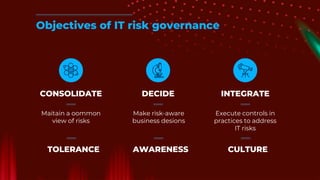
Objectives of IT risk governance
DECIDE
Make risk-aware
business desions
INTEGRATE
Execute controls in
practices to address
IT risks
CONSOLIDATE
Maitain a oommon
view of risks
AWARENESS CULTURE
TOLERANCE
Risk management covers
the process and capability
to balance the costs of
risks and controls to meet
business objectives
Good risk
management saves
money and time by
impacting the
productivity
Risk management covers
the process and capability
to balance the costs of
risks and controls to meet
business objectives
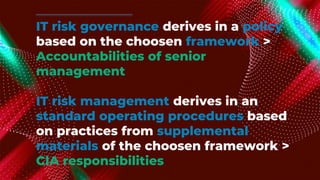
IT risk governance derives in a policy
based on the choosen framework >
Accountabilities of senior
management
IT risk management derives in an
standard operating procedures based
on practices from supplemental
materials of the choosen framework >
CIA responsibilities
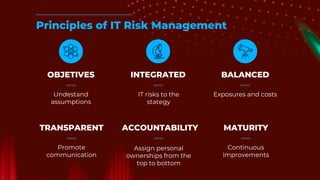
Principles of IT Risk Management
INTEGRATED
IT risks to the
stategy
BALANCED
Exposures and costs
OBJETIVES
Undestand
assumptions
ACCOUNTABILITY MATURITY
Continuous
improvements
TRANSPARENT
Promote
communication
Assign personal
ownerships from the
top to bottom
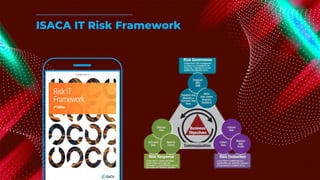
ISACA IT Risk Framework
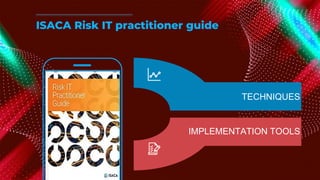
ISACA Risk IT practitioner guide
TECHNIQUES
IMPLEMENTATION TOOLS
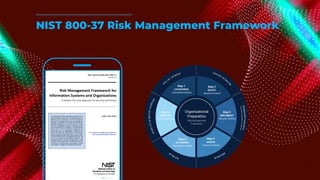
NIST 800-37 Risk Management Framework
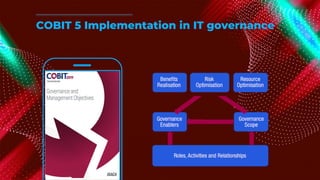
COBIT 5 Implementation in IT governance
The cost of risk
mitigation options
affects the
tolerance
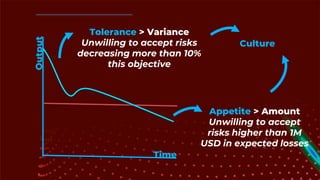
Appetite > Amount
Unwilling to accept
risks higher than 1M
USD in expected losses
Tolerance > Variance
Unwilling to accept risks
decreasing more than 10%
this objective
Time
Output
Culture
Risk culture covers how
open decision-makers
discuss the acceptable
levels of risks aligned
to the set direction for
tolerance and controls
Risk culture has
rewards to own
risks and quickly
respond to
emerging threats
How to
create risk
scenarios
Determine the
value of the IT
assets and services
at risk for the
business objectives
Identify
vulnerabilities of
the IT assets and
services at risks
Identify potential threat
vectors and actors as
factors capable to
exploit vulnerabilities
and generate losses
A list of generic risk
scenarios helps to
define few
concrete risks for a
decision-making
Analyze the impact
value of potential losses
that a threat vector can
produce in exploiting a
vulnerability
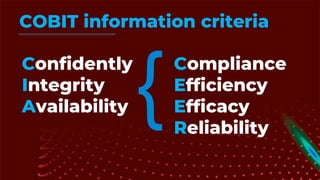
Confidently
Integrity
Availability
Compliance
Efficiency
Efficacy
Reliability
COBIT information criteria
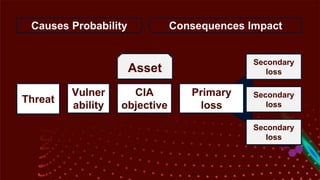
CIA
objective
Threat
Vulner
ability
Secondary
loss
Secondary
loss
Primary
loss
Secondary
loss
Causes Probability Consequences Impact
Asset
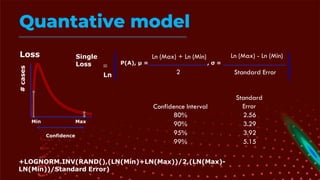
Loss
Min Max
#
cases
Confidence
Ln (Max) + Ln (Min)
2 Standard Error
P(A), μ = , σ =
Single
Loss =
Ln
Ln (Max) - Ln (Min)
Confidence Interval
Standard
Error
80% 2.56
90% 3.29
95% 3.92
99% 5.15
+LOGNORM.INV(RAND(),(LN(Min)+LN(Max))/2,(LN(Max)-
LN(Min))/Standard Error)
Quantative model
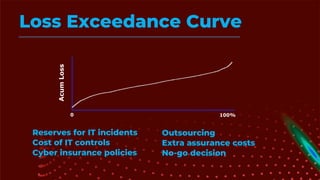
Loss Exceedance Curve
0 100%
Acum
Loss
Reserves for IT incidents
Cost of IT controls
Cyber insurance policies
Outsourcing
Extra assurance costs
No-go decision
IT risks may create non-
IT losses such as
productivity issues, over
costs, fines, frauds and
wrong decision-making
• Internal loss data
External statistics
Simulations
Decision trees
Business impact analysis
Identify current
controls reducing
the impact of
probabilities of risks
Analyze the
probability of a
potential scenario to
materialize in an
event
Analyze scenarios
by decomposing
how CIA
components could
be degraded
Evaluate the
cascading effect of
a risk in other
scenarios in the
timeframe
• Cause/effect analysis
Fault trees
Sensitivity analysis
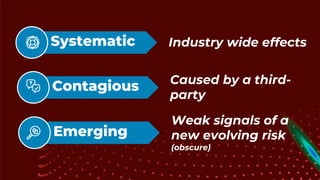
Systematic Industry wide effects
Contagious Caused by a third-
party
Emerging
Weak signals of a
new evolving risk
(obscure)
External enviroment factors of IT
risks > non controlable
● Regulations for cyber compliance
● Technologies
● Locations with natural hazards
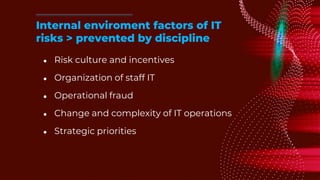
● Risk culture and incentives
● Organization of staff IT
● Operational fraud
● Change and complexity of IT operations
● Strategic priorities
Internal enviroment factors of IT
risks > prevented by discipline
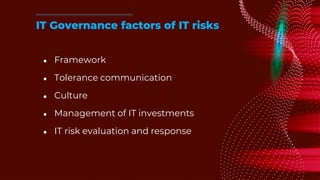
● Framework
● Tolerance communication
● Culture
● Management of IT investments
● IT risk evaluation and response
IT Governance factors of IT risks
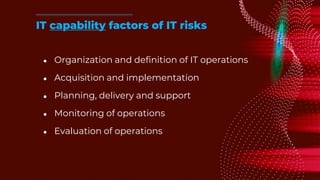
● Organization and definition of IT operations
● Acquisition and implementation
● Planning, delivery and support
● Monitoring of operations
● Evaluation of operations
IT capability factors of IT risks
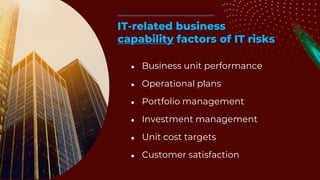
● Business unit performance
● Operational plans
● Portfolio management
● Investment management
● Unit cost targets
● Customer satisfaction
IT-related business
capability factors of IT risks
How to
respond to
risk
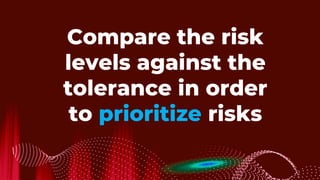
Compare the risk
levels against the
tolerance in order
to prioritize risks
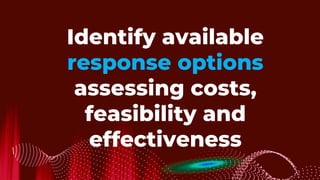
Identify available
response options
assessing costs,
feasibility and
effectiveness
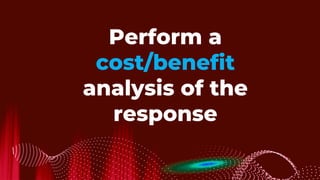
Perform a
cost/benefit
analysis of the
response
Assess alternatives
to treat several
risks with a
response plan
Monitor the
execution of the
risk response plans
and communicate
deviations
Prepare incident
response plans
with recovery time
objectives and
escalations
Test how enhanced
controls are being
deployed
Reassess and
communicate the
risk when the
response plan is
executed
Monitor changes in
the environment
and lessons learnt
from events
CREDITS: This presentation template was
created by Slidesgo, including icons by Flaticon,
and infographics & images by Freepik.
How to
report and
monitor
risks
Provide good
advice to
decision makers
Key risk indicators
are early warnings
of trends in the
risk levels and
correlations
Key risk indicators
identify potential
changes in the
threat size and
intensity
Key risk indicators
are owned to
adjust priorities
and correct
actions
Key risk indicators
have targets
related to the
tolerance
Key risk indicators
• sensitivity
• scope
• time coverage
CREDITS: This presentation template was
created by Slidesgo, including icons by Flaticon,
and infographics & images by Freepik.
THANKS!
@Hewyler
/hernanwyler
Please keep this slide for attribution.

Information Risk Management - Cyber Risk Management - IT Risks