The Research Journalism InitiativeSupporting Human Rights through EducationCreativity and Conflict: Methods for Using Technology to Explore the “Other”
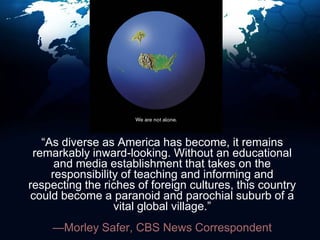
“As diverse as America has become, it remains remarkably inward-looking. Without an educational and media establishment that takes on the responsibility of teaching and informing and respecting the riches of foreign cultures, this country could become a paranoid and parochial suburb of a vital global village.”—Morley Safer, CBS News Correspondent
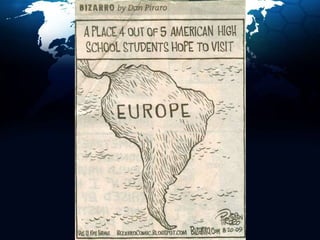
Among the findings from a Roper Poll of 18-24 year old Americans, conducted for National Geographic in 2006…Despite the wall-to-wall coverage of the damage from Hurricane Katrina, one-third of respondents couldn’t pinpoint Louisiana on a map and 48% were unable to locate Mississippi.Fewer than three in 10 think it important to know the locations of countries in the news and just 14% believe speaking another language is a necessary skill.
Two-thirds didn’t know that the earthquake that killed 70,000 people in October 2005 occurred in Pakistan.Six in 10 could not find Iraq on a map of the Middle East.While the outsourcing of jobs to India has been a major U.S. business story, 47% could not find the Indian subcontinent on a map of Asia.
While Israeli-Palestinian strife has been in the news for the entire lives of the respondents, 75% were unable to locate Israel on a map of the Middle East.Nearly three-quarters incorrectly named English as the most widely spoken native language.Six in 10 did not know the border between North and South Korea is the most heavily fortified in the world. Thirty percent thought the most heavily fortified border was between the United States and Mexico.
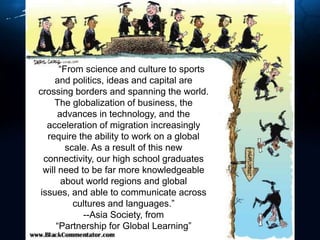
	“From science and culture to sports and politics, ideas and capital are crossing borders and spanning the world. The globalization of business, the advances in technology, and the acceleration of migration increasingly require the ability to work on a global scale. As a result of this new connectivity, our high school graduates will need to be far more knowledgeable about world regions and global issues, and able to communicate across cultures and languages.”--Asia Society, from “Partnership for Global Learning”
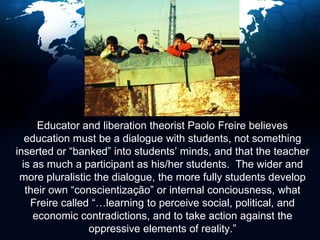
    Educator and liberation theorist Paolo Freire believes education must be a dialogue with students, not something inserted or “banked” into students’ minds, and that the teacher is as much a participant as his/her students.  The wider and more pluralistic the dialogue, the more fully students develop their own “conscientização” or internal conciousness, what Freire called “…learning to perceive social, political, and economic contradictions, and to take action against the oppressive elements of reality.”
The Research Journalism InitiativeNo foreign sky protected me,no stranger's wing shielded my face.I stand as witness to the common lot,survivor of that time, that place.Requiem, by Anna Akhmatova
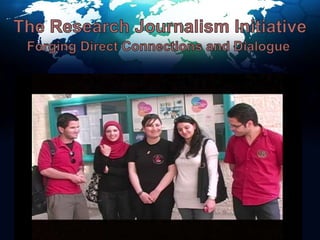
The Research Journalism InitiativeForging Direct Connections and Dialogue
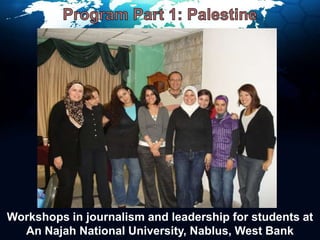
Program Part 1: PalestineWorkshops in journalism and leadership for students at An Najah National University, Nablus, West Bank
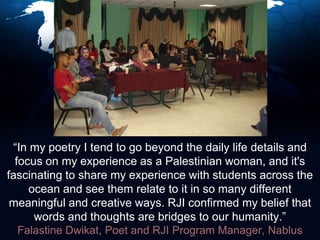
“In my poetry I tend to go beyond the daily life details and focus on my experience as a Palestinian woman, and it's fascinating to share my experience with students across the ocean and see them relate to it in so many different meaningful and creative ways. RJI confirmed my belief that words and thoughts are bridges to our humanity.”Falastine Dwikat, Poet and RJI Program Manager, Nablus
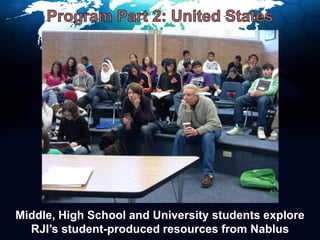
Program Part 2: United StatesMiddle, High School and University students explore RJI’s student-produced resources from Nablus
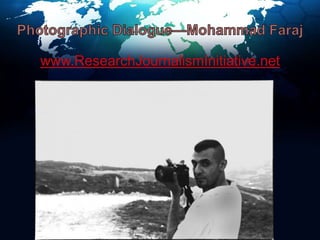
Photographic Dialogue—Mohammad Farajwww.ResearchJournalismInitiative.net
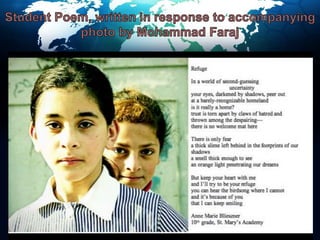
Student Poem, written in response to accompanying photo by Mohammad Faraj
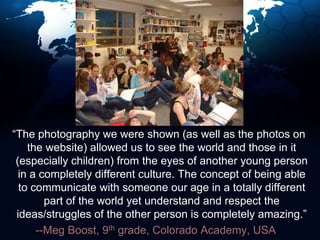
  “The photography we were shown (as well as the photos on the website) allowed us to see the world and those in it (especially children) from the eyes of another young person in a completely different culture. The concept of being able to communicate with someone our age in a totally different part of the world yet understand and respect the ideas/struggles of the other person is completely amazing.”--Meg Boost, 9th grade, Colorado Academy, USA
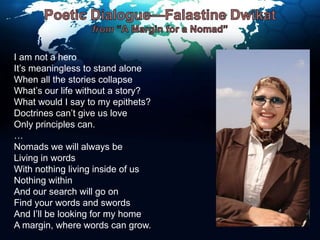
Poetic Dialogue—Falastine Dwikatfrom “A Margin for a Nomad”I am not a heroIt’s meaningless to stand aloneWhen all the stories collapseWhat’s our life without a story?What would I say to my epithets?Doctrines can’t give us loveOnly principles can.…Nomads we will always beLiving in wordsWith nothing living inside of usNothing withinAnd our search will go onFind your words and swordsAnd I’ll be looking for my homeA margin, where words can grow.
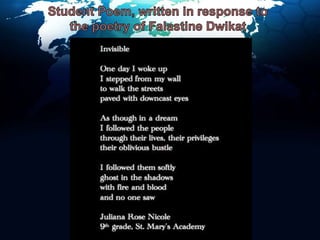
Student Poem, written in response to the poetry of Falastine Dwikat
Student-Produced Media and Online Dialogue“It Was,” by Megan Cronin (11th grade)“The Dark Side of Hope,” by Frankie Frank (11th grade)St. Mary’s Academy, Denver, USARJI and Taking IT Global“Seeing two worlds come together because of poetry and writing opened my eyes to the beauty of diversity and the importance of communication.  My writing has become less about me and more about the world around me.  I’ve learned that writing is a testament to the events and people we encounter.”–Frankie Frank, 11th grade, St. Mary’s Academy
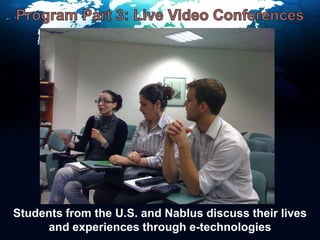
Program Part 3: Live Video ConferencesStudents from the U.S. and Nablus discuss their lives and experiences through e-technologies
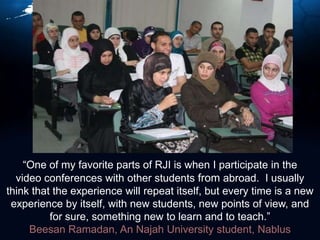
“One of my favorite parts of RJI is when I participate in the video conferences with other students from abroad.  I usually think that the experience will repeat itself, but every time is a new experience by itself, with new students, new points of view, and for sure, something new to learn and to teach.”Beesan Ramadan, An Najah University student, Nablus
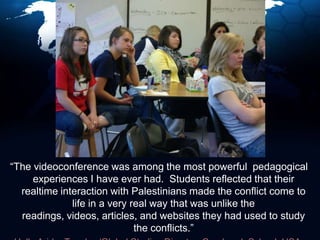
 “The videoconference was among the most powerful  pedagogical experiences I have ever had.  Students reflected that their realtime interaction with Palestinians made the conflict come to life in a very real way that was unlike the readings, videos, articles, and websites they had used to study the conflicts.”  Holly Arida, Teacher/Global Studies Director, Cranbrook School, USA
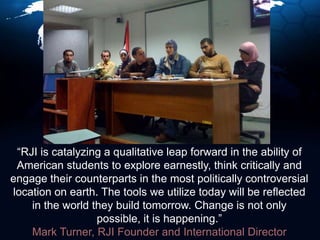
“RJI is catalyzing a qualitative leap forward in the ability of American students to explore earnestly, think critically and engage their counterparts in the most politically controversial location on earth. The tools we utilize today will be reflected in the world they build tomorrow. Change is not only possible, it is happening.” Mark Turner, RJI Founder and International Director
RJI strives to develop global educational frameworks and methodologies which foster…a culture of questioning and dialogue, developing comfort with discomfort and difficult dialoguea willingness to humanize conflict, honoring others’   views and seeing the world pluralisticallyinternal and primary source exploration, not external/observational education or mimicryexperiential education—project-based learning where DVC and related projects aren’t “dessert” but are at     the heart of students’ explorations
RJI strives to develop global educational frameworks and methodologies which foster…inquiry-based critical thinking, geared toward solution building, collaboration and 21st Century leadership skillsstudent-directed explorations and self expression, which improve creativity and student engagementguided, interactive discussions and assignments online, under the control of the teacher, to ensure substantive and authentic educational experiences, not just “cyber-flirting”
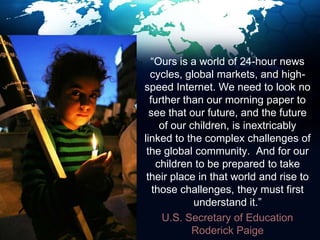
    “Ours is a world of 24-hour news cycles, global markets, and high-speed Internet. We need to look no further than our morning paper to see that our future, and the future of our children, is inextricably linked to the complex challenges of the global community.  And for our children to be prepared to take their place in that world and rise to those challenges, they must first understand it.”     U.S. Secretary of Education Roderick Paige
Jennifer D. KleinDirector of Educational DevelopmentJennifer@ResearchJournalismInitiative.netwww.ResearchJournalismInitiative.netand click on Resources for Teachersfind more Teacher Resources at http://rji.tiged.org/teacherforum

Rji 2010

  • 1.
    The Research JournalismInitiativeSupporting Human Rights through EducationCreativity and Conflict: Methods for Using Technology to Explore the “Other”
  • 2.
    “As diverse asAmerica has become, it remains remarkably inward-looking. Without an educational and media establishment that takes on the responsibility of teaching and informing and respecting the riches of foreign cultures, this country could become a paranoid and parochial suburb of a vital global village.”—Morley Safer, CBS News Correspondent
  • 4.
    Among the findingsfrom a Roper Poll of 18-24 year old Americans, conducted for National Geographic in 2006…Despite the wall-to-wall coverage of the damage from Hurricane Katrina, one-third of respondents couldn’t pinpoint Louisiana on a map and 48% were unable to locate Mississippi.Fewer than three in 10 think it important to know the locations of countries in the news and just 14% believe speaking another language is a necessary skill.
  • 5.
    Two-thirds didn’t knowthat the earthquake that killed 70,000 people in October 2005 occurred in Pakistan.Six in 10 could not find Iraq on a map of the Middle East.While the outsourcing of jobs to India has been a major U.S. business story, 47% could not find the Indian subcontinent on a map of Asia.
  • 6.
    While Israeli-Palestinian strifehas been in the news for the entire lives of the respondents, 75% were unable to locate Israel on a map of the Middle East.Nearly three-quarters incorrectly named English as the most widely spoken native language.Six in 10 did not know the border between North and South Korea is the most heavily fortified in the world. Thirty percent thought the most heavily fortified border was between the United States and Mexico.
  • 8.
    “From science andculture to sports and politics, ideas and capital are crossing borders and spanning the world. The globalization of business, the advances in technology, and the acceleration of migration increasingly require the ability to work on a global scale. As a result of this new connectivity, our high school graduates will need to be far more knowledgeable about world regions and global issues, and able to communicate across cultures and languages.”--Asia Society, from “Partnership for Global Learning”
  • 9.
    Educator and liberation theorist Paolo Freire believes education must be a dialogue with students, not something inserted or “banked” into students’ minds, and that the teacher is as much a participant as his/her students. The wider and more pluralistic the dialogue, the more fully students develop their own “conscientização” or internal conciousness, what Freire called “…learning to perceive social, political, and economic contradictions, and to take action against the oppressive elements of reality.”
  • 10.
    The Research JournalismInitiativeNo foreign sky protected me,no stranger's wing shielded my face.I stand as witness to the common lot,survivor of that time, that place.Requiem, by Anna Akhmatova
  • 11.
    The Research JournalismInitiativeForging Direct Connections and Dialogue
  • 12.
    Program Part 1:PalestineWorkshops in journalism and leadership for students at An Najah National University, Nablus, West Bank
  • 13.
    “In my poetryI tend to go beyond the daily life details and focus on my experience as a Palestinian woman, and it's fascinating to share my experience with students across the ocean and see them relate to it in so many different meaningful and creative ways. RJI confirmed my belief that words and thoughts are bridges to our humanity.”Falastine Dwikat, Poet and RJI Program Manager, Nablus
  • 14.
    Program Part 2:United StatesMiddle, High School and University students explore RJI’s student-produced resources from Nablus
  • 15.
  • 16.
    Student Poem, writtenin response to accompanying photo by Mohammad Faraj
  • 17.
    “Thephotography we were shown (as well as the photos on the website) allowed us to see the world and those in it (especially children) from the eyes of another young person in a completely different culture. The concept of being able to communicate with someone our age in a totally different part of the world yet understand and respect the ideas/struggles of the other person is completely amazing.”--Meg Boost, 9th grade, Colorado Academy, USA
  • 18.
    Poetic Dialogue—Falastine Dwikatfrom“A Margin for a Nomad”I am not a heroIt’s meaningless to stand aloneWhen all the stories collapseWhat’s our life without a story?What would I say to my epithets?Doctrines can’t give us loveOnly principles can.…Nomads we will always beLiving in wordsWith nothing living inside of usNothing withinAnd our search will go onFind your words and swordsAnd I’ll be looking for my homeA margin, where words can grow.
  • 19.
    Student Poem, writtenin response to the poetry of Falastine Dwikat
  • 20.
    Student-Produced Media andOnline Dialogue“It Was,” by Megan Cronin (11th grade)“The Dark Side of Hope,” by Frankie Frank (11th grade)St. Mary’s Academy, Denver, USARJI and Taking IT Global“Seeing two worlds come together because of poetry and writing opened my eyes to the beauty of diversity and the importance of communication. My writing has become less about me and more about the world around me. I’ve learned that writing is a testament to the events and people we encounter.”–Frankie Frank, 11th grade, St. Mary’s Academy
  • 21.
    Program Part 3:Live Video ConferencesStudents from the U.S. and Nablus discuss their lives and experiences through e-technologies
  • 22.
    “One of my favorite partsof RJI is when I participate in the video conferences with other students from abroad. I usually think that the experience will repeat itself, but every time is a new experience by itself, with new students, new points of view, and for sure, something new to learn and to teach.”Beesan Ramadan, An Najah University student, Nablus
  • 23.
    “The videoconferencewas among the most powerful pedagogical experiences I have ever had. Students reflected that their realtime interaction with Palestinians made the conflict come to life in a very real way that was unlike the readings, videos, articles, and websites they had used to study the conflicts.” Holly Arida, Teacher/Global Studies Director, Cranbrook School, USA
  • 24.
    “RJI is catalyzinga qualitative leap forward in the ability of American students to explore earnestly, think critically and engage their counterparts in the most politically controversial location on earth. The tools we utilize today will be reflected in the world they build tomorrow. Change is not only possible, it is happening.” Mark Turner, RJI Founder and International Director
  • 25.
    RJI strives todevelop global educational frameworks and methodologies which foster…a culture of questioning and dialogue, developing comfort with discomfort and difficult dialoguea willingness to humanize conflict, honoring others’ views and seeing the world pluralisticallyinternal and primary source exploration, not external/observational education or mimicryexperiential education—project-based learning where DVC and related projects aren’t “dessert” but are at the heart of students’ explorations
  • 26.
    RJI strives todevelop global educational frameworks and methodologies which foster…inquiry-based critical thinking, geared toward solution building, collaboration and 21st Century leadership skillsstudent-directed explorations and self expression, which improve creativity and student engagementguided, interactive discussions and assignments online, under the control of the teacher, to ensure substantive and authentic educational experiences, not just “cyber-flirting”
  • 27.
    “Ours is a world of 24-hour news cycles, global markets, and high-speed Internet. We need to look no further than our morning paper to see that our future, and the future of our children, is inextricably linked to the complex challenges of the global community. And for our children to be prepared to take their place in that world and rise to those challenges, they must first understand it.” U.S. Secretary of Education Roderick Paige
  • 28.
    Jennifer D. KleinDirectorof Educational DevelopmentJennifer@ResearchJournalismInitiative.netwww.ResearchJournalismInitiative.netand click on Resources for Teachersfind more Teacher Resources at http://rji.tiged.org/teacherforum

Editor's Notes

  • #9 Our students must emerge from schools college-ready and globally competent, prepared to compete, connect, and cooperate with their generation around the world. Parents, teachers, policymakers, and business leaders have begun to respond to this reality and are seeking to redesign education to focus on learning for the 21st century. However, the U.S. education system has not yet created an environment to prepare every student for the globalized world. To move international education from the margins to the mainstream, we must work together to ensure an environment of excellence and equity in a global era.