Hyunwoo Park
Kaili Xue
Keisha Ridwan
Selina Perng
IMAGE: PEXELS
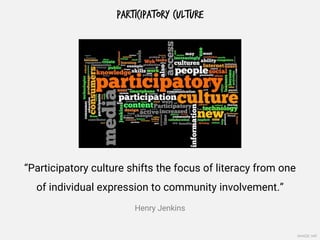
PARTICIPATORY CULTURE
“Participatory culture shifts the focus of literacy from one
of individual expression to community involvement.”
Henry Jenkins
IMAGE: MIT
PARTICIPATORY CULTURE
Many young people are already part
of this process through:
• Affiliations
• Expressions
• Collaborative Problem-Solving
• Circulations
SOURCE: Jenkins, H. et al. (2006) Confronting the Challenges of Participatory Culture: Media Education for the 21st Century, Cambridge & London: The MIT Press.
AFFINITY SPACE
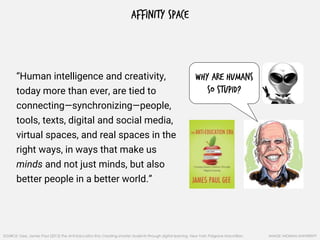
“Human intelligence and creativity,
today more than ever, are tied to
connecting—synchronizing—people,
tools, texts, digital and social media,
virtual spaces, and real spaces in the
right ways, in ways that make us
minds and not just minds, but also
better people in a better world.”
SOURCE: Gee, James Paul (2013) The Anti-Education Era: Creating smarter students through digital learning, New York: Palgrave Macmillan. IMAGE: INDIANA UNIVERSITY
Why are humans
so stupid?
HUMANS ARE NOT SMART ALONE
“School is often based not on problem solving, which
perforce involves actions and goals, but on learning
information, facts, and formulas that one has read about in
texts or heard about in lectures. It is not surprising, then, that
research has long shown that a student’s doing well in
school, in terms of grades and tests, does not correlate with
being able to solve problems in the areas in which the
student has been taught (e.g., math, civics, physics).”
(Gee, 2013, p. 178)
Association gives pleasure: humans needs sense of worth –
participation and control and counting to others.
SOURCE: Gee, James Paul (2013) The Anti-Education Era: Creating smarter students through digital learning, New York: Palgrave Macmillan.
IMAGE: JISC
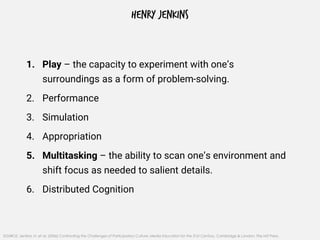
HENRY JENKINS
1. Play – the capacity to experiment with one’s
surroundings as a form of problem-solving.
2. Performance
3. Simulation
4. Appropriation
5. Multitasking – the ability to scan one’s environment and
shift focus as needed to salient details.
6. Distributed Cognition
SOURCE: Jenkins, H. et al. (2006) Confronting the Challenges of Participatory Culture: Media Education for the 21st Century, Cambridge & London: The MIT Press.
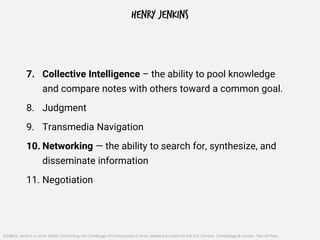
HENRY JENKINS
7. Collective Intelligence – the ability to pool knowledge
and compare notes with others toward a common goal.
8. Judgment
9. Transmedia Navigation
10. Networking — the ability to search for, synthesize, and
disseminate information
11. Negotiation
SOURCE: Jenkins, H. et al. (2006) Confronting the Challenges of Participatory Culture: Media Education for the 21st Century, Cambridge & London: The MIT Press.
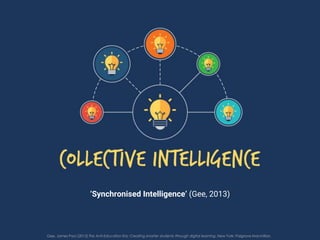
‘Synchronised Intelligence’ (Gee, 2013)
Gee, James Paul (2013) The Anti-Education Era: Creating smarter students through digital learning, New York: Palgrave Macmillan.
JAMES PAUL GEE
• Gee suggests ‘collective intelligence’ and ‘passionate
affinity spaces’ for students and teachers. We must all
learn how to be part of big minds with big ideas.
• Students must learn to balance sciences empirical
methods with the liberals arts.
• Mind visions – we must demand that ‘each student
become a maker of visions, a visionary, and not just a
spectator of visions.’ (Thompson, 2015)
SOURCE: Gee, James Paul (2013) The Anti-Education Era: Creating smarter students through digital learning, New York: Palgrave Macmillan.
JAMES PAUL GEE
• The best way to help poor children is high-quality early
education to close the literacy gap.
• Educators must engage children and help parents engage
their children in extended conversations about the world.
This instruction must incorporate rich images. It must
teach children to engage in goal-based actions.
• Pre-school must essentially extend children’s experiences
beyond their neighbourhood. In other words, parents and
educators must help children develop islands of
expertise.
SOURCE: Gee, James Paul (2013) The Anti-Education Era: Creating smarter students through digital learning, New York: Palgrave Macmillan.
IMAGE: PEXELS
THE PARTICIPATION GAP / THE LITERACY GAP
“… the unequal access to the opportunities,
experiences, skills, and knowledge that will
prepare youth for full participation …”
(Jenkins et al., 2006)
SOURCE: Jenkins, H. et al. (2006) Confronting the Challenges of Participatory Culture: Media Education for the 21st Century, Cambridge & London: The MIT Press.
Albert Einstein? Clifford Stoll? Frank Zappa?
MEDIA EDUCATION 2
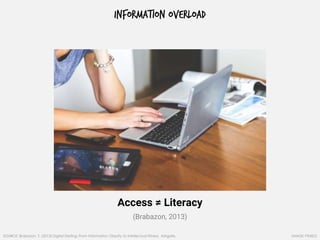
INFORMATION OVERLOAD
Access ≠ Literacy
(Brabazon, 2013)
IMAGE: PEXELSSOURCE: Brabazon, T. (2013) Digital Dieting: From Information Obesity to Intellectual Fitness. Ashgate.
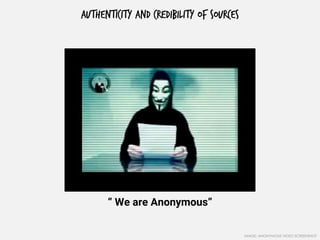
AUTHENTICITY AND CREDIBILITY OF SOURCES
“ We are Anonymous”
IMAGE: ANONYMOUS VIDEO SCREENSHOT
Questioning the “Wisdom of the Crowds”
MEDIA EDUCATION 2
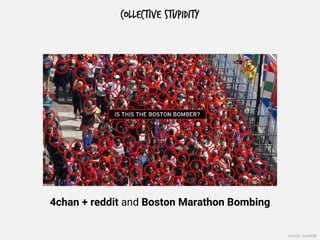
COLLECTIVE STUPIDITY
4chan + reddit and Boston Marathon Bombing
IMAGE: GAWKER
COLLECTIVE STUPIDITY
SOURCE: Pratchett, T. (1995) ‘Maskerade’, Discworld, Book 18, Victor Gollancz.
“And, since the IQ of a mob is the IQ of its
most stupid member divided by the number
of mobsters, it was never very clear to anyone
what had happened.”
Terry Pratchett, Maskerade
IMAGE: PEXELS
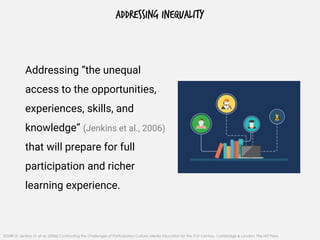
ADDRESSING INEQUALITY
Addressing “the unequal
access to the opportunities,
experiences, skills, and
knowledge” (Jenkins et al., 2006)
that will prepare for full
participation and richer
learning experience.
SOURCE: Jenkins, H. et al. (2006) Confronting the Challenges of Participatory Culture: Media Education for the 21st Century, Cambridge & London: The MIT Press.
TACKLING THE ETHICS CHALLENGE
Utilising media education as the avenue to prepare
learners for ‘their increasingly public roles as media
makers and community participants’, breaking down
‘traditional forms of professional training and
socialisation’ (Jenkins et al., 2006).
SOURCE: Jenkins, H. et al. (2006) Confronting the Challenges of Participatory Culture: Media Education for the 21st Century, Cambridge & London: The MIT Press.
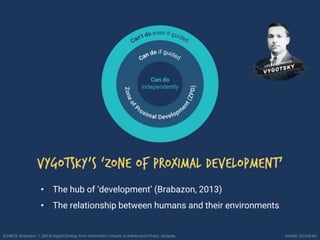
• The hub of ‘development’ (Brabazon, 2013)
• The relationship between humans and their environments
SOURCE: Brabazon, T. (2013) Digital Dieting: From Information Obesity to Intellectual Fitness. Ashgate. IMAGE: LETOUKAN
SCAFFOLDING
• Pedagogical process works
• The entire community takes on some
responsibility for helping newbies find their way
(Jenkins, 2006)
SOURCE: Jenkins, Henry (2006). Convergence Culture: Where Old and New Media Collide. New York: NYU Press
Hyunwoo Park
Kaili Xue
Keisha Ridwan
Selina Perng

Learning through Affinity Spaces

  • 1.
    Hyunwoo Park Kaili Xue KeishaRidwan Selina Perng
  • 2.
  • 3.
    PARTICIPATORY CULTURE “Participatory cultureshifts the focus of literacy from one of individual expression to community involvement.” Henry Jenkins IMAGE: MIT
  • 4.
    PARTICIPATORY CULTURE Many youngpeople are already part of this process through: • Affiliations • Expressions • Collaborative Problem-Solving • Circulations SOURCE: Jenkins, H. et al. (2006) Confronting the Challenges of Participatory Culture: Media Education for the 21st Century, Cambridge & London: The MIT Press.
  • 5.
    AFFINITY SPACE “Human intelligenceand creativity, today more than ever, are tied to connecting—synchronizing—people, tools, texts, digital and social media, virtual spaces, and real spaces in the right ways, in ways that make us minds and not just minds, but also better people in a better world.” SOURCE: Gee, James Paul (2013) The Anti-Education Era: Creating smarter students through digital learning, New York: Palgrave Macmillan. IMAGE: INDIANA UNIVERSITY Why are humans so stupid?
  • 6.
    HUMANS ARE NOTSMART ALONE “School is often based not on problem solving, which perforce involves actions and goals, but on learning information, facts, and formulas that one has read about in texts or heard about in lectures. It is not surprising, then, that research has long shown that a student’s doing well in school, in terms of grades and tests, does not correlate with being able to solve problems in the areas in which the student has been taught (e.g., math, civics, physics).” (Gee, 2013, p. 178) Association gives pleasure: humans needs sense of worth – participation and control and counting to others. SOURCE: Gee, James Paul (2013) The Anti-Education Era: Creating smarter students through digital learning, New York: Palgrave Macmillan.
  • 7.
  • 9.
    HENRY JENKINS 1. Play– the capacity to experiment with one’s surroundings as a form of problem-solving. 2. Performance 3. Simulation 4. Appropriation 5. Multitasking – the ability to scan one’s environment and shift focus as needed to salient details. 6. Distributed Cognition SOURCE: Jenkins, H. et al. (2006) Confronting the Challenges of Participatory Culture: Media Education for the 21st Century, Cambridge & London: The MIT Press.
  • 10.
    HENRY JENKINS 7. CollectiveIntelligence – the ability to pool knowledge and compare notes with others toward a common goal. 8. Judgment 9. Transmedia Navigation 10. Networking — the ability to search for, synthesize, and disseminate information 11. Negotiation SOURCE: Jenkins, H. et al. (2006) Confronting the Challenges of Participatory Culture: Media Education for the 21st Century, Cambridge & London: The MIT Press.
  • 11.
    ‘Synchronised Intelligence’ (Gee,2013) Gee, James Paul (2013) The Anti-Education Era: Creating smarter students through digital learning, New York: Palgrave Macmillan.
  • 12.
    JAMES PAUL GEE •Gee suggests ‘collective intelligence’ and ‘passionate affinity spaces’ for students and teachers. We must all learn how to be part of big minds with big ideas. • Students must learn to balance sciences empirical methods with the liberals arts. • Mind visions – we must demand that ‘each student become a maker of visions, a visionary, and not just a spectator of visions.’ (Thompson, 2015) SOURCE: Gee, James Paul (2013) The Anti-Education Era: Creating smarter students through digital learning, New York: Palgrave Macmillan.
  • 13.
    JAMES PAUL GEE •The best way to help poor children is high-quality early education to close the literacy gap. • Educators must engage children and help parents engage their children in extended conversations about the world. This instruction must incorporate rich images. It must teach children to engage in goal-based actions. • Pre-school must essentially extend children’s experiences beyond their neighbourhood. In other words, parents and educators must help children develop islands of expertise. SOURCE: Gee, James Paul (2013) The Anti-Education Era: Creating smarter students through digital learning, New York: Palgrave Macmillan.
  • 14.
  • 15.
    THE PARTICIPATION GAP/ THE LITERACY GAP “… the unequal access to the opportunities, experiences, skills, and knowledge that will prepare youth for full participation …” (Jenkins et al., 2006) SOURCE: Jenkins, H. et al. (2006) Confronting the Challenges of Participatory Culture: Media Education for the 21st Century, Cambridge & London: The MIT Press.
  • 16.
    Albert Einstein? CliffordStoll? Frank Zappa? MEDIA EDUCATION 2
  • 17.
    INFORMATION OVERLOAD Access ≠Literacy (Brabazon, 2013) IMAGE: PEXELSSOURCE: Brabazon, T. (2013) Digital Dieting: From Information Obesity to Intellectual Fitness. Ashgate.
  • 18.
    AUTHENTICITY AND CREDIBILITYOF SOURCES “ We are Anonymous” IMAGE: ANONYMOUS VIDEO SCREENSHOT
  • 19.
    Questioning the “Wisdomof the Crowds” MEDIA EDUCATION 2
  • 20.
    COLLECTIVE STUPIDITY 4chan +reddit and Boston Marathon Bombing IMAGE: GAWKER
  • 21.
    COLLECTIVE STUPIDITY SOURCE: Pratchett,T. (1995) ‘Maskerade’, Discworld, Book 18, Victor Gollancz. “And, since the IQ of a mob is the IQ of its most stupid member divided by the number of mobsters, it was never very clear to anyone what had happened.” Terry Pratchett, Maskerade
  • 22.
  • 23.
    ADDRESSING INEQUALITY Addressing “theunequal access to the opportunities, experiences, skills, and knowledge” (Jenkins et al., 2006) that will prepare for full participation and richer learning experience. SOURCE: Jenkins, H. et al. (2006) Confronting the Challenges of Participatory Culture: Media Education for the 21st Century, Cambridge & London: The MIT Press.
  • 24.
    TACKLING THE ETHICSCHALLENGE Utilising media education as the avenue to prepare learners for ‘their increasingly public roles as media makers and community participants’, breaking down ‘traditional forms of professional training and socialisation’ (Jenkins et al., 2006). SOURCE: Jenkins, H. et al. (2006) Confronting the Challenges of Participatory Culture: Media Education for the 21st Century, Cambridge & London: The MIT Press.
  • 25.
    • The hubof ‘development’ (Brabazon, 2013) • The relationship between humans and their environments SOURCE: Brabazon, T. (2013) Digital Dieting: From Information Obesity to Intellectual Fitness. Ashgate. IMAGE: LETOUKAN
  • 26.
    SCAFFOLDING • Pedagogical processworks • The entire community takes on some responsibility for helping newbies find their way (Jenkins, 2006) SOURCE: Jenkins, Henry (2006). Convergence Culture: Where Old and New Media Collide. New York: NYU Press
  • 27.
    Hyunwoo Park Kaili Xue KeishaRidwan Selina Perng

Editor's Notes

  • #7 Association gives pleasure : Humans needs sense of worth participation and control and counting to others. Affinity space : People are in them by choice Not age graded People with different skills and different levels of expertise Some with interest but also some who are passionate Those with passions set the high standard that others acknowledge and seek to emulate Also doing not only knowing! Could be big or small contribution but everyone is welcomed
  • #10 Play – The capacity to experiment with one’s surroundings as a form of problem-solving. Performance – the ability to adopt alternative identities for the purpose of improvisation and discovery. Simulation – the ability to interpret and construct dynamic models of real-world processes. Appropriation – the ability to meaningfully sample and remix media content. Multitasking – the ability to scan one’s environment and shift focus as needed to salient details. Distributed Cognition – the ability to interact meaningfully with tools that expand mental capacities.
  • #11 7. Collective Intelligence — the ability to pool knowledge and compare notes with others toward a common goal 8. Judgment — the ability to evaluate the reliability and credibility of different information sources 9. Transmedia Navigation — the ability to follow the flow of stories and information across multiple modalities 10. Networking — the ability to search for, synthesize, and disseminate information 11. Negotiation — the ability to travel across diverse communities, discerning and respecting multiple perspectives, and grasping and following alternative norms
  • #14 Play video games, because they enchants on problem solving and gives the gamer pleasure of participation. Digital me Affinity space are tools: According to Gee (2013, p. 203), since digital media are (like books) ways of making and taking meaning(information and emotions), the higher-order value-added way to deal with digital and social media is the same way as it is for books. Unless we take some books or some digital media further in terms of persistence, problem solving, connection making, skill building, production, and critique, they will not, in the end, really make us smarter. Literacies Gee considers Teacher as ‘resources ‘ for students’ active and collaborative problem solving experience and compared teachers to video-gamers. (p69)
  • #15 Problem with A
  • #21 Mentionn samples of successful collective intelligence such as Wikipedia, some subreddits, and Mozilla.