Presented byJERRY STONEHOUSETax Advantaged and “Safe”Retirement Savings Advisor
"New Knowledge is the mostvaluable commodity on earth.
"New Knowledge is the mostvaluable commodity on earth.The more truth wehave to work with,the richer we become."Kurt Vonnegut
Just Say “NO!”to a401(k), 403(b), 457,IRA, SEP or ROTH!
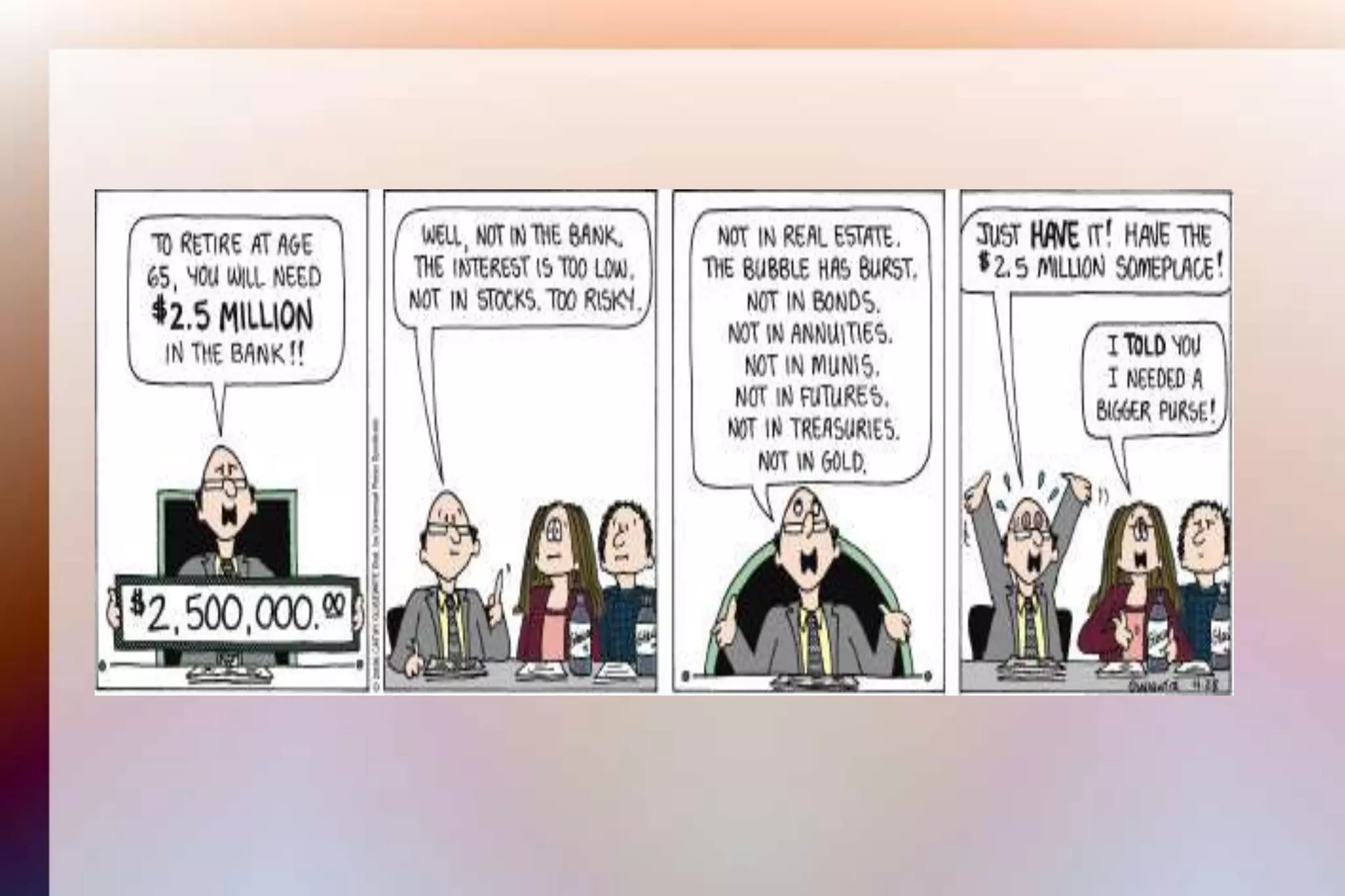
Truth #1IRS QualifiedRetirement Savings Plans403b / 457 / IRA / SEP / 401kAre a Failure!
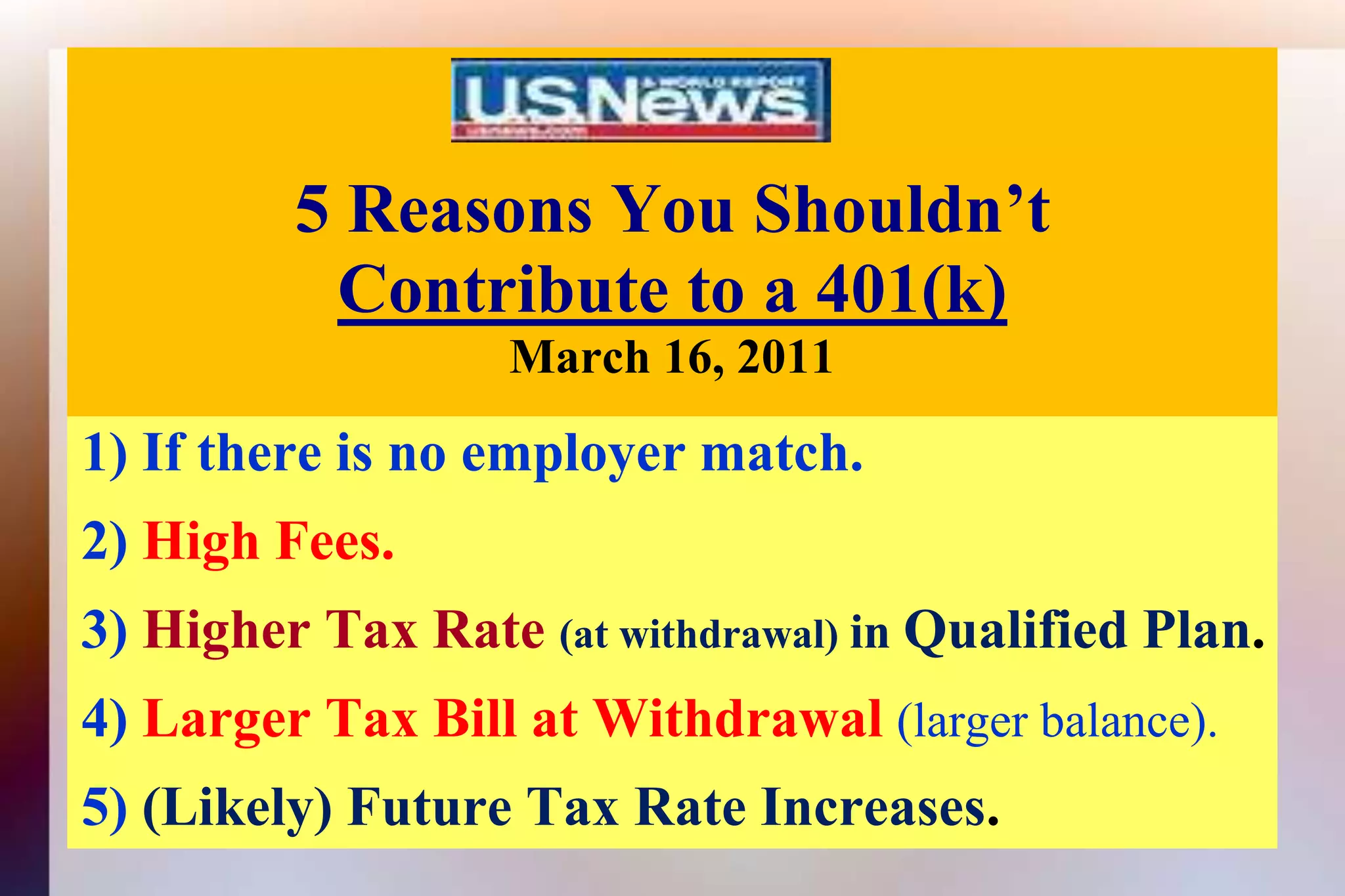
5 Reasons You Shouldn’tContribute to a 401(k)March 16, 2011 1) If there is no employer match. 2) High Fees. 3) Higher Tax Rate (at withdrawal) in Qualified Plan.4) Larger Tax Bill at Withdrawal (larger balance).5) (Likely) Future Tax Rate Increases.

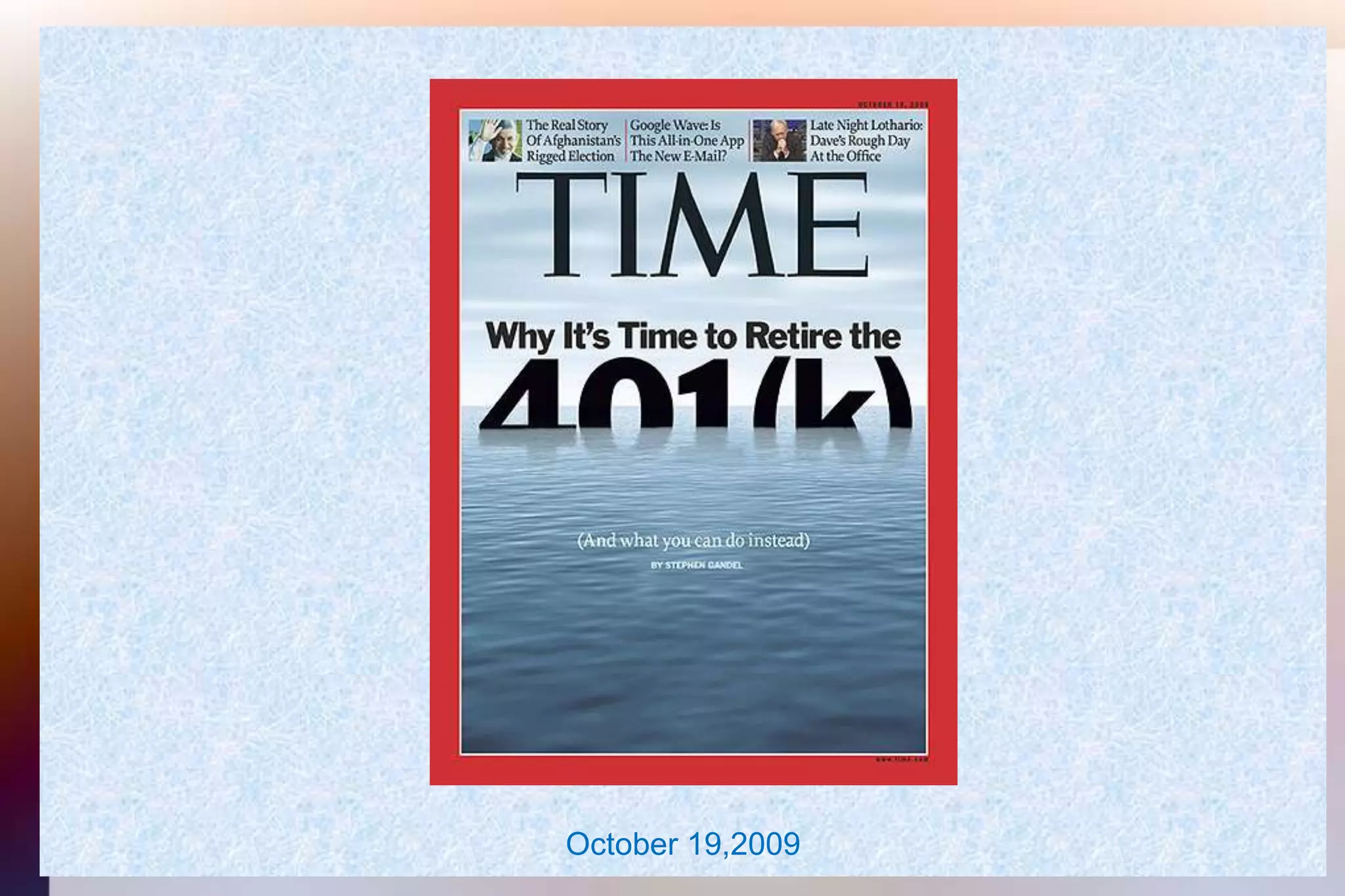
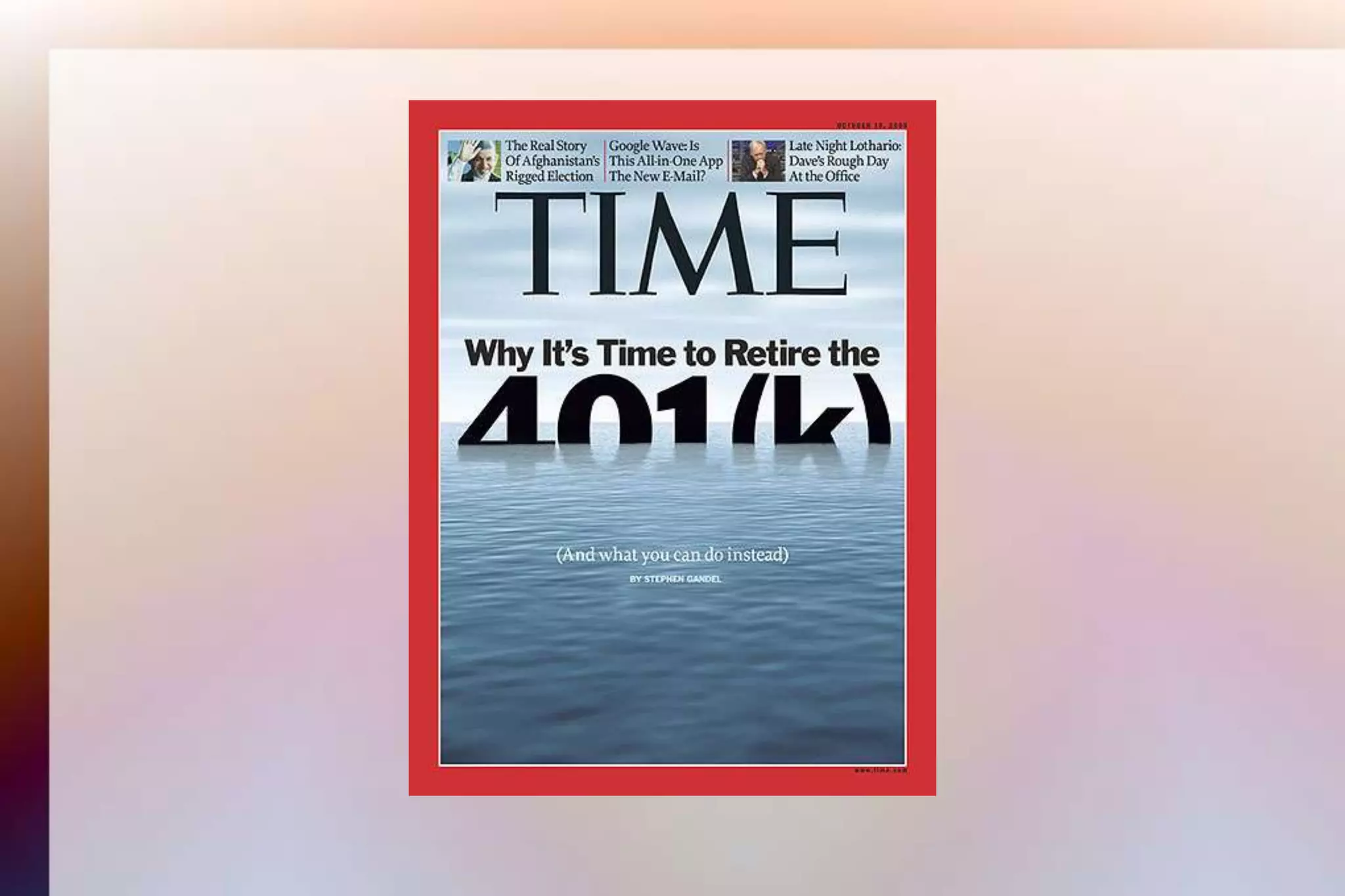
October 19,2009
“Why It’s Time to Retire the 401(k)”“The ugly truth is that the401(k) is a lousy idea,a rotten repository forour retirement reserves …”
“…The biggest factor in whether the 401(k) works as designed has    to do with when you retire. If the market rises that year, you're fine.   If you retired last year, you're toast.
“…The biggest factor in whether the 401(k) works as designed has    to do with when you retire. If the market rises that year, you're fine.   If you retired last year, you're toast.  And the chances of your    becoming a victim of this huge flaw in the 401(k) plan are pretty high.
“…The biggest factor in whether the 401(k) works as designed has    to do with when you retire. If the market rises that year, you're fine.   If you retired last year, you're toast.  And the chances of your    becoming a victim of this huge flaw in the 401(k) plan are pretty high.    The market  fell in four of the nine years since the beginning of the    decade. That means anyone retiring this decade had a nearly 50%    chance of leaving work in a down market.
“…The biggest factor in whether the 401(k) works as designed has    to do with when you retire. If the market rises that year, you're fine.   If you retired last year, you're toast.  And the chances of your    becoming a victim of this huge flaw in the 401(k) plan are pretty high.    The market  fell in four of the nine years since the beginning of the    decade. That means anyone retiring this decade had a nearly 50%    chance of leaving work in a down market.  In fact, your chances of    retiring into a down market are even greater than that:  forced    retirements spike in recessions just as the stock market is tanking.”
“Guaranteed accounts don't have to be run by the 	government. The ERISA 	Industry Committee that 	represents the nation's largest employers, has proposed 	a system that would allow individuals the ability to buy	a guaranteed retirement account on their own. Some 	government regulation would be needed, but it would be a ‘Private Plan’ .”
“But the policy would beportable. Contribute for 30 years 	and you would be guaranteed income in retirement, no 	matter how many employers you worked for.
 “But the policy would be portable. Contribute for 30 years 	and you would be guaranteed income in retirement, no 	matter how many employers you worked for.	  Combine yourretirement-insurance check with the	money you get from Social Security, which can equal as 	much as 50% of final pay, and presto: you have something 	approachingretirement security.”
 “But the policy would be portable. Contribute for 30 years 	and you would be guaranteed income in retirement, no 	matter how many employers you worked for.	  Combine yourretirement-insurance check with the	money you get from Social Security, which can equal as 	much as 50% of final pay, and presto: you have something 	approachingretirement security.”We need a NEW, Safer way to save for retirement because …
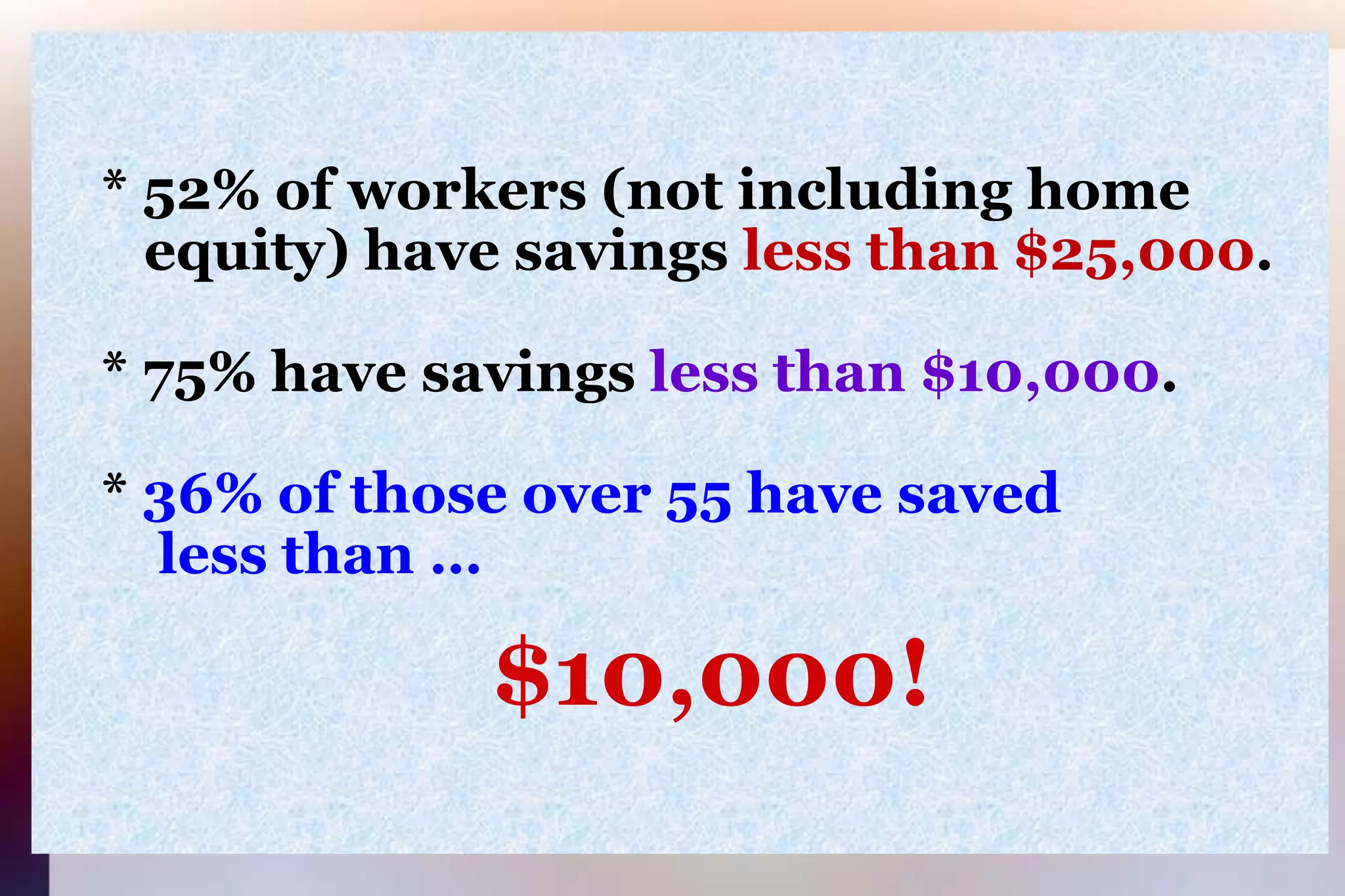
    * 52% of workers (not including home       equity) have savings less than $25,000.
    * 52% of workers (not including home       equity) have savings less than $25,000.    * 75% have savings less than $10,000.
    * 52% of workers (not including home       equity) have savings less than $25,000.    * 75% have savings less than $10,000.    * 36% of those over 55 have saved        less than …$10,000!
Most Americans will be too poor to retire at 65!Nov. 1, 2009 / Center for Retirement Research at Boston College 51% are at high risk of falling short ofhaving enough money in retirement.
Most Americans will be too poor to retire at 65!Nov. 1, 2009 / Center for Retirement Research at Boston College 51% are at high risk of falling short ofhaving enough money in retirement.  “The disappearance of pension plans, as well as troubles with the Social 	Security system, place younger Americans at a higher risk of being unable	to hold on to their standards of living during retirement. The cradle-to-the-	grave relationship with the employer is severed…
Most Americans will be too poor to retire at 65!Nov. 1, 2009 / Center for Retirement Research at Boston College 51% are at high risk of falling short ofhaving enough money in retirement.  “The disappearance of pension plans, as well as troubles with the Social 	Security system, place younger Americans at a higher risk of being unable	to hold on to their standards of living during retirement. The cradle-to-the-	grave relationship with the employer is severed…Younger people have to be responsible for their own retirement.”
Most Americans will be too poor to retire at 65!Nov. 1, 2009 / Center for Retirement Research at Boston College 51% are at high risk of falling short ofhaving enough money in retirement.	  “The disappearance of pension plans, as well as troubles with the Social 	Security system, place younger Americans at a higher risk of being unable	to hold on to their standards of living during retirement. The cradle-to-the-	grave relationship with the employer is severed…Younger people have to be responsible for their own retirement.”“Retiring won’t become impossible, but it will require some thoughtful planning.   Many workers will need to save and invest more, reducedebt and work longer to maintain their standard of living in retirement.”
Truth #2Stock Investment Gains– for Investors –are LOUSY!
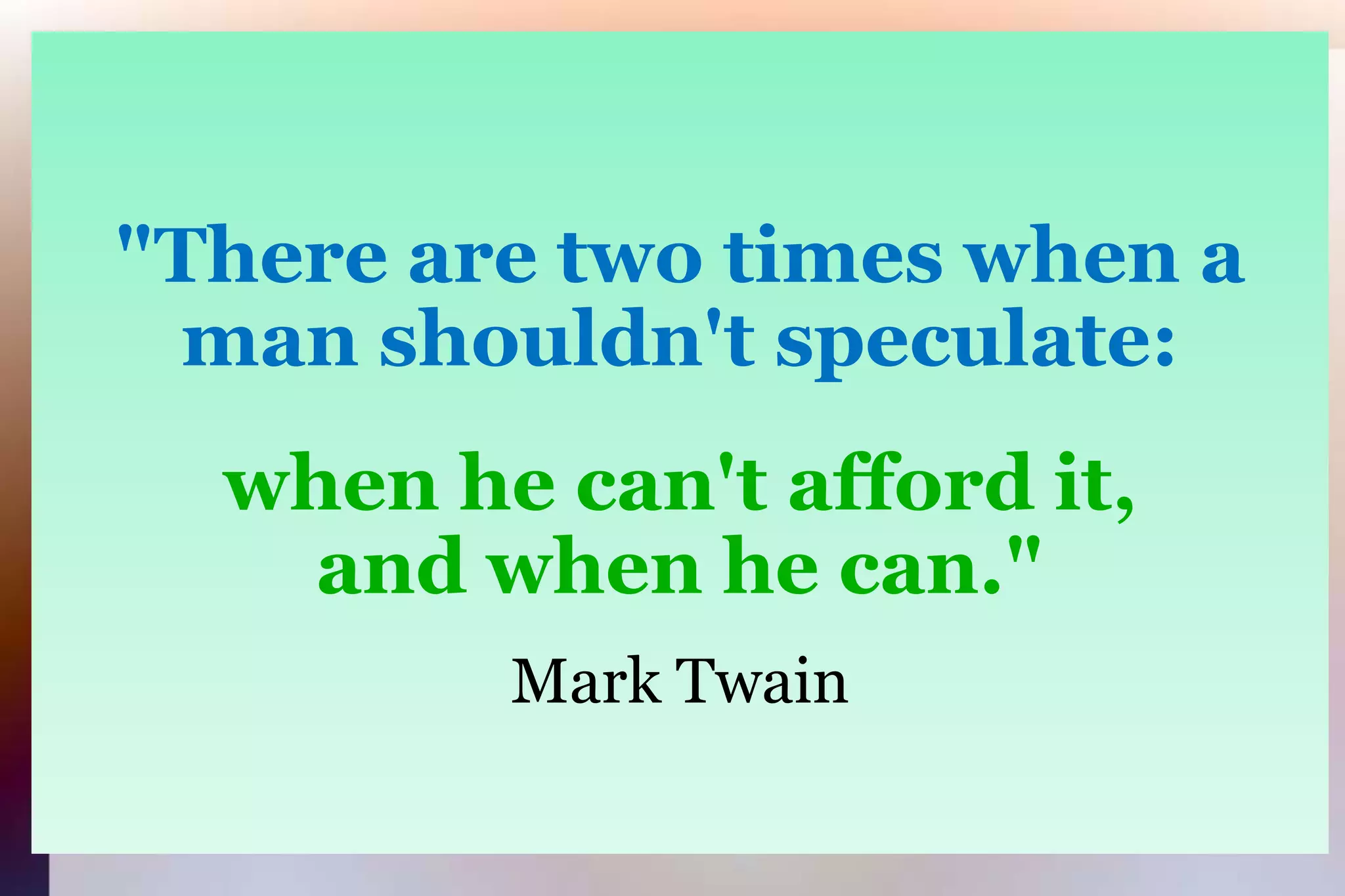
"There are two times when aman shouldn't speculate:
"There are two times when aman shouldn't speculate:when he can't afford it,and when he can."Mark Twain
Morningstar & Harvard Business SchoolBCT Study4000 Mutual Funds 1996-2002Investor ROI Net Fees = 2.924%
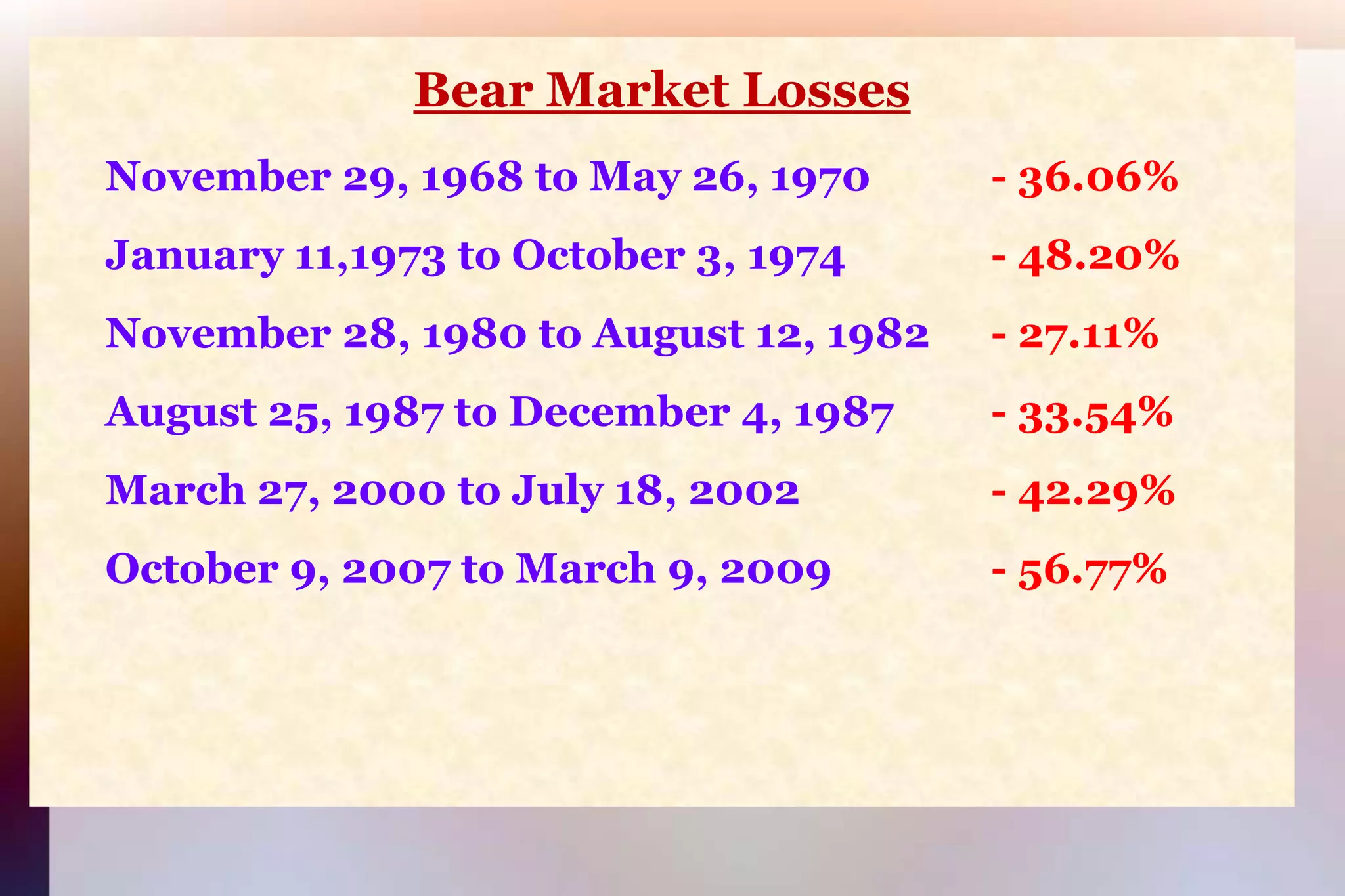
Bear Market LossesNovember 29, 1968 to May 26, 1970 - 36.06% January 11,1973 to October 3, 1974  - 48.20%November 28, 1980 to August 12, 1982	- 27.11%August 25, 1987 to December 4, 1987  - 33.54%March 27, 2000 to July 18, 2002 - 42.29%October 9, 2007 to March 9, 2009	  - 56.77%
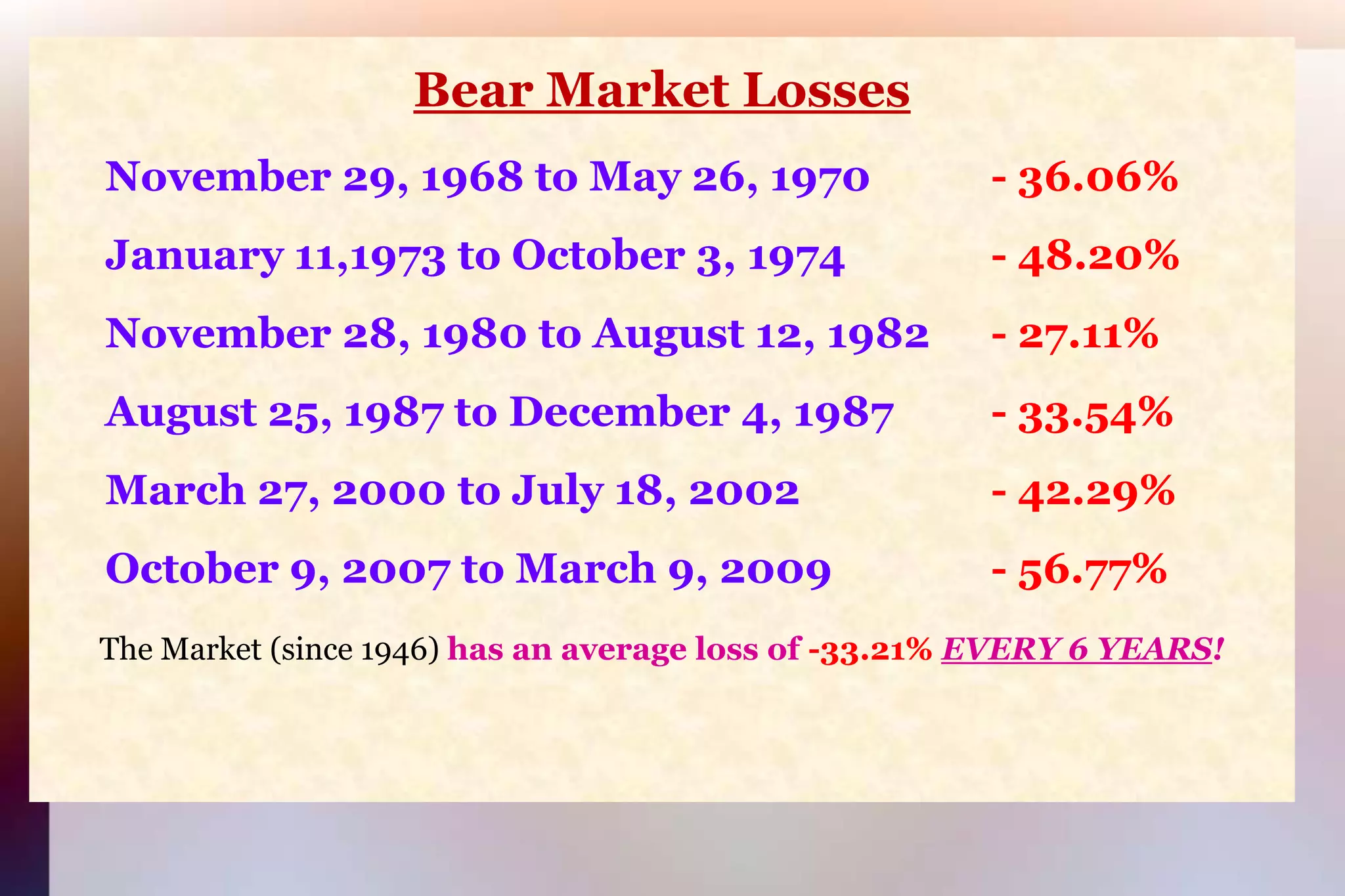
Bear Market LossesNovember 29, 1968 to May 26, 1970 - 36.06% January 11,1973 to October 3, 1974  - 48.20%November 28, 1980 to August 12, 1982	- 27.11%August 25, 1987 to December 4, 1987  - 33.54%March 27, 2000 to July 18, 2002 - 42.29%October 9, 2007 to March 9, 2009	  - 56.77%The Market (since 1946) has an average loss of -33.21% EVERY 6 YEARS!
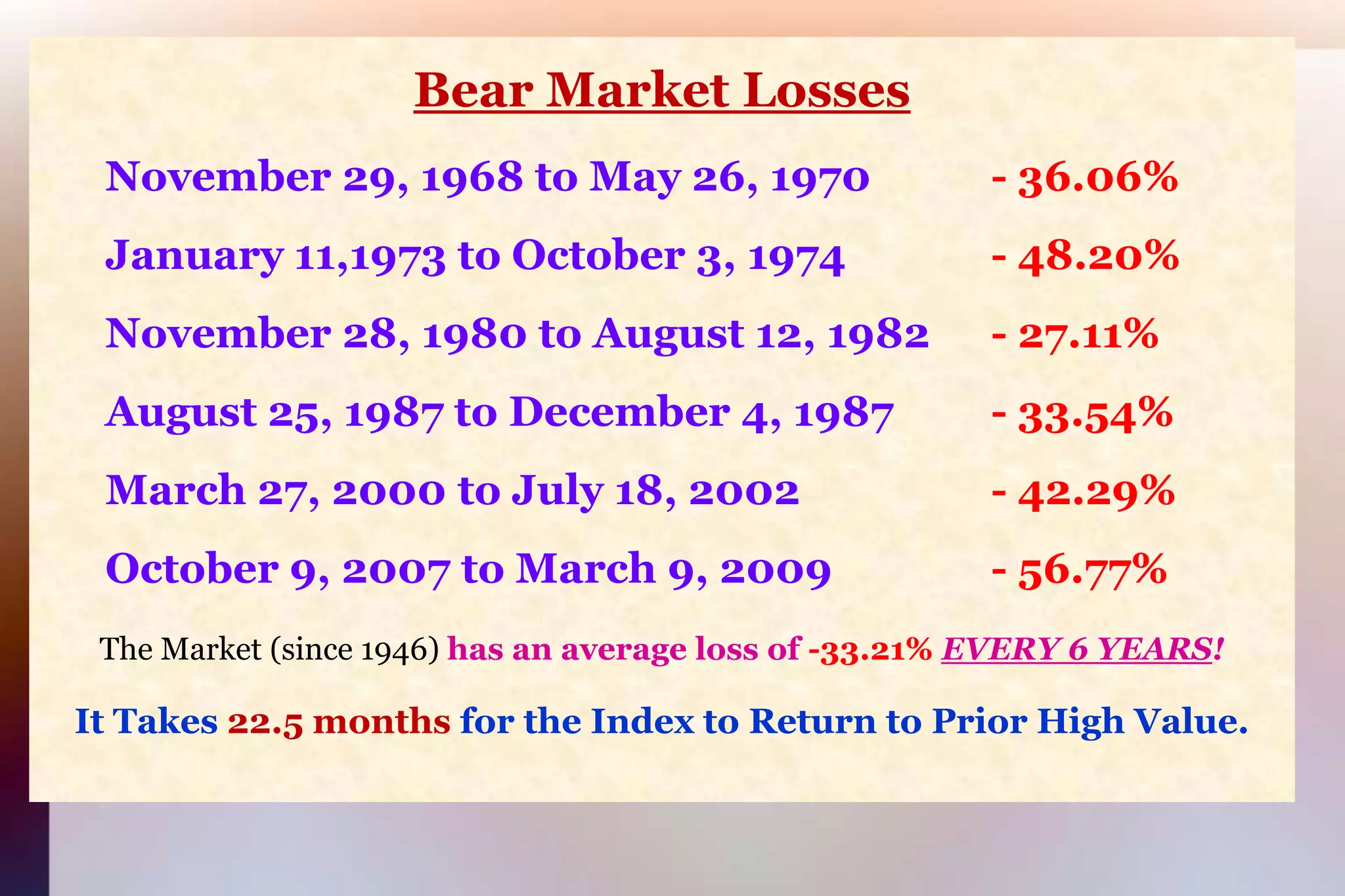
Bear Market LossesNovember 29, 1968 to May 26, 1970 - 36.06% January 11,1973 to October 3, 1974  - 48.20%November 28, 1980 to August 12, 1982	- 27.11%August 25, 1987 to December 4, 1987  - 33.54%March 27, 2000 to July 18, 2002 - 42.29%October 9, 2007 to March 9, 2009	  - 56.77%The Market (since 1946) has an average loss of -33.21% EVERY 6 YEARS!It Takes 22.5 months for the Index to Return to Prior High Value.
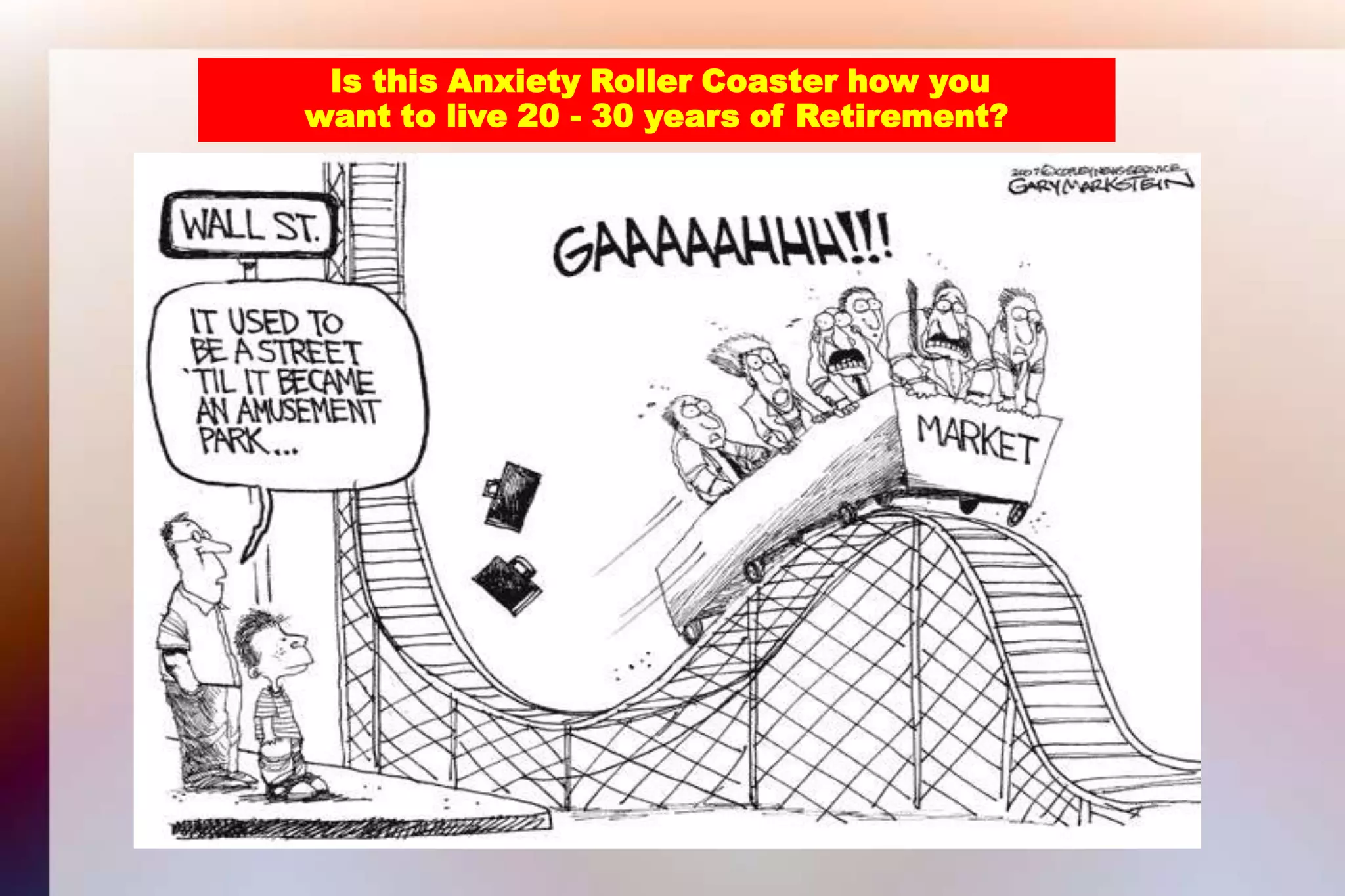
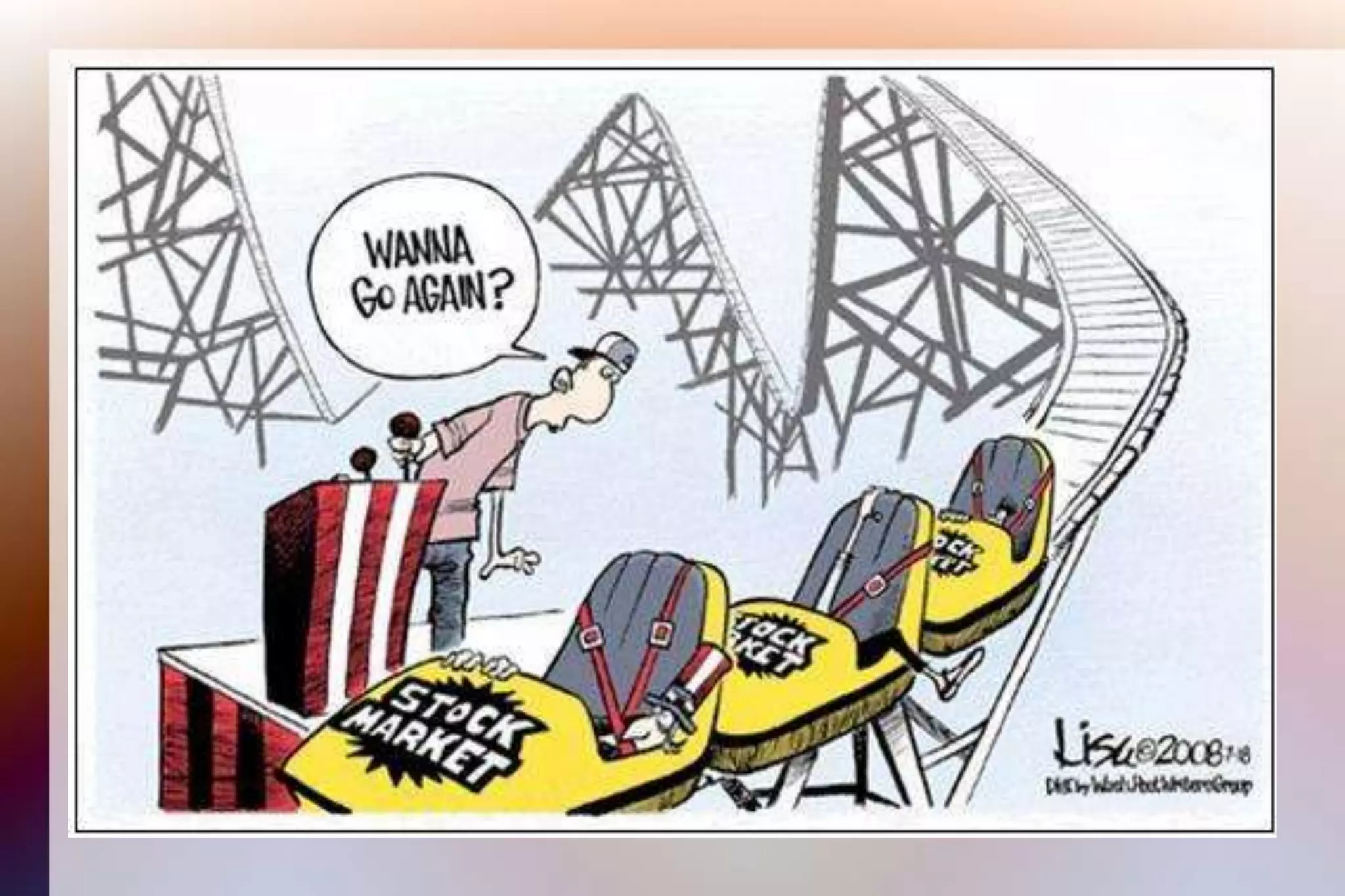
Is this Anxiety Roller Coaster how youwant to live 20 - 30 years of Retirement?
Wall Street Always Wins!Even when you lose Wall Street alwayswins with fees you ALWAYS pay –when the market goes up –AND when it goes down!
MorningstarManagement Fee [8-17-09]: 	Average domestic fee is 1.39%.										International is                 1.56%.
MorningstarManagement Fee [8-17-09]: 	Average domestic fee is 1.39%.										International is                 1.56%.Transaction Fee   [6-19-09]:  	This annual fee is            1.64%.										For Small Cap Fund it’s  2.80%.
MorningstarManagement Fee [8-17-09]: 	Average domestic fee is 1.39%.										International is                 1.56%.Transaction Fee   [6-19-09]:  	This annual fee is            1.64%.										For Small Cap Fund it’s  2.80%.“Vastly more important than expense ratios and no one’s talking about it.”			These are in ADDITION to Fund fees. You don’t control a fund’s transaction			costs. That’s determined in part by how often the fund manager trades the			securities in the fund’s portfolio, and how costly those trades are.
MorningstarManagement Fee [8-17-09]: 	Average domestic fee is 1.39%.										International is                 1.56%.Transaction Fee   [6-19-09]:  	This annual fee is            1.64%.										For Small Cap Fund it’s  2.80%.“Vastly more important than expense ratios and no one’s talking about it.”			These are in ADDITION to Fund fees. You don’t control a fund’s transaction			costs. That’s determined in part by how often the fund manager trades the			securities in the fund’s portfolio, and how costly those trades are.The Minimum Average TOTAL Actual Annual Fund Fees = 3.03%!
MorningstarManagement Fee [8-17-09]: 	Average domestic fee is 1.39%.										International is                 1.56%.Transaction Fee   [6-19-09]:  	This annual fee is            1.64%.										For Small Cap Fund it’s  2.80%.“Vastly more important than expense ratios and no one’s talking about it.”			These are in ADDITION to Fund fees. You don’t control a fund’s transaction			costs. That’s determined in part by how often the fund manager trades the			securities in the fund’s portfolio, and how costly those trades are.The Minimum Average TOTAL Actual Annual Fund Fees = 3.03%!Investment NewsERISA Costs [10-15-09]:“It's fair to say that in many cases the total ERISA(401k) drag is close to about 1% of plan assets.”
MorningstarManagement Fee [8-17-09]: 	Average domestic fee is 1.39%.										International is 1.56%.Transaction Fee   [6-19-09]:  	This annual fee is 1.64%.										For Small Cap Fund it’s 2.80%.“Vastly more important than expense ratios and no one’s talking about it.”			These are in ADDITION to Fund fees. You don’t control a fund’s transaction			costs. That’s determined in part by how often the fund manager trades the			securities in the fund’s portfolio, and how costly those trades are.The Minimum Average TOTAL Actual Annual Fund Fees = 3.03%!Investment NewsERISA Costs [10-15-09]:“It's fair to say that in many cases the total ERISA(401k) drag is close to about 1% of plan assets.”Summary: Many plans are in the range of 4% to 5% in TOTALyearly costs – the worst plans charge even more.After all the fees …
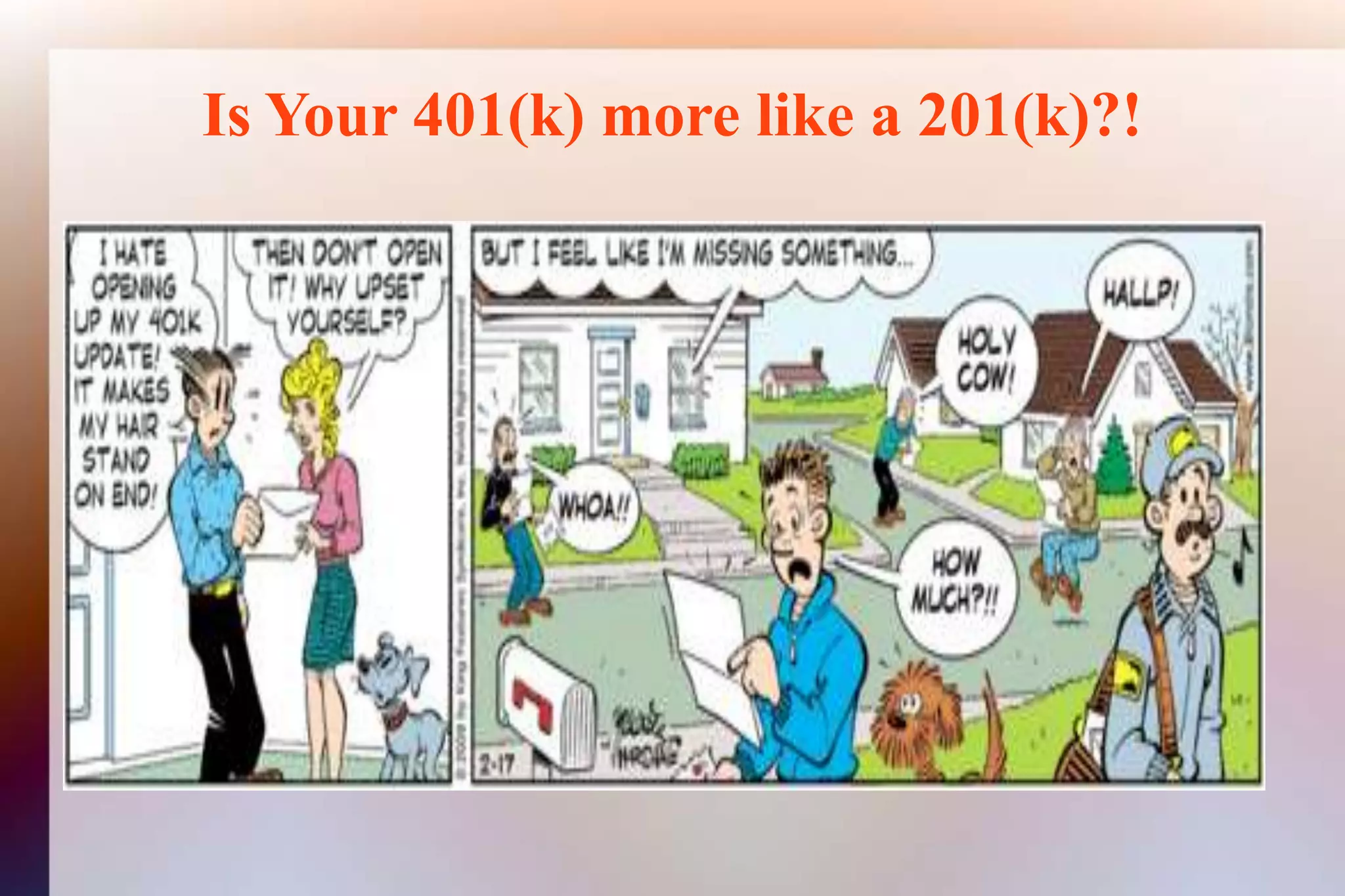
Is Your 401(k) more like a 201(k)?!
Putnam InvestmentsPresident and Chief Executive Officer Robert L. Reynoldscalls for a “ New Generation” of Workplace Savings Planswith Lower Volatility and Lifetime Income SolutionsOctober 1, 2009“After Market Meltdown, Better Plan DesignNeeded to Secure Reliable Lifetime Income” “Index funds and other passive investments that track benchmarks  are guaranteed to lose value when the markets they track   sink.
Putnam InvestmentsPresident and Chief Executive Officer Robert L. Reynoldscalls for a “ New Generation” of Workplace Savings Planswith Lower Volatility and Lifetime Income SolutionsOctober 1, 2009“After Market Meltdown, Better Plan DesignNeeded to Secure Reliable Lifetime Income” “Index funds and other passive investments that track benchmarks  are guaranteed to lose value when the markets they track   sink.  People in or near retirement are not well served by too-great a concentration of passive (index) investments, thinking they are a protection against a downturn …”
“(Retirement) plans should be made muchmore resistant to market downturns … The next challenge in workplace savingsplans will be to offer guidelines, evenguardrails, to ensure that worker’s savingsare Protected as they reach retirement age.”
BECAUSE …
THE WALL STREET JOURNALOctober 15, 2009The Lost Decade of Stock Investing“Advisers sold us a bill of goodsabout the lasting valueof real estate and stocks.”
THE WALL STREET JOURNALOctober 15, 2009The Lost Decade of Stock Investing“Advisers sold us a bill of goodsabout the lasting valueof real estate and stocks.”  “If you invested $100 in the S&P 500 at the end of the last decade,you're happy with Dow 10,000 but still hoping for a34.5% rally before year end -- just to break even.
THE WALL STREET JOURNALOctober 15, 2009The Lost Decade of Stock Investing“Advisers sold us a bill of goodsabout the lasting valueof real estate and stocks.”  “If you invested $100 in the S&P 500 at the end of the last decade,you're happy with Dow 10,000 but still hoping for a34.5% rally before year end -- just to break even.You'll need a staggering 72% rally when adjusting for inflation.”
“Quantitative Analysis of Investor Behavior”March 9, 2009DALBAR Study Reveals Carnage forEquity, Bond and Asset Allocation ShareholdersThe reality is that investors are not rational, and makebuy and sell decisions at the worst possible moments.
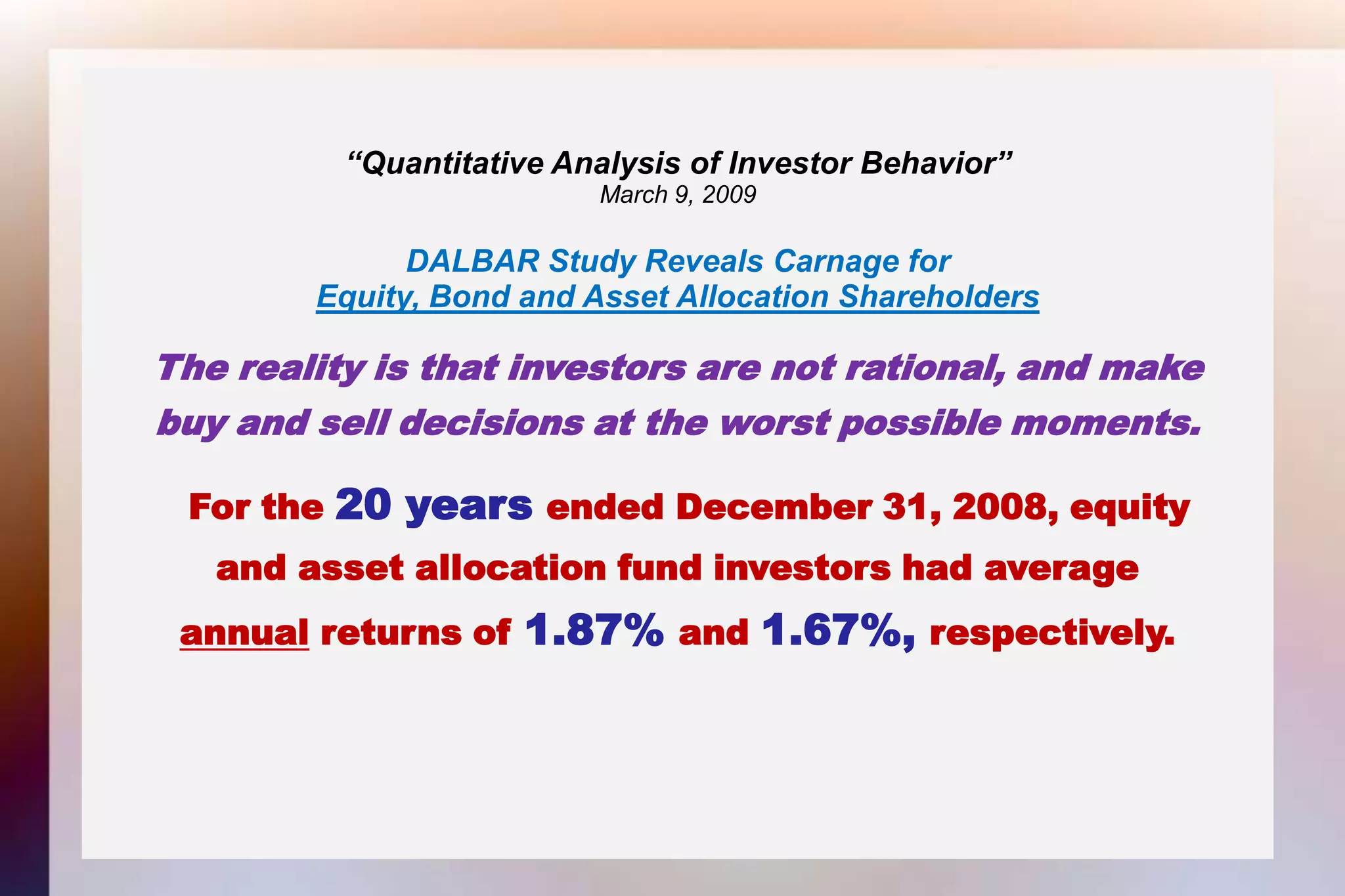
“Quantitative Analysis of Investor Behavior”March 9, 2009DALBAR Study Reveals Carnage forEquity, Bond and Asset Allocation ShareholdersThe reality is that investors are not rational, and makebuy and sell decisions at the worst possible moments.For the 20 years ended December 31, 2008, equityand asset allocation fund investors had averageannual returns of 1.87% and 1.67%, respectively.
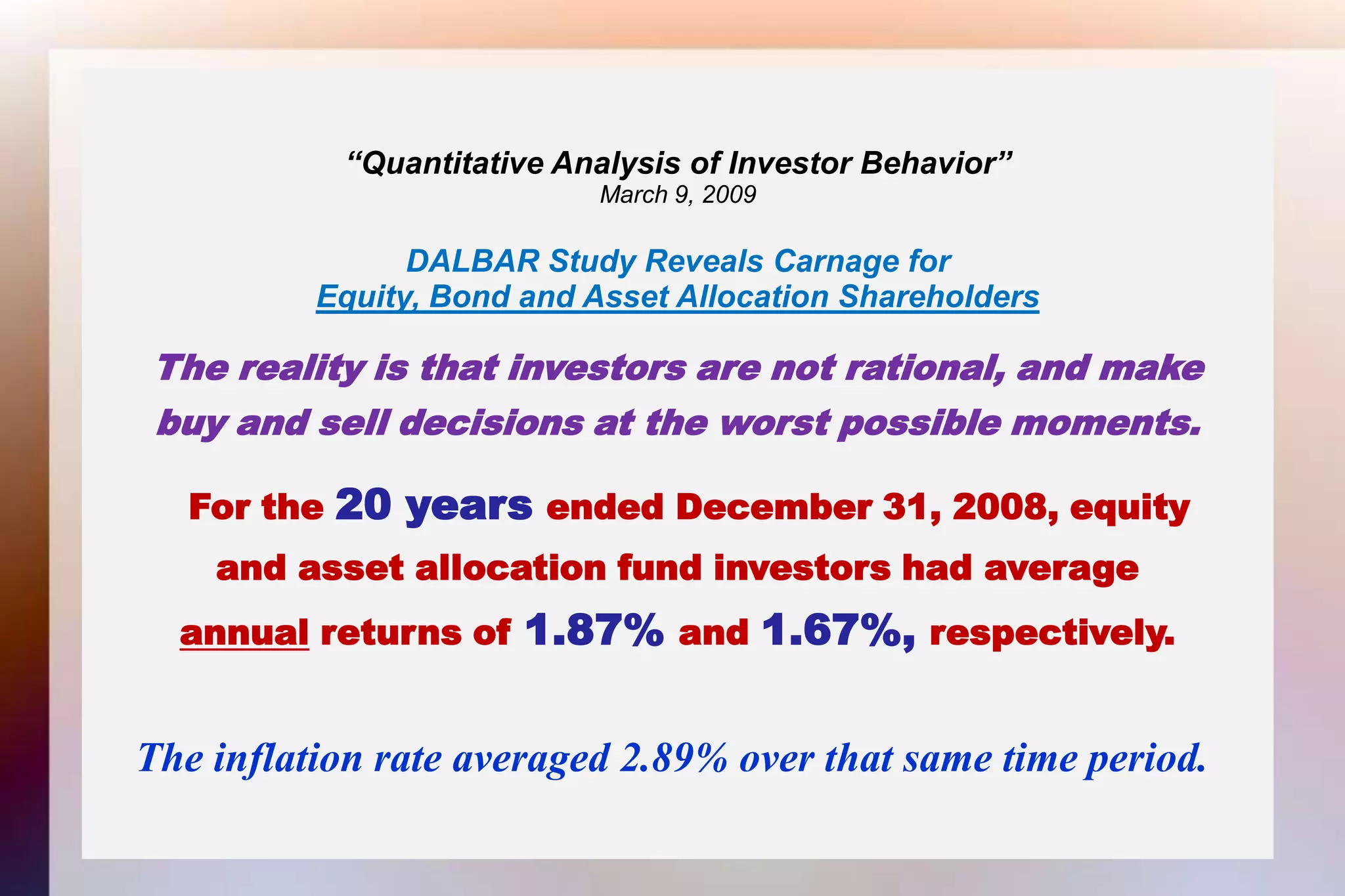
“Quantitative Analysis of Investor Behavior”March 9, 2009DALBAR Study Reveals Carnage forEquity, Bond and Asset Allocation ShareholdersThe reality is that investors are not rational, and makebuy and sell decisions at the worst possible moments.For the 20 years ended December 31, 2008, equityand asset allocation fund investors had averageannual returns of 1.87% and 1.67%, respectively. The inflation rate averaged 2.89% over that same time period. 
What About the Future?
What About the Future?Market Watch – Wall Street Journal / 12-7-10‘10 reasons to shun stocks till banks crash’“Do not buy stocks. Not for retirement.Not in the coming decade. Don’t. Huge risks.” “Wall Street is a loser. Stocks are Wall Street’s ultimate sucker bet. And it’ll sucker you again. You’ll lose, worse than in the last decade. Wake up before Wall Street banks trigger the next meltdown, igniting mass bankruptcy.”
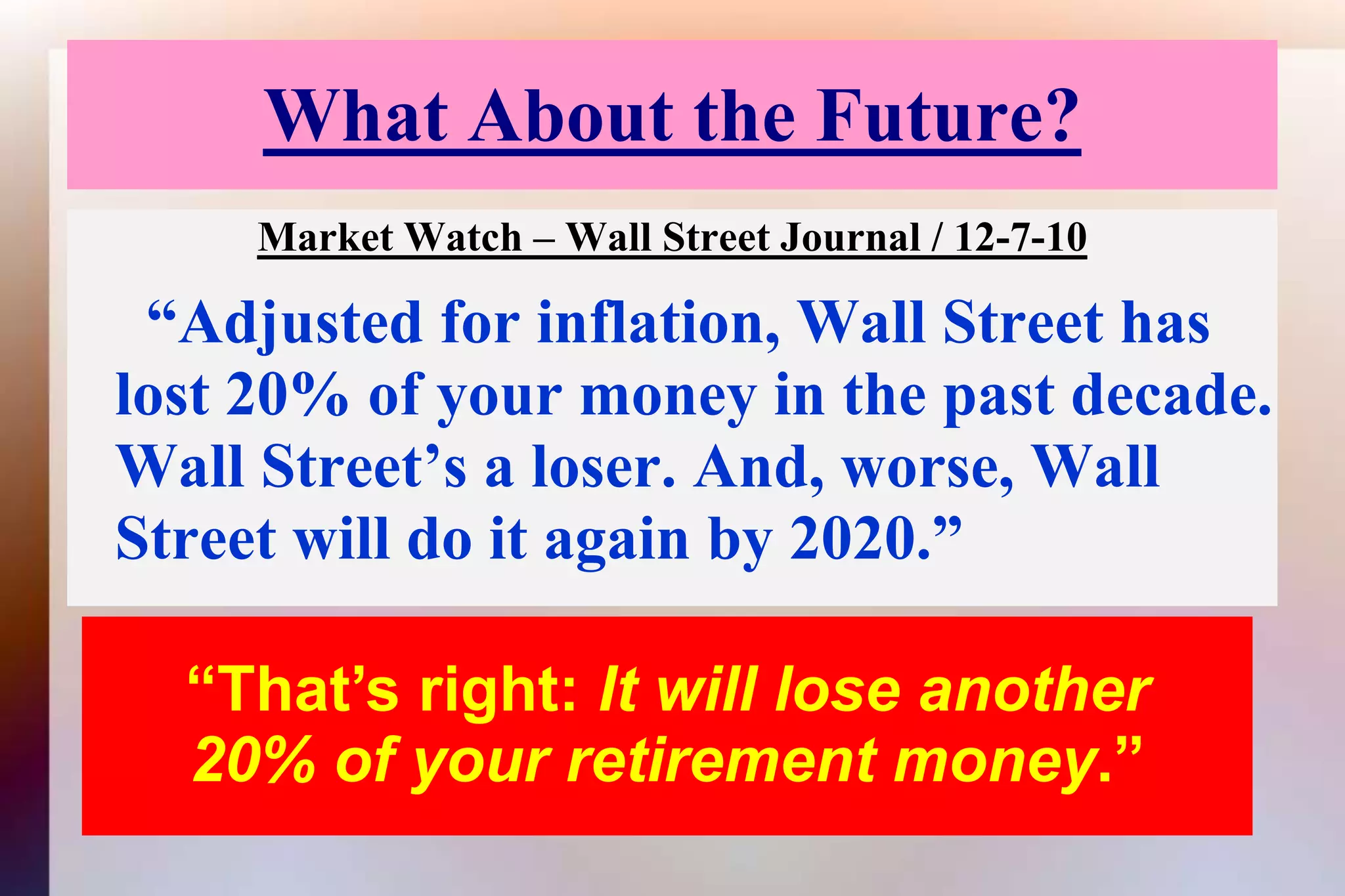
What About the Future?Market Watch – Wall Street Journal / 12-7-10“Adjusted for inflation, Wall Street has lost 20% of your money in the past decade. Wall Street’s a loser. And, worse, Wall Street will do it again by 2020.”
What About the Future?Market Watch – Wall Street Journal / 12-7-10  “Adjusted for inflation, Wall Street has lost 20% of your money in the past decade. Wall Street’s a loser. And, worse, Wall Street will do it again by 2020.” “That’s right: It will lose another20% of your retirement money.”
With Retirement Savings,It’s a Sprint to the Finish21 January 2011    “What would you do if your financialplanner prescribed the following advice?‘Save and invest diligently for 30 years,then cross your fingers and pray your investments will double over the lastdecade before you retire’.”
With Retirement Savings,It’s a Sprint to the Finish21 January 2011    “What would you do if your financialplanner prescribed the following advice?‘Save and invest diligently for 30 years,then cross your fingers and pray your investments will double over the lastdecade before you retire’.” “You might as well go to Las Vegas.”
With Retirement Savings,It’s a Sprint to the Finish21 January 2011  “The problem is that even if you do everything right and save at a respectable rate, you’re still relying on the market to push you to the finish line in the last decade before retirement. Why?
With Retirement Savings,It’s a Sprint to the Finish21 January 2011  “The problem is that even if you do everything right and save at a respectable rate, you’re still relying on the market to push you to the finish line in the last decade before retirement. Why?     Reaching your goal is highly dependent on the power of compounding.”
With Retirement Savings,It’s a Sprint to the Finish21 January 2011“But if you’re dealt a bad set of returns during an extended period of time just before you retire or shortly thereafter, your plan could be thrown wildly off track. Many baby boomers know the feeling all too well, given the stock market’s weak showing during the last decade.”
21 January 2011  “The homestretch before retirement is   often  the most anxiety-inducing because workers  have neither the time nor the financial capacity to recover before they begin taking withdrawals.”“When the bad returns come in thefinal  10 years, no reasonable amountof savings will make up the shortfall.”
LOST DECADEThe Stock Market Roller Coaster of 2000 – 2009left these years known as the “Lost Decade”..After average costs $1 after 10 yearswas worth 55 cents!
LOST DECADEThe Stock Market Roller Coaster of 2000 – 2009left these years known as the “Lost Decade”..After average costs $1 after 10 yearswas worth 55 cents!.The ROI was – 44.96%!
Albert EinsteinInsanity:"Doing the same thing		 over and over
Albert EinsteinInsanity:"Doing the same thing		 over and over andexpecting different results."
Truth #3Taxes MUST go UP!
August 19,2009Don't put any more money in yourtax-deferred retirement savings
August 19,2009Don't put any more money in yourtax-deferred retirement savings“This is heresy in a world where people hate taxes … (but) thingshave changed in the past year … The old thinking was that youshould defer tax bills until ‘you are in a lower bracket at retirement’.
August 19,2009Don't put any more money in yourtax-deferred retirement savings“This is heresy in a world where people hate taxes … (but) thingshave changed in the past year … The old thinking was that youshould defer tax bills until ‘you are in a lower bracket at retirement’.Higher bracket is more like it.
August 19,2009Don't put any more money in yourtax-deferred retirement savings“This is heresy in a world where people hate taxes … (but) thingshave changed in the past year … The old thinking was that youshould defer tax bills until ‘you are in a lower bracket at retirement’.Higher bracket is more like it.If you are 45 and prosperous, plan on big federal deficitsand higher income taxes when you retire in 2031.
August 19,2009Don't put any more money in yourtax-deferred retirement savings“This is heresy in a world where people hate taxes … (but) thingshave changed in the past year … The old thinking was that youshould defer tax bills until ‘you are in a lower bracket at retirement’.Higher bracket is more like it.If you are 45 and prosperous, plan on big federal deficitsand higher income taxes when you retire in 2031.You might be better off skipping the 401(k).
August 19,2009Don't put any more money in yourtax-deferred retirement savings“This is heresy in a world where people hate taxes … (but) thingshave changed in the past year … The old thinking was that youshould defer tax bills until ‘you are in a lower bracket at retirement’.Higher bracket is more like it.If you are 45 and prosperous, plan on big federal deficitsand higher income taxes when you retire in 2031.You might be better off skipping the 401(k).Maybe you should pay tax on your salary now!”
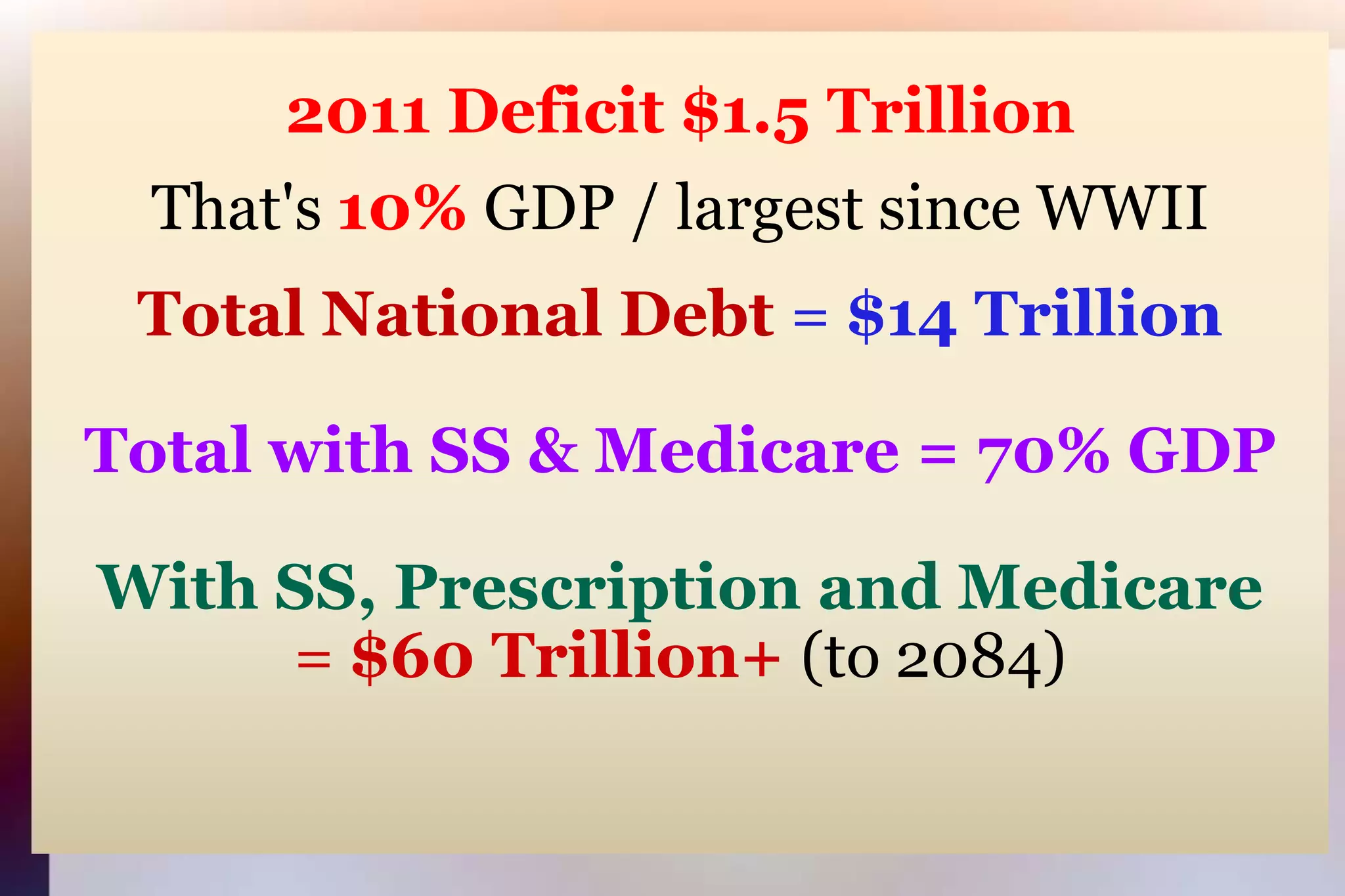
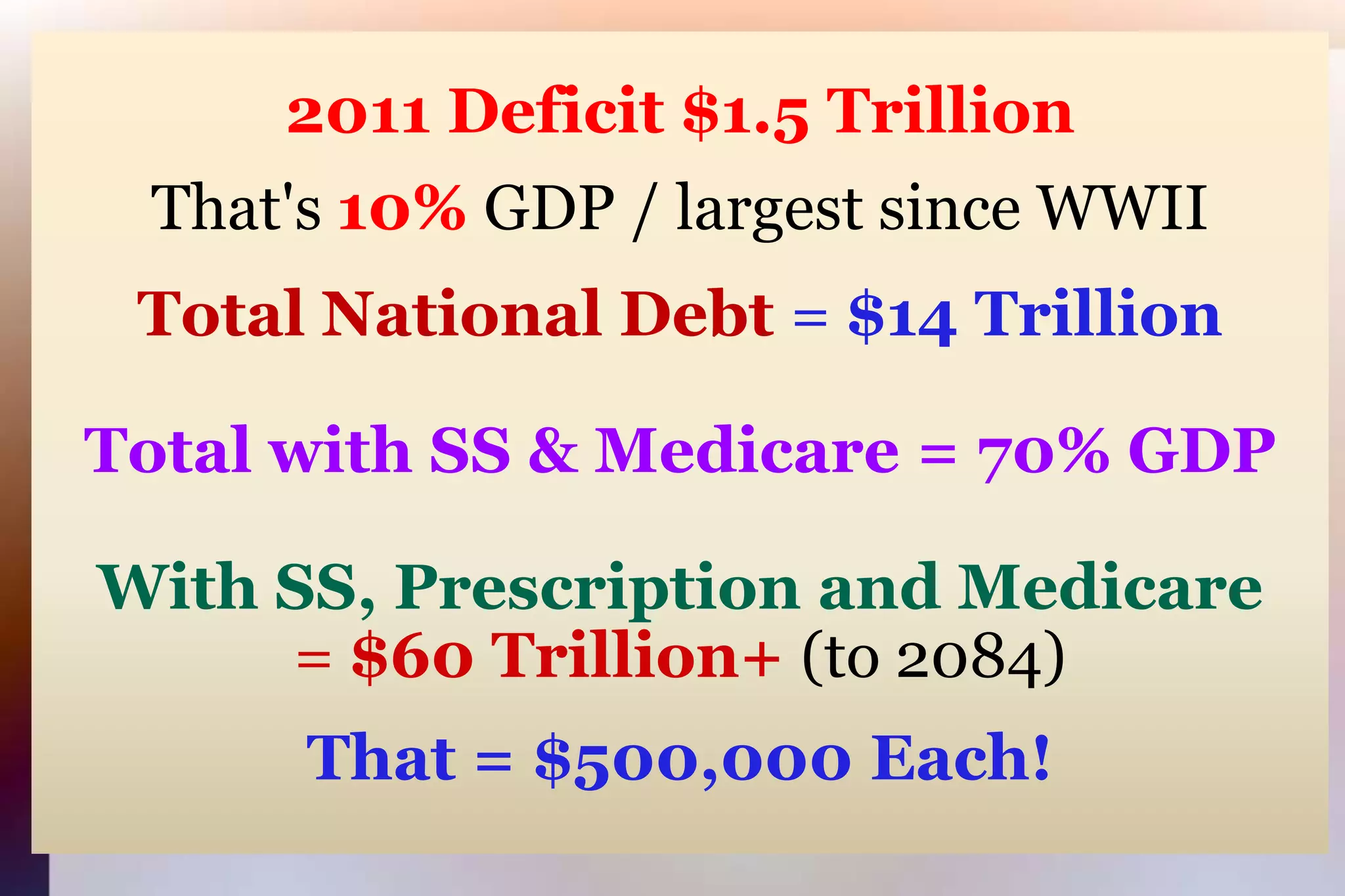
2011 Deficit $1.5 TrillionThat's 10% GDP / largest since WWII
2011 Deficit $1.5 TrillionThat's 10% GDP / largest since WWIITotal National Debt = $14 Trillion
2011 Deficit $1.5 TrillionThat's 10% GDP / largest since WWIITotal National Debt = $14 TrillionTotal with SS & Medicare = 70% GDP
2011 Deficit $1.5 TrillionThat's 10% GDP / largest since WWIITotal National Debt = $14 TrillionTotal with SS & Medicare = 70% GDPWith SS, Prescription and Medicare= $60 Trillion+ (to 2084)
2011 Deficit $1.5 TrillionThat's 10% GDP / largest since WWIITotal National Debt = $14 TrillionTotal with SS & Medicare = 70% GDPWith SS, Prescription and Medicare= $60 Trillion+ (to 2084)That = $500,000 Each!
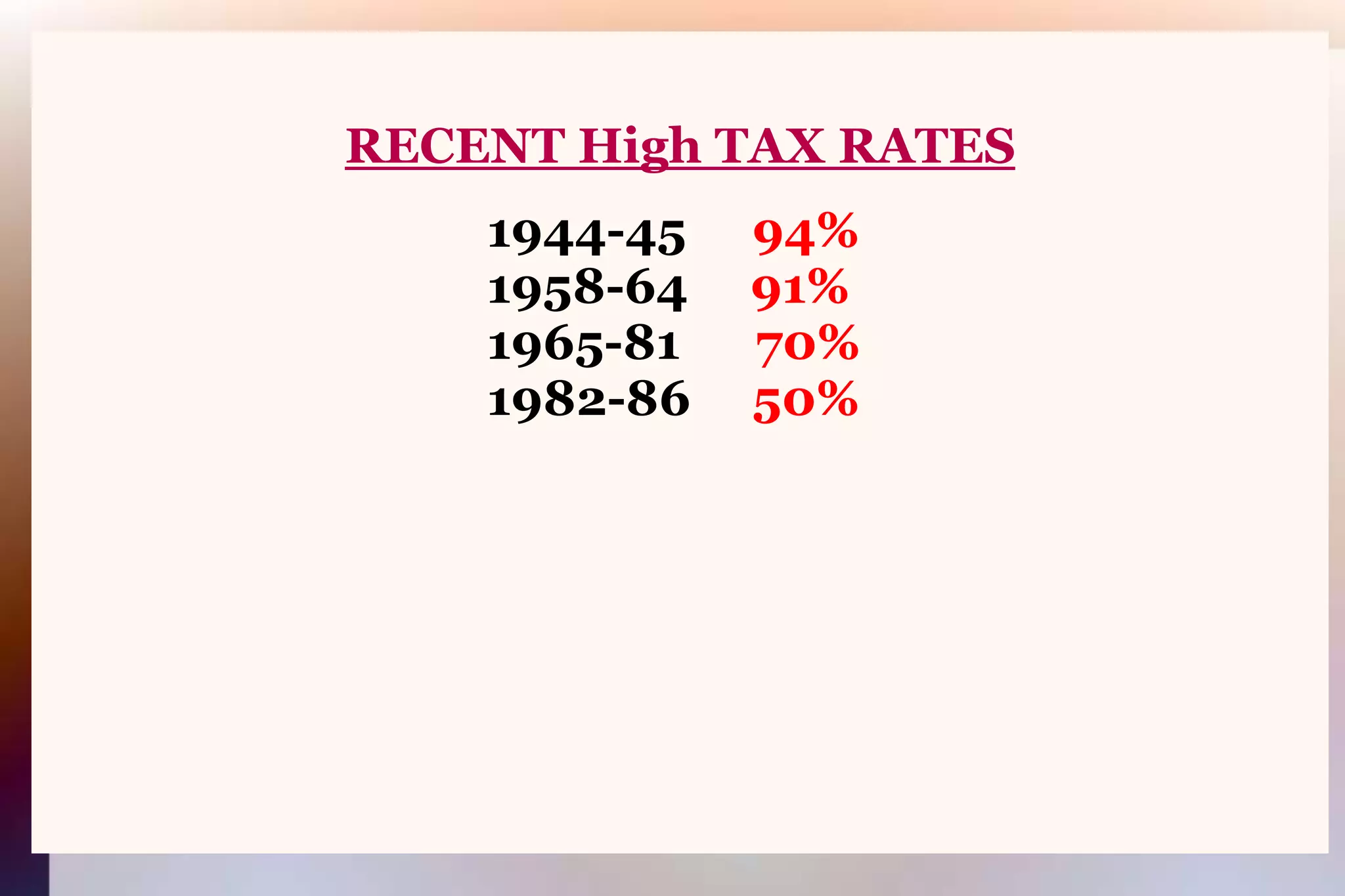
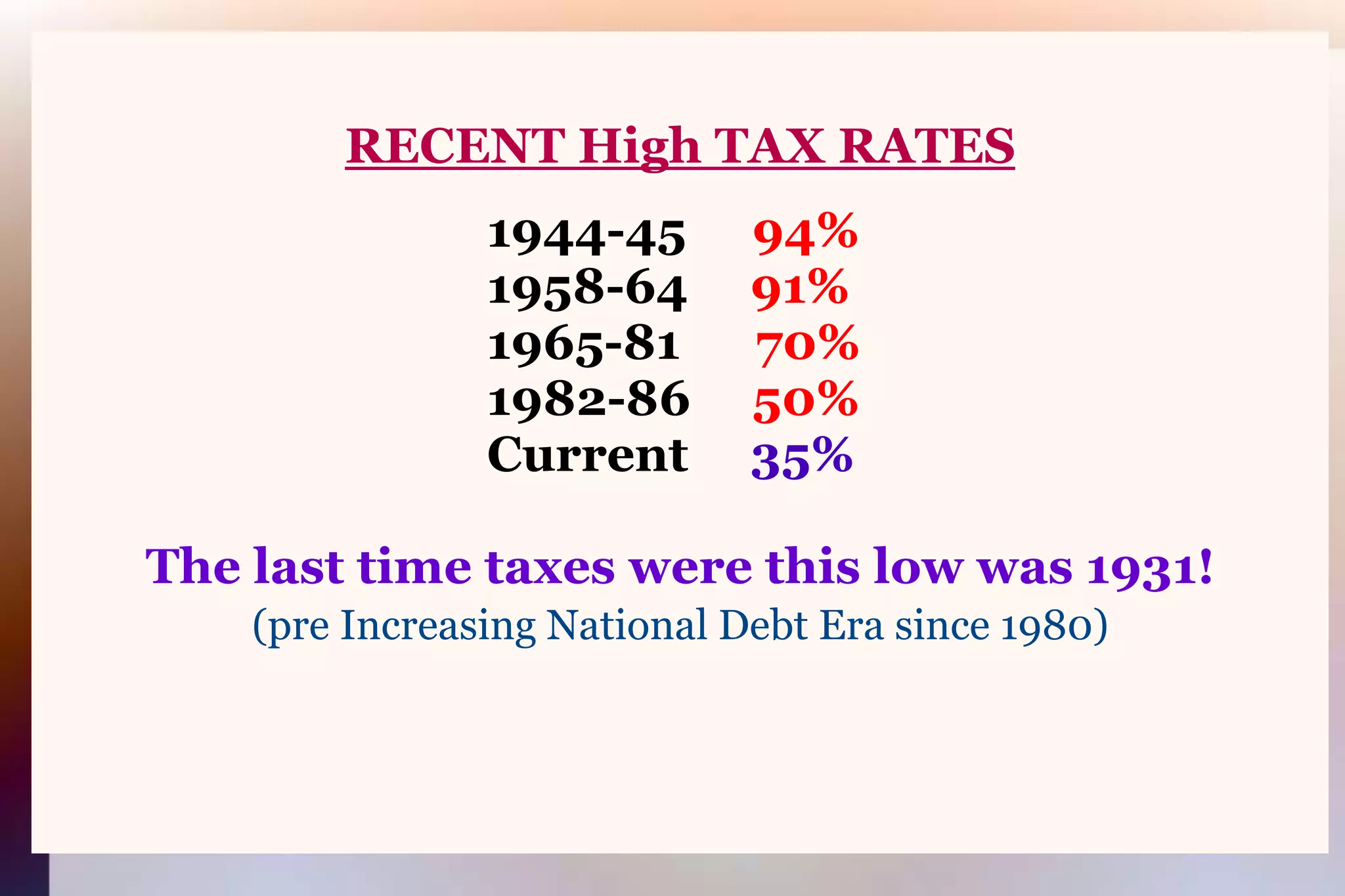
RECENT High TAX RATES								1944-4594%								1958-64     91%								1965-81      70%								1982-8650%
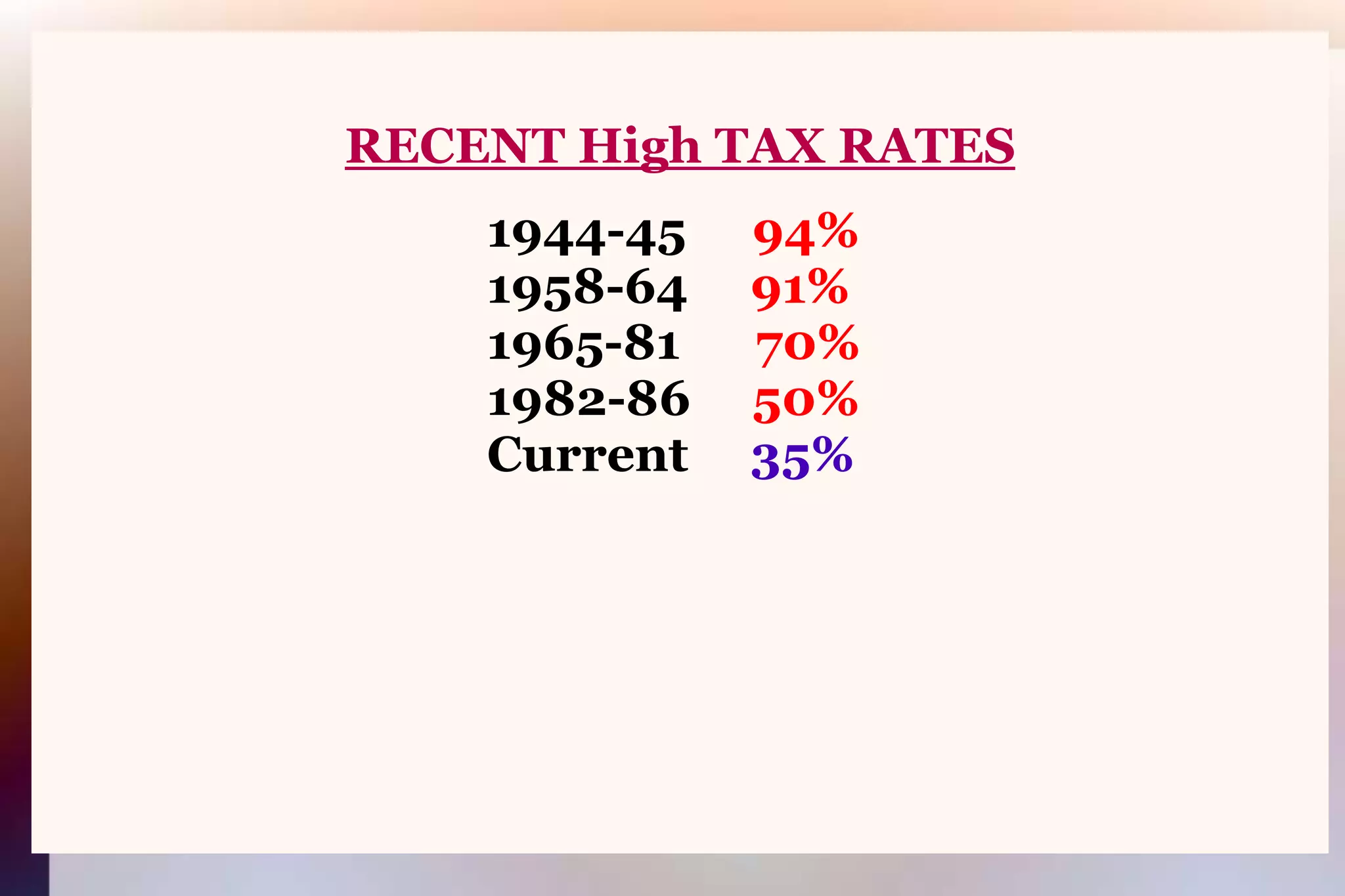
RECENT High TAX RATES								1944-4594%								1958-64     91%								1965-81      70%								1982-8650%							Current     35%
RECENT High TAX RATES								1944-4594%								1958-64     91%								1965-81      70%								1982-8650%							Current     35%The last time taxes were this low was 1931! (pre Increasing National Debt Era since 1980)
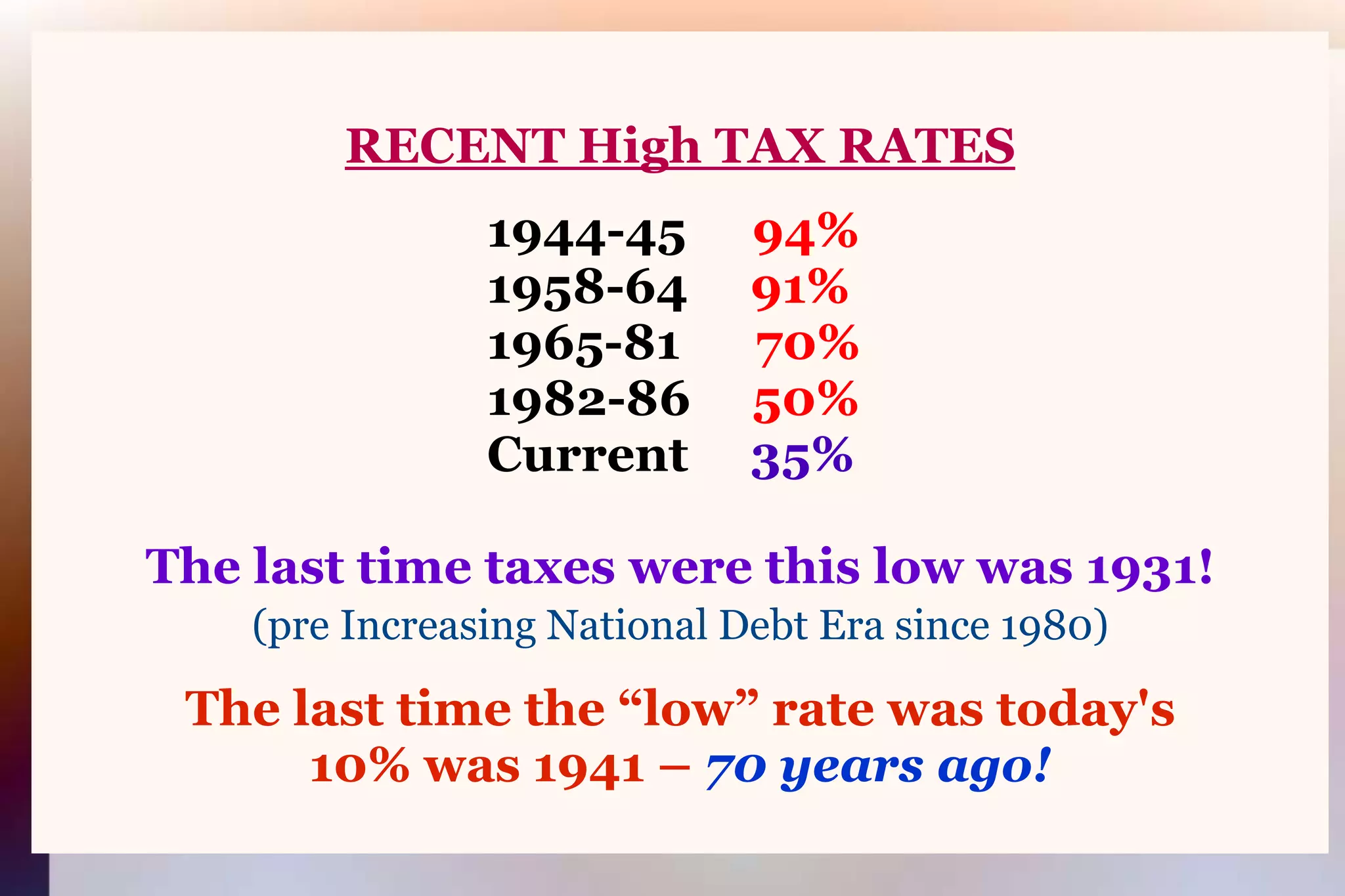
RECENT High TAX RATES								1944-4594%								1958-64     91%								1965-81      70%								1982-8650%							Current     35%The last time taxes were this low was 1931! (pre Increasing National Debt Era since 1980)The last time the “low” rate was today's10% was 1941 – 70 years ago!
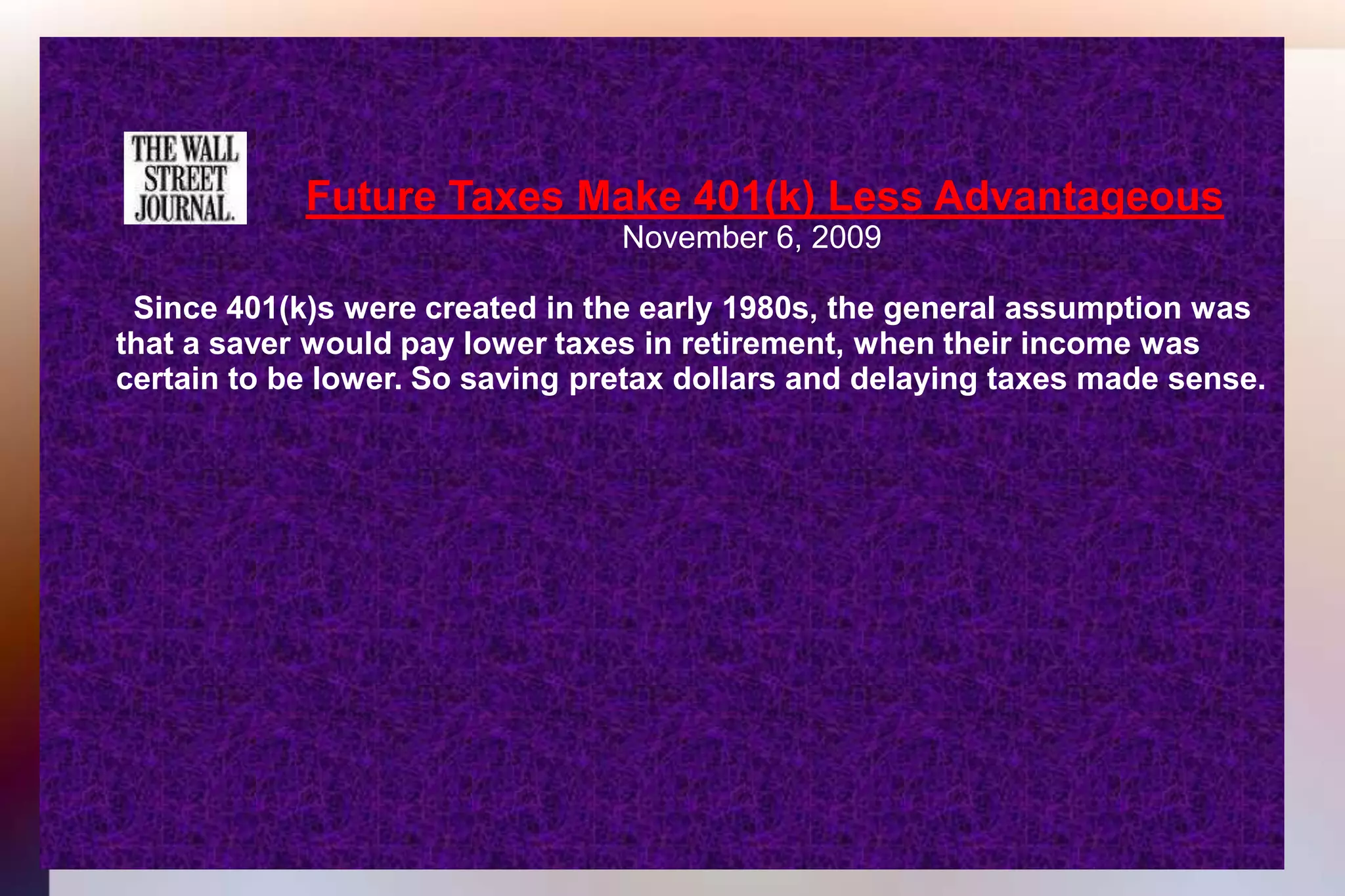
Future Taxes Make 401(k) Less Advantageous 									November 6, 2009 	  Since 401(k)s were created in the early 1980s, the general assumption was 	that a saver would pay lower taxes in retirement, when their income was 	certain to be lower. So saving pretax dollars and delaying taxes made sense.
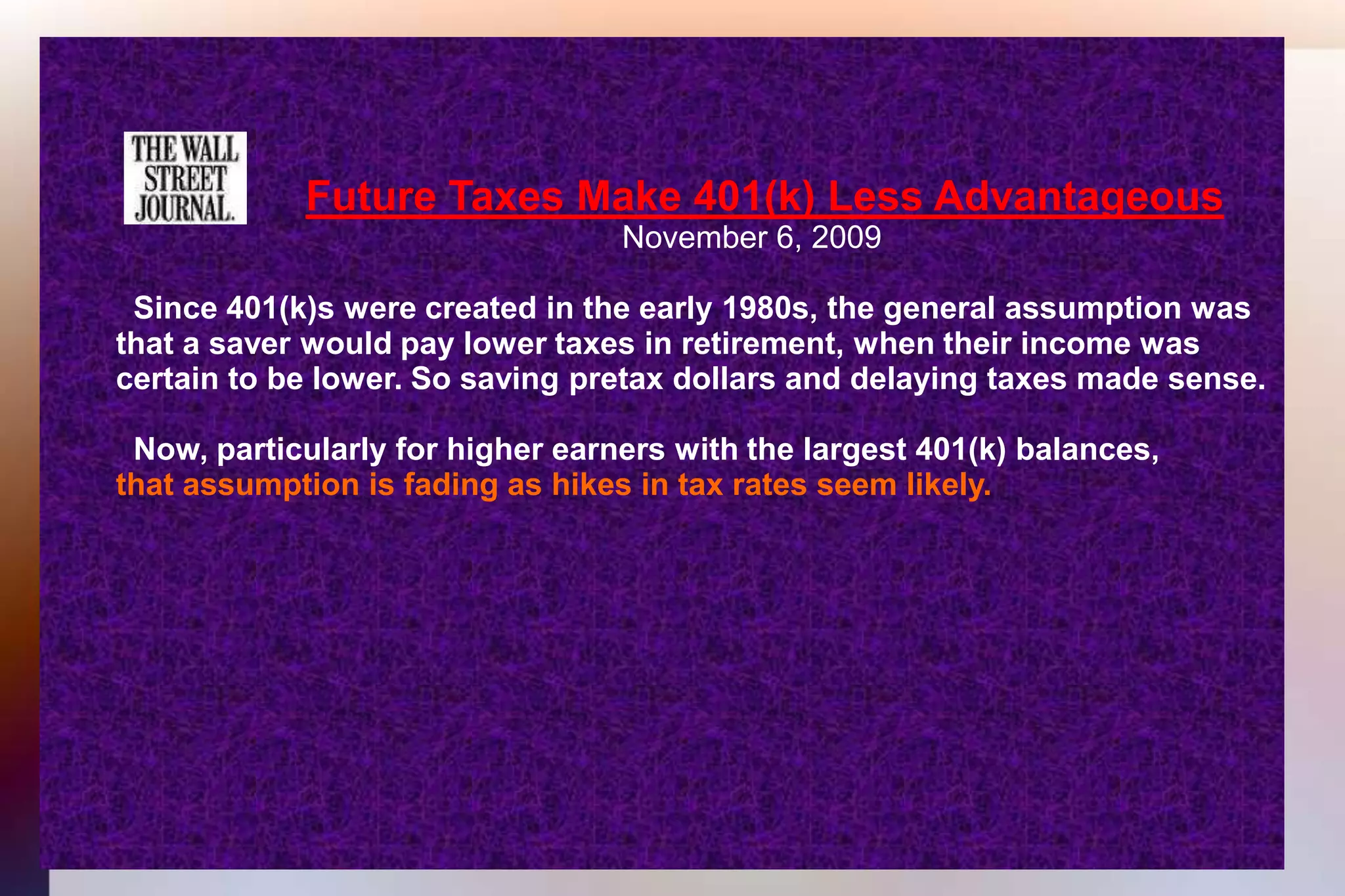
Future Taxes Make 401(k) Less Advantageous 									November 6, 2009 	  Since 401(k)s were created in the early 1980s, the general assumption was 	that a saver would pay lower taxes in retirement, when their income was 	certain to be lower. So saving pretax dollars and delaying taxes made sense.	  Now, particularly for higher earners with the largest 401(k) balances,that assumption is fading as hikes in tax rates seem likely.
Future Taxes Make 401(k) Less Advantageous 									November 6, 2009 	  Since 401(k)s were created in the early 1980s, the general assumption was 	that a saver would pay lower taxes in retirement, when their income was 	certain to be lower. So saving pretax dollars and delaying taxes made sense.	  Now, particularly for higher earners with the largest 401(k) balances,that assumption is fading as hikes in tax rates seem likely. 	  (Another) problem high earners may face by saving only in a pretax 401(k)	is that, years later, large withdrawals could trigger the tax on Social Security.
Future Taxes Make 401(k) Less Advantageous 									November 6, 2009 	  Since 401(k)s were created in the early 1980s, the general assumption was 	that a saver would pay lower taxes in retirement, when their income was 	certain to be lower. So saving pretax dollars and delaying taxes made sense.	  Now, particularly for higher earners with the largest 401(k) balances,that assumption is fading as hikes in tax rates seem likely. 	  (Another) problem high earners may face by saving only in a pretax 401(k)	is that, years later, large withdrawals could trigger the tax on Social Security.	  (Not deferring taxes) is a good choice for higher earners whose income	isn't likely to fall in retirement and for young investors, who will likely see 	their salaries and taxes increase.
                    / 22 October 2008"It's Time for Young Voters to Get Mad!"To Voters under 35:"You have a heavily mortgaged future.You'll pay for Social Security andMedicare for aging baby boomers ...
                    / 22 October 2008"It's Time for Young Voters to Get Mad!"To Voters under 35:"You have a heavily mortgaged future.You'll pay for Social Security andMedicare for aging baby boomers ...the needed federal tax increase might total 50% over the next 25 years."
Truth #4Social Security is NOT Secure!
        Social Security is going BROKE!2008        - 65% Rely on SS for 50%          of their income!
        Social Security is going BROKE!2008        - 65% Rely on SS for 50%          of their income!        - 33% Rely on SS for 90% of their income!
        Social Security is going BROKE!2008        - 65% Rely on SS for 50%          of their income!        - 33% Rely on SS for 90% of their income!        - Accounts for 1/3 of discretionary income            for couples earning over $500,000 year!
        Social Security is going BROKE!2008        - 65% Rely on SS for 50%          of their income!        - 33% Rely on SS for 90% of their income!        - Accounts for 1/3 of discretionary income            for couples earning over $500,000 year!        - 1 in 7 Americans receive a check from SS!
        Social Security is going BROKE!2008        - 65% Rely on SS for 50%          of their income!        - 33% Rely on SS for 90% of their income!        - Accounts for 1/3 of discretionary income            for couples earning over $500,000 year!        - 1 in 7 Americans receive a check from SS!        - # Workers per Retiree:                    1960 = 5          2009 = 3.3          2020 = 2!
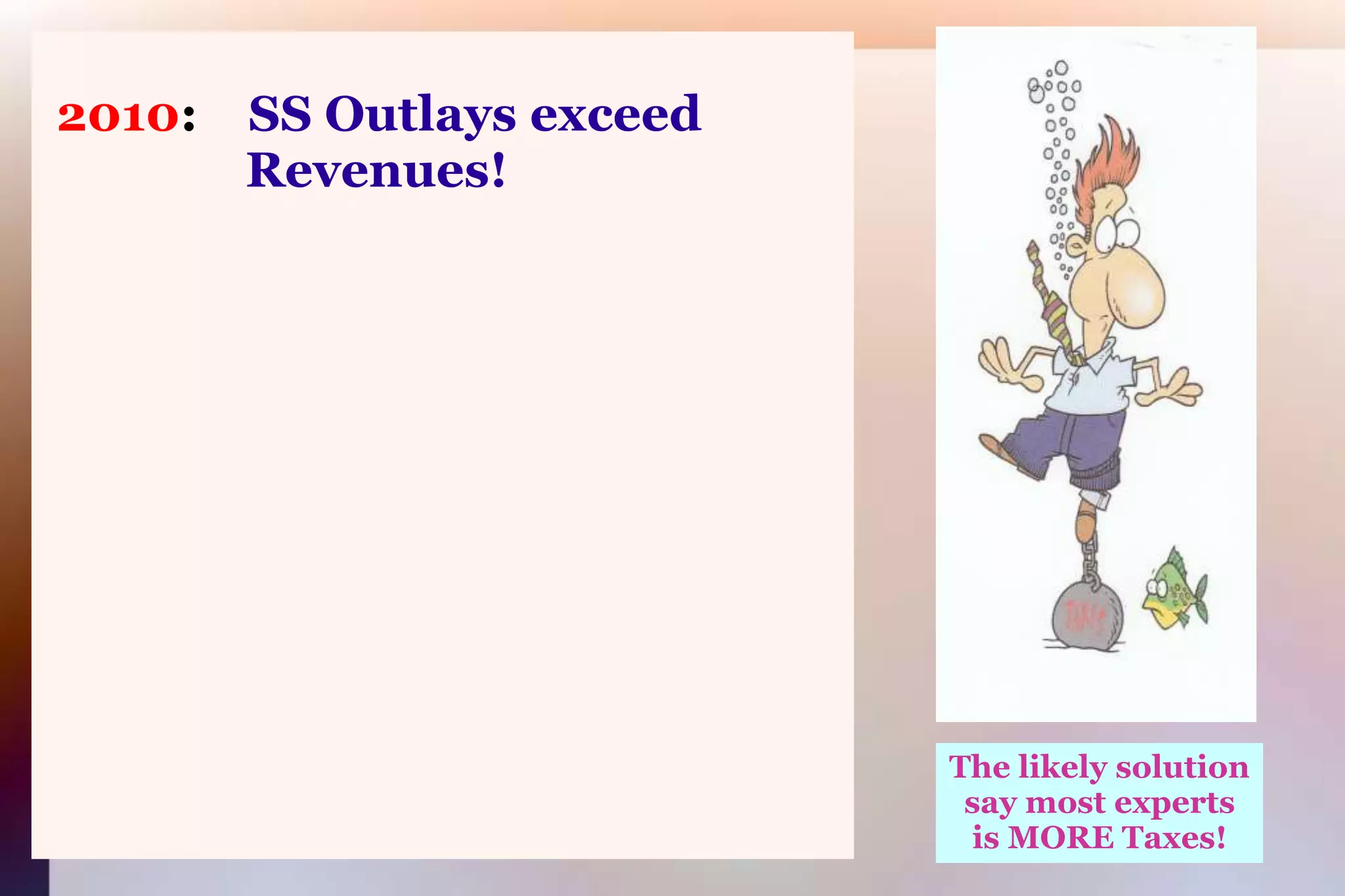
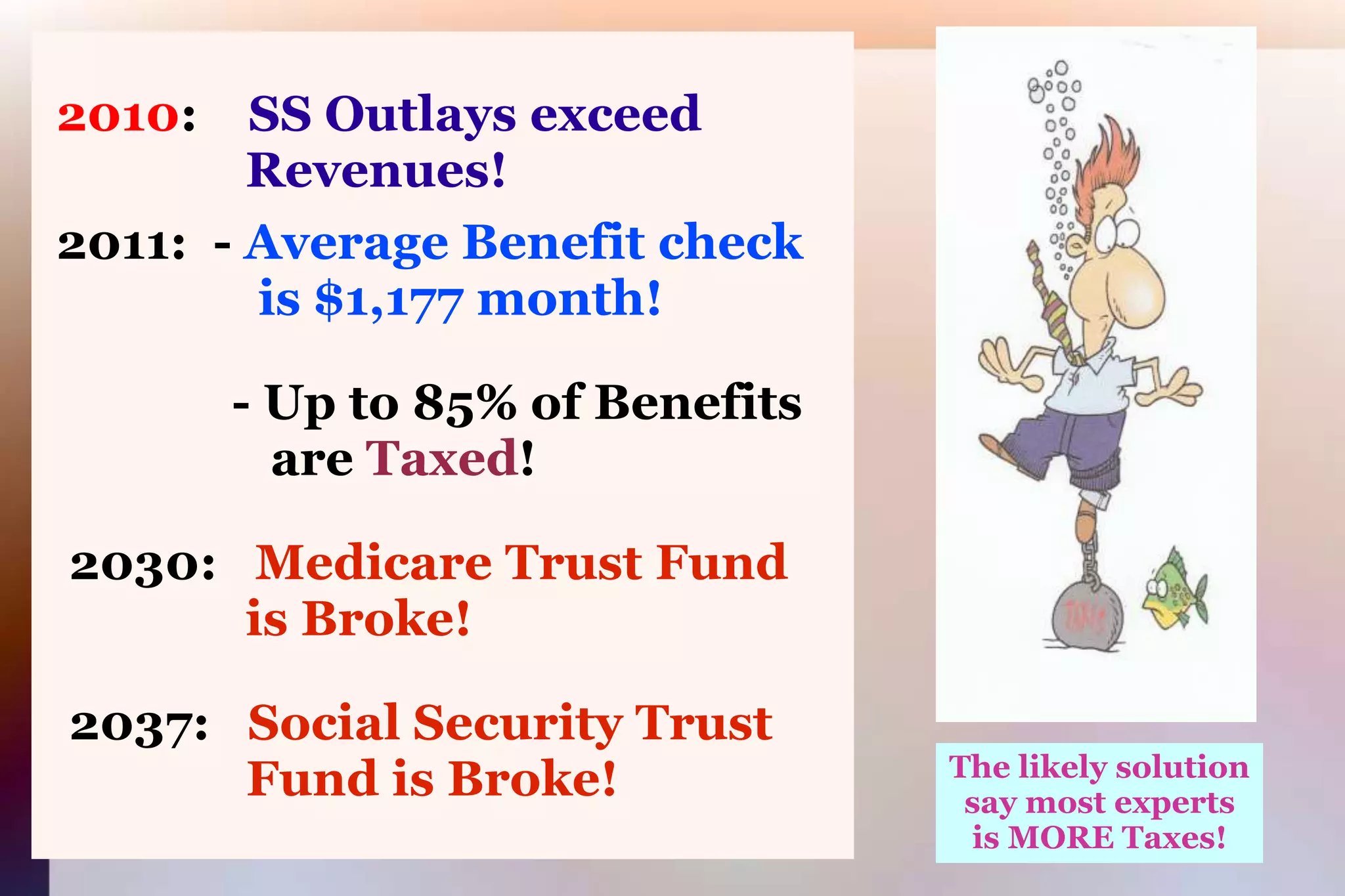
2010:SS Outlays exceed 			      Revenues!The likely solutionsay most expertsis MORE Taxes!
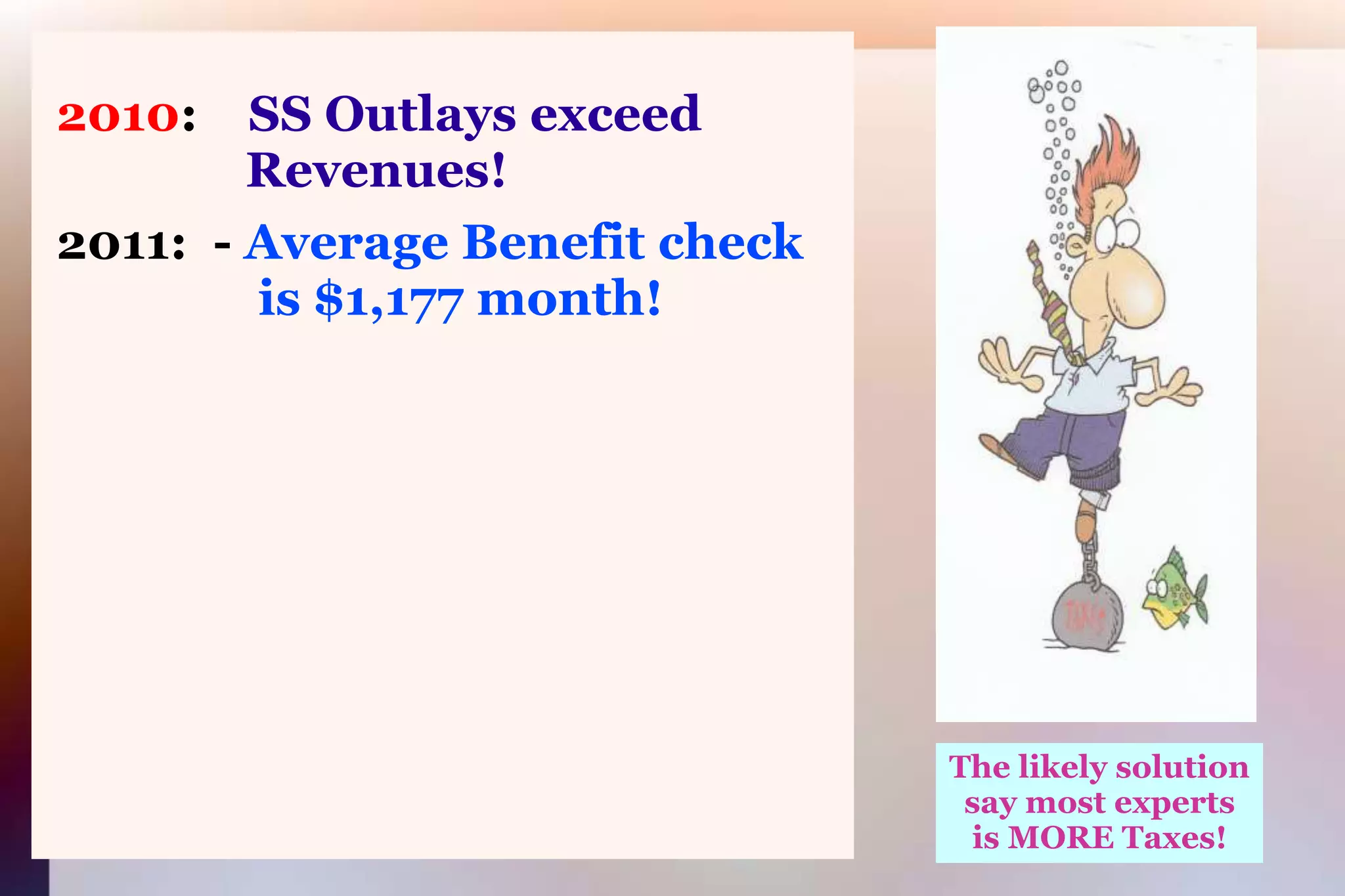
2010:SS Outlays exceed 			      Revenues! 2011:  - Average Benefit check 			       is $1,177 month!The likely solutionsay most expertsis MORE Taxes!
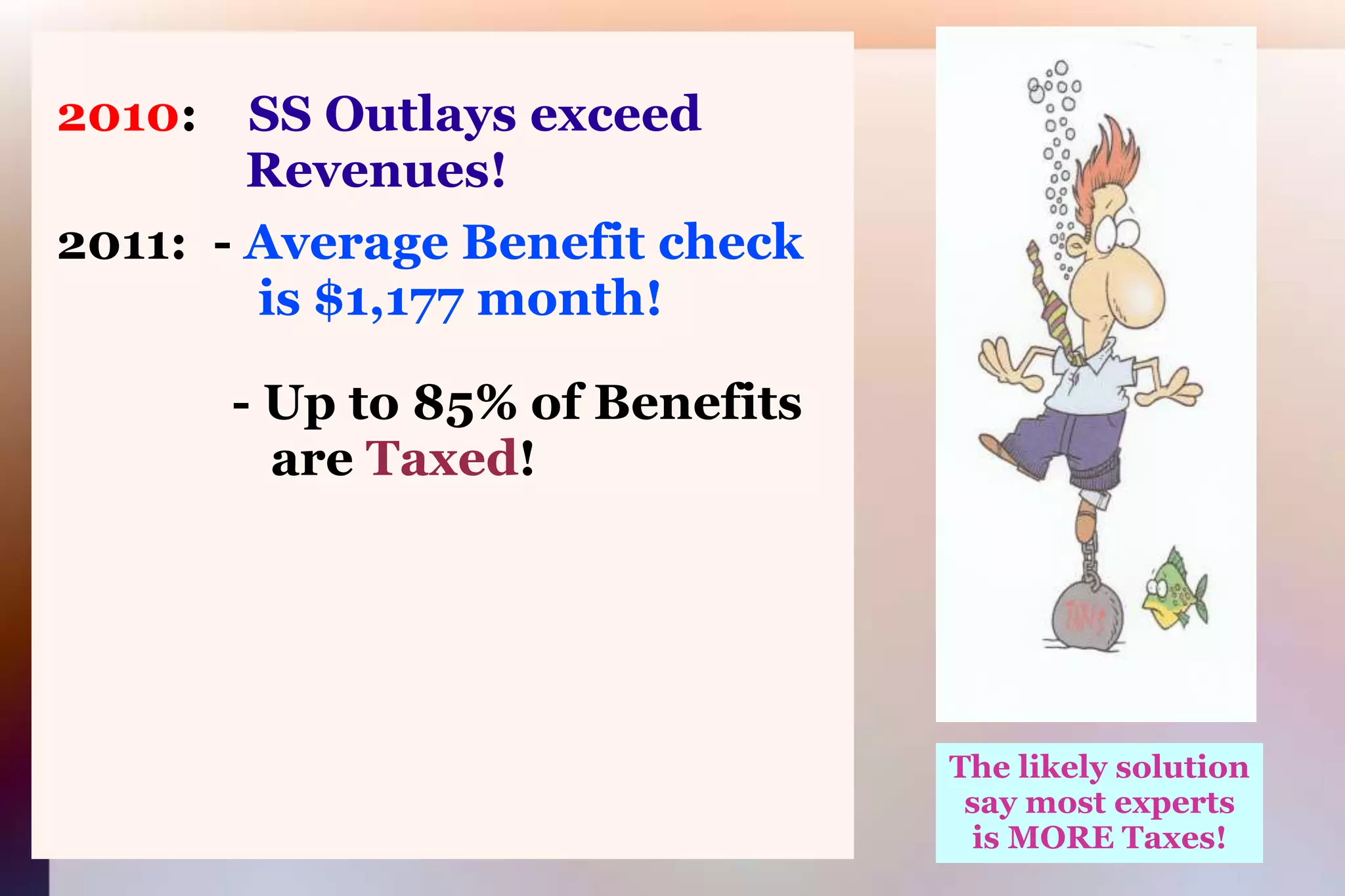
2010:SS Outlays exceed 			      Revenues! 2011:  - Average Benefit check 			       is $1,177 month!               - Up to 85% of Benefits 			        are Taxed!The likely solutionsay most expertsis MORE Taxes!
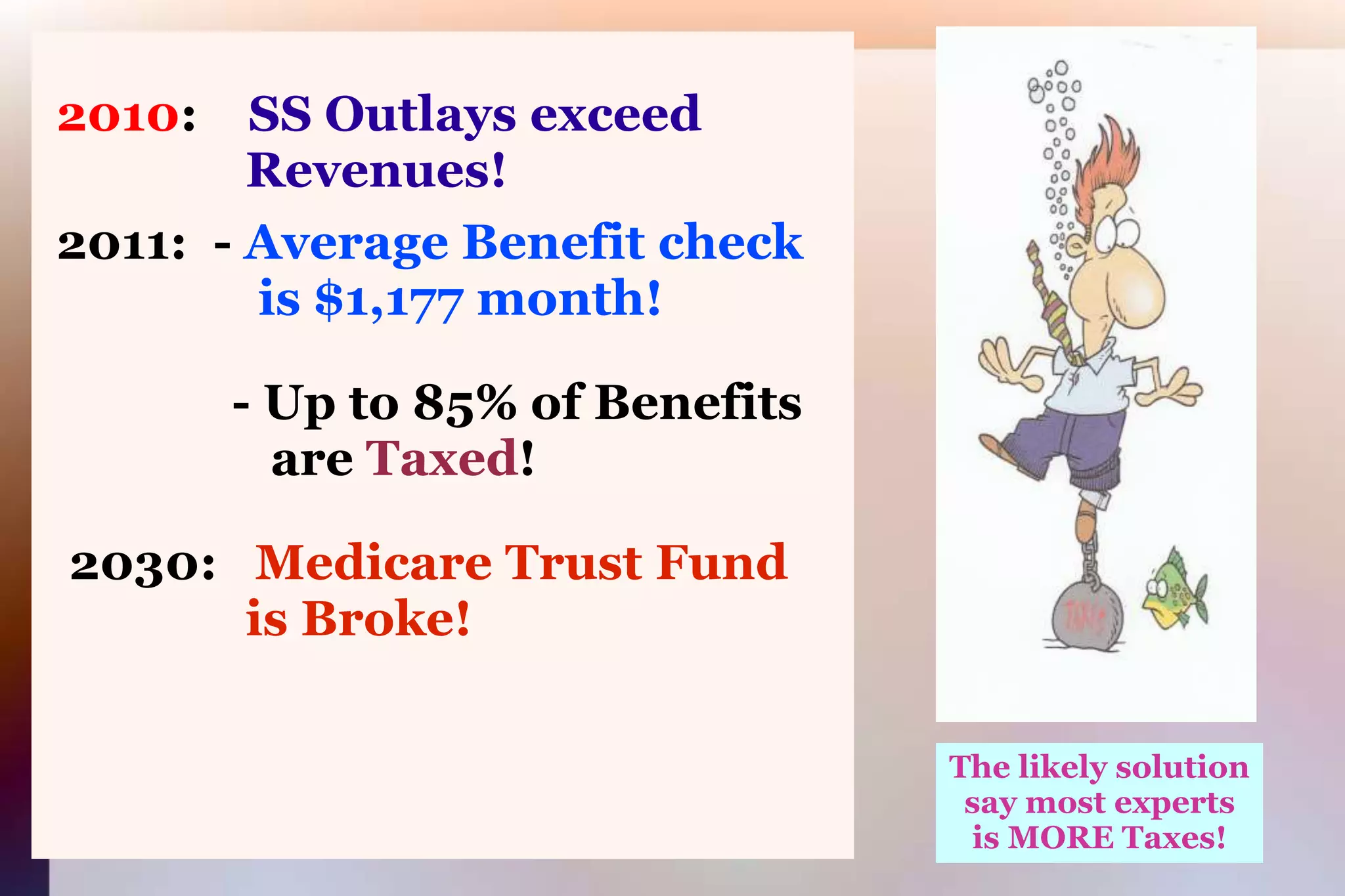
2010:SS Outlays exceed 			      Revenues! 2011:  - Average Benefit check 			       is $1,177 month!               - Up to 85% of Benefits 			        are Taxed!2030:   Medicare Trust Fund     is Broke!The likely solutionsay most expertsis MORE Taxes!
2010:SS Outlays exceed 			      Revenues! 2011:  - Average Benefit check 			       is $1,177 month!               - Up to 85% of Benefits 			        are Taxed!2030:   Medicare Trust Fund     is Broke!2037:   Social Security Trust 				 Fund is Broke!The likely solutionsay most expertsis MORE Taxes!
But What Else is Left?
But What Else is Left?What Possible Investment is There?!
"The Difficulty liesnot in the new ideas,
"The Difficulty liesnot in the new ideas,but in escapingfrom the old ones."John Maynard Keynes20th Century Economist"The General Theory of Employment, Interest and Money"
“The solution: a new type of ‘insurance’.
“The solution: a new type of ‘insurance’.Retirement savings, it turns out, are exactlythe type of asset we need insurance for.
“The solution: a new type of ‘insurance’.Retirement savings, it turns out, are exactlythe type of asset we need insurance for.We need insurance to protect against risks wecan't predict (when the market collapses)and can't afford to recover from on our own.”
Fortunately,there ISa“NEW” Solution!
With all these benefits, today it is called …"The 'NEW' Asset Class Investment"March 26, 2008"This is a safe bet, long terminvestment with high interest,almost no volatility and liquid.
With all these benefits, today it is called …"The 'NEW' Asset Class Investment"March 26, 2008"This is a safe bet, long terminvestment with high interest,almost no volatility and liquid.You do not have to die to enjoythese returns (and) it canwork like a Roth ...
“It’s dramatic advantage is that 	you pay no tax on the gains 	ever, and you can spend them 	while you are alive tax free.”
WHAT IS IT?!
Permanent Life Insurance
For Retirement Savingsit’s often called a“Private Plan”
For Retirement Savingsit’s often called a“Private Plan”It IS Approved by Congressand Regulated by the IRSwith IRC 7702(a)
"It ain't what you don't knowthat gets you into trouble.
"It ain't what you don't knowthat gets you into trouble.It's what you know for surethat just ain't so."Mark Twain
			April 2009Myth. Life Insurance is not a good investment.
			April 2009Myth. Life Insurance is not a good investment.“This canard spread as 401(k)s and IRA's supplantedLife Insurance as Americans' most popular ways to buildSavings while deferring taxes.  But two factors point toa revival of Life insurance as an investment:
			April 2009Myth. Life Insurance is not a good investment.“This canard spread as 401(k)s and IRA's supplantedLife Insurance as Americans' most popular ways to buildSavings while deferring taxes.  But two factors point toa revival of Life insurance as an investment:One is guaranteed credits on cash values,which means if you pay the premiums, you cannot lose money unless the company fails.(The other is if you are over 65, you canoften sell it for several times its cash value)!”
			April 2009Myth. Life Insurance is not a good investment.“This canard spread as 401(k)s and IRA's supplantedLife Insurance as Americans' most popular ways to buildSavings while deferring taxes.  But two factors point toa revival of Life insurance as an investment:One is guaranteed credits on cash values,which means if you pay the premiums, you cannot lose money unless the company fails.(The other is if you are over 65, you canoften sell it for several times its cash value)!”TRUTH: “A good investment is one in which you put moneyaway now and have more later.  Checked your 401(k) lately?”
BUT this is NOT yourGrandparents Life Insurance!
Returns can beLINKEDto the S&P 500(or other index)
Returns can beLINKEDto the S&P 500(or other index)You areNOTINthestock market!
Returns can beLINKEDto the S&P 500(or other index)You areNOTINthestock market!This means youKEEPALLAnnualgains!
Your Principaland GainsCANNOTgo down in valuebecause ofthe market --they can only goUP!
Juicing Your Life Insurance5 June 2010This year's hottest life-insurance product   is well-suited to an era of sudden "flash   crashes" and overall uncertainty: It appeals   to people eager to capture stock-market   gainswhile avoiding undue risk. The   product (is) "indexed universal life”.
Juicing Your Life Insurance5 June 2010     The twist in these new policies is the use of a   stock-market index to help determine the interest   rate for the cash-value account. In many versions,   insurers link to the Standard & Poor's 500-stock   index, but cap the annual interest rate …
Juicing Your Life Insurance5 June 2010     The twist in these new policies is the use of a   stock-market index to help determine the interest   rate for the cash-value account. In many versions,   insurers link to the Standard & Poor's 500-stock   index, but cap the annual interest rate … For   downside protection, some policies promise a   minimum interest rate of as much as 2%, even in   losing years for stocks, while others simply   protect against losses.
Juicing Your Life Insurance5 June 2010The product "resonates with people" says the chief actuary (for one co.).“It has a guarantee sopeople can sleep at night,and it has upside potential”.
For Retirement Savings…ZERO IS HERO!
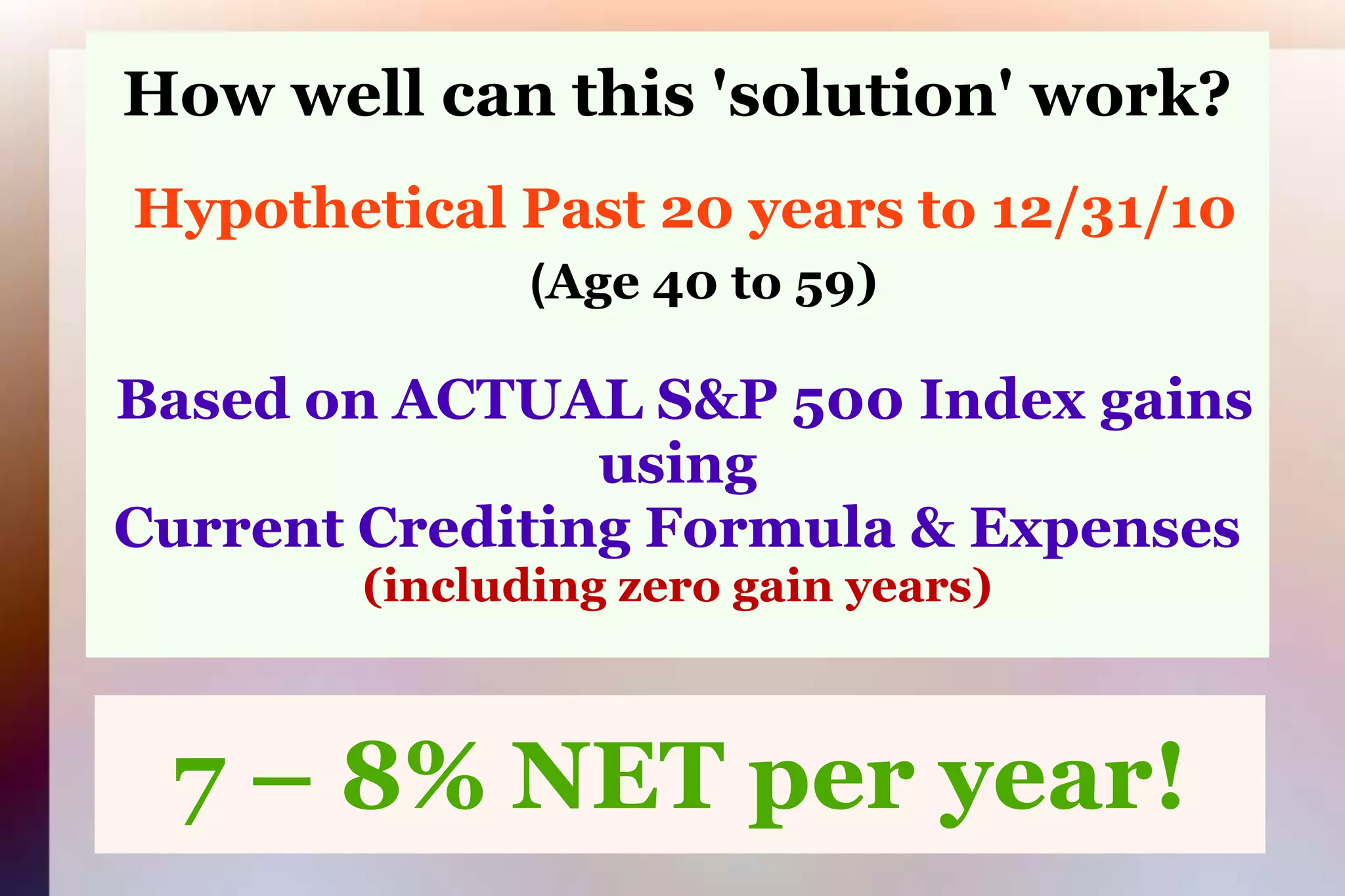
How well can this 'solution' work?Hypothetical Past 20 years to 12/31/10(Age 40 to 59) Based on ACTUAL S&P 500 Index gains usingCurrent Crediting Formula & Expenses(including zero gain years)7 – 8% NET per year!
This isIndexed Life!THE Retirement SavingsInvestment for the Future!
Thanks to IRS IRC: 7702(a)Indexed Universal Life (IUL)is the ONLYInvestment approved by Congressand the IRS to provideyouALLof theseBenefits and Features ...
TAX FREE Income!
TAX FREE to Heirs!
Putnam Investment Retirement Survey 2005“A majority of retirees said theirBIGGEST MISTAKEin planning for Retirementwas failing to invest in TAX FREE Accounts.”
Putnam Investment Retirement Survey 2005“A majority of retirees said theirBIGGEST MISTAKEin planning for Retirementwas failing to invest in TAX FREE Accounts.”With Indexed Life …
...it's OTHER dramatic advantage is that you payNO tax on the gains ever –Your Retirement Incomeis Tax Free!
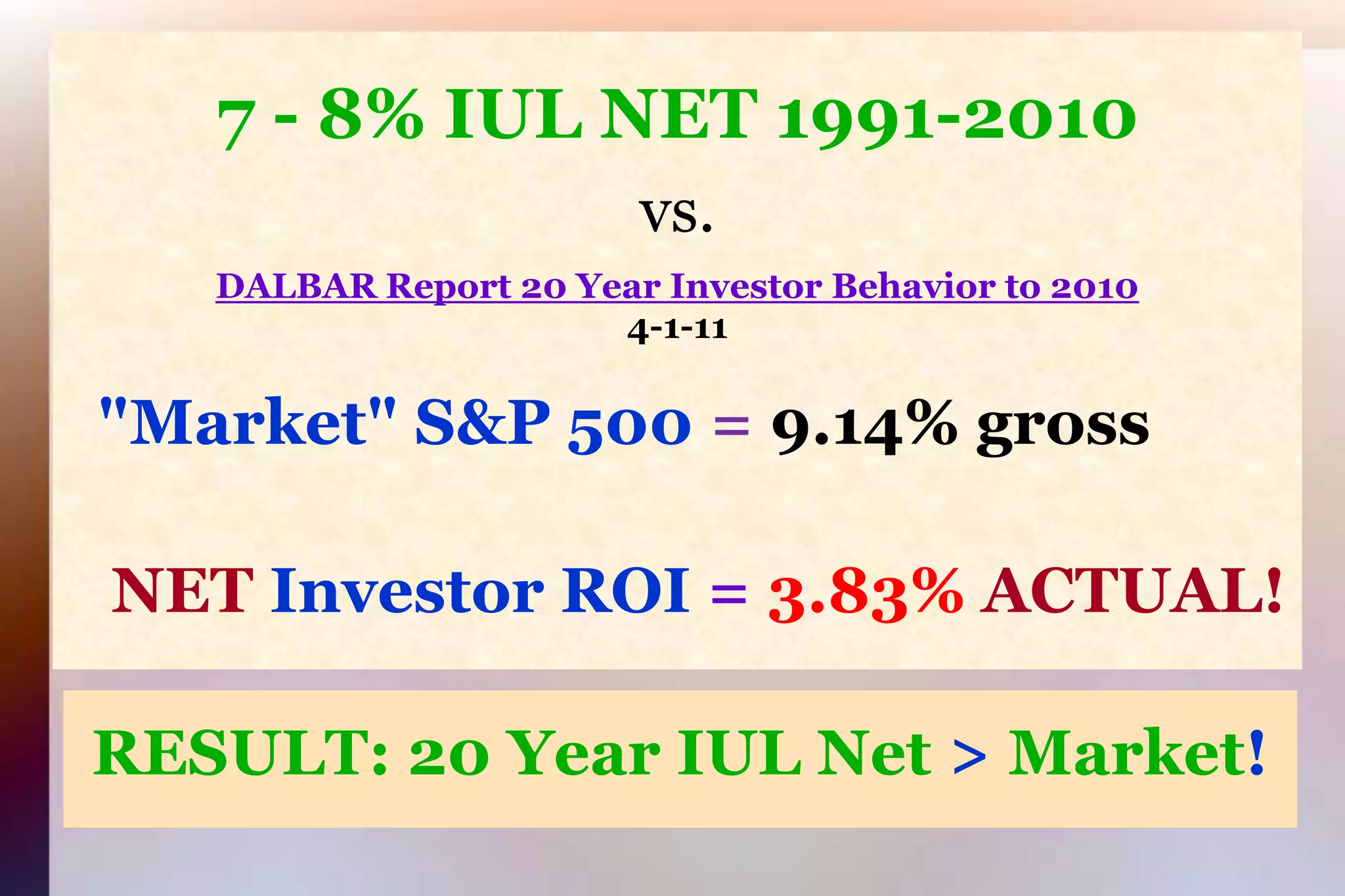
7 - 8% IUL NET 1991-2010 vs.DALBAR Report 20 Year Investor Behavior to 20104-1-11
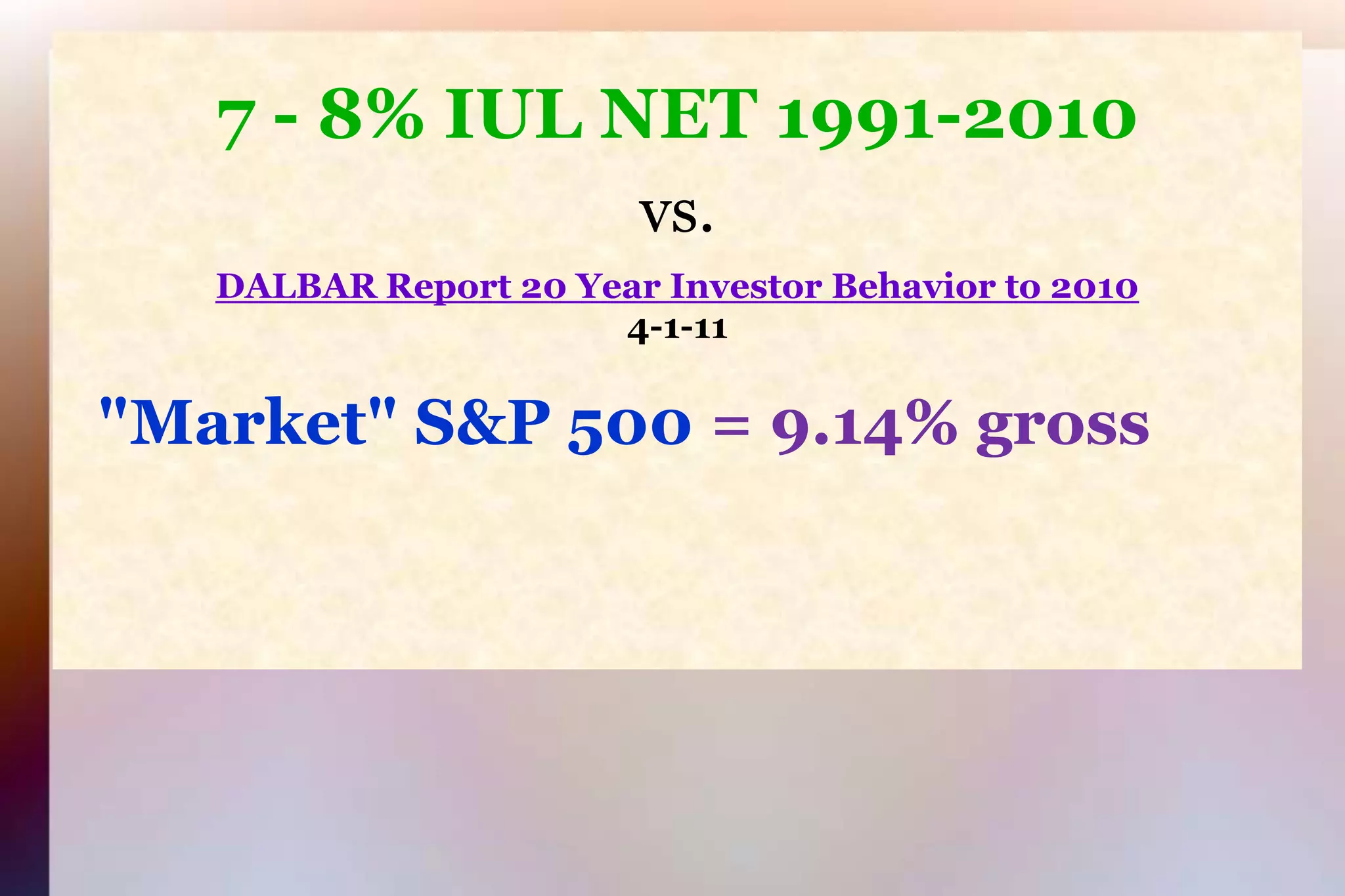
7 - 8% IUL NET 1991-2010 vs.DALBAR Report 20 Year Investor Behavior to 20104-1-11"Market" S&P 500 = 9.14% gross
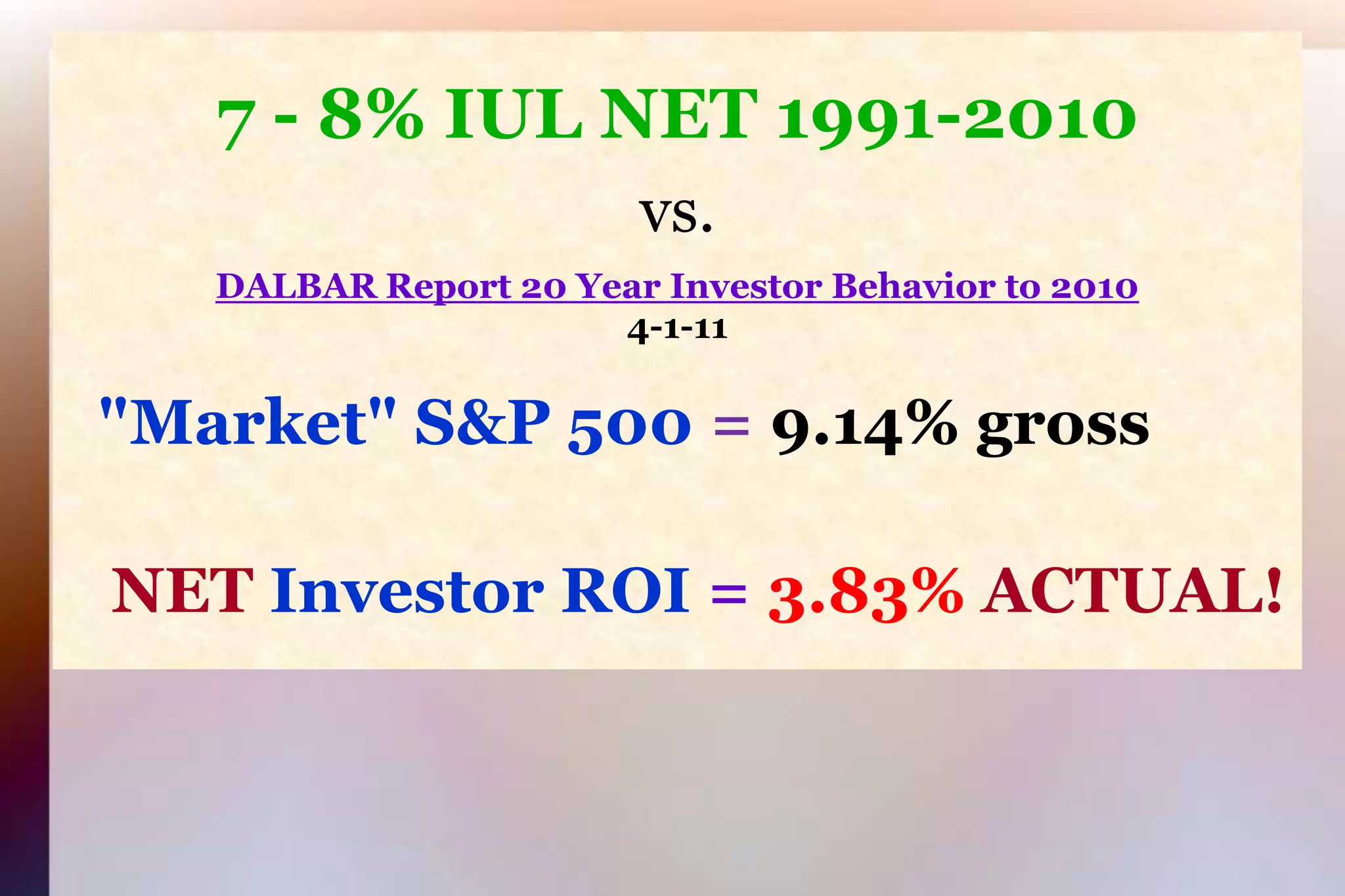
7 - 8% IUL NET 1991-2010 vs.DALBAR Report 20 Year Investor Behavior to 20104-1-11"Market" S&P 500 = 9.14% grossNET Investor ROI =3.83% ACTUAL!
7 - 8% IUL NET 1991-2010 vs.DALBAR Report 20 Year Investor Behavior to 20104-1-11"Market" S&P 500 = 9.14% grossNET Investor ROI =3.83% ACTUAL!RESULT: 20 Year IUL Net > Market!
Indexed Life also does NOT have the RestrictiveQualified Plan Contribution, Access and Loan Rules!
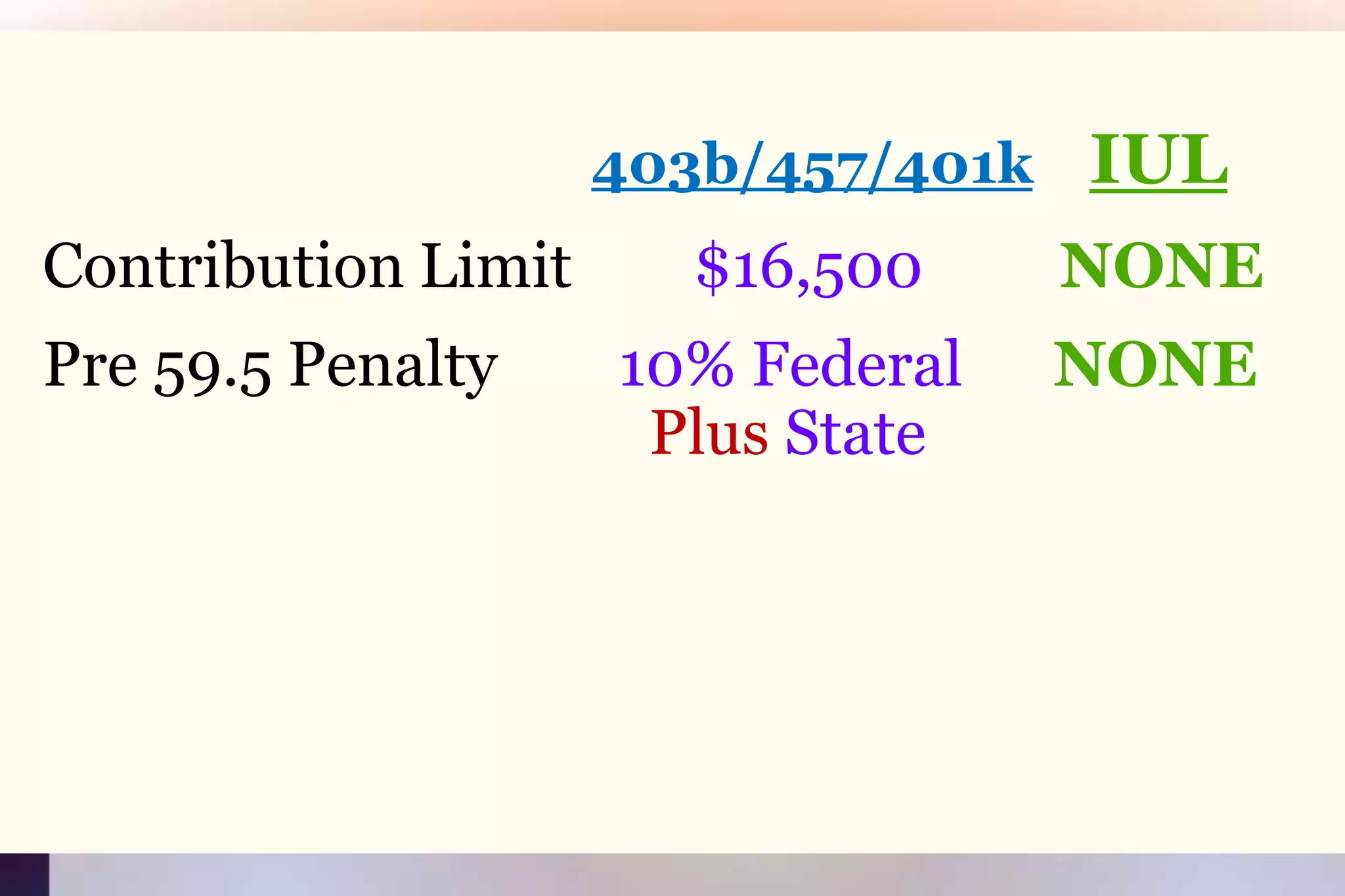
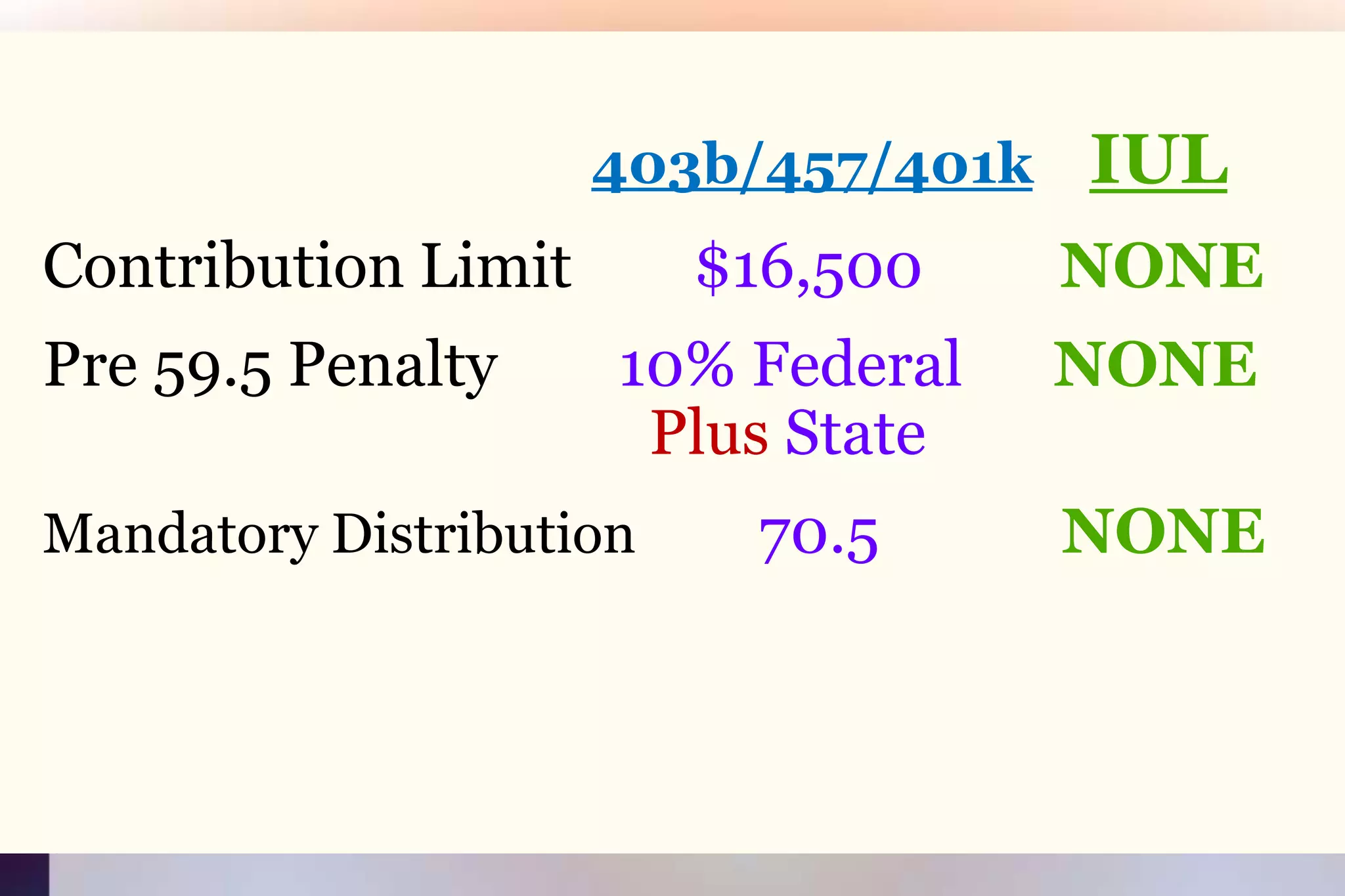
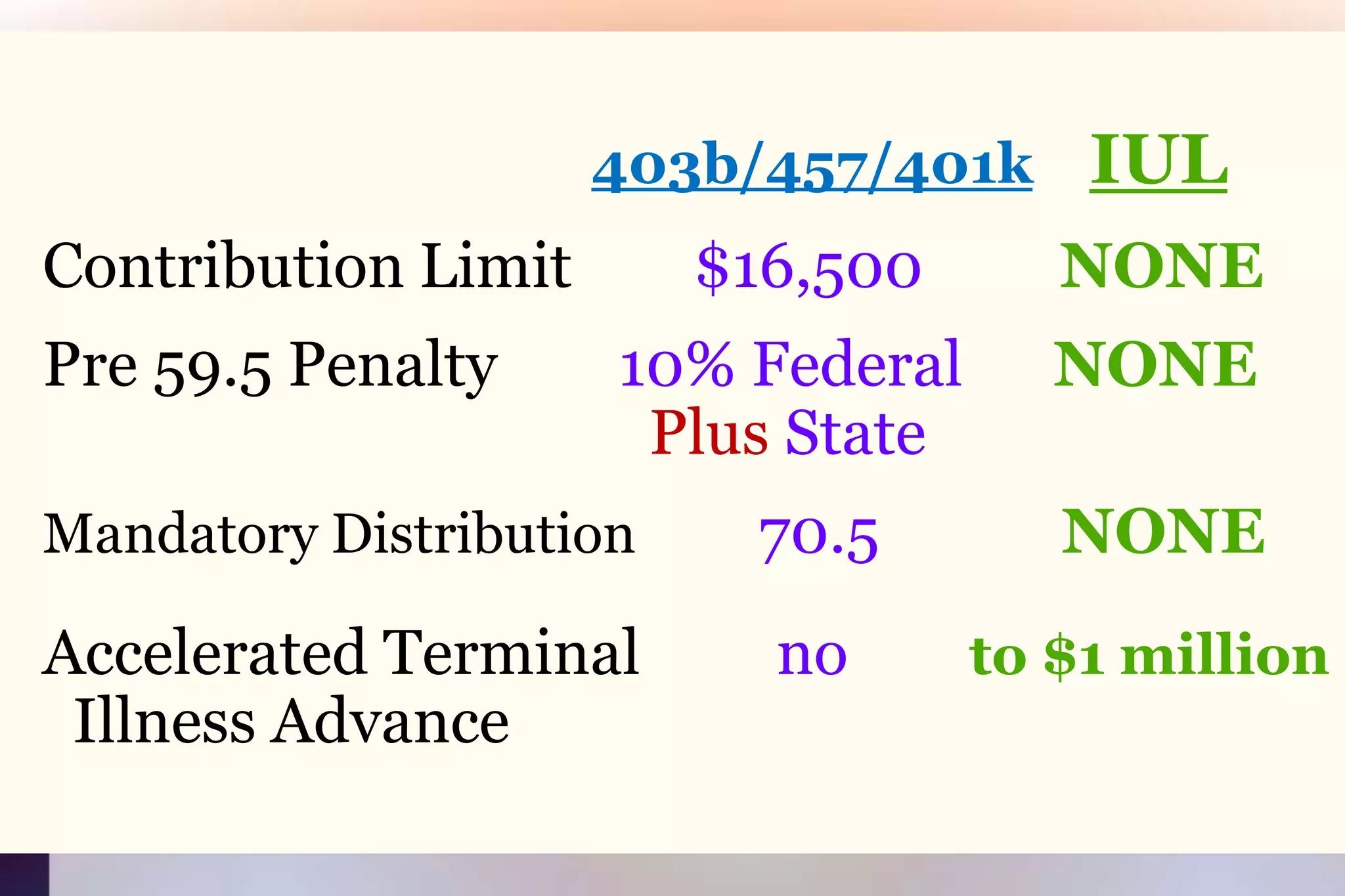
403b/457/401kIUL  Contribution Limit        $16,500         NONE
403b/457/401kIUL  Contribution Limit        $16,500         NONE  Pre 59.5 Penalty        10% Federal      NONEPlusState
403b/457/401kIUL  Contribution Limit        $16,500         NONE  Pre 59.5 Penalty        10% Federal      NONEPlusStateMandatory Distribution         70.5            NONE
403b/457/401kIUL  Contribution Limit        $16,500         NONE  Pre 59.5 Penalty        10% Federal      NONEPlusStateMandatory Distribution         70.5            NONE  Accelerated Terminal        noto $1 million  Illness Advance
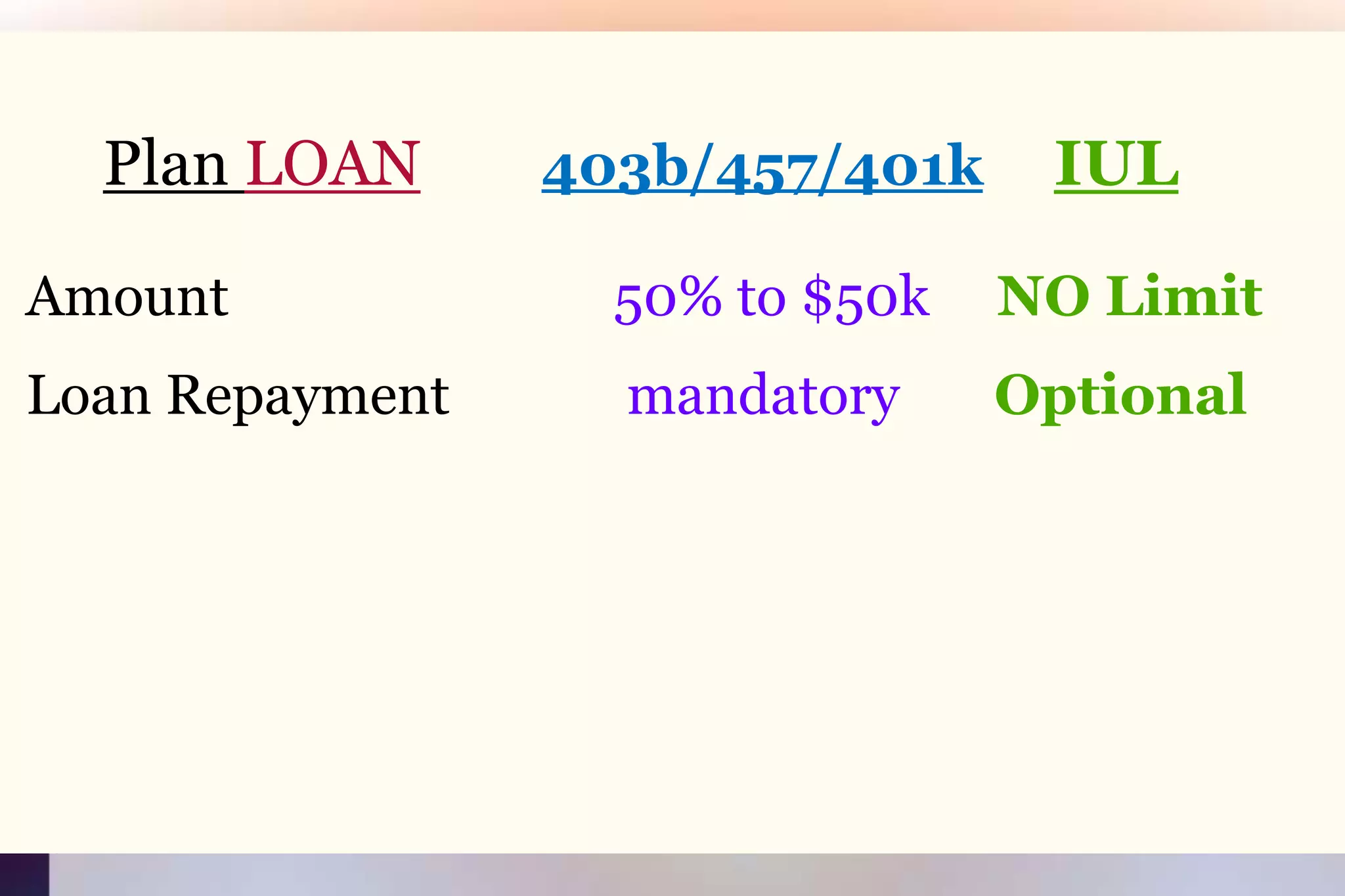
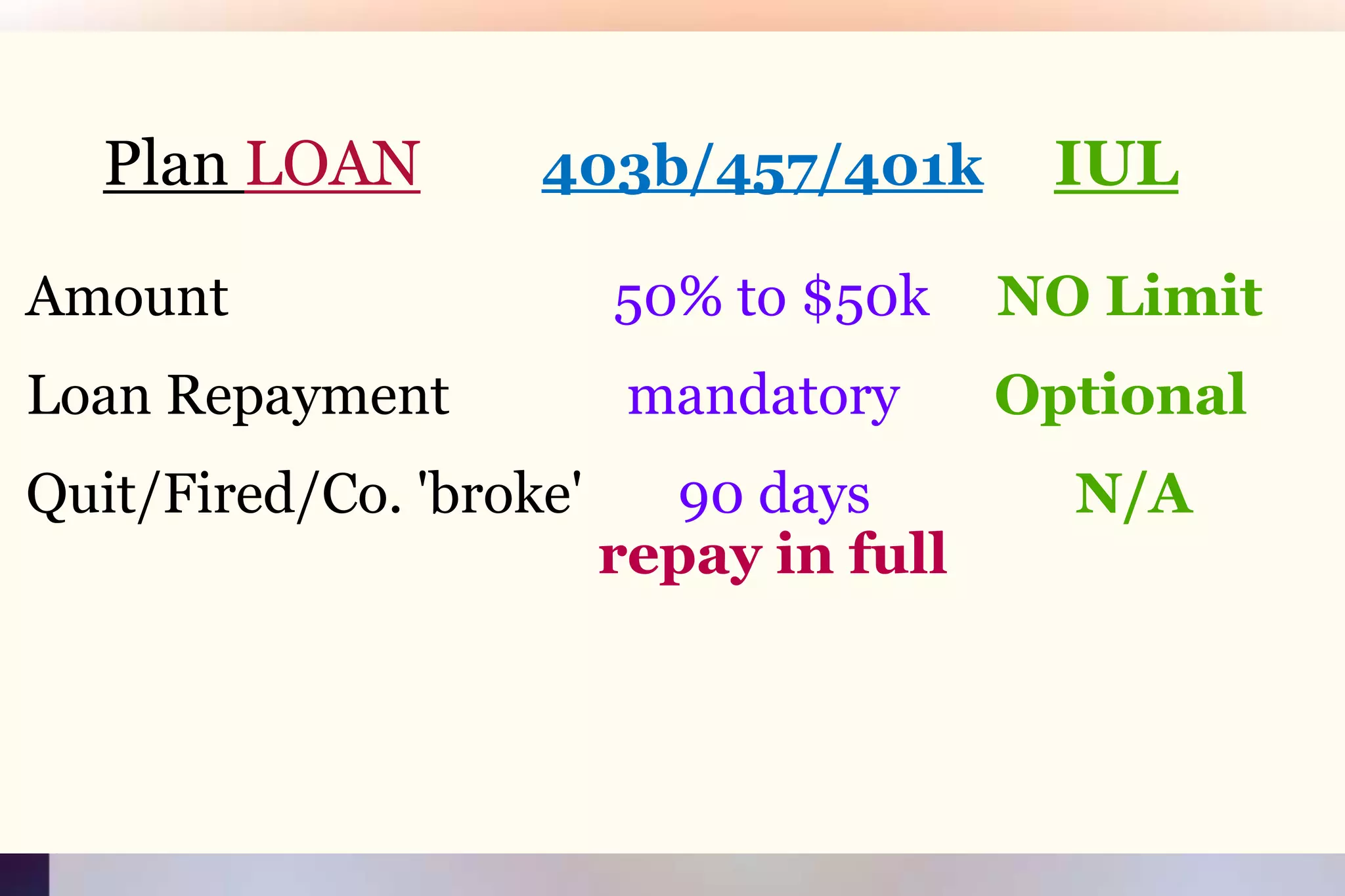
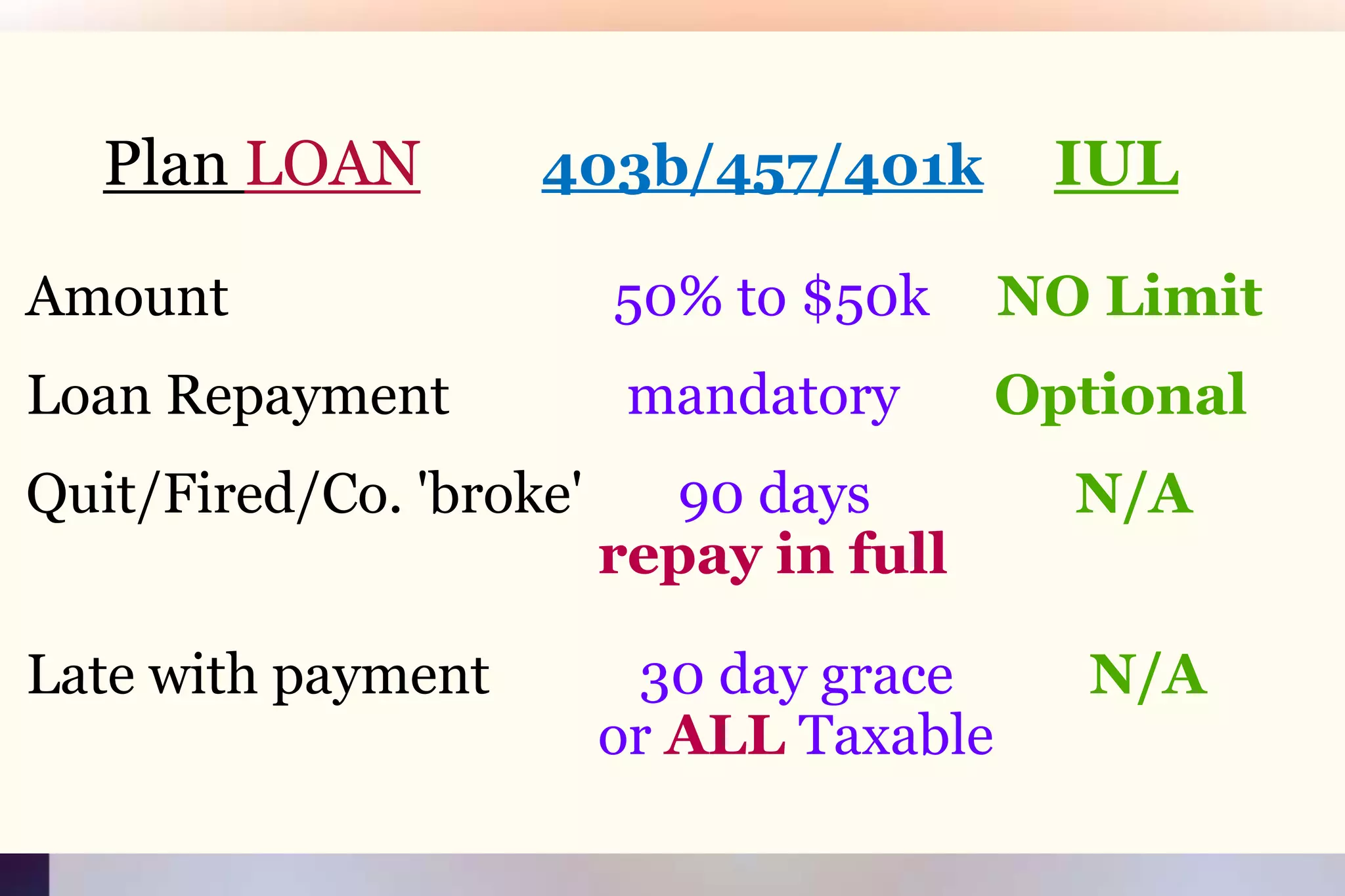
Plan LOAN403b/457/401kIULAmount				50% to $50kNO Limit
Plan LOAN403b/457/401kIULAmount				50% to $50kNO Limit Loan Repayment             mandatoryOptional
Plan LOAN403b/457/401kIULAmount				50% to $50kNO Limit Loan Repayment             mandatoryOptional Quit/Fired/Co. 'broke'       90 days               N/Arepay in full
Plan LOAN403b/457/401kIULAmount				50% to $50kNO Limit Loan Repayment             mandatoryOptional Quit/Fired/Co. 'broke'       90 days               N/Arepay in full Late with payment           30 day grace          N/AorALLTaxable
Indexed Life also includes:LifetimeLife Insurance(may guarantee Retirement Plancompletion for Survivor Spouse)
The Life Insurance can also be used forPENSION MAXto Increase Your Pension Income $hundreds or $thousands per month!Popular for Teacher & Government Pension Plans:	STRS      [State Teachers Retirement System]    	PERS     [Public Employees Retirement System]
Accelerated “Living” BenefitWith 1 or 2 year terminal diagnosisup to $1 million Advance Benefit!
Accelerated “Living” BenefitWith 1 or 2 year terminal diagnosisup to $1 million Advance Benefit!Money can be used for ANYpurpose -including treatment that couldSAVE YOUR LIFE!
With Indexed LifeYou can also …Be Your OWN Banker!(Great Financial Strategy for those in their 20's & 30's!)You can use your savings to finance your life while on your journey to retirement!
AND Finance Your Retirement TOOWhile You D0!Age 40Save $1,000 Monthto Age 65
AND Finance Your Retirement TOOWhile You D0!Age 65 Cash Value= $857,000
AND Finance Your Retirement TOOWhile You D0!Age 65 Cash Value= $857,000Tax Free Retirement Income = $50,000 Yr!
AND Finance Your Retirement TOOWhile You D0!Age 65 Cash Value= $857,000Tax Free Retirement Income = $50,000 Yr!  Age 85 Cash Value               = $2,229,000!
AND Finance Your Retirement TOOWhile You D0!Age 65 Cash Value= $857,000Tax Free Retirement Income = $50,000 Yr!  Age 85 Cash Value               = $2,229,000!    (Or give	Yourselfa Raise!)
The BEST COLLEGE SAVINGS Plan! * Can take out “Tuition” Tax/Penalty Free!
The BEST COLLEGE SAVINGS Plan! * Can take out “Tuition” Tax/Penalty Free! * NOT included in college aid formulas!
The BEST COLLEGE SAVINGS Plan! * Can take out “Tuition” Tax/Penalty Free! * NOT included in college aid formulas! * CV Remains the Parents Savings!
The BEST COLLEGE SAVINGS Plan! * Can take out “Tuition” Tax/Penalty Free! * NOT included in college aid formulas! * CV Remains the Parents Savings! * Balance can continue to grow to provide 		Tax FREE Retirement Income!
The BEST COLLEGE SAVINGS Plan! * Can take out “Tuition” Tax/Penalty Free! * NOT included in college aid formulas! * CV Remains the Parents Savings! * Balance can continue to grow to provide 		Tax FREE Retirement Income! * Life Insurance on Parent to guarantee      College paid for if premature death.
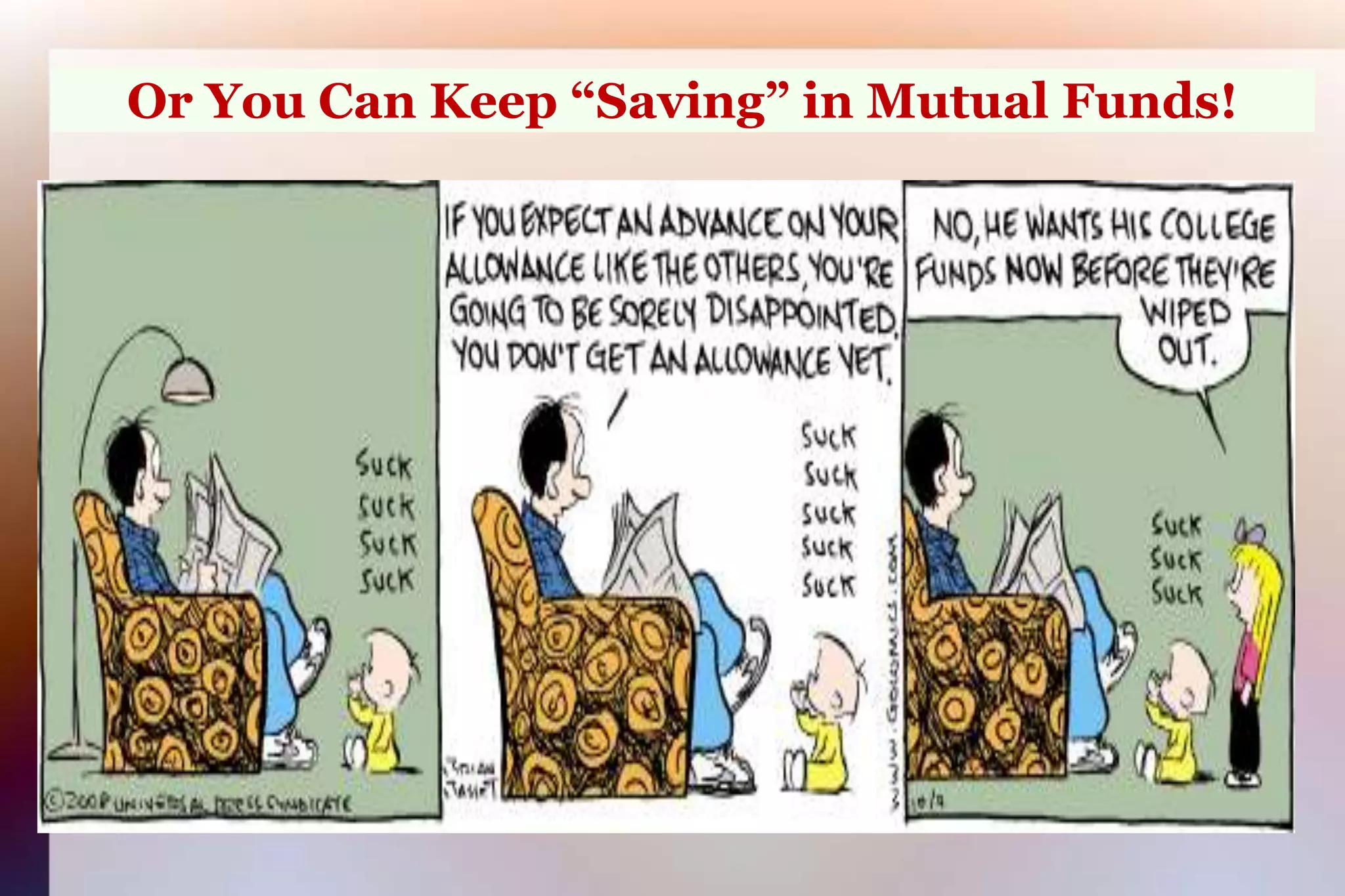
Or You Can Keep “Saving” in Mutual Funds!
BONUS!TheTax Free Income from Indexed Life(unlike Municipal Bondsand Qualified Savings withdrawals)
BONUS!TheTax Free Income from Indexed Life(unlike Municipal Bondsand Qualified Savings withdrawals)isNOTincluded inthe formula to taxup to 85% of yourSocial Security!
BONUS!TheTax Free Income from Indexed Life(unlike Municipal Bondsand Qualified Savings withdrawals)isNOTincluded inthe formula to taxup to 85% of yourSocial Security!  An IUL plan may be the easiest, 'cheapest' and BEST way to Save for Retirement AND Avoid this Tax!
                     November 2007 BEST ALL-AROUNDRETIREMENT ACCOUNTis the Roth IRA:“There's no up-front tax break [IUL], but decades of tax-free growth [IUL], plus tax-free income in retirement [IUL].”
                     November 2007 BEST ALL-AROUNDRETIREMENT ACCOUNTis the Roth IRA:“There's no up-front tax break [IUL], but decades of tax-free growth [IUL], plus tax-free income in retirement [IUL].”Why Stop There?! Even BETTER is ...
An IUL "SUPER ROTH"!Unlikea Roth ...   *  NO Contribution Limits.
An IUL "SUPER ROTH"!Unlikea Roth ...   *  NO Contribution Limits.   *  NO Income Restrictions.
An IUL "SUPER ROTH"!Unlikea Roth ...   *  NO Contribution Limits.   *  NO Income Restrictions.   *  Includes Hundreds of Thousands $'s (or more) in Life Insurance from Day 1[NOT Allowed in Roth! Use it to Pension Max!]
An IUL "SUPER ROTH"!Unlikea Roth ...   *  NO Contribution Limits.   *  NOIncome Restrictions.   *  Includes Hundreds of Thousands $'s (or more) in Life Insurance from Day 1[NOT Allowed in Roth! Use it to Pension Max!]*  NOIRS or State Penalties       for pre 59.5 access to gains.
* NO 5 Year wait for Tax Free Access!
* NO 5 Year wait for Tax Free Access!* Loans Allowed(payments not required!)Can USE the savings to ...
* NO 5 Year wait for Tax Free Access!* Loans Allowed(payments not required!)Can USE the savings to ...* Be Your "Own Banker"!
* NO 5 Year wait for Tax Free Access!* Loans Allowed(payments not required!)Can USE the savings to ...* Be Your "Own Banker"!* Children (or Grandchildren's) College Fund!
* NO 5 Year wait for Tax Free Access!* Loans Allowed(payments not required!)Can USE the savings to ...* Be Your "Own Banker"!* Children (or Grandchildren's) College Fund!* Tax Benefits Grandfathered ...                                              so NO Tax Change Risk!
* NO 5 Year wait for Tax Free Access!* Loans Allowed(payments not required!)Can USE the savings to ...* Be Your "Own Banker"!* Children (or Grandchildren's) College Fund!* Tax Benefits Grandfathered ...                                              so NO Tax Change Risk!	* NO MARKET RISK – You KEEP the Gains!
* NO 5 Year wait for Tax Free Access!* Loans Allowed(payments not required!)Can USE the savings to ...* Be Your "Own Banker"!* Children (or Grandchildren's) College Fund!* Tax Benefits Grandfathered ...                                              so NO Tax Change Risk!	* NO MARKET RISK – You KEEP the Gains!Roth OR IUL "Super Roth"?IUL!
In case you were wondering,many of the companies whooffer IUL are among the oldest(over 100  to 150 years old),most stable, best rated,ANDlargest financial servicescompanies in the world!
In case you were wondering,many of the companies whooffer IUL are among the oldest(over 100  to 150 years old),most stable, best rated,ANDlargest financial servicescompanies in the world![Checks from Ins. Co.’s are a major reasonwhy many survived the Great Depression!]
FINAL TRUTHIndexed Life may be YOURLAST Chance Retirement!
NET CASH VALUE – Saving Stage[NET Fees, Pre 59.5 Penalties and Taxes]Age 45 PNT / Save $1,000 mo. for 20 years[Average Past 25, Thirty Year Periods (since 1953)]YearQualifiedIUL  	5 		   60,918         57,747		6 		   74,989         74,913		     		     10 		 138,667       164,919  15 		 271,882      324,799		     20		 416,619      569,405
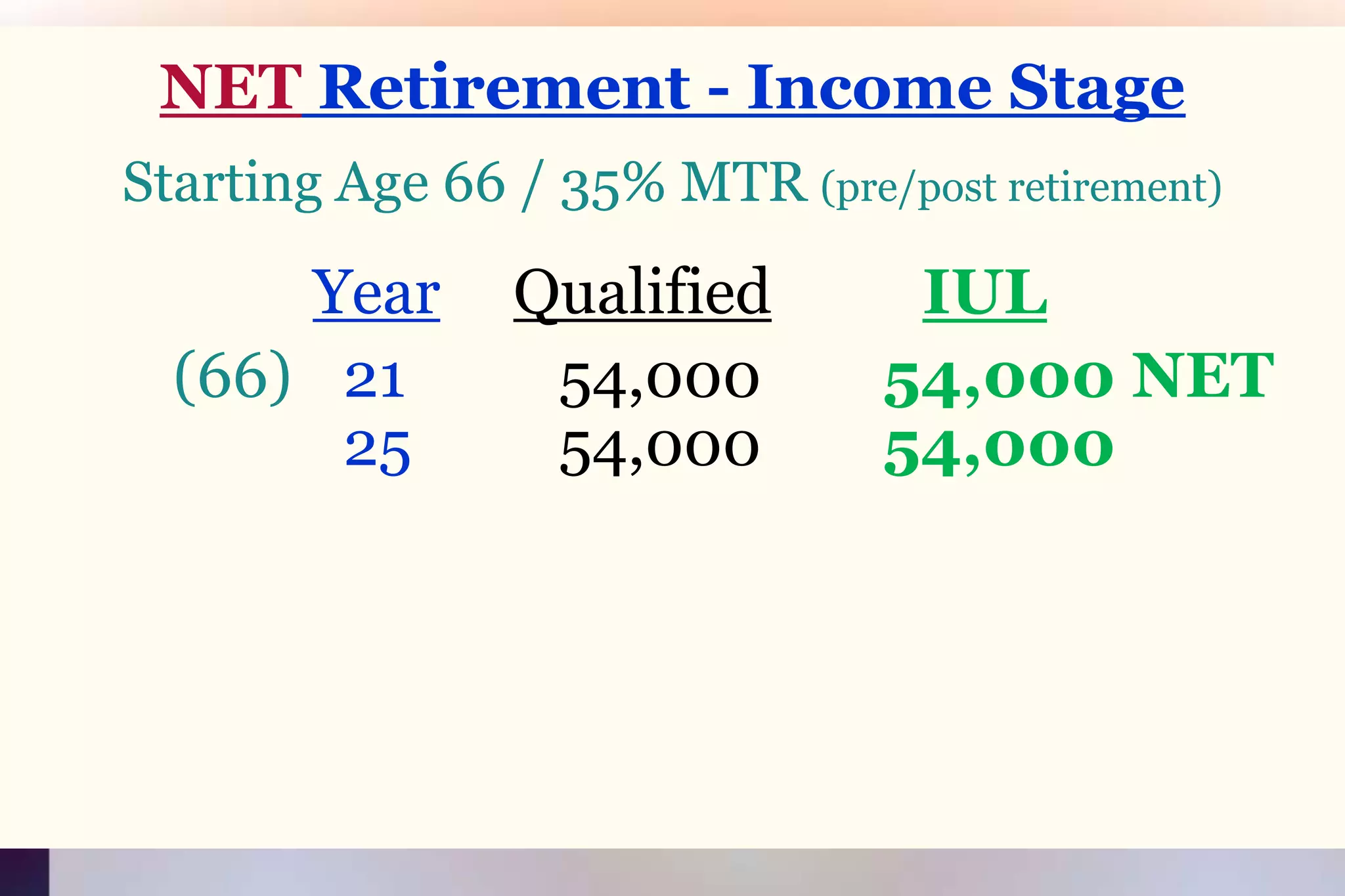
NET Retirement - Income StageStarting Age 66 / 35% MTR (pre/post retirement)YearQualifiedIUL(66)	  21 	   54,000        54,000 NET    		  25 	   54,000        54,000
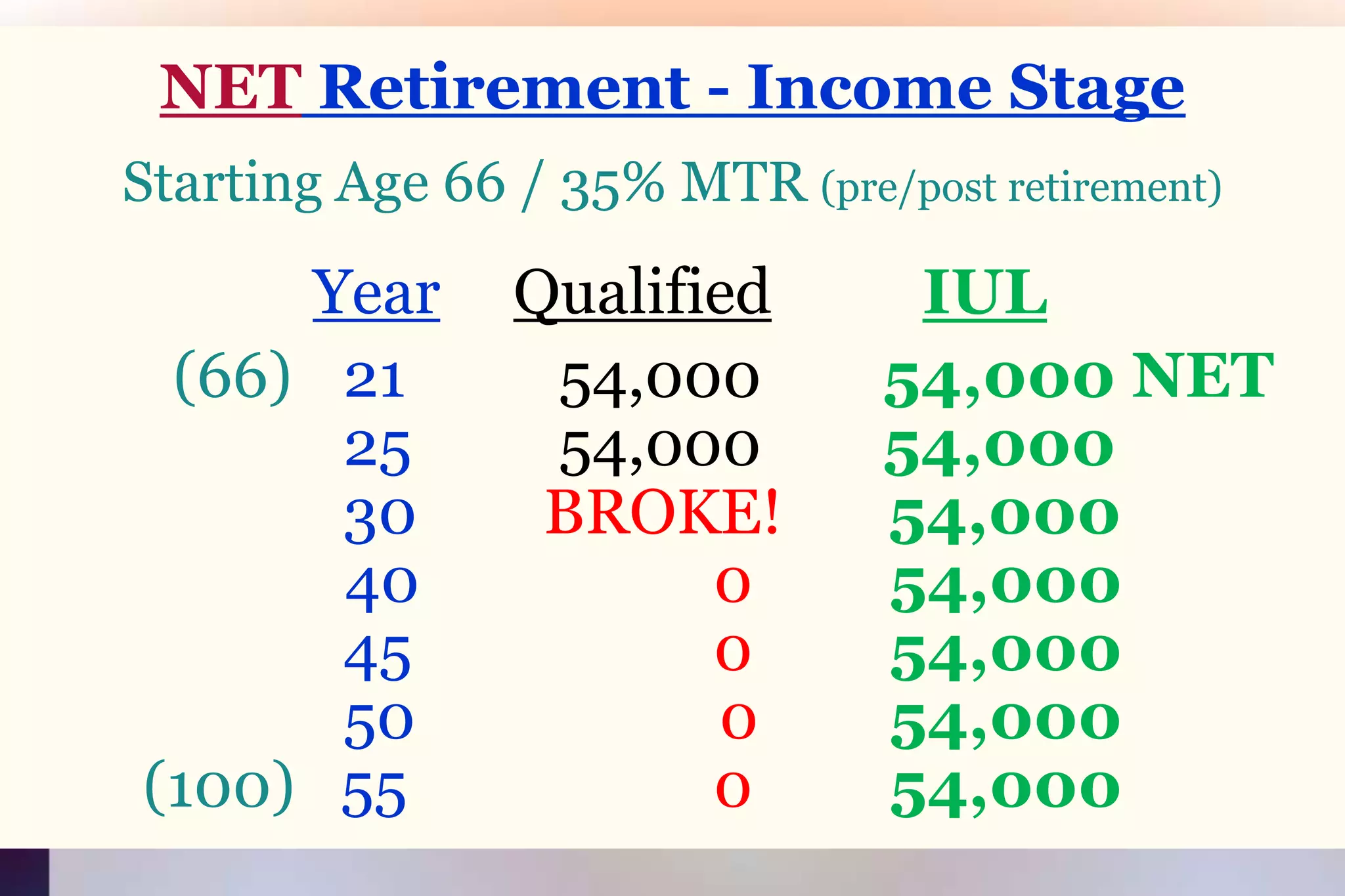
NET Retirement - Income StageStarting Age 66 / 35% MTR (pre/post retirement)YearQualifiedIUL(66)	  21 	   54,000        54,000 NET    		  25 	   54,000        54,000	    		  30 	  BROKE!54,00040 			054,000	    		  45		       	054,000	    		  50		       054,000(100)   55		       	054,000
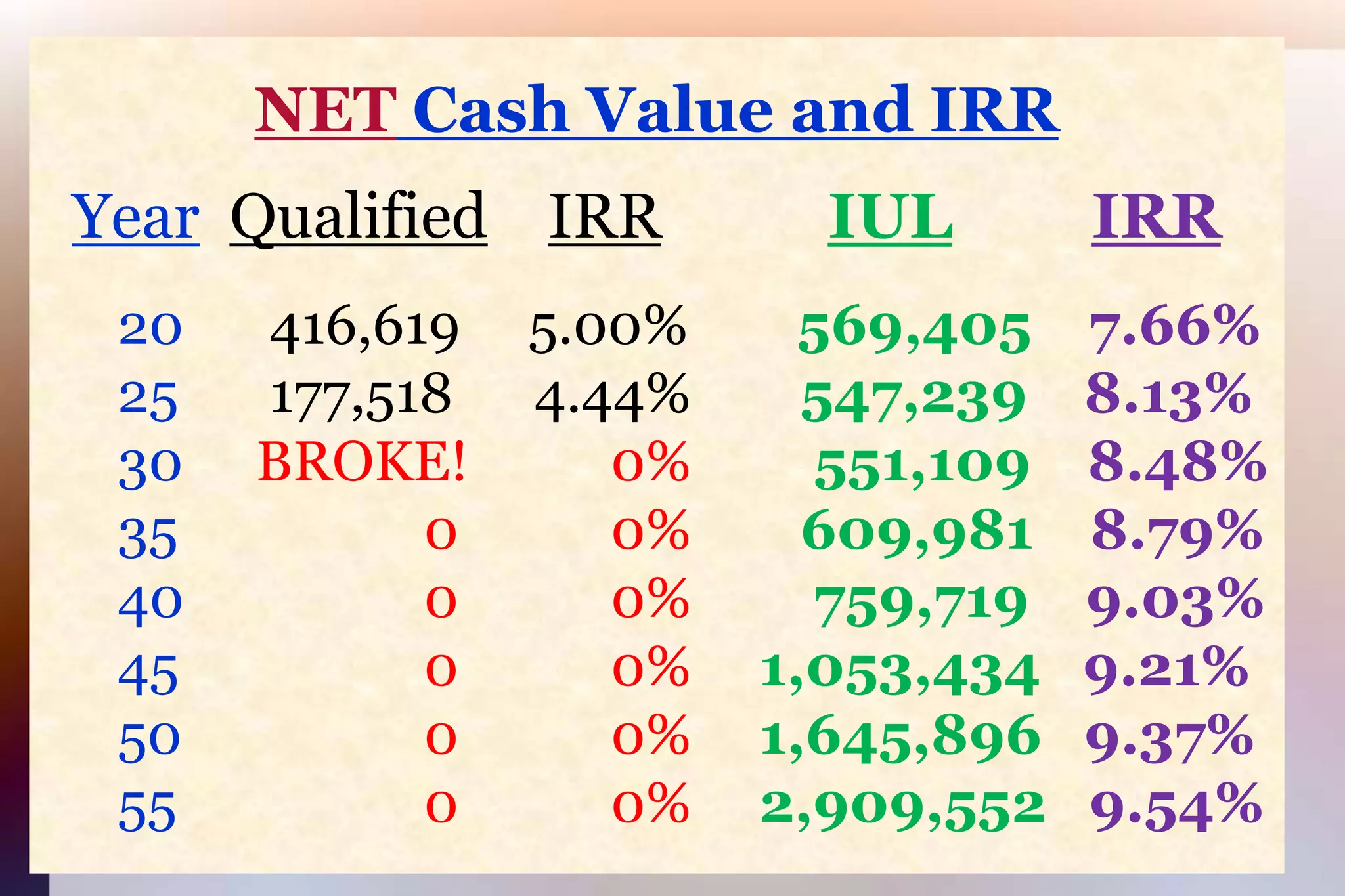
NET Cash Value and IRRYearQualifiedIRRIULIRR20	  416,619     5.00%        569,405    7.66%25	  177,518      4.44%        547,239    8.13%30	 BROKE! 0%         551,109    8.48%35	    00%        609,981    8.79%40	    00%         759,719    9.03%45	    00%     1,053,434   9.21%50	    00%     1,645,896   9.37%55	    00%     2,909,552   9.54%
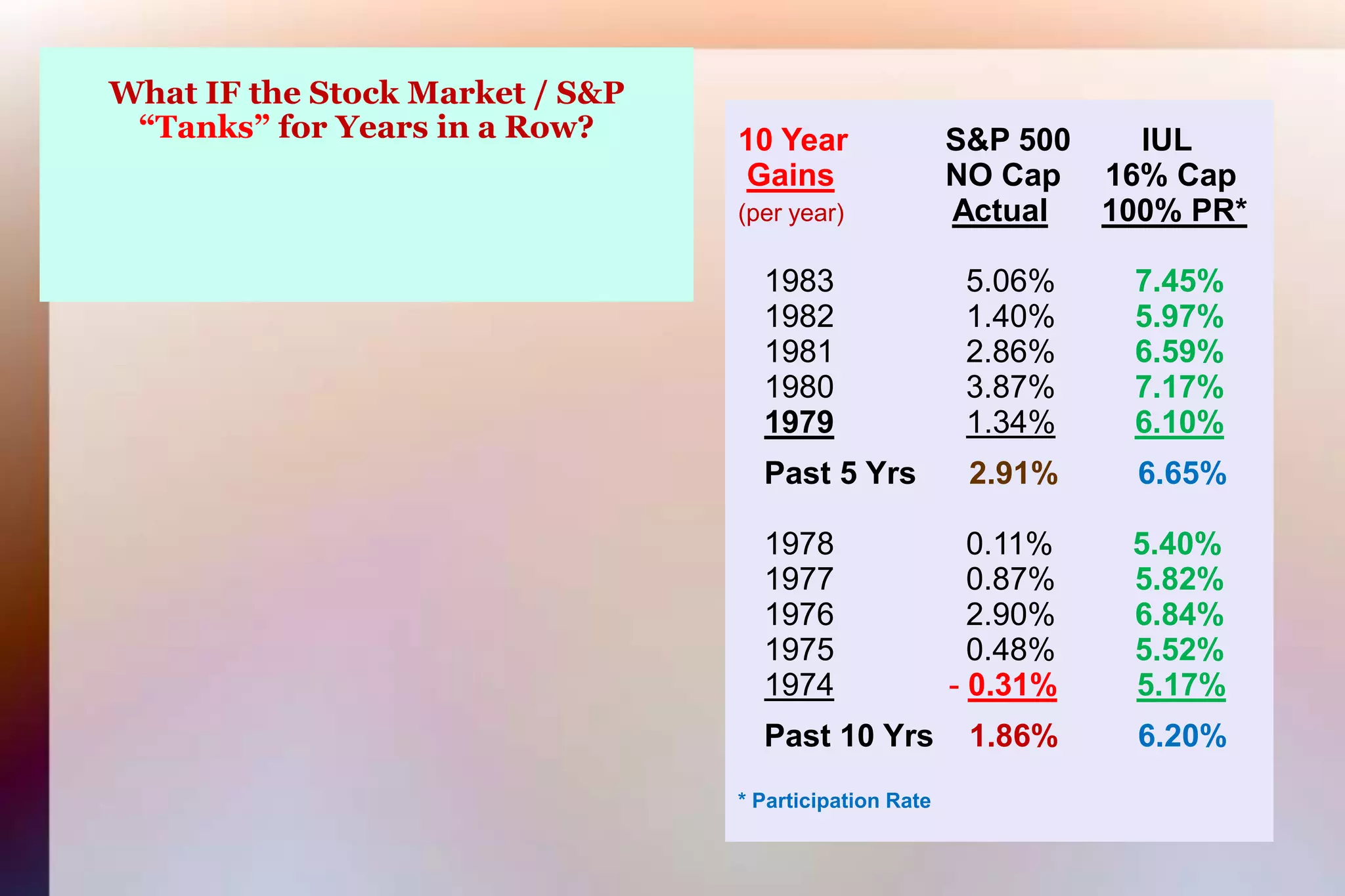
What IF the Stock Market / S&P “Tanks” for Years in a Row?10 Year  S&P 500 IULGainsNO Cap     16% Cap (per year)Actual100% PR*   1983               5.06%         7.45%   1982               1.40%         5.97%   1981               2.86%         6.59%   1980               3.87%         7.17%19791.34%6.10%   Past 5 Yrs      2.91%         6.65%   1978               0.11%         5.40%   1977               0.87%         5.82%   1976               2.90%         6.84%   1975               0.48%         5.52%1974-0.31%5.17%   Past 10 Yrs    1.86%         6.20%* Participation Rate
What IF the Stock Market / S&P “Tanks” for Years in a Row?The average 10 year gain of the S&Pin an IUL the past 65 years is 9.05%.[18% historical average cap]10 Year  S&P 500 IULGainsNO Cap     16% Cap (per year)Actual100% PR*   1983               5.06%         7.45%   1982               1.40%         5.97%   1981               2.86%         6.59%   1980               3.87%         7.17%19791.34%6.10%   Past 5 Yrs      2.91%         6.65%   1978               0.11%         5.40%   1977               0.87%         5.82%   1976               2.90%         6.84%   1975               0.48%         5.52%1974-0.31%5.17%   Past 10 Yrs    1.86%         6.20%* Participation Rate
What IF the Stock Market / S&P “Tanks” for Years in a Row?The average 10 year gain of the S&Pin an IUL the past 65 years is 9.05%.[18% historical average cap]The worst stretch during that time was 1974 to 1983 when the S&P10 year gains averaged 1.86% per yr.10 Year  S&P 500 IULGainsNO Cap     16% Cap (per year)Actual100% PR*   1983               5.06%         7.45%   1982               1.40%         5.97%   1981               2.86%         6.59%   1980               3.87%         7.17%19791.34%6.10%   Past 5 Yrs      2.91%         6.65%   1978               0.11%         5.40%   1977               0.87%         5.82%   1976               2.90%         6.84%   1975               0.48%         5.52%1974-0.31%5.17%   Past 10 Yrs    1.86%         6.20%* Participation Rate
What IF the Stock Market / S&P “Tanks” for Years in a Row?The average 10 year gain of the S&Pin an IUL the past 65 years is 9.05%.[18% historical average cap]The worst stretch during that time was 1974 to 1983 when the S&P10 year gains averaged 1.86% per yr.But at an average (low) cap of 16%IUL would of averaged 6.20% per year – a gain that is 233% MORE!10 Year  S&P 500 IULGainsNO Cap     16% Cap (per year)Actual100% PR*   1983               5.06%         7.45%   1982               1.40%         5.97%   1981               2.86%         6.59%   1980               3.87%         7.17%19791.34%6.10%   Past 5 Yrs      2.91%         6.65%   1978               0.11%         5.40%   1977               0.87%         5.82%   1976               2.90%         6.84%   1975               0.48%         5.52%1974-0.31%5.17%   Past 10 Yrs    1.86%         6.20%* Participation Rate
What IF the Stock Market / S&P “Tanks” for Years in a Row?The average 10 year gain of the S&Pin an IUL the past 65 years is 9.05%.[18% historical average cap]The worst stretch during that time was 1974 to 1983 when the S&P10 year gains averaged 1.86% per yr.But at an average (low) cap of 16%IUL would of averaged 6.20% per year – a gain that is 233% MORE!This is because IUL KEEPSits prior annual gains so whenthe market goes up again itBUILDS on those gainsinstead of having to recover 1st!10 Year  S&P 500 IULGainsNO Cap     16% Cap (per year)Actual100% PR*   1983               5.06%         7.45%   1982               1.40%         5.97%   1981               2.86%         6.59%   1980               3.87%         7.17%19791.34%6.10%   Past 5 Yrs      2.91%         6.65%   1978               0.11%         5.40%   1977               0.87%         5.82%   1976               2.90%         6.84%   1975               0.48%         5.52%1974-0.31%5.17%   Past 10 Yrs    1.86%         6.20%* Participation Rate
What IF the Stock Market / S&P “Tanks” for Years in a Row?The average 10 year gain of the S&Pin an IUL the past 65 years is 9.05%.[18% historical average cap]The worst stretch during that time was 1974 to 1983 when the S&P10 year gains averaged 1.86% per yr.But at an average (low) cap of 16%IUL would of averaged 6.20% per year – a gain that is 233% MORE!This is because IUL KEEPSits prior annual gains so whenthe market goes up again itBUILDS on those gainsinstead of having to recover 1st!Indexed Life =Retirement Security! 10 Year  S&P 500 IULGainsNO Cap     16% Cap (per year)Actual100% PR*   1983               5.06%         7.45%   1982               1.40%         5.97%   1981               2.86%         6.59%   1980               3.87%         7.17%19791.34%6.10%   Past 5 Yrs      2.91%         6.65%   1978               0.11%         5.40%   1977               0.87%         5.82%   1976               2.90%         6.84%   1975               0.48%         5.52%1974-0.31%5.17%   Past 10 Yrs    1.86%         6.20%* Participation Rate
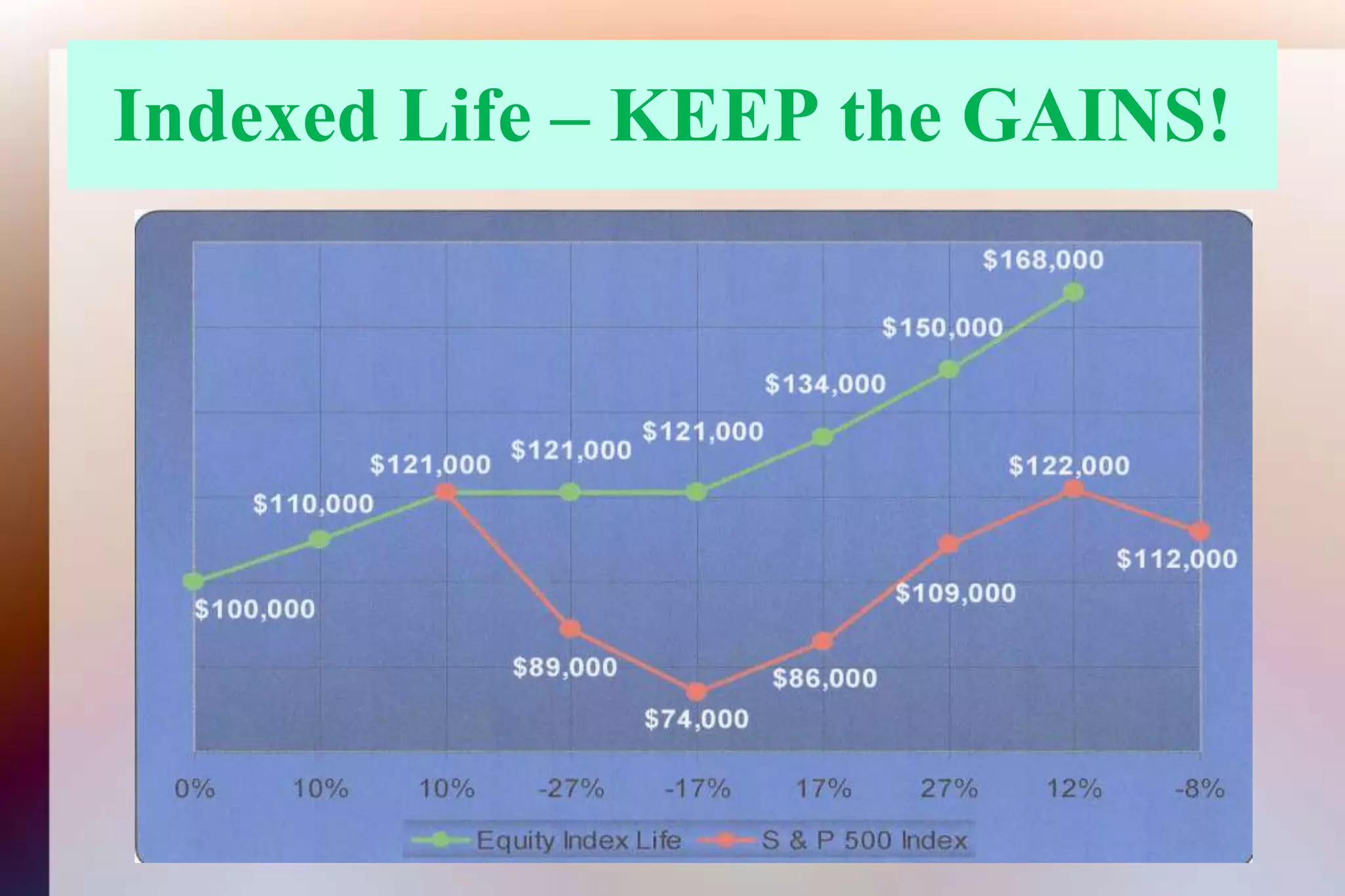
Indexed Life – KEEP the GAINS!
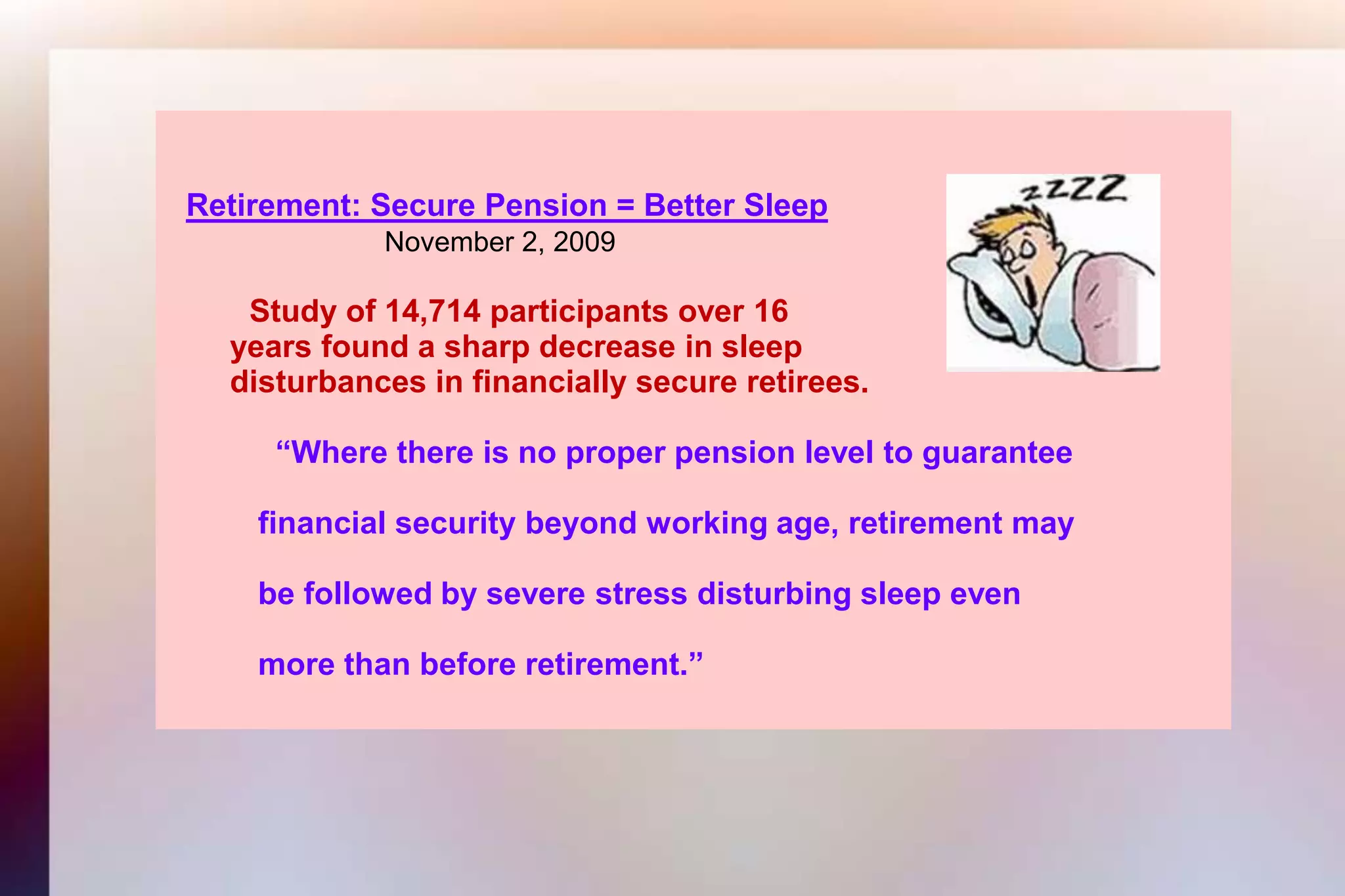
Retirement: Secure Pension = Better SleepNovember 2, 2009Study of 14,714 participants over 16       years found a sharp decrease in sleep       disturbances in financially secure retirees.  	     “Where there is no proper pension level to guarantee 	   financial security beyond working age, retirement may  	   be followed by severe stress disturbing sleep even  	   more than before retirement.”
Qualified Plans(403b/401k/457/IRA/SEP/Roth)
Qualified Plans(403b/401k/457/IRA/SEP/Roth) -Market Risk
Qualified Plans(403b/401k/457/IRA/SEP/Roth) -Market Risk-Future Tax Increases
Qualified Plans(403b/401k/457/IRA/SEP/Roth) -Market Risk-Future Tax Increases-Taxes on Social Security
Qualified Plans(403b/401k/457/IRA/SEP/Roth) -Market Risk-Future Tax Increases-Taxes on Social Security= Sinking / Broke Retirement!
Indexed Life=Retirement Peace of Mind!
Indexed Life=Retirement Peace of Mind!* Eliminate ALL Future ...                - Increased Tax Rate Risk!                               - Stock Roller Coaster Anxiety!
Indexed Life=Retirement Peace of Mind!* Eliminate ALL Future ...                - Increased Tax Rate Risk!                               - Stock Roller Coaster Anxiety!*Feel confident about earning - and  KEEPING– most Future Market Gains!
Indexed Life=Retirement Peace of Mind!* Eliminate ALL Future ...                - Increased Tax Rate Risk!                               - Stock Roller Coaster Anxiety!*Feel confident about earning - and  KEEPING– most Future Market Gains! *Enjoy Steady, Tax Free Income!
This is the "tip of the iceberg" aboutthe MANY Indexed Life Benefits!
"Twenty years from nowyou will be moredisappointed by thethings you didn't do thanby the ones you did do."Mark Twain
Indexed Life Private PlanIs it Right for You?
Indexed Life Private PlanIs it Right for You?If you are saving in a 401k, 403b, 457,SEP, Roth or IRA the answer is likelyYES!
Indexed Life Private PlanIs it Right for You?If you are saving in a 401k, 403b, 457,SEP, Roth or IRA the answer is likelyYES!Let us help you answer that question and show you the difference in Pre Retirement and Retirement Benefits and Income!
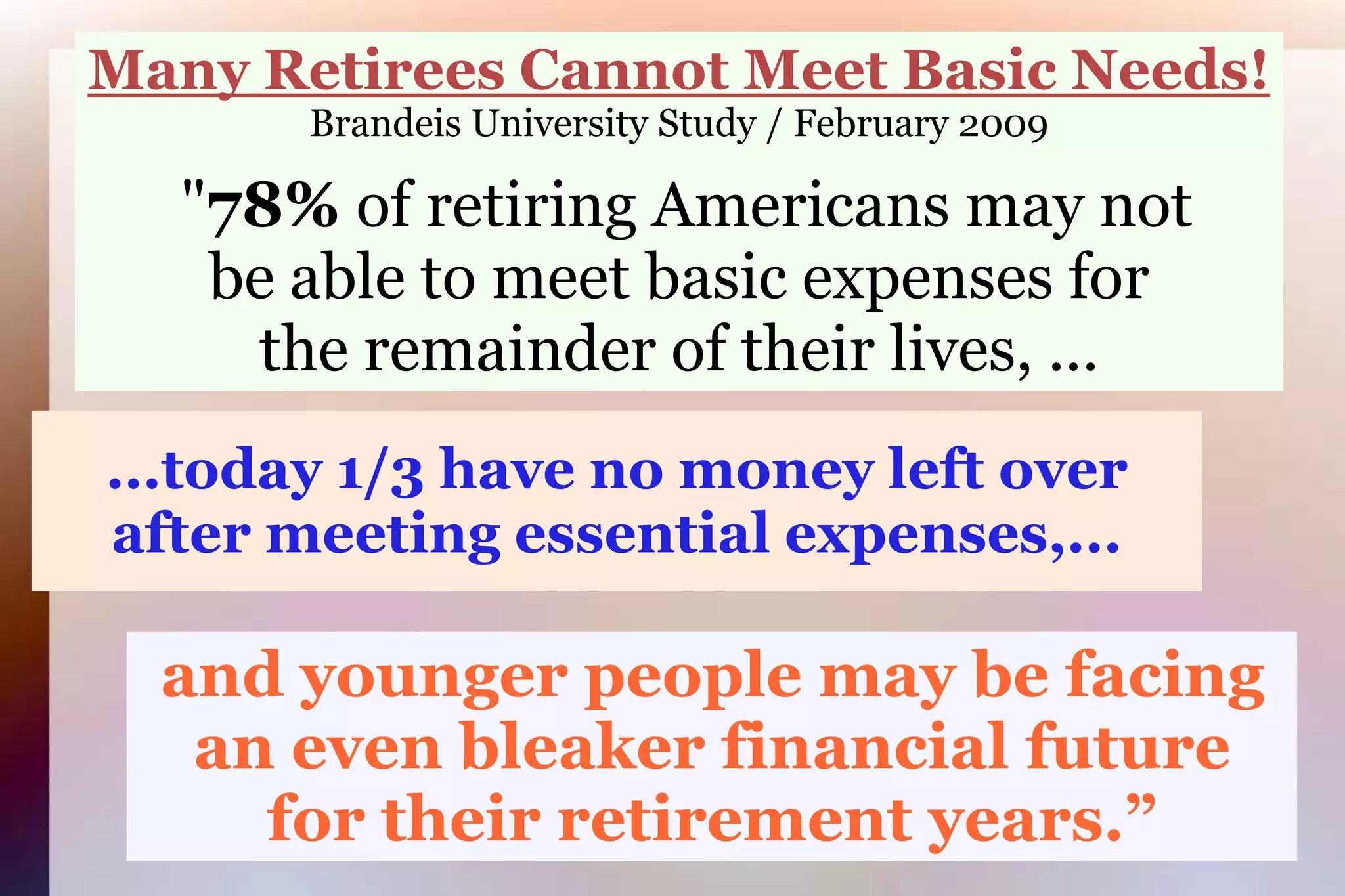
Many Retirees Cannot Meet Basic Needs!Brandeis University Study / February 2009 "78% of retiring Americans may notbe able to meet basic expenses forthe remainder of their lives, ...
Many Retirees Cannot Meet Basic Needs!Brandeis University Study / February 2009 "78% of retiring Americans may notbe able to meet basic expenses forthe remainder of their lives, ... ...today 1/3 have no money left over after meeting essential expenses,...
Many Retirees Cannot Meet Basic Needs!Brandeis University Study / February 2009 "78% of retiring Americans may notbe able to meet basic expenses forthe remainder of their lives, ... ...today 1/3 have no money left over after meeting essential expenses,...and younger people may be facingan even bleaker financial futurefor their retirement years.”
YOU HAVE A CHOICE!DON'T Become a Casualtyof the Looming BoomerRetirement (& TAX) Catastrophe!
YOU HAVE A CHOICE!DON'T Become a Casualtyof the Looming BoomerRetirement (& TAX) Catastrophe!It IS time to Save aSMARTER, BETTER Way!
YOU HAVE A CHOICE!DON'T Become a Casualtyof the Looming BoomerRetirement (& TAX) Catastrophe!It IS time to Save aSMARTER, BETTER Way!TAX FREE Indexed Life!
"Even if you're onthe right track,
"Even if you're onthe right track,You'll get run over ifyou just sit there."Will Rogers
The Time is NOW toSave a BETTER Way!Jerry Stonehouse781 749 3019jstonehous@earthlink.netHingham MA

Risk-free, Tax-free Retirement Strategy

  • 2.
    Presented byJERRY STONEHOUSETaxAdvantaged and “Safe”Retirement Savings Advisor
  • 3.
    "New Knowledge isthe mostvaluable commodity on earth.
  • 4.
    "New Knowledge isthe mostvaluable commodity on earth.The more truth wehave to work with,the richer we become."Kurt Vonnegut
  • 5.
    Just Say “NO!”toa401(k), 403(b), 457,IRA, SEP or ROTH!
  • 6.
    Truth #1IRS QualifiedRetirementSavings Plans403b / 457 / IRA / SEP / 401kAre a Failure!
  • 7.
    5 Reasons YouShouldn’tContribute to a 401(k)March 16, 2011 1) If there is no employer match. 2) High Fees. 3) Higher Tax Rate (at withdrawal) in Qualified Plan.4) Larger Tax Bill at Withdrawal (larger balance).5) (Likely) Future Tax Rate Increases.
  • 8.
  • 9.
    “Why It’s Timeto Retire the 401(k)”“The ugly truth is that the401(k) is a lousy idea,a rotten repository forour retirement reserves …”
  • 10.
    “…The biggest factorin whether the 401(k) works as designed has to do with when you retire. If the market rises that year, you're fine. If you retired last year, you're toast.
  • 11.
    “…The biggest factorin whether the 401(k) works as designed has to do with when you retire. If the market rises that year, you're fine. If you retired last year, you're toast. And the chances of your becoming a victim of this huge flaw in the 401(k) plan are pretty high.
  • 12.
    “…The biggest factorin whether the 401(k) works as designed has to do with when you retire. If the market rises that year, you're fine. If you retired last year, you're toast. And the chances of your becoming a victim of this huge flaw in the 401(k) plan are pretty high. The market fell in four of the nine years since the beginning of the decade. That means anyone retiring this decade had a nearly 50% chance of leaving work in a down market.
  • 13.
    “…The biggest factorin whether the 401(k) works as designed has to do with when you retire. If the market rises that year, you're fine. If you retired last year, you're toast. And the chances of your becoming a victim of this huge flaw in the 401(k) plan are pretty high. The market fell in four of the nine years since the beginning of the decade. That means anyone retiring this decade had a nearly 50% chance of leaving work in a down market. In fact, your chances of retiring into a down market are even greater than that: forced retirements spike in recessions just as the stock market is tanking.”
  • 14.
    “Guaranteed accounts don'thave to be run by the government. The ERISA Industry Committee that represents the nation's largest employers, has proposed a system that would allow individuals the ability to buy a guaranteed retirement account on their own. Some government regulation would be needed, but it would be a ‘Private Plan’ .”
  • 15.
    “But the policywould beportable. Contribute for 30 years and you would be guaranteed income in retirement, no matter how many employers you worked for.
  • 16.
    “But thepolicy would be portable. Contribute for 30 years and you would be guaranteed income in retirement, no matter how many employers you worked for. Combine yourretirement-insurance check with the money you get from Social Security, which can equal as much as 50% of final pay, and presto: you have something approachingretirement security.”
  • 17.
    “But thepolicy would be portable. Contribute for 30 years and you would be guaranteed income in retirement, no matter how many employers you worked for. Combine yourretirement-insurance check with the money you get from Social Security, which can equal as much as 50% of final pay, and presto: you have something approachingretirement security.”We need a NEW, Safer way to save for retirement because …
  • 18.
    * 52% of workers (not including home equity) have savings less than $25,000.
  • 19.
    * 52% of workers (not including home equity) have savings less than $25,000. * 75% have savings less than $10,000.
  • 20.
    * 52% of workers (not including home equity) have savings less than $25,000. * 75% have savings less than $10,000. * 36% of those over 55 have saved less than …$10,000!
  • 22.
    Most Americans willbe too poor to retire at 65!Nov. 1, 2009 / Center for Retirement Research at Boston College 51% are at high risk of falling short ofhaving enough money in retirement.
  • 23.
    Most Americans willbe too poor to retire at 65!Nov. 1, 2009 / Center for Retirement Research at Boston College 51% are at high risk of falling short ofhaving enough money in retirement. “The disappearance of pension plans, as well as troubles with the Social Security system, place younger Americans at a higher risk of being unable to hold on to their standards of living during retirement. The cradle-to-the- grave relationship with the employer is severed…
  • 24.
    Most Americans willbe too poor to retire at 65!Nov. 1, 2009 / Center for Retirement Research at Boston College 51% are at high risk of falling short ofhaving enough money in retirement. “The disappearance of pension plans, as well as troubles with the Social Security system, place younger Americans at a higher risk of being unable to hold on to their standards of living during retirement. The cradle-to-the- grave relationship with the employer is severed…Younger people have to be responsible for their own retirement.”
  • 25.
    Most Americans willbe too poor to retire at 65!Nov. 1, 2009 / Center for Retirement Research at Boston College 51% are at high risk of falling short ofhaving enough money in retirement. “The disappearance of pension plans, as well as troubles with the Social Security system, place younger Americans at a higher risk of being unable to hold on to their standards of living during retirement. The cradle-to-the- grave relationship with the employer is severed…Younger people have to be responsible for their own retirement.”“Retiring won’t become impossible, but it will require some thoughtful planning. Many workers will need to save and invest more, reducedebt and work longer to maintain their standard of living in retirement.”
  • 26.
    Truth #2Stock InvestmentGains– for Investors –are LOUSY!
  • 27.
    "There are twotimes when aman shouldn't speculate:
  • 28.
    "There are twotimes when aman shouldn't speculate:when he can't afford it,and when he can."Mark Twain
  • 29.
    Morningstar & HarvardBusiness SchoolBCT Study4000 Mutual Funds 1996-2002Investor ROI Net Fees = 2.924%
  • 30.
    Bear Market LossesNovember29, 1968 to May 26, 1970 - 36.06% January 11,1973 to October 3, 1974 - 48.20%November 28, 1980 to August 12, 1982 - 27.11%August 25, 1987 to December 4, 1987 - 33.54%March 27, 2000 to July 18, 2002 - 42.29%October 9, 2007 to March 9, 2009 - 56.77%
  • 31.
    Bear Market LossesNovember29, 1968 to May 26, 1970 - 36.06% January 11,1973 to October 3, 1974 - 48.20%November 28, 1980 to August 12, 1982 - 27.11%August 25, 1987 to December 4, 1987 - 33.54%March 27, 2000 to July 18, 2002 - 42.29%October 9, 2007 to March 9, 2009 - 56.77%The Market (since 1946) has an average loss of -33.21% EVERY 6 YEARS!
  • 32.
    Bear Market LossesNovember29, 1968 to May 26, 1970 - 36.06% January 11,1973 to October 3, 1974 - 48.20%November 28, 1980 to August 12, 1982 - 27.11%August 25, 1987 to December 4, 1987 - 33.54%March 27, 2000 to July 18, 2002 - 42.29%October 9, 2007 to March 9, 2009 - 56.77%The Market (since 1946) has an average loss of -33.21% EVERY 6 YEARS!It Takes 22.5 months for the Index to Return to Prior High Value.
  • 33.
    Is this AnxietyRoller Coaster how youwant to live 20 - 30 years of Retirement?
  • 34.
    Wall Street AlwaysWins!Even when you lose Wall Street alwayswins with fees you ALWAYS pay –when the market goes up –AND when it goes down!
  • 35.
    MorningstarManagement Fee [8-17-09]: Average domestic fee is 1.39%. International is 1.56%.
  • 36.
    MorningstarManagement Fee [8-17-09]: Average domestic fee is 1.39%. International is 1.56%.Transaction Fee [6-19-09]: This annual fee is 1.64%. For Small Cap Fund it’s 2.80%.
  • 37.
    MorningstarManagement Fee [8-17-09]: Average domestic fee is 1.39%. International is 1.56%.Transaction Fee [6-19-09]: This annual fee is 1.64%. For Small Cap Fund it’s 2.80%.“Vastly more important than expense ratios and no one’s talking about it.” These are in ADDITION to Fund fees. You don’t control a fund’s transaction costs. That’s determined in part by how often the fund manager trades the securities in the fund’s portfolio, and how costly those trades are.
  • 38.
    MorningstarManagement Fee [8-17-09]: Average domestic fee is 1.39%. International is 1.56%.Transaction Fee [6-19-09]: This annual fee is 1.64%. For Small Cap Fund it’s 2.80%.“Vastly more important than expense ratios and no one’s talking about it.” These are in ADDITION to Fund fees. You don’t control a fund’s transaction costs. That’s determined in part by how often the fund manager trades the securities in the fund’s portfolio, and how costly those trades are.The Minimum Average TOTAL Actual Annual Fund Fees = 3.03%!
  • 39.
    MorningstarManagement Fee [8-17-09]: Average domestic fee is 1.39%. International is 1.56%.Transaction Fee [6-19-09]: This annual fee is 1.64%. For Small Cap Fund it’s 2.80%.“Vastly more important than expense ratios and no one’s talking about it.” These are in ADDITION to Fund fees. You don’t control a fund’s transaction costs. That’s determined in part by how often the fund manager trades the securities in the fund’s portfolio, and how costly those trades are.The Minimum Average TOTAL Actual Annual Fund Fees = 3.03%!Investment NewsERISA Costs [10-15-09]:“It's fair to say that in many cases the total ERISA(401k) drag is close to about 1% of plan assets.”
  • 40.
    MorningstarManagement Fee [8-17-09]: Average domestic fee is 1.39%. International is 1.56%.Transaction Fee [6-19-09]: This annual fee is 1.64%. For Small Cap Fund it’s 2.80%.“Vastly more important than expense ratios and no one’s talking about it.” These are in ADDITION to Fund fees. You don’t control a fund’s transaction costs. That’s determined in part by how often the fund manager trades the securities in the fund’s portfolio, and how costly those trades are.The Minimum Average TOTAL Actual Annual Fund Fees = 3.03%!Investment NewsERISA Costs [10-15-09]:“It's fair to say that in many cases the total ERISA(401k) drag is close to about 1% of plan assets.”Summary: Many plans are in the range of 4% to 5% in TOTALyearly costs – the worst plans charge even more.After all the fees …
  • 41.
    Is Your 401(k)more like a 201(k)?!
  • 42.
    Putnam InvestmentsPresident andChief Executive Officer Robert L. Reynoldscalls for a “ New Generation” of Workplace Savings Planswith Lower Volatility and Lifetime Income SolutionsOctober 1, 2009“After Market Meltdown, Better Plan DesignNeeded to Secure Reliable Lifetime Income” “Index funds and other passive investments that track benchmarks are guaranteed to lose value when the markets they track sink.
  • 43.
    Putnam InvestmentsPresident andChief Executive Officer Robert L. Reynoldscalls for a “ New Generation” of Workplace Savings Planswith Lower Volatility and Lifetime Income SolutionsOctober 1, 2009“After Market Meltdown, Better Plan DesignNeeded to Secure Reliable Lifetime Income” “Index funds and other passive investments that track benchmarks are guaranteed to lose value when the markets they track sink. People in or near retirement are not well served by too-great a concentration of passive (index) investments, thinking they are a protection against a downturn …”
  • 44.
    “(Retirement) plans shouldbe made muchmore resistant to market downturns … The next challenge in workplace savingsplans will be to offer guidelines, evenguardrails, to ensure that worker’s savingsare Protected as they reach retirement age.”
  • 45.
  • 46.
    THE WALL STREETJOURNALOctober 15, 2009The Lost Decade of Stock Investing“Advisers sold us a bill of goodsabout the lasting valueof real estate and stocks.”
  • 47.
    THE WALL STREETJOURNALOctober 15, 2009The Lost Decade of Stock Investing“Advisers sold us a bill of goodsabout the lasting valueof real estate and stocks.” “If you invested $100 in the S&P 500 at the end of the last decade,you're happy with Dow 10,000 but still hoping for a34.5% rally before year end -- just to break even.
  • 48.
    THE WALL STREETJOURNALOctober 15, 2009The Lost Decade of Stock Investing“Advisers sold us a bill of goodsabout the lasting valueof real estate and stocks.” “If you invested $100 in the S&P 500 at the end of the last decade,you're happy with Dow 10,000 but still hoping for a34.5% rally before year end -- just to break even.You'll need a staggering 72% rally when adjusting for inflation.”
  • 50.
    “Quantitative Analysis ofInvestor Behavior”March 9, 2009DALBAR Study Reveals Carnage forEquity, Bond and Asset Allocation ShareholdersThe reality is that investors are not rational, and makebuy and sell decisions at the worst possible moments.
  • 51.
    “Quantitative Analysis ofInvestor Behavior”March 9, 2009DALBAR Study Reveals Carnage forEquity, Bond and Asset Allocation ShareholdersThe reality is that investors are not rational, and makebuy and sell decisions at the worst possible moments.For the 20 years ended December 31, 2008, equityand asset allocation fund investors had averageannual returns of 1.87% and 1.67%, respectively.
  • 52.
    “Quantitative Analysis ofInvestor Behavior”March 9, 2009DALBAR Study Reveals Carnage forEquity, Bond and Asset Allocation ShareholdersThe reality is that investors are not rational, and makebuy and sell decisions at the worst possible moments.For the 20 years ended December 31, 2008, equityand asset allocation fund investors had averageannual returns of 1.87% and 1.67%, respectively. The inflation rate averaged 2.89% over that same time period. 
  • 53.
  • 54.
    What About theFuture?Market Watch – Wall Street Journal / 12-7-10‘10 reasons to shun stocks till banks crash’“Do not buy stocks. Not for retirement.Not in the coming decade. Don’t. Huge risks.” “Wall Street is a loser. Stocks are Wall Street’s ultimate sucker bet. And it’ll sucker you again. You’ll lose, worse than in the last decade. Wake up before Wall Street banks trigger the next meltdown, igniting mass bankruptcy.”
  • 55.
    What About theFuture?Market Watch – Wall Street Journal / 12-7-10“Adjusted for inflation, Wall Street has lost 20% of your money in the past decade. Wall Street’s a loser. And, worse, Wall Street will do it again by 2020.”
  • 56.
    What About theFuture?Market Watch – Wall Street Journal / 12-7-10 “Adjusted for inflation, Wall Street has lost 20% of your money in the past decade. Wall Street’s a loser. And, worse, Wall Street will do it again by 2020.” “That’s right: It will lose another20% of your retirement money.”
  • 57.
    With Retirement Savings,It’sa Sprint to the Finish21 January 2011 “What would you do if your financialplanner prescribed the following advice?‘Save and invest diligently for 30 years,then cross your fingers and pray your investments will double over the lastdecade before you retire’.”
  • 58.
    With Retirement Savings,It’sa Sprint to the Finish21 January 2011 “What would you do if your financialplanner prescribed the following advice?‘Save and invest diligently for 30 years,then cross your fingers and pray your investments will double over the lastdecade before you retire’.” “You might as well go to Las Vegas.”
  • 59.
    With Retirement Savings,It’sa Sprint to the Finish21 January 2011 “The problem is that even if you do everything right and save at a respectable rate, you’re still relying on the market to push you to the finish line in the last decade before retirement. Why?
  • 60.
    With Retirement Savings,It’sa Sprint to the Finish21 January 2011 “The problem is that even if you do everything right and save at a respectable rate, you’re still relying on the market to push you to the finish line in the last decade before retirement. Why? Reaching your goal is highly dependent on the power of compounding.”
  • 61.
    With Retirement Savings,It’sa Sprint to the Finish21 January 2011“But if you’re dealt a bad set of returns during an extended period of time just before you retire or shortly thereafter, your plan could be thrown wildly off track. Many baby boomers know the feeling all too well, given the stock market’s weak showing during the last decade.”
  • 62.
    21 January 2011 “The homestretch before retirement is often the most anxiety-inducing because workers have neither the time nor the financial capacity to recover before they begin taking withdrawals.”“When the bad returns come in thefinal 10 years, no reasonable amountof savings will make up the shortfall.”
  • 63.
    LOST DECADEThe StockMarket Roller Coaster of 2000 – 2009left these years known as the “Lost Decade”..After average costs $1 after 10 yearswas worth 55 cents!
  • 64.
    LOST DECADEThe StockMarket Roller Coaster of 2000 – 2009left these years known as the “Lost Decade”..After average costs $1 after 10 yearswas worth 55 cents!.The ROI was – 44.96%!
  • 66.
    Albert EinsteinInsanity:"Doing thesame thing over and over
  • 67.
    Albert EinsteinInsanity:"Doing thesame thing over and over andexpecting different results."
  • 68.
  • 69.
    August 19,2009Don't putany more money in yourtax-deferred retirement savings
  • 70.
    August 19,2009Don't putany more money in yourtax-deferred retirement savings“This is heresy in a world where people hate taxes … (but) thingshave changed in the past year … The old thinking was that youshould defer tax bills until ‘you are in a lower bracket at retirement’.
  • 71.
    August 19,2009Don't putany more money in yourtax-deferred retirement savings“This is heresy in a world where people hate taxes … (but) thingshave changed in the past year … The old thinking was that youshould defer tax bills until ‘you are in a lower bracket at retirement’.Higher bracket is more like it.
  • 72.
    August 19,2009Don't putany more money in yourtax-deferred retirement savings“This is heresy in a world where people hate taxes … (but) thingshave changed in the past year … The old thinking was that youshould defer tax bills until ‘you are in a lower bracket at retirement’.Higher bracket is more like it.If you are 45 and prosperous, plan on big federal deficitsand higher income taxes when you retire in 2031.
  • 73.
    August 19,2009Don't putany more money in yourtax-deferred retirement savings“This is heresy in a world where people hate taxes … (but) thingshave changed in the past year … The old thinking was that youshould defer tax bills until ‘you are in a lower bracket at retirement’.Higher bracket is more like it.If you are 45 and prosperous, plan on big federal deficitsand higher income taxes when you retire in 2031.You might be better off skipping the 401(k).
  • 74.
    August 19,2009Don't putany more money in yourtax-deferred retirement savings“This is heresy in a world where people hate taxes … (but) thingshave changed in the past year … The old thinking was that youshould defer tax bills until ‘you are in a lower bracket at retirement’.Higher bracket is more like it.If you are 45 and prosperous, plan on big federal deficitsand higher income taxes when you retire in 2031.You might be better off skipping the 401(k).Maybe you should pay tax on your salary now!”
  • 75.
    2011 Deficit $1.5TrillionThat's 10% GDP / largest since WWII
  • 76.
    2011 Deficit $1.5TrillionThat's 10% GDP / largest since WWIITotal National Debt = $14 Trillion
  • 77.
    2011 Deficit $1.5TrillionThat's 10% GDP / largest since WWIITotal National Debt = $14 TrillionTotal with SS & Medicare = 70% GDP
  • 78.
    2011 Deficit $1.5TrillionThat's 10% GDP / largest since WWIITotal National Debt = $14 TrillionTotal with SS & Medicare = 70% GDPWith SS, Prescription and Medicare= $60 Trillion+ (to 2084)
  • 79.
    2011 Deficit $1.5TrillionThat's 10% GDP / largest since WWIITotal National Debt = $14 TrillionTotal with SS & Medicare = 70% GDPWith SS, Prescription and Medicare= $60 Trillion+ (to 2084)That = $500,000 Each!
  • 81.
    RECENT High TAXRATES 1944-4594% 1958-64 91% 1965-81 70% 1982-8650%
  • 82.
    RECENT High TAXRATES 1944-4594% 1958-64 91% 1965-81 70% 1982-8650% Current 35%
  • 83.
    RECENT High TAXRATES 1944-4594% 1958-64 91% 1965-81 70% 1982-8650% Current 35%The last time taxes were this low was 1931! (pre Increasing National Debt Era since 1980)
  • 84.
    RECENT High TAXRATES 1944-4594% 1958-64 91% 1965-81 70% 1982-8650% Current 35%The last time taxes were this low was 1931! (pre Increasing National Debt Era since 1980)The last time the “low” rate was today's10% was 1941 – 70 years ago!
  • 85.
    Future Taxes Make401(k) Less Advantageous November 6, 2009 Since 401(k)s were created in the early 1980s, the general assumption was that a saver would pay lower taxes in retirement, when their income was certain to be lower. So saving pretax dollars and delaying taxes made sense.
  • 86.
    Future Taxes Make401(k) Less Advantageous November 6, 2009 Since 401(k)s were created in the early 1980s, the general assumption was that a saver would pay lower taxes in retirement, when their income was certain to be lower. So saving pretax dollars and delaying taxes made sense. Now, particularly for higher earners with the largest 401(k) balances,that assumption is fading as hikes in tax rates seem likely.
  • 87.
    Future Taxes Make401(k) Less Advantageous November 6, 2009 Since 401(k)s were created in the early 1980s, the general assumption was that a saver would pay lower taxes in retirement, when their income was certain to be lower. So saving pretax dollars and delaying taxes made sense. Now, particularly for higher earners with the largest 401(k) balances,that assumption is fading as hikes in tax rates seem likely. (Another) problem high earners may face by saving only in a pretax 401(k) is that, years later, large withdrawals could trigger the tax on Social Security.
  • 88.
    Future Taxes Make401(k) Less Advantageous November 6, 2009 Since 401(k)s were created in the early 1980s, the general assumption was that a saver would pay lower taxes in retirement, when their income was certain to be lower. So saving pretax dollars and delaying taxes made sense. Now, particularly for higher earners with the largest 401(k) balances,that assumption is fading as hikes in tax rates seem likely. (Another) problem high earners may face by saving only in a pretax 401(k) is that, years later, large withdrawals could trigger the tax on Social Security. (Not deferring taxes) is a good choice for higher earners whose income isn't likely to fall in retirement and for young investors, who will likely see their salaries and taxes increase.
  • 89.
    / 22 October 2008"It's Time for Young Voters to Get Mad!"To Voters under 35:"You have a heavily mortgaged future.You'll pay for Social Security andMedicare for aging baby boomers ...
  • 90.
    / 22 October 2008"It's Time for Young Voters to Get Mad!"To Voters under 35:"You have a heavily mortgaged future.You'll pay for Social Security andMedicare for aging baby boomers ...the needed federal tax increase might total 50% over the next 25 years."
  • 92.
  • 93.
    Social Security is going BROKE!2008 - 65% Rely on SS for 50% of their income!
  • 94.
    Social Security is going BROKE!2008 - 65% Rely on SS for 50% of their income! - 33% Rely on SS for 90% of their income!
  • 95.
    Social Security is going BROKE!2008 - 65% Rely on SS for 50% of their income! - 33% Rely on SS for 90% of their income! - Accounts for 1/3 of discretionary income for couples earning over $500,000 year!
  • 96.
    Social Security is going BROKE!2008 - 65% Rely on SS for 50% of their income! - 33% Rely on SS for 90% of their income! - Accounts for 1/3 of discretionary income for couples earning over $500,000 year! - 1 in 7 Americans receive a check from SS!
  • 97.
    Social Security is going BROKE!2008 - 65% Rely on SS for 50% of their income! - 33% Rely on SS for 90% of their income! - Accounts for 1/3 of discretionary income for couples earning over $500,000 year! - 1 in 7 Americans receive a check from SS! - # Workers per Retiree: 1960 = 5 2009 = 3.3 2020 = 2!
  • 98.
    2010:SS Outlays exceed Revenues!The likely solutionsay most expertsis MORE Taxes!
  • 99.
    2010:SS Outlays exceed Revenues! 2011: - Average Benefit check is $1,177 month!The likely solutionsay most expertsis MORE Taxes!
  • 100.
    2010:SS Outlays exceed Revenues! 2011: - Average Benefit check is $1,177 month! - Up to 85% of Benefits are Taxed!The likely solutionsay most expertsis MORE Taxes!
  • 101.
    2010:SS Outlays exceed Revenues! 2011: - Average Benefit check is $1,177 month! - Up to 85% of Benefits are Taxed!2030: Medicare Trust Fund is Broke!The likely solutionsay most expertsis MORE Taxes!
  • 102.
    2010:SS Outlays exceed Revenues! 2011: - Average Benefit check is $1,177 month! - Up to 85% of Benefits are Taxed!2030: Medicare Trust Fund is Broke!2037: Social Security Trust Fund is Broke!The likely solutionsay most expertsis MORE Taxes!
  • 104.
  • 105.
    But What Elseis Left?What Possible Investment is There?!
  • 106.
    "The Difficulty liesnotin the new ideas,
  • 107.
    "The Difficulty liesnotin the new ideas,but in escapingfrom the old ones."John Maynard Keynes20th Century Economist"The General Theory of Employment, Interest and Money"
  • 108.
    “The solution: anew type of ‘insurance’.
  • 109.
    “The solution: anew type of ‘insurance’.Retirement savings, it turns out, are exactlythe type of asset we need insurance for.
  • 110.
    “The solution: anew type of ‘insurance’.Retirement savings, it turns out, are exactlythe type of asset we need insurance for.We need insurance to protect against risks wecan't predict (when the market collapses)and can't afford to recover from on our own.”
  • 111.
  • 112.
    With all thesebenefits, today it is called …"The 'NEW' Asset Class Investment"March 26, 2008"This is a safe bet, long terminvestment with high interest,almost no volatility and liquid.
  • 113.
    With all thesebenefits, today it is called …"The 'NEW' Asset Class Investment"March 26, 2008"This is a safe bet, long terminvestment with high interest,almost no volatility and liquid.You do not have to die to enjoythese returns (and) it canwork like a Roth ...
  • 114.
    “It’s dramatic advantageis that you pay no tax on the gains ever, and you can spend them while you are alive tax free.”
  • 115.
  • 116.
  • 117.
    For Retirement Savingsit’soften called a“Private Plan”
  • 118.
    For Retirement Savingsit’soften called a“Private Plan”It IS Approved by Congressand Regulated by the IRSwith IRC 7702(a)
  • 119.
    "It ain't whatyou don't knowthat gets you into trouble.
  • 120.
    "It ain't whatyou don't knowthat gets you into trouble.It's what you know for surethat just ain't so."Mark Twain
  • 121.
    April 2009Myth. LifeInsurance is not a good investment.
  • 122.
    April 2009Myth. LifeInsurance is not a good investment.“This canard spread as 401(k)s and IRA's supplantedLife Insurance as Americans' most popular ways to buildSavings while deferring taxes. But two factors point toa revival of Life insurance as an investment:
  • 123.
    April 2009Myth. LifeInsurance is not a good investment.“This canard spread as 401(k)s and IRA's supplantedLife Insurance as Americans' most popular ways to buildSavings while deferring taxes. But two factors point toa revival of Life insurance as an investment:One is guaranteed credits on cash values,which means if you pay the premiums, you cannot lose money unless the company fails.(The other is if you are over 65, you canoften sell it for several times its cash value)!”
  • 124.
    April 2009Myth. LifeInsurance is not a good investment.“This canard spread as 401(k)s and IRA's supplantedLife Insurance as Americans' most popular ways to buildSavings while deferring taxes. But two factors point toa revival of Life insurance as an investment:One is guaranteed credits on cash values,which means if you pay the premiums, you cannot lose money unless the company fails.(The other is if you are over 65, you canoften sell it for several times its cash value)!”TRUTH: “A good investment is one in which you put moneyaway now and have more later. Checked your 401(k) lately?”
  • 125.
    BUT this isNOT yourGrandparents Life Insurance!
  • 126.
    Returns can beLINKEDtothe S&P 500(or other index)
  • 127.
    Returns can beLINKEDtothe S&P 500(or other index)You areNOTINthestock market!
  • 128.
    Returns can beLINKEDtothe S&P 500(or other index)You areNOTINthestock market!This means youKEEPALLAnnualgains!
  • 129.
    Your Principaland GainsCANNOTgodown in valuebecause ofthe market --they can only goUP!
  • 130.
    Juicing Your LifeInsurance5 June 2010This year's hottest life-insurance product is well-suited to an era of sudden "flash crashes" and overall uncertainty: It appeals to people eager to capture stock-market gainswhile avoiding undue risk. The product (is) "indexed universal life”.
  • 131.
    Juicing Your LifeInsurance5 June 2010 The twist in these new policies is the use of a stock-market index to help determine the interest rate for the cash-value account. In many versions, insurers link to the Standard & Poor's 500-stock index, but cap the annual interest rate …
  • 132.
    Juicing Your LifeInsurance5 June 2010 The twist in these new policies is the use of a stock-market index to help determine the interest rate for the cash-value account. In many versions, insurers link to the Standard & Poor's 500-stock index, but cap the annual interest rate … For downside protection, some policies promise a minimum interest rate of as much as 2%, even in losing years for stocks, while others simply protect against losses.
  • 133.
    Juicing Your LifeInsurance5 June 2010The product "resonates with people" says the chief actuary (for one co.).“It has a guarantee sopeople can sleep at night,and it has upside potential”.
  • 134.
  • 135.
    How well canthis 'solution' work?Hypothetical Past 20 years to 12/31/10(Age 40 to 59) Based on ACTUAL S&P 500 Index gains usingCurrent Crediting Formula & Expenses(including zero gain years)7 – 8% NET per year!
  • 136.
    This isIndexed Life!THERetirement SavingsInvestment for the Future!
  • 137.
    Thanks to IRSIRC: 7702(a)Indexed Universal Life (IUL)is the ONLYInvestment approved by Congressand the IRS to provideyouALLof theseBenefits and Features ...
  • 138.
  • 139.
  • 140.
    Putnam Investment RetirementSurvey 2005“A majority of retirees said theirBIGGEST MISTAKEin planning for Retirementwas failing to invest in TAX FREE Accounts.”
  • 141.
    Putnam Investment RetirementSurvey 2005“A majority of retirees said theirBIGGEST MISTAKEin planning for Retirementwas failing to invest in TAX FREE Accounts.”With Indexed Life …
  • 142.
    ...it's OTHER dramaticadvantage is that you payNO tax on the gains ever –Your Retirement Incomeis Tax Free!
  • 143.
    7 - 8%IUL NET 1991-2010 vs.DALBAR Report 20 Year Investor Behavior to 20104-1-11
  • 144.
    7 - 8%IUL NET 1991-2010 vs.DALBAR Report 20 Year Investor Behavior to 20104-1-11"Market" S&P 500 = 9.14% gross
  • 145.
    7 - 8%IUL NET 1991-2010 vs.DALBAR Report 20 Year Investor Behavior to 20104-1-11"Market" S&P 500 = 9.14% grossNET Investor ROI =3.83% ACTUAL!
  • 146.
    7 - 8%IUL NET 1991-2010 vs.DALBAR Report 20 Year Investor Behavior to 20104-1-11"Market" S&P 500 = 9.14% grossNET Investor ROI =3.83% ACTUAL!RESULT: 20 Year IUL Net > Market!
  • 147.
    Indexed Life alsodoes NOT have the RestrictiveQualified Plan Contribution, Access and Loan Rules!
  • 148.
  • 149.
    403b/457/401kIUL ContributionLimit $16,500 NONE Pre 59.5 Penalty 10% Federal NONEPlusState
  • 150.
    403b/457/401kIUL ContributionLimit $16,500 NONE Pre 59.5 Penalty 10% Federal NONEPlusStateMandatory Distribution 70.5 NONE
  • 151.
    403b/457/401kIUL ContributionLimit $16,500 NONE Pre 59.5 Penalty 10% Federal NONEPlusStateMandatory Distribution 70.5 NONE Accelerated Terminal noto $1 million Illness Advance
  • 152.
  • 153.
    Plan LOAN403b/457/401kIULAmount 50% to$50kNO Limit Loan Repayment mandatoryOptional
  • 154.
    Plan LOAN403b/457/401kIULAmount 50% to$50kNO Limit Loan Repayment mandatoryOptional Quit/Fired/Co. 'broke' 90 days N/Arepay in full
  • 155.
    Plan LOAN403b/457/401kIULAmount 50% to$50kNO Limit Loan Repayment mandatoryOptional Quit/Fired/Co. 'broke' 90 days N/Arepay in full Late with payment 30 day grace N/AorALLTaxable
  • 156.
    Indexed Life alsoincludes:LifetimeLife Insurance(may guarantee Retirement Plancompletion for Survivor Spouse)
  • 157.
    The Life Insurancecan also be used forPENSION MAXto Increase Your Pension Income $hundreds or $thousands per month!Popular for Teacher & Government Pension Plans: STRS [State Teachers Retirement System] PERS [Public Employees Retirement System]
  • 158.
    Accelerated “Living” BenefitWith1 or 2 year terminal diagnosisup to $1 million Advance Benefit!
  • 159.
    Accelerated “Living” BenefitWith1 or 2 year terminal diagnosisup to $1 million Advance Benefit!Money can be used for ANYpurpose -including treatment that couldSAVE YOUR LIFE!
  • 160.
    With Indexed LifeYoucan also …Be Your OWN Banker!(Great Financial Strategy for those in their 20's & 30's!)You can use your savings to finance your life while on your journey to retirement!
  • 161.
    AND Finance YourRetirement TOOWhile You D0!Age 40Save $1,000 Monthto Age 65
  • 162.
    AND Finance YourRetirement TOOWhile You D0!Age 65 Cash Value= $857,000
  • 163.
    AND Finance YourRetirement TOOWhile You D0!Age 65 Cash Value= $857,000Tax Free Retirement Income = $50,000 Yr!
  • 164.
    AND Finance YourRetirement TOOWhile You D0!Age 65 Cash Value= $857,000Tax Free Retirement Income = $50,000 Yr! Age 85 Cash Value = $2,229,000!
  • 165.
    AND Finance YourRetirement TOOWhile You D0!Age 65 Cash Value= $857,000Tax Free Retirement Income = $50,000 Yr! Age 85 Cash Value = $2,229,000! (Or give Yourselfa Raise!)
  • 166.
    The BEST COLLEGESAVINGS Plan! * Can take out “Tuition” Tax/Penalty Free!
  • 167.
    The BEST COLLEGESAVINGS Plan! * Can take out “Tuition” Tax/Penalty Free! * NOT included in college aid formulas!
  • 168.
    The BEST COLLEGESAVINGS Plan! * Can take out “Tuition” Tax/Penalty Free! * NOT included in college aid formulas! * CV Remains the Parents Savings!
  • 169.
    The BEST COLLEGESAVINGS Plan! * Can take out “Tuition” Tax/Penalty Free! * NOT included in college aid formulas! * CV Remains the Parents Savings! * Balance can continue to grow to provide Tax FREE Retirement Income!
  • 170.
    The BEST COLLEGESAVINGS Plan! * Can take out “Tuition” Tax/Penalty Free! * NOT included in college aid formulas! * CV Remains the Parents Savings! * Balance can continue to grow to provide Tax FREE Retirement Income! * Life Insurance on Parent to guarantee College paid for if premature death.
  • 171.
    Or You CanKeep “Saving” in Mutual Funds!
  • 172.
    BONUS!TheTax Free Incomefrom Indexed Life(unlike Municipal Bondsand Qualified Savings withdrawals)
  • 173.
    BONUS!TheTax Free Incomefrom Indexed Life(unlike Municipal Bondsand Qualified Savings withdrawals)isNOTincluded inthe formula to taxup to 85% of yourSocial Security!
  • 174.
    BONUS!TheTax Free Incomefrom Indexed Life(unlike Municipal Bondsand Qualified Savings withdrawals)isNOTincluded inthe formula to taxup to 85% of yourSocial Security! An IUL plan may be the easiest, 'cheapest' and BEST way to Save for Retirement AND Avoid this Tax!
  • 175.
    November 2007 BEST ALL-AROUNDRETIREMENT ACCOUNTis the Roth IRA:“There's no up-front tax break [IUL], but decades of tax-free growth [IUL], plus tax-free income in retirement [IUL].”
  • 176.
    November 2007 BEST ALL-AROUNDRETIREMENT ACCOUNTis the Roth IRA:“There's no up-front tax break [IUL], but decades of tax-free growth [IUL], plus tax-free income in retirement [IUL].”Why Stop There?! Even BETTER is ...
  • 177.
    An IUL "SUPERROTH"!Unlikea Roth ... * NO Contribution Limits.
  • 178.
    An IUL "SUPERROTH"!Unlikea Roth ... * NO Contribution Limits. * NO Income Restrictions.
  • 179.
    An IUL "SUPERROTH"!Unlikea Roth ... * NO Contribution Limits. * NO Income Restrictions. * Includes Hundreds of Thousands $'s (or more) in Life Insurance from Day 1[NOT Allowed in Roth! Use it to Pension Max!]
  • 180.
    An IUL "SUPERROTH"!Unlikea Roth ... * NO Contribution Limits. * NOIncome Restrictions. * Includes Hundreds of Thousands $'s (or more) in Life Insurance from Day 1[NOT Allowed in Roth! Use it to Pension Max!]* NOIRS or State Penalties for pre 59.5 access to gains.
  • 181.
    * NO 5Year wait for Tax Free Access!
  • 182.
    * NO 5Year wait for Tax Free Access!* Loans Allowed(payments not required!)Can USE the savings to ...
  • 183.
    * NO 5Year wait for Tax Free Access!* Loans Allowed(payments not required!)Can USE the savings to ...* Be Your "Own Banker"!
  • 184.
    * NO 5Year wait for Tax Free Access!* Loans Allowed(payments not required!)Can USE the savings to ...* Be Your "Own Banker"!* Children (or Grandchildren's) College Fund!
  • 185.
    * NO 5Year wait for Tax Free Access!* Loans Allowed(payments not required!)Can USE the savings to ...* Be Your "Own Banker"!* Children (or Grandchildren's) College Fund!* Tax Benefits Grandfathered ... so NO Tax Change Risk!
  • 186.
    * NO 5Year wait for Tax Free Access!* Loans Allowed(payments not required!)Can USE the savings to ...* Be Your "Own Banker"!* Children (or Grandchildren's) College Fund!* Tax Benefits Grandfathered ... so NO Tax Change Risk! * NO MARKET RISK – You KEEP the Gains!
  • 187.
    * NO 5Year wait for Tax Free Access!* Loans Allowed(payments not required!)Can USE the savings to ...* Be Your "Own Banker"!* Children (or Grandchildren's) College Fund!* Tax Benefits Grandfathered ... so NO Tax Change Risk! * NO MARKET RISK – You KEEP the Gains!Roth OR IUL "Super Roth"?IUL!
  • 188.
    In case youwere wondering,many of the companies whooffer IUL are among the oldest(over 100 to 150 years old),most stable, best rated,ANDlargest financial servicescompanies in the world!
  • 189.
    In case youwere wondering,many of the companies whooffer IUL are among the oldest(over 100 to 150 years old),most stable, best rated,ANDlargest financial servicescompanies in the world![Checks from Ins. Co.’s are a major reasonwhy many survived the Great Depression!]
  • 190.
    FINAL TRUTHIndexed Lifemay be YOURLAST Chance Retirement!
  • 192.
    NET CASH VALUE– Saving Stage[NET Fees, Pre 59.5 Penalties and Taxes]Age 45 PNT / Save $1,000 mo. for 20 years[Average Past 25, Thirty Year Periods (since 1953)]YearQualifiedIUL 5 60,918 57,747 6 74,989 74,913 10 138,667 164,919 15 271,882 324,799 20 416,619 569,405
  • 193.
    NET Retirement -Income StageStarting Age 66 / 35% MTR (pre/post retirement)YearQualifiedIUL(66) 21 54,000 54,000 NET 25 54,000 54,000
  • 194.
    NET Retirement -Income StageStarting Age 66 / 35% MTR (pre/post retirement)YearQualifiedIUL(66) 21 54,000 54,000 NET 25 54,000 54,000 30 BROKE!54,00040 054,000 45 054,000 50 054,000(100) 55 054,000
  • 195.
    NET Cash Valueand IRRYearQualifiedIRRIULIRR20 416,619 5.00% 569,405 7.66%25 177,518 4.44% 547,239 8.13%30 BROKE! 0% 551,109 8.48%35 00% 609,981 8.79%40 00% 759,719 9.03%45 00% 1,053,434 9.21%50 00% 1,645,896 9.37%55 00% 2,909,552 9.54%
  • 196.
    What IF theStock Market / S&P “Tanks” for Years in a Row?10 Year S&P 500 IULGainsNO Cap 16% Cap (per year)Actual100% PR* 1983 5.06% 7.45% 1982 1.40% 5.97% 1981 2.86% 6.59% 1980 3.87% 7.17%19791.34%6.10% Past 5 Yrs 2.91% 6.65% 1978 0.11% 5.40% 1977 0.87% 5.82% 1976 2.90% 6.84% 1975 0.48% 5.52%1974-0.31%5.17% Past 10 Yrs 1.86% 6.20%* Participation Rate
  • 197.
    What IF theStock Market / S&P “Tanks” for Years in a Row?The average 10 year gain of the S&Pin an IUL the past 65 years is 9.05%.[18% historical average cap]10 Year S&P 500 IULGainsNO Cap 16% Cap (per year)Actual100% PR* 1983 5.06% 7.45% 1982 1.40% 5.97% 1981 2.86% 6.59% 1980 3.87% 7.17%19791.34%6.10% Past 5 Yrs 2.91% 6.65% 1978 0.11% 5.40% 1977 0.87% 5.82% 1976 2.90% 6.84% 1975 0.48% 5.52%1974-0.31%5.17% Past 10 Yrs 1.86% 6.20%* Participation Rate
  • 198.
    What IF theStock Market / S&P “Tanks” for Years in a Row?The average 10 year gain of the S&Pin an IUL the past 65 years is 9.05%.[18% historical average cap]The worst stretch during that time was 1974 to 1983 when the S&P10 year gains averaged 1.86% per yr.10 Year S&P 500 IULGainsNO Cap 16% Cap (per year)Actual100% PR* 1983 5.06% 7.45% 1982 1.40% 5.97% 1981 2.86% 6.59% 1980 3.87% 7.17%19791.34%6.10% Past 5 Yrs 2.91% 6.65% 1978 0.11% 5.40% 1977 0.87% 5.82% 1976 2.90% 6.84% 1975 0.48% 5.52%1974-0.31%5.17% Past 10 Yrs 1.86% 6.20%* Participation Rate
  • 199.
    What IF theStock Market / S&P “Tanks” for Years in a Row?The average 10 year gain of the S&Pin an IUL the past 65 years is 9.05%.[18% historical average cap]The worst stretch during that time was 1974 to 1983 when the S&P10 year gains averaged 1.86% per yr.But at an average (low) cap of 16%IUL would of averaged 6.20% per year – a gain that is 233% MORE!10 Year S&P 500 IULGainsNO Cap 16% Cap (per year)Actual100% PR* 1983 5.06% 7.45% 1982 1.40% 5.97% 1981 2.86% 6.59% 1980 3.87% 7.17%19791.34%6.10% Past 5 Yrs 2.91% 6.65% 1978 0.11% 5.40% 1977 0.87% 5.82% 1976 2.90% 6.84% 1975 0.48% 5.52%1974-0.31%5.17% Past 10 Yrs 1.86% 6.20%* Participation Rate
  • 200.
    What IF theStock Market / S&P “Tanks” for Years in a Row?The average 10 year gain of the S&Pin an IUL the past 65 years is 9.05%.[18% historical average cap]The worst stretch during that time was 1974 to 1983 when the S&P10 year gains averaged 1.86% per yr.But at an average (low) cap of 16%IUL would of averaged 6.20% per year – a gain that is 233% MORE!This is because IUL KEEPSits prior annual gains so whenthe market goes up again itBUILDS on those gainsinstead of having to recover 1st!10 Year S&P 500 IULGainsNO Cap 16% Cap (per year)Actual100% PR* 1983 5.06% 7.45% 1982 1.40% 5.97% 1981 2.86% 6.59% 1980 3.87% 7.17%19791.34%6.10% Past 5 Yrs 2.91% 6.65% 1978 0.11% 5.40% 1977 0.87% 5.82% 1976 2.90% 6.84% 1975 0.48% 5.52%1974-0.31%5.17% Past 10 Yrs 1.86% 6.20%* Participation Rate
  • 201.
    What IF theStock Market / S&P “Tanks” for Years in a Row?The average 10 year gain of the S&Pin an IUL the past 65 years is 9.05%.[18% historical average cap]The worst stretch during that time was 1974 to 1983 when the S&P10 year gains averaged 1.86% per yr.But at an average (low) cap of 16%IUL would of averaged 6.20% per year – a gain that is 233% MORE!This is because IUL KEEPSits prior annual gains so whenthe market goes up again itBUILDS on those gainsinstead of having to recover 1st!Indexed Life =Retirement Security! 10 Year S&P 500 IULGainsNO Cap 16% Cap (per year)Actual100% PR* 1983 5.06% 7.45% 1982 1.40% 5.97% 1981 2.86% 6.59% 1980 3.87% 7.17%19791.34%6.10% Past 5 Yrs 2.91% 6.65% 1978 0.11% 5.40% 1977 0.87% 5.82% 1976 2.90% 6.84% 1975 0.48% 5.52%1974-0.31%5.17% Past 10 Yrs 1.86% 6.20%* Participation Rate
  • 202.
    Indexed Life –KEEP the GAINS!
  • 203.
    Retirement: Secure Pension= Better SleepNovember 2, 2009Study of 14,714 participants over 16 years found a sharp decrease in sleep disturbances in financially secure retirees. “Where there is no proper pension level to guarantee financial security beyond working age, retirement may be followed by severe stress disturbing sleep even more than before retirement.”
  • 204.
  • 205.
  • 206.
  • 207.
    Qualified Plans(403b/401k/457/IRA/SEP/Roth) -MarketRisk-Future Tax Increases-Taxes on Social Security
  • 208.
    Qualified Plans(403b/401k/457/IRA/SEP/Roth) -MarketRisk-Future Tax Increases-Taxes on Social Security= Sinking / Broke Retirement!
  • 209.
  • 210.
    Indexed Life=Retirement Peaceof Mind!* Eliminate ALL Future ... - Increased Tax Rate Risk! - Stock Roller Coaster Anxiety!
  • 211.
    Indexed Life=Retirement Peaceof Mind!* Eliminate ALL Future ... - Increased Tax Rate Risk! - Stock Roller Coaster Anxiety!*Feel confident about earning - and KEEPING– most Future Market Gains!
  • 212.
    Indexed Life=Retirement Peaceof Mind!* Eliminate ALL Future ... - Increased Tax Rate Risk! - Stock Roller Coaster Anxiety!*Feel confident about earning - and KEEPING– most Future Market Gains! *Enjoy Steady, Tax Free Income!
  • 213.
    This is the"tip of the iceberg" aboutthe MANY Indexed Life Benefits!
  • 214.
    "Twenty years fromnowyou will be moredisappointed by thethings you didn't do thanby the ones you did do."Mark Twain
  • 215.
    Indexed Life PrivatePlanIs it Right for You?
  • 216.
    Indexed Life PrivatePlanIs it Right for You?If you are saving in a 401k, 403b, 457,SEP, Roth or IRA the answer is likelyYES!
  • 217.
    Indexed Life PrivatePlanIs it Right for You?If you are saving in a 401k, 403b, 457,SEP, Roth or IRA the answer is likelyYES!Let us help you answer that question and show you the difference in Pre Retirement and Retirement Benefits and Income!
  • 218.
    Many Retirees CannotMeet Basic Needs!Brandeis University Study / February 2009 "78% of retiring Americans may notbe able to meet basic expenses forthe remainder of their lives, ...
  • 219.
    Many Retirees CannotMeet Basic Needs!Brandeis University Study / February 2009 "78% of retiring Americans may notbe able to meet basic expenses forthe remainder of their lives, ... ...today 1/3 have no money left over after meeting essential expenses,...
  • 220.
    Many Retirees CannotMeet Basic Needs!Brandeis University Study / February 2009 "78% of retiring Americans may notbe able to meet basic expenses forthe remainder of their lives, ... ...today 1/3 have no money left over after meeting essential expenses,...and younger people may be facingan even bleaker financial futurefor their retirement years.”
  • 224.
    YOU HAVE ACHOICE!DON'T Become a Casualtyof the Looming BoomerRetirement (& TAX) Catastrophe!
  • 225.
    YOU HAVE ACHOICE!DON'T Become a Casualtyof the Looming BoomerRetirement (& TAX) Catastrophe!It IS time to Save aSMARTER, BETTER Way!
  • 226.
    YOU HAVE ACHOICE!DON'T Become a Casualtyof the Looming BoomerRetirement (& TAX) Catastrophe!It IS time to Save aSMARTER, BETTER Way!TAX FREE Indexed Life!
  • 227.
    "Even if you'reonthe right track,
  • 228.
    "Even if you'reonthe right track,You'll get run over ifyou just sit there."Will Rogers
  • 230.
    The Time isNOW toSave a BETTER Way!Jerry Stonehouse781 749 3019jstonehous@earthlink.netHingham MA

Editor's Notes

  • #50 You have a choice! Between the “Real” Stock Market for your retirement savings. Or you can have “the stock market they sell you” – but ONLY with Indexed Life.