CMC0117PPT 05/09® • Not FDIC/NCUA insured   • Not bank/CU guaranteed  • May lose value   • Not a deposit    • Not insured by any federal agencyCMC0117PPT 05/09
CMC0117PPT 05/09A Word From Our AttorneysAnnuities and life insurance are issued by Jackson National Life Insurance Company® (Home Office: Lansing, Michigan) and in New York, annuities are issued by Jackson National Life Insurance Company of New York® (Home Office: Purchase, New York). Variable products are distributed by Jackson National Life Distributors LLC. May not be available in all states and state variations may apply. These products have limitations and restrictions. Contact the Company for more information. Jackson® is the marketing name for Jackson National Life Insurance Company and Jackson National Life Insurance Company of New York. Before investing, investors should carefully consider the investment objectives, risks, charges and expenses of the variable product and its underlying investment options. The current contract prospectus and underlying fund prospectuses, which are contained in the same document, provide this and other important information. Please contact your representative or the Company to obtain a prospectuses. Please read the prospectuses carefully before investing or sending money. Guarantees are backed by the claims-paying ability of Jackson National Life Insurance Company or Jackson National Life Insurance Company of New York and do not apply to the principal amount or investment performance of the separate account or its underlying investments. An annuity is a long-term, tax-deferred vehicle designed for retirement. Earnings are taxable as ordinary income when distributed and, if withdrawn before age 59½, may be subject to a 10% federal tax penalty. Withdrawals have the effect of reducing the death benefit and surrender value. Tax deferral offers no additional value if an annuity is used to fund a qualified plan, such as a 401(k) or IRA. Tax deferral may not be available if the annuity is owned by a “non-natural person” such as a corporation or certain types of trusts. Jackson neither encourages nor condonesunnecessary replacements or replacements that are not in the best interest of the customer. Jackson and its affiliates do not provide legal, tax or estate-planning advice. For questions about a specific situation, please consult a qualified advisor.

CMC0117PPT 05/09Before We BeginIn response to recent concerns by both the financial industry and the general investing public, we would like you to know that this event is truly complimentary. While we would like to earn your trust and your business, you are under absolutely no obligation to set up an appointment or to purchase any products or services.For additional investor protection information, please visit the investor information section of www.finra.org.
CMC0117PPT 05/09“The aging of America’s Baby Boomers is the most pressing national issue of the century.”Source: “The Age Explosion: Baby Boomers and Beyond,” Harvard Generations Policy Journal, Winter 2004.
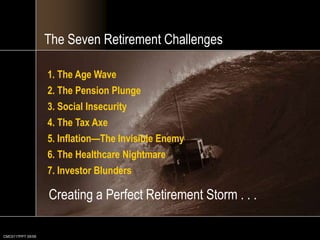
CMC0117PPT 05/09The Seven Retirement Challenges1. The Age Wave2. The Pension Plunge3. Social Insecurity4. The Tax Axe5. Inflation—The Invisible Enemy6. The Healthcare Nightmare7. Investor BlundersCreating a Perfect Retirement Storm . . .
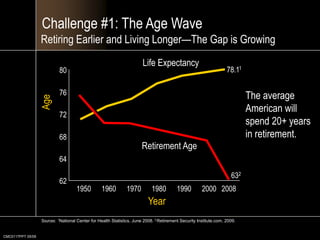
CMC0117PPT 05/09Life Expectancy78.118076Age7268Retirement Age64632621950196019701980199020002008YearChallenge #1: The Age WaveRetiring Earlier and Living Longer—The Gap is GrowingThe average American will spend 20+ years in retirement.Sources:  1National Center for Health Statistics, June 2008. 2 Retirement Security Institute.com, 2009.
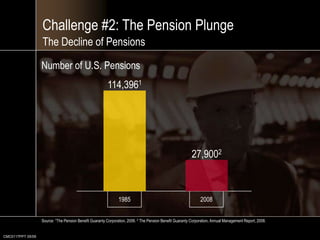
CMC0117PPT 05/09114,396127,900220081985Challenge #2: The Pension PlungeThe Decline of PensionsNumber of U.S. PensionsSource: 1The Pension Benefit Guaranty Corporation, 2006. 2 The Pension Benefit Guaranty Corporation, Annual Management Report, 2008..
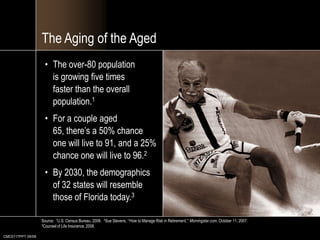
CMC0117PPT 05/09The Aging of the AgedThe over-80 populationis growing five timesfaster than the overall population.1
For a couple aged 65, there’s a 50% chance one will live to 91, and a 25% chance one will live to 96.2
By 2030, the demographics of 32 states will resemble those of Florida today.3Source: 1U.S. Census Bureau, 2008.2Sue Stevens, “How to Manage Risk in Retirement,”Morningstar.com, October 11, 2007. 3Counsel of Life Insurance, 2008.
CMC0117PPT 05/09Even those pensions that have survived may be threatened.
CMC0117PPT 05/09The Pension Benefit Guaranty Corporation had a deficit of $11 billion in 2008.Source: Pension Benefit Guaranty Corporation, Annual Management Report, 2008.CMC0117PPT 09/08Source: InsuranceBroadcast.com, 08/05/2005,©Reuters 2005
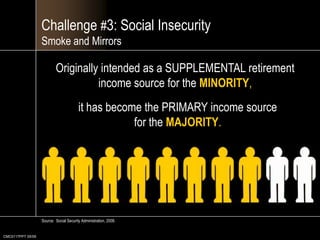
CMC0117PPT 05/09Challenge #3: Social InsecuritySmoke and MirrorsOriginally intended as a SUPPLEMENTAL retirement income source for the MINORITY,it has become the PRIMARY income source for the MAJORITY.Source:  Social Security Administration, 2008.
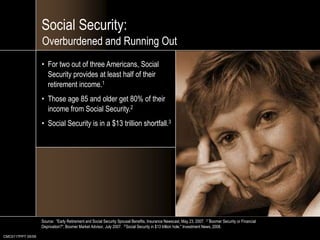
CMC0117PPT 05/09Social Security:Overburdened and Running OutFor two out of three Americans, SocialSecurity provides at least half of theirretirement income.1
Those age 85 and older get 80% of theirincome from Social Security.2
Social Security is in a $13 trillion shortfall.3Source:  1Early Retirement and Social Security Spousal Benefits, Insurance Newscast, May 23, 2007.  2 "Boomer Security or Financial Deprivation?", Boomer Market Advisor, July 2007.  3"Social Security in $13 trillion hole," Investment News, 2008.
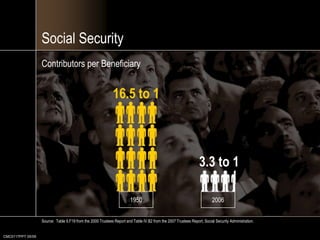
CMC0117PPT 05/0916.5 to 13.3 to 120061950Social SecurityContributors per BeneficiarySource:  Table II.F19 from the 2000 Trustees Report and Table IV.B2 from the 2007 Trustees Report, Social Security Administration.
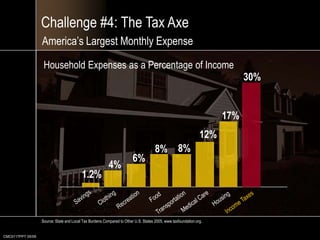
CMC0117PPT 05/0930%17%12%8%8%6%4%1.2%FoodSavingsClothingHousingRecreationMedical CareIncome TaxesTransportationChallenge #4: The Tax AxeAmerica’s Largest Monthly ExpenseHousehold Expenses as a Percentage of IncomeSource: State and Local Tax Burdens Compared to Other U.S. States 2005, www.taxfoundation.org.
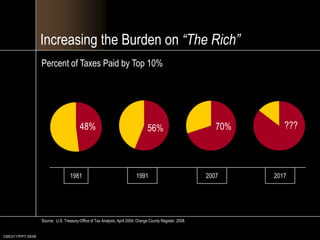
CMC0117PPT 05/09???48%70%56%1991198120172007Increasing the Burden on “The Rich”Percent of Taxes Paid by Top 10%Source:  U.S. Treasury-Office of Tax Analysis, April 2004; Orange County Register, 2008.
CMC0117PPT 05/09Good News:The government is increasing the tax burden on the “rich.”Bad News:You’re rich!Good News/Bad News About Your Taxes
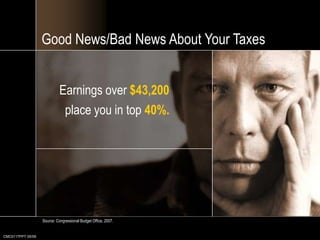
CMC0117PPT 05/09Good News/Bad News About Your TaxesEarnings over $43,200place you in top 40%. Source: Congressional Budget Office, 2007..
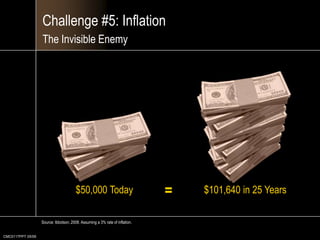
CMC0117PPT 05/09=$101,640 in 25 Years$50,000 TodayChallenge #5: InflationThe Invisible EnemySource: Ibbotson, 2008. Assuming a 3% rate of inflation.
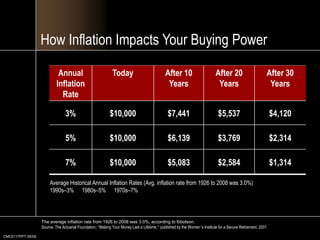
CMC0117PPT 05/09After 30 YearsAfter 20 YearsAfter 10 YearsTodayAnnual Inflation Rate$4,120$5,537$7,441$10,0003%$2,314$3,769$6,139$10,0005%$1,314$2,584$5,083$10,0007%Average Historical Annual Inflation Rates (Avg. inflation rate from 1926 to 2008 was 3.0%)1990s–3%	1980s–5%	1970s–7%How Inflation Impacts Your Buying PowerThe average inflation rate from 1926 to 2008 was 3.0%, according to Ibbotson.Source: The Actuarial Foundation, “Making Your Money Last a Lifetime,” published by the Women’s Institute for a Secure Retirement, 2001.
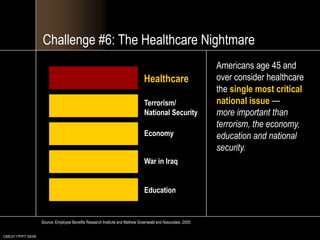
CMC0117PPT 05/09HealthcareTerrorism/National SecurityEconomyWar in IraqEducationChallenge #6: The Healthcare NightmareAmericans age 45 and over consider healthcare the single most critical national issue — more important than terrorism, the economy, education and national security.Source: Employee Benefits Research Institute and Mathew Greenwald and Associates, 2005.
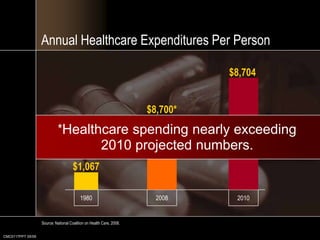
CMC0117PPT 05/09$8,704$8,700**Healthcare spending nearly exceeding 2010 projected numbers.$1,067200819802010Annual Healthcare Expenditures Per PersonSource: National Coalition on Health Care, 2008.
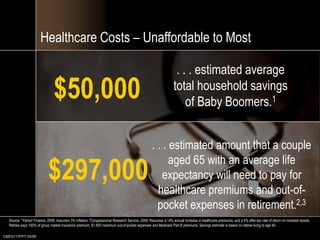
CMC0117PPT 05/09. . . estimated averagetotal household savings of Baby Boomers.1$50,000. . . estimated amount that a couple aged 65 with an average life expectancy will need to pay for healthcare premiums and out-of-pocket expenses in retirement.2,3$297,000Healthcare Costs – Unaffordable to MostSource: 1Yahoo! Finance, 2008. Assumes 3% inflation. 2Congressional Research Service, 2008.3Assumes a 14% annual increase in healthcare premiums, and a 4% after-tax rate of return on invested assets. Retiree pays 100% of group market insurance premium, $1,500 maximum out-of-pocket expenses and Medicare Part B premiums. Savings estimate is based on retiree living to age 90.
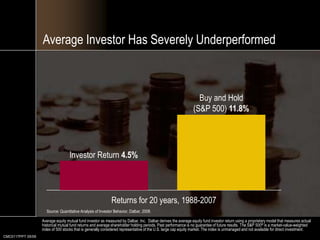
CMC0117PPT 05/09Buy and Hold(S&P 500) 11.8%Investor Return 4.5%Returns for 20 years, 1988-2007Average Investor Has Severely UnderperformedSource: Quantitative Analysis of Investor Behavior, Dalbar, 2008.Average equity mutual fund investor as measured by Dalbar, Inc.  Dalbar derives the average equity fund investor return using a proprietary model that measures actual historical mutual fund returns and average shareholder holding periods. Past performance is no guarantee of future results. The S&P 500® is a market-value-weighted index of 500 stocks that is generally considered representative of the U.S. large cap equity market. The index is unmanaged and not available for direct investment.

But What if I live? Power Point

  • 1.
    CMC0117PPT 05/09® •Not FDIC/NCUA insured • Not bank/CU guaranteed • May lose value • Not a deposit • Not insured by any federal agencyCMC0117PPT 05/09
  • 2.
    CMC0117PPT 05/09A WordFrom Our AttorneysAnnuities and life insurance are issued by Jackson National Life Insurance Company® (Home Office: Lansing, Michigan) and in New York, annuities are issued by Jackson National Life Insurance Company of New York® (Home Office: Purchase, New York). Variable products are distributed by Jackson National Life Distributors LLC. May not be available in all states and state variations may apply. These products have limitations and restrictions. Contact the Company for more information. Jackson® is the marketing name for Jackson National Life Insurance Company and Jackson National Life Insurance Company of New York. Before investing, investors should carefully consider the investment objectives, risks, charges and expenses of the variable product and its underlying investment options. The current contract prospectus and underlying fund prospectuses, which are contained in the same document, provide this and other important information. Please contact your representative or the Company to obtain a prospectuses. Please read the prospectuses carefully before investing or sending money. Guarantees are backed by the claims-paying ability of Jackson National Life Insurance Company or Jackson National Life Insurance Company of New York and do not apply to the principal amount or investment performance of the separate account or its underlying investments. An annuity is a long-term, tax-deferred vehicle designed for retirement. Earnings are taxable as ordinary income when distributed and, if withdrawn before age 59½, may be subject to a 10% federal tax penalty. Withdrawals have the effect of reducing the death benefit and surrender value. Tax deferral offers no additional value if an annuity is used to fund a qualified plan, such as a 401(k) or IRA. Tax deferral may not be available if the annuity is owned by a “non-natural person” such as a corporation or certain types of trusts. Jackson neither encourages nor condonesunnecessary replacements or replacements that are not in the best interest of the customer. Jackson and its affiliates do not provide legal, tax or estate-planning advice. For questions about a specific situation, please consult a qualified advisor.
  • 3.
    CMC0117PPT 05/09Before WeBeginIn response to recent concerns by both the financial industry and the general investing public, we would like you to know that this event is truly complimentary. While we would like to earn your trust and your business, you are under absolutely no obligation to set up an appointment or to purchase any products or services.For additional investor protection information, please visit the investor information section of www.finra.org.
  • 4.
    CMC0117PPT 05/09“The agingof America’s Baby Boomers is the most pressing national issue of the century.”Source: “The Age Explosion: Baby Boomers and Beyond,” Harvard Generations Policy Journal, Winter 2004.
  • 5.
    CMC0117PPT 05/09The SevenRetirement Challenges1. The Age Wave2. The Pension Plunge3. Social Insecurity4. The Tax Axe5. Inflation—The Invisible Enemy6. The Healthcare Nightmare7. Investor BlundersCreating a Perfect Retirement Storm . . .
  • 6.
    CMC0117PPT 05/09Life Expectancy78.118076Age7268RetirementAge64632621950196019701980199020002008YearChallenge #1: The Age WaveRetiring Earlier and Living Longer—The Gap is GrowingThe average American will spend 20+ years in retirement.Sources: 1National Center for Health Statistics, June 2008. 2 Retirement Security Institute.com, 2009.
  • 7.
    CMC0117PPT 05/09114,396127,900220081985Challenge #2:The Pension PlungeThe Decline of PensionsNumber of U.S. PensionsSource: 1The Pension Benefit Guaranty Corporation, 2006. 2 The Pension Benefit Guaranty Corporation, Annual Management Report, 2008..
  • 8.
    CMC0117PPT 05/09The Agingof the AgedThe over-80 populationis growing five timesfaster than the overall population.1
  • 9.
    For a coupleaged 65, there’s a 50% chance one will live to 91, and a 25% chance one will live to 96.2
  • 10.
    By 2030, thedemographics of 32 states will resemble those of Florida today.3Source: 1U.S. Census Bureau, 2008.2Sue Stevens, “How to Manage Risk in Retirement,”Morningstar.com, October 11, 2007. 3Counsel of Life Insurance, 2008.
  • 11.
    CMC0117PPT 05/09Even thosepensions that have survived may be threatened.
  • 12.
    CMC0117PPT 05/09The PensionBenefit Guaranty Corporation had a deficit of $11 billion in 2008.Source: Pension Benefit Guaranty Corporation, Annual Management Report, 2008.CMC0117PPT 09/08Source: InsuranceBroadcast.com, 08/05/2005,©Reuters 2005
  • 13.
    CMC0117PPT 05/09Challenge #3:Social InsecuritySmoke and MirrorsOriginally intended as a SUPPLEMENTAL retirement income source for the MINORITY,it has become the PRIMARY income source for the MAJORITY.Source: Social Security Administration, 2008.
  • 14.
    CMC0117PPT 05/09Social Security:Overburdenedand Running OutFor two out of three Americans, SocialSecurity provides at least half of theirretirement income.1
  • 15.
    Those age 85and older get 80% of theirincome from Social Security.2
  • 16.
    Social Security isin a $13 trillion shortfall.3Source: 1Early Retirement and Social Security Spousal Benefits, Insurance Newscast, May 23, 2007. 2 "Boomer Security or Financial Deprivation?", Boomer Market Advisor, July 2007. 3"Social Security in $13 trillion hole," Investment News, 2008.
  • 17.
    CMC0117PPT 05/0916.5 to13.3 to 120061950Social SecurityContributors per BeneficiarySource: Table II.F19 from the 2000 Trustees Report and Table IV.B2 from the 2007 Trustees Report, Social Security Administration.
  • 18.
    CMC0117PPT 05/0930%17%12%8%8%6%4%1.2%FoodSavingsClothingHousingRecreationMedical CareIncomeTaxesTransportationChallenge #4: The Tax AxeAmerica’s Largest Monthly ExpenseHousehold Expenses as a Percentage of IncomeSource: State and Local Tax Burdens Compared to Other U.S. States 2005, www.taxfoundation.org.
  • 19.
    CMC0117PPT 05/09???48%70%56%1991198120172007Increasing theBurden on “The Rich”Percent of Taxes Paid by Top 10%Source: U.S. Treasury-Office of Tax Analysis, April 2004; Orange County Register, 2008.
  • 20.
    CMC0117PPT 05/09Good News:Thegovernment is increasing the tax burden on the “rich.”Bad News:You’re rich!Good News/Bad News About Your Taxes
  • 21.
    CMC0117PPT 05/09Good News/BadNews About Your TaxesEarnings over $43,200place you in top 40%. Source: Congressional Budget Office, 2007..
  • 22.
    CMC0117PPT 05/09=$101,640 in25 Years$50,000 TodayChallenge #5: InflationThe Invisible EnemySource: Ibbotson, 2008. Assuming a 3% rate of inflation.
  • 23.
    CMC0117PPT 05/09After 30YearsAfter 20 YearsAfter 10 YearsTodayAnnual Inflation Rate$4,120$5,537$7,441$10,0003%$2,314$3,769$6,139$10,0005%$1,314$2,584$5,083$10,0007%Average Historical Annual Inflation Rates (Avg. inflation rate from 1926 to 2008 was 3.0%)1990s–3% 1980s–5% 1970s–7%How Inflation Impacts Your Buying PowerThe average inflation rate from 1926 to 2008 was 3.0%, according to Ibbotson.Source: The Actuarial Foundation, “Making Your Money Last a Lifetime,” published by the Women’s Institute for a Secure Retirement, 2001.
  • 24.
    CMC0117PPT 05/09HealthcareTerrorism/National SecurityEconomyWarin IraqEducationChallenge #6: The Healthcare NightmareAmericans age 45 and over consider healthcare the single most critical national issue — more important than terrorism, the economy, education and national security.Source: Employee Benefits Research Institute and Mathew Greenwald and Associates, 2005.
  • 25.
    CMC0117PPT 05/09$8,704$8,700**Healthcare spendingnearly exceeding 2010 projected numbers.$1,067200819802010Annual Healthcare Expenditures Per PersonSource: National Coalition on Health Care, 2008.
  • 26.
    CMC0117PPT 05/09. .. estimated averagetotal household savings of Baby Boomers.1$50,000. . . estimated amount that a couple aged 65 with an average life expectancy will need to pay for healthcare premiums and out-of-pocket expenses in retirement.2,3$297,000Healthcare Costs – Unaffordable to MostSource: 1Yahoo! Finance, 2008. Assumes 3% inflation. 2Congressional Research Service, 2008.3Assumes a 14% annual increase in healthcare premiums, and a 4% after-tax rate of return on invested assets. Retiree pays 100% of group market insurance premium, $1,500 maximum out-of-pocket expenses and Medicare Part B premiums. Savings estimate is based on retiree living to age 90.
  • 27.
    CMC0117PPT 05/09Buy andHold(S&P 500) 11.8%Investor Return 4.5%Returns for 20 years, 1988-2007Average Investor Has Severely UnderperformedSource: Quantitative Analysis of Investor Behavior, Dalbar, 2008.Average equity mutual fund investor as measured by Dalbar, Inc.  Dalbar derives the average equity fund investor return using a proprietary model that measures actual historical mutual fund returns and average shareholder holding periods. Past performance is no guarantee of future results. The S&P 500® is a market-value-weighted index of 500 stocks that is generally considered representative of the U.S. large cap equity market. The index is unmanaged and not available for direct investment.