MASS MUTUAL CALCULATION (in my head; Q.&D.)
INITIAL RISK APPETITE CALCULATION
Based upon the performance and our knowledge of the insurance and finance industries, the following
table suggests, as an indicative risk limit only, credit appetite available on short notice, primarily for trading
operations. Formal ratifications of amounts and authority would follow to conform with the bank’s
procedures and proposal formats. The following preliminary conditions would apply.
• up to ten years for:
1. AAA / Aaa S&P and Moody’s insurance financial strength (“fin’l strength”) ratings; or,
2. AAA / Aaa and AA+ / Aa1 S&P and Moody’s senior unsecured long-term debt (“LTD”) ratings.
• up to seven years for:
1. AA+ / Aa1 and AA / Aa2 fin’l strength ratings; or,
2. AA / Aa2 and AA- / Aa3 LTD ratings.
• up to five years for:
1. AA- / Aa3; A+ / A1; and, A / A2 fin’l strength ratings; or,
2. A+ / A1 and A / A2 LTD ratings.
• up to three years for A- / A3 fin’l strength ratings and LTD ratings.
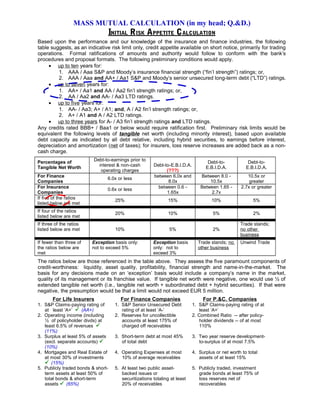
Any credits rated BBB+ / Baa1 or below would require ratification first. Preliminary risk limits would be
equivalent the following levels of tangible net worth (including minority interest), based upon available
debt capacity as indicated by all debt relative, including hybrid securities, to earnings before interest,
depreciation and amortization (net of taxes); for insurers, loss reserve increases are added back as a non-
cash charge.
Percentages of
Tangible Net Worth
Debt-to-earnings prior to
interest & non-cash
operating charges
Debt-to-E.B.I.D.A.
(???)
Debt-to-
E.B.I.D.A.
Debt-to-
E.B.I.D.A.
For Finance
Companies
6.0x or less
between 6.0x and
8.0x
Between 8.0 -
10.5x
10.5x or
greater
For Insurance
Companies
0.6x or less
between 0.6 -
1.65x
Between 1.65 -
2.7x
2.7x or greater
If five of the ratios
listed below are met
25% 15% 10% 5%
If four of the ratios
listed below are met
20% 10% 5% 2%
If three of the ratios
listed below are met 10% 5% 2%
Trade stands;
no other
business
If fewer than three of
the ratios below are
met
Exception basis only:
not to exceed 5%
Exception basis
only: not to
exceed 3%
Trade stands; no
other business
Unwind Trade
The ratios below are those referenced in the table above. They assess the five paramount components of
credit-worthiness: liquidity, asset quality, profitability, financial strength and name-in-the-market. The
basis for any decisions made on an ‘exception’ basis would include a company’s name in the market,
quality of its management or its franchise value. If tangible net worth were negative, one would use ½ of
extended tangible net worth (i.e., tangible net worth + subordinated debt + hybrid securities). If that were
negative, the presumption would be that a limit would not exceed EUR 5 million.
For Life Insurers For Finance Companies For P.&C. Companies
1. S&P Claims-paying rating of
at least ‘A+’  (AA+)
1. S&P Senior Unsecured Debt
rating of at least ‘A-’
1. S&P Claims-paying rating of at
least ‘A+’
2. Operating income (including
½ of policyholder divds) at
least 6.5% of revenues 
(11%)
2. Reserves for uncollectible
accounts at least 175% of
charged off receivables
2. Combined Ratio -- after policy-
holder dividends -- of at most
110%
3. Surplus at least 5% of assets
(excl. separate accounts) 
(10%)
3. Short-term debt at most 45%
of total debt
3. Two year reserve development-
to-surplus of at most 7.5%
4. Mortgages and Real Estate of
at most 30% of investments
 (15%)
4. Operating Expenses at most
10% of average receivables
4. Surplus or net worth to total
assets of at least 15%
5. Publicly traded bonds & short-
term assets at least 50% of
total bonds & short-term
assets  (65%)
5. At least two public asset-
backed issues or
securitizations totaling at least
20% of receivables
5. Publicly traded, investment
grade bonds at least 75% of
loss reserves net of
recoverables

Risk scoring sheet

  • 1.
    MASS MUTUAL CALCULATION(in my head; Q.&D.) INITIAL RISK APPETITE CALCULATION Based upon the performance and our knowledge of the insurance and finance industries, the following table suggests, as an indicative risk limit only, credit appetite available on short notice, primarily for trading operations. Formal ratifications of amounts and authority would follow to conform with the bank’s procedures and proposal formats. The following preliminary conditions would apply. • up to ten years for: 1. AAA / Aaa S&P and Moody’s insurance financial strength (“fin’l strength”) ratings; or, 2. AAA / Aaa and AA+ / Aa1 S&P and Moody’s senior unsecured long-term debt (“LTD”) ratings. • up to seven years for: 1. AA+ / Aa1 and AA / Aa2 fin’l strength ratings; or, 2. AA / Aa2 and AA- / Aa3 LTD ratings. • up to five years for: 1. AA- / Aa3; A+ / A1; and, A / A2 fin’l strength ratings; or, 2. A+ / A1 and A / A2 LTD ratings. • up to three years for A- / A3 fin’l strength ratings and LTD ratings. Any credits rated BBB+ / Baa1 or below would require ratification first. Preliminary risk limits would be equivalent the following levels of tangible net worth (including minority interest), based upon available debt capacity as indicated by all debt relative, including hybrid securities, to earnings before interest, depreciation and amortization (net of taxes); for insurers, loss reserve increases are added back as a non- cash charge. Percentages of Tangible Net Worth Debt-to-earnings prior to interest & non-cash operating charges Debt-to-E.B.I.D.A. (???) Debt-to- E.B.I.D.A. Debt-to- E.B.I.D.A. For Finance Companies 6.0x or less between 6.0x and 8.0x Between 8.0 - 10.5x 10.5x or greater For Insurance Companies 0.6x or less between 0.6 - 1.65x Between 1.65 - 2.7x 2.7x or greater If five of the ratios listed below are met 25% 15% 10% 5% If four of the ratios listed below are met 20% 10% 5% 2% If three of the ratios listed below are met 10% 5% 2% Trade stands; no other business If fewer than three of the ratios below are met Exception basis only: not to exceed 5% Exception basis only: not to exceed 3% Trade stands; no other business Unwind Trade The ratios below are those referenced in the table above. They assess the five paramount components of credit-worthiness: liquidity, asset quality, profitability, financial strength and name-in-the-market. The basis for any decisions made on an ‘exception’ basis would include a company’s name in the market, quality of its management or its franchise value. If tangible net worth were negative, one would use ½ of extended tangible net worth (i.e., tangible net worth + subordinated debt + hybrid securities). If that were negative, the presumption would be that a limit would not exceed EUR 5 million. For Life Insurers For Finance Companies For P.&C. Companies 1. S&P Claims-paying rating of at least ‘A+’  (AA+) 1. S&P Senior Unsecured Debt rating of at least ‘A-’ 1. S&P Claims-paying rating of at least ‘A+’ 2. Operating income (including ½ of policyholder divds) at least 6.5% of revenues  (11%) 2. Reserves for uncollectible accounts at least 175% of charged off receivables 2. Combined Ratio -- after policy- holder dividends -- of at most 110% 3. Surplus at least 5% of assets (excl. separate accounts)  (10%) 3. Short-term debt at most 45% of total debt 3. Two year reserve development- to-surplus of at most 7.5% 4. Mortgages and Real Estate of at most 30% of investments  (15%) 4. Operating Expenses at most 10% of average receivables 4. Surplus or net worth to total assets of at least 15% 5. Publicly traded bonds & short- term assets at least 50% of total bonds & short-term assets  (65%) 5. At least two public asset- backed issues or securitizations totaling at least 20% of receivables 5. Publicly traded, investment grade bonds at least 75% of loss reserves net of recoverables