RISK MANAGMENT
• A risk is a potential problem – it might happen or
it might not, this is uncertainty.
• There is a difference between a Problem and Risk
,Problem is some event which has already
occurred but risk is something that is
unpredictable.
• They are two types of risk strategies
• Reactive
• Proactive
A reactive strategy monitors the project for
likely risks, more commonly the s/w team
does nothing ,until something goes wrong.
Then the team enters into an action to attempt
the problem rapidly.
This often called fire fighting mode
• Proactive is more intelligent strategy for risk
management.
• Proactive strategy begins a long back when
technical work is started.potentional risks are
identified.
• The primary objective is to avoid the risks.
• But not all risks avoided the team works to
develop a contingency plan to control in
effective manner.
• Software risks:
• Risks involves in two characteristics
• uncertainty
• loss (unwanted consequences or losses will
happen)
• They are different categories of risks.
• project risks (project schedule will slip, cost will increase, and total
impact on project)
• technical risks( quality, implementation may become impossible)
• business risks(market risk, sales risk, management risk,)
• Risk identification:
• There is check list for risk identification and
focuses on some set of known and predictable
risks.
• Product size —risks associated with the overall size
of the software to be built or modified.
• Business impact —risks associated with constraints
imposed by management or the marketplace.
• Customer characteristics —risks associated with the
sophistication of the customer and the developer's
ability to communicate with the customer in a timely
manner.
• Development environment —risks associated with the
availability and quality of the tools to be used to build the
product.
• Technology to be built —risks associated with the
complexity of the system to be built and the “newness “
of the technology that is packaged by the system.
• Staff size and experience —risks associated with the
overall technical and project experience of the software
engineers who will do the work.
Risk Components
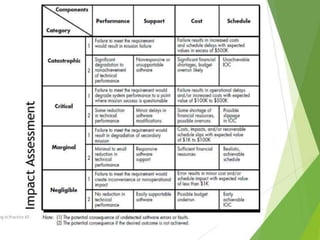
• performance risk —the degree of uncertainty
that the product will meet its requirements
and be fit for its intended use.
• cost risk —the degree of uncertainty that the
project budget will be maintained.
• support risk —the degree of uncertainty that
the resultant software will be easy to correct,
adapt, and enhance
• schedule risk —the degree of uncertainty that
the project schedule will be maintained and
that the product will be delivered on time
• Risk Projection:
• Risk projection is also called as risk estimation
• It attempts to rate each risk in two ways
• 1)likelihood or probability of the risk
• 2)the problems associated with risk.
• The group of people define four risk
projection steps.
• A) Establish a scale that reflects the perceived
likelihood of a risk
• B) delineate(identify exact position) the
consequences of risk
• C)estimate the impact of risk on project and the
product
• D) note the over all accuracy of the risk projection
• RMMM Plan:
• A risk management strategy can be included in
the s/w project plan or the risk management.
• The RMMM plan documents all work
performed as part of risk analysis and is used
by the project manager.
• Some s/w teams do not develop a formal
RMMM document.
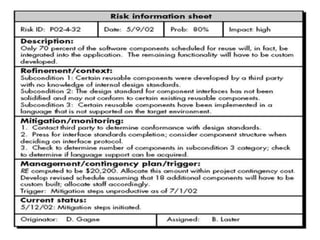
• Each risk is documented individually using a
risk information sheet(RIS)
• Quality management:
• The main approach of work towards single goal
that is to produce high-quality software.
• Quality concepts:
• quality(it defines a characteristics or attribute of
something)
• Two kinds of quality is measured(quality of
design, quality of conformance)quality of design
refers that the characteristics that designer
specify for an item
• Quality of conformance is the degree to which the
design specifications are followed during
manufacturing.
• User satisfaction=compliant product good quality
delivery within budget and schedule
• Quality control:
• By making inspections,reviews,and tests are done
throughout the process
• Quality Assurance:
• Management should provide assurance regards
to product by giving necessary data about
product quality
• Cost of quality:
• Quality cost may be divided into costs
associated with prevention,appraisal,and
failure
• SQA(software quality assurance)
• Six sigma for software engineering:
• Six sigma is most widely used strategy for quality
assurance in industry today.
• The three core steps to define
• Define customer requirements,deliveriables,and
goals in well methods for customer communication.
• Measure the existing process and its output to
determine current quality.
• Analyze defect metrics and determine few causes.
• Design the process ,to avoid the root causes of
defects
• Verify that the process model will, avoid
defects and meet the customer requirements.
risk managment and quality

risk managment and quality

  • 1.
  • 2.
    • A riskis a potential problem – it might happen or it might not, this is uncertainty. • There is a difference between a Problem and Risk ,Problem is some event which has already occurred but risk is something that is unpredictable. • They are two types of risk strategies • Reactive • Proactive
  • 3.
    A reactive strategymonitors the project for likely risks, more commonly the s/w team does nothing ,until something goes wrong. Then the team enters into an action to attempt the problem rapidly. This often called fire fighting mode
  • 4.
    • Proactive ismore intelligent strategy for risk management. • Proactive strategy begins a long back when technical work is started.potentional risks are identified. • The primary objective is to avoid the risks. • But not all risks avoided the team works to develop a contingency plan to control in effective manner.
  • 5.
    • Software risks: •Risks involves in two characteristics • uncertainty • loss (unwanted consequences or losses will happen) • They are different categories of risks. • project risks (project schedule will slip, cost will increase, and total impact on project) • technical risks( quality, implementation may become impossible) • business risks(market risk, sales risk, management risk,)
  • 6.
    • Risk identification: •There is check list for risk identification and focuses on some set of known and predictable risks. • Product size —risks associated with the overall size of the software to be built or modified. • Business impact —risks associated with constraints imposed by management or the marketplace. • Customer characteristics —risks associated with the sophistication of the customer and the developer's ability to communicate with the customer in a timely manner.
  • 7.
    • Development environment—risks associated with the availability and quality of the tools to be used to build the product. • Technology to be built —risks associated with the complexity of the system to be built and the “newness “ of the technology that is packaged by the system. • Staff size and experience —risks associated with the overall technical and project experience of the software engineers who will do the work.
  • 8.
    Risk Components • performancerisk —the degree of uncertainty that the product will meet its requirements and be fit for its intended use. • cost risk —the degree of uncertainty that the project budget will be maintained. • support risk —the degree of uncertainty that the resultant software will be easy to correct, adapt, and enhance
  • 9.
    • schedule risk—the degree of uncertainty that the project schedule will be maintained and that the product will be delivered on time
  • 11.
    • Risk Projection: •Risk projection is also called as risk estimation • It attempts to rate each risk in two ways • 1)likelihood or probability of the risk • 2)the problems associated with risk. • The group of people define four risk projection steps. • A) Establish a scale that reflects the perceived likelihood of a risk • B) delineate(identify exact position) the consequences of risk
  • 12.
    • C)estimate theimpact of risk on project and the product • D) note the over all accuracy of the risk projection
  • 13.
    • RMMM Plan: •A risk management strategy can be included in the s/w project plan or the risk management. • The RMMM plan documents all work performed as part of risk analysis and is used by the project manager. • Some s/w teams do not develop a formal RMMM document. • Each risk is documented individually using a risk information sheet(RIS)
  • 15.
    • Quality management: •The main approach of work towards single goal that is to produce high-quality software. • Quality concepts: • quality(it defines a characteristics or attribute of something) • Two kinds of quality is measured(quality of design, quality of conformance)quality of design refers that the characteristics that designer specify for an item
  • 16.
    • Quality ofconformance is the degree to which the design specifications are followed during manufacturing. • User satisfaction=compliant product good quality delivery within budget and schedule • Quality control: • By making inspections,reviews,and tests are done throughout the process • Quality Assurance: • Management should provide assurance regards to product by giving necessary data about product quality
  • 17.
    • Cost ofquality: • Quality cost may be divided into costs associated with prevention,appraisal,and failure • SQA(software quality assurance)
  • 18.
    • Six sigmafor software engineering: • Six sigma is most widely used strategy for quality assurance in industry today. • The three core steps to define • Define customer requirements,deliveriables,and goals in well methods for customer communication. • Measure the existing process and its output to determine current quality. • Analyze defect metrics and determine few causes. • Design the process ,to avoid the root causes of defects
  • 19.
    • Verify thatthe process model will, avoid defects and meet the customer requirements.