©2012 CliftonLarsonAllen LLP
                                              ©
          POLICE OFFICERS
     CREDIT UNION CONFERENCE
               2012


      STRATEGIC  DECISION  MAKING
       IN THE CURRENT FINANCIAL 
       IN THE CURRENT FINANCIAL
             ENVIRONMENT


11             ©2012 CliftonLarsonAllen LLP
MARKETPLACE  OPPORTUNITIES
    • With anti‐big bank sentiment at an all‐time high and “profit at any cost”
      Wall Street under high profile scrutiny, not‐for‐profit financial
      cooperatives are positioned f b growth opportunity i d d
              i           ii    d for best      h         i in decades

    • Best opportunity in our credit union lifetime being hindered by corporate
      losses, insurance premiums, income hits through regulation and statutory
      changes and supervisory action proliferation

    • If credit unions cannot seize the marketplace when the brass ring is
      available, it is troublesome to imagine when such an opportunity will re‐
      appear

    • When opportunity rises for credit unions, it rises for all competitors…this
      opportunity is historic and can be lost.
       pp       y


2                                  ©2012 CliftonLarsonAllen LLP
LEGISLATIVE  OUTLOOK
    • MBL CAP relief unpopular with banks but small business focus for credit 
      unions, we need to expertise but must manage the risk
    • CURIA for credit unions was defeated, may come again
    • Possible loss of tax exemption is major carrot
    • FOM enhancements
    • CUSO investment and increased regulation and oversight
    • Interchange loss – 2 major defeats, must continue the fight
    • Loss of independent regulator has been threatened
      Loss of independent regulator has been threatened
    • Going to need to be aggressive, willing to take managed risks in a tough 
      political environment
    • “C
      “Consumer protection” political umbrella is growing – areas of focus 
                      t ti ” liti l         b ll i     i            ff
      (Overdraft fees, CC fees, mortgage refi fees, ATM surcharge, notifications, 
      data collection, affirmative action lending)


3                                   ©2012 CliftonLarsonAllen LLP
POSSIBILITIES...
    • Lower corporate credit union assessments and recovery of legacy assets
    • Mergers will continue and escalate, we will be at 5,000 credit unions 
      before you know it
         –   Troubled Credit Unions
         –   Inefficient Credit Unions
         –   Under capitalized Credit Unions
             U d        i li d C di U i
         –   Succession plan strategy
    •   Fewer Community Banks as well
    •   More shared branching 
        M      h db         hi
    •   Nationwide branding of the Credit Union Industry
    •   Credit Unions will need to grow to survive
    •   To grow and survive Credit Unions will need to stay focused on their 
        strategic advantages 


4                                          ©2012 CliftonLarsonAllen LLP
COMMIT TO COMMUNITY INVOLEMENT
    • Credit union mantra – “People Helping People” 

    • Demonstrate the Credit Union Difference with action 

    • To engage your CU in the community and establish/build relationships
      To engage your CU in the community and establish/build relationships 

    • Because it’s “the right thing to do” as a progressive and responsible 
      business 
      business

    • Improves CU image, reputation and brand recognition, builds goodwill, 
      and grows membership base 
        d           b hi b

    • Benefits the credit union financially –Non‐profit accounts, personal 
      accounts

5                                   ©2012 CliftonLarsonAllen LLP
COMMUNITY INVOLEMENT – HOW TO:
    1.    Define the business objectives for community involvement which 
          support a strategic plan.  
    2.    Design a Corporate Social Responsibility Plan that integrates these 
          business objectives.  
    3.    Determine key partnerships internally and externally. 
    4.    Determine expectations for this program at the onset. 
    5.   Allow ownership of program by team members.
    6.   Recognize participation in the program and make the team aware of its 
         Recognize participation in the program and make the team aware of its
         successes Keep motivation high and commitment strong through 
         recognition. 
    7.   Be willing to adjust the program to the needs of the community or based 
         Be willing to adjust the program to the needs of the community or based
         on feedback.
    8.   Think Big!  ‐ Long term commitments.
    9.
    9    Tell your story – External (press releases, Facebook, Website) 
         Tell your story – External (press releases Facebook Website)
         Internal – Newsletters, Annual Report, Employee and Official meetings
6                                  ©2012 CliftonLarsonAllen LLP
TODAY’S RISK FOCUS
    NCUA Supervisory Focus for 2012 

    “Accordingly, NCUA will focus supervisory efforts on 
      credit unions with elevated levels of credit risks, 
      credit unions with elevated levels of credit risks
      interest rate risks, liquidity risks, and concentration 
      risks.” 

    Source: NCUA Letter to Credit Unions 12 CU 01 
    Source: NCUA Letter to Credit Unions 12‐CU‐01
      (January 2012) 


7                           ©2012 CliftonLarsonAllen LLP
TODAY’S RISK FOCUS
    Greater Risk Management Expectations 

    • What is Concentration Risk? 

    • Measuring Concentration Exposure 

    • Concentration Risk & Capital Adequacy 

    • Formulating Concentration Limits 

8                         ©2012 CliftonLarsonAllen LLP
REGULATOR RISK EXPECTATIONS


    NCUA expects credit union management and officials
    NCUA expects credit union management and officials
    to be aware of what material concentrations exist
    within their balance sheets, to take appropriate steps
      ithi th i b l       h t t t k             i t t
    to measure, monitor, and control such concentrations, 
    and to establish a commensurate level of credit risk
                bl h                   l l f           k
    analysis to monitor significant concentrations. 

    Source: The NCUA Report , October 2011 Number 10 


9                                ©2012 CliftonLarsonAllen LLP
CONCENTRATION RISK
     A risk concentration is any single exposure or group of
     exposures with the potential to produce losses large
     enough (relative to capital, total assets, or overall risk
     level) to threaten financial i tit ti ’ h lth or
     l l) t th t a fi            i l institution’s health
     ability to maintain its core operations.
     According to NCUA – Supervisory Letter 10‐03 , 2010
     “It is up to the credit union management to identify the 
        risk in each product or service line, quantify the risk 
         i ki      h     d t          i li          tif th i k
        and set appropriate concentration limits based on 
        the analysis.
        the analysis ” 

10                          ©2012 CliftonLarsonAllen LLP
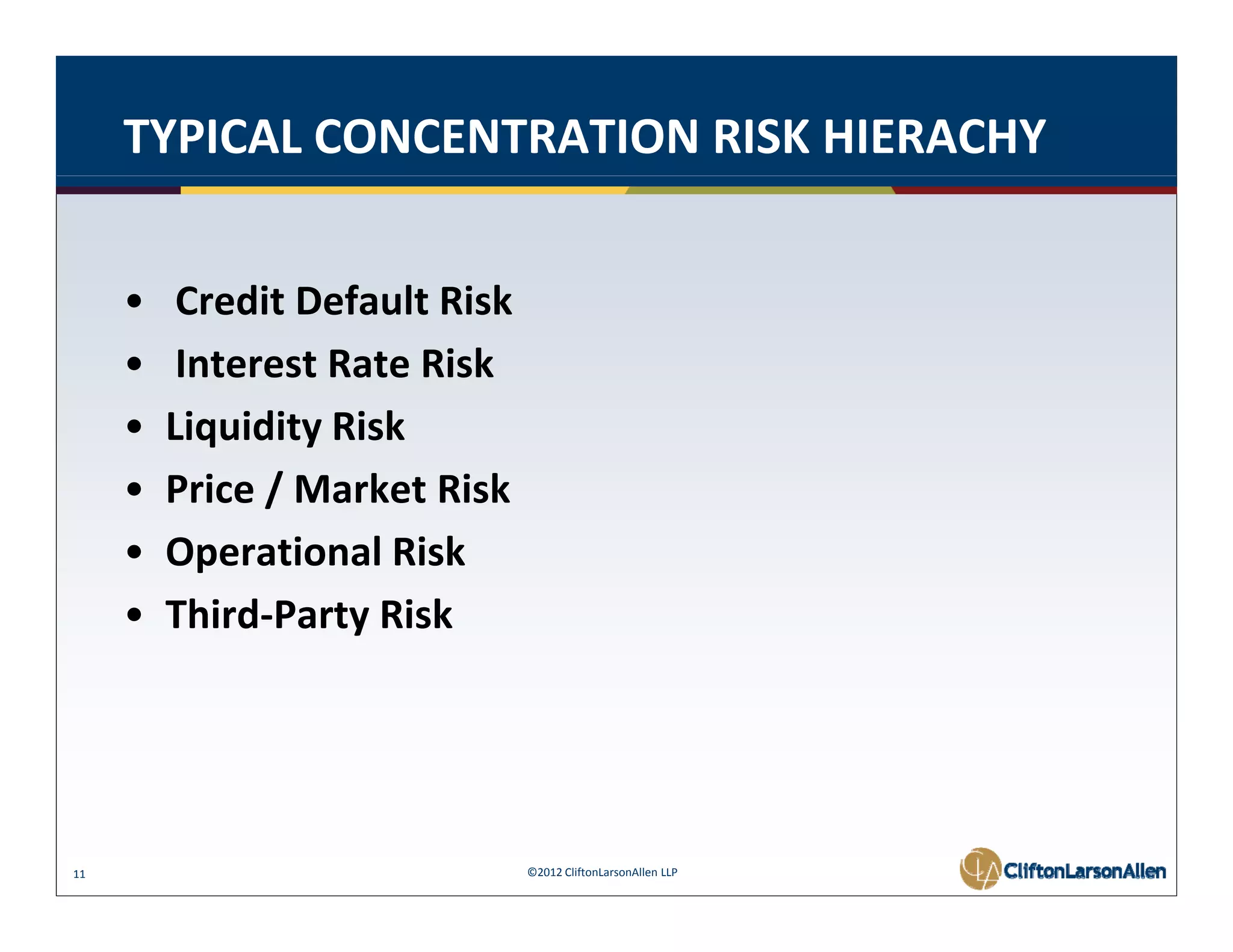
TYPICAL CONCENTRATION RISK HIERACHY


     •    Credit Default Risk
          Credit Default Risk
     •    Interest Rate Risk 
     •   Liquidity Risk 
         Li idit Ri k
     •   Price / Market Risk 
     •   Operational Risk 
                     l k
     •   Third‐Party Risk


11                              ©2012 CliftonLarsonAllen LLP
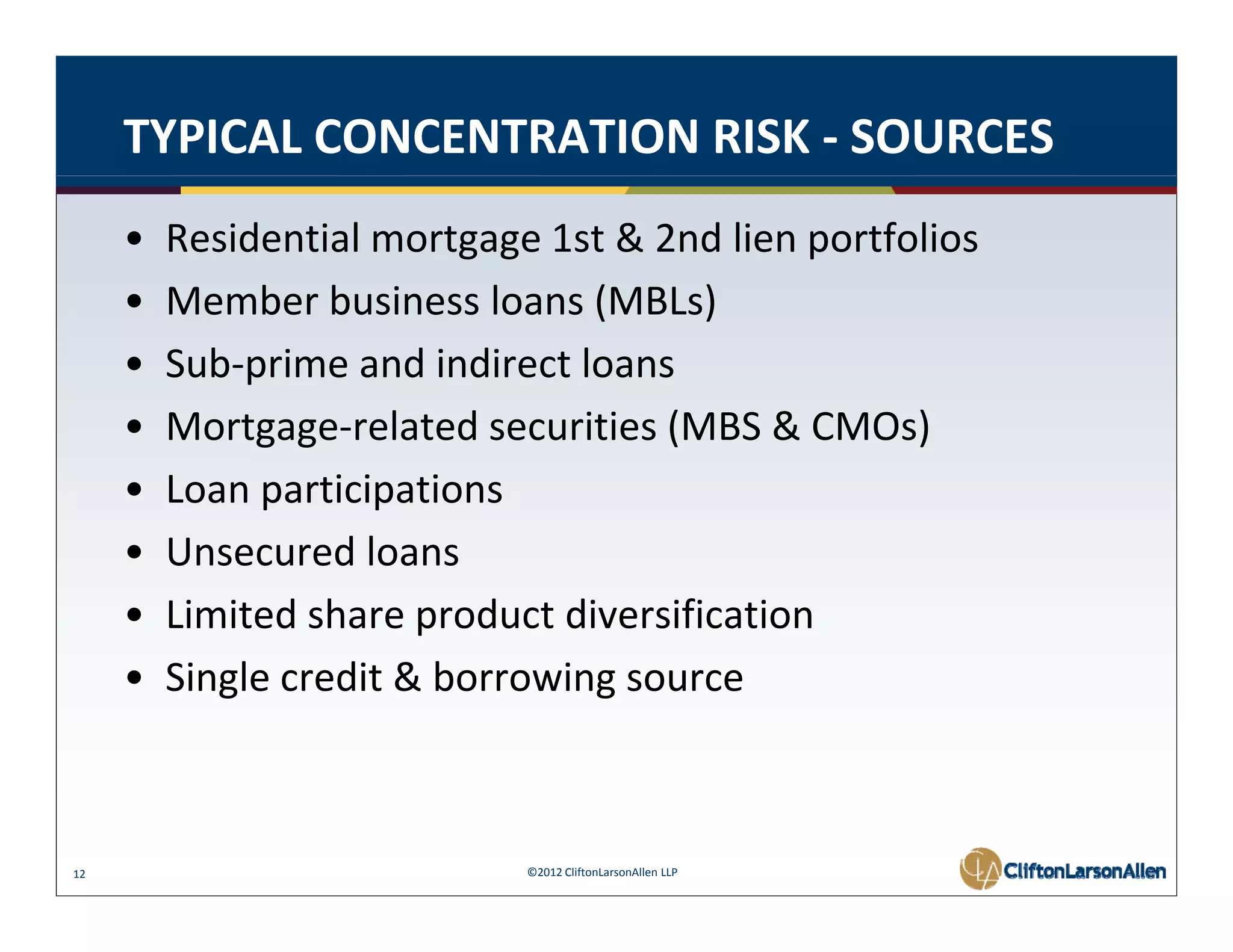
TYPICAL CONCENTRATION RISK ‐ SOURCES
     •   Residential mortgage 1st & 2nd lien portfolios 
     •   Member business loans (MBLs) 
         Member business loans (MBLs)
     •   Sub‐prime and indirect loans 
     •   Mortgage‐related securities (MBS & CMOs) 
         M t           l t d    iti (MBS & CMO )
     •   Loan participations 
     •   Unsecured loans 
                     l
     •   Limited share product diversification 
     •   Single credit & borrowing source 


12                           ©2012 CliftonLarsonAllen LLP
BUILD A RBNW MATIX
     WHAT YOU NEED –

     •   Balance sheet stratified at product and group levels 
     •   Interest rate risk and price volatility risk data 
         I t     t t ik d i              l tilit i k d t
     •   Investments stratified by issuer, type, collateral, etc 
     •   Risk surveillance (MDPA program) 
             k       ll     (                 )
     •   Loan participation or other third‐party data 
     •   Allowance for loan loss data 
     •   Liquidity forecast, liquidity planning 

13                            ©2012 CliftonLarsonAllen LLP
CONCENTRATION LIMITS
     Once a minimum RBNW requirement is known and
     it has been compared against actual  adjusted net
     it has been compared against actual “adjusted” net
     worth, the credit union can: 
     1. Determine if current capital supports the aggregate 
     1 D t      i if         t    it l      t th           t
        balance sheet risk components. 
     2. Identify products that generate the most risk. 
     2 Identify products that generate the most risk
     3. Identify interrelated risks among and/or across 
        product types or scenario.
        product types or scenario
     4. Begin to establish or adjust concentration limits at 
        the product and group levels
        the product and group levels

14                          ©2012 CliftonLarsonAllen LLP
CONCENTRATION LIMITS
     5. Focus on the largest concentration first.
     6. Determine if balance sheet size is held steady or 
     6 Determine if balance sheet size is held steady or
        grows/shrinks. Adjust share‐liabilities if needed. 
     7. Evaluate product and group concentration limits in 
     7 Evaluate product and group concentration limits in
        conjunction with strategic initiatives, budget 
        forecasts, and member trends. 
                 ,
     8. Consider other related ALCO limits or policies. 
     9. Board review and approval. 
     9. Board review and approval.


15                         ©2012 CliftonLarsonAllen LLP
RISK MANAGEMENT
     • Maintain accurate and detailed portfolio data. 
     • Understand and track loan level risk factors
       Understand and track loan‐level risk factors. 
     • Identify & understand interrelationships within 
       balance sheet and between risk components. 
       balance sheet and between risk components
     • Timely and relevant concentration risk reporting. 
     • Documented policies and guidelines
       Documented policies and guidelines. 
     • Effective risk mitigation strategies 


16                         ©2012 CliftonLarsonAllen LLP
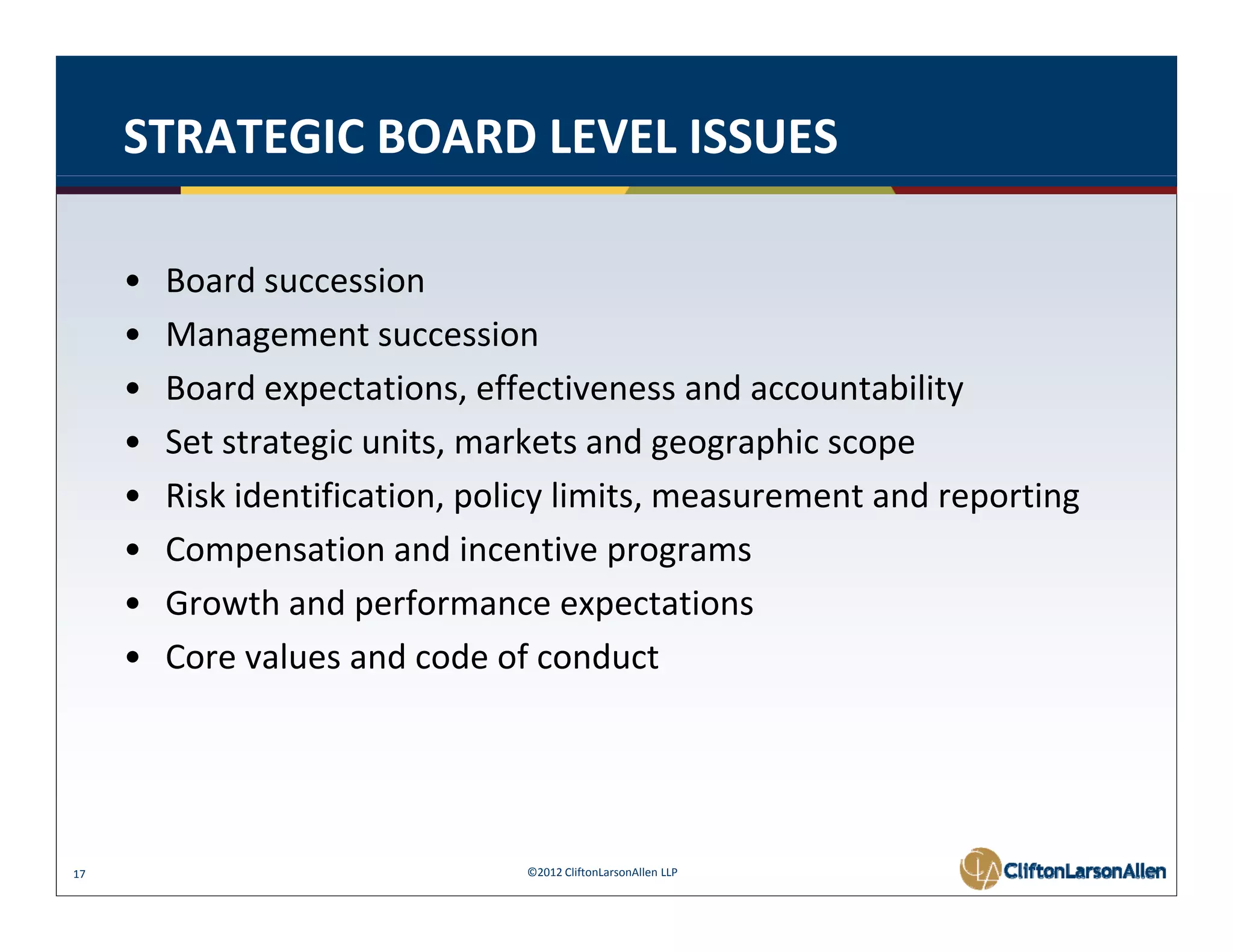
STRATEGIC BOARD LEVEL ISSUES

     •   Board succession
     •   Management succession
     •   Board expectations, effectiveness and accountability
     •   Set strategic units, markets and geographic scope
     •   Risk identification, policy limits, measurement and reporting
     •   Compensation and incentive programs
                            d
     •   Growth and performance expectations
     •   Core values and code of conduct
         Core values and code of conduct


17                               ©2012 CliftonLarsonAllen LLP
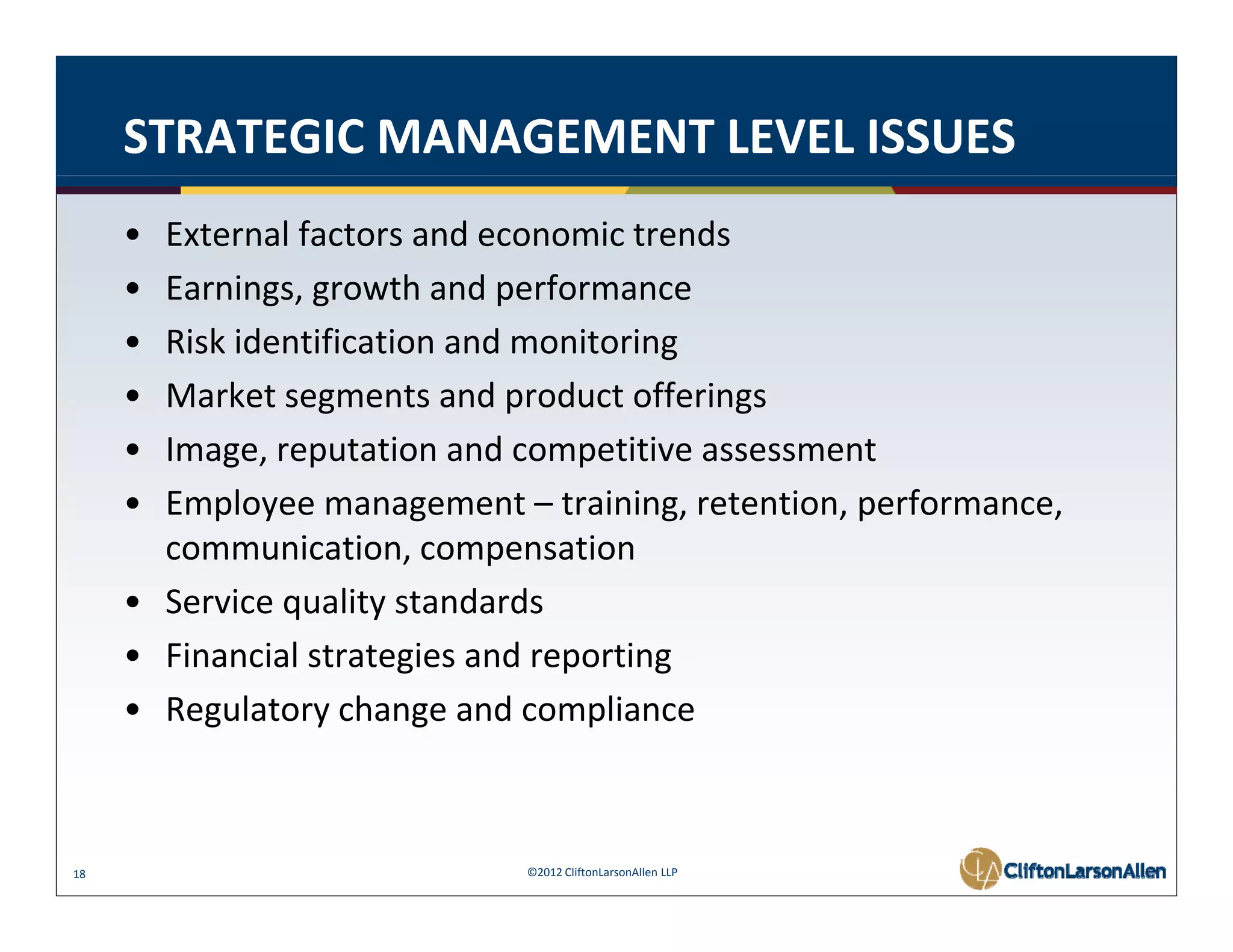
STRATEGIC MANAGEMENT LEVEL ISSUES
     • External factors and economic trends
     • Earnings, growth and performance
       Earnings, growth and performance
     • Risk identification and monitoring
     • Market segments and product offerings
     • Image, reputation and competitive assessment
     • Employee management – training, retention, performance, 
       communication, compensation
                i i                i
     • Service quality standards
     • Financial strategies and reporting
       Financial strategies and reporting
     • Regulatory change and compliance


18                           ©2012 CliftonLarsonAllen LLP
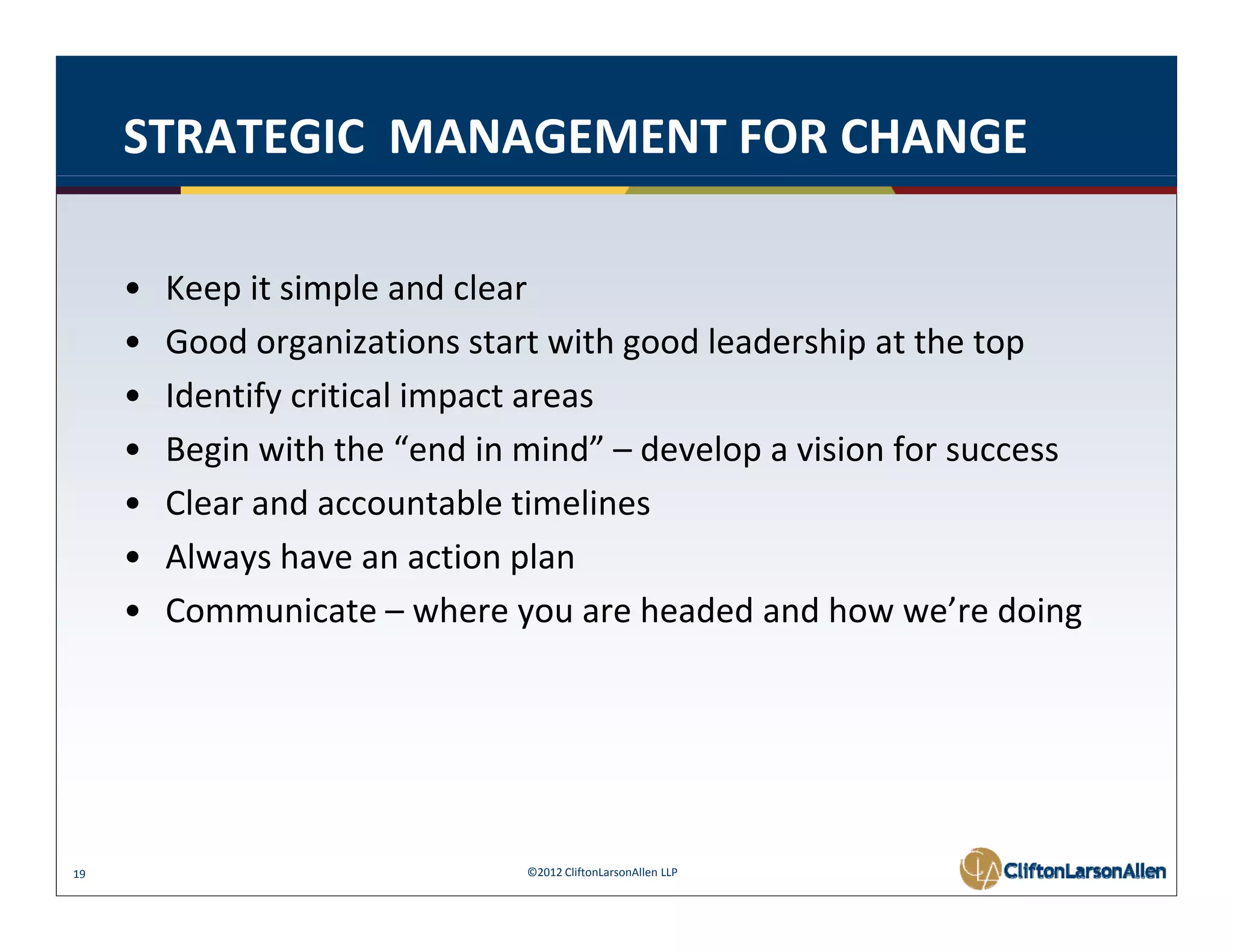
STRATEGIC  MANAGEMENT FOR CHANGE

     •   Keep it simple and clear
         Keep it simple and clear
     •   Good organizations start with good leadership at the top
     •   Identify critical impact areas
     •   Begin with the “end in mind” – develop a vision for success
     •   Clear and accountable timelines
     •   Always have an action plan
     •   Communicate – where you are headed and how we’re doing


19                              ©2012 CliftonLarsonAllen LLP
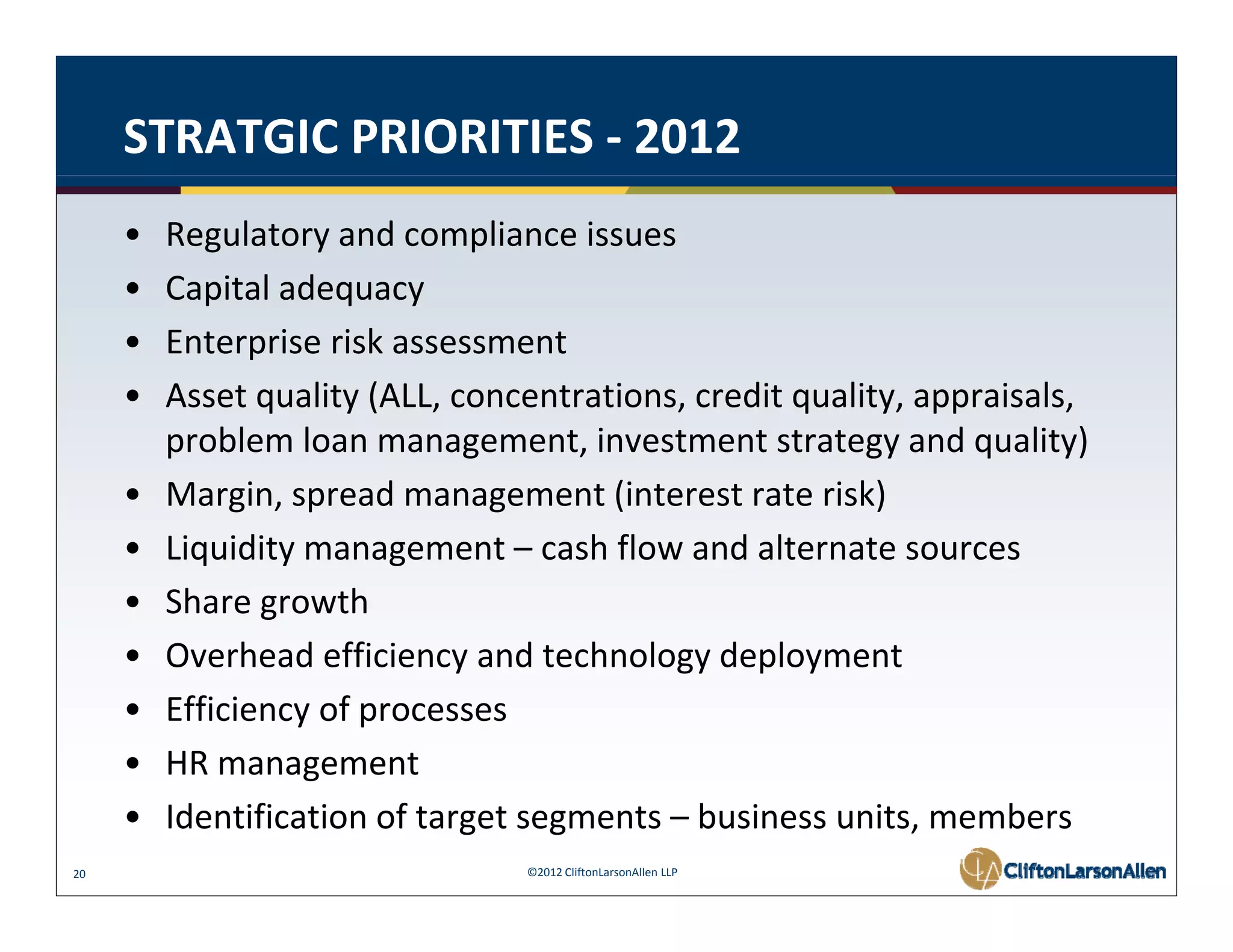
STRATGIC PRIORITIES ‐ 2012
     •   Regulatory and compliance issues
     •   Capital adequacy
         Capital adequacy
     •   Enterprise risk assessment
     •   Asset quality (ALL, concentrations, credit quality, appraisals, 
         problem loan management, investment strategy and quality)
     •   Margin, spread management (interest rate risk)
     •   Liquidity management – cash flow and alternate sources
          i idi                       h fl     d l
     •   Share growth
     •   Overhead efficiency and technology deployment
         Overhead efficiency and technology deployment
     •   Efficiency of processes
     •             g
         HR management
     •   Identification of target segments – business units, members
20                                ©2012 CliftonLarsonAllen LLP
HOW TO OPERATE STRATEGICALLY

     •   Listen to your members 
         Listen to your members
     •   Clearly define your business
     •   Think, plan and act with a long term focus
     •   Build effective processes – for them and you
     •   Understand your “bets” (Risk)
     •   Invest in employees and organizational structure and culture
     •   Ask for business
     •   Resist the status quo – embrace and manage change
         R i t th t t               b        d         h
     •   Operate with a sense of urgency – tackle the big issues


21                              ©2012 CliftonLarsonAllen LLP
• Questions 


     •   Kenneth Welch,  CPA
     •   Partner 
     •   Credit Union Group
     •   Ph. (703) 825‐2182 
     •   Kenneth.welch@cliftonlarsonallen.com
         K      h l h@ lif l         ll

22                                   ©2012 CliftonLarsonAllen LLP

Risk Environment - CliftonLarsenAllen

  • 1.
    ©2012 CliftonLarsonAllen LLP © POLICE OFFICERS CREDIT UNION CONFERENCE 2012 STRATEGIC  DECISION  MAKING IN THE CURRENT FINANCIAL  IN THE CURRENT FINANCIAL ENVIRONMENT 11 ©2012 CliftonLarsonAllen LLP
  • 2.
    MARKETPLACE  OPPORTUNITIES • With anti‐big bank sentiment at an all‐time high and “profit at any cost” Wall Street under high profile scrutiny, not‐for‐profit financial cooperatives are positioned f b growth opportunity i d d i ii d for best h i in decades • Best opportunity in our credit union lifetime being hindered by corporate losses, insurance premiums, income hits through regulation and statutory changes and supervisory action proliferation • If credit unions cannot seize the marketplace when the brass ring is available, it is troublesome to imagine when such an opportunity will re‐ appear • When opportunity rises for credit unions, it rises for all competitors…this opportunity is historic and can be lost. pp y 2 ©2012 CliftonLarsonAllen LLP
  • 3.
    LEGISLATIVE  OUTLOOK • MBL CAP relief unpopular with banks but small business focus for credit  unions, we need to expertise but must manage the risk • CURIA for credit unions was defeated, may come again • Possible loss of tax exemption is major carrot • FOM enhancements • CUSO investment and increased regulation and oversight • Interchange loss – 2 major defeats, must continue the fight • Loss of independent regulator has been threatened Loss of independent regulator has been threatened • Going to need to be aggressive, willing to take managed risks in a tough  political environment • “C “Consumer protection” political umbrella is growing – areas of focus  t ti ” liti l b ll i i ff (Overdraft fees, CC fees, mortgage refi fees, ATM surcharge, notifications,  data collection, affirmative action lending) 3 ©2012 CliftonLarsonAllen LLP
  • 4.
    POSSIBILITIES... • Lower corporate credit union assessments and recovery of legacy assets • Mergers will continue and escalate, we will be at 5,000 credit unions  before you know it – Troubled Credit Unions – Inefficient Credit Unions – Under capitalized Credit Unions U d i li d C di U i – Succession plan strategy • Fewer Community Banks as well • More shared branching  M h db hi • Nationwide branding of the Credit Union Industry • Credit Unions will need to grow to survive • To grow and survive Credit Unions will need to stay focused on their  strategic advantages  4 ©2012 CliftonLarsonAllen LLP
  • 5.
    COMMIT TO COMMUNITY INVOLEMENT • Credit union mantra – “People Helping People”  • Demonstrate the Credit Union Difference with action  • To engage your CU in the community and establish/build relationships To engage your CU in the community and establish/build relationships  • Because it’s “the right thing to do” as a progressive and responsible  business  business • Improves CU image, reputation and brand recognition, builds goodwill,  and grows membership base  d b hi b • Benefits the credit union financially –Non‐profit accounts, personal  accounts 5 ©2012 CliftonLarsonAllen LLP
  • 6.
    COMMUNITY INVOLEMENT – HOW TO: 1. Define the business objectives for community involvement which  support a strategic plan.   2. Design a Corporate Social Responsibility Plan that integrates these  business objectives.   3. Determine key partnerships internally and externally.  4. Determine expectations for this program at the onset.  5. Allow ownership of program by team members. 6. Recognize participation in the program and make the team aware of its  Recognize participation in the program and make the team aware of its successes Keep motivation high and commitment strong through  recognition.  7. Be willing to adjust the program to the needs of the community or based  Be willing to adjust the program to the needs of the community or based on feedback. 8. Think Big!  ‐ Long term commitments. 9. 9 Tell your story – External (press releases, Facebook, Website)  Tell your story – External (press releases Facebook Website) Internal – Newsletters, Annual Report, Employee and Official meetings 6 ©2012 CliftonLarsonAllen LLP
  • 7.
    TODAY’S RISK FOCUS NCUA Supervisory Focus for 2012  “Accordingly, NCUA will focus supervisory efforts on  credit unions with elevated levels of credit risks,  credit unions with elevated levels of credit risks interest rate risks, liquidity risks, and concentration  risks.”  Source: NCUA Letter to Credit Unions 12 CU 01  Source: NCUA Letter to Credit Unions 12‐CU‐01 (January 2012)  7 ©2012 CliftonLarsonAllen LLP
  • 8.
    TODAY’S RISK FOCUS Greater Risk Management Expectations  • What is Concentration Risk?  • Measuring Concentration Exposure  • Concentration Risk & Capital Adequacy  • Formulating Concentration Limits  8 ©2012 CliftonLarsonAllen LLP
  • 9.
    REGULATOR RISK EXPECTATIONS NCUA expects credit union management and officials NCUA expects credit union management and officials to be aware of what material concentrations exist within their balance sheets, to take appropriate steps ithi th i b l h t t t k i t t to measure, monitor, and control such concentrations,  and to establish a commensurate level of credit risk bl h l l f k analysis to monitor significant concentrations.  Source: The NCUA Report , October 2011 Number 10  9 ©2012 CliftonLarsonAllen LLP
  • 10.
    CONCENTRATION RISK A risk concentration is any single exposure or group of exposures with the potential to produce losses large enough (relative to capital, total assets, or overall risk level) to threaten financial i tit ti ’ h lth or l l) t th t a fi i l institution’s health ability to maintain its core operations. According to NCUA – Supervisory Letter 10‐03 , 2010 “It is up to the credit union management to identify the  risk in each product or service line, quantify the risk  i ki h d t i li tif th i k and set appropriate concentration limits based on  the analysis. the analysis ”  10 ©2012 CliftonLarsonAllen LLP
  • 11.
    TYPICAL CONCENTRATION RISK HIERACHY • Credit Default Risk Credit Default Risk • Interest Rate Risk  • Liquidity Risk  Li idit Ri k • Price / Market Risk  • Operational Risk  l k • Third‐Party Risk 11 ©2012 CliftonLarsonAllen LLP
  • 12.
    TYPICAL CONCENTRATION RISK ‐ SOURCES • Residential mortgage 1st & 2nd lien portfolios  • Member business loans (MBLs)  Member business loans (MBLs) • Sub‐prime and indirect loans  • Mortgage‐related securities (MBS & CMOs)  M t l t d iti (MBS & CMO ) • Loan participations  • Unsecured loans  l • Limited share product diversification  • Single credit & borrowing source  12 ©2012 CliftonLarsonAllen LLP
  • 13.
    BUILD A RBNW MATIX WHAT YOU NEED – • Balance sheet stratified at product and group levels  • Interest rate risk and price volatility risk data  I t t t ik d i l tilit i k d t • Investments stratified by issuer, type, collateral, etc  • Risk surveillance (MDPA program)  k ll ( ) • Loan participation or other third‐party data  • Allowance for loan loss data  • Liquidity forecast, liquidity planning  13 ©2012 CliftonLarsonAllen LLP
  • 14.
    CONCENTRATION LIMITS Once a minimum RBNW requirement is known and it has been compared against actual  adjusted net it has been compared against actual “adjusted” net worth, the credit union can:  1. Determine if current capital supports the aggregate  1 D t i if t it l t th t balance sheet risk components.  2. Identify products that generate the most risk.  2 Identify products that generate the most risk 3. Identify interrelated risks among and/or across  product types or scenario. product types or scenario 4. Begin to establish or adjust concentration limits at  the product and group levels the product and group levels 14 ©2012 CliftonLarsonAllen LLP
  • 15.
    CONCENTRATION LIMITS 5. Focus on the largest concentration first. 6. Determine if balance sheet size is held steady or  6 Determine if balance sheet size is held steady or grows/shrinks. Adjust share‐liabilities if needed.  7. Evaluate product and group concentration limits in  7 Evaluate product and group concentration limits in conjunction with strategic initiatives, budget  forecasts, and member trends.  , 8. Consider other related ALCO limits or policies.  9. Board review and approval.  9. Board review and approval. 15 ©2012 CliftonLarsonAllen LLP
  • 16.
    RISK MANAGEMENT • Maintain accurate and detailed portfolio data.  • Understand and track loan level risk factors Understand and track loan‐level risk factors.  • Identify & understand interrelationships within  balance sheet and between risk components.  balance sheet and between risk components • Timely and relevant concentration risk reporting.  • Documented policies and guidelines Documented policies and guidelines.  • Effective risk mitigation strategies  16 ©2012 CliftonLarsonAllen LLP
  • 17.
    STRATEGIC BOARD LEVEL ISSUES • Board succession • Management succession • Board expectations, effectiveness and accountability • Set strategic units, markets and geographic scope • Risk identification, policy limits, measurement and reporting • Compensation and incentive programs d • Growth and performance expectations • Core values and code of conduct Core values and code of conduct 17 ©2012 CliftonLarsonAllen LLP
  • 18.
    STRATEGIC MANAGEMENT LEVEL ISSUES • External factors and economic trends • Earnings, growth and performance Earnings, growth and performance • Risk identification and monitoring • Market segments and product offerings • Image, reputation and competitive assessment • Employee management – training, retention, performance,  communication, compensation i i i • Service quality standards • Financial strategies and reporting Financial strategies and reporting • Regulatory change and compliance 18 ©2012 CliftonLarsonAllen LLP
  • 19.
    STRATEGIC  MANAGEMENT FOR CHANGE • Keep it simple and clear Keep it simple and clear • Good organizations start with good leadership at the top • Identify critical impact areas • Begin with the “end in mind” – develop a vision for success • Clear and accountable timelines • Always have an action plan • Communicate – where you are headed and how we’re doing 19 ©2012 CliftonLarsonAllen LLP
  • 20.
    STRATGIC PRIORITIES ‐ 2012 • Regulatory and compliance issues • Capital adequacy Capital adequacy • Enterprise risk assessment • Asset quality (ALL, concentrations, credit quality, appraisals,  problem loan management, investment strategy and quality) • Margin, spread management (interest rate risk) • Liquidity management – cash flow and alternate sources i idi h fl d l • Share growth • Overhead efficiency and technology deployment Overhead efficiency and technology deployment • Efficiency of processes • g HR management • Identification of target segments – business units, members 20 ©2012 CliftonLarsonAllen LLP
  • 21.
    HOW TO OPERATE STRATEGICALLY • Listen to your members  Listen to your members • Clearly define your business • Think, plan and act with a long term focus • Build effective processes – for them and you • Understand your “bets” (Risk) • Invest in employees and organizational structure and culture • Ask for business • Resist the status quo – embrace and manage change R i t th t t b d h • Operate with a sense of urgency – tackle the big issues 21 ©2012 CliftonLarsonAllen LLP
  • 22.
    • Questions  • Kenneth Welch,  CPA • Partner  • Credit Union Group • Ph. (703) 825‐2182  • Kenneth.welch@cliftonlarsonallen.com K h l h@ lif l ll 22 ©2012 CliftonLarsonAllen LLP