HSE Practitioners
Presented By
Yasser Ramadan
Lead HSE Auditor
Elsewedy Electric PSP
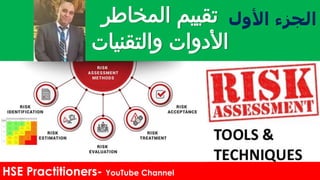
‫المخاطر‬ ‫تقييم‬
‫والتقنيات‬ ‫األدوات‬
HSE Practitioners- YouTube Channel
‫األول‬ ‫الجزء‬
HSE Practitioners- YouTube Channel HSE Practitioners
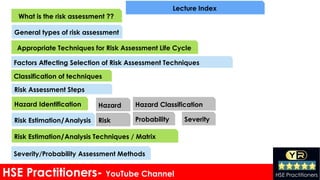
What is the risk assessment ??
General types of risk assessment
Appropriate Techniques for Risk Assessment Life Cycle
Factors Affecting Selection of Risk Assessment Techniques
Classification of techniques
Risk Assessment Steps
Hazard Identification
Risk Estimation/Analysis
Hazard Hazard Classification
Risk Probability Severity
Risk Estimation/Analysis Techniques / Matrix
Severity/Probability Assessment Methods
Lecture Index
HSE Practitioners- YouTube Channel HSE Practitioners
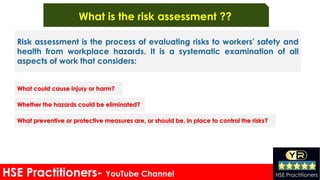
What is the risk assessment ??
What could cause injury or harm?
Whether the hazards could be eliminated?
Risk assessment is the process of evaluating risks to workers' safety and
health from workplace hazards. It is a systematic examination of all
aspects of work that considers:
What preventive or protective measures are, or should be, in place to control the risks?
HSE Practitioners- YouTube Channel HSE Practitioners
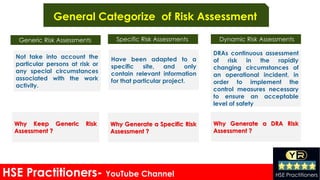
General Categorize of Risk Assessment
Generic Risk Assessments Specific Risk Assessments Dynamic Risk Assessments
Not take into account the
particular persons at risk or
any special circumstances
associated with the work
activity.
Why Keep Generic Risk
Assessment ?
Have been adapted to a
specific site, and only
contain relevant information
for that particular project.
Why Generate a Specific Risk
Assessment ?
Why Generate a DRA Risk
Assessment ?
DRAs continuous assessment
of risk in the rapidly
changing circumstances of
an operational incident, in
order to implement the
control measures necessary
to ensure an acceptable
level of safety
HSE Practitioners- YouTube Channel HSE Practitioners
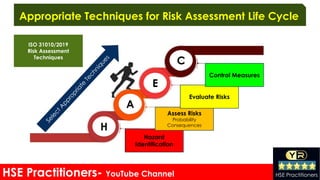
Appropriate Techniques for Risk Assessment Life Cycle
Hazard
Identification
Assess Risks
Probability
Consequences
Evaluate Risks
Control Measures
H
A
E
C
ISO 31010/2019
Risk Assessment
Techniques
HSE Practitioners- YouTube Channel HSE Practitioners
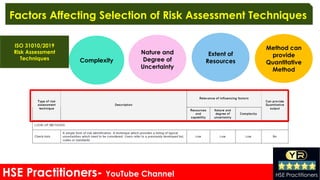
Factors Affecting Selection of Risk Assessment Techniques
Complexity
Nature and
Degree of
Uncertainty
Extent of
Resources
Method can
provide
Quantitative
Method
ISO 31010/2019
Risk Assessment
Techniques
HSE Practitioners- YouTube Channel HSE Practitioners
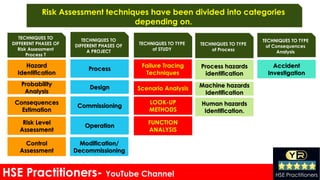
Process hazards
identification
Machine hazards
Identification
Human hazards
Identification.
Failure Tracing
Techniques
Scenario Analysis
LOOK-UP
METHODS
FUNCTION
ANALYSIS
Process
Design
Commissioning
Operation
Modification/
Decommissioning
Risk Assessment techniques have been divided into categories
depending on.
TECHNIQUES TO
DIFFERENT PHASES OF
A PROJECT
TECHNIQUES TO TYPE
of STUDY
TECHNIQUES TO TYPE
of Process
TECHNIQUES TO TYPE
of Consequences
Analysis
Accident
Investigation
Hazard
Identification
Probability
Analysis
Consequences
Estimation
Risk Level
Assessment
Control
Assessment
TECHNIQUES TO
DIFFERENT PHASES OF
Risk Assessment
Process T
HSE Practitioners- YouTube Channel HSE Practitioners
APPLICABILITY OF TECHNIQUES TO DIFFERENT PHASES OF A PROJECT
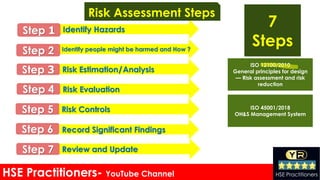
Identify HazardsStep 1
Identify people might be harmed and How ?Step 2
Step 3 Risk Estimation/Analysis
Step 4 Risk Evaluation
Step 7 Review and Update
Step 5 Risk Controls
HSE Practitioners- YouTube Channel HSE Practitioners
Risk Assessment Steps
7
Steps
Record Significant FindingsStep 6
ISO 12100/2010
General principles for design
— Risk assessment and risk
reduction
ISO 45001/2018
OH&S Management System
HSE Practitioners- YouTube Channel HSE Practitioners
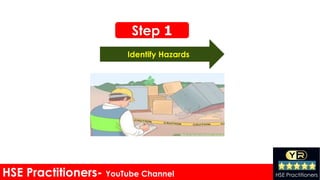
Identify Hazards
Step 1
A hazard is the potential for harm (physical or mental). In practical terms, a hazard
often is associated with a condition or activity that, if left uncontrolled, can result in an
injury or illness. Identifying hazards and eliminating or controlling them as early as
possible will help prevent injuries and illnesses.
HSE Practitioners- YouTube Channel HSE Practitioners
What is Hazard??
Source with a potential to cause injury and ill health
ISO 45001-2018
OSHA.GOV
Hazards can include sources with the potential to cause harm or hazardous situations,
or circumstances with the potential for exposure leading to injury and ill health.
HSE Practitioners- YouTube Channel HSE Practitioners
Continue :What is Hazard??
A hazard is something in your business that could cause harm to people, such as
chemicals, electricity and working at height. A risk is the chance – however large or
small – that a hazard could cause harm.
UK-HSE
Harm - Physical injury or damage to health.
Hazard - A Potential source of harm to a worker.
Different Between Harm and Hazard
HSE Practitioners- YouTube Channel HSE Practitioners
What is Hazard Identification??
Hazard identification helps the organization recognize and understand
hazards in the workplace in order to plan how to eliminate them and
reduce risks. The process should identify work-related sources, situations
or circumstances with the potential to cause injury or ill-health.
HSE Practitioners- YouTube Channel HSE Practitioners
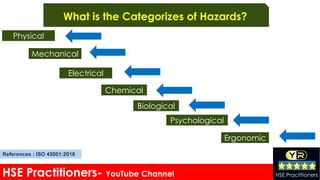
What is the Categorizes of Hazards?
Mechanical
Chemical
Biological
Psychological
Ergonomic
Electrical
References : ISO 45001:2018
Physical
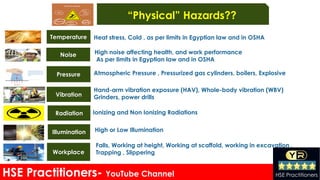
Falls, Working at height, Working at scaffold, working in excavation ,
Trapping , Slippering
Illumination High or Low Illumination
HSE Practitioners- YouTube Channel HSE Practitioners
“Physical” Hazards??
Temperature
Noise
Pressure
Vibration
Radiation
Heat stress, Cold , as per limits in Egyptian law and in OSHA
High noise affecting health, and work performance
As per limits in Egyptian law and in OSHA
Atmospheric Pressure , Pressurized gas cylinders, boilers, Explosive
Hand-arm vibration exposure (HAV), Whole-body vibration (WBV)
Grinders, power drills
Ionizing and Non Ionizing Radiations
Workplace
HSE Practitioners- YouTube Channel HSE Practitioners
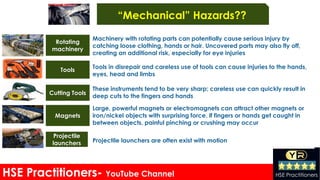
“Mechanical” Hazards??
Rotating
machinery
Tools
Cutting Tools
Magnets
Projectile
launchers
Machinery with rotating parts can potentially cause serious injury by
catching loose clothing, hands or hair. Uncovered parts may also fly off,
creating an additional risk, especially for eye injuries
Tools in disrepair and careless use of tools can cause injuries to the hands,
eyes, head and limbs
These instruments tend to be very sharp; careless use can quickly result in
deep cuts to the fingers and hands
Large, powerful magnets or electromagnets can attract other magnets or
iron/nickel objects with surprising force. If fingers or hands get caught in
between objects, painful pinching or crushing may occur
Projectile launchers are often exist with motion
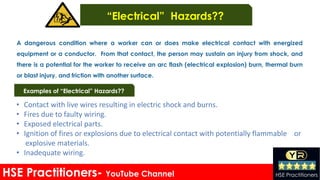
• Contact with live wires resulting in electric shock and burns.
• Fires due to faulty wiring.
• Exposed electrical parts.
• Ignition of fires or explosions due to electrical contact with potentially flammable or
explosive materials.
• Inadequate wiring.
HSE Practitioners- YouTube Channel HSE Practitioners
A dangerous condition where a worker can or does make electrical contact with energized
equipment or a conductor. From that contact, the person may sustain an injury from shock, and
there is a potential for the worker to receive an arc flash (electrical explosion) burn, thermal burn
or blast injury. and friction with another surface.
Examples of “Electrical” Hazards??
“Electrical” Hazards??
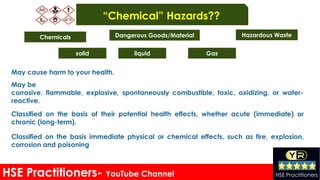
May cause harm to your health.
Classified on the basis of their potential health effects, whether acute (immediate) or
chronic (long-term).
May be
corrosive, flammable, explosive, spontaneously combustible, toxic, oxidizing, or water-
reactive.
Classified on the basis immediate physical or chemical effects, such as fire, explosion,
corrosion and poisoning
HSE Practitioners- YouTube Channel HSE Practitioners
Chemicals Dangerous Goods/Material Hazardous Waste
solid liquid Gas
“Chemical” Hazards??
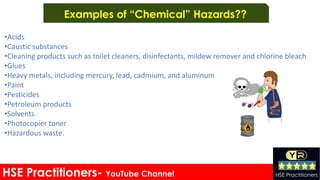
•Acids
•Caustic substances
•Cleaning products such as toilet cleaners, disinfectants, mildew remover and chlorine bleach
•Glues
•Heavy metals, including mercury, lead, cadmium, and aluminum
•Paint
•Pesticides
•Petroleum products
•Solvents
•Photocopier toner
•Hazardous waste.
HSE Practitioners- YouTube Channel HSE Practitioners
Examples of “Chemical” Hazards??
HSE Practitioners- YouTube Channel HSE Practitioners
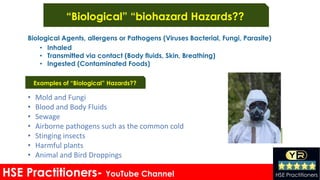
“Biological” “biohazard Hazards??
Biological Agents, allergens or Pathogens (Viruses Bacterial, Fungi, Parasite)
• Inhaled
• Transmitted via contact (Body fluids, Skin, Breathing)
• Ingested (Contaminated Foods)
• Mold and Fungi
• Blood and Body Fluids
• Sewage
• Airborne pathogens such as the common cold
• Stinging insects
• Harmful plants
• Animal and Bird Droppings
Examples of “Biological” Hazards??
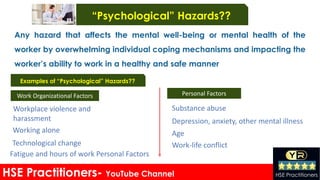
Any hazard that affects the mental well-being or mental health of the
worker by overwhelming individual coping mechanisms and impacting the
worker’s ability to work in a healthy and safe manner
HSE Practitioners- YouTube Channel HSE Practitioners
Work Organizational Factors
“Psychological” Hazards??
Examples of “Psychological” Hazards??
Personal Factors
Workplace violence and
harassment
Working alone
Technological change
Fatigue and hours of work Personal Factors
Substance abuse
Age
Depression, anxiety, other mental illness
Work-life conflict
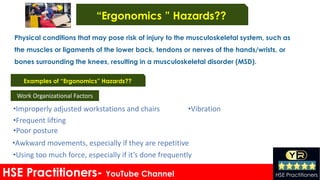
Physical conditions that may pose risk of injury to the musculoskeletal system, such as
the muscles or ligaments of the lower back, tendons or nerves of the hands/wrists, or
bones surrounding the knees, resulting in a musculoskeletal disorder (MSD).
HSE Practitioners- YouTube Channel HSE Practitioners
Work Organizational Factors
“Ergonomics ” Hazards??
Examples of “Ergonomics” Hazards??
•Improperly adjusted workstations and chairs
•Frequent lifting
•Poor posture
•Awkward movements, especially if they are repetitive
•Using too much force, especially if it’s done frequently
•Vibration
HSE Practitioners- YouTube Channel HSE Practitioners
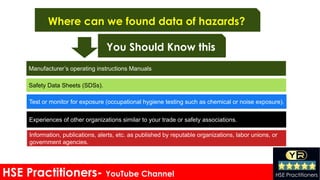
Where can we found data of hazards?
Manufacturer’s operating instructions Manuals
Safety Data Sheets (SDSs).
Test or monitor for exposure (occupational hygiene testing such as chemical or noise exposure).
Experiences of other organizations similar to your trade or safety associations.
Information, publications, alerts, etc. as published by reputable organizations, labor unions, or
government agencies.
You Should Know this
HSE Practitioners- YouTube Channel HSE Practitioners
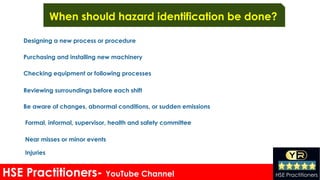
When should hazard identification be done?
Designing a new process or procedure
Purchasing and installing new machinery
Checking equipment or following processes
Reviewing surroundings before each shift
Be aware of changes, abnormal conditions, or sudden emissions
Formal, informal, supervisor, health and safety committee
Near misses or minor events
Injuries

Risk Assessment Process / Tools and Techniques

  • 1.
    HSE Practitioners Presented By YasserRamadan Lead HSE Auditor Elsewedy Electric PSP
  • 3.
    ‫المخاطر‬ ‫تقييم‬ ‫والتقنيات‬ ‫األدوات‬ HSEPractitioners- YouTube Channel ‫األول‬ ‫الجزء‬
  • 4.
    HSE Practitioners- YouTubeChannel HSE Practitioners What is the risk assessment ?? General types of risk assessment Appropriate Techniques for Risk Assessment Life Cycle Factors Affecting Selection of Risk Assessment Techniques Classification of techniques Risk Assessment Steps Hazard Identification Risk Estimation/Analysis Hazard Hazard Classification Risk Probability Severity Risk Estimation/Analysis Techniques / Matrix Severity/Probability Assessment Methods Lecture Index
  • 5.
    HSE Practitioners- YouTubeChannel HSE Practitioners What is the risk assessment ?? What could cause injury or harm? Whether the hazards could be eliminated? Risk assessment is the process of evaluating risks to workers' safety and health from workplace hazards. It is a systematic examination of all aspects of work that considers: What preventive or protective measures are, or should be, in place to control the risks?
  • 6.
    HSE Practitioners- YouTubeChannel HSE Practitioners General Categorize of Risk Assessment Generic Risk Assessments Specific Risk Assessments Dynamic Risk Assessments Not take into account the particular persons at risk or any special circumstances associated with the work activity. Why Keep Generic Risk Assessment ? Have been adapted to a specific site, and only contain relevant information for that particular project. Why Generate a Specific Risk Assessment ? Why Generate a DRA Risk Assessment ? DRAs continuous assessment of risk in the rapidly changing circumstances of an operational incident, in order to implement the control measures necessary to ensure an acceptable level of safety
  • 7.
    HSE Practitioners- YouTubeChannel HSE Practitioners Appropriate Techniques for Risk Assessment Life Cycle Hazard Identification Assess Risks Probability Consequences Evaluate Risks Control Measures H A E C ISO 31010/2019 Risk Assessment Techniques
  • 8.
    HSE Practitioners- YouTubeChannel HSE Practitioners Factors Affecting Selection of Risk Assessment Techniques Complexity Nature and Degree of Uncertainty Extent of Resources Method can provide Quantitative Method ISO 31010/2019 Risk Assessment Techniques
  • 9.
    HSE Practitioners- YouTubeChannel HSE Practitioners Process hazards identification Machine hazards Identification Human hazards Identification. Failure Tracing Techniques Scenario Analysis LOOK-UP METHODS FUNCTION ANALYSIS Process Design Commissioning Operation Modification/ Decommissioning Risk Assessment techniques have been divided into categories depending on. TECHNIQUES TO DIFFERENT PHASES OF A PROJECT TECHNIQUES TO TYPE of STUDY TECHNIQUES TO TYPE of Process TECHNIQUES TO TYPE of Consequences Analysis Accident Investigation Hazard Identification Probability Analysis Consequences Estimation Risk Level Assessment Control Assessment TECHNIQUES TO DIFFERENT PHASES OF Risk Assessment Process T
  • 10.
    HSE Practitioners- YouTubeChannel HSE Practitioners APPLICABILITY OF TECHNIQUES TO DIFFERENT PHASES OF A PROJECT
  • 11.
    Identify HazardsStep 1 Identifypeople might be harmed and How ?Step 2 Step 3 Risk Estimation/Analysis Step 4 Risk Evaluation Step 7 Review and Update Step 5 Risk Controls HSE Practitioners- YouTube Channel HSE Practitioners Risk Assessment Steps 7 Steps Record Significant FindingsStep 6 ISO 12100/2010 General principles for design — Risk assessment and risk reduction ISO 45001/2018 OH&S Management System
  • 12.
    HSE Practitioners- YouTubeChannel HSE Practitioners Identify Hazards Step 1
  • 13.
    A hazard isthe potential for harm (physical or mental). In practical terms, a hazard often is associated with a condition or activity that, if left uncontrolled, can result in an injury or illness. Identifying hazards and eliminating or controlling them as early as possible will help prevent injuries and illnesses. HSE Practitioners- YouTube Channel HSE Practitioners What is Hazard?? Source with a potential to cause injury and ill health ISO 45001-2018 OSHA.GOV Hazards can include sources with the potential to cause harm or hazardous situations, or circumstances with the potential for exposure leading to injury and ill health.
  • 14.
    HSE Practitioners- YouTubeChannel HSE Practitioners Continue :What is Hazard?? A hazard is something in your business that could cause harm to people, such as chemicals, electricity and working at height. A risk is the chance – however large or small – that a hazard could cause harm. UK-HSE Harm - Physical injury or damage to health. Hazard - A Potential source of harm to a worker. Different Between Harm and Hazard
  • 15.
    HSE Practitioners- YouTubeChannel HSE Practitioners What is Hazard Identification?? Hazard identification helps the organization recognize and understand hazards in the workplace in order to plan how to eliminate them and reduce risks. The process should identify work-related sources, situations or circumstances with the potential to cause injury or ill-health.
  • 16.
    HSE Practitioners- YouTubeChannel HSE Practitioners What is the Categorizes of Hazards? Mechanical Chemical Biological Psychological Ergonomic Electrical References : ISO 45001:2018 Physical
  • 17.
    Falls, Working atheight, Working at scaffold, working in excavation , Trapping , Slippering Illumination High or Low Illumination HSE Practitioners- YouTube Channel HSE Practitioners “Physical” Hazards?? Temperature Noise Pressure Vibration Radiation Heat stress, Cold , as per limits in Egyptian law and in OSHA High noise affecting health, and work performance As per limits in Egyptian law and in OSHA Atmospheric Pressure , Pressurized gas cylinders, boilers, Explosive Hand-arm vibration exposure (HAV), Whole-body vibration (WBV) Grinders, power drills Ionizing and Non Ionizing Radiations Workplace
  • 18.
    HSE Practitioners- YouTubeChannel HSE Practitioners “Mechanical” Hazards?? Rotating machinery Tools Cutting Tools Magnets Projectile launchers Machinery with rotating parts can potentially cause serious injury by catching loose clothing, hands or hair. Uncovered parts may also fly off, creating an additional risk, especially for eye injuries Tools in disrepair and careless use of tools can cause injuries to the hands, eyes, head and limbs These instruments tend to be very sharp; careless use can quickly result in deep cuts to the fingers and hands Large, powerful magnets or electromagnets can attract other magnets or iron/nickel objects with surprising force. If fingers or hands get caught in between objects, painful pinching or crushing may occur Projectile launchers are often exist with motion
  • 19.
    • Contact withlive wires resulting in electric shock and burns. • Fires due to faulty wiring. • Exposed electrical parts. • Ignition of fires or explosions due to electrical contact with potentially flammable or explosive materials. • Inadequate wiring. HSE Practitioners- YouTube Channel HSE Practitioners A dangerous condition where a worker can or does make electrical contact with energized equipment or a conductor. From that contact, the person may sustain an injury from shock, and there is a potential for the worker to receive an arc flash (electrical explosion) burn, thermal burn or blast injury. and friction with another surface. Examples of “Electrical” Hazards?? “Electrical” Hazards??
  • 20.
    May cause harmto your health. Classified on the basis of their potential health effects, whether acute (immediate) or chronic (long-term). May be corrosive, flammable, explosive, spontaneously combustible, toxic, oxidizing, or water- reactive. Classified on the basis immediate physical or chemical effects, such as fire, explosion, corrosion and poisoning HSE Practitioners- YouTube Channel HSE Practitioners Chemicals Dangerous Goods/Material Hazardous Waste solid liquid Gas “Chemical” Hazards??
  • 21.
    •Acids •Caustic substances •Cleaning productssuch as toilet cleaners, disinfectants, mildew remover and chlorine bleach •Glues •Heavy metals, including mercury, lead, cadmium, and aluminum •Paint •Pesticides •Petroleum products •Solvents •Photocopier toner •Hazardous waste. HSE Practitioners- YouTube Channel HSE Practitioners Examples of “Chemical” Hazards??
  • 22.
    HSE Practitioners- YouTubeChannel HSE Practitioners “Biological” “biohazard Hazards?? Biological Agents, allergens or Pathogens (Viruses Bacterial, Fungi, Parasite) • Inhaled • Transmitted via contact (Body fluids, Skin, Breathing) • Ingested (Contaminated Foods) • Mold and Fungi • Blood and Body Fluids • Sewage • Airborne pathogens such as the common cold • Stinging insects • Harmful plants • Animal and Bird Droppings Examples of “Biological” Hazards??
  • 23.
    Any hazard thataffects the mental well-being or mental health of the worker by overwhelming individual coping mechanisms and impacting the worker’s ability to work in a healthy and safe manner HSE Practitioners- YouTube Channel HSE Practitioners Work Organizational Factors “Psychological” Hazards?? Examples of “Psychological” Hazards?? Personal Factors Workplace violence and harassment Working alone Technological change Fatigue and hours of work Personal Factors Substance abuse Age Depression, anxiety, other mental illness Work-life conflict
  • 24.
    Physical conditions thatmay pose risk of injury to the musculoskeletal system, such as the muscles or ligaments of the lower back, tendons or nerves of the hands/wrists, or bones surrounding the knees, resulting in a musculoskeletal disorder (MSD). HSE Practitioners- YouTube Channel HSE Practitioners Work Organizational Factors “Ergonomics ” Hazards?? Examples of “Ergonomics” Hazards?? •Improperly adjusted workstations and chairs •Frequent lifting •Poor posture •Awkward movements, especially if they are repetitive •Using too much force, especially if it’s done frequently •Vibration
  • 25.
    HSE Practitioners- YouTubeChannel HSE Practitioners Where can we found data of hazards? Manufacturer’s operating instructions Manuals Safety Data Sheets (SDSs). Test or monitor for exposure (occupational hygiene testing such as chemical or noise exposure). Experiences of other organizations similar to your trade or safety associations. Information, publications, alerts, etc. as published by reputable organizations, labor unions, or government agencies. You Should Know this
  • 26.
    HSE Practitioners- YouTubeChannel HSE Practitioners When should hazard identification be done? Designing a new process or procedure Purchasing and installing new machinery Checking equipment or following processes Reviewing surroundings before each shift Be aware of changes, abnormal conditions, or sudden emissions Formal, informal, supervisor, health and safety committee Near misses or minor events Injuries