Ref. No : Date:
Location: Class room
Persons at
Risk :
PROBABLE RISK
FREQUENCY SCORE
Enter a no. Enter a no. Severity Scores of 9
from 1 to 6 from 1 to 6 multiplied by or above
1 Negligible 1 Improbable Frequency further
2 Minor injury 2 Possible immediate
3 Major injury 3 Occasional assessment
4 Single death 4 Fairly frequent needed
5 Multi-death 5 Frequently
6 Multi-offsite 6 Certainty YES / NO
3 2 6 no
Emergency signage clear, class rooms with fire
notices, fire exits clearly labelled
5 1 5 no Alarm system installed and tested regularly
5 1 5 no Sounders installed
3 2 6 no escape routes well labelled and kept clear
4 2 8 no
exit routes and fire doors checked, H & S
reporting available via eportal
2 1 2 no Door closures in place
Lack of / failure of emergency lighting 3 2 6 no Tested and serviced
Lack of / obstruction of emergency signage 4 1 4 no High signage, signage checked
4 2 8 no Fire fighting equipment available in corridor
1 1 1 no
Combustible material not stored near sources of
ignition
4 1 4 no No chemicals stored in class rooms
2 2 4 no Unsafe heating appliances not used
Consider such hazards as: slips, trips & falls; burns; chemicals; falling
from height; fire; electrocution; amputation; suffocation; noise; crushing;
gas; poisoning; fracture; dislocation; strain; sprain; machinery; vehicles;
tools; animals; weather; young persons, horse play etc.
Score 'severity' as the type of accident that could happen in a 'worst
case scenario' with no controls in place.
Controls / Comments
Staff, Peripatetic Teachers, students, visitors and Contractors
Fire doors wedged/hooked open
Lack of alarm system
Inability to hear alarm
Number and safety of escape routes
Obstructions of emergency exit routes and fire doors
Unsafe use of heating appliances (Radiant bar heaters)
Fire
Lack of suitable fire fighting equipment
Unsafe storage of combustible materials (close to sources
of ignition)
Unsafe storage of chemicals
GENERAL CLASS ROOM RISK ASSESSMENT
Assessor:
Score 'probable frequency' as the likely frequency of an accident with
current controls in place.
Include daily and occasional activities.
SEVERITY YES/NO
IDENTIFIED HAZARDS
Evacuation of building by disabled/those unfamiliar with
the building
4 3 12 yes
See detailed risk assessment high usage of IT
and electrical equipment in general whole
school risk assessments
4 1 4 no Only marker pens used
page 2
PROBABLE RISK
FREQUENCY SCORE
3 2 6 no
Warning signage used to highlight spillages,
notified to the site team and cleared up as soon
as possible.
3 1 3 no
Notified to site team if appropriate, cleared,
removed as soon as possible
3 2 6 no Secured any defects reported via eportal
3 2 6 no Any defects reported via eportal area highlighted
2 2 4 no
Coat hangers used where available, bags
placed carefully under tables to avoid trip risks
3 1 3 no Trailing leads highlighted
3 1 3 no Stored appropriately
2 1 2 no Students not allowed hot drinks in class.
3 1 3 no
Students advised to refrain from sitting on
sources of heat
3 1 3 no
Cleaning chemicals used by cleaners or when
students are not in class room
3 1 3 no Low hazard, child friendly used
3 1 3 no Low hazard used
3 2 6 no
appropriate equipment used to access high level
storage areas when appropriate.
Use of Board Cleaners
Use of marker pen ink
Falls From Height
Access to high level shelves / Cupboards
Hot drinks
Radiators / heating appliances
Use Of Chemicals
Use of Cleaning Chemicals
Use of glues, paints and pens
Slips Trips and Falls
Books, Boxes etc on floor
Burns
Wet floors
Sand / leaves / rubbish on floor
Edges of carpets / mats
Steps/ thresholds
IDENTIFIED HAZARDS SEVERITY YES/NO Controls / Comments
Use of Flammable Chemicals, e.g. Spray paint or marker
pen ink
Over loading electrical supply - high use of extension
leads/multi-adapters
Bags and coats on the floor
Trailing power leads, extension leads.
3 2 6 no Appropriate openers used
3 2 6 no Appropriate equipment used
3 2 6 no
Not a regular activity, carried out by staff
carefully in quiet periods, appropriate equipment
used.
4 1 4 no Restricted opening
Using steps to turn ceiling mounted / high level projectors
on/off
Putting up displays
Pupil falling out of window
Access to open / close high level windows
page 3
PROBABLE RISK
FREQUENCY SCORE
3 2 6
no
Informal visual checks made prior to electrical
equipment use.
3 2 6 no
Informal visual checks made prior to electrical
equipment use.
4 3 12 yes
On going programme see detailed risk
assessment lack of portable equipment testing
in general whole school risk assessments
4 2 8 no
Informal visual inspections carried out by staff
prior to use, faulty equipment removed from
use, labelled and plug removed.
4 1 4 no
Not endorsed, advised that all electrical
appliances require PAT testing prior to use.
4 1 4 no
Electrical equipment and sockets not near sinks
or water sources
0
0
4 1 4 no Students supervised in class
0
4 1 4 no Students supervised in class
0
3 2 6 no
Students eating and drinking in class is not
permitted
0
0
0
2 1 2 no Class noise
0
Noise
General noise levels
Plastic bags
Strangulation / Entanglement
Cords on blinds, curtains, screens
horseplay
Staff / students bringing own electrical equipment into
building
Electrical equipment / sockets in close proximity to a sink /
water supply
Choking
Eating & drinking
Electrocution
Suffocation
Computers, printers, desk lights, audio visual equipment,
fans, heaters & low voltage electrical equipment
Extension leads / multi adapters.
Lack of PAT testing
Lack of regular formal visual examination of electrical
appliances
Controls / CommentsSEVERITY YES/NOIDENTIFIED HAZARDS
0
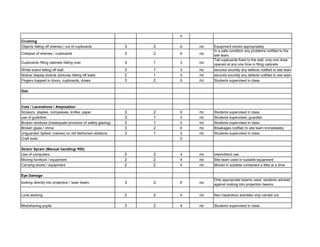
Objects falling off shelves / out of cupboards 3 2 6 no Equipment stored appropriately
Collapse of shelves / cupboards 3 2 6 no
In a safe condition any problems notified to the
site team
Cupboards /filing cabinets falling over 3 1 3 no
Tall cupboards fixed to the wall, only one draw
opened at any one time in filing cabinets
White board falling off wall 3 1 3 no secured soundly any defects notified to site team.
Notice/ display boards /pictures falling off walls 2 1 3 no secured soundly any defects notified to site team.
Fingers trapped in doors, cupboards, draws 3 2 6 no Students supervised in class
Gas
Cuts / Lacerations / Amputation
Scissors, staples, compasses, knifes, paper 3 2 6 no Students supervised in class
use of guillotine 3 1 3 no Students supervised, guarded
Broken windows (inadequate provision of safety glazing) 3 1 3 no Students supervised in class
Broken glass / china 3 2 6 no Breakages notified to site team immediately
Unguarded 'spikes' (valves) on old fashioned radiators 3 1 3 no Students supervised in class
Craft tools 0
Strain/ Sprain (Manual handling/ RSI)
Use of computers 2 2 4 no intermittent use
Moving furniture / equipment 2 2 4 no Site team used or suitable equipment
Carrying books / equipment 2 2 4 no Moved in suitable containers a little at a time
Eye Damage
looking directly into projection / laser beam. 3 2 6 no
Only appropriate beams used, students advised
against looking into projection beams.
Lone working 2 2 4 no Non hazardous activities only carried out
Misbehaving pupils 3 2 6 no Students supervised in class
Crushing

Risk assessment

  • 1.
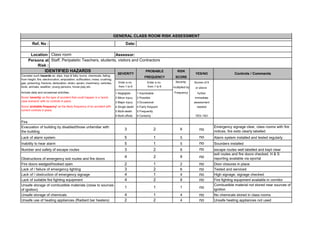
    Ref. No :Date: Location: Class room Persons at Risk : PROBABLE RISK FREQUENCY SCORE Enter a no. Enter a no. Severity Scores of 9 from 1 to 6 from 1 to 6 multiplied by or above 1 Negligible 1 Improbable Frequency further 2 Minor injury 2 Possible immediate 3 Major injury 3 Occasional assessment 4 Single death 4 Fairly frequent needed 5 Multi-death 5 Frequently 6 Multi-offsite 6 Certainty YES / NO 3 2 6 no Emergency signage clear, class rooms with fire notices, fire exits clearly labelled 5 1 5 no Alarm system installed and tested regularly 5 1 5 no Sounders installed 3 2 6 no escape routes well labelled and kept clear 4 2 8 no exit routes and fire doors checked, H & S reporting available via eportal 2 1 2 no Door closures in place Lack of / failure of emergency lighting 3 2 6 no Tested and serviced Lack of / obstruction of emergency signage 4 1 4 no High signage, signage checked 4 2 8 no Fire fighting equipment available in corridor 1 1 1 no Combustible material not stored near sources of ignition 4 1 4 no No chemicals stored in class rooms 2 2 4 no Unsafe heating appliances not used Consider such hazards as: slips, trips & falls; burns; chemicals; falling from height; fire; electrocution; amputation; suffocation; noise; crushing; gas; poisoning; fracture; dislocation; strain; sprain; machinery; vehicles; tools; animals; weather; young persons, horse play etc. Score 'severity' as the type of accident that could happen in a 'worst case scenario' with no controls in place. Controls / Comments Staff, Peripatetic Teachers, students, visitors and Contractors Fire doors wedged/hooked open Lack of alarm system Inability to hear alarm Number and safety of escape routes Obstructions of emergency exit routes and fire doors Unsafe use of heating appliances (Radiant bar heaters) Fire Lack of suitable fire fighting equipment Unsafe storage of combustible materials (close to sources of ignition) Unsafe storage of chemicals GENERAL CLASS ROOM RISK ASSESSMENT Assessor: Score 'probable frequency' as the likely frequency of an accident with current controls in place. Include daily and occasional activities. SEVERITY YES/NO IDENTIFIED HAZARDS Evacuation of building by disabled/those unfamiliar with the building
  • 2.
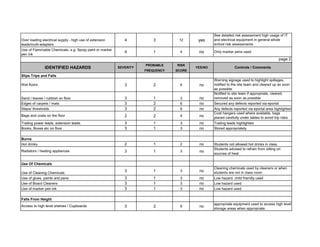
    4 3 12yes See detailed risk assessment high usage of IT and electrical equipment in general whole school risk assessments 4 1 4 no Only marker pens used page 2 PROBABLE RISK FREQUENCY SCORE 3 2 6 no Warning signage used to highlight spillages, notified to the site team and cleared up as soon as possible. 3 1 3 no Notified to site team if appropriate, cleared, removed as soon as possible 3 2 6 no Secured any defects reported via eportal 3 2 6 no Any defects reported via eportal area highlighted 2 2 4 no Coat hangers used where available, bags placed carefully under tables to avoid trip risks 3 1 3 no Trailing leads highlighted 3 1 3 no Stored appropriately 2 1 2 no Students not allowed hot drinks in class. 3 1 3 no Students advised to refrain from sitting on sources of heat 3 1 3 no Cleaning chemicals used by cleaners or when students are not in class room 3 1 3 no Low hazard, child friendly used 3 1 3 no Low hazard used 3 1 3 no Low hazard used 3 2 6 no appropriate equipment used to access high level storage areas when appropriate. Use of Board Cleaners Use of marker pen ink Falls From Height Access to high level shelves / Cupboards Hot drinks Radiators / heating appliances Use Of Chemicals Use of Cleaning Chemicals Use of glues, paints and pens Slips Trips and Falls Books, Boxes etc on floor Burns Wet floors Sand / leaves / rubbish on floor Edges of carpets / mats Steps/ thresholds IDENTIFIED HAZARDS SEVERITY YES/NO Controls / Comments Use of Flammable Chemicals, e.g. Spray paint or marker pen ink Over loading electrical supply - high use of extension leads/multi-adapters Bags and coats on the floor Trailing power leads, extension leads.
  • 3.
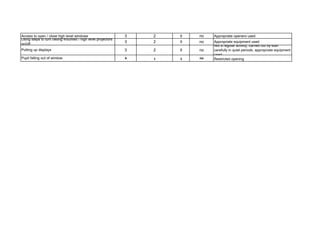
    3 2 6no Appropriate openers used 3 2 6 no Appropriate equipment used 3 2 6 no Not a regular activity, carried out by staff carefully in quiet periods, appropriate equipment used. 4 1 4 no Restricted opening Using steps to turn ceiling mounted / high level projectors on/off Putting up displays Pupil falling out of window Access to open / close high level windows
  • 4.
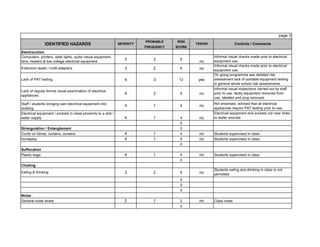
    page 3 PROBABLE RISK FREQUENCYSCORE 3 2 6 no Informal visual checks made prior to electrical equipment use. 3 2 6 no Informal visual checks made prior to electrical equipment use. 4 3 12 yes On going programme see detailed risk assessment lack of portable equipment testing in general whole school risk assessments 4 2 8 no Informal visual inspections carried out by staff prior to use, faulty equipment removed from use, labelled and plug removed. 4 1 4 no Not endorsed, advised that all electrical appliances require PAT testing prior to use. 4 1 4 no Electrical equipment and sockets not near sinks or water sources 0 0 4 1 4 no Students supervised in class 4 1 4 no Students supervised in class 0 4 1 4 no Students supervised in class 0 3 2 6 no Students eating and drinking in class is not permitted 0 0 0 2 1 2 no Class noise 0 Noise General noise levels Plastic bags Strangulation / Entanglement Cords on blinds, curtains, screens horseplay Staff / students bringing own electrical equipment into building Electrical equipment / sockets in close proximity to a sink / water supply Choking Eating & drinking Electrocution Suffocation Computers, printers, desk lights, audio visual equipment, fans, heaters & low voltage electrical equipment Extension leads / multi adapters. Lack of PAT testing Lack of regular formal visual examination of electrical appliances Controls / CommentsSEVERITY YES/NOIDENTIFIED HAZARDS
  • 5.
    0 Objects falling offshelves / out of cupboards 3 2 6 no Equipment stored appropriately Collapse of shelves / cupboards 3 2 6 no In a safe condition any problems notified to the site team Cupboards /filing cabinets falling over 3 1 3 no Tall cupboards fixed to the wall, only one draw opened at any one time in filing cabinets White board falling off wall 3 1 3 no secured soundly any defects notified to site team. Notice/ display boards /pictures falling off walls 2 1 3 no secured soundly any defects notified to site team. Fingers trapped in doors, cupboards, draws 3 2 6 no Students supervised in class Gas Cuts / Lacerations / Amputation Scissors, staples, compasses, knifes, paper 3 2 6 no Students supervised in class use of guillotine 3 1 3 no Students supervised, guarded Broken windows (inadequate provision of safety glazing) 3 1 3 no Students supervised in class Broken glass / china 3 2 6 no Breakages notified to site team immediately Unguarded 'spikes' (valves) on old fashioned radiators 3 1 3 no Students supervised in class Craft tools 0 Strain/ Sprain (Manual handling/ RSI) Use of computers 2 2 4 no intermittent use Moving furniture / equipment 2 2 4 no Site team used or suitable equipment Carrying books / equipment 2 2 4 no Moved in suitable containers a little at a time Eye Damage looking directly into projection / laser beam. 3 2 6 no Only appropriate beams used, students advised against looking into projection beams. Lone working 2 2 4 no Non hazardous activities only carried out Misbehaving pupils 3 2 6 no Students supervised in class Crushing