Download as PDF, PPTX


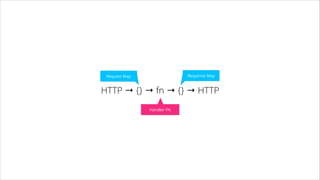
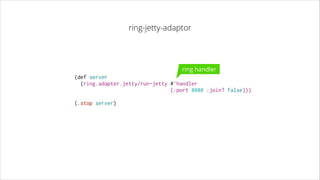
![ring.adaptor.jetty/proxy-handler
(defn- proxy-handler
"Returns an Jetty Handler implementation for the given Ring handler."
[handler]
(proxy [AbstractHandler] []
(handle [_ ^Request base-request request response]
(let [request-map (servlet/build-request-map request)
response-map (handler request-map)]
(when response-map
(servlet/update-servlet-response response response-map)
(.setHandled base-request true))))))](https://image.slidesharecdn.com/ring-austinclojure-1213-131211145432-phpapp02/85/Deconstructing-the-Functional-Web-with-Clojure-4-320.jpg)
![ring.util.servlet/build-request-map
(defn build-request-map
"Create the request map from the HttpServletRequest object."
[^HttpServletRequest request]
{:server-port
(.getServerPort request)
:server-name
(.getServerName request)
:remote-addr
(.getRemoteAddr request)
:uri
(.getRequestURI request)
:query-string
(.getQueryString request)
:scheme
(keyword (.getScheme request))
:request-method
(keyword (.toLowerCase (.getMethod request)))
:headers
(get-headers request)
:content-type
(.getContentType request)
:content-length
(get-content-length request)
:character-encoding (.getCharacterEncoding request)
:ssl-client-cert
(get-client-cert request)
:body
(.getInputStream request)})
not functional :(](https://image.slidesharecdn.com/ring-austinclojure-1213-131211145432-phpapp02/85/Deconstructing-the-Functional-Web-with-Clojure-5-320.jpg)
![ring.util.servlet/update-servlet-response
(defn update-servlet-response
"Update the HttpServletResponse using a response map."
[^HttpServletResponse response, {:keys [status headers body]}]
(when-not response
(throw (Exception. "Null response given.")))
(when status
(set-status response status))
(doto response
(set-headers headers)
(set-body body)))](https://image.slidesharecdn.com/ring-austinclojure-1213-131211145432-phpapp02/85/Deconstructing-the-Functional-Web-with-Clojure-6-320.jpg)
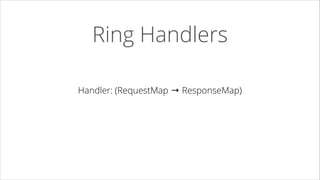
![(defn handler-nil [req]
{:body nil})
response body](https://image.slidesharecdn.com/ring-austinclojure-1213-131211145432-phpapp02/85/Deconstructing-the-Functional-Web-with-Clojure-8-320.jpg)
![ring.util.servlet/set-body
(defn- set-body
"Update a HttpServletResponse body with a String, ISeq, File or InputStream."
[^HttpServletResponse response, body]
(cond
(string? body)
(with-open [writer (.getWriter response)]
(.print writer body))
(seq? body)
;; …
(instance? File body)
;; …
(nil? body)
nil
:else
(throw (Exception. ^String (format "Unrecognized body: %s" body)))))](https://image.slidesharecdn.com/ring-austinclojure-1213-131211145432-phpapp02/85/Deconstructing-the-Functional-Web-with-Clojure-9-320.jpg)
![(defn handler-string [req]
{:body "hello world”})](https://image.slidesharecdn.com/ring-austinclojure-1213-131211145432-phpapp02/85/Deconstructing-the-Functional-Web-with-Clojure-10-320.jpg)
![(defn handler-file [req]
{:body (clojure.java.io/file "info.txt")})](https://image.slidesharecdn.com/ring-austinclojure-1213-131211145432-phpapp02/85/Deconstructing-the-Functional-Web-with-Clojure-11-320.jpg)
![(defn handler-status [req]
{:status 402
:headers {"Location"
"bitcoin:1G9TyAaKrfJn7q4Vrr15DscLXFSRPxBFaH?amount=.001"}})
Handlers can return status code and headers](https://image.slidesharecdn.com/ring-austinclojure-1213-131211145432-phpapp02/85/Deconstructing-the-Functional-Web-with-Clojure-12-320.jpg)
![ring.util.response/*
A few response helpers
(defn response
"Returns a skeletal Ring response with the given body, status of 200, and no
headers."
[body]
{:status 200
:headers {}
:body
body})
!
(defn not-found
"Returns a 404 'not found' response."
[body]
{:status 404
:headers {}
:body
body})
!
(defn redirect
"Returns a Ring response for an HTTP 302 redirect."
[url]
{:status 302
:headers {"Location" url}
:body
""})](https://image.slidesharecdn.com/ring-austinclojure-1213-131211145432-phpapp02/85/Deconstructing-the-Functional-Web-with-Clojure-13-320.jpg)
![(defn handler [req]
(response/response "Hello, world!”))
!
(defn handler [req]
(response/redirect "http://lmgtfy.com/?q=http+redirect"))
!
(defn handler [req]
(response/resource-response "hello.txt"))](https://image.slidesharecdn.com/ring-austinclojure-1213-131211145432-phpapp02/85/Deconstructing-the-Functional-Web-with-Clojure-14-320.jpg)
![Building up a response
(defn handler [req]
(-> (response/response "")
(response/status 302)
(response/header "Location" "http://www.google.com")))](https://image.slidesharecdn.com/ring-austinclojure-1213-131211145432-phpapp02/85/Deconstructing-the-Functional-Web-with-Clojure-15-320.jpg)

![(defn handler-reload1 [req]
(response/response (reload-me/some-work)))
A function we’d like to be reloaded if it changes](https://image.slidesharecdn.com/ring-austinclojure-1213-131211145432-phpapp02/85/Deconstructing-the-Functional-Web-with-Clojure-17-320.jpg)
![(defn handler-reload2 [req]
(require 'ringtest.reload-me :reload)
(handler-reload1 req))
The original handler is wrapped](https://image.slidesharecdn.com/ring-austinclojure-1213-131211145432-phpapp02/85/Deconstructing-the-Functional-Web-with-Clojure-18-320.jpg)
![Abstracting the reloading
(defn wrap-reload [other-handler]
(fn [req]
(require 'ringtest.reload-me :reload)
(other-handler req)))
(def handler-reload3 (wrap-reload #'handler-reload1))](https://image.slidesharecdn.com/ring-austinclojure-1213-131211145432-phpapp02/85/Deconstructing-the-Functional-Web-with-Clojure-19-320.jpg)
![ring.middleware.reload/wrap-reload
(defn wrap-reload
"Reload namespaces of modified files before the request is passed to the
supplied handler.
!
Takes the following options:
:dirs - A list of directories that contain the source files.
Defaults to ["src"]."
[handler & [options]]
(let [source-dirs (:dirs options ["src"])
modified-namespaces (ns-tracker source-dirs)]
(fn [request]
Smarter reloading surrounding the wrapped handler
(doseq [ns-sym (modified-namespaces)]
(require ns-sym :reload))
(handler request))))](https://image.slidesharecdn.com/ring-austinclojure-1213-131211145432-phpapp02/85/Deconstructing-the-Functional-Web-with-Clojure-20-320.jpg)
![ring.server.standalone/add-middleware
This is what “lein ring server” does
(defn- add-middleware [handler options]
(-> handler
(add-auto-refresh options)
(add-auto-reload options)
(add-stacktraces options)))](https://image.slidesharecdn.com/ring-austinclojure-1213-131211145432-phpapp02/85/Deconstructing-the-Functional-Web-with-Clojure-21-320.jpg)
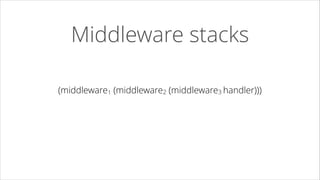
![(defn ring-stack [handler]
Our custom “ring” middleware stack
(-> handler
(wrap-reload)
(wrap-stacktrace)))
(defonce server-atom (atom nil))
And some custom sever code
(defn start [handler]
(swap! server-atom
(fn [server]
(when server (.stop server))
(jetty/run-jetty handler
{:port 8080 :join? false}))))
(defn stop []
(swap! server-atom
(fn [server]
(when server (.stop server))
nil)))](https://image.slidesharecdn.com/ring-austinclojure-1213-131211145432-phpapp02/85/Deconstructing-the-Functional-Web-with-Clojure-23-320.jpg)
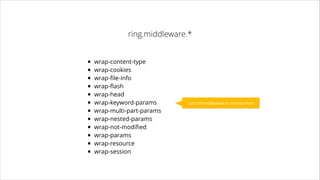
![compojure.handler/api
An existing minimal stack for APIs
(defn api
"Create a handler suitable for a web API. This adds the following
middleware to your routes:
- wrap-params
- wrap-nested-params
- wrap-keyword-params"
[routes]
(-> routes
wrap-keyword-params
wrap-nested-params
wrap-params))](https://image.slidesharecdn.com/ring-austinclojure-1213-131211145432-phpapp02/85/Deconstructing-the-Functional-Web-with-Clojure-25-320.jpg)
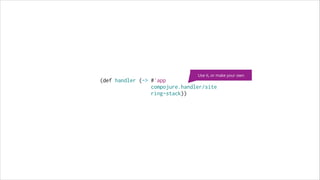
![compojure.handler/site
(defn site
"Create a handler suitable for a standard website. This adds the
following middleware to your routes:
- wrap-session
- wrap-flash
- wrap-cookies
- wrap-multipart-params
- wrap-params
- wrap-nested-params
- wrap-keyword-params
!
A map of options may also be provided. These keys are provided:
:session
- a map of session middleware options
:multipart - a map of multipart-params middleware options"
[routes & [opts]]
(-> (api routes)
(with-opts wrap-multipart-params (:multipart opts))
Extends the API stack
(wrap-flash)
(with-opts wrap-session (:session opts))))](https://image.slidesharecdn.com/ring-austinclojure-1213-131211145432-phpapp02/85/Deconstructing-the-Functional-Web-with-Clojure-26-320.jpg)
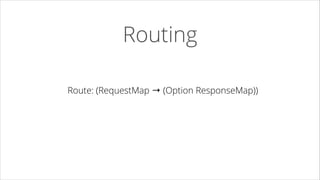
![noir.util.middleware/app-handler
(defn app-handler [app-routes & {:keys [session-options store multipart
middleware access-rules formats]}]
(letfn [(wrap-middleware-format [handler]
(if formats (wrap-restful-format handler :formats formats) handler))]
(-> (apply routes app-routes)
A hook to extend the noir stack
(wrap-middleware middleware)
(wrap-request-map)
(api)
(wrap-base-url)
(wrap-middleware-format)
(with-opts wrap-multipart-params multipart)
(wrap-access-rules access-rules)
(wrap-noir-validation)
Lot’s of customization
(wrap-noir-cookies)
(wrap-noir-flash)
(wrap-noir-session
(update-in session-options [:store] #(or % (memory-store mem)))))))](https://image.slidesharecdn.com/ring-austinclojure-1213-131211145432-phpapp02/85/Deconstructing-the-Functional-Web-with-Clojure-28-320.jpg)
![Not ring handlers
because they don’t
take a request.
(defn home []
(response/response "Home Page"))
(defn foo []
(response/response "Foo Page"))
(defn foo-n [n]
(response/response (str "This is Foo#" n)))
(defn app1 [req]
(condp re-matches (:uri req)
#"/"
(home)
#"/foo"
(foo)
#"/foo/(.*)" :>> #(foo-n (second %))
(response/not-found "Wat")))
Select the page to
show based on URL](https://image.slidesharecdn.com/ring-austinclojure-1213-131211145432-phpapp02/85/Deconstructing-the-Functional-Web-with-Clojure-30-320.jpg)
![Abstract the route dispatch
(defn route-to [handler]
(fn [match]
(if (string? match)
(handler)
(apply handler (rest match)))))
(defn app2 [req]
(condp re-matches (:uri req)
#"/"
Cleaner, but still awkward
:>> (route-to home)
#"/foo"
:>> (route-to foo)
#"/foo/(.*)"
:>> (route-to foo-n)
(response/not-found "Wat")))](https://image.slidesharecdn.com/ring-austinclojure-1213-131211145432-phpapp02/85/Deconstructing-the-Functional-Web-with-Clojure-31-320.jpg)
![Include the pattern
(defn my-route [pattern page-fn]
(fn [req]
(if-let [match (re-matches pattern (:uri req))]
((route-to handler) page-fn))))
(defn app3 [req]
(let [my-routes [(my-route #"/"
home)
Much cleaner
(my-route #"/foo"
foo)
(my-route #"/foo/(.*)" foo-n)
(my-route #".*"
#(response/not-found "Wat"))]]
(some #(% req) my-routes)))
The first route that responds wins](https://image.slidesharecdn.com/ring-austinclojure-1213-131211145432-phpapp02/85/Deconstructing-the-Functional-Web-with-Clojure-32-320.jpg)
![Routing fn includes method and path
(defn app4 [req]
(let [my-routes [(GET "/" [] (home))
Some extra macro magic
(GET "/foo" [] (foo))
(GET "/foo/:id" [id] (foo-n id))
(route/not-found "Wat")]]
(some #(% req) my-routes)))
Some things never change](https://image.slidesharecdn.com/ring-austinclojure-1213-131211145432-phpapp02/85/Deconstructing-the-Functional-Web-with-Clojure-33-320.jpg)
![compojure.core/*
(defn make-route
"Returns a function that will only call the handler if the method and Clout
route match the request."
[method route handler]
(if-method method
(if-route route
(fn [request]
(render (handler request) request)))))
!
(defn- compile-route
"Compile a route in the form (method path & body) into a function."
[method route bindings body]
`(make-route
~method ~(prepare-route route)
(fn [request#]
(let-request [~bindings request#] ~@body))))
!
(defmacro GET "Generate a GET route."
[path args & body]
(compile-route :get path args body))](https://image.slidesharecdn.com/ring-austinclojure-1213-131211145432-phpapp02/85/Deconstructing-the-Functional-Web-with-Clojure-34-320.jpg)
![a collection of routes
(def app5
(routes
(GET "/" [] (home))
(GET "/foo" [] (foo))
(GET "/foo/:id" [id] (foo-n id))
(route/not-found "Wat")))](https://image.slidesharecdn.com/ring-austinclojure-1213-131211145432-phpapp02/85/Deconstructing-the-Functional-Web-with-Clojure-35-320.jpg)
![(defn routing
"Apply a list of routes to a Ring request map."
[request & handlers]
(some #(% request) handlers))
!
(defn routes
"Create a Ring handler by combining several handlers into one."
[& handlers]
#(apply routing % handlers))](https://image.slidesharecdn.com/ring-austinclojure-1213-131211145432-phpapp02/85/Deconstructing-the-Functional-Web-with-Clojure-36-320.jpg)
![(def foo-routes
(routes
(GET "/foo" [] (foo))
(GET "/foo/:id" [id] (foo-n id))))
(def app6
(routes
(GET "/" [] (home))
Routing functions nest easily
foo-routes
(route/not-found "Wat")))](https://image.slidesharecdn.com/ring-austinclojure-1213-131211145432-phpapp02/85/Deconstructing-the-Functional-Web-with-Clojure-37-320.jpg)
![(defn foobar-routes [foobar-type]
(routes
(GET "/" [] (str foobar-type " Page"))
(GET "/:id" [id] (str foobar-type "#" id))))
(def app7
Not ideal - generates the route fn each call
(routes
(GET "/" [] (home))
(context "/foo" [] (foobar-routes "Foo"))
(context "/bar" [] (foobar-routes "Bar"))
(route/not-found "Wat")))](https://image.slidesharecdn.com/ring-austinclojure-1213-131211145432-phpapp02/85/Deconstructing-the-Functional-Web-with-Clojure-38-320.jpg)
![(defmacro context
"Give all routes in the form a common path prefix and set of bindings.
!
The following example demonstrates defining two routes with a common
path prefix ('/user/:id') and a common binding ('id'):
!
(context "/user/:id" [id]
(GET "/profile" [] ...)
(GET "/settings" [] ...))"
[path args & routes]
`(#'if-route ~(context-route path)
(#'wrap-context
(fn [request#]
(let-request [~args request#]
(routing request# ~@routes))))))](https://image.slidesharecdn.com/ring-austinclojure-1213-131211145432-phpapp02/85/Deconstructing-the-Functional-Web-with-Clojure-39-320.jpg)
![compojure.response/Renderable
(defprotocol Renderable
(render [this request]
"Render the object into a form suitable for the given request map."))
!
(extend-protocol Renderable
nil …
String …
APersistentMap …
IFn …
IDeref …
File …
ISeq …
InputStream …
URL … )
Generate response maps based on types](https://image.slidesharecdn.com/ring-austinclojure-1213-131211145432-phpapp02/85/Deconstructing-the-Functional-Web-with-Clojure-40-320.jpg)


The document details the implementation of a web server using the Ring library in Clojure, covering the creation and handling of HTTP requests and responses. It includes various functions for managing middleware, routing, and response generation, demonstrating concepts such as request mapping and handler chaining. Additionally, it discusses error handling and response customization, alongside practical examples of server setup and route definitions.


