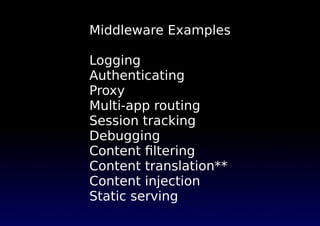
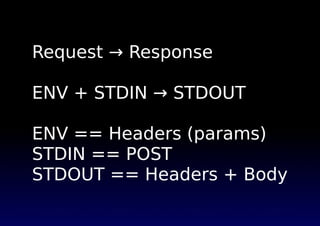
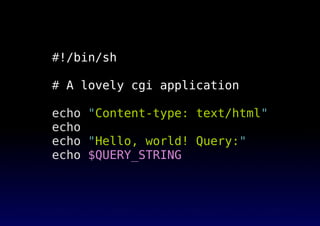
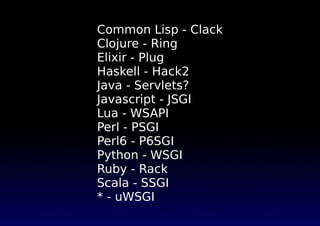
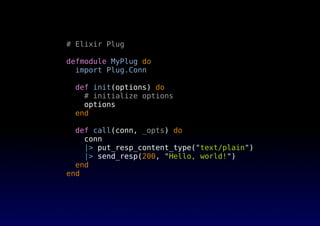
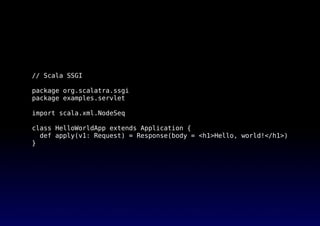
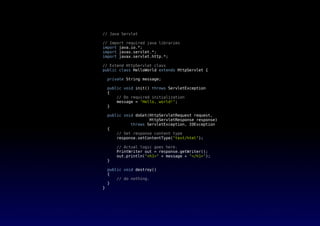
The document discusses the evolution of web application frameworks from CGI scripts to modern frameworks that provide a common interface between web applications and web servers. It provides examples of how "Hello World" applications look in various web application frameworks like Ruby on Rails, Django, and others. It also covers middleware and how middleware can modify requests and responses without changing the application code.






![func app(request) → response
response = [ status, headers, body ]](https://image.slidesharecdn.com/2015-10-07ppdchttpadapters-160513034408/85/2015-10-07-PPDC-HTTP-Adapters-20-320.jpg)
![# Python WSGI
def application(environ, start_response):
start_response('200 OK', [('Content-Type', 'text/plain')])
yield 'Hello, world!'](https://image.slidesharecdn.com/2015-10-07ppdchttpadapters-160513034408/85/2015-10-07-PPDC-HTTP-Adapters-22-320.jpg)
![# Ruby Rack
app = lambda do |env|
[200, {"Content-Type" => "text/plain"}, ["Hello, world!"]]
end](https://image.slidesharecdn.com/2015-10-07ppdchttpadapters-160513034408/85/2015-10-07-PPDC-HTTP-Adapters-23-320.jpg)
![# Perl PSGI
my $app = sub {
my ($env) = @_;
return [200, ['Content-Type' => 'text/plain'], ["Hello, world!"]];
}](https://image.slidesharecdn.com/2015-10-07ppdchttpadapters-160513034408/85/2015-10-07-PPDC-HTTP-Adapters-24-320.jpg)
![// Javascript JSGI
require("jsgi-node").start(function(request){
return {
status:200,
headers:{},
body:["Hello, world!"]
};
});](https://image.slidesharecdn.com/2015-10-07ppdchttpadapters-160513034408/85/2015-10-07-PPDC-HTTP-Adapters-25-320.jpg)
![; Clojure Ring
(ns hello-world.core)
(defn handler [request]
{:status 200
:headers {"Content-Type" "text/html"}
:body "Hello World"})](https://image.slidesharecdn.com/2015-10-07ppdchttpadapters-160513034408/85/2015-10-07-PPDC-HTTP-Adapters-27-320.jpg)
![# Perl6 P6SGI
sub app(%env) {
start {
200, [ Content-Type => 'text/plain' ], [ 'Hello World!' ]
}
}](https://image.slidesharecdn.com/2015-10-07ppdchttpadapters-160513034408/85/2015-10-07-PPDC-HTTP-Adapters-28-320.jpg)
![Lua WSAPI
function hello(wsapi_env)
local headers = { ["Content-type"] = "text/html" }
local function hello_text()
coroutine.yield("Hello, world!")
end
return 200, headers, coroutine.wrap(hello_text)
end](https://image.slidesharecdn.com/2015-10-07ppdchttpadapters-160513034408/85/2015-10-07-PPDC-HTTP-Adapters-30-320.jpg)
![{-# Haskell #-}
{-# LANGUAGE OverloadedStrings #-}
import Hack2
import Hack2.Contrib.Response (set_body_bytestring)
import Hack2.Handler.SnapServer
app :: Application
app = env ->
return $
Response
200 [ ("Content-Type", "text/plain") ] "Hello, world!"
main = run app](https://image.slidesharecdn.com/2015-10-07ppdchttpadapters-160513034408/85/2015-10-07-PPDC-HTTP-Adapters-32-320.jpg)
![Streaming
response = [status, headers, callback]
Keep invoking callback until done](https://image.slidesharecdn.com/2015-10-07ppdchttpadapters-160513034408/85/2015-10-07-PPDC-HTTP-Adapters-33-320.jpg)
![Streaming
response = [status, headers, promise]
Wait for promise results, maybe chained](https://image.slidesharecdn.com/2015-10-07ppdchttpadapters-160513034408/85/2015-10-07-PPDC-HTTP-Adapters-34-320.jpg)

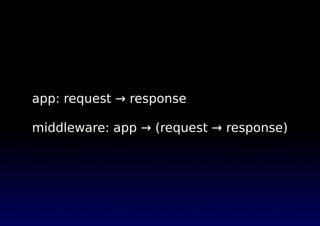
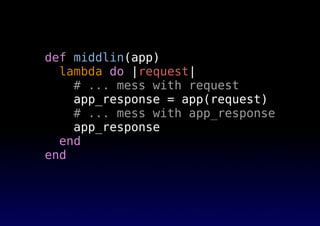
![def log_middleware(app)
lambda do |request|
File.open("middleware.log", "w+") do |f|
f.puts request
end
app_response = app(request)
app_response
end
end
app = lambda do |env|
[200, {"Content-Type" => "text/plain"}, ["Hello, world!"]]
end
new_app = log_middleware(app)](https://image.slidesharecdn.com/2015-10-07ppdchttpadapters-160513034408/85/2015-10-07-PPDC-HTTP-Adapters-39-320.jpg)