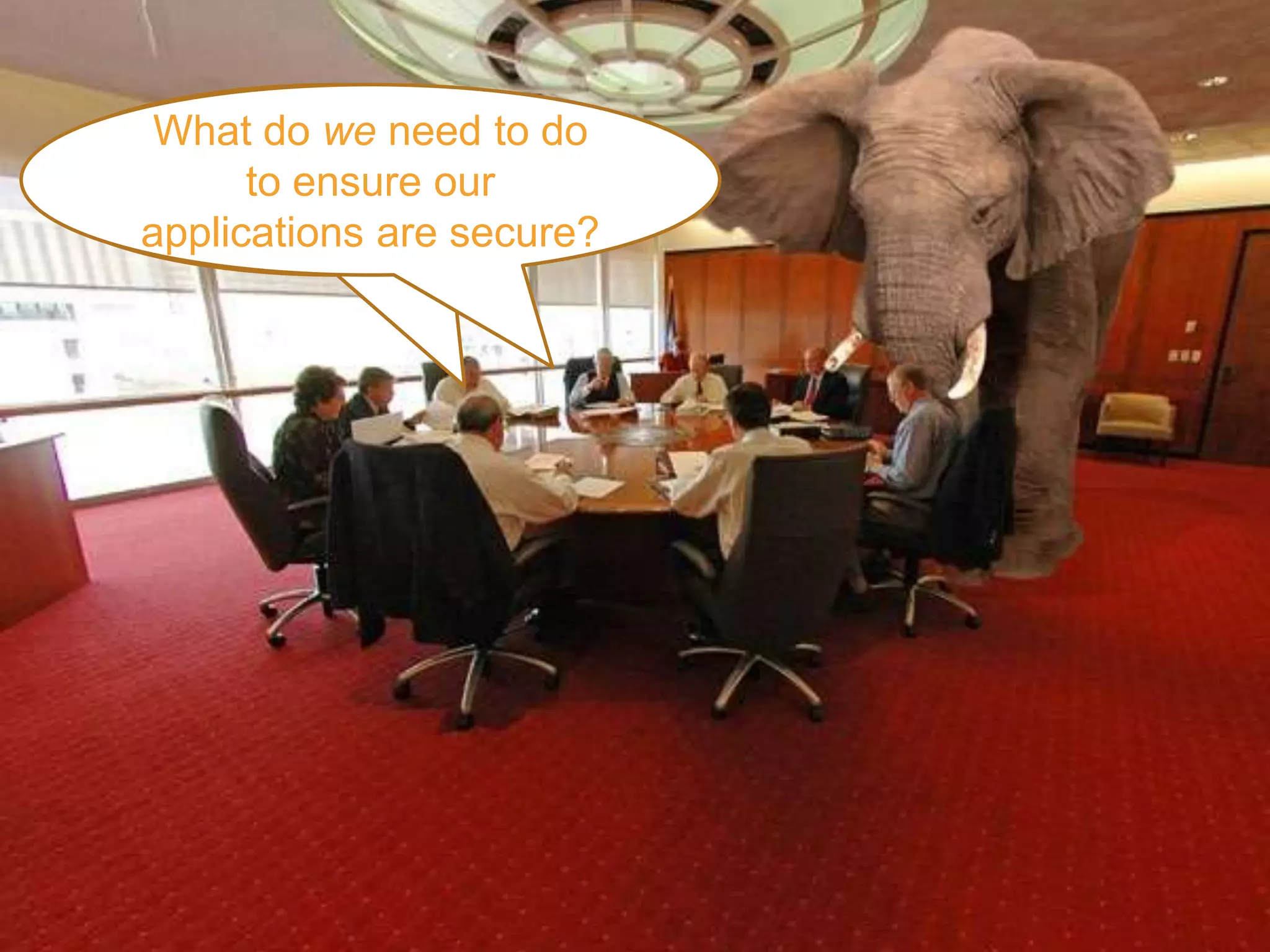
Does AWS meet our do
 What do we need to
      to ensure our
       security
applications are secure?
   requirements?
Security & Compliance Overview
                    Miles Ward | Solutions Architect


      Watch the video of this presentation
Overview

•   Key Security Concepts
•   Certifications
•   Security Features
•   Guidance
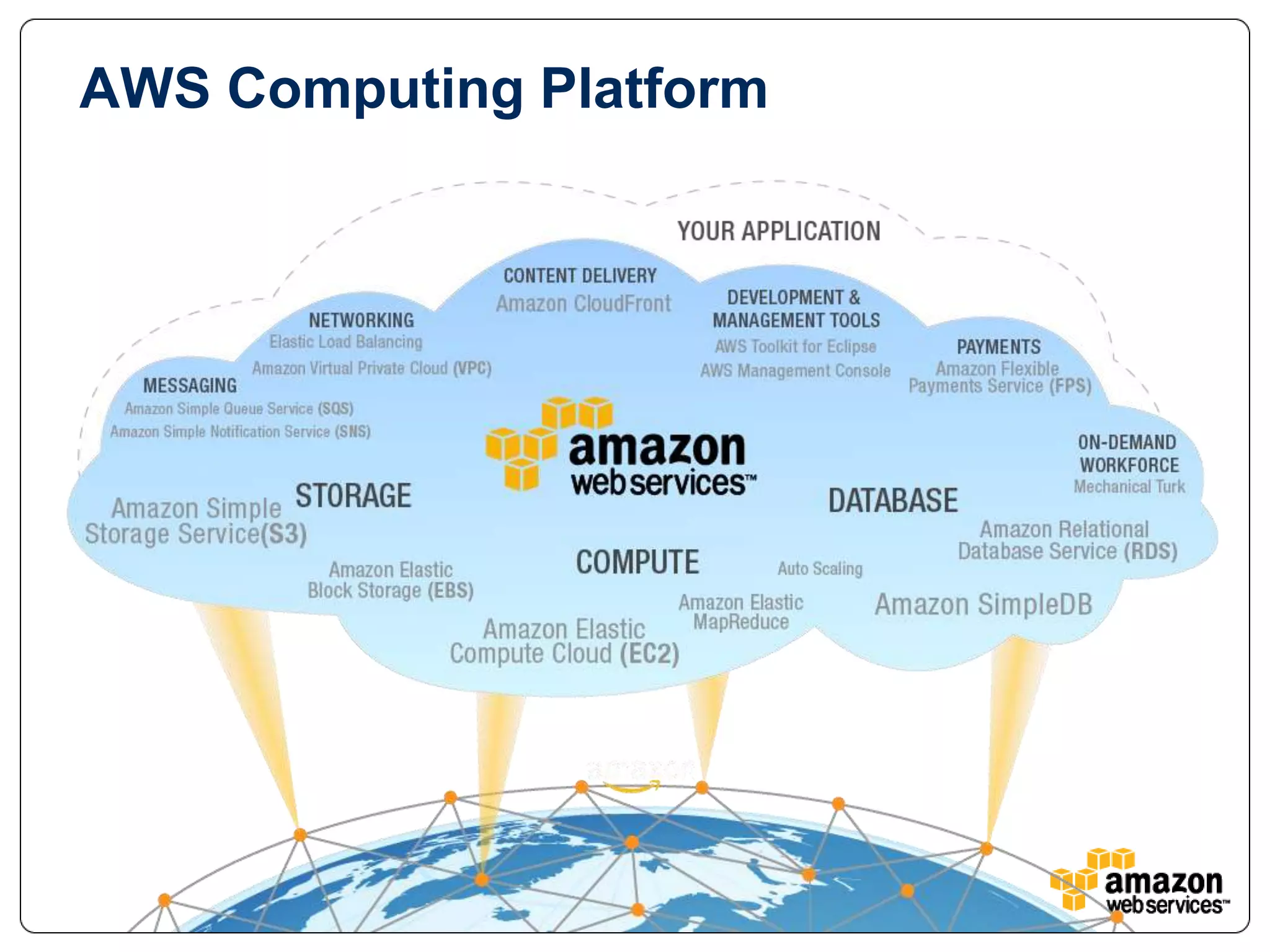
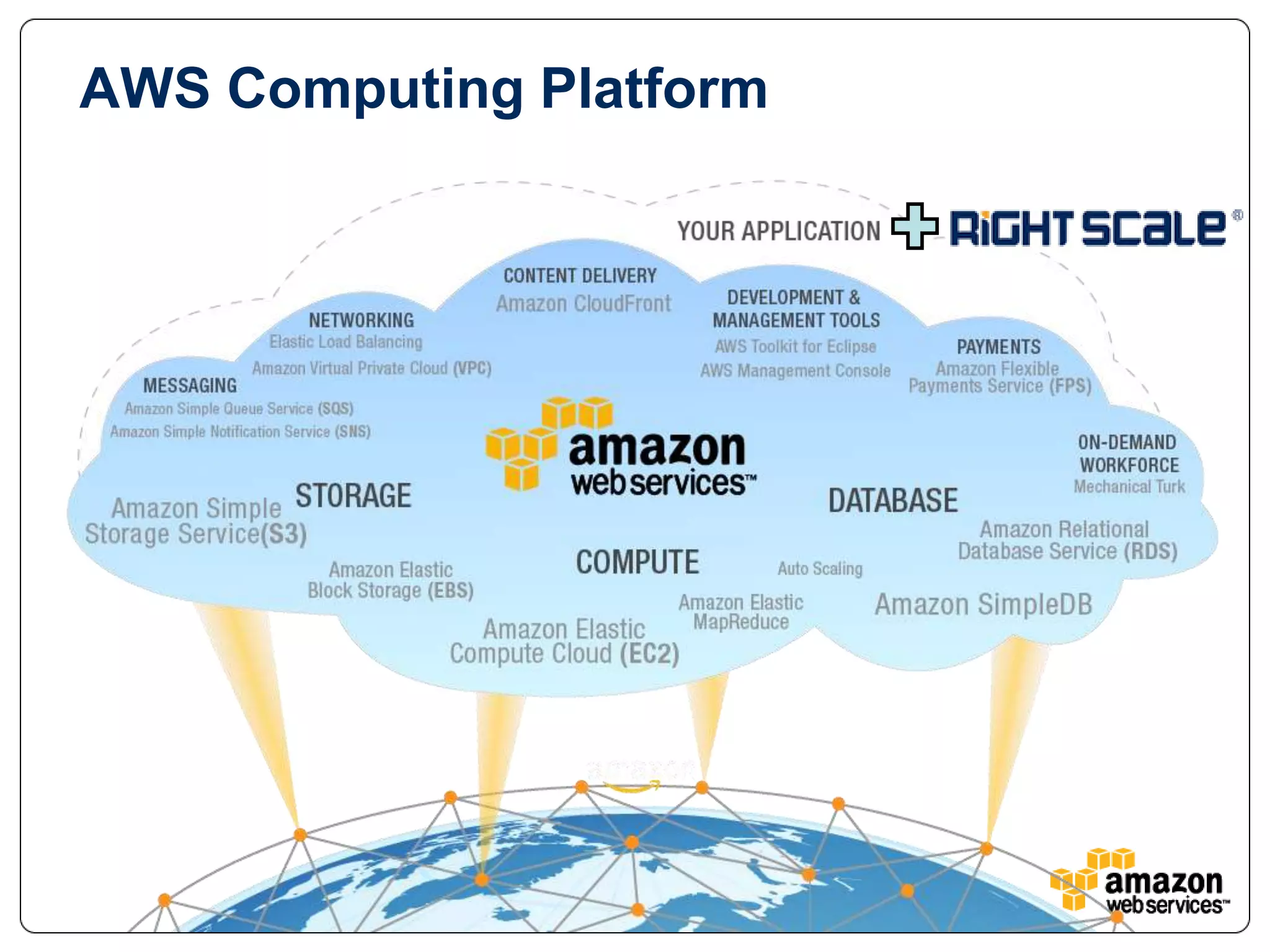
AWS Computing Platform
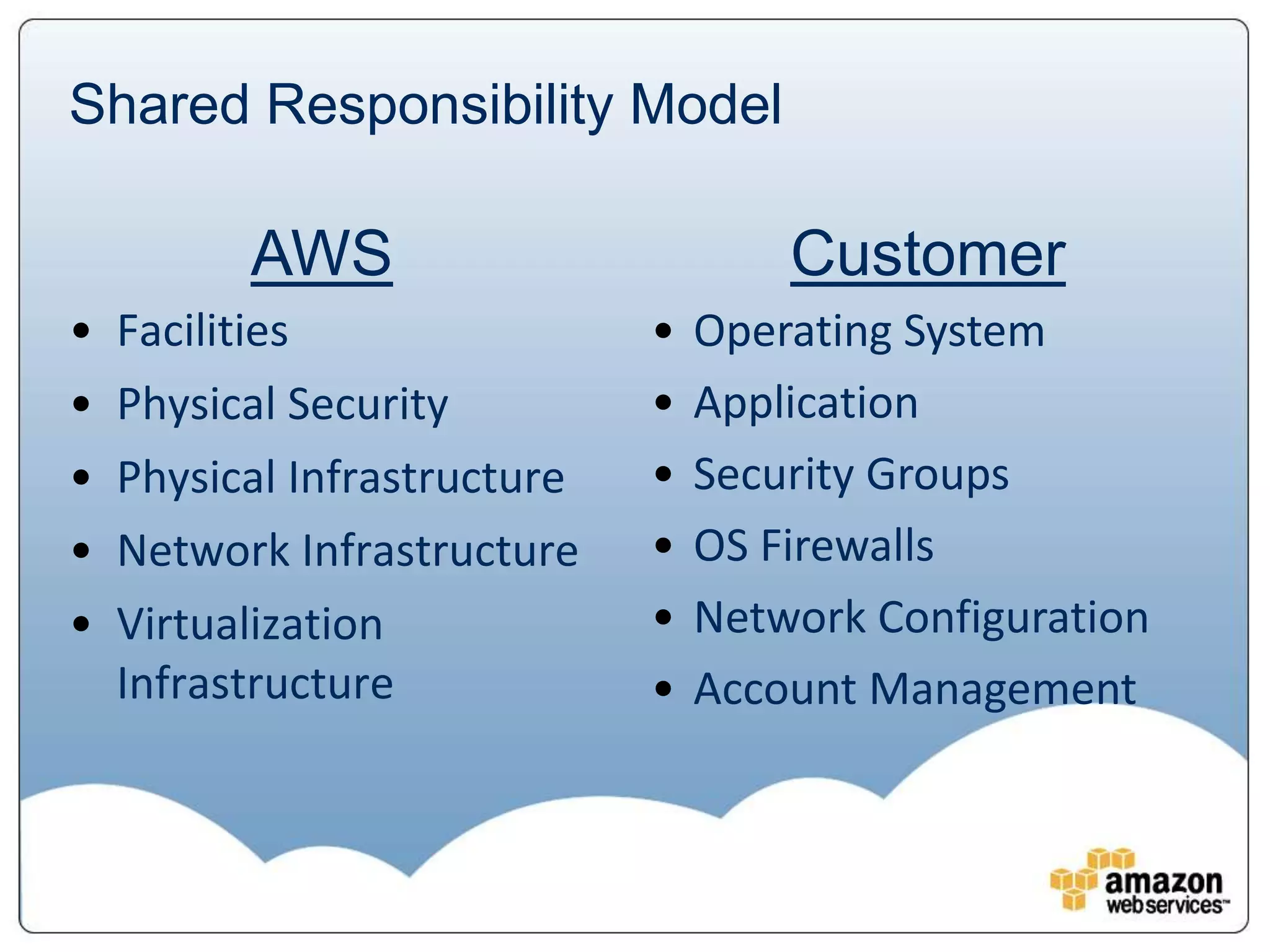
Shared Responsibility Model

          AWS                         Customer
•   Facilities                •   Operating System
•   Physical Security         •   Application
•   Physical Infrastructure   •   Security Groups
•   Network Infrastructure    •   OS Firewalls
•   Virtualization            •   Network Configuration
    Infrastructure            •   Account Management
Who says?
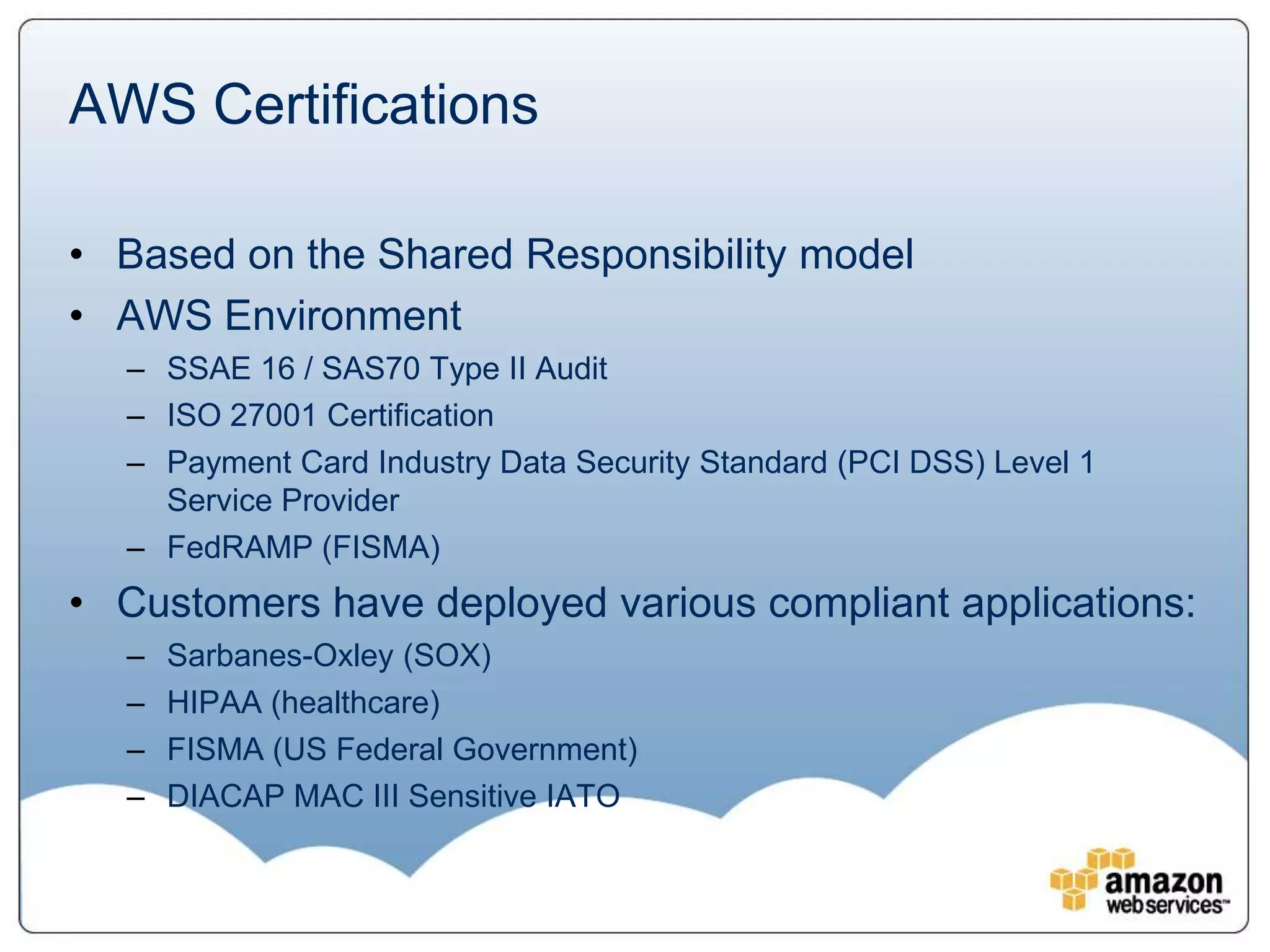
AWS Certifications

• Based on the Shared Responsibility model
• AWS Environment
  – SSAE 16 / SAS70 Type II Audit
  – ISO 27001 Certification
  – Payment Card Industry Data Security Standard (PCI DSS) Level 1
    Service Provider
  – FedRAMP (FISMA)
• Customers have deployed various compliant applications:
  –   Sarbanes-Oxley (SOX)
  –   HIPAA (healthcare)
  –   FISMA (US Federal Government)
  –   DIACAP MAC III Sensitive IATO
SSAE 16 – ISAE 3402
(used to be SAS70 Type II)
•   Covers Access, Change Management and Operations of EC2 and S3
    –   Control Objective 1: Security Organization
    –   Control Objective 2: Amazon Employee Lifecycle
    –   Control Objective 3: Logical Security
    –   Control Objective 4: Secure Data Handling
    –   Control Objective 5: Physical Security
    –   Control Objective 6: Environmental Safeguards
    –   Control Objective 7: Change Management
    –   Control Objective 8: Data Integrity, Availability and Redundancy
    –   Control Objective 9: Incident Handling

•   Includes all Regions
•   Audited by an independent accounting firm and updated every 6 months
•   SAS70 report available under NDA
•   Have just converted to Statement on Standards for Attestation Engagements
    (SSAE) 16 format (equivalent to the International Standard on Assurance
    Engagements [ISAE] 3402)
ISO 27001 Certification

• ISO 27001/27002 certification achieved 11/2010
• Follows ISO 27002 best practice guidance
• Covers the AWS Information Security Management
  System (ISMS)
• Covers EC2, S3, and VPC
• Includes all Regions
• ISO certifying agent: EY CertifyPoint
PCI DSS Level 1 Service Provider

• PCI DSS 2.0 compliant
• Covers core infrastructure & services
   – EC2, EBS, S3, VPC
• Use normally, no special configuration
• Leverage the work of our QSA
• AWS will work with merchants and designated Qualified
  Incident Response Assessors (QIRA)
   – can support forensic investigations
• Certified in all regions
How did AWS do that?
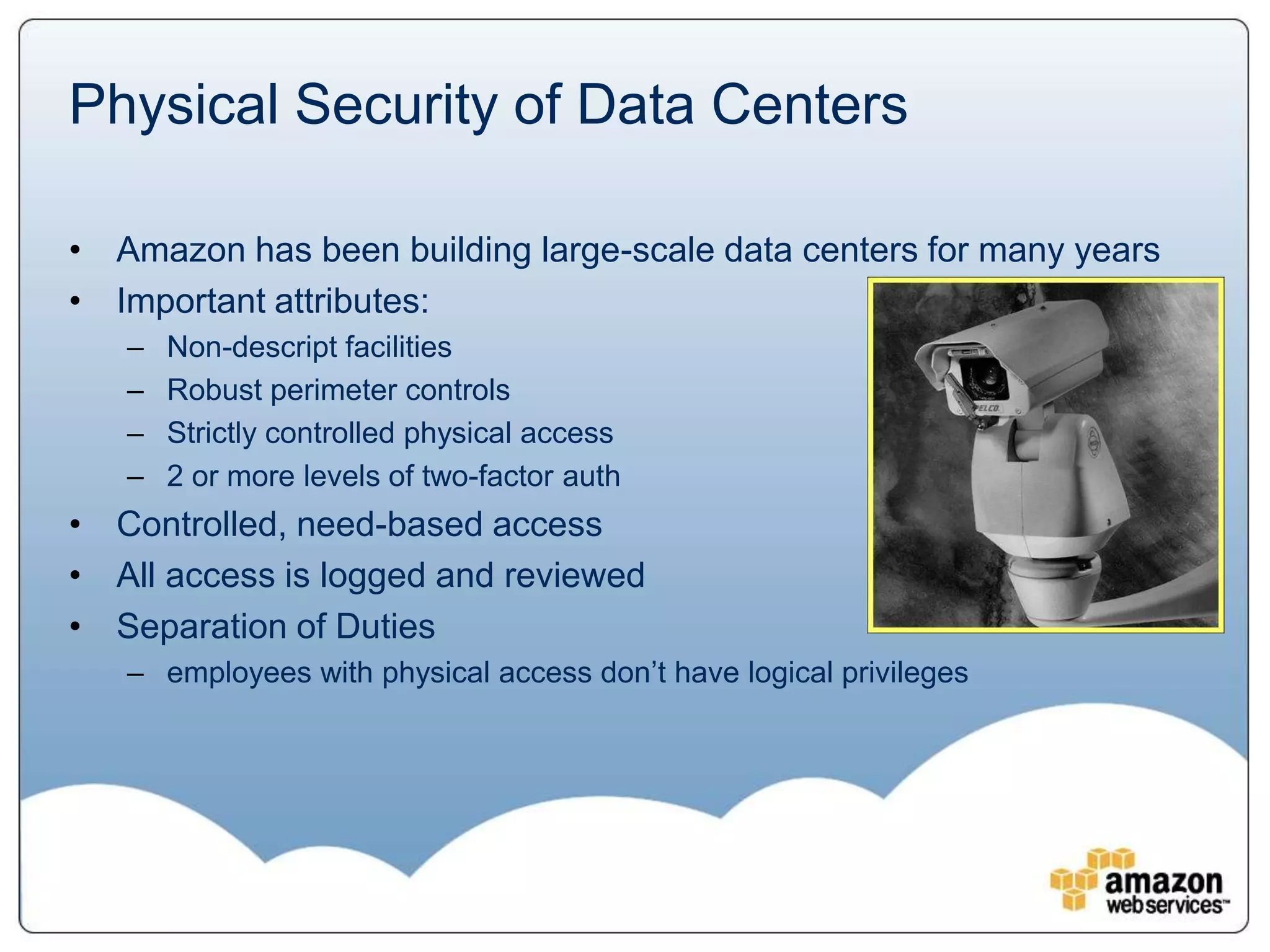
Physical Security of Data Centers

• Amazon has been building large-scale data centers for many years
• Important attributes:
   –   Non-descript facilities
   –   Robust perimeter controls
   –   Strictly controlled physical access
   –   2 or more levels of two-factor auth
• Controlled, need-based access
• All access is logged and reviewed
• Separation of Duties
   – employees with physical access don’t have logical privileges
AWS Configuration Management

• Most updates are done in such a manner that they will
  not impact the customer
• Changes are authorized, logged, tested, approved, and
  documented
• AWS will communicate with customers, either via
  email, or through the AWS Service Health Dashboard
  (http://status.aws.amazon.com/) when there is a chance
  they may be affected


Customers are responsible for change control in their Instances!
EC2 Security

•   Host operating system
    – Individual SSH keyed logins via bastion host for AWS admins
    – All accesses logged and audited
•   Guest (a.k.a. Instance) operating system
    – Customer controlled (customer owns root/admin)
    – AWS admins cannot log in
    – Customer-generated keypairs
•   Stateful firewall
    – Mandatory inbound firewall, default deny mode
    – Customer controls configuration via Security Groups
•   Signed API calls
    – Require X.509 certificate or customer’s secret AWS key
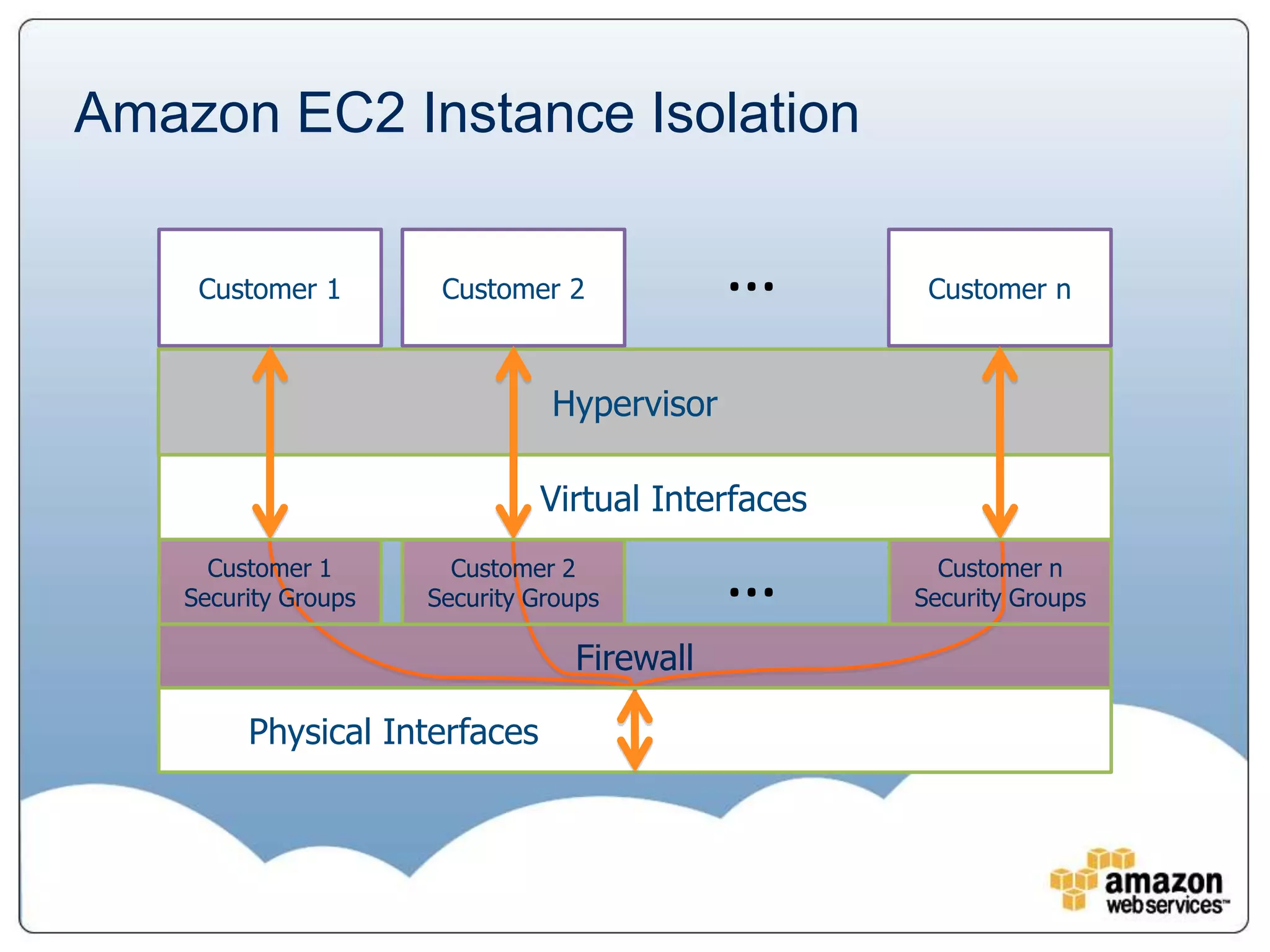
Amazon EC2 Instance Isolation

     Customer 1        Customer 2            …       Customer n


                                Hypervisor

                               Virtual Interfaces
      Customer 1
    Security Groups
                        Customer 2
                      Security Groups        …        Customer n
                                                    Security Groups

                                  Firewall

         Physical Interfaces
Storage Device Decommissioning

• All storage devices go through process
• Uses techniques from
  – DoD 5220.22-M (“National Industrial Security
    Program Operating Manual “)
  – NIST 800-88 (“Guidelines for Media Sanitization”)
• Ultimately
  – degaussed
  – physically destroyed
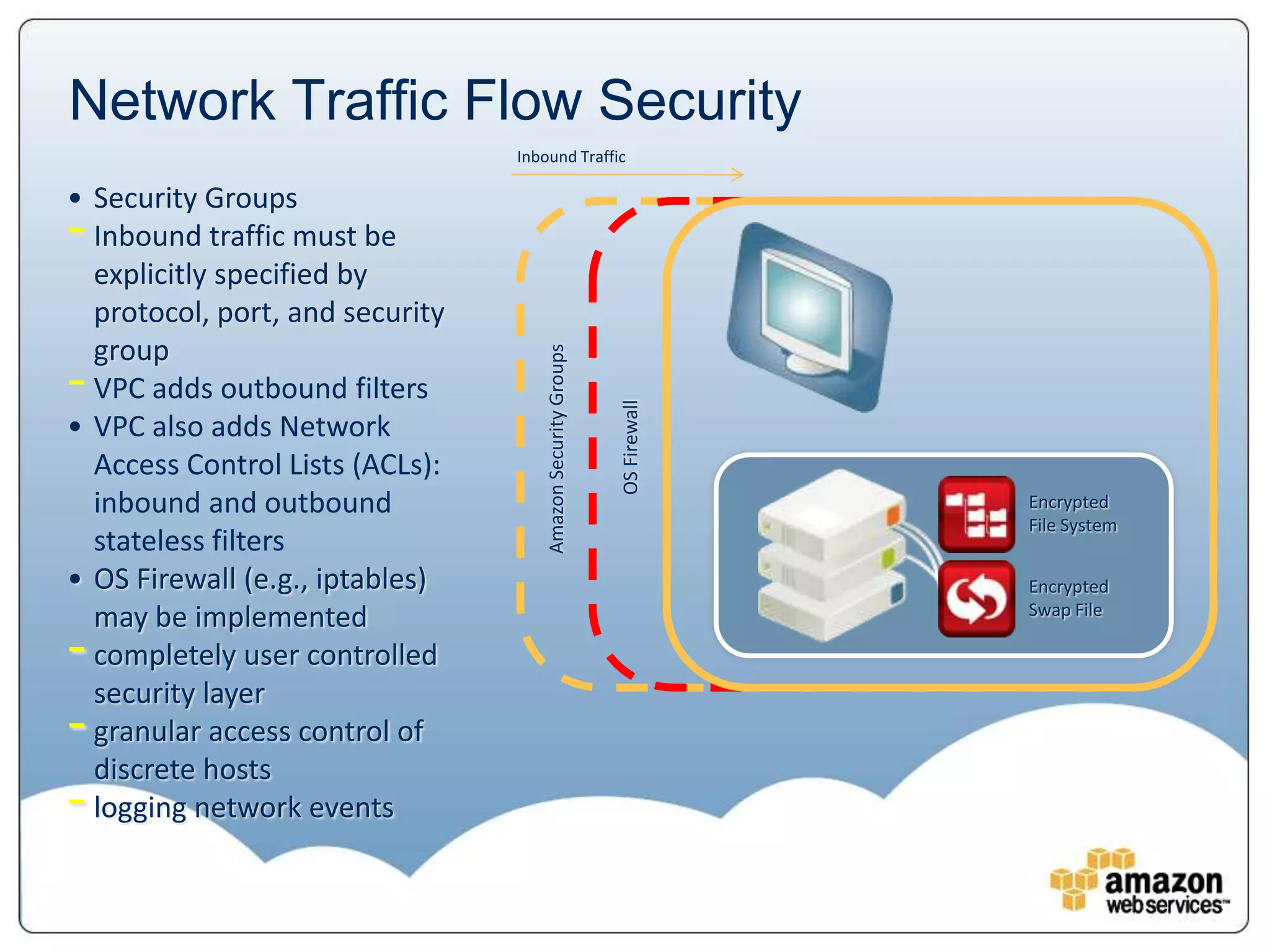
Network Traffic Flow Security
                                 Inbound Traffic

• Security Groups
- Inbound traffic must be
  explicitly specified by
  protocol, port, and security
  group


                                     Amazon Security Groups
- VPC adds outbound filters


                                                              OS Firewall
• VPC also adds Network
  Access Control Lists (ACLs):
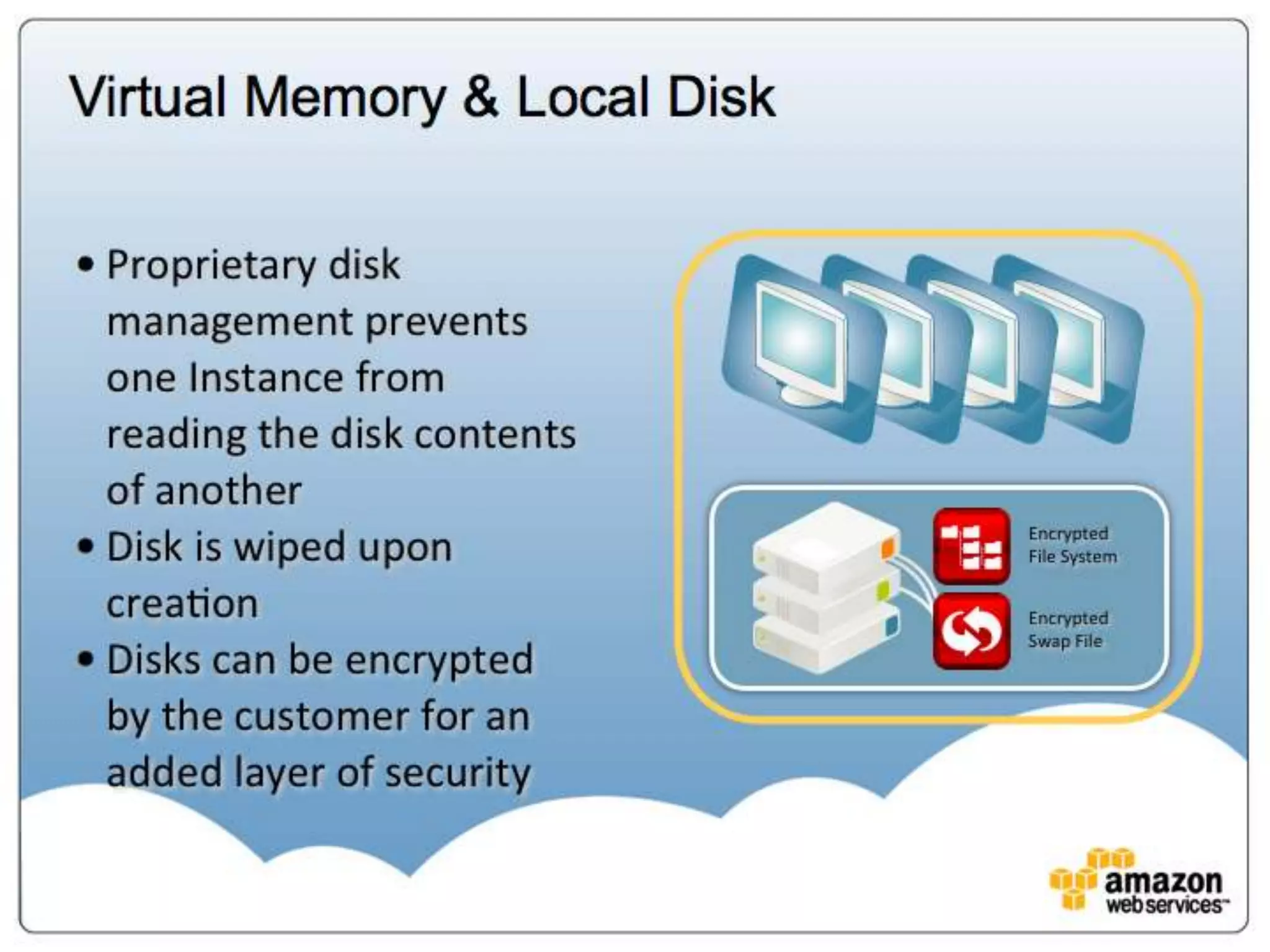
  inbound and outbound                                                      Encrypted
                                                                            File System
  stateless filters
• OS Firewall (e.g., iptables)                                              Encrypted
                                                                            Swap File
  may be implemented
- completely user controlled
  security layer
- granular access control of
  discrete hosts
- logging network events
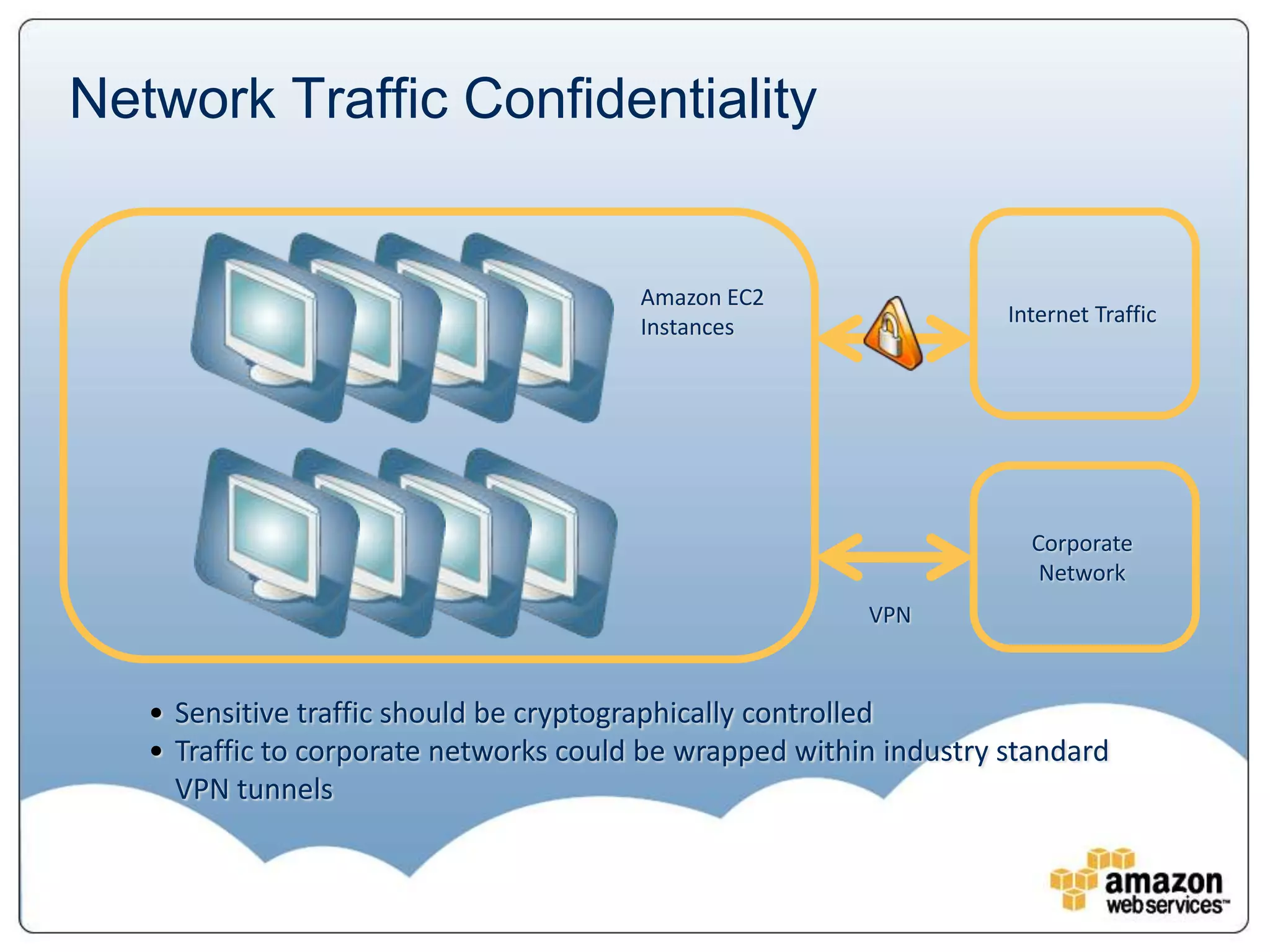
Network Traffic Confidentiality


                                        Amazon EC2
                                                                    Internet Traffic
                                        Instances


                                                                      Corporate
                                                                       Network
                                                         VPN


   • Sensitive traffic should be cryptographically controlled
   • Traffic to corporate networks could be wrapped within industry standard
     VPN tunnels
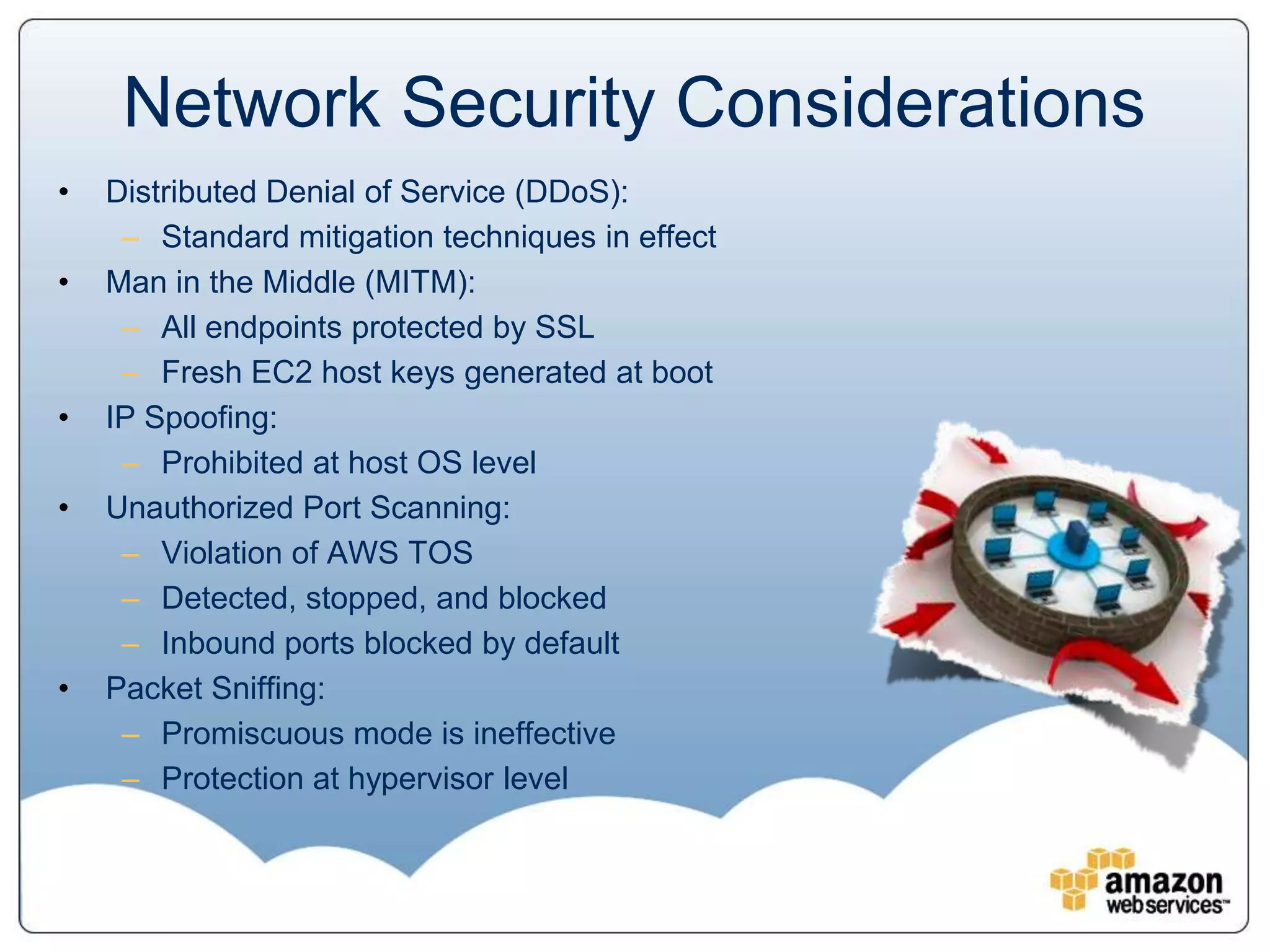
Network Security Considerations
•   Distributed Denial of Service (DDoS):
     – Standard mitigation techniques in effect
•   Man in the Middle (MITM):
     – All endpoints protected by SSL
     – Fresh EC2 host keys generated at boot
•   IP Spoofing:
     – Prohibited at host OS level
•   Unauthorized Port Scanning:
     – Violation of AWS TOS
     – Detected, stopped, and blocked
     – Inbound ports blocked by default
•   Packet Sniffing:
     – Promiscuous mode is ineffective
     – Protection at hypervisor level
How do I build secure?
AWS is Built for “Continuous Availability”

• Scalable, fault tolerant services
• All Datacenters (AZs) are always on
  – No “Disaster Recovery Datacenter”
  – Managed to the same standards
• Robust Internet connectivity
  – Each AZ has redundant, Tier 1 ISP Service Providers
  – Resilient network infrastructure
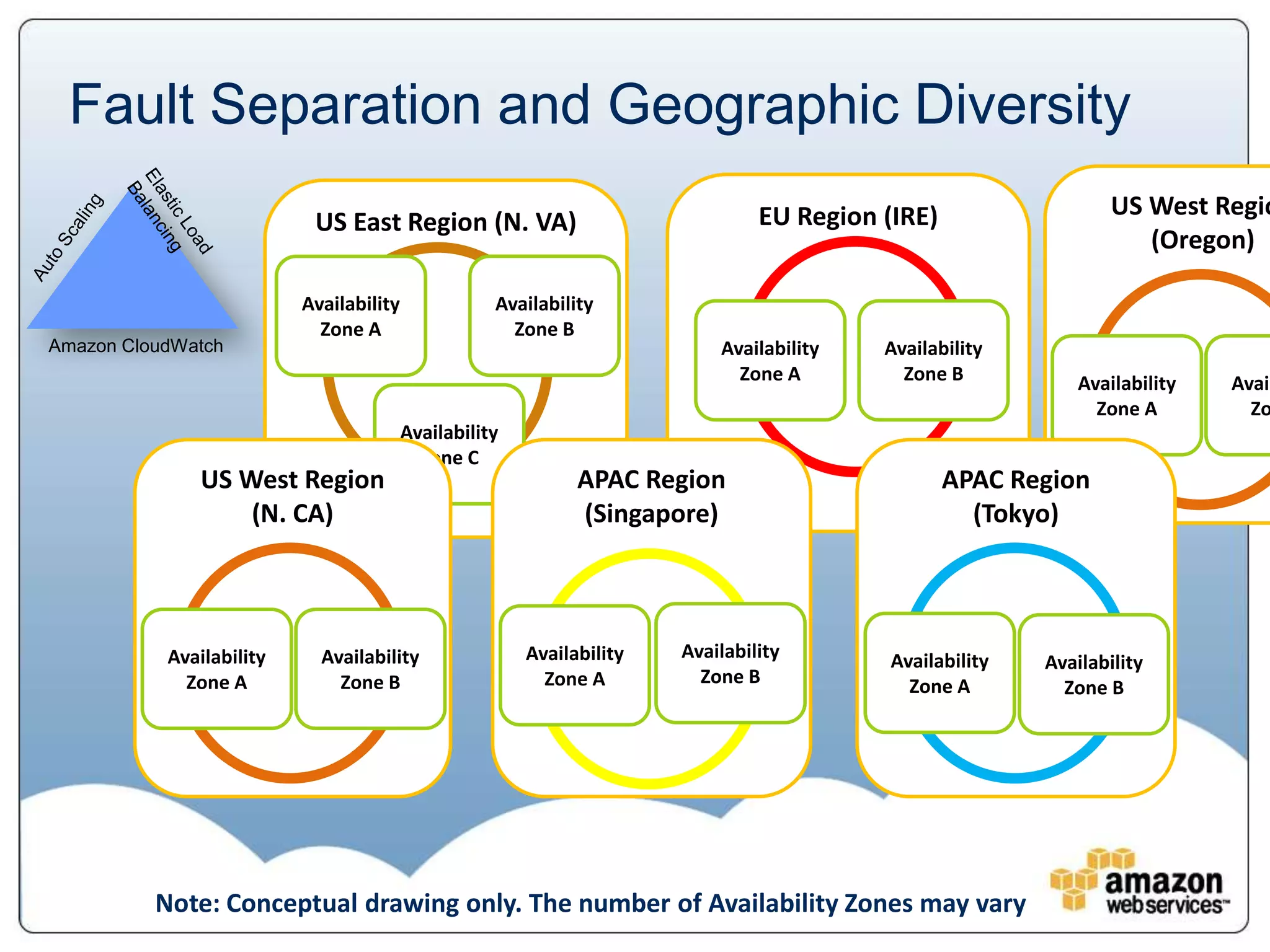
Fault Separation and Geographic Diversity
                                                                                EU Region (IRE)                   US West Regio
                           US East Region (N. VA)
                                                                                                                     (Oregon)

                          Availability              Availability
                            Zone A                    Zone B
Amazon CloudWatch                                                          Availability   Availability
                                                                             Zone A         Zone B            Availability   Avail
                                                                                                                Zone A         Zo
                                         Availability
                                           Zone C
               US West Region                                 APAC Region                         APAC Region
                   (N. CA)                                    (Singapore)                           (Tokyo)


           Availability     Availability                Availability   Availability        Availability   Availability
             Zone A           Zone B                      Zone A         Zone B              Zone A         Zone B


          Note: Conceptual drawing only. The number of Availability Zones may vary
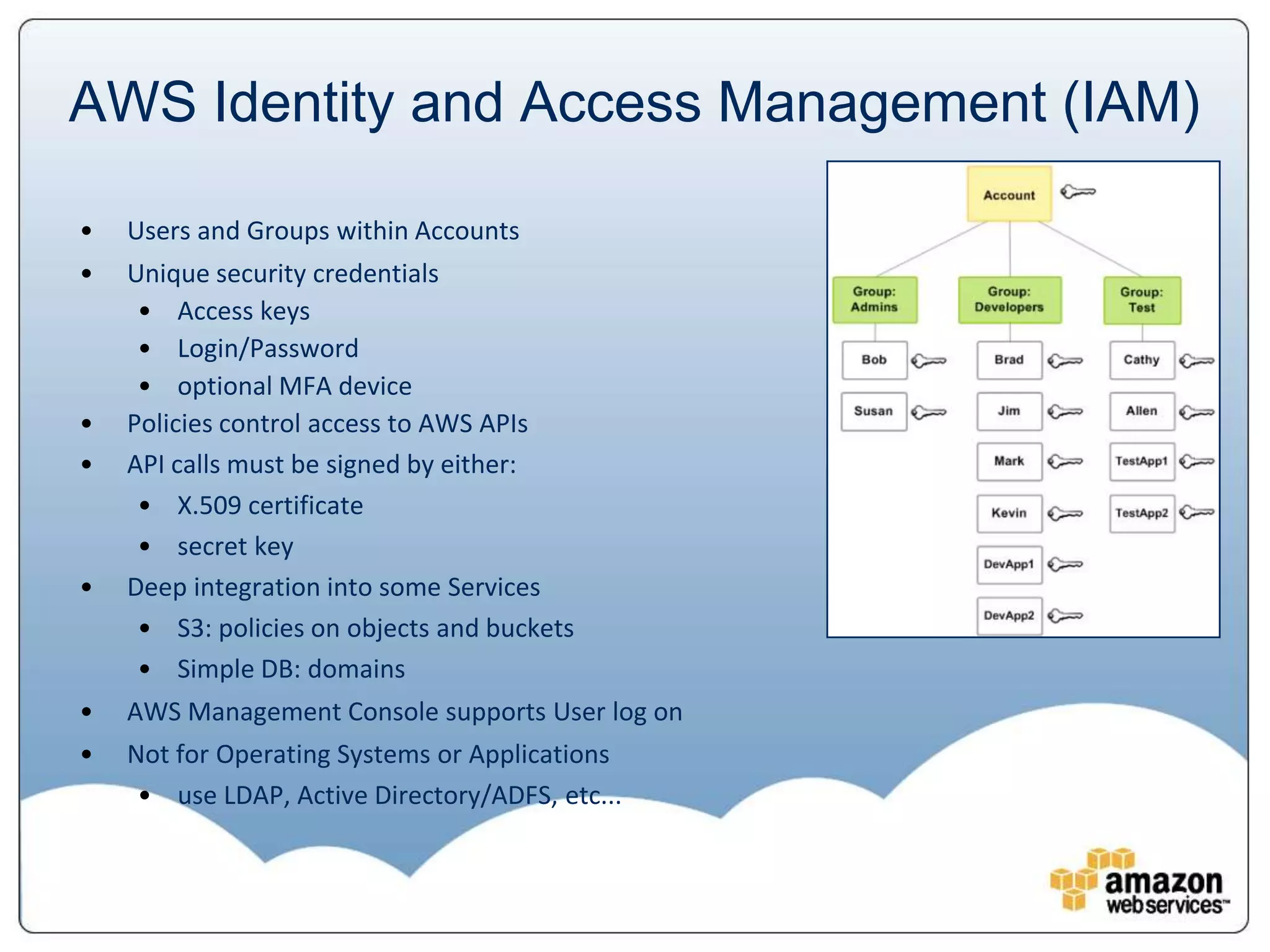
AWS Identity and Access Management (IAM)

•   Users and Groups within Accounts
•   Unique security credentials
     • Access keys
     • Login/Password
     • optional MFA device
•   Policies control access to AWS APIs
•   API calls must be signed by either:
     • X.509 certificate
     • secret key
•   Deep integration into some Services
     • S3: policies on objects and buckets
     • Simple DB: domains
•   AWS Management Console supports User log on
•   Not for Operating Systems or Applications
     • use LDAP, Active Directory/ADFS, etc...
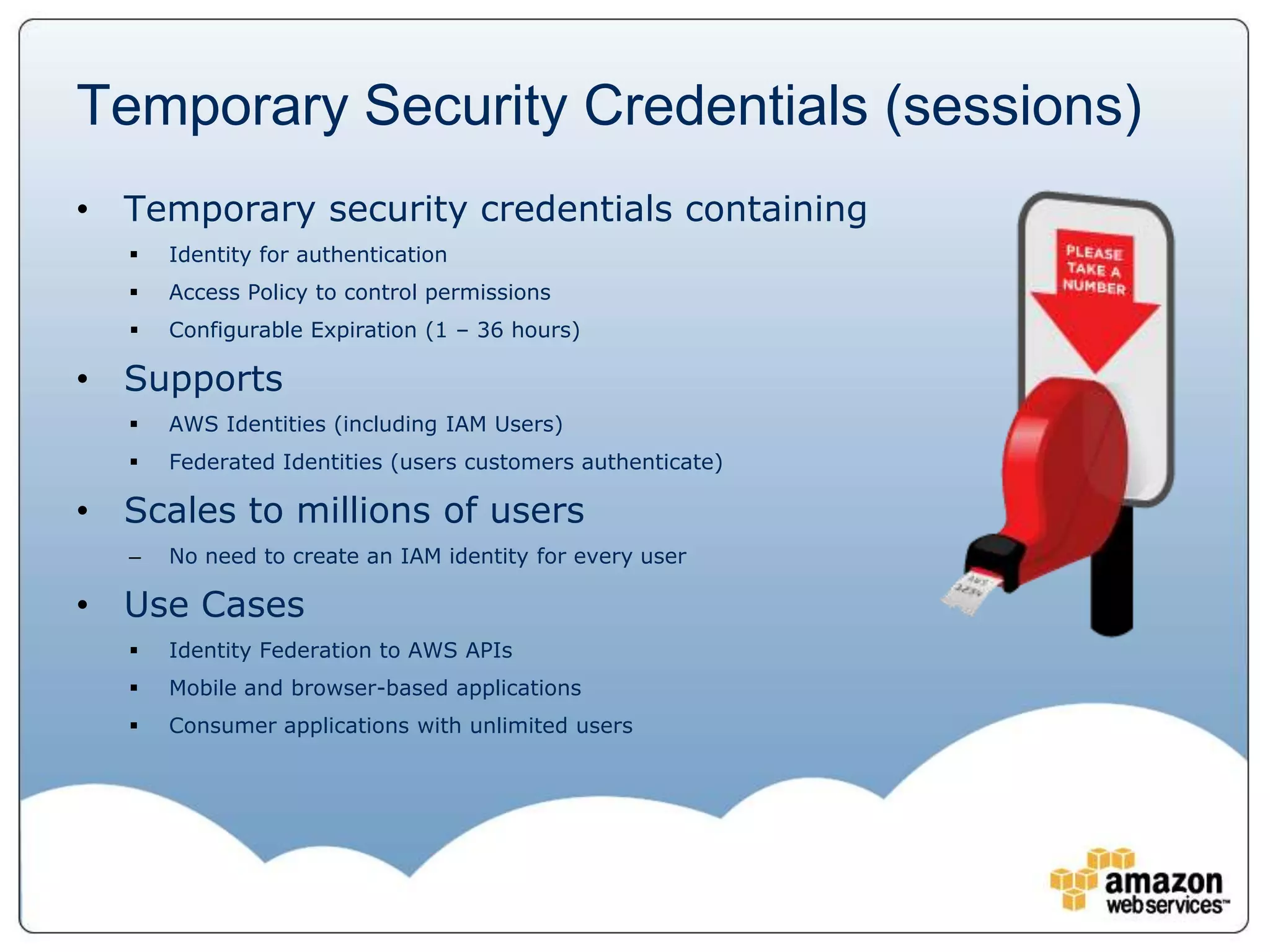
Temporary Security Credentials (sessions)
• Temporary security credentials containing
      Identity for authentication
      Access Policy to control permissions
      Configurable Expiration (1 – 36 hours)

• Supports
      AWS Identities (including IAM Users)
      Federated Identities (users customers authenticate)

• Scales to millions of users
   –   No need to create an IAM identity for every user

• Use Cases
      Identity Federation to AWS APIs
      Mobile and browser-based applications
      Consumer applications with unlimited users
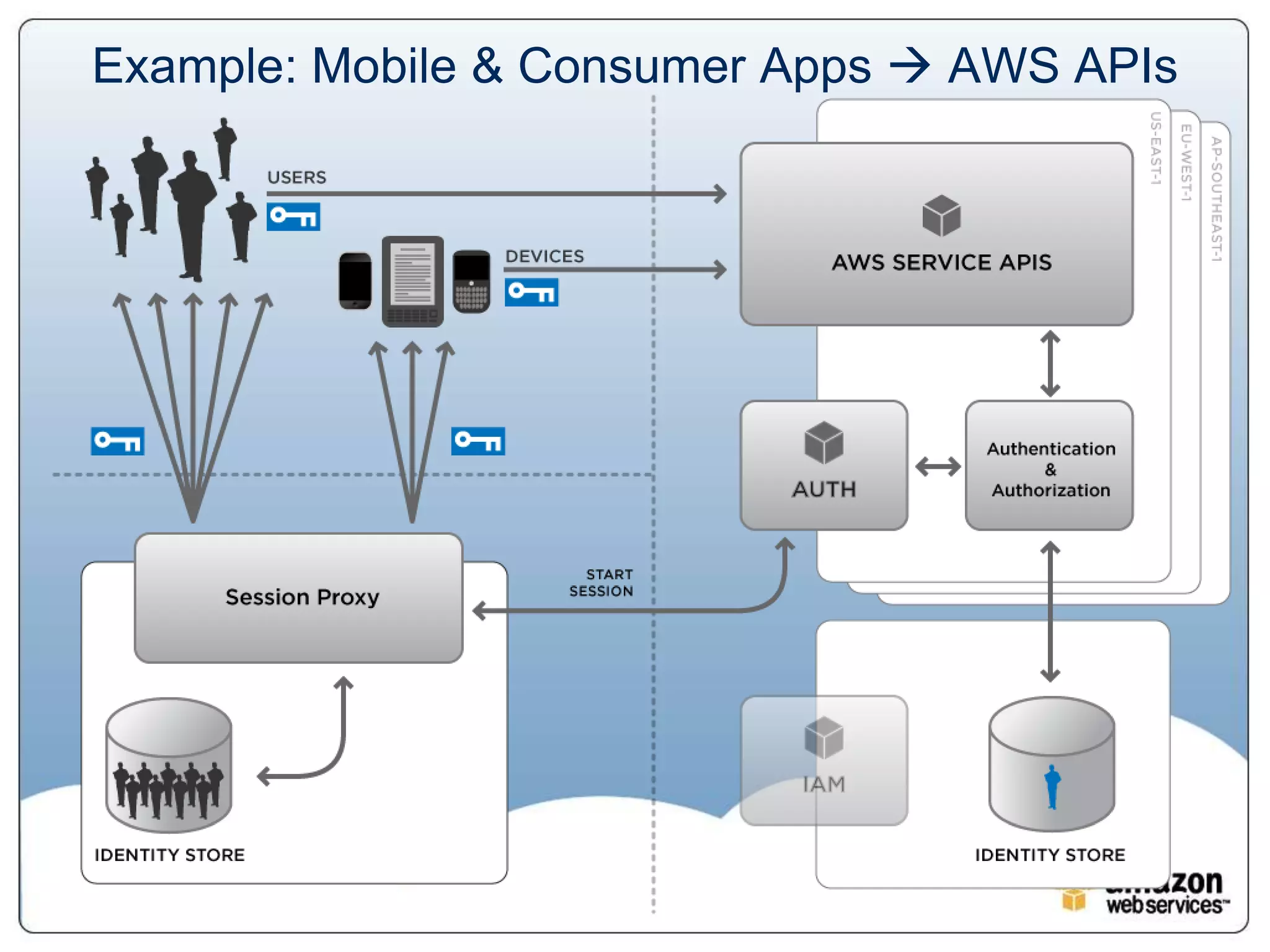
Example: Mobile & Consumer Apps  AWS APIs
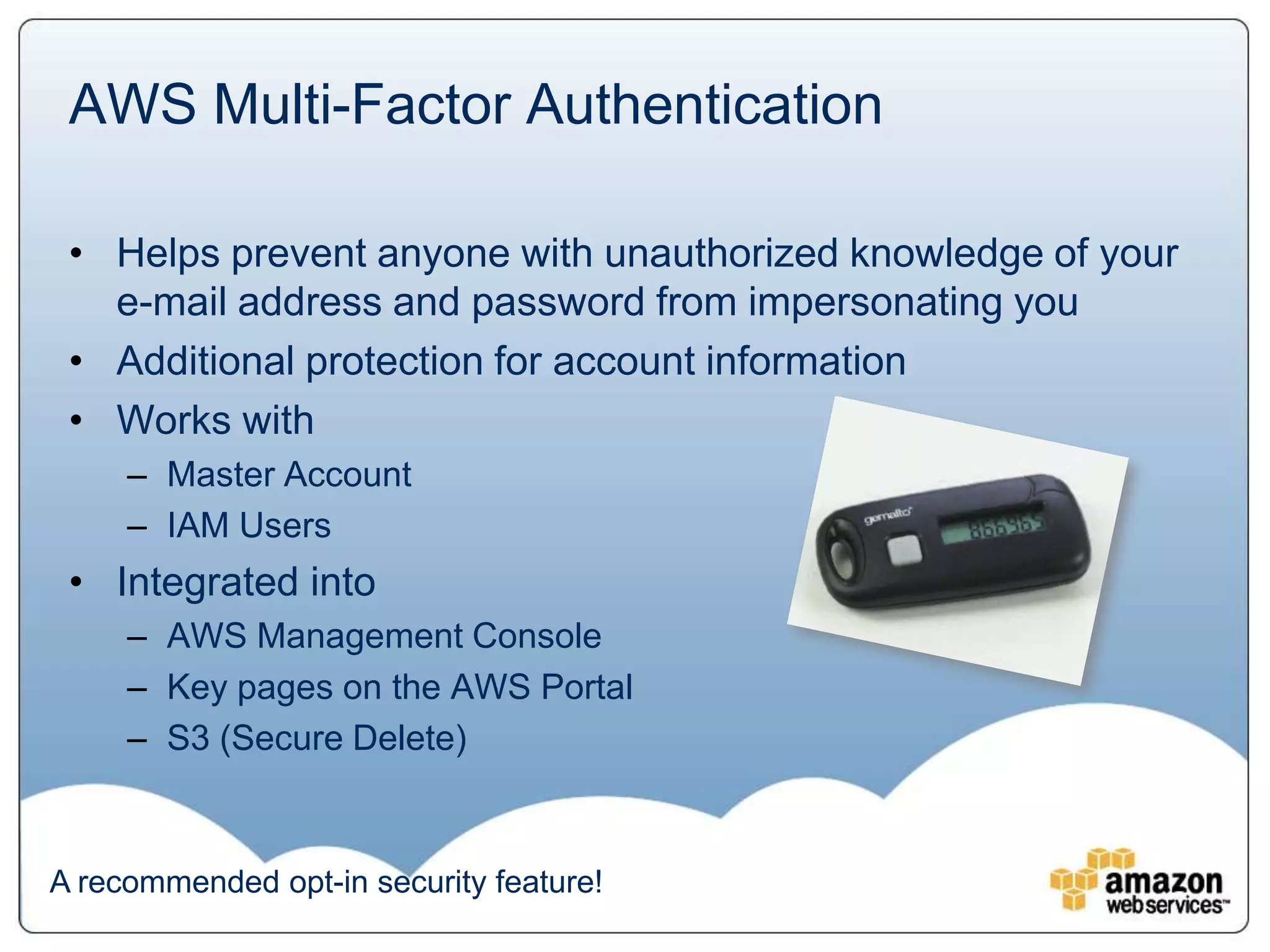
AWS Multi-Factor Authentication

 • Helps prevent anyone with unauthorized knowledge of your
   e-mail address and password from impersonating you
 • Additional protection for account information
 • Works with
     – Master Account
     – IAM Users
 • Integrated into
     – AWS Management Console
     – Key pages on the AWS Portal
     – S3 (Secure Delete)


A recommended opt-in security feature!
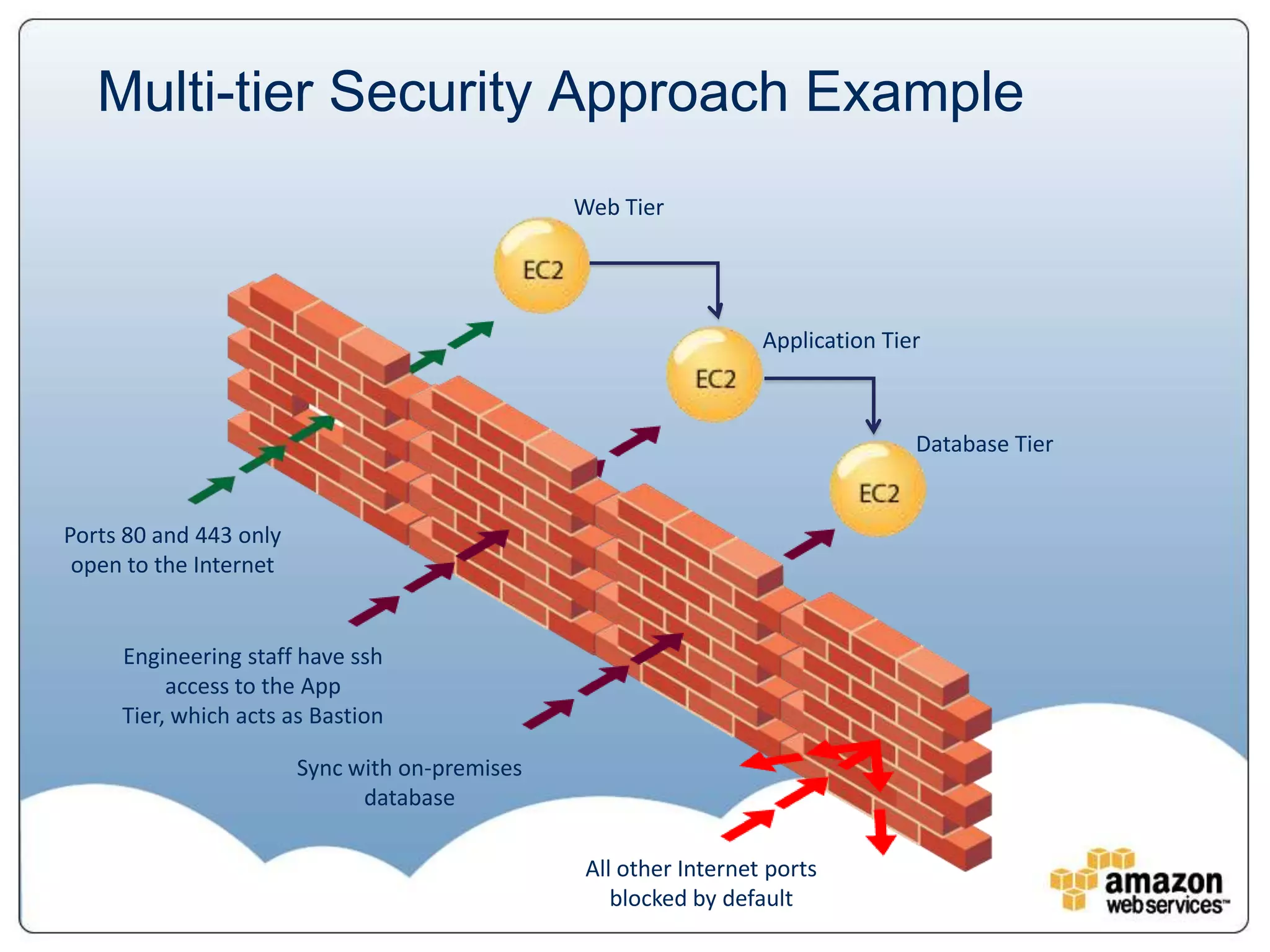
Multi-tier Security Approach Example
                                                Web Tier


                                                                   Application Tier


                                                                                  Database Tier


Ports 80 and 443 only
 open to the Internet


     Engineering staff have ssh
          access to the App
     Tier, which acts as Bastion

                        Sync with on-premises                                             Amazon EC2
                              database                                                    Security Group
                                                                                          Firewall
                                                 All other Internet ports
                                                    blocked by default
Amazon Virtual Private Cloud (VPC)

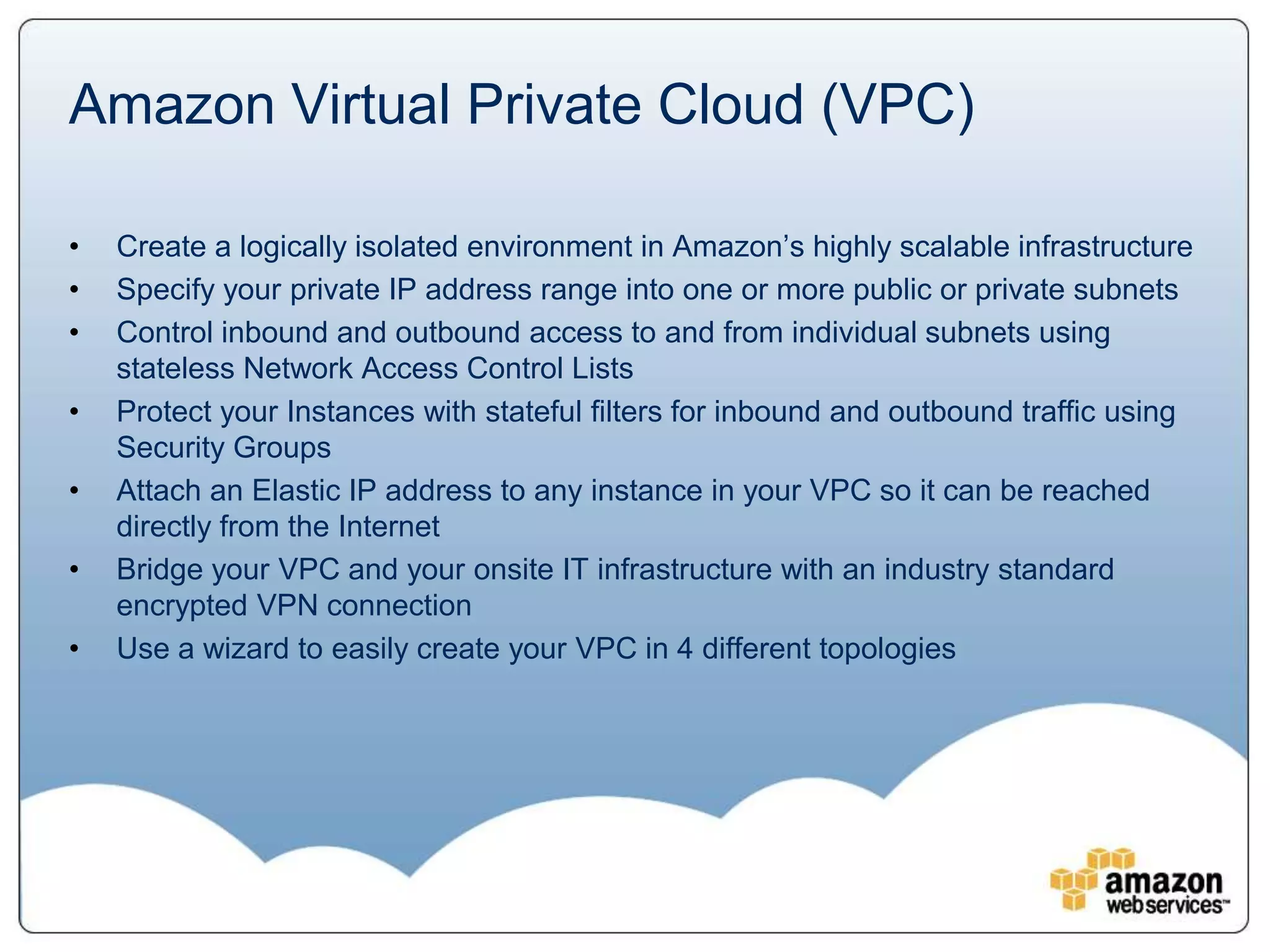
•   Create a logically isolated environment in Amazon’s highly scalable infrastructure
•   Specify your private IP address range into one or more public or private subnets
•   Control inbound and outbound access to and from individual subnets using
    stateless Network Access Control Lists
•   Protect your Instances with stateful filters for inbound and outbound traffic using
    Security Groups
•   Attach an Elastic IP address to any instance in your VPC so it can be reached
    directly from the Internet
•   Bridge your VPC and your onsite IT infrastructure with an industry standard
    encrypted VPN connection
•   Use a wizard to easily create your VPC in 4 different topologies
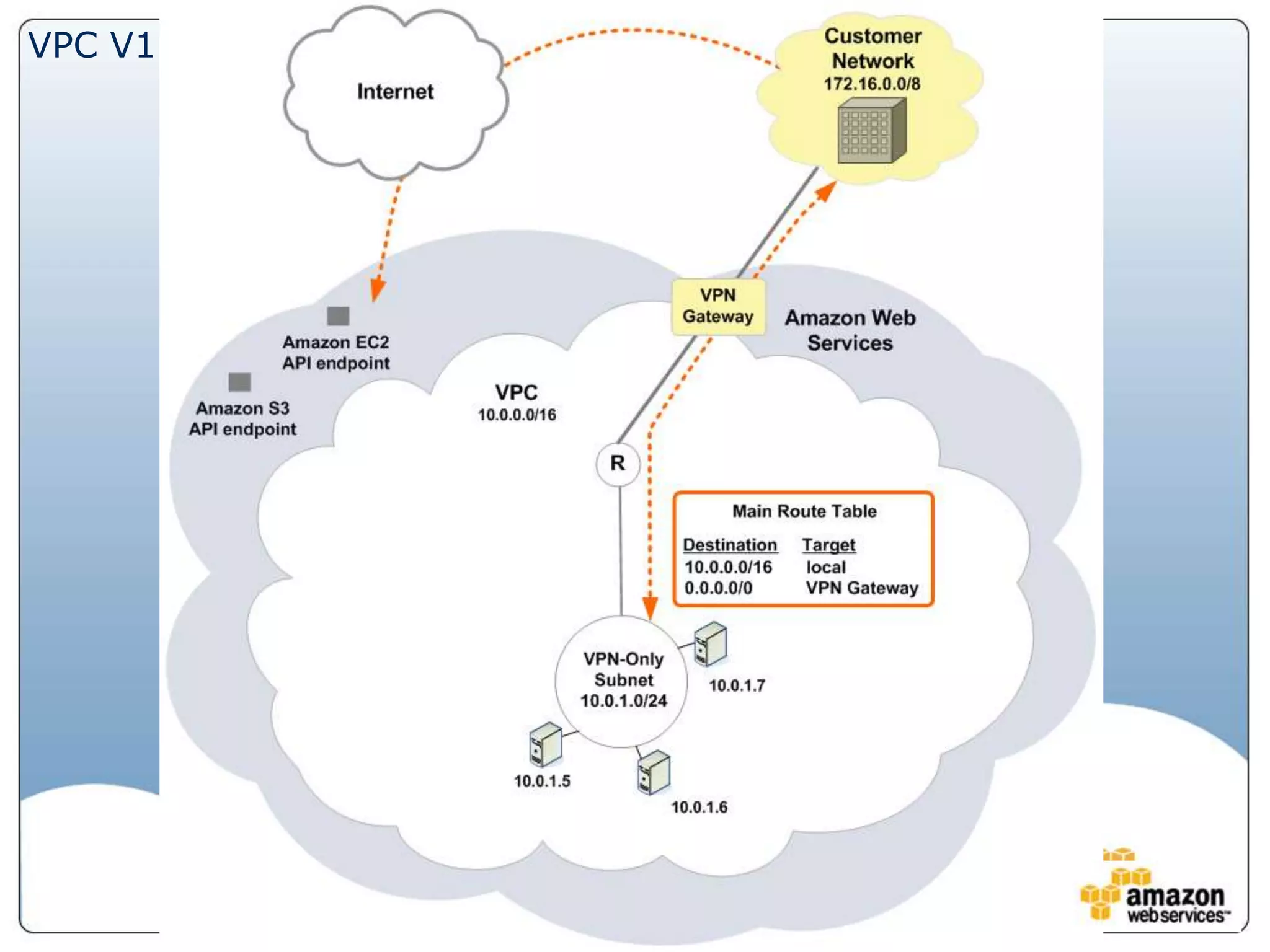
VPC V1
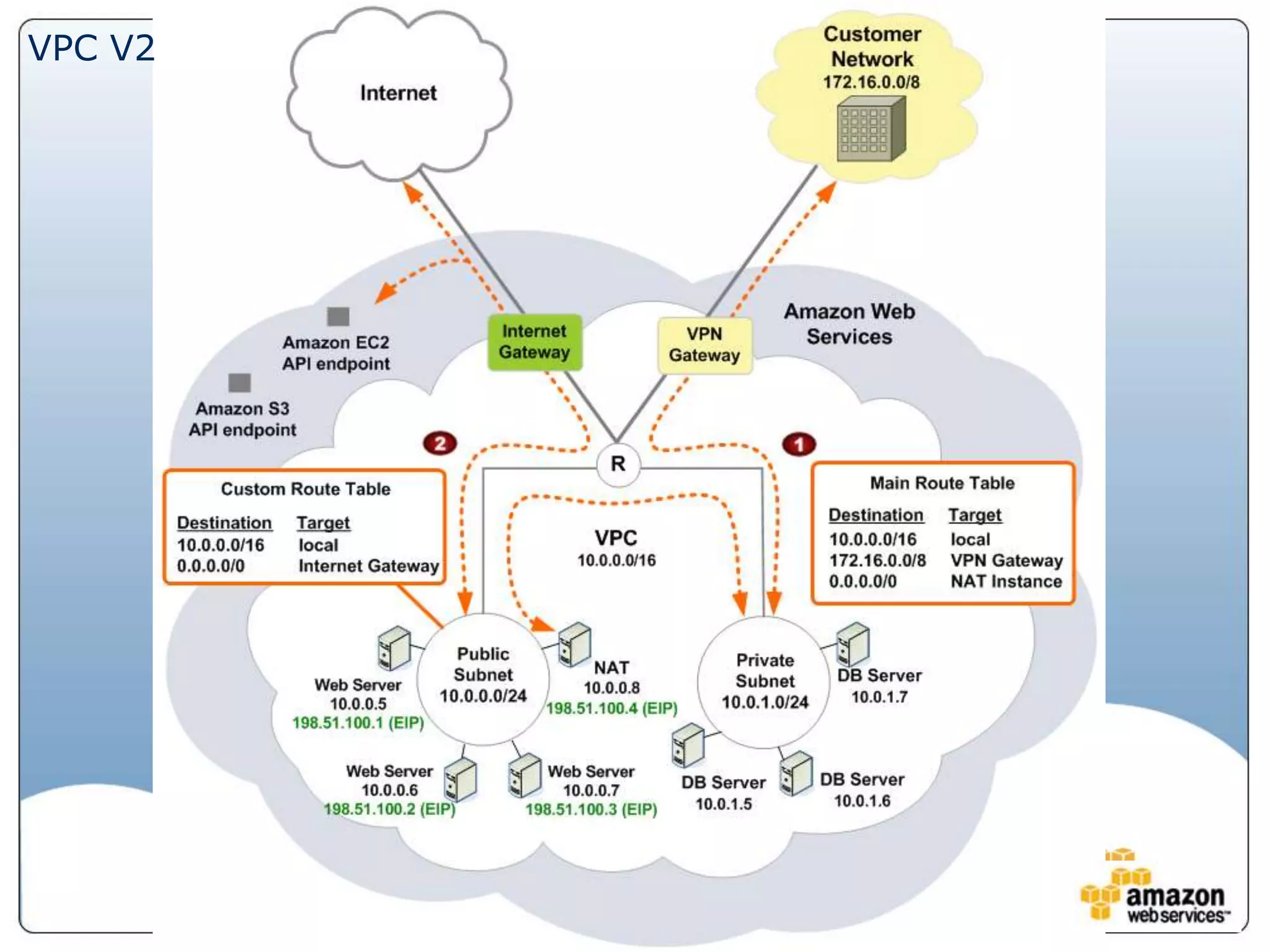
VPC V2
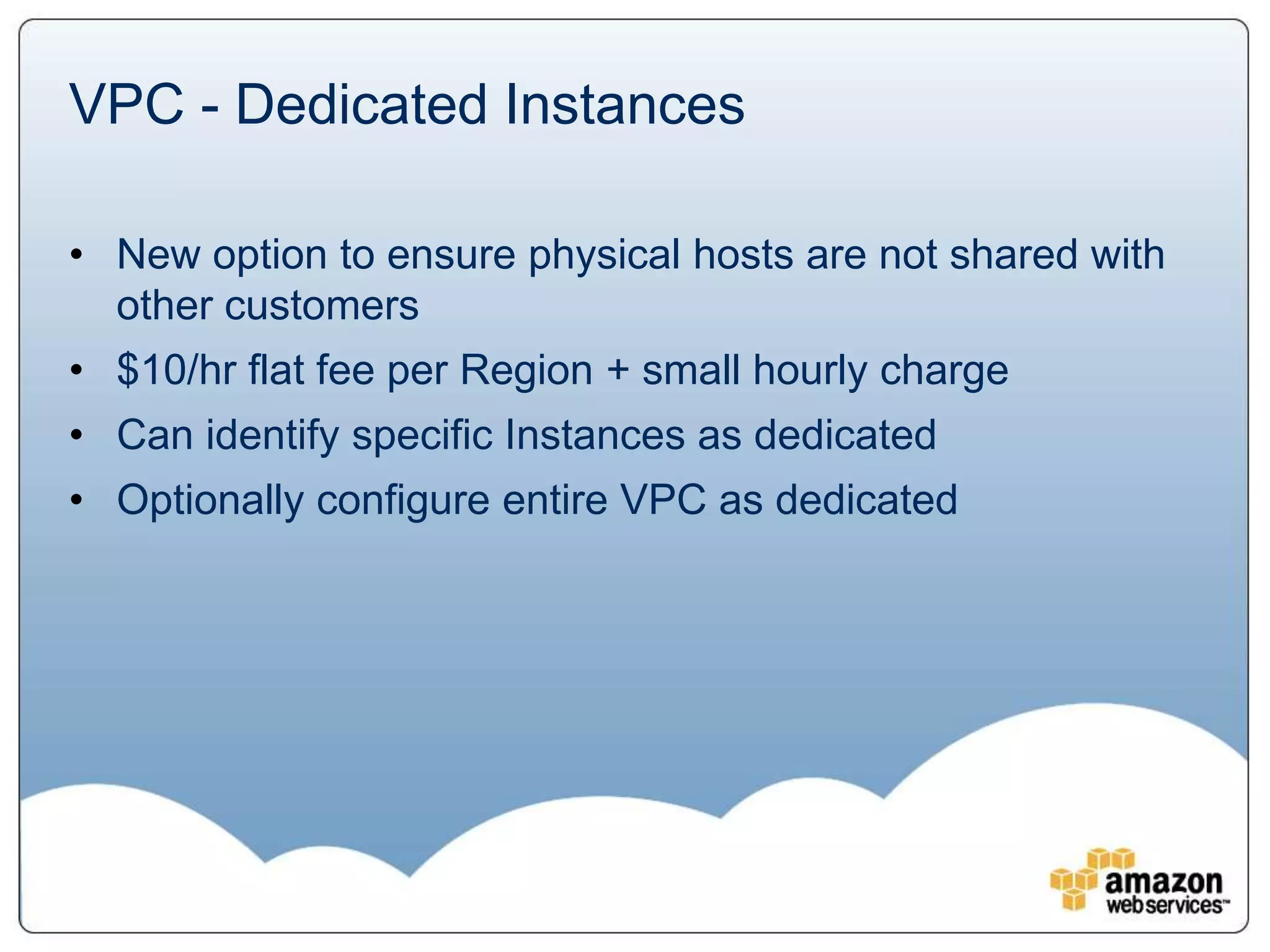
VPC - Dedicated Instances

• New option to ensure physical hosts are not shared with
  other customers
• $10/hr flat fee per Region + small hourly charge
• Can identify specific Instances as dedicated
• Optionally configure entire VPC as dedicated
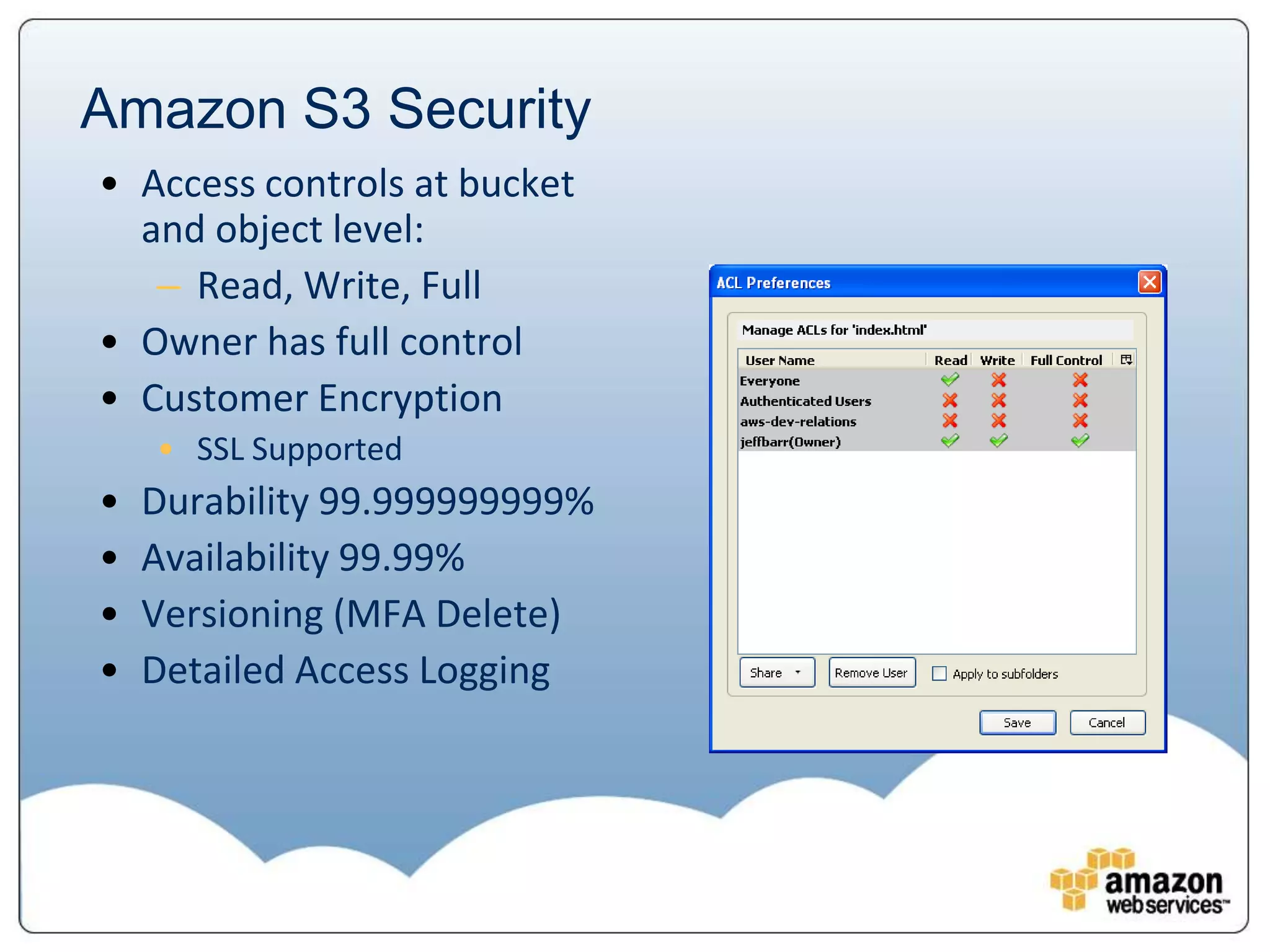
Amazon S3 Security
• Access controls at bucket
  and object level:
   – Read, Write, Full
• Owner has full control
• Customer Encryption
    • SSL Supported
•   Durability 99.999999999%
•   Availability 99.99%
•   Versioning (MFA Delete)
•   Detailed Access Logging
Good ideas:

•   AWS is still the “real world”
•   Least-Privilege design
•   SOA design
•   Classify resources and protect accordingly
•   Security at every layer
•   Inspect what you Expect
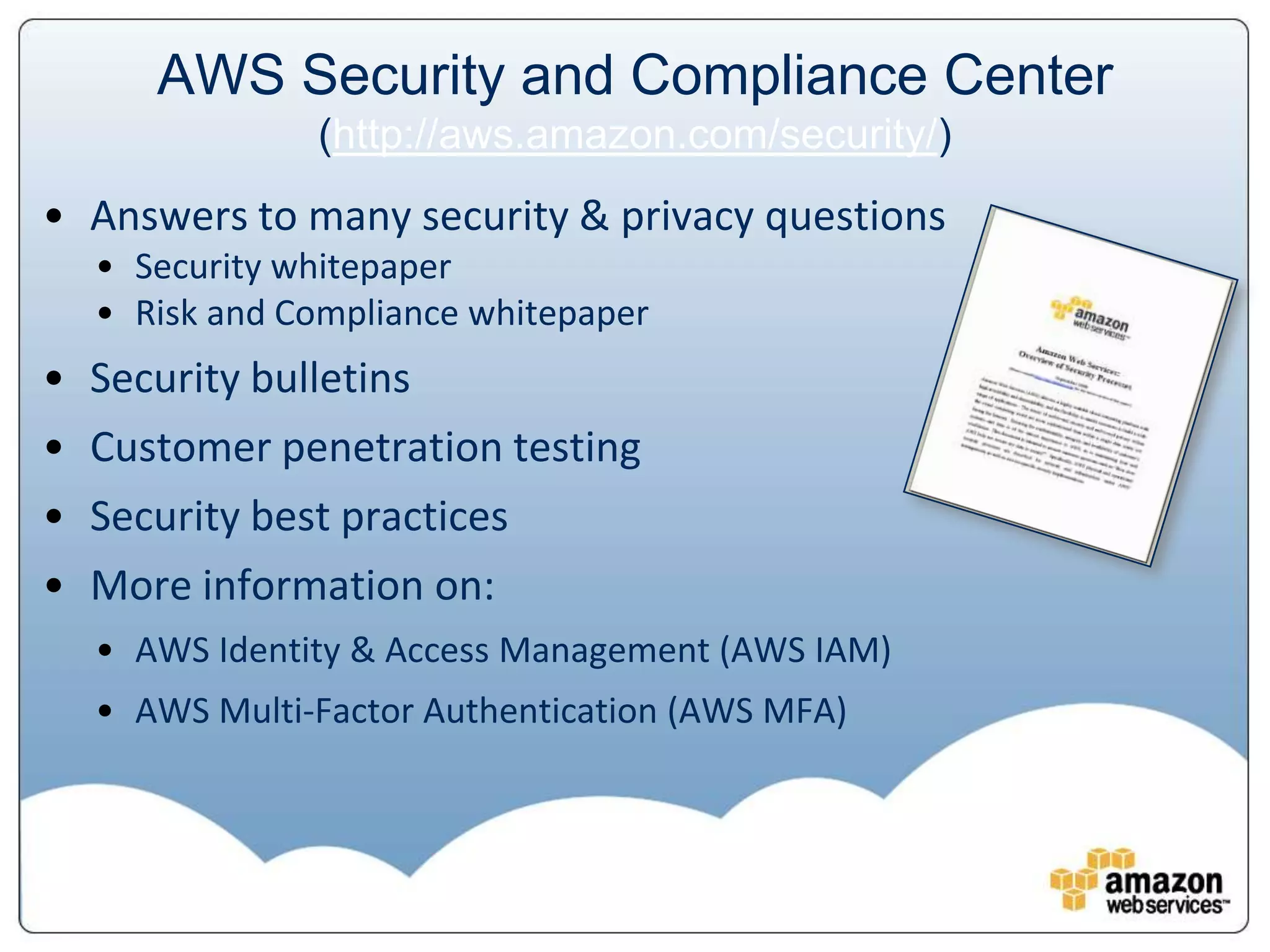
AWS Security and Compliance Center
              (http://aws.amazon.com/security/)
• Answers to many security & privacy questions
  • Security whitepaper
  • Risk and Compliance whitepaper
• Security bulletins
• Customer penetration testing
• Security best practices
• More information on:
  • AWS Identity & Access Management (AWS IAM)
  • AWS Multi-Factor Authentication (AWS MFA)
Your input is *critically* important…
• Thoughts/questions about our compliance or
  certifications?
• Other certifications, compliance requirements or audits to
  explore?
• What risk & compliance services should AWS consider
  offering natively?
• How can we further promote AWS security posture?
Thank You!

aws.amazon.com/security

Miles Ward
• Email: miward@amazon.com
• Skype: miles932
• Twitter: @milesward

AWS - Security and Compliance Overview

  • 1.
    Does AWS meetour do What do we need to to ensure our security applications are secure? requirements?
  • 2.
    Security & ComplianceOverview Miles Ward | Solutions Architect Watch the video of this presentation
  • 3.
    Overview • Key Security Concepts • Certifications • Security Features • Guidance
  • 4.
  • 5.
  • 6.
    Shared Responsibility Model AWS Customer • Facilities • Operating System • Physical Security • Application • Physical Infrastructure • Security Groups • Network Infrastructure • OS Firewalls • Virtualization • Network Configuration Infrastructure • Account Management
  • 7.
  • 8.
    AWS Certifications • Basedon the Shared Responsibility model • AWS Environment – SSAE 16 / SAS70 Type II Audit – ISO 27001 Certification – Payment Card Industry Data Security Standard (PCI DSS) Level 1 Service Provider – FedRAMP (FISMA) • Customers have deployed various compliant applications: – Sarbanes-Oxley (SOX) – HIPAA (healthcare) – FISMA (US Federal Government) – DIACAP MAC III Sensitive IATO
  • 9.
    SSAE 16 –ISAE 3402 (used to be SAS70 Type II) • Covers Access, Change Management and Operations of EC2 and S3 – Control Objective 1: Security Organization – Control Objective 2: Amazon Employee Lifecycle – Control Objective 3: Logical Security – Control Objective 4: Secure Data Handling – Control Objective 5: Physical Security – Control Objective 6: Environmental Safeguards – Control Objective 7: Change Management – Control Objective 8: Data Integrity, Availability and Redundancy – Control Objective 9: Incident Handling • Includes all Regions • Audited by an independent accounting firm and updated every 6 months • SAS70 report available under NDA • Have just converted to Statement on Standards for Attestation Engagements (SSAE) 16 format (equivalent to the International Standard on Assurance Engagements [ISAE] 3402)
  • 10.
    ISO 27001 Certification •ISO 27001/27002 certification achieved 11/2010 • Follows ISO 27002 best practice guidance • Covers the AWS Information Security Management System (ISMS) • Covers EC2, S3, and VPC • Includes all Regions • ISO certifying agent: EY CertifyPoint
  • 11.
    PCI DSS Level1 Service Provider • PCI DSS 2.0 compliant • Covers core infrastructure & services – EC2, EBS, S3, VPC • Use normally, no special configuration • Leverage the work of our QSA • AWS will work with merchants and designated Qualified Incident Response Assessors (QIRA) – can support forensic investigations • Certified in all regions
  • 12.
    How did AWSdo that?
  • 13.
    Physical Security ofData Centers • Amazon has been building large-scale data centers for many years • Important attributes: – Non-descript facilities – Robust perimeter controls – Strictly controlled physical access – 2 or more levels of two-factor auth • Controlled, need-based access • All access is logged and reviewed • Separation of Duties – employees with physical access don’t have logical privileges
  • 14.
    AWS Configuration Management •Most updates are done in such a manner that they will not impact the customer • Changes are authorized, logged, tested, approved, and documented • AWS will communicate with customers, either via email, or through the AWS Service Health Dashboard (http://status.aws.amazon.com/) when there is a chance they may be affected Customers are responsible for change control in their Instances!
  • 15.
    EC2 Security • Host operating system – Individual SSH keyed logins via bastion host for AWS admins – All accesses logged and audited • Guest (a.k.a. Instance) operating system – Customer controlled (customer owns root/admin) – AWS admins cannot log in – Customer-generated keypairs • Stateful firewall – Mandatory inbound firewall, default deny mode – Customer controls configuration via Security Groups • Signed API calls – Require X.509 certificate or customer’s secret AWS key
  • 16.
    Amazon EC2 InstanceIsolation Customer 1 Customer 2 … Customer n Hypervisor Virtual Interfaces Customer 1 Security Groups Customer 2 Security Groups … Customer n Security Groups Firewall Physical Interfaces
  • 18.
    Storage Device Decommissioning •All storage devices go through process • Uses techniques from – DoD 5220.22-M (“National Industrial Security Program Operating Manual “) – NIST 800-88 (“Guidelines for Media Sanitization”) • Ultimately – degaussed – physically destroyed
  • 19.
    Network Traffic FlowSecurity Inbound Traffic • Security Groups - Inbound traffic must be explicitly specified by protocol, port, and security group Amazon Security Groups - VPC adds outbound filters OS Firewall • VPC also adds Network Access Control Lists (ACLs): inbound and outbound Encrypted File System stateless filters • OS Firewall (e.g., iptables) Encrypted Swap File may be implemented - completely user controlled security layer - granular access control of discrete hosts - logging network events
  • 20.
    Network Traffic Confidentiality Amazon EC2 Internet Traffic Instances Corporate Network VPN • Sensitive traffic should be cryptographically controlled • Traffic to corporate networks could be wrapped within industry standard VPN tunnels
  • 21.
    Network Security Considerations • Distributed Denial of Service (DDoS): – Standard mitigation techniques in effect • Man in the Middle (MITM): – All endpoints protected by SSL – Fresh EC2 host keys generated at boot • IP Spoofing: – Prohibited at host OS level • Unauthorized Port Scanning: – Violation of AWS TOS – Detected, stopped, and blocked – Inbound ports blocked by default • Packet Sniffing: – Promiscuous mode is ineffective – Protection at hypervisor level
  • 22.
    How do Ibuild secure?
  • 23.
    AWS is Builtfor “Continuous Availability” • Scalable, fault tolerant services • All Datacenters (AZs) are always on – No “Disaster Recovery Datacenter” – Managed to the same standards • Robust Internet connectivity – Each AZ has redundant, Tier 1 ISP Service Providers – Resilient network infrastructure
  • 24.
    Fault Separation andGeographic Diversity EU Region (IRE) US West Regio US East Region (N. VA) (Oregon) Availability Availability Zone A Zone B Amazon CloudWatch Availability Availability Zone A Zone B Availability Avail Zone A Zo Availability Zone C US West Region APAC Region APAC Region (N. CA) (Singapore) (Tokyo) Availability Availability Availability Availability Availability Availability Zone A Zone B Zone A Zone B Zone A Zone B Note: Conceptual drawing only. The number of Availability Zones may vary
  • 25.
    AWS Identity andAccess Management (IAM) • Users and Groups within Accounts • Unique security credentials • Access keys • Login/Password • optional MFA device • Policies control access to AWS APIs • API calls must be signed by either: • X.509 certificate • secret key • Deep integration into some Services • S3: policies on objects and buckets • Simple DB: domains • AWS Management Console supports User log on • Not for Operating Systems or Applications • use LDAP, Active Directory/ADFS, etc...
  • 26.
    Temporary Security Credentials(sessions) • Temporary security credentials containing  Identity for authentication  Access Policy to control permissions  Configurable Expiration (1 – 36 hours) • Supports  AWS Identities (including IAM Users)  Federated Identities (users customers authenticate) • Scales to millions of users – No need to create an IAM identity for every user • Use Cases  Identity Federation to AWS APIs  Mobile and browser-based applications  Consumer applications with unlimited users
  • 27.
    Example: Mobile &Consumer Apps  AWS APIs
  • 28.
    AWS Multi-Factor Authentication • Helps prevent anyone with unauthorized knowledge of your e-mail address and password from impersonating you • Additional protection for account information • Works with – Master Account – IAM Users • Integrated into – AWS Management Console – Key pages on the AWS Portal – S3 (Secure Delete) A recommended opt-in security feature!
  • 29.
    Multi-tier Security ApproachExample Web Tier Application Tier Database Tier Ports 80 and 443 only open to the Internet Engineering staff have ssh access to the App Tier, which acts as Bastion Sync with on-premises Amazon EC2 database Security Group Firewall All other Internet ports blocked by default
  • 30.
    Amazon Virtual PrivateCloud (VPC) • Create a logically isolated environment in Amazon’s highly scalable infrastructure • Specify your private IP address range into one or more public or private subnets • Control inbound and outbound access to and from individual subnets using stateless Network Access Control Lists • Protect your Instances with stateful filters for inbound and outbound traffic using Security Groups • Attach an Elastic IP address to any instance in your VPC so it can be reached directly from the Internet • Bridge your VPC and your onsite IT infrastructure with an industry standard encrypted VPN connection • Use a wizard to easily create your VPC in 4 different topologies
  • 31.
  • 32.
  • 33.
    VPC - DedicatedInstances • New option to ensure physical hosts are not shared with other customers • $10/hr flat fee per Region + small hourly charge • Can identify specific Instances as dedicated • Optionally configure entire VPC as dedicated
  • 34.
    Amazon S3 Security •Access controls at bucket and object level: – Read, Write, Full • Owner has full control • Customer Encryption • SSL Supported • Durability 99.999999999% • Availability 99.99% • Versioning (MFA Delete) • Detailed Access Logging
  • 35.
    Good ideas: • AWS is still the “real world” • Least-Privilege design • SOA design • Classify resources and protect accordingly • Security at every layer • Inspect what you Expect
  • 36.
    AWS Security andCompliance Center (http://aws.amazon.com/security/) • Answers to many security & privacy questions • Security whitepaper • Risk and Compliance whitepaper • Security bulletins • Customer penetration testing • Security best practices • More information on: • AWS Identity & Access Management (AWS IAM) • AWS Multi-Factor Authentication (AWS MFA)
  • 37.
    Your input is*critically* important… • Thoughts/questions about our compliance or certifications? • Other certifications, compliance requirements or audits to explore? • What risk & compliance services should AWS consider offering natively? • How can we further promote AWS security posture?
  • 38.
    Thank You! aws.amazon.com/security Miles Ward •Email: miward@amazon.com • Skype: miles932 • Twitter: @milesward