Gautam Jayasurya Roll no. 339
Mohini Jain v. State of Karnataka AIR 1992 SC 1858 86 th  amendment. Objective: It is obligatory for the state to provide education for its citizens. Reason: Fundamental Rights would remain beyond the reach of illiterate majority if they are not educated.
Art 21, stands for all the rights which are basic to the dignified enjoyment of life.  Concomitant to other fundamental rights. State under constitutional mandate to provide educational institutions at all levels. J. P. Unnikrishnan vs. State of Andhra Pradesh  1993 SCC (1) 645 Bandhua Mukti Morcha v. U.O.I  (1984) 3 SCC 161: Abolishment of child labour; education, a part of right to life.
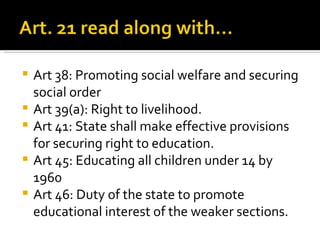
Art 38: Promoting social welfare and securing social order Art 39(a): Right to livelihood.  Art 41: State shall make effective provisions for securing right to education. Art 45: Educating all children under 14 by 1960 Art 46: Duty of the state to promote educational interest of the weaker sections.
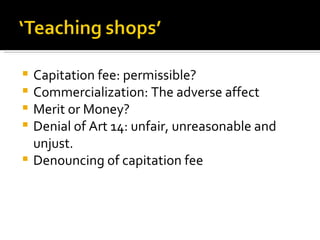
Capitation fee: permissible? Commercialization: The adverse affect Merit or Money? Denial of Art 14: unfair, unreasonable and unjust. Denouncing of capitation fee
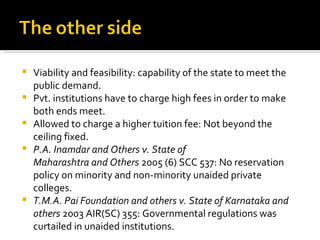
Viability and feasibility: capability 0f the state to meet the public demand. Pvt. institutions have to charge high fees in order to make both ends meet. Allowed to charge a higher tuition fee: Not beyond the ceiling fixed. P.A. Inamdar and Others v. State of Maharashtra and Others  2005 (6) SCC 537: No reservation policy on minority and non-minority unaided private colleges. T.M.A. Pai Foundation and others v. State of Karnataka and others  2003 AIR(SC) 355: Governmental regulations was curtailed in unaided institutions.
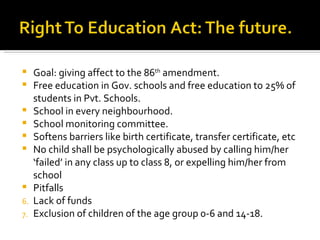
Goal: giving affect to the 86 th  amendment. Free education in Gov. schools and free education to 25% of students in Pvt. Schools. School in every neighbourhood. School monitoring committee. Softens barriers like birth certificate, transfer certificate, etc No child shall be psychologically abused by calling him/her ‘failed’ in any class up to class 8, or expelling him/her from school Pitfalls Lack of funds Exclusion of children of the age group 0-6 and 14-18.
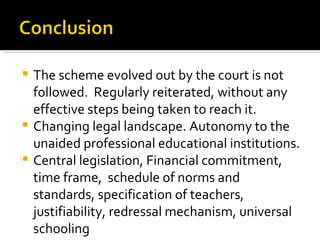
The scheme evolved out by the court is not followed.   Regularly reiterated, without any effective steps being taken to reach it.  Changing legal landscape. Autonomy to the unaided professional educational institutions. Central legislation, Financial commitment, time frame,  schedule of norms and standards, specification of teachers, justifiability, redressal mechanism, universal schooling

Right To Education

  • 1.
  • 2.
    Mohini Jain v.State of Karnataka AIR 1992 SC 1858 86 th amendment. Objective: It is obligatory for the state to provide education for its citizens. Reason: Fundamental Rights would remain beyond the reach of illiterate majority if they are not educated.
  • 3.
    Art 21, standsfor all the rights which are basic to the dignified enjoyment of life. Concomitant to other fundamental rights. State under constitutional mandate to provide educational institutions at all levels. J. P. Unnikrishnan vs. State of Andhra Pradesh 1993 SCC (1) 645 Bandhua Mukti Morcha v. U.O.I (1984) 3 SCC 161: Abolishment of child labour; education, a part of right to life.
  • 4.
    Art 38: Promotingsocial welfare and securing social order Art 39(a): Right to livelihood. Art 41: State shall make effective provisions for securing right to education. Art 45: Educating all children under 14 by 1960 Art 46: Duty of the state to promote educational interest of the weaker sections.
  • 5.
    Capitation fee: permissible?Commercialization: The adverse affect Merit or Money? Denial of Art 14: unfair, unreasonable and unjust. Denouncing of capitation fee
  • 6.
    Viability and feasibility:capability 0f the state to meet the public demand. Pvt. institutions have to charge high fees in order to make both ends meet. Allowed to charge a higher tuition fee: Not beyond the ceiling fixed. P.A. Inamdar and Others v. State of Maharashtra and Others  2005 (6) SCC 537: No reservation policy on minority and non-minority unaided private colleges. T.M.A. Pai Foundation and others v. State of Karnataka and others 2003 AIR(SC) 355: Governmental regulations was curtailed in unaided institutions.
  • 7.
    Goal: giving affectto the 86 th amendment. Free education in Gov. schools and free education to 25% of students in Pvt. Schools. School in every neighbourhood. School monitoring committee. Softens barriers like birth certificate, transfer certificate, etc No child shall be psychologically abused by calling him/her ‘failed’ in any class up to class 8, or expelling him/her from school Pitfalls Lack of funds Exclusion of children of the age group 0-6 and 14-18.
  • 8.
    The scheme evolvedout by the court is not followed.  Regularly reiterated, without any effective steps being taken to reach it.  Changing legal landscape. Autonomy to the unaided professional educational institutions. Central legislation, Financial commitment, time frame,  schedule of norms and standards, specification of teachers, justifiability, redressal mechanism, universal schooling

Editor's Notes

  • #7 Axiomatic truth that,
  • #9 Largest adult illiterate population in the world.