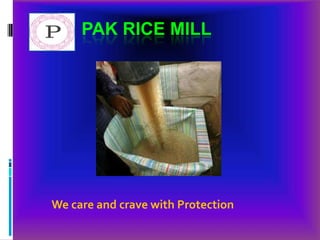
PAK RICE MILL

We care and crave with Protection
Prepared By
Ahsan Nawaz
M. Awais
Qurat ul ain
Sana Rani
Aqsa Gohar

4169
4154
4151
4169
4193

GC University Faisalabad
BBA (3 rd evening)
2/1/2014

3
Topics











Introduction

Importance of rice
Consumption
Export of Rice in Pakistan
International trade of rice
Varieties of Rice
Why we chose this business..?
Favorable condition of rice production
2/1/2014

4
Jnnj PRM











PAK Rice mill
Processing Capacity
Categories of PRM Rice
Processing story of Basmati in PRM
Terminology
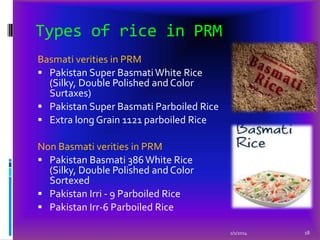
Types of rice in PRM
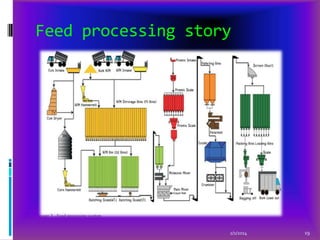
Feed processing story
Strategies for more Production in PRM
Investment of PRM
Calculations
2/1/2014

5
Introduction






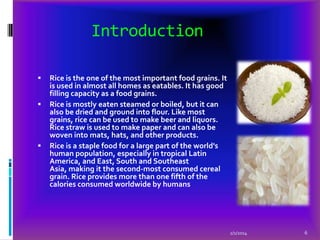
Rice is the one of the most important food grains. It
is used in almost all homes as eatables. It has good
filling capacity as a food grains.
Rice is mostly eaten steamed or boiled, but it can
also be dried and ground into flour. Like most
grains, rice can be used to make beer and liquors.
Rice straw is used to make paper and can also be
woven into mats, hats, and other products.
Rice is a staple food for a large part of the world's
human population, especially in tropical Latin
America, and East, South and Southeast
Asia, making it the second-most consumed cereal
grain. Rice provides more than one fifth of the
calories consumed worldwide by humans

2/1/2014

6
Export of rice in Pakistan
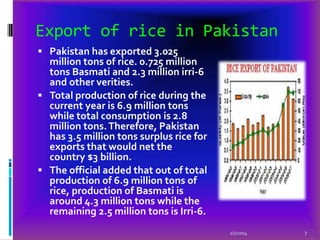
 Pakistan has exported 3.025

million tons of rice. 0.725 million
tons Basmati and 2.3 million irri-6
and other verities.
 Total production of rice during the
current year is 6.9 million tons
while total consumption is 2.8
million tons. Therefore, Pakistan
has 3.5 million tons surplus rice for
exports that would net the
country $3 billion.
 The official added that out of total
production of 6.9 million tons of
rice, production of Basmati is
around 4.3 million tons while the
remaining 2.5 million tons is Irri-6.
2/1/2014

7
Consumption


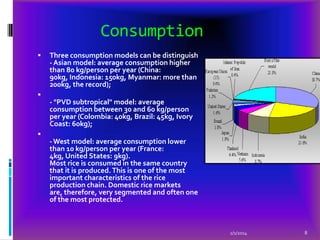
Three consumption models can be distinguish
- Asian model: average consumption higher
than 80 kg/person per year (China:
90kg, Indonesia: 150kg, Myanmar: more than
200kg, the record);



- "PVD subtropical" model: average
consumption between 30 and 60 kg/person
per year (Colombia: 40kg, Brazil: 45kg, Ivory
Coast: 60kg);


- West model: average consumption lower
than 10 kg/person per year (France:
4kg, United States: 9kg).
Most rice is consumed in the same country
that it is produced. This is one of the most
important characteristics of the rice
production chain. Domestic rice markets
are, therefore, very segmented and often one
of the most protected.

2/1/2014

8
International trade of rice
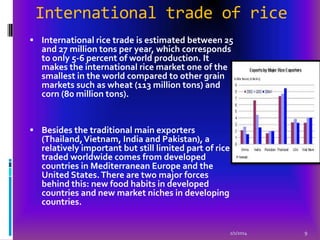
 International rice trade is estimated between 25

and 27 million tons per year, which corresponds
to only 5-6 percent of world production. It
makes the international rice market one of the
smallest in the world compared to other grain
markets such as wheat (113 million tons) and
corn (80 million tons).

 Besides the traditional main exporters

(Thailand, Vietnam, India and Pakistan), a
relatively important but still limited part of rice
traded worldwide comes from developed
countries in Mediterranean Europe and the
United States. There are two major forces
behind this: new food habits in developed
countries and new market niches in developing
countries.

2/1/2014

9
Varieties of Rice

















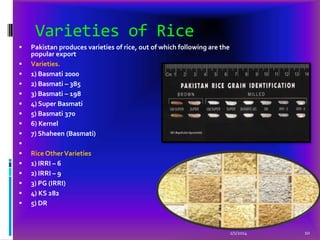
Pakistan produces varieties of rice, out of which following are the
popular export
Varieties.
1) Basmati 2000
2) Basmati – 385
3) Basmati – 198
4) Super Basmati
5) Basmati 370
6) Kernel
7) Shaheen (Basmati)
Rice Other Varieties
1) IRRI – 6
2) IRRI – 9
3) PG (IRRI)
4) KS 282
5) DR

2/1/2014

10
Why we Chose this business?
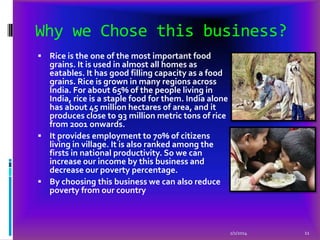
 Rice is the one of the most important food

grains. It is used in almost all homes as
eatables. It has good filling capacity as a food
grains. Rice is grown in many regions across
India. For about 65% of the people living in
India, rice is a staple food for them. India alone
has about 45 million hectares of area, and it
produces close to 93 million metric tons of rice
from 2001 onwards.
 It provides employment to 70% of citizens
living in village. It is also ranked among the
firsts in national productivity. So we can
increase our income by this business and
decrease our poverty percentage.
 By choosing this business we can also reduce
poverty from our country

2/1/2014

11
Favorable condition of rice
production


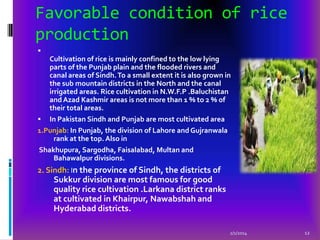
Cultivation of rice is mainly confined to the low lying
parts of the Punjab plain and the flooded rivers and
canal areas of Sindh. To a small extent it is also grown in
the sub mountain districts in the North and the canal
irrigated areas. Rice cultivation in N.W.F.P .Baluchistan
and Azad Kashmir areas is not more than 1 % to 2 % of
their total areas.
 In Pakistan Sindh and Punjab are most cultivated area
1.Punjab: In Punjab, the division of Lahore and Gujranwala
rank at the top. Also in
Shakhupura, Sargodha, Faisalabad, Multan and
Bahawalpur divisions.

2. Sindh: In the province of Sindh, the districts of

Sukkur division are most famous for good
quality rice cultivation .Larkana district ranks
at cultivated in Khairpur, Nawabshah and
Hyderabad districts.
2/1/2014

12
PAK Rice Mill
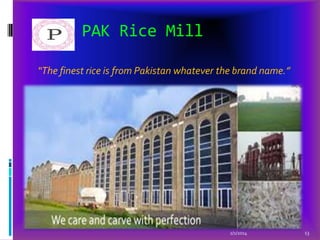
“The finest rice is from Pakistan whatever the brand name.”

2/1/2014

13
Processing Capacity
 PRM maintains quality and sustains a balance







of production and time. The unit-wise
distribution is as follows:
Parboiled unit: 52 ton/ day
Processing unit I: 5ton/HR
Processing Unit II: 7 Ton/HR
PRM is designed keeping in view the instant
honor of huge supplies to the markets with
optimum quality
2/1/2014

14
Categories of PRM
Selected Products

Parboiled IRRI6

Parboiled Super basmati
Related products

Non basmati rice

1121 basmati rice

High quality basmati rice

2/1/2014

15
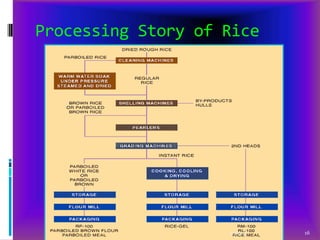
Processing Story of Rice

2/1/2014

16
Terminology
 Rough rice
 Brown rice, husked rice or cargo rice

 Milled rice
 Milling recovery
 Milling degree

 Head rice
 Head rice recovery

2/1/2014

17
Types of rice in PRM
Basmati verities in PRM
 Pakistan Super Basmati White Rice
(Silky, Double Polished and Color
Surtaxes)
 Pakistan Super Basmati Parboiled Rice
 Extra long Grain 1121 parboiled Rice
Non Basmati verities in PRM
 Pakistan Basmati 386 White Rice
(Silky, Double Polished and Color
Sortexed
 Pakistan Irri - 9 Parboiled Rice
 Pakistan Irr-6 Parboiled Rice
2/1/2014

18
Feed processing story

2/1/2014

19
Strategies for more
Production in PRM

The above objectives will be pursued through the
following strategies:
• Improve grain/product quality and develop
technologies to minimize losses and explore,
Facilitate & link production with market.
• Improve local varieties and develop improved
varieties of rice, maize, oilseeds, wheat and
Other cereals and grain legumes specific to different
AEZs.
• Adapt and evolve appropriate crop husbandry and
management practices, including soil
nutrients and water management, for optimizing crop
production processes.
• Identify or develop suitable integrated pest
management (IPM) methods to minimize yield
losses caused by weeds, diseases and insect pests.
• Conduct relevant research on post production
technologies and recommend appropriate
measures for grain/product quality improvement. 2/1/2014

20
Investment

of PRM

 The investment cost for setting up a Rice mill with a capacity of 4 TPH

(tons per hour) will be
 Around Rs. 8.69 Corers and the breakup of the cost is tabulated below.
 The land requirement will be around 4 acres. The pre-operative

expense includes
 Interest during construction of Rs 0.63 Corers. Plant & Machinery

including
 Installation, erecting & commissioning charges are of Rs. 2.80 Corers

and the cost
 of electrical infrastructure & furniture & fixtures works out to Rs. 0.20

Corers.
 Buildings and civil works are estimated to be Rs. 2.02 Corers.

Contingencies,
 Electricity deposits are also considered in the project cost. Margin

money for
 Working capital is estimated to be Rs. 1.32 Corers
2/1/2014

21
Calculations
 Project Cost

 Means of Finance
 Profitability Assumptions:
 Yield and Production:

 Key Financial indicators:

2/1/2014

22
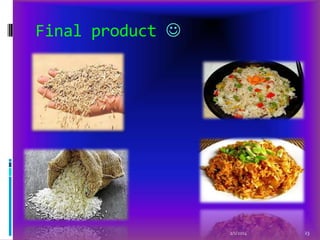
Final product 

2/1/2014

23
2/1/2014

24

Rice Mill

  • 2.
    PAK RICE MILL Wecare and crave with Protection
  • 3.
    Prepared By Ahsan Nawaz M.Awais Qurat ul ain Sana Rani Aqsa Gohar 4169 4154 4151 4169 4193 GC University Faisalabad BBA (3 rd evening) 2/1/2014 3
  • 4.
    Topics         Introduction Importance of rice Consumption Exportof Rice in Pakistan International trade of rice Varieties of Rice Why we chose this business..? Favorable condition of rice production 2/1/2014 4
  • 5.
    Jnnj PRM           PAK Ricemill Processing Capacity Categories of PRM Rice Processing story of Basmati in PRM Terminology Types of rice in PRM Feed processing story Strategies for more Production in PRM Investment of PRM Calculations 2/1/2014 5
  • 6.
    Introduction    Rice is theone of the most important food grains. It is used in almost all homes as eatables. It has good filling capacity as a food grains. Rice is mostly eaten steamed or boiled, but it can also be dried and ground into flour. Like most grains, rice can be used to make beer and liquors. Rice straw is used to make paper and can also be woven into mats, hats, and other products. Rice is a staple food for a large part of the world's human population, especially in tropical Latin America, and East, South and Southeast Asia, making it the second-most consumed cereal grain. Rice provides more than one fifth of the calories consumed worldwide by humans 2/1/2014 6
  • 7.
    Export of ricein Pakistan  Pakistan has exported 3.025 million tons of rice. 0.725 million tons Basmati and 2.3 million irri-6 and other verities.  Total production of rice during the current year is 6.9 million tons while total consumption is 2.8 million tons. Therefore, Pakistan has 3.5 million tons surplus rice for exports that would net the country $3 billion.  The official added that out of total production of 6.9 million tons of rice, production of Basmati is around 4.3 million tons while the remaining 2.5 million tons is Irri-6. 2/1/2014 7
  • 8.
    Consumption  Three consumption modelscan be distinguish - Asian model: average consumption higher than 80 kg/person per year (China: 90kg, Indonesia: 150kg, Myanmar: more than 200kg, the record);  - "PVD subtropical" model: average consumption between 30 and 60 kg/person per year (Colombia: 40kg, Brazil: 45kg, Ivory Coast: 60kg);  - West model: average consumption lower than 10 kg/person per year (France: 4kg, United States: 9kg). Most rice is consumed in the same country that it is produced. This is one of the most important characteristics of the rice production chain. Domestic rice markets are, therefore, very segmented and often one of the most protected. 2/1/2014 8
  • 9.
    International trade ofrice  International rice trade is estimated between 25 and 27 million tons per year, which corresponds to only 5-6 percent of world production. It makes the international rice market one of the smallest in the world compared to other grain markets such as wheat (113 million tons) and corn (80 million tons).  Besides the traditional main exporters (Thailand, Vietnam, India and Pakistan), a relatively important but still limited part of rice traded worldwide comes from developed countries in Mediterranean Europe and the United States. There are two major forces behind this: new food habits in developed countries and new market niches in developing countries. 2/1/2014 9
  • 10.
    Varieties of Rice                 Pakistanproduces varieties of rice, out of which following are the popular export Varieties. 1) Basmati 2000 2) Basmati – 385 3) Basmati – 198 4) Super Basmati 5) Basmati 370 6) Kernel 7) Shaheen (Basmati) Rice Other Varieties 1) IRRI – 6 2) IRRI – 9 3) PG (IRRI) 4) KS 282 5) DR 2/1/2014 10
  • 11.
    Why we Chosethis business?  Rice is the one of the most important food grains. It is used in almost all homes as eatables. It has good filling capacity as a food grains. Rice is grown in many regions across India. For about 65% of the people living in India, rice is a staple food for them. India alone has about 45 million hectares of area, and it produces close to 93 million metric tons of rice from 2001 onwards.  It provides employment to 70% of citizens living in village. It is also ranked among the firsts in national productivity. So we can increase our income by this business and decrease our poverty percentage.  By choosing this business we can also reduce poverty from our country 2/1/2014 11
  • 12.
    Favorable condition ofrice production  Cultivation of rice is mainly confined to the low lying parts of the Punjab plain and the flooded rivers and canal areas of Sindh. To a small extent it is also grown in the sub mountain districts in the North and the canal irrigated areas. Rice cultivation in N.W.F.P .Baluchistan and Azad Kashmir areas is not more than 1 % to 2 % of their total areas.  In Pakistan Sindh and Punjab are most cultivated area 1.Punjab: In Punjab, the division of Lahore and Gujranwala rank at the top. Also in Shakhupura, Sargodha, Faisalabad, Multan and Bahawalpur divisions. 2. Sindh: In the province of Sindh, the districts of Sukkur division are most famous for good quality rice cultivation .Larkana district ranks at cultivated in Khairpur, Nawabshah and Hyderabad districts. 2/1/2014 12
  • 13.
    PAK Rice Mill “Thefinest rice is from Pakistan whatever the brand name.” 2/1/2014 13
  • 14.
    Processing Capacity  PRMmaintains quality and sustains a balance     of production and time. The unit-wise distribution is as follows: Parboiled unit: 52 ton/ day Processing unit I: 5ton/HR Processing Unit II: 7 Ton/HR PRM is designed keeping in view the instant honor of huge supplies to the markets with optimum quality 2/1/2014 14
  • 15.
    Categories of PRM SelectedProducts  Parboiled IRRI6  Parboiled Super basmati Related products  Non basmati rice  1121 basmati rice  High quality basmati rice 2/1/2014 15
  • 16.
    Processing Story ofRice 2/1/2014 16
  • 17.
    Terminology  Rough rice Brown rice, husked rice or cargo rice  Milled rice  Milling recovery  Milling degree  Head rice  Head rice recovery 2/1/2014 17
  • 18.
    Types of ricein PRM Basmati verities in PRM  Pakistan Super Basmati White Rice (Silky, Double Polished and Color Surtaxes)  Pakistan Super Basmati Parboiled Rice  Extra long Grain 1121 parboiled Rice Non Basmati verities in PRM  Pakistan Basmati 386 White Rice (Silky, Double Polished and Color Sortexed  Pakistan Irri - 9 Parboiled Rice  Pakistan Irr-6 Parboiled Rice 2/1/2014 18
  • 19.
  • 20.
    Strategies for more Productionin PRM The above objectives will be pursued through the following strategies: • Improve grain/product quality and develop technologies to minimize losses and explore, Facilitate & link production with market. • Improve local varieties and develop improved varieties of rice, maize, oilseeds, wheat and Other cereals and grain legumes specific to different AEZs. • Adapt and evolve appropriate crop husbandry and management practices, including soil nutrients and water management, for optimizing crop production processes. • Identify or develop suitable integrated pest management (IPM) methods to minimize yield losses caused by weeds, diseases and insect pests. • Conduct relevant research on post production technologies and recommend appropriate measures for grain/product quality improvement. 2/1/2014 20
  • 21.
    Investment of PRM  Theinvestment cost for setting up a Rice mill with a capacity of 4 TPH (tons per hour) will be  Around Rs. 8.69 Corers and the breakup of the cost is tabulated below.  The land requirement will be around 4 acres. The pre-operative expense includes  Interest during construction of Rs 0.63 Corers. Plant & Machinery including  Installation, erecting & commissioning charges are of Rs. 2.80 Corers and the cost  of electrical infrastructure & furniture & fixtures works out to Rs. 0.20 Corers.  Buildings and civil works are estimated to be Rs. 2.02 Corers. Contingencies,  Electricity deposits are also considered in the project cost. Margin money for  Working capital is estimated to be Rs. 1.32 Corers 2/1/2014 21
  • 22.
    Calculations  Project Cost Means of Finance  Profitability Assumptions:  Yield and Production:  Key Financial indicators: 2/1/2014 22
  • 23.
  • 24.