Rasha Y. Tantawy
   Oct. 2011
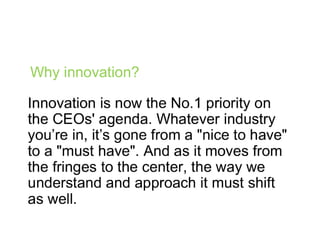
Why
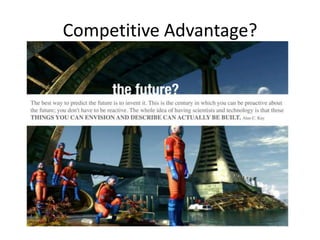
Competitive Advantage?
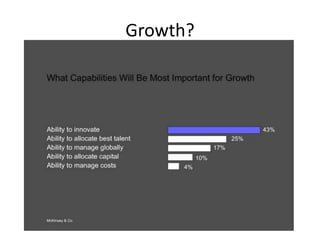
Growth?
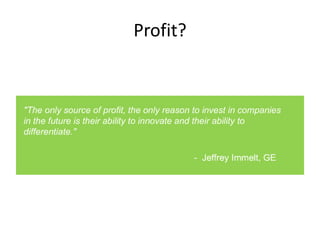
Profit?
Where   is Egypt?
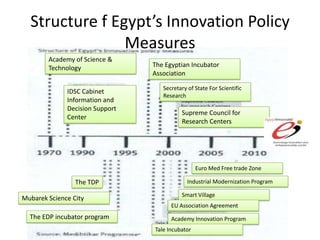
Structure f Egypt’s Innovation Policy
                Measures
        Academy of Science &
        Technology               The Egyptian Incubator
                                 Association

                                    Secretary of State For Scientific
              IDSC Cabinet
                                    Research
              Information and
              Decision Support
                                           Supreme Council for
              Center
                                           Research Centers


                                                  Euro Med Free trade Zone

                 The TDP                      Industrial Modernization Program

                                           Smart Village
Mubarek Science City
                                       EU Association Agreement
  The EDP incubator program            Academy Innovation Program
                                 Tale Incubator
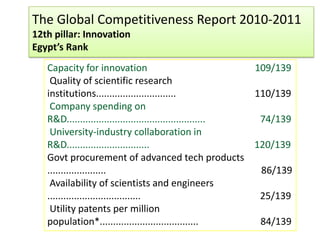
The Global Competitiveness Report 2010-2011
12th pillar: Innovation
Egypt’s Rank
   Capacity for innovation                                 109/139
    Quality of scientific research
   institutions..............................              110/139
    Company spending on
   R&D....................................................  74/139
    University-industry collaboration in
   R&D...............................                      120/139
   Govt procurement of advanced tech products
   ......................                                   86/139
    Availability of scientists and engineers
   ...................................                      25/139
    Utility patents per million
   population*.....................................         84/139
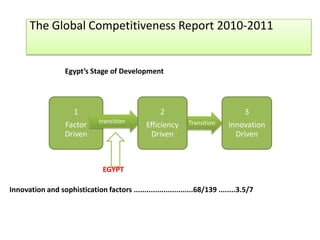
The Global Competitiveness Report 2010-2011


                   Egypt’s Stage of Development


                      1                              2                             3
                               transition                      Transition
                   Factor                       Efficiency                   Innovation
                   Driven                        Driven                        Driven


                                EGYPT

Innovation and sophistication factors ............................68/139 ........3.5/7
Road blocks to Innovation in Egypt?
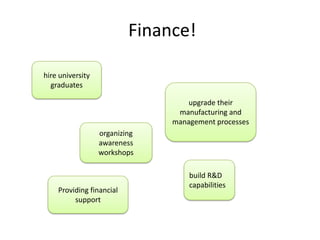
Finance!

hire university
  graduates

                                   upgrade their
                                manufacturing and
                               management processes
                  organizing
                  awareness
                  workshops

                                   build R&D
                                   capabilities
    Providing financial
         support
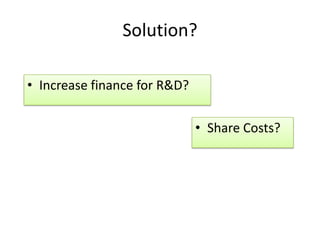
Solution?

• Increase finance for R&D?

                              • Share Costs?
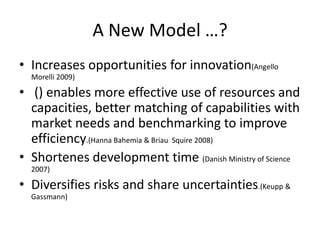
A New Model …?
• Increases opportunities for innovation(Angello
  Morelli 2009)

• () enables more effective use of resources and
  capacities, better matching of capabilities with
  market needs and benchmarking to improve
  efficiency.(Hanna Bahemia & Briau Squire 2008)
• Shortenes development time (Danish Ministry of Science
  2007)

• Diversifies risks and share uncertainties.(Keupp &
  Gassmann)
Open Innovation
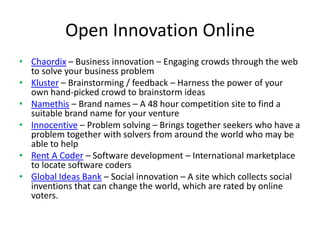
Open Innovation Online
• Chaordix – Business innovation – Engaging crowds through the web
  to solve your business problem
• Kluster – Brainstorming / feedback – Harness the power of your
  own hand-picked crowd to brainstorm ideas
• Namethis – Brand names – A 48 hour competition site to find a
  suitable brand name for your venture
• Innocentive – Problem solving – Brings together seekers who have a
  problem together with solvers from around the world who may be
  able to help
• Rent A Coder – Software development – International marketplace
  to locate software coders
• Global Ideas Bank – Social innovation – A site which collects social
  inventions that can change the world, which are rated by online
  voters.
Open Innovation?
• Open innovation means that the company
  needs to open up its solid boundaries to let
  valuable knowledge flow in from the outside
  in order to create opportunities for
  cooperative innovation processes with
  partners, customers and or suppliers. It also
  includes the exploitation of ideas and IP in
  order to bring them to market faster than
  competitors can.(Gassmann & Enkel 2004)
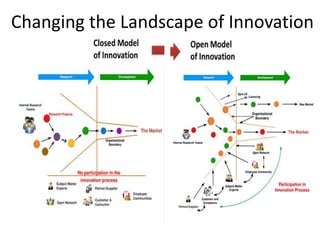
Changing the Landscape of Innovation
Why SMEs?
• SME’s tend to have a greater need “ to look for
  partners with different but complimentary
  capabilities”(Tidd, Bessant & Pavit 2005) because they
  don’t have the access to resources that
  corporates do.
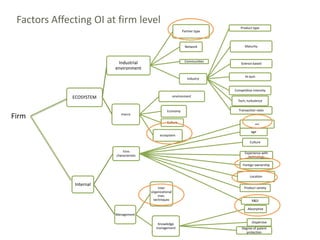
Factors Affecting OI at firm level
                                                                                     Product type
                                                                 Partner type


                                                                   Network             Maturity


                           Industrial                              Communities
                                                                                     Science based
                          environment
                                                                                        Hi tech
                                                                    Industry


                                                                                 Competitive intensity

              ECOSYSTEM                                     environment
                                                                                   Tech, turbulence

                                                     Economy                       Transaction rates
Firm                         macro

                                                     Culture                                  size


                                                                                            age
                                                 ecosystem
                                                                                           Culture

                              Firm                                                     Experience with
                          characteristic                                                 technology

                                                                                      Foreign ownership


                                                                                           Location

              Internal
                                               Inter                                   Product variety
                                           organizational
                                               man.
                                            techniques                                      R&D

                                                                                         Absorptive
                          Management

                                               Knowledge                                    Dispersive
                                              management                             Degree of patent
                                                                                       protection
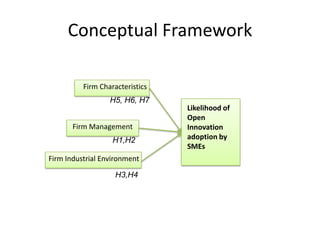
Conceptual Framework

          Firm Characteristics
                  H5, H6, H7
                                 Likelihood of
                                 Open
       Firm Management           Innovation
                   H1,H2         adoption by
                                 SMEs
Firm Industrial Environment

                    H3,H4
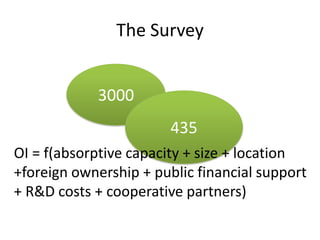
The Survey


            3000
                        435
OI = f(absorptive capacity + size + location
+foreign ownership + public financial support
+ R&D costs + cooperative partners)
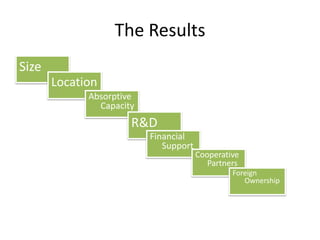
The Results
Size
       Location
             Absorptive
               Capacity
                      R&D
                          Financial
                             Support
                                       Cooperative
                                          Partners
                                                Foreign
                                                   Ownership
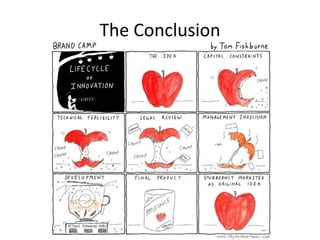
The Conclusion
Open Innovation in Emerging Markets

Open Innovation in Emerging Markets

  • 1.
  • 2.
  • 3.
  • 4.
  • 5.
  • 8.
    Where is Egypt?
  • 9.
    Structure f Egypt’sInnovation Policy Measures Academy of Science & Technology The Egyptian Incubator Association Secretary of State For Scientific IDSC Cabinet Research Information and Decision Support Supreme Council for Center Research Centers Euro Med Free trade Zone The TDP Industrial Modernization Program Smart Village Mubarek Science City EU Association Agreement The EDP incubator program Academy Innovation Program Tale Incubator
  • 10.
    The Global CompetitivenessReport 2010-2011 12th pillar: Innovation Egypt’s Rank Capacity for innovation 109/139 Quality of scientific research institutions.............................. 110/139 Company spending on R&D.................................................... 74/139 University-industry collaboration in R&D............................... 120/139 Govt procurement of advanced tech products ...................... 86/139 Availability of scientists and engineers ................................... 25/139 Utility patents per million population*..................................... 84/139
  • 11.
    The Global CompetitivenessReport 2010-2011 Egypt’s Stage of Development 1 2 3 transition Transition Factor Efficiency Innovation Driven Driven Driven EGYPT Innovation and sophistication factors ............................68/139 ........3.5/7
  • 12.
    Road blocks toInnovation in Egypt?
  • 13.
    Finance! hire university graduates upgrade their manufacturing and management processes organizing awareness workshops build R&D capabilities Providing financial support
  • 15.
    Solution? • Increase financefor R&D? • Share Costs?
  • 16.
    A New Model…? • Increases opportunities for innovation(Angello Morelli 2009) • () enables more effective use of resources and capacities, better matching of capabilities with market needs and benchmarking to improve efficiency.(Hanna Bahemia & Briau Squire 2008) • Shortenes development time (Danish Ministry of Science 2007) • Diversifies risks and share uncertainties.(Keupp & Gassmann)
  • 17.
  • 22.
    Open Innovation Online •Chaordix – Business innovation – Engaging crowds through the web to solve your business problem • Kluster – Brainstorming / feedback – Harness the power of your own hand-picked crowd to brainstorm ideas • Namethis – Brand names – A 48 hour competition site to find a suitable brand name for your venture • Innocentive – Problem solving – Brings together seekers who have a problem together with solvers from around the world who may be able to help • Rent A Coder – Software development – International marketplace to locate software coders • Global Ideas Bank – Social innovation – A site which collects social inventions that can change the world, which are rated by online voters.
  • 23.
    Open Innovation? • Openinnovation means that the company needs to open up its solid boundaries to let valuable knowledge flow in from the outside in order to create opportunities for cooperative innovation processes with partners, customers and or suppliers. It also includes the exploitation of ideas and IP in order to bring them to market faster than competitors can.(Gassmann & Enkel 2004)
  • 24.
  • 25.
    Why SMEs? • SME’stend to have a greater need “ to look for partners with different but complimentary capabilities”(Tidd, Bessant & Pavit 2005) because they don’t have the access to resources that corporates do.
  • 26.
    Factors Affecting OIat firm level Product type Partner type Network Maturity Industrial Communities Science based environment Hi tech Industry Competitive intensity ECOSYSTEM environment Tech, turbulence Economy Transaction rates Firm macro Culture size age ecosystem Culture Firm Experience with characteristic technology Foreign ownership Location Internal Inter Product variety organizational man. techniques R&D Absorptive Management Knowledge Dispersive management Degree of patent protection
  • 27.
    Conceptual Framework Firm Characteristics H5, H6, H7 Likelihood of Open Firm Management Innovation H1,H2 adoption by SMEs Firm Industrial Environment H3,H4
  • 28.
    The Survey 3000 435 OI = f(absorptive capacity + size + location +foreign ownership + public financial support + R&D costs + cooperative partners)
  • 29.
    The Results Size Location Absorptive Capacity R&D Financial Support Cooperative Partners Foreign Ownership
  • 30.

Editor's Notes

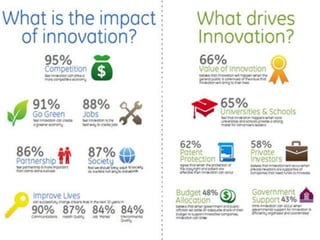
  • #8 To help shed light on the opportunities — and the roadblocks — on innovation GE released a first-of-its-kind report based on an independent survey of 1,000 business executives in 12 countries. The “GE Global Innovation Barometer” found that 95 percent of respondents believe innovation is the main lever for a more competitive national economy. But just how to accomplish that will take a uniquely 21st century path, as respondents are prioritizing technology that addresses local needs; looking for innovation from smaller organizations; and pursuing strategic partnerships to make tangible innovation happen. All of these areas are converging as problems are now bigger — which involves a wider system of players. 88 percent of those surveyed felt innovation was the best way to create jobs
  • #9 Talk about TIEC and ITAC
  • #10 The structure of research and innovation activities in Egypt is presently undergoing significant changes. Until recently research funding suffered and strongly dependedon international grants. There was no clear national policy of research. It became clear that research is the only means to compete. The latest European charts on innovation shows that Egypt has an innovation policy implemented via measures to stimulate investment, venture capital, business incubators, industrial modernization, small and medium enterprises development and entrepreneurship. There is no formal coordination body yet. The delivery of innovation policy is carried out via the programs of related ministries often with assistance from donor organizations. An important factor is the Social Fund for Development (SFD) which finances business centers and incubators as well as the Industrial modernization Program(IMP) and GAFI, the General Authority for Investment and TIEC. The key drivers of innovation are industrial modernization and privatization of state industry.
  • #13 Discussion : what is hindering innovationHow do we take the no out of innovation?
  • #14 A recent research by Dr. nizar on barriers to innovation (Encouraging firms to hire university graduates in both technical and managerial areas, organizing awareness workshops and seminars on the importance for SMEsto upgrade their manufacturing and management processes, providing guidance to SMEs inscreening, choosing, adopting, and adapting the available technologies, providing financialsupport and tax incentives to encourage SMEs acquire advanced technologies and build R&Dcapabilities, reinforcing and tightening the linkages and collaboration between companies anduniversities and research centers,
  • #15 What do we do if we want to innovate in the emerging markets? How do we overcome the financial barrier!
  • #18 The solution
  • #23 A number of online sites are available that specialise in bringing together different parties or groups to work on a particular project or solve a specific problem. Alternatively an organisation can also ask a question through one of its online networks such as Facebook or LinkedIn. A selection of crowd sourcing sites of interest are outlined below:
  • #27 1-Environment: the total surrounding moderating creation, facilitating networking..etc The innovation system operating nationally, regionally, and locally2-Economy: market readiness for diffusion of new innovations3- Culture: a culture that connects people and technologies in an effective way4-Ecosystem: innovation and entrepreneurial ecosystem available for spinning off such as centers, workshops, incubators..etc. “A healthy ecosystem can further perpetuate the adoption of the open architecture through network effects”.(Chesbrough, Appleyard, 2007)1- Size: no of employees: i.e. SME, firm, corporate2-Age: no of years in business: startup..mature3-Culture: a learning culture, an open mindset, allows and accepts mistakes4-Experience with technology:5-ownership: what % of the firm is owned locally and what %international, government, private..etc6-Location: 7-Product variety: what are the products , and how diversified1- Inter organizational: top management attention, project management steering, process management2-Knowledgemanagement: the flow of knowledge with in firm and through the boundaries of the firm:
  • #28 H1. SME’s with higher absorptive capacities are more likely to engage in open innovation.H2: SME’s in industries requiring high R&D costs for innovation will collaborate with partners.H3: The availability of financial support positively affects SME’s tendency to collaborate with partners to innovate.H4: The difficulty to find a cooperating innovative partner has a negative affect on an firms ability to innovate openly.H5. The size of a firm is positively associated with its ability to collaborate with partners to innovateH6: The location of a firm within a resourceful community positively affects its tendency to cooperate in innovation beyond its boundaries.H7: A % of foreign ownership has a positive effect on a firm’s ability to innovate openly